

Infected Tooth Pulp Explained: How Pulpitis Progresses and When a Root Canal Is Planned
Key Takeaways
- The pulp is sealed inside dentin and connects to the body only through a pinhole at each root tip, so inflammation has nowhere to expand and pressure, not bacteria alone, drives the pain.
- Reversible pulpitis can settle once the cavity or faulty filling is treated, but irreversible pulpitis and pulp necrosis cannot recover, according to the Cleveland Clinic.
- A toothache that suddenly stops often signals that the pulp has died, and the NHS states that a dental abscess will not go away on its own.
- Antibiotics act on living tissue and cannot reach a dead pulp, which is why the NHS says they are not usually prescribed for a dental abscess unless infection is spreading.
- No mainstream guidance gives a fixed time from infection to abscess; it can range from days after a fracture to years under a slow cavity.
- The NHS notes root-treated teeth are more brittle and often need a crown, and that tenderness for a few days after treatment is expected.
Infected tooth pulp means bacteria have reached the soft tissue inside a tooth, usually through deep decay or a crack. Early inflammation, called reversible pulpitis, can settle once the cause is removed. Irreversible pulpitis and a dead, infected pulp cannot recover, and the infection may spread to form an abscess. A dentist then plans root canal treatment or extraction; antibiotics alone do not remove the source.
It is a quarter past three in the morning and the molar that only twinged with ice cream last month is now keeping its own time: a slow, heavy pulse that seems to come from the jaw itself. Cold water helped for a while. Now nothing does. Somewhere between the first sensitive bite and this sleepless night, something inside the tooth crossed a line.
That line is the difference between an irritated pulp and an infected tooth pulp, and it matters because the two are treated very differently. One can calm down once a cavity is filled. The other cannot come back, no matter how carefully you brush, and the body’s only ways out are a root canal or losing the tooth.
This explainer walks through what the pulp is, how pulpitis progresses stage by stage, why the pain sometimes vanishes for the wrong reason, and how a dentist decides when root canal treatment is the sensible next step.
What is infected tooth pulp, and how does it happen?
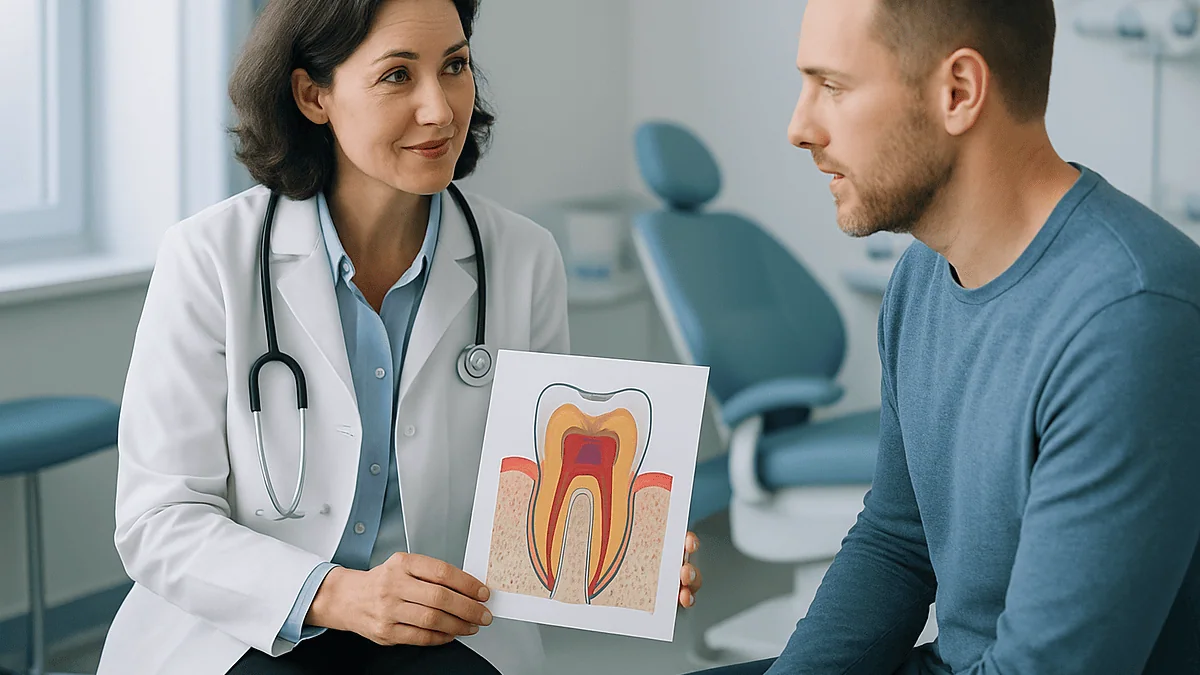
A tooth looks solid, but it is built around a living core. The pulp is the soft tissue at the center of each tooth, a bundle of nerves, small blood vessels and connective tissue that runs from the crown down through the roots. Around it sits dentin, the slightly porous yellow layer that makes up most of the tooth, and over that sits enamel, the hard outer shell. Enamel has no nerves. Dentin has millions of microscopic tubes that lead inward toward the pulp, which is why a deep cavity starts to feel cold, sweet and sharp long before bacteria actually arrive.
Infected tooth pulp is what happens when that sealed chamber is breached. The Cleveland Clinic lists the usual routes: untreated decay that eats through enamel and dentin, a crack or chip that opens a pathway, a knock to the tooth, repeated dental work on the same tooth, and long-term grinding that wears the surface thin. Bacteria travel down the dentin tubules, reach the pulp, and the tissue responds the way any tissue responds to invaders: it swells.
Here the anatomy turns against the patient. Swelling in a fingertip has somewhere to go. Swelling inside a tooth does not, because the pulp chamber is walled in by dentin on every side and connects to the rest of the body only through a pinhole opening at the tip of each root, called the apex. Pressure rises, nerve endings fire, and the small vessels entering through that pinhole are squeezed. That pressure, not the bacteria themselves, is what turns a sensitive tooth into a throbbing one, and it sets the stage for everything that follows.
How pulpitis progresses from reversible to irreversible
Pulpitis simply means inflammation of the pulp, and dentists divide it into two clinical categories because they lead to different decisions. The Cleveland Clinic describes reversible pulpitis as mild inflammation in a pulp that is still healthy enough to recover. The tissue is irritated, often by a cavity or a leaking filling sitting close to it, but blood flow is intact and the immune response can still do its job once the irritant is taken away.

Irreversible pulpitis is the point of no return. Inflammation has become severe enough that the pulp can no longer heal even if the cavity were filled tomorrow. Mechanically, the pressure inside the chamber has compressed the vessels entering at the apex, starving the tissue of oxygen. Parts of the pulp begin to die.
Death of the pulp is called necrosis. Once tissue is dead there is no blood supply to carry white cells or antibiotics into it, and bacteria colonize it freely. The chamber becomes, in effect, a small reservoir of infection inside the jaw. From there the bacteria and their toxins leak out through the apex into the bone around the root tip.
The bone reacts with its own inflammation, known as apical periodontitis, and if pus collects there the result is a periapical abscess: a pocket of pus at the root tip. This sequence, irritation to inflammation to necrosis to abscess, is the whole story of pulpitis, and the speed varies enormously from person to person and tooth to tooth. What does not vary is the direction of travel. Without treatment, the process only moves one way.
Can inflamed tooth pulp heal itself?
Sometimes, and the honest answer depends entirely on which stage the tooth has reached. In reversible pulpitis, the Cleveland Clinic notes that removing the cause, typically by treating the cavity or replacing a faulty filling, gives the pulp the chance to settle on its own. Blood flow returns to normal, the swelling subsides and the sensitivity fades. In this situation a dentist may deliberately choose a filling over anything more invasive and then watch the tooth over follow-up visits.
The pulp cannot heal itself from irreversible pulpitis or necrosis. No rinse, oil, herb or diet reverses dead tissue, and there is no evidence in mainstream guidance that any home remedy restores a pulp once its blood supply has failed. Salt-water rinses can make a sore mouth feel cleaner, but they work on the surface of the gum, not in a chamber sealed inside the tooth.
The trap is that a dying pulp often feels like a healing one. As the nerve tissue dies, the sharp, lingering pain that has been building for days can suddenly ease or disappear. People understandably read this as recovery. The NHS is blunt about dental abscesses: they do not go away on their own, and the Mayo Clinic makes the same point about untreated tooth infections. The quiet phase is usually the interval between pulp death and the bone at the root tip becoming involved.
So the useful question is not whether inflamed pulp can heal, but whether yours is still at the stage where it can. Only an examination, with cold testing and an X-ray, can tell those two situations apart.
Irreversible pulpitis symptoms: how a dentist reads the pain
A dentist cannot see the pulp directly, so diagnosis is a matter of reading patterns. The single most useful clue, according to the Cleveland Clinic’s description of the two conditions, is what the pain does after the trigger is gone. In reversible pulpitis, a cold drink causes a sharp jolt that stops within seconds of swallowing. In irreversible pulpitis the ache lingers well after the cold has passed, arrives without any trigger at all, and often wakes people at night, when lying flat raises blood pressure in the head and increases pressure inside the tooth.

Chair-side, this is tested deliberately. A cotton pellet chilled with a refrigerant spray is touched to the suspect tooth and to a healthy neighbor for comparison. The dentist times the response. An exaggerated, lingering reaction points toward irreversible inflammation; no response at all, on a tooth that once hurt, suggests the pulp has died. Tapping the tooth checks whether the bone at the root tip has become tender, which signals the infection has moved beyond the pulp chamber.
An X-ray fills in what testing cannot. It shows how deep a cavity runs, whether an old filling sits against the pulp, and whether a dark halo has formed at the root tip where bone has been lost to infection. Some clinics add an electric pulp test, which checks whether nerve fibers still conduct.
None of this is a self-checklist. Pain in one tooth is frequently felt in another, or in the ear or jaw, and a cracked tooth can mimic several conditions at once. The patterns above explain what your dentist is looking for and why the questions sound so specific; they are not a way to grade your own tooth at the kitchen table.
How long can a tooth be infected before an abscess forms?
There is no reliable number, and any article that gives you one is guessing. Mainstream guidance from the NHS, the Mayo Clinic and MedlinePlus describes the sequence from decay to pulp infection to abscess, but none of them attaches a timeline, because the biology does not allow it. A pulp exposed by a fracture in a sports injury can become infected within days. A slow cavity under an old filling may irritate the pulp for years before it finally dies, and a dead pulp can sit quietly for months before enough pus collects at the root tip to cause obvious swelling.
Several variables set the pace. The size of the opening into the pulp matters, since a wide breach lets more bacteria in faster. The mix of bacteria matters. So does the body’s immune response and whether the infection finds a drainage route. When pus can escape through a tiny channel to the gum surface, forming a small pimple-like bump called a sinus tract, the pressure stays low and the tooth may barely hurt even though bone is being destroyed underneath. When it cannot escape, pressure builds quickly and the pain becomes severe.
What the evidence does support is the direction of travel. The NHS states that a dental abscess will not resolve without treatment, and the Mayo Clinic lists spread to the jaw, neck and, rarely, the bloodstream among the complications of leaving one untreated. Every week of delay is a week in which more bone around the root can be lost, which in turn affects how straightforward any later root canal or extraction will be.
The practical translation: a tooth that has been reliably painful, or that once hurt and then went silent, deserves an appointment now rather than a waiting period.
What happens when an infected tooth pulp becomes an abscess
An abscess is a collection of pus, the thick fluid of dead white cells, bacteria and broken-down tissue that the body produces when it walls off an infection. In dentistry the type that follows pulp death is the periapical abscess, sitting at the tip of the root. The NHS also describes a periodontal abscess, which starts in the gum rather than the pulp and follows a different path; this article concerns the first kind.
As pus accumulates at the apex, it needs somewhere to go. It dissolves the surrounding bone, which is why a periapical abscess shows on an X-ray as a dark circle around the root tip. It may then track toward the thinnest bone, usually on the cheek side, lift the gum and produce the swelling people notice in the mirror. If it breaks through, the Mayo Clinic notes a sudden rush of foul-tasting, salty fluid in the mouth and a rapid drop in pain. The NHS warns that this relief is misleading: the abscess may have burst, but the infected pulp that feeds it is still inside the tooth.
When the pus tracks into the soft tissues of the face or under the jaw instead, the result is cellulitis, a diffuse spreading infection rather than a contained pocket. The face swells, the skin becomes hot and tight, and the infection can involve the floor of the mouth or the tissues around the eye. This is the point at which a dental problem becomes a medical one.
MedlinePlus lists the common accompaniments of an abscess: throbbing pain, sensitivity to biting, swelling, fever and swollen glands under the jaw. These are the body’s signals that the infection is no longer confined to the pulp chamber.
Sepsis from tooth infection: what are the first signs?
Sepsis is the body’s own extreme reaction to an infection, in which the immune response begins to damage organs and drop blood pressure. It is a rare outcome of a tooth infection, but the Mayo Clinic lists it among the recognized complications of an untreated abscess, and it is the reason dentists take facial swelling and fever seriously rather than treating them as simply more toothache.
The early signs are not dental at all, which is exactly what makes them dangerous to miss. The NHS sepsis guidance describes, in adults, acting confused or having slurred speech or not making sense; skin, lips or tongue that look blue, gray, pale or blotchy; a rash that does not fade when a glass is rolled over it; and difficulty breathing, breathlessness or very fast breathing. In children the NHS adds fast breathing, a weak or high-pitched cry, mottled skin, unusual sleepiness or difficulty waking. Any of these, in someone who also has a known tooth infection, is grounds for emergency services, not a dental appointment.
Between a simple abscess and sepsis sits a middle zone that also needs urgent, same-day care. The NHS dental abscess guidance highlights difficulty breathing or swallowing, swelling that spreads toward the eye or down the neck, and a high temperature. These indicate that infection has moved into spaces where it can compress the airway or reach the bloodstream.
Most people with an infected tooth pulp will never come close to this. The point of naming the signs is proportion: an aching tooth can wait for the next available dental slot; a swollen face with a fever cannot; confusion, breathlessness or mottled skin means calling for emergency help immediately.
Tooth pulp infection treatment: what the options actually are
Every effective treatment for an infected tooth pulp rests on the same principle: the source has to be removed. Dead pulp has no blood supply, so nothing the body or a medicine cabinet can deliver through the bloodstream reaches it. That leaves two definitive options, and the NHS and Cleveland Clinic describe both. Root canal treatment removes the infected pulp and seals the empty canals so the tooth can stay in the mouth. Extraction removes the tooth and the infection with it.
A third step often comes first in an emergency: drainage. When a swollen, painful abscess is present, a dentist may open the tooth to let pus escape or make a small incision in the gum. Pressure falls and pain eases within hours, but drainage is a relief measure, not the treatment; the root canal or extraction still follows.
Antibiotics have a narrower role than most people expect. They circulate in the blood and act on bacteria in living tissue, which means they can help control infection spreading through the face, jaw or body. They cannot clear bacteria from the dead space inside a tooth. For this reason the NHS states that antibiotics are not usually prescribed for a dental abscess unless the infection is spreading or the person is at particular risk, and that they are used alongside, never instead of, dental treatment. Whether an antibiotic is appropriate for you is a judgment for the dentist or doctor who examines you.
Pain relief in the days before treatment is a legitimate need. A pharmacist or dentist can advise which over-the-counter option suits your health history; what none of them do is change what is happening inside the tooth.
How a root canal actually works, step by step
The name puts people off, so it helps to know what happens. Root canal treatment, also called endodontic treatment, is the cleaning and sealing of the hollow canals inside the roots of a tooth. It may be carried out by a general dentist or by an endodontist, a dentist with additional training in treating the inside of teeth.
The tooth is numbed with local anesthetic. The NHS notes that root canal treatment should not be painful for this reason, and that for most people it feels similar to having a large filling. A small rubber sheet, the rubber dam, is stretched around the tooth to keep saliva and bacteria out of the canals while they are being cleaned.
The dentist then opens the top of the tooth to reach the pulp chamber and uses very fine flexible files, some hand-held and some rotary, to remove the pulp tissue and shape each canal. Molars usually have three or four canals; front teeth typically one. The canals are flushed repeatedly with a disinfecting solution to kill the bacteria the files cannot physically reach.
Once clean, dry and shaped, the canals are filled with a rubber-like material called gutta-percha and a sealer, packed tightly to leave no space for bacteria to recolonize. The NHS explains that treatment is often completed over more than one appointment; between visits a medicated dressing and temporary filling protect the tooth. Finally the opening is closed with a permanent filling, and because a root-treated tooth is more brittle, the NHS notes that a crown is often recommended to protect it from fracture. The tooth is no longer alive, but it remains anchored in the bone and works like any other.
Who is usually offered a root canal, and who is asked to wait
Root canal treatment is planned when the pulp is judged to be irreversibly inflamed or dead and the tooth itself is worth keeping. In practice, the Cleveland Clinic describes it as the standard route for irreversible pulpitis and for necrotic teeth with or without an abscess, provided enough sound tooth structure remains to hold a filling or crown and the surrounding bone can support the root.
Some patients are asked to wait, and the reasons are usually sensible rather than dismissive. A tooth with reversible pulpitis is treated by removing the irritant, typically the cavity, and then observed; opening a pulp that could have recovered would mean a bigger procedure than necessary. A tooth whose diagnosis is unclear, where pain is referred from elsewhere or cold testing gives mixed results, may be reviewed again rather than treated on a guess. Someone with acute facial swelling may have drainage first, so the definitive treatment can be carried out once the tissues have settled.
Others are steered toward extraction instead. A tooth broken down below the gum line, a root split lengthwise, advanced gum disease that has loosened the tooth, or canals so curved or blocked they cannot be cleaned may make root canal treatment unlikely to hold. The NHS describes root canal treatment as usually successful and reports that in about 9 out of 10 cases a treated tooth can survive for up to 10 years; that is a population figure, not a forecast for any single tooth, and the dentist’s assessment of your specific tooth carries more weight than the average.
Where medical conditions affect bleeding, healing or infection risk, the dental team may coordinate with your doctor first. The decision belongs to you and your treating clinicians together.
Pulpitis, abscess and root canal at a glance
The stages blur into one another in real life, but laying them side by side shows why the same complaint, “my tooth hurts,” can lead to a filling for one person and a root canal or extraction for another. The pain patterns below reflect the Cleveland Clinic’s descriptions of reversible and irreversible pulpitis and the NHS and MedlinePlus accounts of dental abscess.
| Stage | What is happening inside | How pain typically behaves | What a dentist usually plans |
|---|---|---|---|
| Reversible pulpitis | Pulp inflamed but alive; blood supply intact | Sharp with cold or sweet, fades within seconds | Treat the cause, usually a filling; review |
| Irreversible pulpitis | Severe inflammation; pressure compressing vessels | Lingers after triggers, spontaneous, often worse at night | Root canal treatment or extraction |
| Pulp necrosis | Pulp dead; bacteria colonize the chamber | May go quiet; tooth no longer responds to cold | Root canal treatment or extraction |
| Periapical abscess | Pus collecting at root tip; bone being lost | Throbbing, tender to bite, possible swelling or gum bump | Drainage if needed, then root canal or extraction; antibiotics only if spreading |
| Spreading infection | Cellulitis of face or neck; systemic signs | Facial swelling, fever, difficulty swallowing | Urgent or emergency care; antibiotics with drainage |
Two things stand out. Pain intensity is a poor guide to seriousness: the quietest row, necrosis, is the one most likely to be ignored. And from irreversible pulpitis onward, the treatment column does not change; what changes is how urgent it has become and how much bone is left to work with.
What the days and weeks after root canal treatment usually look like
The first few hours are mostly about numbness. Until the local anesthetic wears off, it is easy to bite the cheek or tongue, so most dentists suggest waiting to eat and choosing soft food on the treated side afterward. Once feeling returns, the NHS says it is normal for the tooth to feel sensitive or tender for a few days, particularly when biting. That tenderness comes from the bone and ligament around the root tip, which were inflamed before treatment and take time to settle, not from the tooth itself, which now has no nerve.
If treatment is spread over more than one appointment, the tooth carries a temporary filling in between. Temporary materials are softer than permanent ones, so chewing hard or sticky food on that tooth risks breaking the seal and letting bacteria back into the cleaned canals. The dentist will say how long the gap will be; in the meantime, brushing and flossing the area normally is expected.
The permanent restoration is the step people most often postpone, and it matters more than it seems. The NHS notes that a root-treated tooth is more brittle than a living one because it has lost its internal moisture and often a good deal of structure to decay. A crown or strong filling spreads chewing forces across the tooth and protects it from splitting. A root-filled tooth that fractures is frequently a tooth that has to be removed.
Over the following months the bone at the root tip regrows into the space the infection dissolved. This cannot be felt; it is checked on follow-up X-rays, and a dentist will say when they want to see the tooth again. Pain that worsens after the first few days, new swelling or a return of the old throbbing are reasons to call the practice rather than wait for that review.
What people often get wrong about infected tooth pulp
The most costly misunderstanding is that a tooth that stops hurting has healed. As earlier sections explain, silence often marks the death of the pulp, the moment infection becomes permanent rather than the moment it leaves. The NHS and Mayo Clinic both state plainly that a tooth abscess does not go away on its own.
The second is that antibiotics fix the problem. They can calm a spreading infection, which is why they are sometimes prescribed, but they cannot reach dead tissue inside a tooth. The NHS is explicit that they are not a substitute for dental treatment. Repeated courses without treating the tooth expose a person to side effects and contribute to antibiotic resistance while the reservoir of infection stays put.
Third, that root canals are agonizing. The reputation comes from an era before reliable local anesthesia and from the fact that people usually arrive already in severe pain. The NHS describes the procedure itself as not painful when the tooth is properly numbed and compares it to a large filling.
Fourth, that a root-treated tooth makes people ill elsewhere in the body. This idea traces to early twentieth-century “focal infection” theory, which was abandoned as research failed to support it. Modern guidance from the sources cited here treats root canal therapy as a routine way to keep a tooth, not as a health risk.
Fifth, that extraction is always the simpler, safer choice. It removes the infection, but it also removes a tooth, and the space that follows brings its own decisions about drifting neighbors and replacement. Both options are legitimate; the right one depends on the tooth, the bone around it and what you want. Sixth, that clove oil, garlic or rinses can treat the infection. They may briefly numb or freshen; they change nothing inside the tooth.
Questions to ask your care team
A consultation about an infected tooth pulp moves fast, especially when you are in pain, and the questions that matter most tend to surface on the drive home. Bringing a short list keeps the decision genuinely shared.
Start with the diagnosis. Ask whether the pulp is judged reversible, irreversible or already dead, and what specifically led to that conclusion: the cold test, the X-ray, the tenderness on tapping. If the dentist is uncertain, ask what a review would involve and how long they would want to wait. Ask whether the X-ray shows bone loss at the root tip, because that changes urgency.
Then the treatment plan. Why root canal rather than extraction for this tooth, or the reverse? How much sound tooth is left, and will it need a crown afterward? How many appointments are expected, and what is the tooth protected with in between? If the dentist plans to refer you to an endodontist, ask what about the tooth makes that sensible, such as curved canals or a previous root filling.
Ask about the interval before treatment. What should you do if swelling develops or pain escalates before your appointment, and whom do you call outside working hours? If an antibiotic is being considered, ask what it is expected to achieve and what it is not.
Finally, ask about aftercare in concrete terms: what is normal in the first few days, what would prompt an earlier call, and when the tooth will be checked again. If you have a medical condition, take blood-thinning medicines or have had problems with local anesthetic, raise it before the appointment so the team can plan around it rather than discover it in the chair.
When to call your doctor
Most infected pulp is a dental urgency rather than a medical emergency: it needs an appointment soon, ideally within days, but it does not need an ambulance. The exceptions are the situations where infection has left the tooth and started to threaten the airway, the eye or the bloodstream. The NHS dental abscess guidance and the Mayo Clinic identify these as reasons for same-day emergency care rather than waiting for a dental slot.
- Swelling of the face or jaw that is spreading, particularly toward the eye or down the neck
- Difficulty swallowing, difficulty opening the mouth fully, or any difficulty breathing
- A high temperature alongside a swollen, painful tooth or face
- Feeling generally unwell, shivering or unusually drowsy with a known tooth infection
A different set of signs points to sepsis and means calling emergency services immediately, whether or not you have managed to see a dentist. The NHS lists confusion or slurred speech; skin, lips or tongue that look blue, gray, pale or blotchy; a rash that does not fade under a pressed glass; and breathlessness or very fast breathing. In a child, add mottled skin, a weak high-pitched cry, or being difficult to wake.
Short of these, call your dentist promptly if a tooth has ached steadily for more than a day or two, if it once hurt and has now gone numb or silent, if a pimple-like bump has appeared on the gum, or if pain after a recent filling or root canal is getting worse rather than better. Pregnant people, those with diabetes, heart valve conditions or a weakened immune system, and anyone on medicines that suppress immunity should mention this when booking, because it changes how quickly the team will want to see them. Whatever the situation, the choice of treatment and its timing rests with the clinicians who examine you.
Frequently asked questions
Can inflamed tooth pulp heal itself?
Only in the early, reversible stage. When inflammation is mild and the blood supply is intact, treating the cause, usually a cavity or leaking filling, lets the pulp settle. Once pulpitis becomes irreversible or the pulp dies, no rinse, remedy or waiting period restores it, and the infection persists inside the tooth until a dentist removes it by root canal treatment or extraction.
How can I treat an infected tooth pulp at home?
You cannot treat the infection itself at home, because the dead tissue inside the tooth is beyond the reach of rinses, oils or the bloodstream. What you can do is manage discomfort while arranging an appointment: keep the area clean, avoid chewing on the tooth, and ask a pharmacist which over-the-counter pain relief suits your health history. The definitive treatment is dental.
What are the first signs of sepsis from tooth infection?
The early signs are not in the mouth. The NHS lists confusion or slurred speech, skin or lips that look blue, gray, pale or blotchy, a rash that does not fade when a glass is rolled over it, and breathlessness or very fast breathing. Any of these alongside a tooth infection means calling emergency services immediately. Sepsis from a tooth is rare but recognized as a complication of untreated abscess.
How long can a tooth be infected before an abscess forms?
There is no reliable figure, and mainstream guidance from the NHS, Mayo Clinic and MedlinePlus does not give one. A pulp exposed by a fracture may become infected within days, while a slow cavity can irritate the pulp for years. A dead pulp may also sit quietly for months before pus builds at the root tip. What is consistent is that untreated infection does not resolve by itself.
Does infected tooth pulp always need a root canal?
Not always, but once the pulp is irreversibly inflamed or dead, the choice is between root canal treatment and extraction; there is no third option that leaves the infection in place. A root canal is planned when enough sound tooth remains to restore and the surrounding bone is healthy. Teeth that are split, badly broken down or loosened by gum disease are more often removed.
Will antibiotics fix infected tooth pulp?
No. Antibiotics travel through the blood to living tissue, and a dead pulp has no blood supply, so the bacteria inside the tooth are untouched. The NHS states antibiotics are not usually prescribed for a dental abscess unless the infection is spreading or the person is at higher risk, and that they accompany dental treatment rather than replace it. Whether you need one is your clinician’s call.
Why did my toothache suddenly stop?
Often because the pulp has died. As the nerve tissue inside the tooth loses its blood supply, the lingering, throbbing pain of irreversible pulpitis can fade or vanish, even though bacteria now occupy the chamber. Pain frequently returns later as pressure builds at the root tip. A tooth that hurt badly and then went silent should be examined rather than assumed healed.
Is root canal treatment painful?
The NHS says root canal treatment should not be painful, because the tooth is numbed with local anesthetic, and that for most people it feels similar to having a large filling. Its reputation comes partly from the severe pain people are usually in beforehand. Afterward, the NHS notes the tooth may feel tender for a few days as the bone around the root settles.
What irreversible pulpitis symptoms does a dentist look for?
A dentist tests how the tooth responds rather than relying on your description alone. Pain that lingers well after a cold stimulus is removed, pain that starts without a trigger, and pain that wakes you at night point toward irreversible inflammation, according to the Cleveland Clinic. Tenderness on tapping and a dark area at the root tip on X-ray show infection reaching the bone.
How many visits does a root canal take?
It varies with the tooth and how infected it is. The NHS explains that root canal treatment is often completed over more than one appointment, with a medicated dressing and temporary filling protecting the tooth in between. Front teeth with a single canal may be finished sooner than molars with three or four. Your dentist will outline the expected number of visits for your tooth.
References
This article is for general information only and is not a substitute for professional medical advice. Please consult a qualified doctor about your individual situation.

More from the Blog
What Tooth Decay Looks and Feels Like: Early Signs, Stages and When to See a Dentist
Early tooth decay often looks like a dull, chalky white patch on the enamel, usually near the gumline or between teeth, and typically causes…

Eating After a Tooth Extraction: Soft Foods, Straws to Avoid and Getting Back to Normal
After a tooth extraction, most people are asked to stick to cool, soft foods such as yogurt, applesauce or smooth soup for the first…

Questions to Ask Your Surgeon and Orthodontist Before Orthognathic Surgery
Before orthognathic (corrective jaw) surgery, ask your surgeon which jaw or jaws will be moved and why, what the alternatives are, how surgery and…

How Clear Aligner Treatment Unfolds: From Scan to Attachments to Your First Trays
Clear aligner treatment usually unfolds in stages: an orthodontic examination and digital scan of the teeth, a computer-planned sequence of movements the clinician reviews…

How a Jaw Cyst Is Diagnosed: Panoramic X-Ray, CT Imaging and Pathology Review
A jaw cyst is usually diagnosed in three steps. A panoramic dental X-ray first reveals a dark, fluid-filled space in the bone, often by…

Gummy Smile Results: How the Gum Line Settles and What a Balanced Smile Realistically Means
Gummy smile results depend on the cause and the method used. Gum reshaping produces a new gum line that is visible at once but…