

Why Gums Recede: Brushing Force, Bite Stress and Gum Disease Behind Gum Recession

Key Takeaways
- Gums recede through two different failures: the tissue is worn away from outside, as with hard brushing, or the bone beneath it is destroyed, as in periodontitis, and the gum follows.
- Exposed roots are covered by thin cementum and porous dentin rather than enamel, which is why they sting with cold and decay more readily than the crown.
- NIH data indicate roughly 42 percent of US adults aged 30 and older have periodontitis, the inflammatory disease that drives much generalized recession.
- The abfraction theory linking clenching to gum-line notches is plausible but rests on mixed evidence, so bite stress is best viewed as an accelerator rather than a proven sole cause.
- Receded gum tissue does not regrow on its own, and no toothpaste or rinse regenerates it; only cause control halts the loss, and only grafting can cover an exposed root.
- Brushing twice daily for about two minutes with a soft brush and light pressure, as the NHS and Cleveland Clinic advise, protects gums better than scrubbing harder.
Gums recede when the tissue around a tooth is pulled, worn or destroyed faster than it can maintain itself. The three main drivers are aggressive brushing that abrades thin gum tissue, chronic gum disease (periodontitis) that dissolves the bone holding gums in place, and possibly heavy bite stress from clenching. Genetics, tooth position, smoking and piercings add risk. Receded tissue does not regrow on its own, but a dentist can slow or repair it.
A woman in her forties runs her tongue along her top front teeth in the bathroom mirror and notices something she cannot unsee: one tooth looks longer than its neighbor. There is a faint yellow band at the gum line that was not there a few years ago, and cold water now makes that spot sting. Nothing hurts exactly. It just looks wrong, and it feels like a small betrayal from a mouth she has brushed faithfully twice a day.
That scene plays out in dental chairs every day, and the first question is nearly always the same: why do gums recede when I take care of my teeth? The honest answer is that recession usually has more than one cause, some of them hiding inside habits that feel virtuous.
This explainer works through the evidence on brushing force, bite stress and gum disease, what can and cannot be reversed, and the questions worth bringing to your own dental team.
What actually happens when gums recede
Think of the gum, or gingiva, as a snug collar of pink tissue wrapped around the neck of each tooth. Beneath that collar sits a ridge of jawbone, and the gum only stays where the bone supports it. When recession happens, the collar slides down the tooth, exposing the root that was meant to stay buried.
The root matters because it is built differently from the crown. The visible part of a tooth is covered in enamel, the hardest substance in the body. The root is covered in cementum, a thin, softer layer that wears away quickly once exposed, revealing dentin underneath. Dentin is porous, riddled with microscopic tubules that lead straight toward the nerve, which is why an exposed root often zings with cold air or ice cream, according to Cleveland Clinic.
Two structures have to fail for recession to occur. Either the soft gum tissue itself is worn or torn away, or the underlying bone shrinks and the gum follows it down. Mechanical causes like heavy brushing tend to attack the tissue directly. Inflammatory causes like periodontitis, the advanced form of gum disease in which the bone and fibers anchoring a tooth are destroyed, take the bone first.
Recession is measured in millimeters from where the enamel ends to where the gum now sits, and it rarely announces itself with pain. Most people discover it through sensitivity, a tooth that looks unusually tall, a notch they can feel with a fingernail, or a dentist reading numbers aloud during a checkup. Once the root is exposed, it is also more vulnerable to decay, because cementum and dentin dissolve at a higher acidity threshold than enamel does. That is why recession is treated as a health issue and not only a cosmetic one.
Why gums recede: the three forces most often to blame
Ask three dentists why gums recede and you may hear three emphases, but the evidence funnels toward the same short list. Recession is almost always a mismatch between how much stress the gum receives and how much tissue and bone it has to absorb it.
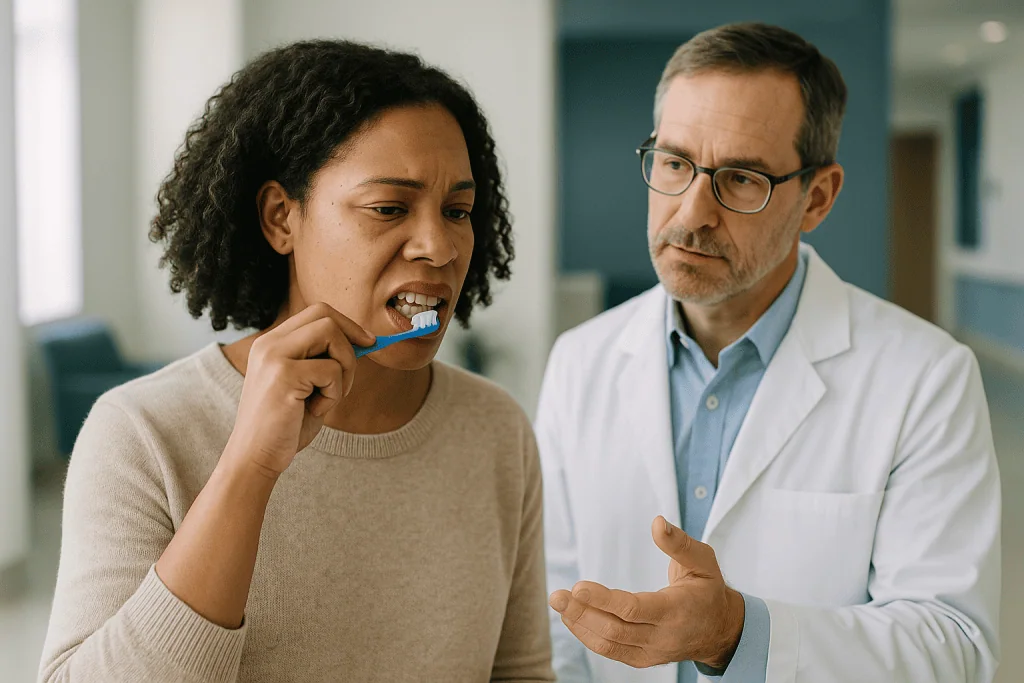
The first force is abrasion. Gum tissue is living skin, and like skin it can be scrubbed thin. Hard bristles, a heavy hand and a horizontal sawing motion at the gum line wear away tissue a few cells at a time, year after year.
The second is inflammation. Plaque bacteria that sit undisturbed at the gum margin trigger an immune response. In gingivitis, the earliest stage, gums swell and bleed but the bone is intact. In periodontitis, the same inflammation begins dissolving the ligament and bone that hold the gum up, and the gum drops as its foundation disappears. The NHS describes this progression as the main way gum disease leads to tooth loss.
The third, and the most debated, is load. Clenching and grinding put enormous force on teeth, and some researchers believe that flexing at the gum line contributes to notches and recession, though the evidence here is weaker than for the first two.
| Driver | What it attacks first | Typical pattern | Strength of evidence |
|---|---|---|---|
| Brushing force | Gum tissue | Outer surfaces, often left side in right-handed people, wedge-shaped notches | Strong |
| Gum disease | Bone and ligament | Generalized, between teeth, with bleeding and deeper pockets | Strong |
| Bite stress | Root surface and possibly bone | Isolated teeth under heavy load, worn tips, jaw tension | Moderate to weak |
Most mouths show a blend. A person with naturally thin gums who brushes hard and clenches at night has three risk factors stacked on the same few teeth, and those are the teeth that recede first.
How hard brushing wears gums away
The cruel irony of toothbrush recession is that it punishes effort. People who scrub because they want spotless teeth often produce the classic picture: healthy, pale gums elsewhere, and clean, shiny, exposed roots on the canine and premolar teeth where the brush lands hardest.
Mechanically, three things do the damage. Stiff bristles concentrate pressure on a small strip of tissue. Force increases that pressure; many people press far harder than needed to remove plaque, which is soft and comes off with gentle contact. Direction finishes the job, because a side-to-side scrub drags the bristle tips across the gum margin instead of sweeping plaque away from it. Over years this thins the tissue until it simply cannot cover the root.
Cleveland Clinic lists forceful or aggressive brushing among the leading causes of gum recession and recommends a soft-bristled brush used with light pressure. Both the NHS and Cleveland Clinic advise brushing for about two minutes twice a day; the point is time and coverage, not strength.
A few clues suggest brushing is your culprit. Recession is on the outer, cheek-facing surfaces rather than between teeth. Gums do not bleed, because the tissue is healthy, just thin. Splayed, frayed bristles on a brush that is only a few weeks old betray a heavy hand. Some people also notice V-shaped notches at the gum line, called abrasion lesions, where cementum and dentin have been worn along with the gum.
Electric brushes are not automatically gentler. Pressing an oscillating head into the gum can do the same harm, though many models include a pressure sensor that flashes or stalls when force is excessive. Your dentist or hygienist can watch you brush and show you a modified technique, usually angling bristles toward the gum line and moving in small circles or short sweeps rather than scrubbing.
Bite stress, clenching and grinding: what the evidence really shows
Bruxism is the medical name for clenching or grinding the teeth, often during sleep and often without awareness. The forces involved are large, and dentists have long observed that teeth under heavy load sometimes develop wedge-shaped defects and recession at the gum line even in people who brush gently.
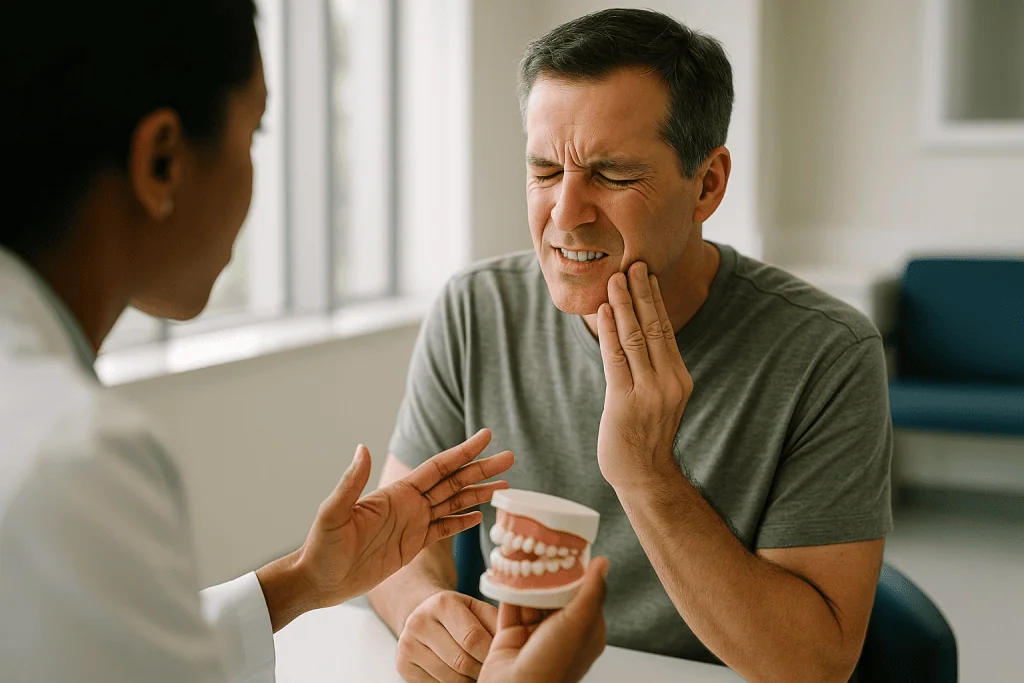
The proposed mechanism is called abfraction. The theory holds that a tooth flexes microscopically under off-axis force, and the repeated bending fatigues the thin cementum and enamel at the neck of the tooth, causing tiny fractures that chip away and leave a notch. Because the gum is attached right at that spot, the tissue may lose its anchorage and drift down.
This is where honesty matters. Abfraction is a plausible and widely taught idea, yet laboratory evidence has been mixed, and studies in living people have struggled to separate the effect of bite force from the effects of brushing and acidic diet on the same lesions. Mayo Clinic lists grinding and clenching among risk factors that stress the tissues around teeth, and Cleveland Clinic includes bruxism among contributors to recession, but neither presents it as a proven primary cause on its own.
A practical reading of the evidence: heavy bite stress probably does not create recession from nothing in a healthy mouth, but it can accelerate damage where gums are already thin or inflamed, and it certainly wears enamel and can crack teeth. Signs your dentist may notice include flattened tooth tips, scalloped edges on the tongue, jaw muscle tenderness on waking and morning headaches.
Management is aimed at protecting teeth rather than reversing recession: a custom night guard, addressing stress and sleep, and correcting a bite that concentrates force on a few teeth. Whether any of that slows recession is uncertain, and your dentist should say so plainly.
How gum disease drives recession from the inside
If brushing damage is erosion, gum disease is subsidence. The tissue does not wear from the outside; the ground beneath it gives way.
It starts with plaque, the sticky film of bacteria that forms on teeth within hours of cleaning. Left along the gum margin, plaque hardens into tartar, which cannot be brushed off and gives bacteria a rough surface to colonize. The body responds with inflammation: gums redden, swell and bleed when touched. This stage, gingivitis, is reversible with thorough cleaning, according to MedlinePlus.
When inflammation persists, the immune system’s own chemicals begin dismantling the periodontal ligament, the network of fibers tethering the tooth to bone, and the bone itself. A pocket opens between gum and tooth, deepening as support is lost. Swollen tissue may temporarily hide the damage; once inflammation is treated and swelling subsides, the gum settles down onto whatever bone remains, and recession becomes visible. Patients are sometimes dismayed that their gums look worse after a deep cleaning, when in fact the cleaning has revealed damage already done.
Periodontitis is common. NIH’s National Institute of Dental and Craniofacial Research reports that roughly 42 percent of US adults aged 30 and older have some periodontitis, and about 8 percent have the severe form. Smoking, diabetes, certain medicines that dry the mouth and a family history raise the risk, per Mayo Clinic.
Disease-driven recession has a different signature from brushing damage. It tends to appear between teeth as well as on the outer surfaces, gums bleed easily, breath may be persistently unpleasant, teeth can loosen or drift, and a dental probe finds deep pockets. Treatment begins with scaling and root planing, a deep cleaning that removes tartar and bacterial toxins from root surfaces below the gum line, followed by maintenance visits. Controlling the disease does not restore lost bone, but it halts the slide.
Thin gums, tooth position and age: who is prone to receding gums
Two people can brush identically and end up with very different gums, because the tissue they started with is not the same. Some people inherit a thick, wide band of tough gum, called keratinized tissue, and a broad ridge of bone. Others have a thin, translucent gum with little bone over the roots. Thin tissue, sometimes called a thin phenotype, recedes with far less provocation.
Tooth position adds to this. A tooth that erupted slightly outside the arch, or was moved there by orthodontics, may sit with almost no bone covering its outer root. Cleveland Clinic notes that crooked or misaligned teeth and poorly fitting dental appliances can both contribute. A tight frenum, the small band of tissue connecting lip to gum, can also tug at the gum margin every time the lip moves.
Then there are habits and exposures. Tobacco in any form starves gum tissue of blood flow and dramatically raises periodontitis risk; the NHS names smoking as one of the biggest modifiable risk factors for gum disease. Lip and tongue piercings rub against gum repeatedly and are a well documented cause of localized recession. Hormonal shifts during pregnancy make gums more reactive to plaque, though they do not cause recession by themselves.
People often ask at what age gums start receding. There is no threshold. Recession is unusual in healthy children, becomes noticeable in some people in their twenties and thirties (especially those with thin tissue, piercings or heavy brushing), and is very common later in life. Cleveland Clinic summarizes survey data suggesting roughly half of adults aged 18 to 64 and the large majority over 65 have recession on at least one tooth. The reason is cumulative exposure rather than aging itself: more years of brushing, more years of plaque, more years of load. Healthy gums do not have to recede simply because a birthday passes.
Can receding gums grow back on their own?
This is the question people most want a yes to, and the truthful answer is no. Gum tissue that has migrated down a root does not regrow upward by itself, and no toothpaste, rinse, oil pull or supplement has been shown in mainstream evidence to regenerate it. Cleveland Clinic states this directly: receded gums do not grow back.
The biology explains why. Gum height is dictated by the bone beneath it. When brushing wears tissue away, the remaining gum has no scaffold above its current level to climb onto. When periodontitis destroys bone, the gum has literally lost its foundation, and bone does not spontaneously rebuild around a tooth once the ligament attachment is gone.
There is one legitimate exception that causes confusion. Inflamed gums are swollen. When gingivitis is treated, the swelling subsides and the gum may look like it has shrunk, or in other cases redden tissue that was puffy becomes firm and hugs the tooth more closely, which can make a slightly receded margin appear improved. That is inflammation resolving, not tissue regenerating, and it will not lift a gum back over an exposed root.
Products marketed for “regrowing” gums typically rely on this effect, on reduced sensitivity, or on nothing measurable. Fluoride toothpaste and desensitizing pastes that block dentin tubules can make exposed roots less painful, which is worthwhile, but they change how the root feels, not where the gum sits.
What the body cannot do, a surgeon partly can. Grafting procedures move or add tissue to cover exposed roots, and in periodontitis, regenerative techniques attempt to rebuild some bone in specific defect shapes. Those are treatments performed by a clinician, discussed in the next section, and their suitability depends heavily on why the gum receded in the first place. Stopping the cause remains the only thing that reliably prevents further loss.
Can receding gums be repaired? Gum recession treatment options explained
Repair is possible in many cases, and the menu of options ranges from doing very little to surgery. Which one fits depends on how much root is exposed, whether the cause is controlled, how thick the neighboring tissue is, and what bothers you: sensitivity, appearance, decay risk or ongoing loss.
The first tier is monitoring plus cause control. For mild recession with no symptoms, dentists often measure it, photograph it, correct the brushing technique or treat the gum disease, and recheck at intervals. Stable recession that is not progressing may need nothing else.
The second tier addresses symptoms. Desensitizing agents applied in the office or used at home reduce cold sensitivity. Where a root has worn into a notch or decayed, a tooth-colored filling can seal and protect it, though it does not replace gum.
The third tier is surgical root coverage, performed by a periodontist, a dentist who specializes in gum and bone. The most studied approach is the connective tissue graft: a small piece of tissue is taken from beneath the surface of the palate and tucked under the gum at the receded site, where it thickens the tissue and covers the root. Variations use donor or collagen-based material instead of palate tissue, avoiding a second wound, and tunneling or pinhole techniques that slide existing gum downward through small openings without a full incision. Cleveland Clinic lists these among standard treatments.
For recession caused by periodontitis, treatment is sequenced differently. Disease must be controlled first with deep cleaning and, where pockets remain, flap surgery that opens the gum to clean and reshape bone. Grafting onto inflamed, infected tissue fails.
None of these approaches offers guaranteed full coverage, and results vary with defect type, tissue thickness and whether the original cause has been eliminated. A good consultation will show you your own measurements, explain which category your recession falls into, and describe realistic outcomes rather than promising perfection.
Who gum grafting is usually for, and who is asked to wait
Surgery is not the default answer to recession, and a candid periodontist will often talk someone out of it. The decision weighs benefit against a procedure that involves anesthesia, stitches and a couple of weeks of care.
Grafting is most often suggested when recession is progressing despite cause control, when an exposed root is painfully sensitive and desensitizers have not helped, when the root is developing decay or wear that is difficult to restore, or when the remaining gum is so thin that further loss seems likely. Appearance is a legitimate reason too, particularly for front teeth, provided expectations are realistic.
Certain situations favor waiting or choosing another path. Active gum disease must be treated and stable first; grafting into inflammation is set up to fail. Heavy brushing or a piercing that has not been addressed will damage a graft just as it damaged the original gum. Smokers are frequently asked to stop before surgery, because tobacco impairs the blood supply the graft depends on to survive; the NHS and Mayo Clinic both identify smoking as a major threat to gum healing. Uncontrolled diabetes, certain blood-thinning or bone-affecting medicines, and pregnancy may prompt a delay or coordination with the prescribing physician, and no medicine should be altered without that clinician’s direction.
Anatomy matters as well. Recession that has destroyed the bone and gum between teeth, the little pink triangles called papillae, is much harder to cover fully, and a surgeon may recommend partial coverage or thickening the tissue to prevent further loss rather than promising a complete result. Teeth that are very loose from periodontitis may not be worth grafting at all.
Children and adolescents are usually observed rather than operated on, since tissue may thicken as the jaw matures and orthodontic movement can change the picture. In every case, the treating team makes the call after examining the mouth in front of them.
What the days and weeks after a gum graft usually look like
People are often more anxious about recovery than the procedure itself, so it helps to know the ordinary rhythm. This section describes a typical course; your own surgeon’s instructions take precedence over anything written here.
The procedure is done under local anesthesia in an outpatient chair, and most people go home the same day. The graft site is covered with stitches and sometimes a protective dressing or clear plastic guard over the palate if tissue was taken from there. The first two to three days bring the most swelling and soreness, especially at the donor site, which many patients describe as feeling like a pizza burn on the roof of the mouth.
During the first week or two, the rules are about protecting a fragile blood supply. That usually means no brushing or flossing directly on the grafted teeth, a prescribed or recommended antiseptic rinse instead, soft and cool foods, no straws, no strenuous exercise for a few days, and absolutely no smoking. Pulling the lip to inspect the site is discouraged because it can tug the stitches. Cleveland Clinic notes that initial healing generally takes about one to two weeks, after which stitches dissolve or are removed and gentle brushing resumes.
Over the following months the graft matures. Its color evens out to match the surrounding gum, and its final position settles; surgeons often wait several months before judging the result. Sensitivity from the exposed root usually eases once it is covered, though some tenderness can linger while tissue thickens.
Bruising on the cheek, a small amount of blood-tinged saliva, and a feeling of tightness are common and expected. What is not expected is covered in the red-flag section later in this article. Follow-up visits allow the team to check that the graft has taken and to reinforce the gentle brushing technique that will protect it for years.
How to stop receding gums from getting worse
Because lost tissue does not return, prevention is where most of the leverage lies, and it is refreshingly low-tech. The goal is to remove the cause that matches your pattern of recession, not to add products.
Start with the brush. A soft-bristled head, held so lightly that the bristles barely bend, angled toward the gum line and moved in small circles or short strokes, cleans plaque effectively without shaving tissue. Both the NHS and Cleveland Clinic recommend brushing twice daily for about two minutes with a fluoride toothpaste. If your bristles splay within weeks, your hand is too heavy. Ask a hygienist to watch you brush; most people are surprised by what they see.
Clean between teeth once a day with floss or interdental brushes sized to your gaps. Snapping floss down into the gum injures it; curve the floss around each tooth and slide gently below the margin. This is the step that controls the between-teeth plaque driving periodontitis.
Keep the professional appointments your dentist recommends, which may be more frequent if you have a history of gum disease. Scaling removes tartar you cannot reach, and probing measurements track recession millimeter by millimeter, catching progression before you notice it.
If you smoke or vape, stopping is the single most effective change for gum health, per the NHS. If you grind, discuss a night guard. If you have an oral piercing that rubs the gum, the evidence is unambiguous that removing it protects the tissue.
Manage conditions that feed inflammation. Diabetes and gum disease worsen each other, and Mayo Clinic lists poor blood sugar control among periodontitis risk factors. Dry mouth from medicines increases plaque, so mention it to your physician rather than stopping anything on your own.
Finally, resist the urge to scrub away the yellow root you have discovered. It is not dirt. Brushing harder is precisely how it got there.
What people often get wrong about why gums recede
Recession attracts myths because it is visible, gradual and quietly upsetting. A few deserve correcting.
“My gums recede because I do not brush hard enough.” The opposite is more common. Plaque is soft and lifts with gentle contact; the pressure that makes brushing feel thorough is the pressure that wears gum. People with the cleanest teeth often have the most toothbrush recession.
“It is just aging.” Recession accumulates with age because exposures accumulate, not because gum tissue is programmed to retreat. Older adults with thick tissue, gentle habits and no periodontitis can keep stable gums for life, while a twenty-five-year-old with a lip piercing and a stiff brush can lose several millimeters.
“Bleeding gums are normal.” Healthy gums do not bleed with brushing or flossing. Bleeding signals gingivitis, the reversible stage, and the moment to clean more carefully, not less. MedlinePlus notes that many people mistakenly stop flossing when they see blood, which allows the inflammation to advance.
“A toothpaste or oil can regrow gums.” No over-the-counter product has been shown to regenerate gum tissue. Some reduce sensitivity or inflammation, which is useful, but the gum stays where the bone is.
“Grinding is definitely causing my recession.” Bite stress is a plausible contributor with mixed evidence, and it rarely acts alone. A night guard protects enamel and jaw joints, which is reason enough to wear one if recommended, but it should not be sold as a recession fix.
“Sensitivity means a cavity.” Cold sensitivity at the gum line is most often exposed dentin, not decay. Only an examination can tell them apart, and exposed roots do decay more easily, so the distinction matters.
“My gums looked worse after the deep cleaning, so it harmed them.” The cleaning revealed damage that swelling had concealed. Firm, pale, non-bleeding gums sitting lower than before are a treated mouth, not a damaged one.
Questions to ask your care team about gum recession
A ten-minute conversation with your dentist or periodontist is worth more than an hour of searching, provided you arrive with the right questions. These are the ones that tend to change decisions.
- Which of my teeth are receding, by how many millimeters, and is it progressing compared with my last measurements?
- What do you think is the main cause in my mouth: brushing, gum disease, bite stress, thin tissue or something else? Can you show me the evidence for that on my own teeth?
- Do I have periodontitis, and how deep are my pockets? If so, what is the treatment sequence, and how will we know it is controlled?
- Can you watch me brush and correct my technique before we discuss anything else?
- Is my recession stable enough to simply monitor? How often would you want to remeasure it?
- If treatment is recommended, what are the alternatives, including doing nothing, and what happens if I choose to wait?
- For a graft, which technique would you use and why? Where would the tissue come from, and what does the donor site feel like afterward?
- What is a realistic amount of root coverage for my defect type, and what could make the result fall short?
- Should I stop smoking, adjust anything with my physician, or address a night guard or piercing before surgery?
- What will the first two weeks look like, what should I avoid, and what symptoms should prompt a call?
- How will we protect the graft long term so the same cause does not undo it?
Write the answers down. Recession is measured in millimeters and tracked over years, so a paper or phone record of your own numbers helps you and any future clinician see whether the plan is working. If an answer sounds like a guarantee, ask what the evidence actually shows; a trustworthy clinician will welcome the question.
When to call your doctor or dentist
Recession itself is slow, and most of it can wait for a scheduled visit. Some situations should not.
Book a prompt dental appointment if you notice gums bleeding regularly when you brush or floss, gums that are red, swollen or tender, persistent bad breath or a bad taste that cleaning does not clear, teeth that feel loose or have shifted position, a change in how your teeth fit together, pus or discharge at the gum line, or a tooth that has suddenly become very sensitive or painful. These can indicate active periodontitis or an abscess, and earlier treatment preserves more bone, according to the NHS and Mayo Clinic.
After a gum graft or periodontal surgery, call your surgeon the same day if bleeding does not slow with firm gauze pressure, swelling or pain worsens rather than improves after the third day, you develop fever or spreading redness, the graft appears to have lifted or shifted, stitches come out early, or you notice a foul taste or discharge from the site. Numbness that persists well beyond the expected wearing-off of anesthesia also warrants a call.
Seek urgent medical care, not just a dental appointment, for facial swelling that is spreading toward the eye or neck, difficulty swallowing or breathing, a high fever with mouth pain, or bleeding that will not stop. A dental infection can occasionally spread into the tissues of the face and neck, and that is an emergency.
People with diabetes, heart valve conditions, immune suppression or those taking blood thinners or medicines that affect bone should mention gum symptoms to both their dentist and their prescribing physician, since these conditions can change how gum disease and its treatment are managed. Every decision about treatment, timing and medicines belongs with the team that examines you.
Frequently asked questions
How can I stop my gums from receding?
Identify and remove the cause that matches your pattern. Switch to a soft brush, use light pressure with small circular strokes, and clean between teeth daily without snapping floss into the gum. Treat gum disease with professional cleanings and keep recommended checkups so recession can be measured over time. Stopping smoking, wearing a night guard if you grind, and removing oral piercings that rub the gum all reduce further loss.
Can receding gums grow back again?
No. Gum tissue that has migrated down a root does not regrow on its own, because its height depends on the bone beneath it, and neither tissue nor bone rebuilds spontaneously. Swelling from gingivitis can subside and make gums look slightly different after treatment, but that is inflammation resolving, not regrowth. Surgical grafting is the only established way to cover an exposed root.
Can receding gums be repaired?
Often, yes. A periodontist can perform a connective tissue graft, moving tissue from the palate or using donor material to thicken the gum and cover the root, or use tunneling techniques that shift existing gum. Recession caused by gum disease must be controlled first with deep cleaning. Coverage is not guaranteed and depends on defect shape, tissue thickness and whether the original cause has stopped.
At what age do gums start receding?
There is no set age. Recession is rare in healthy children, appears in some people in their twenties and thirties, especially those with thin tissue, piercings or heavy brushing, and becomes very common later in life. Cleveland Clinic summarizes survey data suggesting about half of adults aged 18 to 64 have recession on at least one tooth. Accumulated exposure, not aging itself, is the driver.
What are the main receding gums causes?
The three best supported causes are aggressive brushing that abrades gum tissue, periodontitis that destroys the bone supporting the gum, and, with weaker evidence, heavy bite stress from clenching or grinding. Thin inherited tissue, teeth positioned outside the jaw arch, smoking, lip or tongue piercings and a tight frenum add risk. Most people have more than one factor acting on the same teeth.
Does brushing too hard really cause gum recession?
Yes, and it is one of the most common causes dentists see. Stiff bristles, heavy pressure and a horizontal scrubbing motion thin the gum margin over years, typically on the outer surfaces of canines and premolars. The gums usually look healthy and do not bleed, just receded. Frayed bristles on a new brush are a telltale sign that pressure is excessive.
Can grinding my teeth make my gums recede?
Possibly, though the evidence is less certain than for brushing or gum disease. The abfraction theory proposes that flexing under heavy bite force causes tiny fractures at the gum line that undermine the tissue, but studies have struggled to separate this from brushing and diet. Grinding clearly wears enamel and strains the jaw, so a night guard is often worthwhile regardless of its effect on recession.
Why do my gums look more receded after a deep cleaning?
Because inflammation was hiding the damage. Swollen, infected gums sit higher than the bone actually supports. Once scaling and root planing remove tartar and bacteria, the swelling subsides and the gum settles onto the remaining bone, revealing recession that was already there. Firm, pale, non-bleeding gums at a lower level indicate the disease is being controlled, not that the cleaning caused harm.
Is gum recession treatment always surgery?
No. Many cases are managed by correcting the cause and monitoring measurements over time. Sensitivity can be eased with desensitizing agents, and worn or decayed root notches can be sealed with a filling. Gum disease is treated with deep cleaning and maintenance visits. Grafting is usually reserved for recession that keeps progressing, causes persistent sensitivity, threatens the root with decay, or significantly affects appearance.
How long does recovery from a gum graft take?
Initial healing generally takes about one to two weeks, according to Cleveland Clinic, during which you avoid brushing the site, eat soft cool foods, skip straws and strenuous activity, and do not smoke. The donor site on the palate is often the sorest part. The graft continues to mature and blend in over several months, and surgeons typically judge the final result after that period.
References
- Cleveland Clinic: Gum Recession
- NHS: Gum disease
- MedlinePlus: Gum Disease
- NIH National Institute of Dental and Craniofacial Research: Periodontal (Gum) Disease
This article is for general information only and is not a substitute for professional medical advice. Please consult a qualified doctor about your individual situation.

More from the Blog

Questions to Ask Your Surgeon and Orthodontist Before Orthognathic Surgery
Before orthognathic (corrective jaw) surgery, ask your surgeon which jaw or jaws will be moved and why, what the alternatives are, how surgery and…

How Clear Aligner Treatment Unfolds: From Scan to Attachments to Your First Trays
Clear aligner treatment usually unfolds in stages: an orthodontic examination and digital scan of the teeth, a computer-planned sequence of movements the clinician reviews…

How a Jaw Cyst Is Diagnosed: Panoramic X-Ray, CT Imaging and Pathology Review
A jaw cyst is usually diagnosed in three steps. A panoramic dental X-ray first reveals a dark, fluid-filled space in the bone, often by…

Gummy Smile Results: How the Gum Line Settles and What a Balanced Smile Realistically Means
Gummy smile results depend on the cause and the method used. Gum reshaping produces a new gum line that is visible at once but…

How TMJ Disorder Progresses: Clicking, Locking and Bite-Related Discomfort Explained
TMJ disorder usually begins with painless clicking as the cushioning disc inside the jaw joint slips out of position, can progress to intermittent or…

Is It Dry Socket? Tooth Extraction Pain That Returns and When to Call Your Dentist
Dry socket is a healing complication in which the blood clot that should protect an extraction site fails to form, dissolves early, or is…