

Inner Thigh Pain: Adductor Strain, Hip and Groin Causes and When It Needs a Check
Key Takeaways
- The adductor longus tendon, the cord at the top of the inner thigh, is the single most commonly injured structure when inner thigh pain follows a sudden movement.
- NHS guidance indicates most strains feel better within 2 weeks, while strenuous exercise should be avoided for up to 8 weeks to limit re-injury.
- The Hölmich 1999 randomized trial showed that active strengthening outperformed passive treatment for long-standing adductor-related groin pain.
- Hip osteoarthritis is usually felt in the groin and inner thigh rather than at the side of the hip, and loss of inward rotation is an early examination sign.
- A throbbing, swollen, warm leg without an injury, especially after surgery, travel or immobility, fits deep vein thrombosis and needs same-day assessment.
- A groin lump that enlarges on coughing suggests a hernia, and one that becomes hard, tender and irreducible with vomiting is an emergency.
Inner thigh pain most often comes from a strained adductor muscle, the group that pulls the leg inward, and usually settles with rest and gradual loading. Hip joint problems, a hernia, a pinched nerve or, rarely, a blood clot can cause similar pain. A warm, swollen, painful leg or sudden breathlessness needs emergency care the same day.
It usually starts with a step that goes sideways. A foot slides on wet grass, a leg stretches too far reaching for a ball, or a sprint ends with a sharp catch high on the inside of the leg. By the next morning, getting out of the car hurts and so does pulling the knees together.
Inner thigh pain is one of the most searched leg complaints for a reason: the area is crowded. Five adductor muscles, the hip joint, the femoral blood vessels and two major nerves all pass through a space not much wider than a hand. Pain there can come from any of them, and from the lower spine and groin as well.
This guide walks through the likely culprits in order of how common they are, explains how a clinician sorts one from another, and is clear about the small number of situations where waiting is the wrong call.
Why does my inner thigh hurt? The short answer
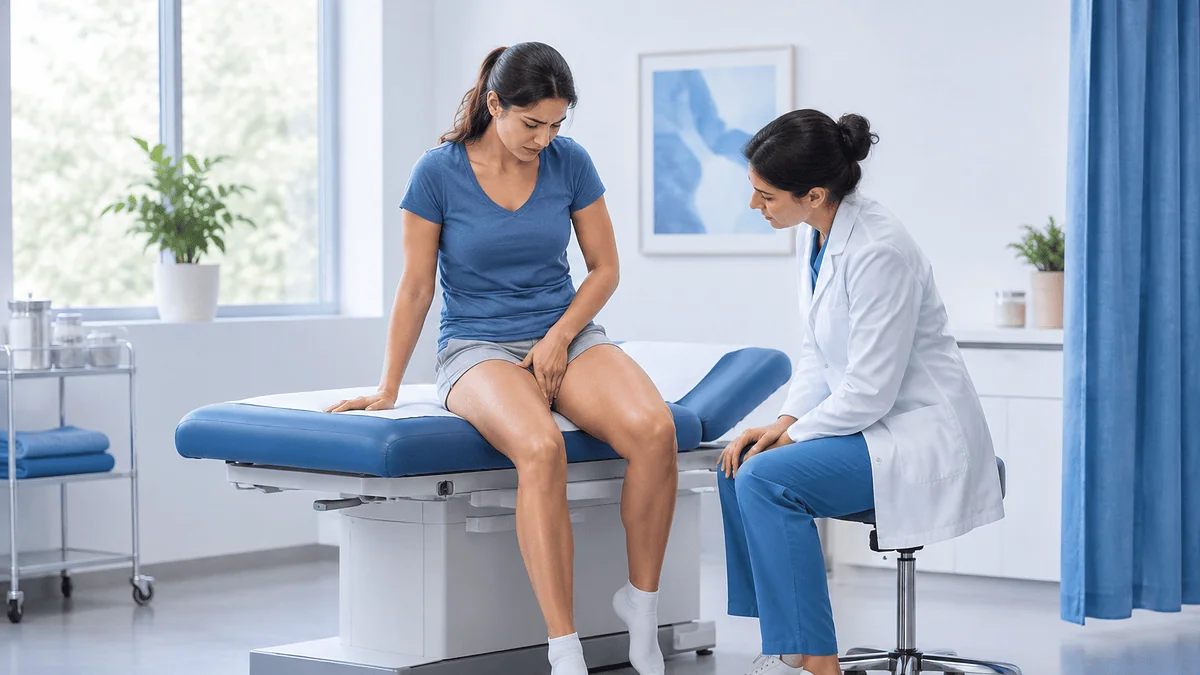
In most adults, the answer is a strained adductor muscle. The adductors are the band of muscles running from the pubic bone down the inside of the thigh, and they tear a little when the leg is forced outward or when a kick, sprint or change of direction asks more of them than they can give. The pain is sharp at first, sits high on the inside of the thigh, and gets worse when you squeeze the knees together.
The next most common group is pain referred from the hip joint. Osteoarthritis, a torn labrum (the cartilage rim around the hip socket) or impingement can all be felt in the groin and inner thigh rather than over the hip itself. A hernia in the groin, a nerve irritated in the lower back or pelvis, and tendon problems where the adductors attach to the pubic bone fill out the list.
One cause changes the urgency entirely. A deep vein thrombosis, a blood clot in a leg vein, can present as a throbbing, swollen, warm inner thigh or calf, often on one side only. If that describes your leg, or if leg pain comes with chest pain or breathlessness, the NHS advice is to seek emergency care immediately rather than wait for an appointment. Everything else in this article can be sorted out over days.
What actually sits in the inner thigh
The inside of the thigh is a corridor, and knowing what travels through it explains why the same pain can have such different causes.

Closest to the skin are the adductor muscles: adductor longus, brevis and magnus, plus gracilis and pectineus. Adductor longus is the one most often injured; its tendon is the taut cord you can feel at the top of the inner thigh when you press the knees together. These muscles stabilize the pelvis on every stride, which is why sprinting, skating and kicking sports load them hardest.
Deeper lies the hip joint itself, a ball and socket whose nerve supply overlaps with the groin and inner thigh. That shared wiring is why worn hip cartilage is often felt in front rather than at the side.
Running down the inner thigh in a protected channel are the femoral artery and vein, the main blood supply to the leg. The femoral vein is the usual site of a clot that extends upward from the calf.
Two nerves matter. The obturator nerve supplies the adductors and a patch of skin on the inner thigh; the femoral nerve and the L2 to L4 spinal roots supply the front and inside of the thigh. Irritation of either produces burning, tingling or weakness rather than the dull ache of a muscle.
Finally, the groin crease above holds the inguinal canal, where hernias push through, and lymph nodes that swell with infection.
Adductor strain: the most common cause of inner thigh pain
A strain is a tear of muscle fibers, graded from a few overstretched fibers to a complete rupture. In the adductors it typically happens at the junction between muscle and tendon near the pubic bone, where the tissue is least elastic.
The story is usually clear. A sudden movement, a sharp pain high on the inside of the thigh, and then stiffness that peaks a day or two later. Pressing on the tendon hurts, bruising may track down the thigh over the following days, and squeezing a ball between the knees reproduces the pain. Walking is uncomfortable but possible; a complete tear, which is uncommon, leaves a visible gap and marked weakness.
Recovery depends on grade. The NHS guidance on sprains and strains notes that most feel better within 2 weeks, while strenuous exercise should be avoided for up to 8 weeks to limit the risk of further damage. Higher-grade tears take the longer end of that range, and returning to sprinting too early is the classic way to turn a two-week injury into a two-month one.
A landmark randomized trial, Hölmich and colleagues in 1999, compared an active strengthening program against passive treatment for long-standing adductor-related groin pain in athletes and found strengthening clearly more effective. That finding still underpins modern rehabilitation: adductors recover by being loaded progressively, not by being stretched aggressively or left alone.
Why does my upper thigh hurt near my groin?
Pain at the very top of the inner thigh, where the leg meets the trunk, is a question in its own right because three structures overlap there and the treatment for each differs.
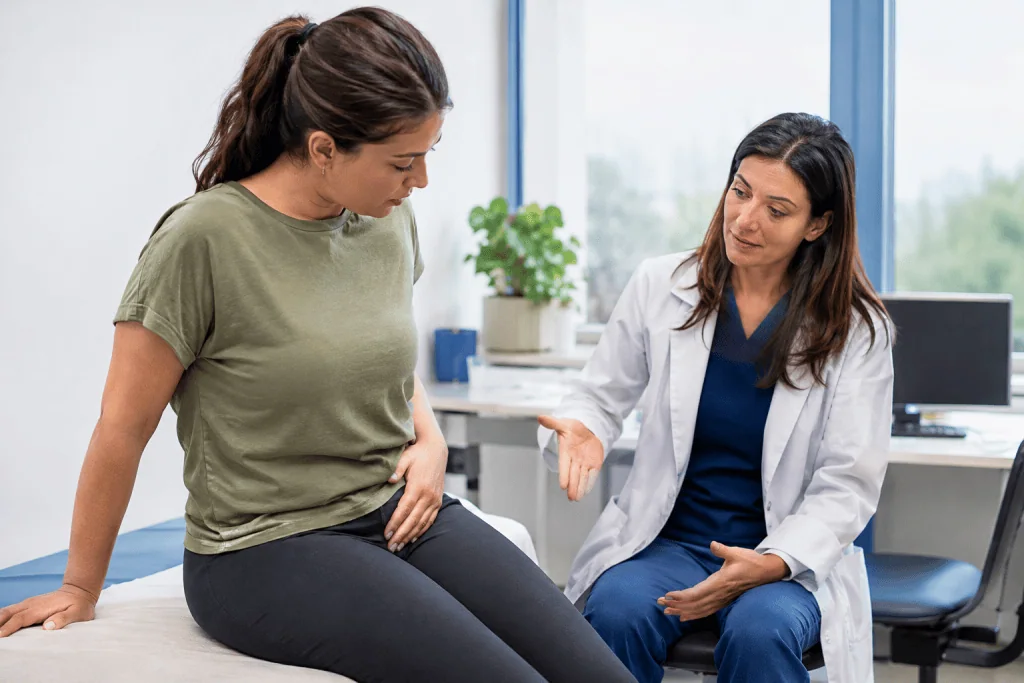
If the pain came on with a specific movement and is sharpest when pressing the knees together or stretching the leg out sideways, the adductor tendon or its attachment is the usual source. When this becomes chronic in athletes it is often labeled adductor-related groin pain. The 2014 Doha agreement meeting on groin pain in athletes, published in 2015, replaced older vague labels with this anatomy-based classification precisely because tendon, pubic bone and hip joint pain had been lumped together.
If instead the pain is a deep ache felt in the groin crease, worse after sitting, stiff in the morning and provoked by turning the leg inward, the hip joint moves up the list. Clinicians look for a reduced range of rotation and a positive impingement test, where flexing and rotating the hip reproduces the pain.
Pain over the pubic bone itself, tender in the midline and worse with running, points toward osteitis pubis, an overload of the joint between the two halves of the pelvis seen in distance runners and footballers.
A lump or dragging sensation in the groin that enlarges with coughing suggests a hernia rather than any of the above. These distinctions are made on examination, and often confirmed with imaging only when symptoms persist.
Could it be a hernia?
A hernia occurs when a loop of bowel or fatty tissue pushes through a weak point in the abdominal wall. Inguinal hernias, which emerge in the groin crease, are by far the most common type in adults and can send a dull, dragging discomfort down toward the inner thigh.
The features that separate a hernia from a muscle strain are the lump and the pattern. Most people notice a soft swelling in the groin that appears on standing, coughing or lifting and often disappears when lying down. The discomfort tends to build through the day rather than being sharp at the moment of injury. Femoral hernias, which emerge slightly lower and are more common in women, can be harder to feel but carry a higher risk of trapping tissue.
The NHS guidance on hernias is specific about warning signs: sudden severe pain, a lump that becomes hard or tender and cannot be pushed back, vomiting, and difficulty passing stool or wind. Those features suggest a strangulated hernia, in which the blood supply to the trapped tissue is cut off, and they need emergency assessment.
A clinician diagnoses most hernias by examination, asking the person to stand and cough while feeling the groin. Ultrasound is used when the picture is unclear. Not every hernia needs an operation; small, painless ones are sometimes watched, and the decision rests with the surgeon who assesses it.
Hip joint causes: osteoarthritis, labral tears and impingement
The hip joint is a surprisingly common source of pain felt in the inner thigh, and it is the one most often missed by people who assume a sore hip should hurt at the side.
Osteoarthritis, the gradual wearing of joint cartilage, typically announces itself as groin or inner thigh ache in people over 50, worse after activity and after rest, with morning stiffness that eases within half an hour. Putting on socks or getting out of a low chair becomes awkward because inward rotation and deep flexion are lost first. The NHS hip pain guidance lists osteoarthritis as the most common cause of hip pain in adults.
A labral tear, damage to the cartilage rim that deepens the hip socket, produces a sharper, catching pain, sometimes with clicking, in younger and more active people. It often coexists with femoroacetabular impingement, a shape mismatch between the ball and socket that pinches the rim during deep flexion.
How does a clinician tell joint from muscle? Joint pain is reproduced by moving the hip passively, with the muscles relaxed; muscle pain needs the adductors to contract or stretch. A plain X-ray shows osteoarthritis and bone shape; an MRI, sometimes with contrast injected into the joint, is used for labral tears when the result would change the plan.
For osteoarthritis, exercise, weight management and physiotherapy come first, with surgery reserved for pain that limits daily life despite those measures.
Nerve-related pain: burning, tingling or numbness on the inner thigh
When inner thigh pain burns, tingles or is paired with numbness or weakness, the nerves deserve attention. Two patterns are seen.
Obturator neuropathy is irritation of the obturator nerve as it passes through the pelvis. It causes aching in the groin and a strip of altered sensation on the inner thigh, sometimes with weakness when bringing the leg inward. It is uncommon and is most often reported in athletes with chronic adductor pain, after pelvic surgery, or during pregnancy and childbirth.
More common is pain referred from the lower spine. The L2, L3 and L4 nerve roots supply the front and inside of the thigh, so a disc bulge or narrowing at those levels can produce thigh pain with little or no back pain. Clues include pain that changes with sitting or bending, a reduced knee reflex, and weakness straightening the knee. Diabetes can also affect these roots directly, a condition called diabetic amyotrophy, causing severe thigh pain followed by wasting of the thigh muscles.
The examination separates these from a strain fairly quickly: nerve pain is not reproduced by pressing on the adductor tendon, sensation is altered, and reflexes may differ between legs. Nerve conduction studies or an MRI of the spine are used when the diagnosis matters for treatment.
Red flags in this group are new weakness, numbness in the saddle area, or changes in bladder or bowel control; those require same-day assessment.
Deep vein thrombosis: the inner thigh pain not to miss
A deep vein thrombosis, or DVT, is a blood clot in one of the deep veins of the leg. It matters because a piece of the clot can travel to the lungs, causing a pulmonary embolism, which can be life-threatening.
The NHS describes the typical picture: throbbing pain in one leg, usually the calf or thigh, swelling, skin that is warm to the touch and may look red or darkened, and swollen veins that feel hard or sore. The pain is not related to a specific injury, does not get better with rest, and often worsens over a day or two. A clot in the femoral vein produces these changes along the inner thigh.
The CDC lists the situations that raise risk: recent surgery, particularly hip or knee operations, hospital stays, long periods of immobility including long journeys, cancer, pregnancy and the weeks after birth, estrogen-containing contraception or hormone therapy, and a previous clot.
Clinicians assess the likelihood with a structured score, most commonly the Wells score, published in 1997, then confirm or exclude the clot with a D-dimer blood test and a Doppler ultrasound of the leg veins. Treatment is with anticoagulant medicines, which stop the clot growing while the body breaks it down; the type and duration are decided by the treating clinician.
The NHS advice is unambiguous: a swollen, painful, warm leg should be assessed urgently the same day, and breathlessness or chest pain alongside leg symptoms is an emergency.
Less common causes that still need a check
A handful of conditions sit lower on the probability list but higher on the importance list, because each is managed differently from a strain and gets worse if treated as one.
Femoral neck stress fracture. A hairline crack in the upper thigh bone, seen in distance runners, military recruits and people with low bone density. The clue is groin or inner thigh pain that builds over weeks, hurts with every step, and does not fit a single injury. Plain X-rays are often normal early; MRI is the test that shows it. Continuing to run on it risks a complete fracture.
Osteitis pubis. Inflammation of the joint at the front of the pelvis, tender exactly in the midline, common in sports with repeated kicking and cutting. It overlaps with adductor tendon pain and is managed mostly with load modification.
Infection. Cellulitis of the inner thigh, an abscess, or infected lymph nodes in the groin produce spreading redness, heat, fever and tenderness that is skin-deep rather than within the muscle. These need prompt assessment, as does a hot, painful hip in someone who is unwell.
Bone or soft tissue tumors. Rare, but persistent night pain in the thigh that is not linked to activity, unexplained weight loss or a growing mass should be imaged rather than watched.
Hip avascular necrosis. Loss of blood supply to the ball of the hip, linked to long-term steroid use, heavy alcohol intake and some blood disorders, causing groin pain that progresses despite rest.
Inner thigh pain in children and during pregnancy
Two groups follow different rules, and in both the right step is assessment rather than home management of the pain itself.
Children and adolescents. Thigh or knee pain in a child is often the hip, because the hip joint’s nerve supply refers pain downward. Two conditions matter. Slipped capital femoral epiphysis, in which the growing head of the thigh bone slips off its neck, is most common in early adolescence and presents with limp, groin or thigh pain and a leg that turns outward; it needs urgent orthopedic care because delay damages the joint. Perthes disease, a temporary loss of blood supply to the hip in younger children, causes a limp and thigh pain that comes and goes over weeks. A child who limps, refuses to bear weight, or has a fever with hip pain should be seen the same day; a child with persistent thigh pain for more than a week or two should have the hip examined and usually X-rayed.
Pregnancy. Pelvic girdle pain, discomfort around the pubic bone and inner thighs caused by increased joint laxity and changing load, affects a sizeable minority of pregnant people and usually improves after birth. It is managed with physiotherapy, pelvic support and activity advice through the maternity team. Pregnancy also raises the risk of DVT, so a swollen, painful leg, particularly on the left, should be assessed urgently rather than attributed to normal swelling.
How clinicians tell the causes apart
Much of the diagnosis is made before any test, by matching the story and the examination against a short list of patterns. The table below summarizes what each cause typically looks like and what usually happens next.
| Cause | Typical features | Usual next step |
|---|---|---|
| Adductor strain | Sudden onset with movement; sharp pain high on inner thigh; tender tendon; pain squeezing knees together | Rest, ice, protected movement, then progressive strengthening; imaging only if not improving |
| Hip osteoarthritis | Gradual groin or inner thigh ache; morning stiffness; reduced rotation; age usually over 50 | Examination and X-ray; exercise and physiotherapy first |
| Labral tear or impingement | Deep catching groin pain in active adults; clicking; pain with deep flexion | Examination; MRI if the result would change management |
| Inguinal or femoral hernia | Groin lump worse on coughing or standing; dragging ache; may reduce when lying | Examination; ultrasound if unclear; surgical opinion |
| Nerve-related pain | Burning or tingling; numbness; weakness; pain altered by spine position | Neurological examination; spine MRI or nerve studies when indicated |
| Deep vein thrombosis | Throbbing, swelling, warmth in one leg; no injury; risk factors present | Same-day assessment; D-dimer and Doppler ultrasound |
| Stress fracture | Progressive pain with every step over weeks; runners; often normal X-ray | MRI; strict rest from impact |
The single most useful question a clinician asks is whether the pain started at one identifiable moment. A clear mechanism points toward muscle or tendon; a gradual, unexplained onset widens the search to joint, bone, vein and nerve.
How to ease inner thigh pain at home
For a straightforward strain, the first few days follow the approach the NHS summarizes as RICE: rest, ice, compression and elevation. Rest means avoiding the movements that provoke pain, not lying still; walking within comfort is encouraged. Ice wrapped in a cloth for short periods in the first couple of days limits swelling. A compression bandage can help comfort, and keeping the leg raised when sitting reduces throbbing. Mainstream guidance advises against heat, alcohol, running and massage in the first days, since all can increase bleeding into the muscle.
Over-the-counter pain relief is reasonable for short-term comfort; a pharmacist or clinician can advise what suits your health history, and anyone on prescribed medicines should not change them on their own account.
Once walking is comfortable, usually within a few days to two weeks, the goal shifts from protection to loading. The evidence from the Hölmich 1999 trial favors a graded strengthening program, and physiotherapists typically build it in stages: gentle isometric squeezes of a ball between the knees, then side-lying leg lifts, then standing adductor work with a band, and finally lateral lunges and controlled change-of-direction drills. Each stage should be tolerable, with pain settling within a day, before the next is added. Gentle stretching is fine once the sharp pain has gone, but forcing a stretch early slows healing.
Home care is for pain that fits a strain. It does not apply to a swollen, warm leg, a groin lump, fever, or pain with numbness or weakness.
What the examination and tests involve
Expect the consultation to start with questions rather than scans. How the pain began, where exactly it sits, what makes it worse, whether there is swelling, numbness or a lump, and whether you have had recent surgery, immobility or a previous clot all narrow the list considerably.
The physical examination usually includes watching you walk, pressing along the adductor tendons and the pubic bone, resisted adduction (squeezing the clinician’s hand or a ball between the knees), passive movement of the hip through flexion and rotation, a check of the groin for hernia while you cough, and a brief neurological screen of sensation, strength and reflexes. Measuring the circumference of both legs and checking for warmth and tenderness along the veins looks for DVT.
Tests follow only when they would change the plan. A plain X-ray of the pelvis and hip shows osteoarthritis, bone shape and, in children, a slipped epiphysis. Ultrasound is quick and useful for tendon tears, hernias and, with Doppler, for clots. MRI is the test for labral tears, stress fractures, high-grade muscle tears and spinal nerve compression. Blood tests are reserved for suspected infection, inflammatory arthritis or clotting assessment.
Most adductor strains need no imaging at all; the diagnosis is clinical and the treatment is the same whatever a scan might show. Imaging becomes worthwhile when pain is not improving on the expected timeline, when the story does not fit a strain, or when a decision about surgery depends on it.
What people often get wrong about inner thigh pain
The most common mistake is stretching an acute strain hard, on the theory that a tight muscle needs lengthening. In the first days a strain is a bleeding, healing tear; pulling on it adds damage. Loading comes later and gently.
The second is the opposite error: resting completely for weeks. Muscle that is not used loses strength quickly, and the Hölmich trial showed that active training outperformed passive treatment for chronic adductor pain. The NHS notes that most strains feel better within two weeks, and stiffness beyond that often reflects deconditioning rather than ongoing injury.
A third is assuming hip pain must be felt at the side of the hip. Worn hip cartilage is usually felt in the groin and inner thigh, so years of “groin strain” in an older adult sometimes turns out to be osteoarthritis once the hip is examined properly.
Fourth, people attribute a swollen, warm leg to a pulled muscle because it followed a long flight or a few days in bed. Those are exactly the circumstances in which a clot forms, and a strain does not usually cause whole-leg swelling.
Finally, viral videos promising relief in seconds by pressing on a trigger point are describing, at best, brief muscle relaxation. No single technique reverses a tear, a hernia or a worn joint, and the evidence supports graded strengthening over quick fixes.
When to see a doctor
Most inner thigh pain from a strain improves steadily and needs no appointment. Seek care when the pattern breaks from that expectation.
Call emergency services or go to the emergency department if leg pain comes with chest pain, breathlessness, coughing up blood, or fainting; if a groin lump becomes hard, very painful or cannot be pushed back, especially with vomiting; if you cannot bear weight at all after an injury; or if there is new numbness in the saddle area or loss of bladder or bowel control.
Arrange same-day assessment for a leg that is swollen, warm, red or darkened and painful without an injury, particularly after surgery, immobility, long travel, during pregnancy or with a history of clots; for fever with hip or thigh pain; for spreading redness or a hot, tender swelling; and for any child who is limping or refusing to walk.
Book a routine appointment if pain has not improved after about two weeks of sensible home care, if it keeps recurring with sport, if it wakes you at night or is unrelated to activity, if you notice a lump in the groin, if there is weakness, tingling or numbness, or if you have unexplained weight loss alongside the pain.
None of these lists can replace an examination. If something about your leg worries you and does not fit a simple strain, that instinct is a good enough reason to be seen.
Frequently asked questions
Why does my inner thigh hurt when I walk?
Walking pain on the inner thigh most often reflects an adductor strain, because the adductors stabilize the pelvis with every stride. Hip joint problems such as osteoarthritis or a labral tear also hurt with walking but tend to ache deeper in the groin. Pain with every step that builds over weeks in a runner raises the possibility of a femoral stress fracture, which needs imaging rather than more rest-and-return cycles.
How do I get rid of pain in the inner thigh?
For a simple strain, the first days call for rest from provoking movements, ice, compression and elevation, as NHS guidance describes. After that, graded strengthening of the adductors, starting with gentle isometric squeezes and progressing to band work and lunges, is the approach supported by the Hölmich 1999 trial. Pain that does not fit a strain, with swelling, a lump, fever or numbness, needs assessment rather than home treatment.
What could be causing pain in my thigh muscles?
The usual cause is a muscle strain or overuse from sport, a new exercise program or a sudden movement. Delayed-onset soreness after unaccustomed activity peaks at one to two days and settles within a week. Thigh muscle pain with cramping, weakness, dark urine or no clear activity trigger should be assessed, since nerve compression, circulation problems and, rarely, muscle inflammation can present the same way.
What exercises can I do to relieve pain in my upper thigh?
Once sharp pain has settled, physiotherapists typically progress through isometric adductor squeezes with a ball between the knees, side-lying inner thigh lifts, standing adduction against a resistance band, and then lateral lunges and controlled side-to-side movement. Each stage should be tolerable with symptoms settling within a day. Aggressive stretching in the first days slows healing and is best avoided.
How long does an adductor strain take to heal?
NHS guidance on sprains and strains states that most feel better within 2 weeks, and that strenuous exercise should be avoided for up to 8 weeks to reduce the risk of further damage. Mild strains sit at the shorter end; higher-grade tears and complete ruptures take longer and are sometimes assessed with ultrasound or MRI. Returning to sprinting before the muscle has regained strength is the main reason strains recur.
Can inner thigh pain be a blood clot?
Yes. A deep vein thrombosis in the femoral vein can cause throbbing pain, swelling, warmth and reddened or darkened skin along the inner thigh, usually on one side and without a specific injury. The risk is higher after surgery, immobility, long journeys, in pregnancy and with hormone-containing medicines. The NHS advises same-day assessment for these symptoms, and emergency care if breathlessness or chest pain develops.
Why does my inner thigh hurt near my groin when I sit?
Pain that worsens with sitting and deep flexion of the hip points more toward the hip joint, particularly femoroacetabular impingement or a labral tear in active adults and osteoarthritis in older adults, than toward a muscle strain. Nerve irritation from the lower spine can also change with sitting. A clinician distinguishes these by moving the hip passively and checking sensation and reflexes.
Can a hernia cause inner thigh pain?
It can. Inguinal and femoral hernias in the groin crease often produce a dragging ache that extends toward the inner thigh, worse on standing, coughing or lifting, usually with a soft lump that may disappear when lying down. NHS guidance warns that a lump that becomes hard, very painful or cannot be pushed back, especially with vomiting, may be a strangulated hernia and needs emergency care.
Is inner thigh pain in a child something to worry about?
Thigh or knee pain in a child frequently comes from the hip. A limp, refusal to bear weight, or pain with fever should be assessed the same day. Persistent pain over a week or two warrants a hip examination and usually an X-ray, because slipped capital femoral epiphysis in adolescents and Perthes disease in younger children both need early orthopedic care to protect the joint.
When should inner thigh pain be scanned?
Most adductor strains are diagnosed on examination and need no imaging. Scans are worthwhile when pain is not improving on the expected two-week timeline, when the story does not fit a strain, when a stress fracture, labral tear or nerve compression is suspected, or when a surgical decision depends on the result. Doppler ultrasound is used promptly whenever a clot is possible.
References
This article is for general information only and is not a substitute for professional medical advice. Please consult a qualified doctor about your individual situation.
Add us as a Preferred Source to see more of our trusted health content across Google Search, AI Overviews and Discover.

More from the Blog

Fractures in Older Adults: How Bone Density and Balance Shape Treatment and Prevention
Fracture treatment for older adults usually combines prompt surgery or careful immobilization with early movement, pain control and a plan to protect the rest…
How Long Is a Pavlik Harness Worn? Full-Time Weeks, Weaning and the Follow-Up Ultrasounds
A Pavlik harness is usually worn full-time, day and night, for about 6 to 12 weeks, then for reduced hours over a weaning period…
Pain on the Outer Side of the Foot: Tendon, Bone and Joint Causes and When It Needs a Check
Pain on the outer side of the foot most often comes from the fibularis (peroneal) tendons, the fifth metatarsal bone, a lingering ankle sprain…

Life in the Boots-and-Bar Brace After Ponseti Casting: Sleep, Play and Sticking With It
After Ponseti casting for clubfoot, the boots-and-bar brace keeps the corrected foot from drifting back. Guidelines describe full-time wear (about 23 hours a day)…
Neck Pain on One Side: Muscle, Nerve and Joint Causes on the Left or Right and When to Check
Neck pain on one side most often comes from a strained muscle, an awkward sleeping position or a stiff facet joint, and it usually…
When Can You Walk After Robotic Hip Replacement? From Walker to Crutches to Unaided
Most people stand and take their first supported steps within 24 hours of robotic hip replacement, often the same day, using a walker or…