

Is a Dental Spa Right for Anxious Patients? Comfort Care Without Cutting Corners
Key Takeaways
- The term dental spa has no clinical or legal definition, so it tells you nothing about a practice's infection control or diagnostic thoroughness.
- Roughly one in three adults reports some anxiety about dental visits according to the NHS, and avoidance rather than fear itself is what allows small problems to grow.
- A complete dental examination includes checking each tooth, measuring gum pockets, screening the soft tissues and throat, and deciding on X-rays by individual risk, none of which should be skipped for a nervous patient.
- Nitrous oxide clears within minutes of removing the mask and most people can drive afterward, whereas oral or intravenous sedation requires an escort and no driving for the rest of the day.
- Cognitive behavioral therapy and graded exposure have stronger evidence for lasting reduction of dental fear than any amenity or sedative.
- A dentist who declines to drop X-rays or insists on a medical review before sedation is demonstrating quality, not spoiling the comfort.
A dental spa can suit many anxious patients when the comfort features sit on top of standard clinical care rather than replacing it. Warm blankets, music, and paced appointments may lower stress, and evidence-based options such as breathing techniques, talking therapy, and clinician-supervised sedation address the fear itself. The setting matters less than the team's infection control, diagnostic thoroughness, and willingness to let you pause.
The chair is warm. There is lavender in the air, a blanket over your knees, headphones ready. And still your pulse is thudding, because the last time you sat in a dental chair you were nine, and nobody asked if you were ready.
That is the moment many people first search for a dental spa for anxious patients. The pitch is gentle: a calmer room, a slower pace, a team that treats fear as a legitimate clinical concern rather than an inconvenience. The worry, quietly, is whether all that softness costs something in rigor. Does a dentist who offers paraffin hand treatments still find the early cavity? Does the soothing playlist mean the gum measurements get skipped?
Those are fair questions, and they deserve better answers than marketing copy. This explainer walks through what actually happens in comfort-focused dental care, what the evidence says helps fear, and how to tell whether a practice is adding comfort or subtracting care.
What is a dental spa, and how is it different from an ordinary practice?
A dental spa is a dental practice that layers spa-style amenities over routine dentistry. The dentistry itself is meant to be identical: examinations, cleanings, fillings, crowns, extractions, and gum treatment. What changes is the environment and the pacing. You might find aromatherapy, heated neck wraps, noise-cancelling headphones, ceiling screens, longer appointment slots, and a consultation room away from the operatory, which is simply the room with the dental chair and equipment.
None of these features is regulated as a medical intervention, and none is required for safe dentistry. Their purpose is to reduce the sensory load that many fearful people describe: the drill’s pitch, the smell of clove-like dental materials, the overhead light, the feeling of being tilted back and unable to see. For someone whose fear is largely sensory or situational, softening those triggers can be meaningful. For someone whose fear is rooted in a past traumatic experience, the amenities help less than the way the team communicates.
The term itself has no legal definition. A practice can call itself a spa whether it offers a full menu of extras or a single scented candle. That is the first practical point: the label tells you almost nothing about clinical standards. Licensing, infection control, radiograph protocols, and continuing education requirements apply to every dental practice regardless of the decor, and the NHS notes that dentists are expected to accommodate fearful patients as part of normal care rather than as a premium add-on.
So the honest framing is this: a dental spa is ordinary dentistry with deliberate attention to comfort. Whether that attention translates into genuinely better experiences for anxious patients depends on what sits underneath the amenities.
How a dental spa for anxious patients actually works, step by step
The first difference is usually before you arrive. Comfort-focused practices often send an intake form that asks directly about fear: what triggers it, what happened before, whether you prefer to know every step or none of them. That conversation is the clinically valuable part. Cleveland Clinic describes telling your dentist about your fear as the single most useful thing an anxious patient can do, because it lets the team adapt communication rather than guess.
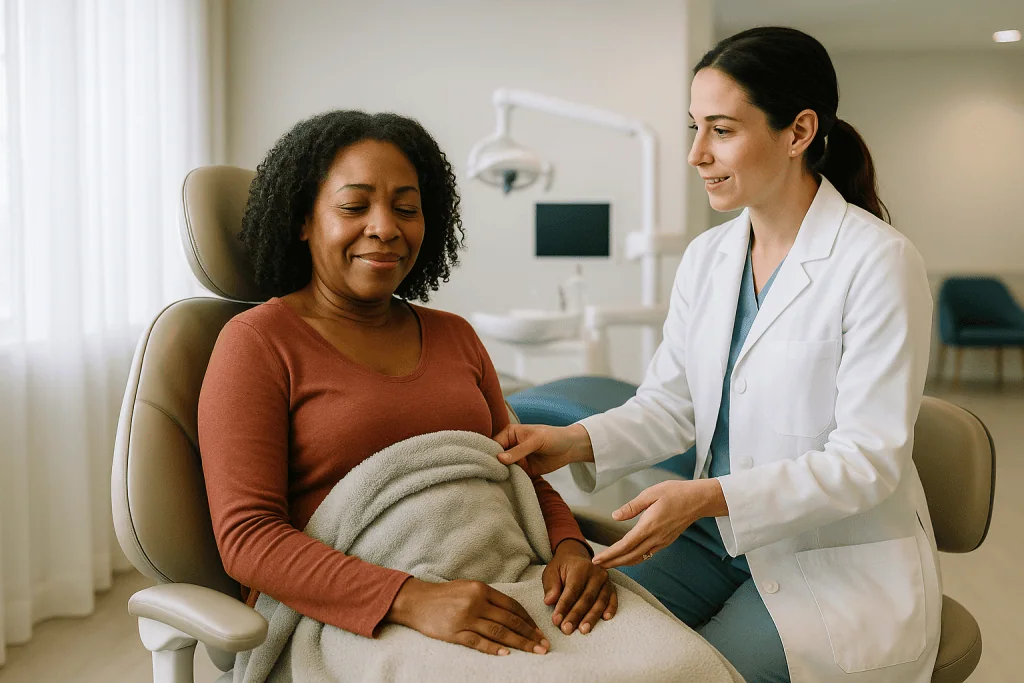
On arrival, the waiting area is often quieter, and some practices book fearful patients at times when the practice is less busy. You may meet the dentist in a consultation room, sitting upright, fully clothed, with no instruments in sight. This is where you agree on a signal, such as a raised hand, that means stop. A tell-show-do approach is common: the dentist explains what is about to happen, shows you the instrument, then does the step. This technique comes from pediatric dentistry and works for adults too.
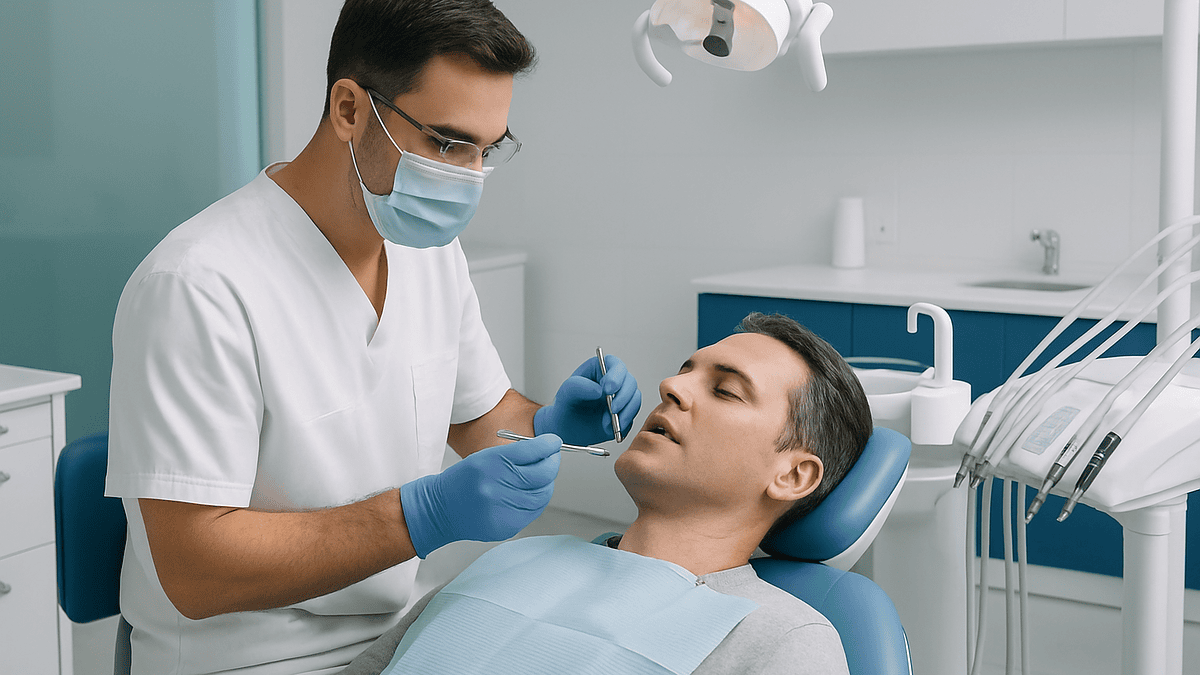
In the chair, the extras appear: a blanket, music, a screen, perhaps a scented eye pillow. The examination proceeds exactly as it would anywhere else. Mayo Clinic describes the standard dental exam as checking teeth for decay, measuring the gum pockets, examining the soft tissues of the mouth and throat, and taking X-rays when indicated. If any of those steps is skipped because you seemed nervous, comfort has slipped into corner-cutting.
Pauses are built in. Many practices offer shorter first visits, sometimes a cleaning only, so trust builds before treatment. Some offer nitrous oxide, a mild inhaled sedative gas, or oral sedation, which is a tablet taken before the visit under the dentist’s direction; both are discussed later. The appointment ends with a debrief, and often a plan for how the next visit will be paced.
Why dental anxiety is a medical issue, not a character flaw
Fear of the dentist is common enough that it deserves plain language. Cleveland Clinic notes that dentophobia, an intense fear of dental care, sits within the broader family of specific phobias, and that a substantial share of adults report some dental fear, with a smaller group avoiding care altogether. The NHS says that around one in three adults experience some anxiety about dental visits. The mechanism is ordinary: the brain tags the sights, sounds, and smells of dentistry as threatening, and the body responds with a faster heartbeat, sweating, and muscle tension, sometimes before the appointment even begins.
Avoidance is where the harm accumulates. Skipping visits lets small problems grow. A cavity that would have needed a simple filling becomes a root canal; early gum inflammation, called gingivitis, progresses toward periodontitis, which is infection that damages the bone anchoring the teeth. Then the person returns in pain, needs a longer and more invasive procedure, and the fear is reinforced. MedlinePlus describes regular check-ups as the way problems are caught while they are still small.
Anxiety also changes the procedure itself. Tense jaw muscles make it harder to keep the mouth open; a heightened startle response makes sudden movements more likely; and pain perception rises when the nervous system is on alert. That is why calming a patient is not indulgence, it is part of doing the work safely.
Framing the fear this way matters for how you read a dental spa’s offer. A practice that treats anxiety as a real clinical variable, asks about it, documents it, and adapts to it, is practicing good medicine. One that treats anxiety only as a reason to upsell amenities has missed the point.
Who a dental spa is usually for, and who is usually asked to wait
Comfort-focused settings tend to help people whose fear is moderate and situational: those who dread the sound of the drill, feel trapped when the chair tilts back, or have simply avoided care for years and want a gentler re-entry. People with a strong gag reflex, sensory sensitivities, or a history of feeling rushed often report the slower pacing as the most useful part. Adults returning after a long gap frequently do well with a first appointment that is conversation and cleaning only.

Some situations call for more than amenities can offer. Severe phobia with panic symptoms usually benefits from psychological treatment, discussed later, alongside or before dental work. Anyone considering sedation needs a medical history review first. Cleveland Clinic lists conditions that require extra caution with sedation, including sleep apnea, significant heart or lung disease, and some medication interactions. In those cases a dentist may refer to a colleague with additional sedation training or to a hospital-based dental service.
Pregnancy is not a reason to skip dental care, and routine cleanings and urgent treatment are generally considered appropriate, but sedation and elective procedures are usually discussed with the obstetric team and often timed for after delivery. Children can benefit from many comfort strategies, particularly tell-show-do and parental presence, though pediatric sedation decisions belong entirely with the treating dentist.
Who is asked to wait? Typically, someone with an active dental infection who needs prompt treatment rather than a paced introduction, and someone whose medical status needs clearance before any sedative is used. Waiting in that context means sequencing, not refusal: urgent care first, comfort-focused routine care afterward. The decision about pathway always sits with the treating team, who can see your mouth and your medical history together.
Comfort extras versus clinical essentials: what should never change
The clearest way to think about a dental spa for anxious patients is to separate what is optional from what is not. Comfort features are negotiable; clinical standards are not. The table below sets them side by side.
| Element | Comfort feature (optional) | Clinical essential (non-negotiable) |
|---|---|---|
| Environment | Music, aromatherapy, warm blankets, ceiling screens | Sterilized instruments, surface disinfection between patients, single-use items where indicated |
| Communication | Consultation lounge, longer slots | Full medical and medication history, informed consent, agreed stop signal |
| Examination | Paced or split visits | Decay check on every tooth, gum pocket measurements, soft-tissue and oral cancer screening, X-rays when indicated |
| Sedation | Offered as a comfort option | Pre-sedation assessment, monitoring of vital signs, trained staff, emergency equipment |
| Aftercare | Follow-up call, comfort kit | Written instructions, clear route for urgent contact |
The middle column can be trimmed to nothing and you would still receive safe dentistry. The right-hand column cannot be trimmed at all. Mayo Clinic’s description of a dental exam is a useful checklist: if your visit included a gum check, a look at the tongue, cheeks, and throat, and a discussion of whether X-rays were due, the essentials were covered. If the appointment was pleasant but you cannot recall any of those, ask.
One more distinction worth holding onto: a practice that says no is often demonstrating quality. A dentist who declines to skip X-rays because you are nervous, or who insists on a medical review before sedation, is protecting you, not spoiling the mood.
Sedation dentistry for anxiety: what the options involve
Sedation dentistry means using medicines to lower anxiety and awareness during dental treatment while you remain breathing on your own. It is a spectrum, and Cleveland Clinic describes the usual levels. What follows is mechanism and typical timelines only; whether any of it is appropriate for you is a decision for the dentist and, where relevant, your physician.
Nitrous oxide is a mild sedative gas breathed through a small mask over the nose. It works within minutes, produces a relaxed, sometimes slightly floaty feeling, and because it is cleared quickly through the lungs, its effects fade soon after the mask is removed. Cleveland Clinic notes that most people can drive themselves home afterward, which makes it the most commonly used option for routine visits.
Oral sedation uses a medicine, typically from the benzodiazepine class, taken before the appointment as directed by the dentist. It slows activity in the brain’s fear circuits and produces drowsiness. Because it lingers longer, you will need someone to drive you home, and Cleveland Clinic advises against driving for the rest of the day.
Intravenous sedation delivers medicine through a vein, allowing the clinician to adjust the level during treatment. It requires additional training, continuous monitoring of heart rate, oxygen levels, and blood pressure, and an escort home. General anesthesia, where you are fully unconscious, is usually reserved for complex surgery or specific medical needs and typically happens in a hospital setting.
Every level carries risks, including breathing suppression, nausea, and interactions with other medicines, which is why the pre-sedation medical review exists. Sedation does not treat the fear itself; it makes a given appointment tolerable. Many clinicians pair it with the non-drug approaches in the next section so that reliance can reduce over time.
How to overcome dental anxiety without medication: what the evidence supports
The most durable dental fear treatment options are psychological, and they have a stronger evidence base than any amenity. Cognitive behavioral therapy, or CBT, is a structured talking therapy that helps you identify the thoughts driving fear and test them against experience. The NHS highlights CBT as an effective approach for dental phobia, and it is often delivered over a small number of sessions. Some dental services now employ psychologists or trained dental staff for this purpose.
Graded exposure sits inside CBT and also works on its own. You approach the feared situation in steps: sitting in the waiting room, then the chair, then having a mirror placed in your mouth, then a cleaning. Each step is repeated until the anxiety falls before moving on. This is essentially what a well-run dental spa does when it offers a first visit with no treatment, whether or not anyone calls it exposure.
Breathing and muscle relaxation are simpler and immediately available. Mayo Clinic describes slow diaphragmatic breathing and progressive muscle relaxation as techniques that dampen the body’s stress response, lowering heart rate and muscle tension. Practicing at home first means the skill is ready when the chair tilts back. A useful pattern is to breathe out slowly for longer than you breathe in, which nudges the nervous system toward calm.
Distraction has modest but real value. Music through headphones, a film on a ceiling screen, or a hand-held object to squeeze can occupy attention that would otherwise track every sound. Hypnosis and acupuncture are sometimes offered; the evidence for them in dental anxiety is limited and mixed, so treat them as optional extras rather than proven treatments. Rebuilding trust with one consistent clinician remains, in most people’s accounts, the thing that changes fear most.
Does a dental spa for anxious patients cut corners? How to check
The question in the title deserves a direct answer: it can, but the risk comes from the individual practice, not the concept. Amenities cost money and time, and a practice under pressure could theoretically shorten clinical steps to make room. The reassurance is that the essential steps are visible if you know what to look for.
Start with infection control, which is the same in every setting. Instruments should come out of sealed sterilization pouches opened in front of you. Staff should change gloves between tasks and wear masks and eye protection during treatment. Surfaces you can see, including the chair, light handles, and tray, should be wiped or covered between patients. The CDC sets infection-control expectations for dental settings, and no scented candle changes them.
Look next at the examination. A thorough check involves the dentist looking at each tooth, running a probe around the gum line and calling out or recording numbers, lifting your tongue, and feeling the sides of your neck. X-rays should be discussed in terms of your risk and the time since your last set, not skipped because you would rather not. Mayo Clinic notes that X-ray frequency depends on individual factors, so a blanket promise of no X-rays is a warning sign rather than a kindness.
Then consider how treatment is proposed. A plan that emphasizes cosmetic procedures over addressing decay or gum disease deserves scrutiny. A dentist who explains findings, offers alternatives including doing nothing for now, and does not pressure you toward same-day decisions is behaving as guidelines expect. Finally, notice how sedation is handled. A medical history that is read and discussed, monitoring equipment on the counter, and clear instructions about escorts and eating beforehand all indicate that comfort is being delivered safely. Their absence suggests the reverse.
What the days and weeks after a comfort-focused visit usually look like
For a visit without sedation, the aftermath is the same as any dental appointment. A cleaning may leave gums slightly tender for a day or so, especially if it was your first in years and there was tartar to remove. A filling with local anesthetic, the numbing injection, typically leaves the lip or tongue numb for a couple of hours, and you will be asked to avoid chewing on that side until sensation returns to prevent biting yourself.
After nitrous oxide, Cleveland Clinic notes that the gas clears rapidly and most people resume normal activity the same day. After oral or intravenous sedation, expect drowsiness and patchy memory of the appointment for several hours; you should not drive, operate machinery, sign important documents, or care for dependants alone until the next day, and someone should stay with you for the first few hours. Mild nausea or a headache can occur and usually passes.
The more interesting timeline is psychological. Many people describe the first successful visit as a turning point, but fear rarely disappears in one appointment. Graded exposure works through repetition, so the second and third visits, ideally with the same clinician, are where confidence consolidates. Booking the next appointment before leaving, while the relief is fresh, is a practical way to avoid the drift back into avoidance.
Home care in the following weeks is where the long-term payoff lies. The NHS advises brushing twice daily with fluoride toothpaste for about two minutes and cleaning between the teeth daily. MedlinePlus recommends regular check-ups, commonly every six months though your dentist may suggest a different interval based on your risk. If a treatment plan was agreed, the schedule for those visits should be written down, along with who to contact if pain or swelling develops in between.
What people often get wrong about dental spas and dental fear
The first misconception is that comfort features are a substitute for treating anxiety. They are not. A warm blanket lowers the sensory temperature of a visit; it does not change the beliefs that make the visit frightening. The approaches with lasting evidence are CBT, graded exposure, and a trusting clinical relationship, and the NHS points fearful patients toward those rather than toward amenities.
The second is the reverse error: assuming that anything pleasant must be unserious. Plenty of thorough, evidence-driven dentists work in calm, well-designed rooms. Decor is not a proxy for competence in either direction.
Third, many people believe sedation means being unconscious. Most dental sedation is conscious sedation: you can respond to instructions, breathe on your own, and often remember parts of the visit. Cleveland Clinic describes general anesthesia as the exception, reserved for particular cases.
Fourth is the idea that a dentist will judge you for years of avoidance or the state of your teeth. Dental professionals see neglected mouths daily, and the fact that you have arrived is the part that matters clinically. A practice that shames patients is failing a basic standard; a good one will say so out loud.
Fifth, people assume the fear itself is childish. Dental anxiety in adults is often traceable to a specific bad experience, sometimes decades old, and phobias are recognized medical conditions. Treating fear as legitimate is what makes it treatable.
Finally, a common belief is that if you can just get through one visit under sedation, the problem is solved. Sedation is a bridge. Without some work on the fear, the next appointment starts from the same place. The useful goal is care you can tolerate with progressively less help, not care you never remember.
Is a dental spa worth it? Weighing comfort against evidence
Here is an opinion, grounded in what the evidence actually shows. The features that help anxious patients most are not the ones on the amenities list. They are time, predictability, and control: a clinician who explains, who agrees a stop signal and honors it, who breaks treatment into manageable visits, and who does the same thorough examination for a frightened patient as for a relaxed one. Those things can exist in a plain room and can be absent in a beautiful one.
That said, sensory comfort is not nothing. For people whose triggers are specifically the sounds and smells of dentistry, headphones and a pleasant environment lower the baseline enough that breathing techniques can work. And the mere fact that a practice advertises itself as anxiety-aware signals that the team has thought about the problem, which often correlates with better communication.
The real test is what happens when comfort and clinical need pull in different directions. You would rather skip X-rays; the dentist explains why they are due and offers to take them at the next visit if you prefer, but does not simply drop them. You would like sedation for a cleaning; the dentist explores whether nitrous oxide or a paced non-sedated visit might serve you as well, and reviews your medical history before agreeing to anything. A practice that handles those moments with honesty rather than accommodation is offering comfort care without cutting corners.
So the answer to the title is conditional. A dental spa is right for an anxious patient when the comfort is added to complete care, the fear is addressed as a treatable condition, and the team is as willing to say no as to say yes. If those conditions are met, the decor is a bonus. If they are not, no amount of lavender will compensate.
Questions to ask your care team before booking
A short conversation before the first visit reveals more than any website. These questions are neutral and any well-run practice will welcome them.
- How do you adapt a first appointment for someone who is very anxious, and can the first visit be a conversation and examination only?
- Will I see the same dentist and hygienist at each visit, so that trust can build?
- What signal can I use to pause, and how will the team respond when I use it?
- Which parts of the standard examination, including gum measurements, soft-tissue screening, and X-rays, will be done at my visit, and how do you decide when X-rays are due?
- What sedation options do you offer, who administers and monitors them, what training does that person hold, and what medical information do you need from me first?
- If sedation is used, what are the instructions about eating, escorts, and the rest of the day?
- Do you offer or refer for psychological support such as CBT or graded exposure for dental fear?
- How do you sterilize instruments, and can I see the pouches opened at the chair?
- If I need treatment beyond what you provide, how does referral work?
- How do I reach someone if I have pain, swelling, or bleeding after a visit?
Notice how the answers are given as much as what they contain. A team that answers patiently, without pressure to book a package or commit to a treatment plan on the spot, is showing you how they will behave in the chair. Write the answers down; anxiety makes recall unreliable, and having them in front of you before the appointment is itself a small act of control.
When to call your doctor or dentist
Comfort-focused care changes the atmosphere of a visit, not the medical realities around it. Some situations need prompt attention regardless of how relaxed the appointment felt.
Contact your dentist or, if unavailable, a doctor or urgent care service if you notice any of the following after treatment: swelling of the face, jaw, or neck that is increasing; difficulty swallowing or breathing; a fever with facial pain; bleeding from an extraction site that does not slow with firm pressure on a clean gauze pad; severe pain not eased by the measures your dentist advised; or numbness from a local anesthetic that persists well beyond the expected few hours. MedlinePlus notes that untreated dental infection can spread, and swelling near the airway is a medical emergency that warrants emergency services.
After sedation, seek urgent help for persistent vomiting, confusion that is not clearing, chest pain, a slow or irregular pulse, or breathing that seems shallow or labored. The person accompanying you home should know these signs.
Between visits, do not wait for the next scheduled appointment if you develop a toothache that keeps you awake, a tooth that becomes loose, a persistent mouth ulcer that has not healed after three weeks, a lump in the mouth or neck, or bleeding gums accompanied by bad breath and receding gum tissue. These are reasons to be seen, not reasons to feel embarrassed.
If your anxiety itself is causing panic attacks, sleep loss, or avoidance of all healthcare, speak with your primary care doctor. Dental phobia is treatable, and a referral for psychological support can run alongside dental care. Every decision about investigation, treatment, and sedation rests with the clinicians who can examine you; this article is context, not a substitute for that assessment.
Making the decision: a practical path for anxious patients
If you have read this far, you are probably closer to booking than you were. A workable sequence, drawn from the guidance already cited, looks like this.
Begin by naming the fear to yourself and, ideally, in writing. Is it pain, loss of control, embarrassment, the sounds, a past event? The NHS suggests telling the dental team exactly this, because the adaptations differ. Fear of pain points toward careful local anesthesia and possibly nitrous oxide; fear of losing control points toward stop signals and step-by-step narration; fear of judgment points toward a team that explicitly welcomes returning patients.
Next, call two or three practices, including at least one that does not market itself as a spa, and ask the questions from the earlier section. Compare how they respond rather than what they offer. Choose the one where you felt heard.
Book a first visit with no treatment. Practice the breathing pattern Mayo Clinic describes a few times at home. Bring headphones and a playlist even if the practice provides them; familiarity helps. Arrive early enough not to feel rushed.
Afterward, book the next appointment before leaving. If the visit went badly, that is information, not failure; tell the practice, or try another. If it went well, resist the urge to schedule everything at once. Confidence built gradually holds better than confidence borrowed from a single good day.
Consider psychological support in parallel if fear remains high after two or three visits. CBT for dental phobia is time-limited and the NHS describes it as effective for many people. The end point is not a spa or a sedative; it is being able to look after your teeth for the rest of your life with whatever level of help you actually need.
Frequently asked questions
What is a dental spa, in plain terms?
A dental spa is an ordinary dental practice that adds comfort amenities such as music, warm blankets, aromatherapy, and longer appointments on top of standard care. The examinations, treatments, licensing, and infection-control rules are the same as in any other dental office. The label is a marketing description, not a clinical category, so it does not by itself indicate higher or lower standards.
Is sedation dentistry for anxiety safe?
For most healthy adults, dental sedation supervised by a trained clinician with monitoring is considered low risk, but every level carries some risk, including breathing suppression, nausea, and medication interactions. Cleveland Clinic notes that conditions such as sleep apnea and heart or lung disease require extra caution. A full medical history review beforehand is essential, and the decision belongs with the dentist and, where relevant, your physician.
How can I overcome dental anxiety without medication?
The approaches with the best evidence are cognitive behavioral therapy, graded exposure, and slow controlled breathing. The NHS points to CBT as effective for dental phobia, and Mayo Clinic describes breathing and muscle relaxation techniques that lower the body’s stress response. Telling your dental team about the fear and agreeing a stop signal also reduces anxiety by restoring a sense of control.
Will a dentist judge me for avoiding care for years?
A competent dental team will not. Neglected mouths are an everyday part of dental practice, and clinicians know that fear is the usual reason for long gaps. If you encounter shaming language, that reflects poorly on the practice, not on you. Many anxiety-aware practices explicitly welcome returning patients and offer a first visit that is conversation and examination only.
Does a dental spa skip X-rays or gum checks to keep patients comfortable?
It should not, and a practice that promises no X-rays as a comfort feature is raising a warning sign rather than offering kindness. Mayo Clinic describes X-ray frequency as depending on individual risk and time since the last set. Gum measurements, soft-tissue screening, and a decay check on every tooth are part of any complete examination regardless of the setting.
Can I drive home after nitrous oxide?
Usually yes. Cleveland Clinic notes that nitrous oxide clears from the body within minutes of the mask being removed, and most people can drive themselves home. This is different from oral or intravenous sedation, after which you must not drive for the rest of the day and need someone to accompany you home. Follow your own dentist’s instructions.
What dental fear treatment options exist beyond a spa setting?
Options include cognitive behavioral therapy, graded exposure, hypnosis, distraction techniques, nitrous oxide, oral or intravenous sedation, and for selected cases general anesthesia in a hospital setting. Psychological approaches address the fear itself, while sedation makes individual appointments tolerable. Many clinicians combine both so that reliance on sedation can decrease over time. Your dentist or doctor can refer you for psychological support.
Is a dental spa suitable for children with dental fear?
Many comfort strategies suit children well, particularly tell-show-do explanations, parental presence, distraction, and short first visits. Amenities such as screens can help. Any sedation decision for a child rests entirely with the treating dentist after a medical review, and some children are referred to pediatric specialists. The most useful preparation is calm, honest language at home without describing the visit as scary.
Can I have dental treatment at a dental spa during pregnancy?
Routine dental care and urgent treatment are generally considered appropriate during pregnancy, and keeping gums healthy matters because pregnancy hormones can increase gum inflammation. Sedation and elective procedures are usually discussed with the obstetric team and often deferred until after delivery. Tell the dental team about the pregnancy so that X-rays and medicines can be planned accordingly.
How often should an anxious patient see the dentist?
MedlinePlus describes regular check-ups, commonly every six months, though your dentist may recommend a longer or shorter interval depending on your risk of decay and gum disease. For anxious patients, more frequent shorter visits early on can build confidence through repetition, which is how graded exposure works. Booking the next appointment before leaving helps prevent drifting back into avoidance.
References
This article is for general information only and is not a substitute for professional medical advice. Please consult a qualified doctor about your individual situation.

More from the Blog
Simple vs Surgical Tooth Extraction: How the Two Procedures and Recoveries Differ
A simple extraction removes a tooth that is fully visible above the gum, using an elevator and forceps, and usually heals within days. A…
Root Canal Recovery: What the First Days Feel Like and When to Check In
Most people recover from a root canal within a few days. Mild soreness or tenderness when biting typically peaks in the first 24 to…
Simple vs Surgical Wisdom Teeth Removal: How the Approach Depends on the Tooth’s Position
A simple wisdom tooth extraction is used when the tooth has fully erupted and can be loosened and lifted out with hand instruments. A…
How Long Does Dental Numbness Last? Anesthetics, Timelines and Safe Waiting
Numbness from a routine dental injection usually lasts two to five hours in the lips and cheek, while the tooth itself often regains feeling…
Tooth Decay Treatment Visit: Numbing, Removing Damaged Tissue and Restoring the Tooth
A cavity treatment procedure usually has three steps: the dentist numbs the area with a local anesthetic, removes the softened, decayed part of the…

How a Smile Makeover Is Planned: Photographs, Digital Impressions and Smile Design
A smile makeover is planned in stages: a dental health examination first, then a set of standardized photographs, a digital scan of the teeth,…