

Is Arm Liposuction Enough for Your Upper Arms? Skin Elasticity and the Pinch Test Explained
Key Takeaways
- Liposuction removes fat but does not remove or dependably tighten skin, so on the upper arm the final shape is decided by how the skin contracts afterward.
- The pinch test combines a fold-thickness check for fat with a recoil check for skin elasticity, and together they predict whether skin will follow the new contour.
- Mayo Clinic notes liposuction is generally considered for people within about 30 percent of ideal weight with firm, elastic skin, and that poor elasticity can leave treated skin looking loose.
- A skin-dominant arm, where tissue hangs well beyond the fat, is usually matched to an arm lift rather than suction, because removing volume there can make the hang more visible.
- Fat cells removed by liposuction do not return, but remaining cells throughout the body enlarge with weight gain, so a stable weight protects the result.
- Sudden shortness of breath, chest pain, confusion or calf pain after liposuction are emergencies that can signal a clot or fat embolism and need immediate care.
Arm liposuction is usually enough when upper-arm bulk is mostly fat and the overlying skin is still elastic enough to shrink back once that fat is removed. Surgeons estimate this with a pinch test and by watching how the skin recoils. When skin is thin, loose or hangs well beyond the fat, liposuction alone may leave laxity, and an arm lift, alone or combined, is often discussed instead.
The moment usually arrives in a fitting room. A sleeveless dress fits everywhere except the place you notice when you raise your arm to reach the hanger, and the underside of the upper arm keeps moving a half-second after the rest of you has stopped. You lower the arm, choose the version with sleeves, and later that night type a search that ends with the word candidate.
Whether you are a reasonable arm liposuction candidate is a narrower question than it sounds. Liposuction removes fat. It does not remove skin, and it does not tighten skin in any dependable way. So the real question a surgeon is answering when they take your arm in their hands is not how much fat is there, but what the skin will do once that fat is gone.
That is why so much of an upper-arm consultation looks oddly low-tech: a pinch, a gentle pull, a pause to watch. This article explains what those few seconds reveal, and why they matter more than any device in the room.
What does "arm liposuction candidate" actually mean?
In clinical shorthand, a candidate for any elective procedure is someone for whom the likely benefit outweighs the likely harm, and for whom the procedure can realistically deliver what the person is hoping for. For the upper arm, that second half does most of the work. Liposuction reliably reduces the volume of fat beneath the skin. Whether the arm then looks slimmer and smoother depends on tissue the cannula never touches.
Mayo Clinic frames the general profile plainly: liposuction is typically considered for people close to a stable, healthy weight, with firm, elastic skin and pockets of fat that have not responded to diet and exercise, and it is not a treatment for obesity or a way to lose weight. The same page notes that when skin elasticity is poor, liposuction can leave the treated area looking loose rather than contoured.
Translate that to the arm and you get three layered questions a surgeon is asking at once:
- Is the fullness mainly fat, or mainly skin that has stretched and stayed stretched?
- If it is fat, will the skin above it contract enough to follow the new shape?
- Is the person medically well enough for a procedure that involves anesthesia, fluid shifts and a healing period?
Notice that none of these can be answered from a photograph or a weight on a scale. A slim marathon runner in their sixties may be a poor arm liposuction candidate because their skin has lost recoil, while a heavier person in their thirties with thick, springy skin may be a straightforward one. Age, sun exposure, past weight fluctuations and genetics all feed into skin quality, which is why the assessment is done by hand, on the day, with the arm in several positions.
Keep that framing in mind as you read on. Every section that follows is really a way of answering the same question: enough for what, in whose arm?
Why upper arms behave differently from bellies and thighs
The abdomen forgives. It has a relatively thick skin envelope, a broad surface for fat to spread across, and it sits against a firm wall of muscle. Suction out fat there and the skin has a fair chance of settling flat. The upper arm is a different animal.

Look at the back of your own arm with it held out at shoulder height, palm facing the floor. The tissue that concerns most people sits along the posterior and inner surface, between the elbow and the armpit. Skin here is relatively thin and only loosely anchored to the muscle beneath. It hangs from a cylinder rather than lying over a flat plane, so gravity acts along its whole length whenever the arm is lifted. There is also a natural fold where the arm meets the chest wall, and loose tissue tends to gather toward it.
Fat in this region is usually a single, fairly superficial layer rather than the deep and superficial compartments seen in the trunk. That makes it accessible, but it also means there is little cushioning between the cannula, the skin and the structures below. Contour irregularities, which Mayo Clinic lists among liposuction’s recognized complications, show more readily on a thin-skinned cylinder than on a padded abdomen.
Two more anatomical points shape the conversation. First, the arm carries important nerves and veins close to the surface on its inner side, so surgeons tend to be conservative there. Second, the arm moves constantly and in every direction, which affects how swelling drains, how compression garments fit and how quickly healing tissue is stretched.
None of this makes the arm a bad place to treat. It simply means the margin between a pleasing result and a disappointing one is narrower, and that skin behavior, not fat volume, sits at the center of the decision.
How arm liposuction works: what actually happens in the room
Liposuction is the removal of fat through a thin hollow tube called a cannula, connected to suction. That single sentence covers a procedure that, in practice, has a few distinct stages.
Before anything is removed, the surgeon usually infuses the area with a large volume of dilute fluid. This is the tumescent technique, a term that simply means the tissue is swollen with liquid. The fluid typically contains a local anesthetic to numb the area and a medicine that narrows blood vessels to limit bleeding and bruising. MedlinePlus and Mayo Clinic both describe this as the most common approach for body contouring. The fluid firms up the fat so it can be broken apart and drawn out more evenly, which matters a great deal on a curved, thin-skinned arm.
Depending on how much tissue is being treated and the person’s health, the procedure is done under local anesthesia with sedation or under general anesthesia. That choice belongs to the anesthesia and surgical team, not to a checklist.
Small incisions, often placed near the elbow crease or toward the armpit, allow the cannula to pass through the fat in overlapping tunnels. Some surgeons use additional energy sources, such as ultrasound or laser, to loosen fat before suction. Mayo Clinic notes these variations exist; the evidence that any one of them reliably tightens arm skin more than another is limited, and a cautious reader should treat marketing claims to the contrary with skepticism.
What liposuction does not do is worth stating just as clearly. It does not remove skin. It does not repair stretched connective tissue. It does not change muscle. Mayo Clinic is explicit that liposuction will not improve cellulite or other surface irregularities, and that when skin has poor elasticity it may look loose afterward. In other words, the procedure changes what is under the skin and then waits to see how the skin responds, which brings us to elasticity.
Arm liposuction skin elasticity: the variable that decides the result
Elasticity is skin’s ability to return to its original shape after being stretched. Think of the difference between a new hair tie and one that has been through the wash a hundred times. Both still hold; only one snaps back.
That recoil comes from two proteins in the dermis, the skin’s middle layer. Collagen provides structure, and elastin provides the spring. Both decline with age, both are damaged by ultraviolet light, and both are strained by repeated cycles of weight gain and loss. Smoking accelerates the loss. Genetics sets the starting point. None of these can be measured precisely in a clinic, but their combined effect can be observed.
Why does this decide the outcome of arm liposuction rather than merely influence it? Because the procedure creates a deficit. Fat is removed, and a skin envelope that was sized for the old volume now covers a smaller one. Skin with good elasticity contracts over the following weeks and months, following the new contour. Skin with poor elasticity does not; it drapes. Mayo Clinic’s plain warning that poor skin elasticity can leave liposuctioned skin looking loose describes exactly this mechanism.
The arm makes the stakes higher than elsewhere for reasons covered above: the skin is thin, it hangs, and it is on display every time you lift your hand. A modest amount of laxity that would vanish beneath a waistband is visible at a wave goodbye.
Skin quality is not a verdict on anyone’s habits or age. It is a physical property, like eye color or shoe size, that helps match the right procedure to the right arm. People with reduced elasticity are not being turned away from improvement; they are being pointed toward a different tool, usually one that addresses skin directly. Recognizing that early spares a person the frustration of paying twice, in recovery time, for a result the first procedure was never able to deliver.
The arm lipo pinch test explained: what your surgeon is checking
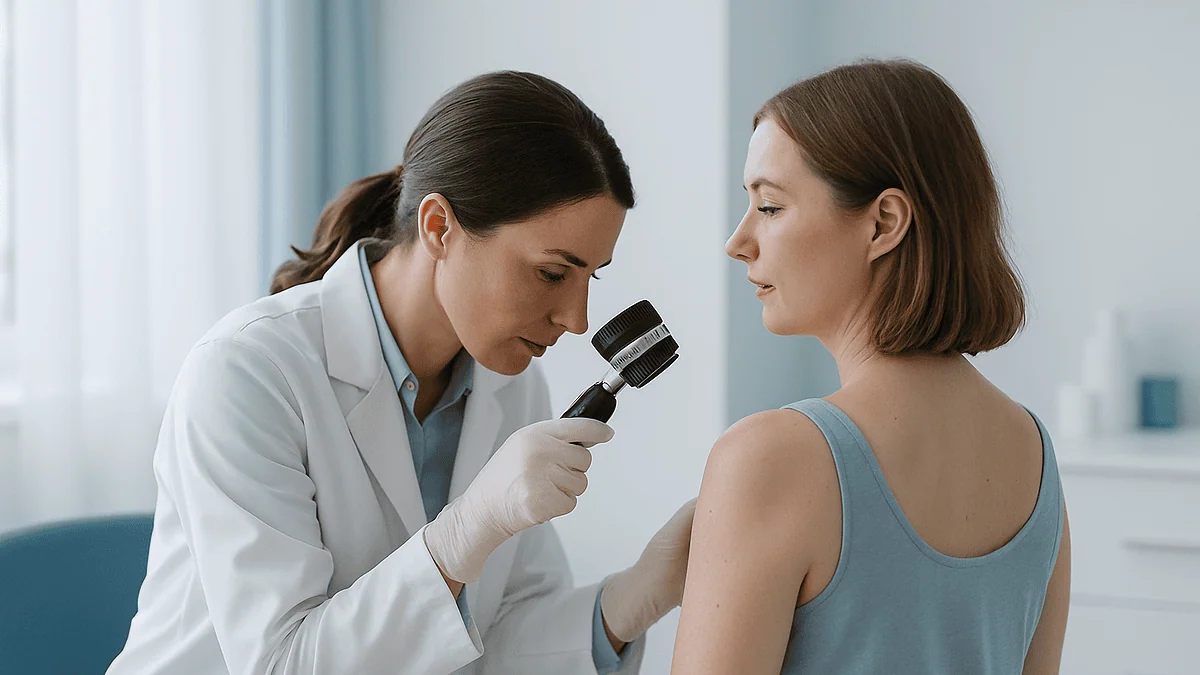
Ask a body-contouring surgeon to assess your arms and the first thing they will probably do is reach for them. The pinch test has no instrument, no screen and no reading. It is a series of small manual checks, and it tells the examiner more than most imaging could.
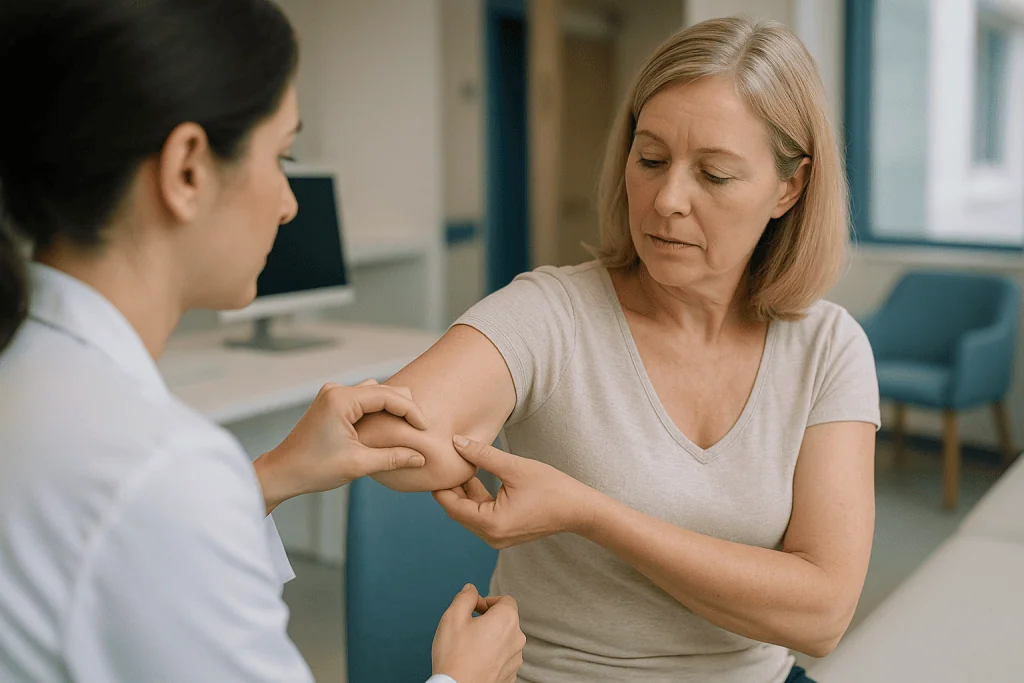
The first pinch measures fat. With the arm relaxed and out to the side, the surgeon lifts a fold of skin and underlying tissue between thumb and fingers along the back of the arm. A thick fold means there is a meaningful layer of fat to remove; a thin fold means the fullness is coming from somewhere else, usually skin.
The second maneuver assesses skin. The surgeon gently pulls the skin away from the arm, holds it a moment, then releases it and watches. Skin that snaps back promptly has retained elastin and is likely to contract after fat removal. Skin that returns slowly, or sits in a soft tent before subsiding, has less recoil. Fine surface wrinkling that appears when the skin is pushed together is another sign of a thinned dermis.
The third check is the arm at shoulder height, then overhead. The surgeon looks at how far the tissue hangs below the line of the bone, where the excess gathers, and whether it extends onto the side of the chest. Some also lift the excess upward to simulate what a lift would achieve, so you can see the difference between removing fat and removing skin.
Put together, these give a rough picture that can be summarized in one question: if the fat were gone tomorrow, would this skin follow? A thick fold with brisk recoil suggests yes. A thin fold with slow recoil suggests no. Most arms land somewhere in between, which is why the examination leads into a conversation about trade-offs rather than a simple pass or fail.
Three kinds of upper arms, and why the fix differs
Surgeons tend to sort upper arms into broad patterns based on what the pinch test shows. The labels vary; the logic does not.
The fat-dominant arm has a generous fold, skin that recoils well, and little or no hang beyond the fat itself when the arm is raised. This is the arm liposuction was designed for. The skin is expected to contract to the new shape over the months that follow, and no incision beyond the small access points is needed.
The skin-dominant arm has a thin fold and a clear curtain of tissue hanging below the bone when the arm is lifted, often reaching toward the elbow or onto the chest wall. Much of what looks like bulk is redundant skin. Liposuction here removes little fat and may worsen the hang by taking away the small amount of volume that was filling the envelope. Skin excision, an arm lift, is the operation that addresses this pattern.
The mixed arm has both a meaningful fat layer and moderate skin laxity. This is the largest and hardest group. Options include liposuction alone with an honest expectation of some remaining looseness, an arm lift alone, or liposuction combined with a lift so that fat is thinned and skin is tightened in one operation. Where the excess is concentrated matters: laxity near the armpit can sometimes be handled with a shorter scar hidden in the fold, while laxity along the whole arm generally requires a longer incision.
The point of sorting is not to fit you into a box. It is to make sure the procedure being discussed is aimed at the tissue that is actually causing the problem. A person with a skin-dominant arm who undergoes liposuction alone has not had a failed operation; they have had the wrong one for their anatomy, and the pinch test exists to prevent exactly that mismatch.
Who is usually a good arm liposuction candidate, and who is asked to wait
Drawing on Mayo Clinic’s general criteria and applying them to the arm, the profile most surgeons look for includes:
- A weight that has been stable for some months, so the result is not undone by later change. Mayo Clinic notes that people considered for liposuction are usually within about 30 percent of their ideal weight.
- Localized fat along the back or inner upper arm that persists despite reasonable diet and activity.
- Skin that passes the recoil test described above.
- Good general health, without conditions that impair healing or raise anesthesia risk, such as poorly controlled diabetes, heart disease or clotting disorders.
- Not smoking, because nicotine narrows blood vessels and slows wound healing.
- Realistic expectations: a slimmer contour, not a different arm.
People who are usually asked to wait, or to consider something else, fall into a few groups. Those actively losing or gaining weight are often advised to reach a plateau first, since fat removed now sets nothing in stone if the rest of the body changes. Those with the skin-dominant pattern are guided toward a lift rather than being scheduled for suction that will not help. Anyone with an uncontrolled medical condition is referred back to their physician, because elective surgery should not be the setting where a health problem is discovered.
Pregnancy and breastfeeding are reasons to postpone. So is a recent significant illness. Some surgeons ask people with a history of blood clots, or who take medicines that affect bleeding, to have a preoperative discussion with the prescribing clinician; any change to a prescribed medicine is that clinician’s call, never the patient’s alone and never the surgeon’s without coordination.
Being asked to wait is not a rejection. In elective surgery, the decision to operate is a shared one, and the treating team’s willingness to say not yet is one of the clearer signs that they are weighing your interests rather than their schedule.
Arm liposuction vs arm lift: a side-by-side
An arm lift, or brachioplasty, is an operation that removes excess skin and some fat from the upper arm through an incision, then re-drapes the remaining skin more tightly. Liposuction removes fat through small punctures and leaves the skin to contract on its own. The two are frequently combined. Here is how they compare on the questions people actually ask.
| Question | Arm liposuction | Arm lift (brachioplasty) |
|---|---|---|
| What it removes | Fat only | Skin, plus fat as needed |
| Best matched to | Fat-dominant arm with good skin recoil | Skin-dominant arm with hanging tissue |
| Incisions | Small punctures near elbow or armpit | Longer incision, often along the inner arm or hidden in the armpit fold |
| Visible scar | Minimal | Permanent scar whose length depends on the pattern of laxity |
| Effect on loose skin | Limited; may worsen laxity if skin is poor | Directly tightens |
| Anesthesia | Local with sedation or general, per the team | Usually general |
| Typical early recovery | Mayo Clinic: a few days off work, a few weeks before full activity | Generally longer, with incision care and more activity limits |
| Main trade-off | Result depends on skin behavior | Scar in exchange for tightness |
The table makes the central trade-off visible. Liposuction offers minimal scarring but asks the skin to do part of the work. A lift guarantees nothing about the final shape either, but it does not rely on skin contraction, and it pays for that certainty with a scar that some people find acceptable and others do not.
Neither column is superior. A person with excellent skin who chose a lift would carry a scar they did not need; a person with hanging skin who chose liposuction would recover from an operation that could not reach their concern. The pinch test is how the team decides which column you are reading.
Loose skin after arm liposuction: how it happens and what shapes it
The most common disappointment after arm liposuction is not that fat remains. It is that the arm is thinner but looser. Understanding why helps you judge, before surgery, how likely that is for you.
When fat is removed, the skin envelope becomes temporarily oversized. Over the following weeks, swelling fills some of that space, which is why arms often look tight and smooth early on. As swelling drains, the true relationship between skin and the new volume emerges. Skin with good elasticity has been quietly contracting during this time, and the two meet. Skin with poor elasticity has not, and a gap appears as drape, softness or fine wrinkling.
Several factors push the odds one way or the other:
- Baseline skin quality, assessed by recoil on the day.
- How much fat is removed. Taking more creates a larger deficit for the skin to close.
- How evenly it is removed. Leaving a thin, uniform layer under the skin gives it something to settle against; over-thinning invites both looseness and irregularity.
- Age and sun history, which shape collagen and elastin.
- Weight stability afterward. Mayo Clinic notes that remaining fat cells enlarge with weight gain, and repeated stretching does skin no favors.
A skilled team manages the second and third points; the others are yours before you ever walk in. This is why a surgeon who suggests removing less than you hoped, or who steers a mixed arm toward a combined procedure, is often protecting you from the outcome described here.
If laxity does appear, it is rarely dangerous. It is a cosmetic result that did not match the goal, and it can usually be discussed with the same team once swelling has fully settled, which NHS guidance suggests can take up to six months. Deciding whether to accept it, or to consider a skin-tightening operation later, is a conversation, not an emergency.
What the first days and weeks usually look like
Timelines below are typical ranges drawn from Mayo Clinic, MedlinePlus and NHS patient information. Your team’s instructions override anything written here.
The first two or three days are dominated by swelling, bruising and a deep ache along the treated arm. Fluid from the tumescent infusion may leak from the small incisions for a day or so; this is expected and is usually managed with absorbent dressings. Most people are fitted with a compression garment before leaving, a snug elastic sleeve that supports the tissue, limits swelling and encourages the skin to settle. Mayo Clinic describes wearing such garments for a few weeks.
Movement is encouraged early. Gentle walking and normal use of the hands help circulation and reduce the risk of blood clots, a recognized complication of any procedure involving anesthesia and reduced mobility. Heavy lifting, vigorous exercise and anything that swings the arms hard are usually restricted for longer.
Mayo Clinic notes that people often return to desk-type work within a few days and to full activity, including exercise, within a few weeks. The arm is unusual in one respect: it is hard to rest. Reaching, dressing and driving all involve it, so people frequently report the first week feeling more limiting than they expected.
Bruising tends to fade over two to three weeks. Numbness or altered sensation over the treated skin is common and, per Mayo Clinic, is usually temporary, though it can occasionally persist. Firmness or small lumps under the skin often appear as healing tissue forms and typically soften with time and gentle massage if the team recommends it.
The shape you see at two weeks is not the shape you will see at six months. Early swelling can make arms look deceptively smooth; the honest result appears only after it has drained. Photographs taken at fixed intervals, with the arm in the same position, are a fairer record than a mirror check in different light each morning.
What people often get wrong about arm liposuction
Some misunderstandings surface in nearly every consultation. Correcting them changes how people weigh the decision.
“Liposuction tightens skin.” It does not, at least not in any way that can be relied upon. Some contraction happens after fat is removed in people whose skin is already elastic; the procedure reveals elasticity rather than creating it. Mayo Clinic’s caution about loose skin after liposuction in people with poor elasticity is the plain version of this.
“Energy-assisted devices solve the skin problem.” Ultrasound- or laser-assisted liposuction can help break up fat before suction. Claims that they meaningfully tighten arm skin rest on small studies with short follow-up, and mainstream patient guidance does not present them as a substitute for skin removal when laxity is significant.
“Fat comes back somewhere else.” Mayo Clinic explains that fat cells removed by liposuction are gone, but the remaining cells throughout the body enlarge with weight gain. The treated arm keeps its proportional advantage only if weight stays stable. That is not fat migrating; it is ordinary weight gain distributed across whatever cells remain.
“Liposuction is a weight-loss method.” The amount of fat removed in a single session is limited for safety, and Mayo Clinic and NHS both state that liposuction is not a treatment for obesity. It is a shaping tool for localized deposits.
“A thinner arm is always a better-looking arm.” On a thin-skinned cylinder, over-aggressive removal can produce visible waves, depressions or a loose sleeve of skin. Many surgeons deliberately leave a thin, even layer of fat for this reason.
“If the pinch test says no, nothing can be done.” The pinch test says no to one specific tool. Skin-dominant arms are addressed by a different operation, and the person is not less deserving of care because their anatomy points elsewhere.
Each of these corrections points back to the same idea: the procedure is only as good as the match between what it does and what your arm needs.
Risks, in plain clinical language
Liposuction is common, but it is surgery, and the arm’s anatomy makes some risks more relevant than others. The list below reflects complications described by Mayo Clinic, MedlinePlus and NHS.
Contour irregularities. Uneven fat removal, poor skin elasticity or unusual healing can leave the arm bumpy, wavy or asymmetric. On thin arm skin these show readily. Mayo Clinic notes such changes may be permanent.
Fluid collection. A seroma is a pocket of clear fluid that forms under the skin after tissue has been disturbed. Small ones resolve on their own; larger ones may need to be drained with a needle.
Numbness and altered sensation. Temporary numbness is expected. Persistent change, or nerve irritation with tingling and burning, is less common but recognized, and the inner arm is a region where nerves run close to the surface.
Infection. Uncommon, but any incision can become infected. Redness spreading from a puncture, warmth, increasing pain or fever are the usual signs.
Bleeding and bruising. The vessel-narrowing medicine in tumescent fluid limits this, but bruising is universal to some degree and occasionally extensive.
Skin damage. If the cannula passes too close to the surface, or if energy devices are used, skin can be burned or lose blood supply, which may leave discoloration or scarring.
Blood clots and fat embolism. Clots in the leg veins can travel to the lungs after any operation. Separately, Mayo Clinic describes fat embolism, in which loosened fat enters the bloodstream and lodges in the lungs or brain. Both are rare and both are emergencies, with symptoms covered in the red-flag section below.
Anesthesia and fluid-related problems. Large volumes of infused fluid and the local anesthetic within them can, rarely, cause heart, kidney or toxicity problems, which is one reason the amount treated in a session is limited.
Every one of these is discussed during informed consent. If a consultation glosses over them, that is itself useful information.
Alternatives, and what the evidence says about nonsurgical options
Before, or instead of, any operation, it is fair to ask what else changes the shape of the upper arm.
Weight and activity. Fat on the back of the arm is ordinary body fat; it shrinks when overall body fat falls and grows when it rises. Where each person loses first is largely genetic, and the arm is a late responder for many. Resistance exercise builds the triceps muscle beneath, which firms the shape of the arm and can improve how the overlying tissue sits, though it does not remove fat from that specific spot. Anyone weighing surgery is usually advised to reach a stable weight first, both for safety and because it clarifies which tissue is actually left.
Nonsurgical fat reduction devices. Cold-based, heat-based and ultrasound-based devices marketed for fat reduction have evidence of modest fat-layer reduction in small areas. Studies are generally small, industry-sponsored and short in follow-up. They do not remove skin and, like liposuction, may unmask laxity in an arm that is skin-dominant.
Nonsurgical skin tightening. Radiofrequency and ultrasound devices aimed at the dermis are promoted for mild laxity. The honest summary of the evidence is that changes, where measured, are subtle and variable, and no mainstream guideline positions them as an alternative to surgical skin removal when hanging tissue is present. Presenting them as equivalent would be presenting an unproven therapy as effective, which this article will not do.
Doing nothing. This is a legitimate choice. Upper-arm fullness is not a medical condition, carries no health risk in itself, and the decision to treat it rests entirely on how much it matters to you against the recovery, risk and scarring involved.
Arm lift, alone or combined. Covered in the comparison table above, this remains the surgical alternative for skin-dominant and many mixed arms.
A good consultation should walk through this list without steering. If only one option is ever discussed, ask why.
Questions to ask your care team
A consultation goes better when you arrive with questions that get at the mechanism rather than the brochure. These are worth writing down.
- When you pinched my arm, what did you feel? How much of the fullness is fat and how much is skin?
- How did my skin recoil, and what does that suggest about how it will settle after fat is removed?
- Would you describe my arms as fat-dominant, skin-dominant or mixed? What are you basing that on?
- If we do liposuction alone, what degree of loose skin should I realistically expect at six months?
- Do you think an arm lift, or a combined procedure, would match my anatomy better? What would the scar look like and where would it sit?
- How much fat would you plan to remove, and why not more or less?
- Which anesthesia do you recommend for me and who will be administering it?
- Which of the recognized complications are most relevant to my arms and my health history?
- What is your plan if I develop a fluid collection, an irregularity or loose skin?
- How long should I expect to wear compression, and when can I return to work, driving and exercise?
- Are there any medicines or supplements I take that need to be discussed with the clinician who prescribes them before surgery?
- Should I postpone because my weight is still changing, or for any other reason?
- What would make you decline to operate on me?
Listen as much to how the questions are received as to the answers. A team that welcomes the question about declining to operate is showing you that the decision is genuinely shared. Bring a companion if you can; two sets of ears catch more, and the discussion of scars, laxity and trade-offs is easier to weigh afterward when someone else heard it too.
The final decision, including whether to proceed at all, sits with you and the treating team together. No article, including this one, can make it for you.
When to call your doctor
Most recovery after arm liposuction is uncomfortable but uneventful. A small number of symptoms need same-day attention or emergency care, and knowing them beforehand matters more than memorizing every possible complication.
Seek emergency care immediately for any of the following, which can indicate a blood clot in the lungs, fat embolism or a severe reaction:
- Sudden shortness of breath, chest pain or a racing heart.
- Confusion, severe headache, fainting or difficulty speaking.
- Coughing up blood.
- Severe pain, swelling or redness in a calf or thigh, which can signal a clot in the leg.
Call your surgical team the same day for:
- Fever, chills or feeling generally unwell.
- Redness that spreads outward from an incision, increasing warmth, or pus-like drainage.
- Pain that worsens after the first few days rather than easing, or pain that is not controlled by what the team advised.
- Rapidly increasing swelling on one arm, a tense or shiny appearance, or a soft fluid-filled bulge.
- Bleeding that soaks through dressings or does not slow with gentle pressure.
- Numbness, tingling or weakness in the hand or fingers that is new or getting worse.
- Skin over the treated area turning dark, dusky or unusually pale.
For anything that worries you but does not appear above, the right move is still to call. Surgical teams expect these calls in the first weeks and would far rather hear about something minor than learn later that a problem went unreported.
A reminder that applies to every section of this article: nothing here is a diagnosis, a promise or a substitute for the assessment of the clinicians who examine you. The pinch test, the elasticity check and the choice between liposuction and a lift are theirs to interpret, with you, in the room.
Frequently asked questions
How does arm liposuction skin elasticity get assessed without any equipment?
By hand, with a pull-and-release check. The surgeon draws the skin on the back of the arm away from the muscle, holds it briefly and lets go, then watches how quickly it returns. Prompt recoil suggests enough elastin to contract after fat removal; a slow return or a soft tent suggests reduced elasticity. Fine wrinkling when skin is pushed together is another clue. It is an estimate, not a measurement, but it correlates well with how skin behaves afterward.
What is the arm lipo pinch test actually measuring?
Two separate things. Pinching a fold of tissue between thumb and fingers estimates how thick the fat layer is; a generous fold means there is fat to remove. Pulling and releasing the skin tests recoil. Raising the arm to shoulder height shows how much tissue hangs beyond the bone. Together these tell the surgeon whether your arm is fat-dominant, skin-dominant or mixed, which in turn decides whether liposuction alone is likely to help.
Arm liposuction vs arm lift: how do I know which one I need?
The pattern of your tissue decides it, not your preference alone. A thick pinch with brisk skin recoil and little hang points to liposuction. A thin pinch with skin curtaining below the arm when raised points to an arm lift, which removes skin through an incision. Many arms are mixed and may be offered a combined procedure. The trade-off is minimal scarring that depends on skin contraction versus a permanent scar that does not.
How common is loose skin after arm liposuction?
Mainstream patient sources do not give a reliable percentage, and any figure quoted to you should be treated cautiously. What is well established, per Mayo Clinic, is the mechanism: when skin elasticity is poor, liposuction can leave the treated area looking loose. The likelihood for you depends on baseline skin quality, how much fat is removed and how evenly, your age and sun history, and whether your weight stays stable afterward.
Can arm liposuction tighten skin at all?
Not in a dependable way. Skin that is already elastic contracts after fat is removed, which can look like tightening, but the procedure reveals existing elasticity rather than creating it. Energy-assisted techniques such as ultrasound or laser are marketed for tightening, yet the supporting studies are small and short-term, and patient guidance from Mayo Clinic and NHS does not present them as a substitute for skin removal when laxity is significant.
How long does recovery from arm liposuction take?
Mayo Clinic describes a few days before returning to work and a few weeks before resuming full activity including exercise, with a compression garment worn for a few weeks. Bruising typically fades over two to three weeks. Swelling settles more slowly; NHS guidance notes the treated area can take up to six months to settle completely, so the early shape is not the final one. Your team’s instructions take priority over these general ranges.
Will the fat come back after arm liposuction?
Fat cells that are removed do not regenerate, but the cells that remain across the body grow larger with weight gain, as Mayo Clinic explains. If weight stays stable, the treated arm keeps its new proportions. If weight rises, the arm will gain along with everywhere else, though it may still carry proportionally less than before. Liposuction is not a weight-loss method and should not be relied on to prevent future gain.
Is arm liposuction safe if I am still losing weight?
Most surgeons advise reaching a stable weight first. Fat removed now is fixed, but the skin envelope and the rest of the body keep changing, which can distort the result and may leave more loose skin than the pinch test predicted. Weight stability also clarifies how much of the remaining fullness is skin rather than fat, so the right procedure can be chosen. Being asked to wait is a routine part of safe elective surgery.
What are the most serious risks of arm liposuction?
Rare but serious complications include blood clots that travel to the lungs, fat embolism in which loosened fat enters the bloodstream, and heart, kidney or anesthetic toxicity problems related to large fluid volumes, all described by Mayo Clinic. More common issues are contour irregularities, fluid collections called seromas, temporary or occasionally persistent numbness, and infection. Sudden breathlessness, chest pain, confusion or calf pain after surgery require emergency care.
Do nonsurgical skin-tightening treatments work for upper arms?
The evidence is limited. Radiofrequency and ultrasound devices aimed at the skin have shown subtle, variable changes in small, short-follow-up studies, mostly in mild laxity. No mainstream guideline positions them as equivalent to surgical skin removal when tissue hangs from the arm. They may be discussed for very mild looseness, but a team should be clear that outcomes are modest and uncertain rather than presenting them as a proven alternative.
References
This article is for general information only and is not a substitute for professional medical advice. Please consult a qualified doctor about your individual situation.

More from the Blog

How Fat Transfer Works Step by Step: Harvesting, Purifying and Injecting Your Own Fat
Fat transfer, also called fat grafting, is done in three stages during one procedure. A surgeon removes fat from an area such as the…
Is Body Aesthetics Surgery Right for You? Weight Stability, Skin Quality and Overall Health
A body aesthetics surgery candidate is usually an adult whose weight has held steady for months, who does not smoke, whose long-term conditions are…

Does Hi Def Liposuction Build Muscle? Separating Fact From Marketing on Sculpted Abs
No. Hi def liposuction does not build muscle. It removes fat from the thin layer under the skin and sculpts what remains so that…

CoolSculpting vs Liposuction: What Each Can Remove, Downtime and Who Suits Which Approach
Cryolipolysis (the technique widely known by the trade name CoolSculpting) and liposuction both target pockets of fat under the skin, but they differ in…
Which Patients Suit Fat Grafting? Donor Areas, Skin Quality and Volume Goals Explained
A good fat grafting candidate is generally a healthy, non-smoking adult at a stable weight who has enough surplus fat in a donor area…

Does Laser Liposuction Hurt? Anesthesia Options and Managing Soreness in the First Days
Laser liposuction is usually done under local anesthesia, so most people feel pressure, warmth and tugging rather than sharp pain during the procedure. Soreness…