

Is Classic Liposuction Right for You? Skin Elasticity, Stable Weight and Realistic Areas

Key Takeaways
- Skin elasticity, not the amount of fat, is the strongest predictor of whether liposuction leaves a smooth contour or a loose fold, which is why the pinch test matters more than the scale.
- Hospital sources describe the typical candidate as near a healthy weight, often framed as within about 30 percent of ideal weight, with weight stable for months rather than still changing.
- A New England Journal of Medicine study found that removing roughly 9 to 10 kilograms of abdominal fat by liposuction did not improve insulin sensitivity, blood pressure, or cholesterol 10 to 12 weeks later.
- Liposuction reaches only fat under the skin; firm abdominal fullness that pushes back from beneath the muscle is visceral fat and cannot be treated with a cannula.
- Removing more fat in one session raises the risk of fluid imbalance, anesthetic toxicity, and clots, which is why surgeons often stage large plans across more than one operation.
- Swelling can make treated areas look fuller for weeks, and Mayo Clinic and Cleveland Clinic describe the final contour emerging only over several months, up to around six.
A typical classic liposuction candidate is an adult at or near a stable weight for several months, with localized fat pockets that resist diet and exercise, skin that still springs back when pinched, no uncontrolled medical conditions, and realistic expectations. Liposuction reshapes contours; it is not a weight-loss or metabolic treatment, and the final decision always rests with a qualified surgical team.
She has run three half marathons. Her cholesterol is unremarkable, her blood pressure boringly normal, and yet the soft roll above each hip has not budged in a decade. Her sister lost the same weight and the same roll simply vanished. Hers stayed. It is a small, private frustration, and it is the reason most people first type classic liposuction candidate into a search bar late at night.
The answer is less about wanting it and more about physiology. Surgeons are weighing three things when they look at that hip: how much the skin will shrink afterward, whether the weight underneath is likely to stay put, and whether the area itself tends to respond to a cannula rather than a kitchen. Get those three right and liposuction can be a satisfying reshaping tool. Get them wrong and the result is a loose fold where a firm curve was promised.
This explainer walks through each one, using what mainstream medical sources actually say rather than what brochures imply.
What does "classic" liposuction actually mean?
Classic liposuction is the technique most people picture: a thin hollow tube attached to a vacuum, moved back and forth beneath the skin to loosen and draw out fat. Surgeons call the tube a cannula. The most common modern version is tumescent liposuction, in which the fat is first swollen with a large volume of dilute salt solution containing a local anesthetic (usually lidocaine, a numbing medicine) and epinephrine, a drug that narrows blood vessels. That mixture makes the fat firmer and easier to remove, reduces bleeding, and provides pain relief that lasts into the first day of recovery, according to Mayo Clinic and MedlinePlus.
Everything else you see marketed is a variation on that theme. Ultrasound-assisted liposuction uses sound-wave energy to break up fat before suction. Laser-assisted and radiofrequency-assisted versions use heat. Power-assisted liposuction adds a mechanically vibrating cannula. These tools may make some areas easier for the surgeon to work, but the NHS is careful to note that evidence for meaningful differences in final results is limited, and no energy-based device turns a poor candidate into a good one. The skin still has to shrink. The weight still has to stay stable.
Why does the distinction matter to you? Because “classic” is often used in two different senses. Sometimes it means suction-assisted without added energy. Sometimes it simply means traditional surgical liposuction as opposed to nonsurgical fat-reduction treatments such as cold-based or injectable approaches. This article uses the second, broader sense: fat removed through small incisions with a cannula, under local or general anesthesia. When a surgeon uses a different term, ask which one they mean. The candidacy rules described here apply to all of them.
How classic liposuction works, from the first marking to the last stitch
On the morning of surgery, the surgeon draws on you while you stand. Fat pockets shift when you lie down, so the topographic map of circles and arrows is made upright, and photographs are taken for comparison later. Anesthesia comes next: local numbing with light sedation for one or two small areas, general anesthesia when several regions are being treated or the volumes are larger. MedlinePlus describes both routes as standard.
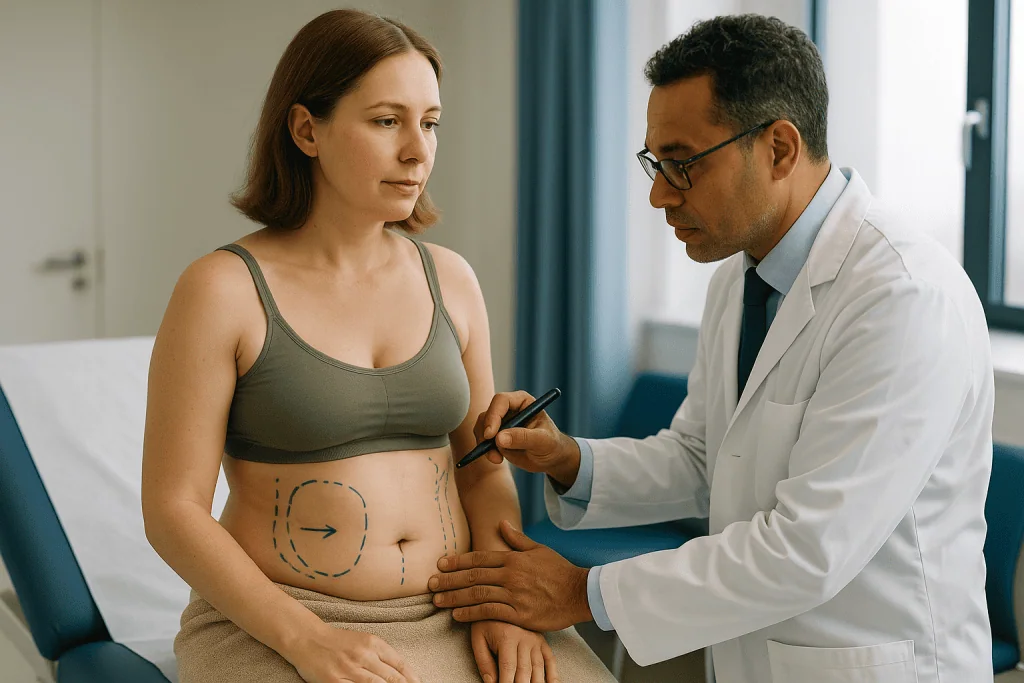
Small incisions, usually a few millimeters long, are made in skin folds or places a swimsuit would cover. Through them the tumescent fluid is infused, and the team waits, often 20 to 30 minutes in typical practice, for the epinephrine to constrict blood vessels and the anesthetic to take effect. The fat becomes firm, almost like a chilled stick of butter, which is exactly the point.
Then the cannula goes in. The surgeon moves it in overlapping fan-shaped tunnels through the fat layer, keeping the tip in the deeper fat and away from the skin surface, because the layer just under the skin is where dimpling and ridges are born. Suction pulls out a mixture of fat, tumescent fluid, and a small amount of blood into a graduated canister. Watching that canister is part of safety: the surgeon is tracking fluid balance, not chasing a number.
Incisions are either closed with a stitch or left open to drain, and a compression garment, a firm elastic wrap that presses the treated skin against the underlying tissue, goes on before you leave the room. Mayo Clinic notes most people go home the same day unless large volumes were removed. What you notice first is heaviness and leaking fluid, both expected. What you cannot see yet, and will not for weeks, is the new contour under the swelling.
Who is usually a classic liposuction candidate, and who is asked to wait
Strip the marketing away and the profile of a good classic liposuction candidate is remarkably consistent across Mayo Clinic, Cleveland Clinic, and NHS guidance. It is an adult who is healthy, not smoking, at a weight that has been steady for months, close to what a clinician would consider a reasonable weight for their height, and troubled by specific fat deposits rather than overall size. Cleveland Clinic frames the weight piece as being within roughly 30 percent of ideal body weight; Mayo Clinic uses similar language. Firm, elastic skin and good muscle tone underneath are the other half of the equation.
Equally important is who is asked to wait, and why. Surgeons commonly pause when:
- weight is still moving, whether from an ongoing diet, a new medicine, or recent pregnancy, because the contour being sculpted will not be the contour that settles;
- a person hopes the procedure will treat obesity or improve blood sugar, blood pressure, or cholesterol, because the evidence says it will not (more on that below);
- skin is loose, striated, or already hanging, because removing volume beneath it makes laxity worse;
- there are uncontrolled medical conditions, such as poorly managed diabetes, heart disease, or a bleeding tendency, which MedlinePlus lists as reasons to defer or avoid surgery;
- the person is a current smoker, since nicotine narrows blood vessels and impairs healing;
- expectations are pinned to a photograph of someone else’s body.
Notice that none of these are moral judgments. They are predictions. A surgeon who postpones is estimating that the risk-to-benefit ratio will look better in six months than it does today. A consultation that ends with “not yet” and a clear explanation of what would change the answer is a sign of a careful team, not a rejection.
Liposuction and skin elasticity: what the pinch test is really measuring
The single most decisive factor in candidacy is not fat. It is what the skin over the fat will do once the fat is gone. Skin elasticity is the capacity of the skin to contract back to its new, smaller footprint, and it depends on collagen and elastin fibers in the deep skin layer. Those fibers weaken with age, sun exposure, smoking, rapid weight cycling, and pregnancy. Liposuction removes the stuffing; it does nothing to the fabric of the pillowcase.

During a consultation you will feel the surgeon pinch a fold of skin, lift it, and let go. They are watching two things: how quickly it snaps back and whether the surface shows fine wrinkling when compressed. Skin that recoils instantly and stays smooth is likely to redrape well. Skin that hesitates, or crinkles like tissue paper, tends to look looser after surgery, not tighter. Mayo Clinic states plainly that people with poor skin elasticity may end up with sagging skin in the treated area.
Stretch marks are a clue worth taking seriously. A stretch mark is a small tear in the deep skin layer that healed with scar tissue, and areas heavily marked in this way have already lost some of their ability to contract. Prior significant weight loss, especially more than a small fraction of body weight, often leaves this kind of skin.
What about devices that claim to tighten as they remove? Heat-based cannulas can produce some skin contraction in some patients, but the NHS notes that evidence they are consistently better than standard liposuction is lacking. If skin laxity is your main concern, surgeons typically discuss excisional procedures, meaning operations that remove skin, alongside or instead of liposuction. That is an honest conversation, and it is worth having before the marking pen comes out.
Why does stable weight matter before liposuction?
Fat cells are odd. In adulthood their number is relatively fixed; when you gain weight they mostly swell, and when you lose weight they mostly shrink. Liposuction is one of the few things that actually reduces their number in a given area. That sounds like a permanent fix, and in one narrow sense it is: the removed cells do not regenerate. The catch is that the remaining cells, both in the treated area and everywhere else, still swell if calories exceed needs. Mayo Clinic describes exactly this pattern: gain weight afterward, and fat distribution changes, sometimes appearing in untreated areas.
This is why surgeons ask for months of stability rather than a target number. Someone mid-way through a weight-loss effort presents a moving target. Sculpt the flank at one weight, and if the person loses another fifteen pounds, the skin that was borderline becomes clearly loose. If they regain, the untreated abdomen may grow while the treated hips stay slim, producing an odd, unbalanced silhouette. Stability tells the surgeon the canvas is dry.
Body mass index, a ratio of weight to height used as a rough screening measure, comes up in consultations, and it is worth understanding its limits. Cleveland Clinic and Mayo Clinic frame candidacy around being near a healthy weight rather than around a hard BMI cutoff, because a muscular person can carry a high BMI with little fat, and a small-framed person can be at a “normal” BMI with a genuinely stubborn deposit. Your surgeon will look at you, not just the chart.
Medicines that change appetite or weight deserve a specific mention. If you have recently started or stopped one, or your prescribing clinician is adjusting it, tell the surgical team. The right moment for contouring is usually after your weight has settled on that regimen, and only your prescriber should make decisions about the medicine itself.
Realistic areas: where classic liposuction tends to work, and where it disappoints
Not all fat is equal. The deposits that respond best are dense, discrete, and sit over firm tissue with good skin above them. The ones that disappoint are diffuse, sit beneath thin or loose skin, or are actually internal fat that no cannula can reach. The table below summarizes what hospital-based sources and standard surgical teaching generally describe.
| Area | Typical suitability | The honest caveat |
|---|---|---|
| Outer thighs (“saddlebags”) | Often favorable | Skin here is usually thick and elastic; inner thigh skin is thinner and less forgiving. |
| Flanks and “love handles” | Often favorable | One of the most commonly treated regions; results depend on weight staying steady. |
| Lower abdomen | Variable | Works when fat is under the skin; does nothing for fat inside the abdominal cavity or separated muscles after pregnancy. |
| Under the chin (submental) | Often favorable in younger skin | Neck skin laxity with age may need a skin-tightening procedure instead. |
| Upper arms | Variable | Loose arm skin may hang more after fat removal; excision is sometimes discussed. |
| Knees, ankles, calves | Selective | Small volumes, prolonged swelling, and a higher chance of visible irregularity. |
| Buttocks | Cautious | Aggressive removal can flatten and cause sagging; surgeons are often conservative here. |
The abdomen deserves one more sentence, because it is where hopes and anatomy most often collide. Press your fingers into your belly while lying flat. Fat you can pinch between finger and thumb is subcutaneous and is potentially treatable. Firmness that pushes back from beneath the muscle is visceral fat, wrapped around the organs, and it responds to diet, activity, and medical care, never to liposuction. A surgeon who says “most of that is inside” is giving you accurate, useful information.
Cellulite, the dimpled texture caused by fibrous bands tethering skin to deeper tissue, is another frequent disappointment. Mayo Clinic notes that liposuction does not improve it and may make it more visible.
How much fat can liposuction remove in one session?
This is the question surgeons most want to reframe. The honest answer is that the safe amount is set by physiology and by the surgeon’s judgment, not by how much you would like gone. MedlinePlus is direct: the more fat removed, the higher the risk. Larger volumes mean more fluid shifting between blood vessels and tissue, more anesthetic absorbed, longer operating time, and a greater chance of complications involving the heart, kidneys, or lungs. Mayo Clinic lists these fluid-related problems among the serious risks.
Surgeons and professional bodies describe the largest removals as “large-volume” liposuction and treat it differently: more monitoring, often an overnight stay, sometimes staged across two operations rather than one. Whether a given plan falls into that category is a clinical decision that depends on your size, health, and the areas involved. A person who is told “we can address the flanks and outer thighs today, and revisit the abdomen once you have healed” is being offered caution, not a lesser service.
It also helps to understand what the volume in the canister actually is. A large share is tumescent fluid and a little blood, not pure fat. The number that matters for your appearance is not liters but distribution, and the number that matters for safety is total volume in and out. Surgeons track both.
Think of what liposuction changes in clothing terms rather than scale terms. A successful outcome is often a smoother line under a fitted shirt or trousers that no longer pull at one spot, not a different reading on the bathroom scale. Cleveland Clinic and the NHS both make the same point from different angles: this is a shaping operation, and the amount removed is measured against safety, not against a wish list. If a consultation leads with a promised number of liters, that is a reason to ask more questions, not fewer.
Liposuction vs weight loss: what the metabolic evidence shows
Here is the myth that does the most quiet damage: that removing fat surgically must deliver at least some of the health benefits of losing it the slow way. It is an intuitive idea, and the best available evidence says it is wrong.
A small but influential study published in the New England Journal of Medicine followed 15 women, some with type 2 diabetes and some with normal blood sugar, who underwent large-volume abdominal liposuction removing roughly 9 to 10 kilograms of fat. Ten to twelve weeks later, the researchers measured insulin sensitivity in liver, muscle, and fat tissue, along with inflammatory markers, blood pressure, and cholesterol. None had improved meaningfully. The authors concluded that removing subcutaneous fat does not reproduce the metabolic effects of weight loss achieved through a negative energy balance (PubMed, Klein et al.).
Why not? Two reasons are usually offered. First, liposuction cannot reach visceral fat, the fat inside the abdomen that is most strongly linked to insulin resistance and cardiovascular risk. Second, the health effects of diet-and-activity weight loss appear to come from changes in how the whole body handles energy, including shrinking fat cells everywhere, improved muscle metabolism, and lower liver fat, rather than from the simple absence of a certain mass of fat under the skin.
The practical implication is that liposuction belongs in a different mental category from weight-loss surgery, weight-loss medicines, or lifestyle change. Those are treatments for a health condition. Liposuction is a cosmetic contouring operation. Both Mayo Clinic and the NHS state it plainly: it is not a treatment for obesity, and it is not a substitute for a healthy lifestyle. If your motivation is metabolic, that conversation belongs with your primary care clinician or an obesity medicine specialist, and a responsible surgeon will say so.
What are the real risks of classic liposuction?
Every operation carries risk, and liposuction’s are specific enough to be worth knowing in plain language. The NHS, Mayo Clinic, and MedlinePlus describe a consistent list, which divides usefully into the common and cosmetic, and the rare and serious.
Common effects are bruising, swelling, temporary numbness, and fluid leaking from incisions for a day or two. Most fade over weeks. Cosmetic complications are less predictable. Contour irregularities, meaning bumps, waves, or dents, happen when fat is removed unevenly or when skin fails to redrape; Mayo Clinic notes these can be permanent. A seroma is a pocket of clear fluid that collects under the skin and may need to be drained with a needle. Numbness sometimes persists. Skin can develop patches of altered color, and incisions can scar more visibly than expected.
Serious complications are uncommon but real. Infection is possible after any surgery. A fat embolism occurs when a fragment of loosened fat enters a blood vessel and travels to the lungs or brain; it is rare and dangerous. Deep vein thrombosis, a clot in a leg vein, can form after surgery and travel to the lungs. Large fluid shifts can strain the heart and kidneys, and absorbing too much local anesthetic can affect the heart and nervous system, which is one reason volume limits exist. Internal puncture, when the cannula passes too deep and injures an organ, is rare and may require emergency repair.
Two risk multipliers appear again and again in hospital guidance: treating many areas or large volumes in one session, and having surgery in a facility without proper monitoring and resuscitation capability. Ask where the procedure will happen, what anesthesia will be used, and who will be watching you throughout. Those are not awkward questions. They are the questions.
When a classic liposuction candidate is steered toward alternatives
Being a reasonable classic liposuction candidate on paper does not always mean liposuction is the right answer. Surgeons frequently redirect people in three situations, and understanding them can save you a disappointing operation.
The first is loose skin. If the fold you dislike is mostly skin rather than fat, or if elasticity is poor, the discussion usually turns to excisional surgery: an abdominoplasty, which removes lower abdominal skin and can tighten separated abdominal muscles; a brachioplasty for the arms; a thigh lift; or a neck lift. These leave longer scars in exchange for actually removing the excess. Liposuction is sometimes combined with them to refine the result. MedlinePlus lists this pairing as common.
The second is generalized excess weight. When the concern is overall size rather than a pocket, the evidence points toward structured lifestyle programs, medical weight management including prescribed medicines where appropriate, or metabolic surgery. These improve health markers in ways liposuction does not, as the metabolic evidence above shows. Any decision about medicines or bariatric surgery belongs with the prescribing or treating clinician, not a cosmetic consultation.
The third is a small deposit in someone who wants to avoid surgery altogether. Nonsurgical fat-reduction methods exist, including cold-based, heat-based, and injectable approaches. Their effects are typically modest and gradual, they suit small areas, and they are not a shortcut around skin laxity either. The NHS characterizes nonsurgical treatments broadly as less predictable in result than surgery. They are an option to discuss, not a proven equivalent.
Doing nothing is also an alternative, and a legitimate one. A body that is healthy and strong but keeps a soft hip is not a medical problem. A good surgeon will say that too.
Liposuction recovery timeline: the first days and weeks
Recovery from liposuction is less about pain than about patience. The following ranges reflect what Mayo Clinic, the NHS, and Cleveland Clinic describe as typical; your own course may be faster or slower, and your surgical team’s instructions override anything written here.
The first two or three days bring soreness, heaviness, and drainage of pink-tinged fluid from the incisions. Bruising peaks around this time. Compression garments are worn almost continuously, and walking around the house is encouraged from day one because movement lowers the risk of clots. Most people are eating and moving normally, just gingerly.
By one to two weeks, bruising is fading and many people return to desk-based work. The NHS suggests planning roughly two weeks away from work, and longer for physically demanding jobs. Strenuous exercise usually waits several weeks, again per your team. Swelling remains, and here expectations need managing: the treated area may look fuller than before, because fluid has replaced fat. That is normal and temporary.
Between four and eight weeks, the compression garment is often reduced or stopped, per Mayo Clinic’s description of a few weeks of wear, and the outline begins to emerge. Numbness, tightness, and firm lumpy patches under the skin are common at this stage and generally soften with time and gentle massage if your surgeon recommends it.
Final results are slow. Mayo Clinic states that the true contour is visible only after swelling fully resolves, which can take several months; Cleveland Clinic gives a range extending to around six months. Photograph yourself monthly rather than daily. The changes are real, but they arrive at the pace of skin remodeling, not of the calendar you had in mind.
What people often get wrong about liposuction
The gap between what people expect and what liposuction delivers is where most regret lives. These are the misunderstandings that come up again and again in consultations, corrected against what medical sources actually say.
“The fat can’t come back.” The removed cells do not return, but the remaining ones enlarge with weight gain, and new fat can appear in untreated areas. Mayo Clinic and the NHS both stress that results depend on maintaining a stable weight.
“It will tighten my skin.” Liposuction removes volume beneath the skin. Whether the skin follows depends on its own elasticity, and loose skin can look looser afterward. Energy-based devices have not been shown to change this reliably.
“It’s a way to lose weight.” The scale barely moves, and the metabolic markers of health do not improve, as the New England Journal of Medicine study showed. This is contouring, not weight loss.
“It’s minor surgery.” It is genuine surgery with rare but serious risks, including clots, fat embolism, and fluid imbalance. The word “minimally invasive” describes the incisions, not the operation.
“More areas in one go saves time.” It also multiplies risk. Larger volumes and longer operations are the settings in which serious complications cluster, which is why staged procedures are often proposed.
“Cellulite will improve.” It typically does not, and Mayo Clinic notes it can look worse.
“I’ll see the result in two weeks.” You will see swelling in two weeks. The result takes months.
“A stubborn belly means fat under the skin.” Often it is visceral fat inside the abdomen, out of reach of any cannula.
The pattern across all of these is the same: liposuction changes shape, in the right area, under the right skin, at the right weight. Every disappointment traces back to one of those conditions being ignored.
Questions to ask your care team
A consultation is a two-way assessment. You are being evaluated, and you are also evaluating whether this team explains things clearly and cautiously. Bring these questions written down; the good answers are specific, and the worrying answers are vague or promotional.
Start with candidacy. Ask what, in your particular anatomy, makes you a good or borderline candidate, and specifically how they judged your skin elasticity. Ask whether any of the fat you are concerned about is visceral, and therefore untreatable. Ask what would change their recommendation, such as a period of weight stability or stopping smoking.
Move to the plan. Which areas, in which order, and why? Would they stage the procedure across more than one session, and what would prompt that? What anesthesia will be used, and who will administer and monitor it? Where will the operation take place, and what emergency capabilities does that facility have?
Then the realistic outcome. What result do they expect for you, described in words rather than someone else’s photographs? Which of your concerns will liposuction not address, and what alternatives exist for those? How likely are contour irregularities in the areas planned, and what is their approach if a touch-up is needed?
Finally, recovery and safety. How long will compression be worn? When can you drive, work, and exercise? What are the specific warning signs that should prompt a call, and what number do you call outside office hours? Who will see you at follow-up, and how many visits are planned?
One more question is worth asking yourself rather than the surgeon: if the answer is “not now” or “not this,” am I willing to hear it? The teams most worth trusting are the ones comfortable saying both.
When to call your doctor
Most recovery worries are ordinary: bruising, swelling, fluid seeping from incisions in the first day or two, tenderness that responds to the pain plan your team gave you. A few signs are not ordinary, and they need the same-day attention of your surgical team, or emergency care if you cannot reach them. The list below reflects red flags described by the NHS, Mayo Clinic, and MedlinePlus.
Seek emergency care immediately if you develop sudden shortness of breath, chest pain, coughing up blood, confusion, or fainting. These can signal a clot that has traveled to the lungs or a fat embolism, both of which are rare and time-critical.
Call your surgical team promptly for pain, swelling, warmth, or redness in one calf or thigh, which may indicate a deep vein thrombosis; a fever or chills; spreading redness, heat, or foul-smelling discharge from an incision; bleeding that soaks through dressings rather than staining them; a rapidly enlarging, tense, or very painful area under the skin; severe abdominal pain, nausea, or vomiting after abdominal liposuction; very little urine output or dizziness on standing, which can reflect fluid imbalance; or numbness, tingling, or weakness that is worsening rather than stable.
Also call, without embarrassment, if something simply feels wrong to you. Postoperative teams expect these calls and would far rather hear about a false alarm than miss an early complication. Keep the after-hours contact number where you can find it before you leave the facility, and make sure whoever is staying with you during the first night knows where it is too. In the weeks that follow, persistent fluid collections, hard lumps that are not softening, or contour concerns are not emergencies, but they are exactly what your scheduled follow-up appointments exist to assess, so raise them there rather than waiting.
Frequently asked questions
What makes someone a good classic liposuction candidate?
A good candidate is a healthy adult at a stable weight near a range a clinician considers reasonable, with specific fat deposits that resist diet and exercise, firm elastic skin over those areas, no uncontrolled medical conditions, non-smoking status, and realistic expectations. Mayo Clinic and Cleveland Clinic describe this profile consistently. The decision is individual and made by the surgical team after examining you, not by a checklist alone.
How does liposuction skin elasticity affect results?
Skin elasticity determines whether the skin contracts to fit the smaller volume beneath it after fat is removed. Elastic skin redrapes smoothly; lax, stretch-marked, or sun-damaged skin may sag more afterward. Surgeons assess this by pinching and watching the recoil. Mayo Clinic notes that people with poor elasticity risk loose skin, and skin-removing procedures may be discussed instead of or alongside liposuction.
How much fat can liposuction remove safely?
There is no single number that applies to everyone; the safe volume depends on your size, health, the areas treated, and the anesthesia used, and it is set by the surgeon. MedlinePlus notes that removing larger amounts increases risk, and very large removals are handled with extra monitoring or staged over more than one operation. The canister also contains fluid and blood, not only fat.
Liposuction vs weight loss: does liposuction improve health?
No. Liposuction removes fat under the skin for shape, not for health. A New England Journal of Medicine study of women who had roughly 9 to 10 kilograms of abdominal fat removed found no improvement in insulin sensitivity, inflammatory markers, blood pressure, or cholesterol afterward. Weight loss through diet, activity, medical care, or metabolic surgery produces those benefits; liposuction does not.
What is the typical liposuction recovery timeline?
Soreness, bruising, and fluid drainage dominate the first few days, with walking encouraged from day one. Many people return to desk work in about two weeks, per NHS guidance, and wear a compression garment for several weeks. Strenuous exercise waits longer. Swelling settles over months, and Mayo Clinic and Cleveland Clinic describe the final contour appearing only after several months, sometimes around six.
Does fat come back after liposuction?
The specific fat cells removed do not regrow, but the remaining fat cells everywhere in the body enlarge with weight gain. Mayo Clinic notes that if you gain weight after liposuction, fat distribution can change, sometimes appearing more in untreated areas. Results are durable only with a stable weight, which is why surgeons ask for months of stability before operating.
Can liposuction remove belly fat?
It can remove fat that sits under the skin of the abdomen, the kind you can pinch. It cannot reach visceral fat, which lies inside the abdominal cavity around the organs and pushes back firmly when pressed. Visceral fat responds to lifestyle change and medical care, not surgery. It also cannot repair separated abdominal muscles after pregnancy, which is addressed by a different operation.
Is liposuction safe?
It is a genuine surgical procedure with common minor effects such as bruising, swelling, and temporary numbness, and rare but serious risks including infection, blood clots, fat embolism, fluid imbalance affecting the heart and kidneys, and organ injury. The NHS and Mayo Clinic describe these. Risk rises with larger volumes and more areas treated, and with facilities lacking proper monitoring, so ask where and how you will be cared for.
Does liposuction help cellulite or loose skin?
Generally no. Cellulite results from fibrous bands tethering skin to deeper tissue, and Mayo Clinic notes liposuction does not improve it and may make dimpling more visible. Loose skin can appear looser once supporting fat is removed. When laxity is the main concern, surgeons usually discuss skin-removing procedures such as an abdominoplasty or arm lift, sometimes combined with liposuction for refinement.
Who should not have liposuction?
People with uncontrolled medical conditions such as poorly managed diabetes, heart disease, or bleeding disorders; current smokers; those whose weight is still changing or who are pregnant or recently postpartum; people with poor skin elasticity in the target area; and anyone hoping to treat obesity or improve metabolic health are usually asked to wait or consider alternatives. MedlinePlus lists several of these. Your surgical team makes the final assessment.
References
This article is for general information only and is not a substitute for professional medical advice. Please consult a qualified doctor about your individual situation.

More from the Blog

What the Tumescent Solution Does in Tumescent Liposuction: Bleeding, Bruising and Comfort
Tumescent solution is a large volume of very dilute salt water carrying a local anesthetic and epinephrine, infused into the fat before liposuction. It…

How Monsplasty Is Performed: Liposuction, Skin Removal and Where the Incision Sits
Monsplasty reshapes the mons pubis, the soft fatty mound over the pubic bone, using one of two approaches or both together. Liposuction removes excess…

Who Is a Candidate for Vaginoplasty? Childbirth Changes, Symptoms and Surgical Timing
A candidate for vaginoplasty is usually someone who has finished childbearing, has persistent looseness or bulging of the vaginal wall (often after vaginal birth),…

What Are the Risks of Monsplasty? Swelling, Numbness and the Signs Worth Reporting Early
Monsplasty risks are mostly the ordinary risks of any skin-and-fat contouring operation: swelling that can last for months, temporary or occasionally lasting numbness, bruising,…

Pectoral Augmentation Recovery: When Chest Training Can Restart Without Risking the Implant
After pectoral augmentation, surgeons typically ask patients to avoid direct chest training for roughly six to eight weeks. Gentle walking usually starts within a…

Tumescent vs Traditional Liposuction: What the Diluted Anesthetic Changes for Patients
Tumescent liposuction infiltrates the fat layer with a large volume of very dilute local anesthetic, a blood-vessel-constricting agent and saline before fat is suctioned,…