

Is Egg Retrieval Done Under Anesthesia? What IVF Patients Feel on the Day and After

Key Takeaways
- Most US fertility programs perform egg retrieval under deep intravenous sedation monitored by an anesthesia professional, so patients are asleep for the procedure but usually do not need a breathing tube.
- The collection itself lasts around 15 to 20 minutes according to the NHS, and it is scheduled roughly 34 to 36 hours after the trigger injection, which is why the appointment time cannot move.
- A Cochrane systematic review found no single pain-relief method clearly superior for oocyte retrieval outcomes, and combining sedation with a local block tended to give better comfort than one method alone.
- Egg retrieval involves no skin incision or stitches, and both the NHS and Mayo Clinic describe it as a same-day procedure, which is why it is classed as minor rather than major surgery.
- Sedation medicines wear off within minutes but impair judgment and reflexes for the rest of the day, so an adult escort home and a full day off are safety instructions rather than suggestions.
- Ovarian hyperstimulation syndrome is caused by the stimulation medicines rather than the retrieval and tends to appear in the days afterward, so rapidly increasing swelling or reduced urination in that week warrants a call.
Yes. In most fertility programs, egg retrieval is done under intravenous sedation or a light general anesthetic given by an anesthesia professional, so patients are asleep or deeply relaxed and remember little. Some centers use local anesthetic with pain relief instead. The procedure typically lasts about 15 to 20 minutes, and most people go home the same day with mild cramping.
The night before, she lays out loose sweatpants and a phone charger, then reads the instruction sheet a fourth time. Nothing to eat after midnight. Someone to drive her home. Arrive with a full bladder? No, an empty one. The word that keeps snagging her attention is not “needle” or “ovary” but “sedation,” because nobody has quite explained what that will feel like.
This is the quiet worry underneath the loud one. Weeks of injections, scans and blood draws have built toward a single morning, and the question of egg retrieval anesthesia, will I be awake, will I feel it, what will I remember, often gets a two-sentence answer in a rushed appointment.
It deserves a longer one. What follows walks through what actually happens in the room, why different centers choose different approaches, what the medical evidence says about comfort and safety, and what the days afterward tend to look like.
What does egg retrieval anesthesia actually mean?
“Anesthesia” is a broad word, and the confusion starts there. For egg retrieval, it can describe anything from a numbing injection near the cervix to a full general anesthetic, and the approach varies by country, by program and by patient.
Most people in the United States receive intravenous sedation. Sedation means medicine given through a small cannula in a hand or arm vein that makes you drowsy, relaxed and, at deeper levels, unresponsive to the procedure. An anesthesia professional, an anesthesiologist or a nurse anesthetist, stays at your side, adjusting the medicine moment by moment and watching your breathing, oxygen level, heart rate and blood pressure on a monitor.
Sedation sits on a spectrum. Conscious sedation, as MedlinePlus describes it, leaves you able to respond to questions but feeling calm and often with little memory afterward. Deep sedation takes you further, into a sleep-like state you do not remember at all. General anesthesia is the far end: complete unconsciousness, sometimes with a device to support your airway. In practice, egg retrieval usually lands in the deep-sedation zone, which is why patients describe “going to sleep” even though it is technically not a full general anesthetic.
The NHS describes egg collection in the United Kingdom as a procedure done under sedation, and the Mayo Clinic notes that patients are sedated and given pain medication. A smaller number of programs, more often outside the US, use a local anesthetic block near the cervix combined with pain-relieving and calming medicines while the patient remains awake.
None of these is the “right” method for everyone. What matters is that you know which one your program uses and why, and that an anesthesia professional has reviewed your history before the day arrives.
What actually happens in the room, step by step
Picture a small procedure suite rather than an operating theater. There is a bed with leg supports, an ultrasound machine, a warm incubator in an adjoining lab, and usually three or four people: the fertility doctor, the anesthesia professional, a nurse and an embryologist waiting behind a pass-through window.

You arrive having fasted, change into a gown, and a nurse places a small IV cannula. The anesthesia professional asks about allergies, previous anesthetics and when you last ate. Then the sedation begins. Most patients describe a cool feeling in the arm, a few seconds of heaviness, and nothing further until they wake in recovery.
The retrieval itself uses a technique called transvaginal ultrasound-guided aspiration. An ultrasound probe, the same kind used at your monitoring scans, is placed in the vagina. A thin needle runs along a guide attached to the probe, passes through the vaginal wall into the ovary, and draws the fluid out of each follicle. A follicle is the small fluid-filled sac that has been growing around each egg during stimulation. The fluid travels through fine tubing to a test tube, which the embryologist examines under a microscope to find the egg.
There is no abdominal incision and no stitches. The Mayo Clinic notes that abdominal surgery is used only rarely, when the ovaries cannot be reached through the vagina.
Once every accessible follicle has been drained on both sides, the probe is removed, the doctor checks for bleeding, and the sedation is stopped. Because the medicines are short-acting, most patients begin waking within minutes and are moved to a recovery area to rest.
How long does egg retrieval take?
Shorter than most people expect. The NHS states that the collection procedure itself lasts around 15 to 20 minutes, and the Mayo Clinic gives a similar estimate of about 20 minutes. The number of follicles matters, more follicles mean more needle passes and a slightly longer procedure, but even a large response rarely stretches far past half an hour.
The whole visit is longer. Build in time for check-in, the anesthesia conversation, IV placement, the procedure and then a period of observation while the sedation wears off. Programs differ, but a half-day at the center is a reasonable expectation, and your team will give you their own typical window.
Timing before the procedure is precise for a reason. Retrieval is scheduled roughly 34 to 36 hours after the “trigger” injection, the final medicine that tells the eggs to complete their maturation, according to the Mayo Clinic. Too early and the eggs are not ready; too late and the ovary may release them on its own. That is why your appointment time is fixed to the minute, and why a late-night trigger injection is normal rather than a scheduling quirk.
What sedation adds to the timeline is mostly the wake-up. Short-acting intravenous agents are chosen precisely because they clear quickly, but MedlinePlus notes that drowsiness, slowed reflexes and impaired judgment can last for the rest of the day. That is the origin of the rules you have already been told: no driving, no signing important documents, no alcohol, and an adult to accompany you home.
So the honest answer has two parts. The procedure is quick. The day is not, and planning for a slow, quiet one makes everything easier.
Is egg retrieval painful? And how painful is it without anesthesia?
With effective sedation, the procedure itself is not felt. Patients wake with a sense of having been briefly absent, and what they experience afterward is cramping rather than sharp pain, closer to a strong period than to a surgical wound. The NHS lists cramps and a small amount of vaginal bleeding as expected effects in the hours after collection, and the Mayo Clinic describes cramping and a feeling of fullness or pressure.
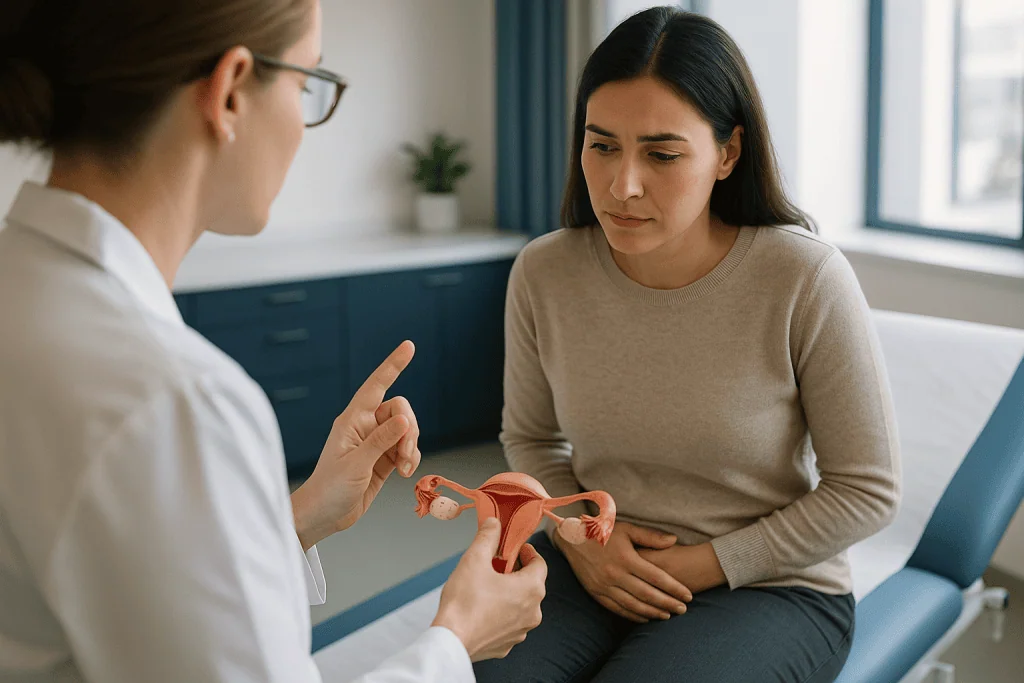
The question “how painful is egg retrieval without anesthesia?” deserves a straight answer: it would hurt. The ovaries are sensitive to being punctured and to the pulling that happens as follicles are drained, and after stimulation they are enlarged and tender. That is why no mainstream program performs retrieval with nothing at all.
What some programs do use is a lighter approach: a local anesthetic injected near the cervix, called a paracervical block, plus intravenous pain relief and a calming medicine, with the patient awake. People who have had this describe pressure and intermittent cramping during the needle passes, with pain that is real but generally tolerable and brief. Whether it is acceptable depends heavily on the individual, the number of follicles and how easily the ovaries can be reached.
A Cochrane systematic review that pooled trials comparing different pain-relief methods for oocyte retrieval found that combining approaches, for example, sedation plus a local block, tended to give better pain control than any single method, and did not identify one technique as clearly superior for pregnancy outcomes. That is the state of the evidence: several reasonable ways to do this, and the choice belongs to the team caring for you.
If you have a history of severe pain with pelvic exams, or a past anesthetic that did not go well, say so at the planning stage. Both change how the team prepares.
Is propofol used as anesthesia for egg retrieval?
Often, yes. Propofol is a short-acting intravenous sedative-hypnotic, a class of medicine that produces sleep quickly and wears off quickly once the infusion stops. Those two properties make it a common choice for brief procedures such as endoscopy and egg retrieval, where the goal is a patient who is comfortably asleep for twenty minutes and then awake and clear-headed soon afterward.
It is not the only ingredient. Propofol relieves awareness rather than pain, so anesthesia professionals typically pair it with a fast-acting opioid analgesic, a pain-relieving medicine, so that the body is not stressed by the needle passes even while the mind is unaware of them. Some teams add a short-acting benzodiazepine, a medicine that reduces anxiety and memory of the procedure. Others include the local anesthetic block discussed above.
People understandably ask whether any of this reaches the eggs. Follicular fluid is being drawn out as the medicines circulate, and small amounts of some agents can be measured in it. The Cochrane review of pain relief for oocyte retrieval did not find evidence that the choice of sedation method changed pregnancy rates, and mainstream reproductive practice has used these agents for decades. Your embryology and anesthesia teams will have chosen an approach with this in mind.
What the anesthesia professional is actually doing during those twenty minutes is more active than “putting you to sleep.” They titrate the infusion to your responses, watch your breathing, propofol can slow it, and keep oxygen flowing through a small mask or nasal tube. This is why the presence of a dedicated anesthesia professional, rather than the doctor doing the retrieval, is the standard in most sedation-based programs.
Which medicines are used, in what combination, is a clinical decision for your anesthesia team. Ask them; they will tell you.
Is egg retrieval considered major surgery?
No. By any conventional definition, egg retrieval is a minor procedure. It involves no incision through skin or muscle, no opening of the abdomen, no stitches and, in the overwhelming majority of cases, no overnight stay. The needle passes through the vaginal wall, which heals without intervention, and the puncture sites on the ovary are tiny.
That said, “minor” describes the technique, not necessarily your experience of it. Your ovaries have been stimulated for days and may be several times their usual size. You are fasting, anxious and possibly sleep-deprived. The emotional stakes are anything but minor. Calling the procedure small is accurate; calling the day small is not.
Where it sits relative to other procedures helps. The sedation used is comparable to that for a colonoscopy or a dental extraction under intravenous sedation. The recovery is closer to a heavy period than to any operation. The NHS notes that you can usually go home the same day, and the Mayo Clinic describes it as an outpatient procedure.
The risks are real but uncommon and specific. The NHS lists bleeding, infection and injury to nearby structures such as the bladder or bowel as possible complications of egg collection. The Cleveland Clinic and Mayo Clinic add the risks of the sedation itself, nausea, a sore throat if an airway device was used, and rare allergic or breathing reactions, which is why fasting and monitoring matter.
The other risk people worry about, ovarian hyperstimulation syndrome, comes from the stimulation medicines rather than the retrieval, and is discussed further down. So the honest framing is this: a minor procedure, done under careful monitoring, in a body that has been through a demanding two weeks. Plan your rest accordingly.
Egg retrieval anesthesia options compared
Programs choose among a handful of approaches, and the table below sets them side by side. It describes typical features, not guarantees; your own experience will depend on the medicines chosen, your response to them and the anesthesia team’s judgment on the day.
| Approach | What it involves | What you typically feel | Where it is commonly used |
|---|---|---|---|
| Deep intravenous sedation | Short-acting sedative plus pain-relieving medicine through an IV; anesthesia professional monitors breathing and oxygen; usually no breathing tube | Asleep within a minute, no memory of the procedure, cramping on waking | Most US programs; standard in many countries |
| General anesthesia | Deeper unconsciousness, often with a device to support the airway | Nothing during the procedure; possible sore throat or grogginess after | Selected patients, difficult access, significant medical history, patient preference |
| Conscious sedation plus local block | Lighter IV sedative and analgesic; local anesthetic injected near the cervix | Drowsy but responsive; pressure and cramping during needle passes; partial memory | Some programs, more often outside the US |
| Local block with oral or IV pain relief only | Paracervical anesthetic; patient fully awake | Awake; intermittent cramping and pressure; quicker to leave | Less common; small follicle numbers or patient request |
Two threads run through the table. First, comfort during the procedure rises as you move toward deeper sedation, while recovery time and airway involvement rise with it. Second, the Cochrane review on this question found no single approach clearly better than the others for the outcome most patients care about: the eggs and the embryos that follow.
What the evidence does support is matching the method to the person. A patient with sleep apnea, a difficult airway, severe reflux or a history of anesthesia complications may be steered toward one option; a patient with two follicles and a strong wish to stay awake toward another. That matching conversation is the point of the pre-anesthesia review.
Who is usually offered sedation, and who is asked to wait
Sedation for egg retrieval is offered to almost everyone going through in vitro fertilization, and to people freezing eggs for their own future use or for donation. The stimulation phase and the retrieval are essentially the same regardless of what happens to the eggs afterward.
The more useful question is who might be asked to postpone the retrieval itself, and the answer usually has to do with safety on the day rather than eligibility for anesthesia.
Fasting is the most common reason a procedure is delayed. Sedation relaxes the reflexes that keep stomach contents out of the airway, and MedlinePlus emphasizes following the fasting instructions precisely. Arriving having eaten breakfast can mean rescheduling, and because retrieval timing is fixed to the trigger injection, rescheduling may mean the cycle is lost. It is the rule most worth respecting.
An acute illness, a chest infection, a fever, active vomiting, may prompt the anesthesia professional to advise waiting, because breathing and airway management are harder in a person who is unwell. Uncontrolled blood pressure or a new heart symptom would be treated the same way.
Certain medical histories do not delay the procedure but change how it is planned. Obstructive sleep apnea, a body mass index in a range that affects airway management, significant reflux, previous difficult intubation, known allergy to anesthetic agents or a family history of malignant hyperthermia, a rare inherited reaction to some anesthetics, all lead the team to choose medicines and monitoring differently, and sometimes to move the retrieval to a setting with more resources.
People taking blood-thinning medicines, or with bleeding disorders, will have a specific plan made in advance, because puncturing the ovary carries a bleeding risk. Do not stop or adjust any prescribed medicine on your own; ask your fertility team and prescriber how it should be handled.
The decision to proceed, delay or modify sits with the treating team, made on the morning with you in front of them.
How to prepare for egg retrieval sedation the day before
Most of the preparation is unglamorous and matters a great deal. Start with the trigger injection: it is given at a specific time, usually the evening two nights before, and the retrieval is scheduled roughly 34 to 36 hours later, per the Mayo Clinic. Set two alarms. Many programs ask you to photograph the empty vial as confirmation.
Then the fasting rules. Your center will give you precise cut-off times for food and for clear fluids; follow them exactly and, if you are unsure whether something counts as “clear,” ask rather than guess. Take or hold your regular morning medicines only as instructed by the team that prescribed them.
Arrange your adult escort now. Under sedation you cannot drive, cycle, take a taxi alone in most programs, or be responsible for children for the rest of the day. MedlinePlus is unambiguous that judgment and reflexes stay impaired for the day even when you feel alert.
Pack for comfort, not appearance. Loose trousers with a soft waistband, slip-on shoes, a warm layer for the recovery area, a sanitary pad for light spotting, and a small snack for afterward. Leave jewelry, nail polish on at least one finger (the oxygen monitor clips there), contact lenses and perfume at home, as most anesthesia guidance advises.
Tell the team, ideally days beforehand, about anything that could affect the anesthetic: previous reactions, sleep apnea, smoking or vaping, recreational drug use, herbal supplements, loose teeth or dental work. None of these will be judged; all of them change the plan.
Finally, prepare the evening after. Clear your schedule, stock the kitchen, and decide who will bring you a hot-water bottle. A quiet, uneventful recovery is a planned event, not a lucky one.
What you feel waking up and in the first 24 hours
The first sensation is usually confusion about time. Patients often ask whether the procedure has started when it finished ten minutes ago. That gap is the sedation doing what it was designed to do, and it closes within minutes.
Cramping arrives next: a low, steady ache across the pelvis, sometimes stronger on one side if that ovary had more follicles. The Mayo Clinic describes it as cramping with fullness or pressure. Nausea is possible, more so if you are prone to motion sickness or have had nausea after previous anesthetics; the recovery nurse can give medicine for it, and mentioning your history beforehand helps them prepare.
Light vaginal bleeding is expected, per the NHS, and a pad will handle it. A few patients notice a sore throat if an airway device was used, or a small bruise where the IV sat.
Before you go home, the team will usually tell you how many eggs were collected. Some people find this number a joy, others a disappointment, and the sedation can amplify either. Give yourself permission to react later, once your head is clear.
At home, rest. Eat lightly at first, drink fluids, and use the pain relief your team has recommended rather than reaching for something you assume is fine, some common over-the-counter painkillers are avoided in fertility cycles, and the prescribing clinician’s guidance is the one to follow. A hot-water bottle on the lower abdomen helps many people.
The Mayo Clinic notes that you should feel able to resume normal activities the next day, though bloating and tenderness may persist. If cramping worsens through the evening rather than easing, or if any of the red flags described near the end of this article appear, call the center’s out-of-hours line without waiting.
Egg retrieval recovery: what the following days and weeks look like
Most people describe the day after retrieval as sore but manageable, and the third day as noticeably better. The NHS notes that cramping and light bleeding settle over a few days. Bloating often outlasts the cramping, because the ovaries remain enlarged for a while and because fluid shifts follow stimulation. Trousers that fit last week may not fit this week; that is normal and temporary.
Activity can return gradually. Gentle walking helps digestion and circulation and is encouraged. Vigorous exercise, heavy lifting and anything that jolts the pelvis are generally paused until the ovaries shrink back, because an enlarged ovary is more prone to twisting on its blood supply: a rare complication called ovarian torsion that presents as sudden severe one-sided pain. Your team will tell you when to resume your usual routine.
The medicines change. Stimulation injections stop, and if you are heading toward a fresh embryo transfer, a hormone that prepares the uterine lining, progesterone, usually begins. The Mayo Clinic describes transfer taking place two to five days after retrieval when it is done in the same cycle. If your embryos are being frozen, the hormonal wind-down is faster.
Your period typically arrives within about two weeks of retrieval if no transfer occurs, and it is often heavier than usual because the lining has been thickened by high hormone levels.
Watch the second half of the first week with particular attention. Ovarian hyperstimulation syndrome, or OHSS: an exaggerated response to fertility medicines in which fluid leaks from blood vessels into the abdomen, tends to appear or worsen in the days after retrieval, and the NHS notes that a pregnancy can prolong it. Mild bloating is expected. Rapidly increasing swelling, weight gain over a day or two, and reduced urination are not, and belong in the red-flag section below.
Emotionally, the fortnight after retrieval is a waiting game. Plan things to do with your hands and your attention.
What people often get wrong about egg retrieval anesthesia
“You’re put under general anesthesia with a breathing tube.” Usually not. Most programs use deep intravenous sedation without an airway device, monitored by an anesthesia professional. A true general anesthetic with airway support is reserved for specific situations, and your team will tell you if that applies.
“You’ll be awake and feel everything.” Also usually not. Under deep sedation, patients have no memory of the procedure. Where lighter sedation with a local block is used, you may be aware of pressure and cramping, but you will not be unmedicated. Ask which approach your program uses rather than assuming from an online forum.
“It’s major surgery.” There is no incision, no stitches and normally no overnight stay. The NHS describes it as a same-day procedure lasting around 15 to 20 minutes.
“The anesthetic can damage the eggs.” The Cochrane review of pain relief methods for oocyte retrieval did not find that the choice of sedation changed pregnancy outcomes. Reproductive teams choose agents with the eggs in mind, and these medicines have been used in this setting for decades.
“I’ll be back at work by lunchtime.” The procedure is short; the sedation’s effects on judgment and coordination last the day, as MedlinePlus notes. Taking the full day off is not indulgence, it is the instruction.
“More pain afterward means more eggs.” Pain does not reliably track egg number. Some people with many follicles feel little; others with few feel sore. Bloating relates more closely to the size of the ovaries and to fluid shifts than to the count.
“Bleeding afterward means something went wrong.” Light spotting is expected. Heavy bleeding that soaks a pad within an hour is not, and is one of the reasons to call.
The pattern behind these myths is a mismatch between the drama of the moment and the modesty of the procedure. Both things can be true at once.
Questions to ask your care team before retrieval day
The pre-procedure conversation is short, and it is easy to leave with unasked questions. Write these down and bring them.
- Which type of anesthesia does your program use for egg retrieval, deep sedation, general anesthesia, or a local block with lighter sedation, and who will be giving it?
- Will an anesthesia professional be present and monitoring me for the whole procedure?
- Given my medical history, is there anything that changes how you plan the anesthetic?
- What are the exact fasting times for food and for clear fluids, and which of my regular medicines should I take, hold or discuss with my prescriber?
- How long should I expect to be at the center in total, and when can my escort expect to collect me?
- What pain relief do you recommend afterward, and which common painkillers should I avoid during this cycle?
- What level of cramping and bleeding is normal, and what specifically should make me call?
- Will you tell me how many eggs were collected before I leave, or later by phone?
- When can I return to work, exercise and sexual activity?
- Am I at higher-than-average risk of ovarian hyperstimulation syndrome, and what signs should I watch for in the week after?
- What is the out-of-hours number, and who answers it?
A few of these will have answers on your instruction sheet already; asking them aloud confirms nothing has changed and gives you a chance to hear the reasoning. The anesthesia professional is often the person you meet for the shortest time on the day, so it is worth asking whether you can speak with them beforehand if you have a complex history.
Ask, too, what would prompt the team to postpone. Knowing in advance that a cold, a missed fasting window or a high blood pressure reading could delay things removes the shock if it happens.
When to call your doctor after egg retrieval
Most recoveries are uneventful, and the aim here is not to alarm but to make sure you know the difference between expected discomfort and a signal to pick up the phone. Fertility programs run out-of-hours lines for exactly this purpose, and calling with a question that turns out to be nothing is never the wrong choice.
Contact your care team promptly, the same day, if you notice any of the following:
- Pain that is severe, increasing rather than easing, or not controlled by the pain relief you were given.
- Sudden severe pain on one side, especially with nausea or vomiting, which can suggest ovarian torsion.
- Heavy vaginal bleeding, soaking a pad within an hour, or passing clots.
- Fever, chills, or a feeling of being unwell that develops in the hours or days after the procedure.
- Rapidly increasing abdominal swelling, a sudden gain in weight over a day or two, or noticeably reduced urination, which the NHS lists among signs of ovarian hyperstimulation syndrome.
- Shortness of breath, chest pain, or a persistent cough.
- Feeling faint, dizzy on standing, or a racing heartbeat.
- Pain, burning or blood on passing urine, or difficulty passing urine at all.
- Persistent vomiting that prevents you from keeping fluids down.
Seek emergency care immediately, rather than waiting for a callback, for chest pain, severe breathlessness, collapse, or pain so intense you cannot stand upright. These are rare after egg retrieval, but they are not situations for a voicemail.
Two quieter reasons to call also matter. If the sedation has left you with a reaction you did not expect, prolonged drowsiness into the next day, or a sore throat that is not improving, your anesthesia team wants to know, both for your comfort and for the record before any future procedure. And if you feel emotionally overwhelmed in the days after retrieval, most programs have counseling support; asking for it is part of the treatment, not a departure from it.
Whatever the symptom, the treating team has your notes, knows your follicle count and your history, and is the right place to start.
Frequently asked questions
How painful is egg retrieval without anesthesia?
It would be genuinely painful, which is why no mainstream program performs retrieval with nothing at all. Stimulated ovaries are enlarged and tender, and puncturing them causes sharp cramping. Programs that keep patients awake still use a local anesthetic block near the cervix plus intravenous pain relief, and patients describe pressure and brief cramping rather than agony. Deep sedation, the more common approach, removes awareness of the procedure entirely.
Is egg retrieval considered major surgery?
No. It is a minor, same-day procedure with no incision or stitches. A thin needle guided by ultrasound passes through the vaginal wall into each ovary to drain the follicles. The NHS describes it as taking around 15 to 20 minutes under sedation. The main risks are uncommon: bleeding, infection, injury to nearby structures, and reactions to sedation. Recovery feels more like a heavy period than an operation.
Is propofol used as anesthesia for egg retrieval?
Frequently, yes. Propofol is a short-acting intravenous sedative that produces sleep quickly and clears quickly, making it suited to brief procedures. It does not relieve pain on its own, so anesthesia teams usually pair it with a fast-acting pain-relieving medicine and sometimes a local block. Which agents are used is a decision for your anesthesia professional, who will explain the plan when you ask.
How long does egg retrieval surgery take?
The procedure itself usually takes about 15 to 20 minutes according to the NHS, with the Mayo Clinic giving a similar estimate of around 20 minutes. More follicles mean a slightly longer procedure. The full visit is longer, typically a half-day, because it includes check-in, the anesthesia review, IV placement and a period of observation while the sedation wears off before you are cleared to go home with your escort.
What does egg retrieval sedation feel like?
Most people feel a cool sensation in the IV arm, a few seconds of heaviness, and then nothing until they wake in recovery, often asking whether the procedure has started. Deep sedation leaves no memory of the retrieval. On waking, the typical sensations are pelvic cramping, a feeling of fullness, mild grogginess and sometimes nausea. Judgment and coordination remain affected for the rest of the day even when you feel alert.
Do you get a breathing tube during egg retrieval?
Usually not. Most programs use deep intravenous sedation in which you breathe on your own, with oxygen delivered through a small mask or nasal tube while an anesthesia professional monitors you. A true general anesthetic with an airway device is used in selected cases, for example, difficult ovarian access or a medical history that makes airway support safer. Your team will tell you in advance if that applies to you.
Can the anesthesia affect egg quality or the embryos?
Current evidence does not show that it does. A Cochrane systematic review comparing pain-relief methods for oocyte retrieval found no difference in pregnancy outcomes between approaches. Small amounts of some agents can be detected in follicular fluid, and reproductive teams choose short-acting medicines partly for that reason. These techniques have been used in fertility practice for decades, and the choice of method rests with your anesthesia and embryology teams.
What is egg retrieval recovery like in the first week?
The first day brings cramping, light spotting and grogginess; by the third day most people feel noticeably better. Bloating often lasts longer because the ovaries remain enlarged. The Mayo Clinic notes normal activities can usually resume the next day, though vigorous exercise is generally paused until the team clears it. Watch the second half of the week for rapidly increasing swelling or reduced urination, which can signal ovarian hyperstimulation syndrome.
Why do I have to fast before egg retrieval sedation?
Sedation relaxes the reflexes that normally keep stomach contents out of the airway, so food or fluid in the stomach can be inhaled into the lungs while you are unconscious. That is a serious complication, and fasting is the way to prevent it. Follow the exact times your program gives for food and clear fluids; arriving having eaten may mean the retrieval is postponed, which in a time-critical cycle can mean the cycle is lost.
Why can't I drive or work after egg retrieval sedation?
The sedation medicines clear from your bloodstream quickly, but their effect on judgment, reaction time and coordination lasts for the rest of the day, as MedlinePlus explains for both conscious sedation and general anesthesia. You may feel alert while still impaired. That is why programs require an adult to accompany you home and advise against driving, operating machinery, signing legal documents or drinking alcohol until the next day.
References
- NHS: IVF: What happens
- NHS: IVF: Risks
- MedlinePlus: Conscious sedation for surgical procedures
- Cleveland Clinic: IVF (In Vitro Fertilization)
This article is for general information only and is not a substitute for professional medical advice. Please consult a qualified doctor about your individual situation.

More from the Blog

When Is Artificial Fertilisation Recommended? The Decision Path From Simple Options to IVF
Artificial fertilisation, better called assisted reproduction, is usually recommended only after simpler steps have been tried or ruled out. Guidelines suggest seeing a doctor…

PCOS and Fertility: Why Ovulation Stalls and the Step-by-Step Options
PCOS is the most common cause of ovulation-related infertility, yet most people who have it can conceive. Excess androgens and insulin keep ovarian follicles…

The Vaginal Microbiome: Lactobacillus, pH and Why Balance Matters
The vaginal microbiome is the community of bacteria living in the vagina. In most people of reproductive age it is dominated by Lactobacillus species,…

Recovery After GIFT: Going Home the Same Day, Pelvic Discomfort and When Activity Resumes
GIFT recovery time is usually short because the procedure is a brief laparoscopy under general anesthesia: most people go home the same day, feel…

The Breastfeeding Diet: What Really Passes Into Milk and What Does Not
A breastfeeding diet does not need to be special or restrictive. Most of what you eat does not pass into milk unchanged; the breast…

What to Ask at Your First Female Infertility Consultation and How to Read the Treatment Plan
At a first female infertility consultation, ask what the tests are looking for, what your own results mean for age and ovarian reserve, which…