

Is Minimally Invasive Urology Right for Your Case? What to Ask Before Agreeing to a Plan

Key Takeaways
- "Minimally invasive urology" covers at least three distinct families, laparoscopic, robotic-assisted and endoscopic, so the first question to ask is which one is proposed and why.
- The robot has no independent function; it translates the surgeon's hand movements, which is why the team's experience with the specific operation matters more than the equipment.
- Keyhole approaches typically mean less blood loss, less pain and a shorter stay, but they remove the same tissue as open surgery and carry the same cancer-control responsibility.
- Every laparoscopic or robotic operation includes the possibility of conversion to an open incision for safety, and it is fair to ask how often this happens in your surgeon's own practice.
- After ureteroscopy a temporary ureteral stent is common and its urgency, flank ache and pink urine are expected effects rather than complications, though fever is not.
- Active surveillance for small kidney masses and low-risk prostate cancer is a recognized treatment decision in its own right, so settle whether surgery is needed before debating how it is done.
Minimally invasive urology, which covers laparoscopic, robotic-assisted and scope-based procedures, suits many kidney, bladder and prostate conditions, but not every case. Whether it is right for you depends on the size and position of the problem, previous abdominal surgery, your heart and lung fitness, and your surgeon's experience with that technique. Ask about alternatives, the chance of switching to open surgery, and the expected recovery before agreeing to a plan.
The consultation ran long, and the surgeon ended it with a drawing: three small circles on the belly where the ports would go, and a dotted line showing where an old-fashioned incision would have been. The patient folded the paper into her bag and, on the walk to the parking garage, finally said the sentence she had been rehearsing for a week. “How do I know if minimally invasive urology is right for me, or just right in general?”
It is a sharper question than it sounds. Keyhole and robotic techniques have become the default for a great deal of kidney, bladder and prostate surgery, and the word “minimally” does a lot of reassuring work. Smaller scars, less time in a hospital bed, back to the dog walk sooner. Most of that is real.
But a technique is not a decision. The decision is whether this approach, for this problem, in this body, with this team, is the one most likely to get the job done safely. That is what the rest of this article is about.
Is minimally invasive urology right for me? Start with what the phrase actually covers
“Minimally invasive” is an umbrella, not a single operation. In urology it usually means one of three families of technique, and they are different enough that the question has to be asked separately for each.
Laparoscopy is surgery performed through a few small incisions, using a thin camera and long instruments while the abdomen is inflated with carbon dioxide gas to create working space. Robotic-assisted surgery is laparoscopy with a twist: the surgeon sits at a console and controls instruments that are held by mechanical arms. The robot does nothing on its own; it translates the surgeon’s hand movements, filters tremor and offers a magnified three-dimensional view, as Mayo Clinic’s overview of robotic surgery describes.
Endoscopic (or endourologic) surgery is different again. Nothing is cut on the outside at all. A fine telescope travels along the natural plumbing, up the urethra into the bladder, or further up the ureter into the kidney, to treat stones, strictures or small tumors from the inside.
So when a surgeon says your case suits a minimally invasive approach, the first clarifying question is simple: which one? A kidney stone, an enlarged prostate and a kidney tumor can all be treated “minimally invasively” through entirely different doors, with different anesthetics, different recovery curves and different things that can go wrong.
It also helps to notice what the phrase does not promise. It describes the size of the entry point, not the size of the operation inside. Removing a whole kidney through three small ports is still removing a whole kidney. The incisions are modest; the surgery is not.
Hold that distinction in mind. It will keep every later section honest.
How minimally invasive urologic surgery actually works: what happens in the operating room
Picture the laparoscopic or robotic version first, because it is the one most people mean. You are asleep under general anesthesia, which is medicine that keeps you unconscious and pain-free throughout. A breathing tube supports your lungs. A urinary catheter, a soft tube into the bladder, is placed so the team can monitor urine and keep the bladder empty.
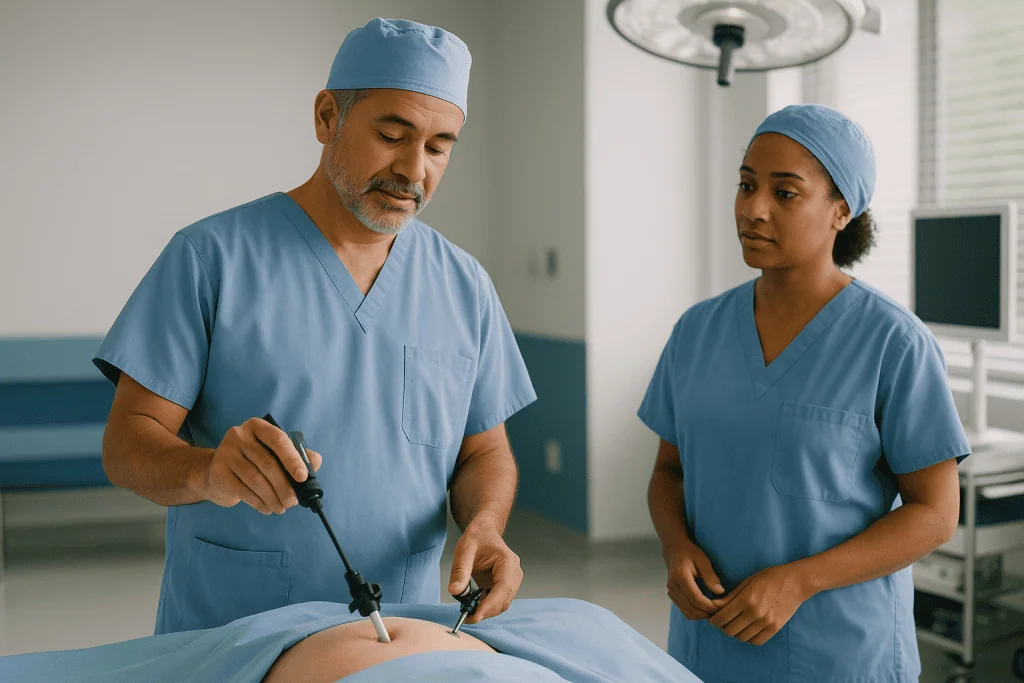
The surgeon makes a small cut, usually near the navel, and introduces gas to lift the abdominal wall away from the organs like a tent. Three to five additional ports, each a few millimeters to about a centimeter wide, are placed under direct camera vision. From there the operation proceeds much as an open operation would: the kidney, prostate or bladder is freed from surrounding tissue, blood vessels are sealed or clipped, and the diseased part is removed or repaired. If an organ has to come out whole, one port is enlarged just enough to retrieve it in a bag.
A robotic console changes where the surgeon sits, not what gets done. The wristed instruments bend in ways a human wrist cannot, which is why robotic platforms are used heavily for operations in the tight bowl of the pelvis, such as prostate removal or bladder reconstruction.
The endoscopic version skips the abdomen entirely. For a ureteroscopy, the telescope passes up the urethra, through the bladder and into the ureter, the tube that drains each kidney. A laser fiber fragments a stone into dust or retrievable pieces. For percutaneous nephrolithotomy, often shortened to PCNL, the surgeon reaches a large kidney stone through a single small tunnel in the back, guided by X-ray or ultrasound, as the NHS treatment page for kidney stones outlines.
Every version ends the same way: the team confirms there is no bleeding, closes the small wounds, and you wake up in recovery with a nurse checking your blood pressure, pain and urine output.
Laparoscopic vs open urologic surgery: what changes and what does not
The honest comparison is less dramatic than the marketing version. What changes with a laparoscopic or robotic approach is mostly the route in and the trauma to the abdominal wall. What stays the same is the operation itself and the reason for doing it.
Here is what the evidence consistently supports. Smaller incisions mean less damage to muscle and skin, so there is typically less postoperative pain and a lower need for strong pain relief. Blood loss is usually lower because the magnified view and gas pressure make small vessels easier to see and control. Hospital stays tend to be shorter and people get back on their feet sooner. Mayo Clinic lists these as the expected benefits of robotic and laparoscopic surgery, while noting they are not guaranteed for any individual.
Here is what does not change. The cancer, if there is one, has to be removed with the same margins. The stone has to come out completely. The reconstruction has to hold. For kidney cancer, the NHS makes the point plainly: keyhole and open operations aim to remove the same tissue, and the choice depends on the tumor and the surgeon’s judgment, not on which approach sounds more modern.
There are situations where open surgery still earns its place. Very large tumors, tumors growing into major veins, extensive scar tissue from earlier operations, or a need to feel tissue directly with the fingers can all tip the balance. Some surgeons also prefer an open approach when a patient’s lungs or heart cannot comfortably tolerate the gas pressure and the head-down tilt that laparoscopy often requires.
So the real question is never “keyhole or open?” in the abstract. It is “for this tumor, this stone or this blockage, which route gets the complete job done with the least harm?”
Who minimally invasive urology is usually for, and who is usually asked to wait
Surgeons think about suitability in two layers: the problem and the person.

On the problem side, minimally invasive approaches are well established for removing all or part of a kidney, removing the prostate for cancer, treating an enlarged prostate from inside the urethra, reconstructing a blocked junction between kidney and ureter, removing the adrenal gland, and treating the great majority of kidney and ureteral stones. The NIH’s National Institute of Diabetes and Digestive and Kidney Diseases describes shock wave lithotripsy, ureteroscopy and PCNL as the standard options for stones that will not pass on their own.
On the person side, the ideal candidate has reasonable heart and lung reserve, no extensive previous surgery in the same area, and a body habitus that allows safe port placement. None of these are absolute barriers. Many people with higher body weight or previous operations do well, but each factor adds complexity that your surgeon should be weighing out loud with you.
Who is asked to wait? Several groups, for different reasons. Someone with an active urinary infection usually needs it treated first, because operating on infected urine raises the risk of sepsis. Someone with uncontrolled blood pressure, poorly controlled diabetes or a recent heart event may be sent for optimization before any elective operation. People on blood-thinning medicines need a plan, agreed between the surgeon and the prescribing clinician, for whether and when to pause them; that decision belongs to those clinicians, never to the patient alone.
There is also a quieter group: people whose problem may not need surgery at all yet. Small kidney masses in older adults, small stones that are not causing symptoms, and mild prostate enlargement are often monitored rather than operated on. Being asked to wait is not a dismissal. It is often the evidence-based answer.
Minimally invasive kidney stone treatment: shock waves, scopes and tunnels
Stones deserve their own section because they are the most common reason people meet the phrase “minimally invasive urology,” and because the choice between techniques is unusually clear-cut.
Three tools dominate. Shock wave lithotripsy sends focused sound energy through the skin to crack a stone into fragments small enough to pass; there is no incision and often no general anesthetic. Ureteroscopy, described above, reaches the stone with a telescope and laser from inside. PCNL goes through a small tunnel in the back directly into the kidney and is reserved for larger or more complex stone burdens.
Which one fits depends mostly on size, location and composition. The NHS notes that stones up to about 10 mm are often candidates for shock wave treatment, that ureteroscopy is used for stones in the ureter and many in the kidney, and that PCNL is typically chosen for stones too large for the other methods. Dense stones that resist shock waves, stones in the lower part of the kidney where fragments struggle to drain, and stones in people with bleeding tendencies or pregnancy all push the decision toward a particular tool.
Two practical points often surprise people. First, you may wake from ureteroscopy with a ureteral stent, a soft hollow tube left temporarily between kidney and bladder to keep urine draining while swelling settles. Stents are common and usually short-term, but they can cause urgency, a dull flank ache and visible blood in the urine until removed. Second, shock wave treatment does not remove the stone; it breaks it, and the fragments still have to pass over the following days or weeks, which can hurt.
Ask which tool is proposed, why that one for your stone, whether a stent is planned, and what happens if fragments remain. Those four questions cover most of the decision.
Robotic urology surgery recovery time: what the following days and weeks usually look like
Recovery depends far more on which organ was operated on than on whether a robot was involved, so treat the ranges below as typical patterns, not promises. Your team’s instructions override anything written here.
After endoscopic stone surgery, many people go home the same day or the next, as the NHS stone treatment guidance describes. Expect burning on urination, pink urine and some flank discomfort for a few days, more if a stent is in place. Light activity is usually encouraged almost immediately.
After laparoscopic or robotic removal of a kidney, MedlinePlus describes a hospital stay that commonly runs from one to a few days, with most people returning to ordinary daily activities over the following weeks and avoiding heavy lifting for roughly four to six weeks while the small wounds and the deeper tissue heal. Shoulder-tip pain in the first day or two is common and comes from the surgical gas irritating the diaphragm; it fades as the gas is absorbed.
After robotic prostate removal, the distinctive feature is the catheter, which usually stays in for about one to two weeks while the new join between bladder and urethra heals, according to Cleveland Clinic’s overview of the procedure. Urinary leakage and changes in erections are expected early on and improve over months rather than weeks for many, though the degree varies and no surgeon can promise an individual result.
Across all of these, a few rules hold. Walk early and often; it lowers the risk of blood clots and chest infections. Drink enough that your urine stays pale unless told otherwise. Expect fatigue out of proportion to the size of the scars; the body is healing an operation, not a wound. And keep every follow-up appointment, because that is where stent removal, catheter removal and pathology results happen.
Comparing minimally invasive urology approaches at a glance
A table cannot make the decision, but it can show why your surgeon’s answer for a stone will sound nothing like a colleague’s answer for a kidney tumor. The entries below summarize the typical pattern described by the NHS, MedlinePlus and Mayo Clinic resources cited at the end of this article; your own course may differ.
| Approach | Typical uses | Entry point | Anesthesia usually | Typical hospital stay | Distinctive early issues |
|---|---|---|---|---|---|
| Shock wave lithotripsy | Smaller kidney and upper ureter stones | None; energy through skin | Sedation or light general | Day case | Fragments must pass; bruising on flank |
| Ureteroscopy | Ureteral and many kidney stones, small upper tract tumors | Natural passage via urethra | General or spinal | Day case to overnight | Stent symptoms, burning, pink urine |
| PCNL | Large or complex kidney stones | Small tunnel through the back | General | One to a few nights | Temporary drainage tube, flank soreness |
| Laparoscopic or robotic | Kidney, prostate, adrenal, bladder, reconstruction | Three to five small abdominal ports | General | One to several nights depending on organ | Shoulder-tip gas pain, catheter, lifting limits |
| Open surgery | Very large tumors, vein involvement, dense scarring | Single larger incision | General | Longer than keyhole equivalent | More wound pain, longer lifting restriction |
Two observations jump out. The first is that “minimally invasive” spans everything from a half-day appointment to a major operation with a multi-night stay. The second is that open surgery still sits on the list, not as a failure but as a deliberate choice for specific anatomy. If your surgeon recommends it, the right response is “what about my case makes open the safer route?” rather than “can we not do it with the robot?”
What the evidence actually shows about the benefits of keyhole and robotic urology
It is worth separating the claims that are well supported from those that are plausible but softer.
Well supported: compared with the equivalent open operation, laparoscopic and robotic approaches tend to produce less blood loss, less postoperative pain, shorter hospital stays and faster return to normal activity. Mayo Clinic and Cleveland Clinic both summarize these as the expected advantages, and they align with decades of surgical experience across specialties. Smaller wounds also mean a lower risk of incisional hernia, where tissue bulges through a weakened scar.
Softer: the idea that robotic surgery is clinically superior to conventional laparoscopy performed by an equally experienced surgeon. For most urologic operations, the robot’s advantage is ergonomic and visual. It makes delicate suturing in the deep pelvis easier for the surgeon, which may translate into more consistent results, but head-to-head trials have generally found the two approaches comparable on the outcomes that matter to patients. When the evidence is uncertain, the honest statement is that the robot changes how the operation feels to perform more than it changes what is achieved.
Also softer: any suggestion that a minimally invasive approach removes a cancer more completely or controls it for longer. The approach is a route; completeness depends on the disease and the surgeon. Guidelines from major urology bodies treat open and minimally invasive radical surgery as acceptable options for suitable patients, with the choice guided by anatomy and expertise rather than by one being inherently better at treating the cancer.
Why does this matter to you? Because it reframes the question. You are not choosing between a good operation and a worse one. You are choosing a route, and the most important variable in that choice is probably the experience of the team with the specific route they propose. That is a fair thing to ask about directly.
Risks of minimally invasive urologic surgery, and the "conversion to open" conversation
Smaller scars do not mean smaller risks. The risk profile shifts; it does not disappear.
Shared with all surgery: bleeding that may need transfusion, infection of a wound or of the urine, blood clots in the legs or lungs, reactions to anesthesia, and injury to nearby structures such as bowel, blood vessels or the spleen. In kidney and prostate surgery, injury to the ureter or the rectum is rare but serious. MedlinePlus lists these among the recognized risks of kidney removal regardless of approach.
Specific to laparoscopy and robotics: complications from placing the first port blindly or from the gas itself, including irritation of the diaphragm and, rarely, gas entering a blood vessel. The steep head-down position used in pelvic robotic surgery can raise pressure in the eyes and face and strain the heart and lungs over a long operation, which is one reason people with significant heart or lung disease are assessed carefully beforehand.
Specific to endoscopic stone surgery: perforation or scarring of the ureter, residual fragments that need a second procedure, and sepsis if infected urine is pushed back into the bloodstream. Stent-related symptoms are near-universal rather than a complication, but they still catch people off guard.
Then there is conversion. Every laparoscopic or robotic operation carries a possibility that the surgeon will need to switch to an open incision mid-procedure, most often because of bleeding, dense scar tissue or anatomy that cannot be safely handled through the ports. Conversion is a safety decision, not a failure, and consenting to a keyhole operation means consenting to the possibility of waking with a larger scar. Ask your surgeon how often this happens in their hands and for your kind of case. A team that answers that question comfortably, with a real number from their own practice, is telling you something reassuring about how they work.
The alternatives: active surveillance, medicines, and the option of not operating yet
A plan is only a good plan if it was chosen against the alternatives, so it is reasonable to ask your team to lay them out even if surgery still wins.
Active surveillance means monitoring a condition with scans or tests at set intervals and intervening only if it grows or changes. It is a recognized strategy for small kidney masses, particularly in older adults or people with other serious illnesses, where the mass may never cause harm within a person’s lifetime. It is also the standard first approach for many low-risk prostate cancers. Surveillance is not neglect; it is a treatment decision with its own schedule and exit criteria.
Medicines play a central role in two of urology’s biggest workloads. For an enlarged prostate, drug classes that relax the muscle at the bladder outlet or shrink prostate tissue over months can relieve symptoms enough that surgery is never needed; the prescribing clinician decides whether that path fits, and how long to try it before judging the result. For small ureteral stones, a short course of a muscle-relaxing medicine is sometimes used to help a stone pass, alongside pain relief and fluids. The mechanism and typical timelines are things to ask about; the choice to start, continue or stop any of these belongs with the prescriber.
Watchful waiting, as distinct from surveillance, applies where a problem is mild and the person is not bothered. Many small, silent kidney stones fall into this category. The NHS notes that most small stones pass on their own and that treatment is reserved for stones causing pain, blockage or infection.
Finally, open surgery itself is an alternative, and for some anatomy the better one. Hearing “we could also do this open, and here is why we are not” is a sign of a surgeon who has genuinely weighed the options.
What people often get wrong about minimally invasive urology
Some of these myths come from hopeful marketing, some from well-meaning friends, and some from the word “minimally” itself.
“Minimally invasive means minor.” It means small entry points. Removing a kidney or a prostate through ports is major surgery under general anesthesia with real recovery and real risks. Plan your time off and your support at home accordingly.
“The robot does the surgery.” It does not. Every movement is made by the surgeon at the console. The platform magnifies, steadies and articulates; it has no independent function. Your outcome rests on the human, which is why experience with the specific operation is the question to ask.
“Keyhole is always better than open.” For many cases it offers a gentler recovery with equivalent results. For some, open surgery is safer and more complete. The surgeon who recommends open for your tumor may be exercising exactly the judgment you want.
“I will feel fine in a few days.” Pain usually eases quickly, but fatigue, appetite changes and the simple work of healing last weeks. The scars heal faster than the inside does.
“If they break up my stone, it is gone.” Shock wave lithotripsy fragments stones; the pieces still have to pass. Ureteroscopy can leave small residual fragments that are monitored or treated later. Ask what “stone-free” means in your plan.
“A stent is a complication.” Stents are a planned, temporary part of many stone operations. Their symptoms are expected, not a sign something went wrong, though severe pain or fever still warrant a call.
“Newer always means better.” The evidence favors experience and appropriate selection over novelty. A technique being new is not, by itself, a reason to choose it.
Questions to ask your care team before agreeing to a minimally invasive plan
Write these down and bring them. A good team welcomes the list; it shortens the conversation rather than lengthening it.
- Which minimally invasive technique exactly, and why that one for my case? Laparoscopic, robotic, ureteroscopic and percutaneous are different operations with different trade-offs.
- What are the alternatives, including surveillance, medicines and open surgery, and why do you prefer this option?
- How often do you perform this specific operation, and how often does it convert to open in your practice? You are asking about the team, not challenging it.
- What does recovery look like week by week, and when can I expect to drive, work, lift and exercise? Ask for ranges tied to your operation, not general figures.
- Will I have a stent, catheter or drain, how long is it likely to stay, and how is it removed?
- Which of my medicines need a plan before surgery, and who is making that decision? This should sit with the surgeon and your prescribing clinician together.
- What are the specific risks for someone with my history? Previous abdominal surgery, heart or lung disease, diabetes and kidney function all change the picture.
- If a cancer is involved, how will the completeness of removal be confirmed, and when will I get those results?
- What symptoms after surgery should make me call, and what number do I call?
- If I want a second opinion, how do I arrange one without delaying care? Asking this is normal and should be received as such.
Listen for how the answers are given as much as what is said. Specific numbers, acknowledged uncertainty and a willingness to describe the alternatives fairly are the hallmarks of a team that has already asked itself your questions.
Is minimally invasive urology right for me? A framework for weighing the answer
By this point the question has split into four smaller ones, and each has a reasonably clear way to think about it.
Is the problem one that needs treating now? If surveillance or medicines are legitimate options, the choice of surgical technique is premature. Settle the “whether” before the “how.”
Is the problem anatomically suited to the proposed route? This is the surgeon’s call, but you can test it. Ask what features of your scan make the keyhole route reasonable and what would have pushed them toward open. A confident, specific answer is reassuring. A vague “we do everything robotically” is not.
Is my body suited to it? Heart and lung reserve, previous operations, current infections and medicines that affect bleeding all matter. If your team has not asked about these, raise them yourself.
Is this team suited to it? Experience with the specific operation is one of the most consistent predictors of smooth surgery across the literature. You are entitled to ask how many of these procedures the team performs and how they handle complications.
If all four answers line up, the gentler recovery of a minimally invasive approach is a genuine gain and a sensible choice. If any one of them wobbles, that is not a reason to refuse surgery; it is a reason to ask one more question, request a second opinion, or accept that open surgery may be the better route for you.
The decision ultimately rests with your treating team, who can see the scans and know the trade-offs. Your part is to make sure the decision is about you, not about the technique. A folded drawing of three small circles is a fine place to start that conversation, as long as the conversation actually happens.
When to call your doctor: red-flag signs after minimally invasive urologic surgery
Most recoveries are uneventful, and most of the sensations in the first week are expected: mild wound soreness, shoulder-tip discomfort from gas, pink-tinged urine, stent urgency, and tiredness. The signs below are different. They suggest bleeding, infection, a blocked kidney or a clot, and they need prompt assessment rather than waiting for the next scheduled visit. Your team will have given you a direct number; use it.
Call the same day or seek urgent care if you notice:
- Fever, shaking chills or feeling suddenly very unwell, which can signal urinary infection or sepsis, particularly after stone surgery.
- Urine that is dark red or contains clots, or any bleeding that is increasing rather than settling.
- Inability to pass urine, or a catheter that stops draining despite drinking normally.
- Severe or escalating flank or abdominal pain not relieved by the pain plan you were given, or a belly that is becoming swollen and hard.
- Redness, warmth, spreading swelling or pus at any wound site.
- Persistent vomiting, or inability to keep fluids down for more than a day.
- A swollen, painful calf, which may indicate a blood clot.
Call emergency services immediately for sudden chest pain, shortness of breath, coughing up blood, fainting, or confusion. These can indicate a clot that has traveled to the lungs or a serious bleed, and minutes matter.
Before surgery, there are red flags too. If you develop a fever, burning urination, a new cough or chest symptoms in the days before your operation, tell the team; operating through an active infection raises risk, and a short postponement is often the safer decision. None of this is cause for alarm. It is simply the part of the plan where you know exactly what to watch for and whom to tell.
Frequently asked questions
What is the difference between laparoscopic and robotic urologic surgery?
Both use small incisions and a camera; the difference is how the instruments are controlled. In laparoscopy the surgeon holds long instruments directly. In robotic-assisted surgery the surgeon operates from a console and mechanical arms hold wristed instruments that bend more freely and filter hand tremor. The robot performs no independent action. For most urologic operations the two approaches produce comparable results in experienced hands, with the robot mainly easing delicate work deep in the pelvis.
Is minimally invasive surgery safe for older adults with heart or lung problems?
Often yes, but it depends on assessment. Laparoscopic and robotic surgery use gas pressure in the abdomen and sometimes a steep head-down position, both of which stress the heart and lungs during a long operation. An anesthetist will evaluate your reserve beforehand, and for some people an open approach, a shorter endoscopic procedure or surveillance may be safer. Share your full medical history and medication list so the team can weigh these factors properly.
What are the most important questions to ask a urologist before surgery?
Ask which exact technique is proposed and why for your anatomy, what the alternatives are including surveillance and open surgery, how often the surgeon performs this specific operation, how often it converts to open in their practice, what recovery looks like week by week, whether you will have a stent or catheter and for how long, and which of your medicines need a plan before surgery. Also ask what symptoms should prompt a call afterward.
How long is robotic urology surgery recovery time compared with open surgery?
Recovery depends more on the organ than on the robot. MedlinePlus describes hospital stays after keyhole kidney removal commonly lasting one to a few days, with heavy lifting avoided for roughly four to six weeks. After robotic prostate removal the catheter usually stays about one to two weeks. Open equivalents typically involve a longer stay and more wound pain. These are typical ranges, not promises, and your team’s instructions take priority.
Which minimally invasive kidney stone treatment is used for which stones?
Size and location drive the choice. The NHS notes shock wave lithotripsy is often used for stones up to about 10 mm, ureteroscopy with laser for stones in the ureter and many in the kidney, and percutaneous nephrolithotomy for stones too large for the other methods. Stone density, position in the lower kidney, pregnancy and bleeding risk also shift the decision. Ask which tool is proposed, why, and whether a stent is planned.
Why would a surgeon recommend open surgery instead of a minimally invasive approach?
Usually because of anatomy. Very large tumors, tumors extending into major veins, extensive scar tissue from previous operations, or a need to feel tissue directly can make open surgery safer and more complete. Some heart or lung conditions also make the gas pressure and positioning of laparoscopy risky. A recommendation for open surgery is a judgment about your case, not a step backward, and you can ask what features of your scans led to it.
What does conversion to open surgery mean, and how common is it?
Conversion means the surgeon switches from keyhole ports to a traditional incision during the operation, most often because of bleeding, dense adhesions or anatomy that cannot be safely handled through small openings. It is a safety decision rather than a failure. Rates vary by operation, patient and surgeon, so general figures are not very useful; ask your own team how often it happens for your type of case in their practice.
Do I always need a stent or catheter after minimally invasive urologic surgery?
Not always, but often. A ureteral stent is common after ureteroscopy to keep the kidney draining while swelling settles, and it causes urgency, flank ache and pink urine until removed. A urinary catheter is placed during most abdominal procedures and is removed within a day or two for many operations, but stays about one to two weeks after prostate removal while the new connection heals. Ask what is planned for your operation.
Can a small kidney mass or small stone be monitored instead of operated on?
Yes, in many cases. Active surveillance with periodic imaging is a recognized option for small kidney masses, particularly in older adults or people with other serious illnesses, since many such masses grow slowly. The NHS notes most small kidney stones pass on their own and treatment is reserved for stones causing pain, blockage or infection. Whether monitoring suits you is a decision for your treating team based on your scans and health.
What symptoms after urologic surgery mean I should call the doctor right away?
Fever or chills, urine that is dark red or contains clots, inability to pass urine or a catheter that stops draining, severe or worsening pain, a hard swollen abdomen, wound redness or pus, persistent vomiting, or a swollen painful calf all need same-day contact. Chest pain, breathlessness, coughing blood, fainting or confusion require emergency services immediately. Mild soreness, shoulder-tip discomfort and pink-tinged urine in the first days are usually expected.
References
- NHS: Kidney stones, treatment
- NHS: Kidney cancer, treatment
- MedlinePlus: Kidney removal
- NIH NIDDK: Treatment for kidney stones
This article is for general information only and is not a substitute for professional medical advice. Please consult a qualified doctor about your individual situation.

More from the Blog

Packing for Urological Surgery: A Companion’s Checklist for the Ward and the Trip Home
What to pack for urology surgery comes down to three small bags: a document folder (medicine list, allergy card, consent and contact numbers), ward…

Why Is Urodynamic Testing Done After Spinal Cord Injury or Stroke? Neurogenic Bladder Explained
Urodynamic testing is done after spinal cord injury or stroke because a bladder that has lost its normal nerve control can store urine at…

Why Low Testosterone Is Confirmed With Two Morning Blood Tests Before Treatment Begins
Low testosterone is confirmed with two separate morning blood tests because testosterone peaks early in the day, swings from hour to hour and day…

Bladder Scanner vs Catheter Measurement: Two Ways to Do a Post Void Residual Test Compared
A bladder scan and a catheter measurement both check post void residual, the urine left in the bladder right after urinating. The scanner estimates…

How Uremic Syndrome Is Treated: Stabilization, Dialysis When Needed and Longer-Term Care
Uremic syndrome treatment has three layers. First, clinicians stabilize the patient by correcting dangerous potassium, acid, fluid and heart-rhythm problems and treating any reversible…

Leaks, Urgency or Repeat Infections: How Female Bladder Care Is Planned Step by Step
Female bladder problems treatment starts by identifying which problem is present: stress leaks, urgency, repeat infections, or a mix. Care then moves in steps,…