

Knee Clicking: When It Matters and When It Does Not
Key Takeaways
- Most knee clicks come from gas shifting in joint fluid or tendons sliding over bone, neither of which damages the joint.
- Painless clicking with full movement is classed as physiologic crepitus and is considered a normal finding at any age.
- Osteoarthritis is signaled by stiffness after rest, swelling, and deep ache far more than by sound, which is its least specific feature.
- A meniscus tear typically follows a twist and brings swelling, pain on rotation, and sometimes true locking, a combination the everyday click does not produce.
- Grinding behind the kneecap that aches on stairs or after sitting points to kneecap tracking, one of the causes most responsive to hip and thigh strengthening.
- A knee that cannot bear weight, has locked, looks deformed, or is hot and red with fever needs same-day care regardless of how it sounds.
Knees click for several ordinary reasons: gas bubbles shifting in joint fluid, tendons or ligaments sliding over bone, or slightly roughened cartilage surfaces moving past each other. Painless clicking without swelling, locking, or giving way is usually harmless and common at every age. Clicking that comes with pain, swelling, a knee that locks or feels unstable, or that began after an injury deserves a medical evaluation.
Picture a quiet office at 8:40 in the morning. Someone stands up from a chair, and their knee announces it, a crisp pop loud enough that the colleague two desks over looks up. Nothing hurts. The person laughs it off, walks to the coffee machine, and forgets about it until the same knee does it again on the stairs that evening.
That small scene plays out in millions of households, and it is the reason this question ranks so high in search engines. The noise feels like it should mean something. Bones are not supposed to sound like bubble wrap, or so the instinct goes.
The honest answer is more reassuring, and more interesting, than either extreme you will read online. A clicking knee is neither proof that something is wearing out nor a sound to ignore in every case. The difference lies almost entirely in what travels with the sound: pain, swelling, locking, or a recent twist. Let us separate the mechanics from the myths.
What is actually making the noise inside my knee?
The knee is the largest joint in the body, and it is a busy one. Two long bones meet there, a floating kneecap glides in a groove on the front, and the whole assembly is wrapped in ligaments, tendons, and a capsule filled with lubricating fluid. Plenty of parts can make a sound.
Clinicians group these sounds under one word: crepitus. It covers everything from a single sharp pop to a fine, sandy grinding you can feel with your hand on the kneecap. Three mechanisms explain almost all of it.
The first is gas. Joint fluid holds dissolved gases, and when the joint capsule stretches quickly, pressure inside drops and a small cavity forms and collapses. That is the same event that makes knuckles crack. It is sudden, usually painless, and cannot be repeated immediately because the gas takes time to redissolve.
The second is soft tissue moving over bone. Tendons and ligaments run across bony ridges around the knee, and a tight band snapping over one of those ridges produces a duller click, often in the same spot every time you bend to a particular angle.
The third is cartilage. The smooth surfaces that let bone glide on bone are not perfectly polished in anyone past their teens. Tiny irregularities catching and releasing can create a grinding that is louder when the joint is loaded, such as on a deep squat or a staircase descent.
None of these mechanisms is inherently harmful. What matters is which one you have, and what else is happening alongside it.
Is it bad if your knee clicks every time you bend it?
A click that arrives on schedule, at the same angle, every single time, tends to worry people more than an occasional pop. Repetition feels like a mechanical fault. In most cases it is closer to a mechanical signature.
Think of a door that creaks at exactly the point where the hinge takes the most weight. The creak is reliable because the geometry is reliable. A tendon that snaps over a bony prominence at 90 degrees of bend will do so every time you pass through 90 degrees. A kneecap that sits a few millimeters off center in its groove will scrape at the same moment of every squat. Predictability is not the same as progression.
The question to ask is whether anything besides the sound is changing. According to the NHS, knee pain that comes with a noise is common and often improves on its own, and it is the pain, swelling, or difficulty moving that guide whether a check is needed, not the noise itself. A knee that has clicked identically for years, with no swelling and full movement, is telling you about its shape, not about damage.
A knee whose click has recently arrived, is now accompanied by an ache after sitting, or has started to feel as though it might give way on stairs is a different story. Here the sound is a passenger to a symptom that deserves attention. Track the passenger, not the sound. If you can bend fully, straighten fully, squat, kneel, and climb without pain or catching, a consistent click is very unlikely to signal structural harm.
Why does my knee click but not hurt?
Painless clicking has a name in orthopedics: physiologic crepitus. It is regarded as a normal finding, in the same category as a joint that hyperextends slightly or a shoulder that clunks when you stretch overhead. It is common in healthy, active people and in people who have never had a knee injury.
Why some knees are noisier than others comes down to anatomy that varies from person to person. The depth of the groove that holds the kneecap, the angle at which the thigh meets the shin, the tightness of the band of tissue running down the outside of the thigh, even how much fluid the joint produces on a given day, all shape the acoustics.
Position matters too. A knee that has been bent under a desk for two hours has had its fluid settle and its gases concentrate. The first straightening is more likely to pop. Cold mornings, long car rides, and the first few reps at the gym are all familiar triggers.
A useful test you can do at home is the one clinicians use informally: press your palm lightly over the kneecap while you slowly bend and straighten. A faint vibration or a single pop with no discomfort is the physiologic pattern. A coarse grinding you can feel through your hand, especially if it comes with a dull ache under the kneecap, is worth mentioning at your next visit, though even that is frequently benign.
The Mayo Clinic notes that crepitus without pain generally needs no treatment. The absence of pain is not a loophole. It is the single most informative piece of evidence you have.
Does knee clicking mean arthritis?
Here is where the myth does the most damage, because it makes healthy people feel their knees are on a countdown. Clicking alone does not diagnose osteoarthritis. Plenty of people with loud knees have pristine cartilage on imaging, and plenty of people with advanced arthritis have quiet joints.
What the evidence actually supports is narrower. Osteoarthritis, as described by the NIH’s National Institute of Arthritis and Musculoskeletal and Skin Diseases, involves gradual breakdown of the cartilage that cushions the ends of bones, and one of its recognized symptoms is a grating or crackling sensation when the joint moves. So crepitus can be part of the picture. It is one clue among several, and it is the least specific of them.
The clues that carry more weight are stiffness after rest that eases with movement, pain that builds through the day or after activity, swelling that comes and goes, and a slow loss of the ability to fully straighten or bend. Osteoarthritis also tends to arrive with company: it is more common after age 50, after a previous knee injury, and in people carrying more body weight, because load on the joint accelerates cartilage wear.
The grinding of osteoarthritis usually feels different from a tendon snap or a gas pop. It is continuous through the range of motion, rougher, and most people describe it as sandpaper rather than a click. It often pairs with a deep ache rather than a sharp twinge.
If you have painless clicking and none of the accompanying symptoms, the honest reading of the evidence is that your knee is not telling you about arthritis. If the grinding has started to hurt, or morning stiffness has crept in, a clinician can assess the whole pattern rather than the sound in isolation.
Does knee clicking mean a meniscus tear?
The meniscus is a pair of C-shaped cartilage pads that sit between thigh bone and shin bone, acting as shock absorbers and stabilizers. Tears are among the most common knee injuries, according to the Mayo Clinic, and they can indeed cause a click. So can dozens of things that are not tears.
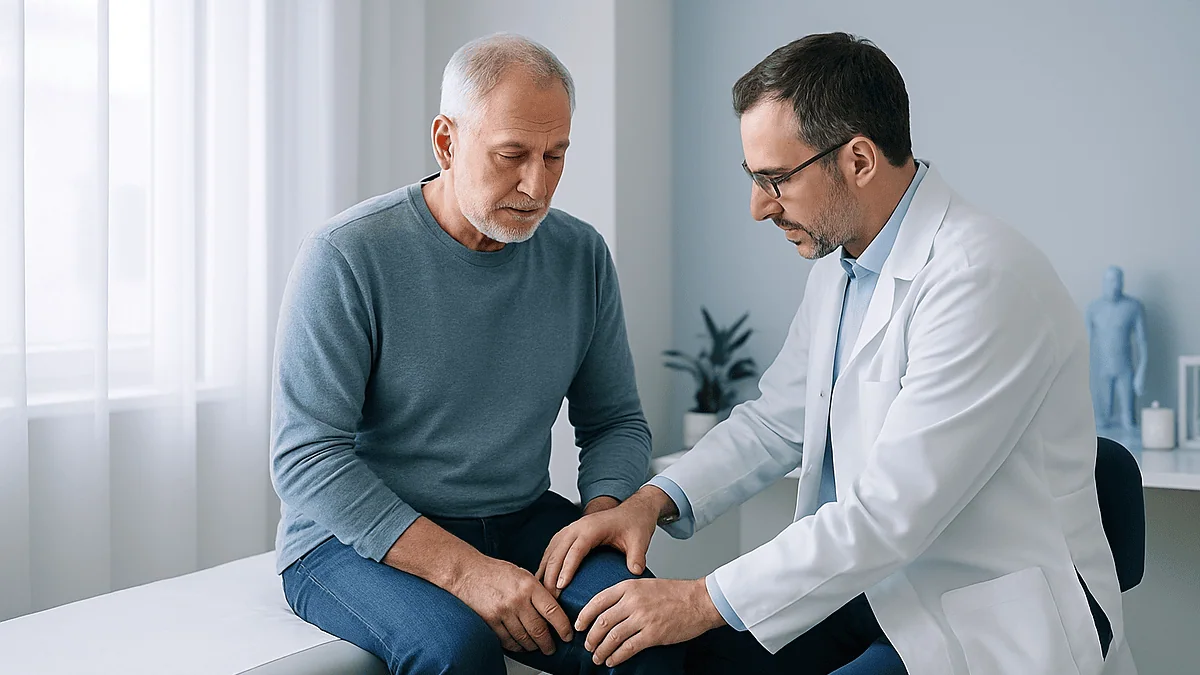
The distinguishing feature of a meniscus problem is rarely the sound. It is the story around it. Tears typically follow a twist, a pivot, or a squat with the foot planted, often during sport but sometimes during something as ordinary as standing up from a low chair. Older meniscus tissue is more brittle and can tear with less force.
Symptoms the Mayo Clinic lists for a torn meniscus include pain, especially when twisting or rotating the knee, swelling and stiffness that build over a day or two, difficulty straightening the knee fully, and a sensation of the knee locking in place or being unable to move through its full range. A popping sensation at the moment of injury is common, and some people feel a persistent catch afterward.
Compare that with the everyday click: no injury event, no swelling, no locking, and full straightening. Those two pictures do not overlap much.
One more distinction helps. A torn flap of meniscus can physically block the joint, producing a true mechanical lock where the knee gets stuck bent and needs to be wiggled free. Physiologic crepitus never does that. If your knee has locked, even once, it moves the click from background noise into something that warrants an examination. If it simply pops and carries on, the meniscus is an unlikely suspect.
Why does my knee grind under the kneecap when I squat or climb stairs?
A specific kind of noise deserves its own explanation: a grinding or rubbing sensation right behind the kneecap, most noticeable on stairs, deep squats, or after sitting with knees bent for a movie. It often comes with a dull ache in the same spot.
This pattern points toward the patellofemoral joint, the interface where the kneecap glides in its groove at the front of the thigh bone. The Mayo Clinic describes patellofemoral pain syndrome as pain at the front of the knee around the kneecap, common in runners and jumpers, and often worsened by squatting, kneeling, stairs, and prolonged sitting. Grinding or clicking is a frequent accompaniment.
The mechanism is tracking. The kneecap is supposed to ride centrally in its groove. When the muscles that guide it are imbalanced, when the hip is weak and lets the thigh rotate inward, or when foot mechanics tilt the shin, the kneecap can drift slightly and rub against the sides of the groove. The result is pressure on the cartilage under the kneecap, an ache, and a sound.
The encouraging part is that this is one of the more responsive causes of knee noise. Because it is driven by muscle control rather than a torn structure, it often improves with targeted strengthening of the thigh and hip muscles and with adjusting training load. Many people notice the grinding fades as the ache does.
If the sensation is painless, it may simply be your anatomy, since the depth and shape of the groove vary between people. If it hurts, especially when you sit for a long time and then stand, that is the pattern worth mentioning to a clinician or physical therapist.
My knee started clicking after an injury or surgery. Is that normal?
New noise after a known event is a different category from lifelong clicking, and it deserves a more careful look, though not necessarily an alarmed one.
After a sprain, fall, or twist, the knee often swells. Swelling changes the pressure and volume of fluid inside the joint, which alters how gases dissolve and how tissues slide. A knee that was quiet before and clicks for a few weeks afterward may simply be reflecting that changed environment. As swelling resolves and normal movement returns, the sound frequently settles.
Surgery is a bigger disruption. Any procedure that opens or enters the joint leaves scar tissue, and scar tissue does not glide like the tissue it replaces. Clicking or catching in the months after a knee operation is common and is usually discussed by surgical teams as an expected part of recovery. The joint is relearning how to move, and the muscles around it have often weakened during the period of restricted activity.
What should prompt a call to the team that treated you is a change in the pattern rather than the presence of sound. A click that becomes painful, a knee that begins to lock or give way, swelling that returns after it had gone, or warmth and redness around the joint are the signals to report. The Mayo Clinic lists inability to bear weight, marked swelling, obvious deformity, and fever with a red, painful joint as reasons to seek prompt care.
Follow the rehabilitation plan you were given. The strengthening exercises in those plans are not busywork; they restore the muscular control that keeps the joint tracking smoothly, and a smoother-tracking joint is very often a quieter one.
Why are my knees louder than they used to be?
People in their forties and fifties often report that knees which were silent at 25 have become percussive. This shift is real, and it has explanations that stop well short of damage.
Cartilage changes texture over decades. The glassy surface of a young joint gradually develops microscopic roughness. This is a universal process, and on its own it produces sound long before it produces symptoms. Two surfaces that used to glide silently now catch and release in small ways, and each catch is a tiny click.
Joint fluid changes too. Its viscosity and volume are not fixed, and the way gases dissolve in it shifts with age, hydration, and activity. Tendons lose some of their elasticity and may snap over bone more abruptly than a supple younger tendon would.
Muscle also declines without deliberate effort, and weaker thigh and hip muscles offer less guidance to the kneecap and less shock absorption for the whole joint. That is one reason noise sometimes drops off when someone starts a strength program: not because cartilage regrew, but because the joint is better controlled.
The NIH notes that osteoarthritis becomes more common with age, and it would be dishonest to pretend age-related noise never overlaps with early cartilage wear. The distinction, again, is whether pain, stiffness after rest, or reduced motion are present. A louder but pain-free knee at 50 is behaving like most knees at 50.
What you can influence is the muscular side of the equation. Cartilage texture is largely outside your control. The strength and coordination of the muscles that guide the joint are not, and they respond to training at any age.
Sound versus symptoms: what the pattern usually suggests
Reading a knee is a matter of pattern recognition. The table below lays out the common sound types alongside the features that typically distinguish a harmless noise from one that merits assessment. It is a guide to thinking, not a diagnostic tool; only an examination can confirm what is happening.
| What you notice | Most likely mechanism | Reassuring if | Worth evaluating if |
|---|---|---|---|
| Single sharp pop, not repeatable right away | Gas shifting in joint fluid | No pain, full movement | Pop happened during an injury and swelling followed |
| Click at the same angle every time | Tendon or ligament sliding over bone | Present for years, painless | Newly painful, or a snapping sensation with instability |
| Fine grinding under the kneecap | Kneecap tracking in its groove | No ache, no stiffness after sitting | Front-of-knee ache on stairs, squats, or after prolonged sitting |
| Coarse, continuous grating through the whole bend | Roughened joint cartilage | Painless and long-standing | Morning stiffness, swelling, deep ache, loss of motion |
| Click followed by catching or a true lock | Possible meniscus or loose fragment | Rarely reassuring | Any locking, especially after a twist |
Two threads run through every row. Pain and locking are the features that shift a sound from curiosity to symptom. A knee that moves fully and comfortably, however loud, is behaving like a healthy joint.
How do I get my knee to stop clicking?
The most honest answer is that you may not be able to, and you may not need to. If the click is painless and caused by the shape of your bones or the position of a tendon, no exercise will change your anatomy, and no reputable clinician will promise silence.
The realistic goal is different: a knee that is strong, mobile, and comfortable. When people pursue that goal, the noise often diminishes as a side effect, because a well-controlled joint tracks more smoothly and the tissues around it move with less friction.
Strengthening the quadriceps, the large muscle group at the front of the thigh, is the foundation. These muscles guide the kneecap and absorb load. The hip muscles matter almost as much. Weak muscles on the outer hip allow the thigh to rotate inward during walking and squatting, which pulls the kneecap off center. Physical therapists frequently prioritize hip strength for exactly this reason.
Flexibility contributes too. A tight band of tissue along the outer thigh or tight calf and hamstring muscles can alter how the knee moves through its range. Gentle, regular stretching addresses this over weeks rather than days.
Warming up before activity helps in the short term. Fluid circulates, tissues become more pliable, and the first-movement pop that happens after sitting is less likely. A few minutes of easy walking or cycling before harder effort is enough.
What does not help: forcing the knee to crack repeatedly to relieve a sensation of tightness, or stopping all activity to protect the joint. Motion nourishes cartilage. A knee that is moved regularly and loaded sensibly is healthier than one kept still.
What kind of exercise is safe for a clicking knee?
People with noisy knees often quietly abandon activities they enjoy, reasoning that the sound is a warning. For the painless click, that is a loss with no benefit. For the painful one, the choice of movement matters more than the decision to move.
Low-impact activities load the joint without pounding it. Cycling, swimming, and walking on level ground keep the knee moving through its range with modest force. The Mayo Clinic’s guidance on knee pain highlights choosing activities such as swimming or cycling when knees are sore, and building strength in the muscles that support the joint.
Strength training belongs on the list, not off it. The key is range and load. Partial squats, leg presses through a comfortable arc, step-ups onto a low step, and exercises that target the outer hip build the control that keeps the kneecap centered. Start with body weight or light resistance and progress gradually. The rule of thumb many therapists use is that mild discomfort during exercise that settles within a day is acceptable, while pain that lingers or swelling the next morning means the load was too much.
Deep squats, lunges, and jumping are not forbidden, but they are high-load positions for the kneecap. If they hurt, reduce depth or volume before removing them entirely. Pain-free clicking during these movements is not a reason to stop.
Consistency beats intensity. Muscles adapt over weeks, not sessions. A modest program done three times a week for two months will change how a knee feels far more than an ambitious one abandoned after ten days.
If exercise consistently provokes pain, swelling, or a sense of instability, that pattern should be assessed before continuing, ideally by a clinician who can watch how you move.
Does cracking your knee cause arthritis or damage?
This is the fear behind the fear. Many people believe each pop is grinding away cartilage, and that a lifetime of clicks adds up to a worn-out joint. The evidence does not support that idea.
The gas-bubble mechanism, the one behind most sudden pops, involves fluid and dissolved gas, not cartilage contacting cartilage. No tissue is abraded when a bubble forms and collapses. The long-standing research on habitual knuckle cracking has failed to find a link to arthritis, and there is no reason the knee would behave differently.
Tendon snaps are similarly benign in themselves. A tendon flicking over a bony ridge does not wear the ridge down, though repeated snapping that becomes painful can indicate the tendon is irritated, which is a soft-tissue issue rather than joint damage.
The one scenario where sound and damage genuinely coexist is the coarse grinding of established osteoarthritis. Even here, causation runs the other way: the roughened cartilage causes the sound. The sound does not cause the roughening. Moving an arthritic knee, noise and all, is generally recommended over resting it, because motion supports cartilage nutrition and maintains the muscle strength that protects the joint.
What can plausibly harm a knee over time is not noise but load without preparation: sudden increases in training, repeated high-impact activity on weak muscles, or ignoring pain and swelling until a small problem becomes a large one. Those are the habits worth changing.
So the reassurance is straightforward. You are not wearing your knee out by letting it pop. You would be doing it a disservice by avoiding movement because of the sound.
When should I see a doctor about a clicking knee?
Most clicking knees never need a clinic. The sound alone, without any of the features below, is not a reason to book an appointment. The features that change that calculation are well established and worth knowing by heart.
Seek care promptly, the same day or at an urgent care setting, if any of these apply. The Mayo Clinic advises immediate attention for a knee that cannot bear weight or feels unstable, marked swelling, an obvious deformity of the leg or knee, inability to fully straighten or bend the knee, or a fever together with redness, pain, and swelling in the joint. A knee that has locked and cannot be freed belongs on this list, as does any noise that began with a fall, a collision, or a hard twist and was followed by rapid swelling.
Arrange a routine appointment if the click has become painful, if you have developed stiffness after rest that takes more than a few minutes to ease, if swelling comes and goes without an obvious cause, or if the knee feels as though it might give way on stairs or uneven ground. The NHS suggests seeing a GP if knee pain is severe, does not improve within a few weeks, or stops you doing normal activities.
Red flags in one place: cannot bear weight, locked knee, visible deformity, hot and red joint with fever, sudden large swelling, or a pop during injury followed by instability. Any one of these warrants a same-day evaluation.
Everything else, the isolated painless click, the years-old pop on standing, the grind you can feel but not feel hurting, can wait for a routine visit or does not need one at all. Trust the symptoms, not the sound.
What happens at an appointment for knee noise?
Knowing what to expect lowers the barrier to going, so here is the usual shape of a visit for a knee that clicks and hurts.
The conversation comes first, and it does most of the work. A clinician will want to know when the noise started, whether an injury preceded it, what movements provoke pain, whether the knee has ever locked or given way, and how stiffness behaves after rest. This history alone often points strongly toward one mechanism.
The physical examination follows. Expect the clinician to watch you walk, to feel around the kneecap and joint line for tenderness, to check for fluid in the joint, and to move the knee through specific positions that stress the meniscus, the ligaments, or the kneecap. Crepitus is assessed by feel as much as by sound, with a hand placed over the kneecap during movement.
Imaging is not automatic. MedlinePlus notes that X-rays can show bone alignment and arthritis-related changes, while MRI is used when soft tissue such as the meniscus or ligaments needs to be seen. Many painful clicking knees are managed without any imaging at all, because the examination has already answered the question, and imaging is reserved for cases where locking, instability, or a clear injury suggest a structural problem.
The most common outcome is a plan built around movement: a physical therapy referral or a home exercise program targeting thigh and hip strength, advice on activity modification, and a follow-up to see how the knee responds over several weeks. If medication is discussed for pain or inflammation, the choice, timing, and duration are decisions for the prescribing clinician based on your history.
Surgery is uncommon for knee noise and is considered mainly when a mechanical block, such as a displaced meniscus fragment, is confirmed.
Frequently asked questions
Why does my knee click?
The most common causes are gas bubbles forming and collapsing in joint fluid, tendons or ligaments sliding over bony ridges, and slightly roughened cartilage surfaces catching as the joint moves. All three are ordinary mechanics rather than signs of damage. The sound becomes meaningful only when pain, swelling, locking, or instability accompany it, or when it began after an injury.
How do I get my knee to stop clicking?
You may not be able to eliminate a painless click, because it often reflects your anatomy rather than a problem. What you can do is strengthen the thigh and hip muscles that guide the kneecap, keep the surrounding tissues flexible, and warm up before activity. Many people find the noise diminishes as joint control improves, though a quieter knee is a bonus, not the goal. Comfort and full movement matter more.
Is it bad if your knee clicks every time you bend it?
A consistent click at the same angle usually reflects a tendon or the kneecap passing over a fixed point in your anatomy, which is why it repeats so predictably. If it has been present for a long time without pain, swelling, or catching, it is very unlikely to indicate harm. A click that has recently become painful or is joined by instability should be assessed.
Does knee clicking mean arthritis?
No, not on its own. Clicking is common in knees with healthy cartilage, and many arthritic knees are quiet. Osteoarthritis is identified by the full pattern: stiffness after rest, pain that builds with activity, swelling, and gradual loss of motion, sometimes with a coarse continuous grating. Painless clicking without those features is not evidence of arthritis.
Does knee clicking mean a meniscus tear?
Usually not. A meniscus tear typically follows a twist or pivot and brings pain when rotating the knee, swelling over a day or two, difficulty fully straightening, and sometimes a true locking sensation. A click without an injury event, without swelling, and without locking is far more likely to be ordinary crepitus. If your knee has ever locked, that is the feature worth reporting.
Why does my knee crack when I stand up after sitting?
Sitting with knees bent lets joint fluid settle and dissolved gases concentrate, so the first movement is more likely to produce a pop. Tendons that have been held in one position for a while can also snap more abruptly over bone. This first-movement pop is one of the most common and most benign forms of knee noise, and gentle movement before standing tends to reduce it.
Why do my knees grind when I climb stairs?
Stairs load the joint between the kneecap and the thigh bone heavily, so any slight off-center tracking of the kneecap becomes audible and sometimes palpable. If the grinding is painless, it is likely your anatomy. If it comes with an ache at the front of the knee, especially after prolonged sitting, it fits the pattern of patellofemoral pain, which often responds well to hip and thigh strengthening.
Does cracking your knee cause damage?
There is no evidence that letting a knee pop wears it out. The gas-bubble mechanism involves fluid, not cartilage contacting cartilage, and tendon snaps do not erode bone. Where grinding and arthritis coexist, the roughened cartilage causes the sound rather than the reverse. What can harm a knee over time is sudden overload on weak muscles or ignoring pain and swelling.
Should I stop exercising if my knee clicks?
Not if the click is painless. Movement supports cartilage health and keeps the muscles that protect the joint strong, so avoiding activity because of noise does more harm than good. If exercise brings pain, swelling the next day, or a sense of the knee giving way, reduce the load or change the activity and consider an assessment. Low-impact options such as cycling and swimming are well tolerated by most knees.
When should I see a doctor about a clicking knee?
See a clinician if the click is painful, if you have stiffness after rest, recurring swelling, or a knee that feels unstable. Seek same-day care if the knee cannot bear weight, has locked, looks deformed, is hot and red with a fever, or swelled rapidly after an injury. A long-standing painless click with full movement does not need an appointment.
References
This article is for general information only and is not a substitute for professional medical advice. Please consult a qualified doctor about your individual situation.

More from the Blog

When Does Trigger Finger Need Surgery? Splints, Injections and the Point of Release
Trigger finger usually needs surgery only when a finger locks and cannot be straightened, when night splinting and one or two corticosteroid injections have…
How Foot Deformities Progress Over Time and How Orthopedic Treatment Is Planned
Most foot deformities progress slowly, over years, as soft tissues stretch, joints drift and bone remodels under repeated load; bunions widen, flatfoot moves from…

Nerve Pain: How It Differs From Other Pain and the Treatments That Target It
Nerve pain, also called neuropathic pain, comes from damage or malfunction in the nerves themselves rather than from injured tissue, which is why it…

NHS Hip Replacement Waiting Times: What They Mean and What You Can Do
In England, the NHS aims to start hip replacement treatment within 18 weeks of GP referral, but many patients currently wait longer, often several…

How Arthritis Wears a Joint Down: When Damage Reaches the Point Where Replacement Is Discussed
Arthritis wears a joint down by thinning the cartilage that cushions the bone ends, roughening the bone beneath, and inflaming the joint lining, until…
How X-Rays and CT Scans Guide Trauma Surgery Decisions After a Serious Injury
After a serious injury, X-rays and CT scans give trauma surgeons a map of what is broken, bleeding or displaced before anyone decides to…