

Life With Dental Implants: Cleaning Tools, Foods, Night Guards and the Recall Schedule
Key Takeaways
- An implant has no periodontal ligament, so it gives almost no pain warning when the surrounding bone starts to recede, which is why bleeding on brushing is the sign to watch rather than soreness.
- Bone bonding to the titanium post takes several months according to Mayo Clinic, and hard or sticky foods on that side during this window can loosen a fixture before it has fused.
- The gum groove where crown meets tissue, not the porcelain crown, is where plaque collects; a soft brush angled under the gum edge plus an interdental brush or threaded floss each night is the core routine.
- A custom occlusal splint redistributes grinding forces that an implant would otherwise transmit straight to the crown screw and bone, but it only helps people whose dentist finds evidence of bruxism.
- NHS guidance sets dental recall between every three months and two years based on risk; implant patients with past gum disease, smoking or unstable diabetes are usually placed at the shorter end.
- Cleveland Clinic notes an implant can last a lifetime with care, yet the crown on top is a wearing part that is commonly refurbished or replaced during that lifetime without the implant itself failing.
Life with dental implants centers on protecting the gum and bone around the post rather than the crown itself. That means a soft brush and interdental brush or floss under the crown daily, avoiding very hard or sticky foods while healing, a professionally made night guard if you clench or grind, and professional checkups at the interval your dental team sets, typically between every three months and two years depending on risk.
The first thing many people do after the final crown is fitted is bite an apple in the parking lot. Not because anyone told them to, but because for two years they have been cutting fruit into cautious slices and they want to know what a whole bite feels like again. It feels, most report, a little strange for a week. Then it feels like nothing at all, which is the point.
What comes next is less dramatic and more important. Life with dental implants is not a finish line; it is a maintenance contract you sign with your own gums. The titanium post cannot decay, but the tissue holding it in place can inflame, recede and, in a minority of cases, let go. The tools you choose, the foods you learn to respect, whether you clench at night, and how often a professional looks under that crown decide which way the story goes.
This explainer walks through each of those decisions with what the evidence actually shows, and leaves the final calls where they belong: with the team who placed your implant.
How does a dental implant actually work once it is in your mouth?
An implant has three parts, and it helps to picture them separately. The fixture is a small titanium screw placed in the jawbone. The abutment is a connector that pokes through the gum. The crown is the visible tooth-shaped cap that sits on top. When a dentist talks about your implant, they usually mean all three.
What makes the fixture stay put is osseointegration, which simply means bone cells grow directly onto the metal surface until the two are locked together. Titanium is used because bone tolerates it well and bonds to it rather than walling it off. Mayo Clinic describes this bonding as taking several months, which is why most implant treatment is spread across separate appointments rather than done in a single afternoon.
Here is the detail that shapes daily life: a natural tooth is suspended in its socket by a ligament, a thin cushion of fibers with its own blood supply and nerve endings. An implant has no ligament. It is fused to bone. Two consequences follow. First, you do not feel bite pressure on an implant the way you feel it on a tooth, so it is easy to load it harder than you realize. Second, the gum seal around an implant is weaker than the one around a natural tooth, because the collagen fibers run parallel to the post rather than inserting into it. Bacteria that slip under that seal meet less resistance.
Neither fact is a reason for worry. Both are reasons for the specific habits described in the sections that follow, from the angle of your brush to the guard you might wear at night.
Life with dental implants: what the first days and weeks usually look like
Right after fixture placement, expect what you would expect from minor oral surgery: swelling of the face and gums, some bruising, mild bleeding and soreness at the site. Mayo Clinic lists all four as ordinary and notes that your surgeon may recommend soft foods while the wound heals. Ice applied to the cheek in short spells and sleeping with the head slightly raised are common comfort measures; your team will tell you what suits your case.
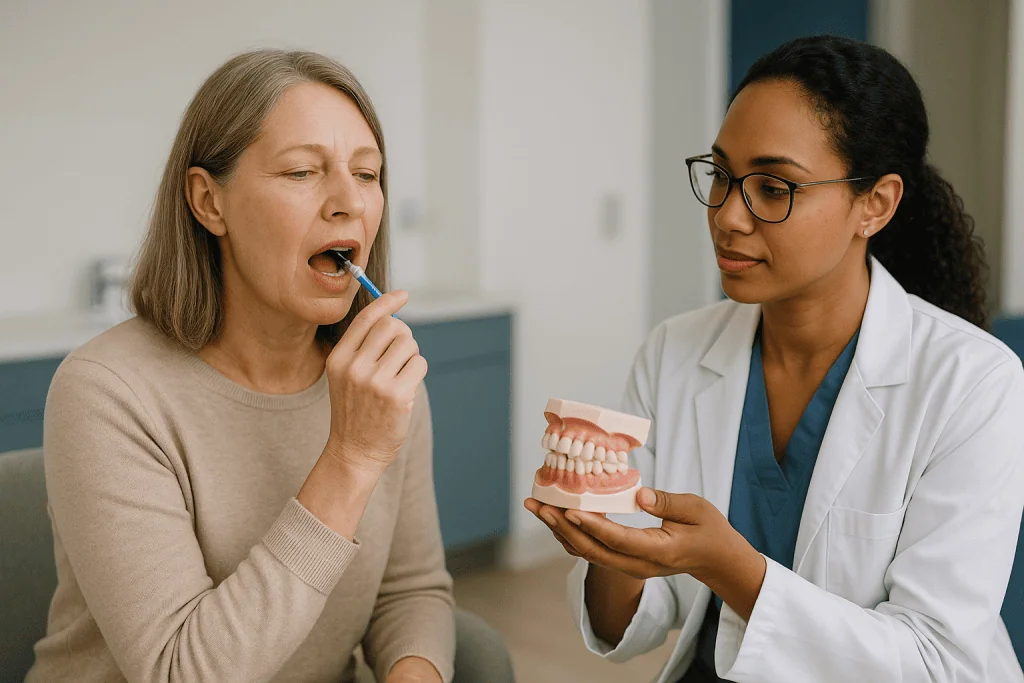
The gum usually settles within a week or two. The bone, as noted, takes several months to bond. During that stretch you may have a small metal cap showing through the gum, a temporary tooth, or nothing at all, depending on how your treatment was planned. Cleaning around the site is gentle and specific: many teams advise a very soft brush and an antiseptic rinse for the first days rather than vigorous brushing directly on stitches. Follow their instructions rather than a general rule.
Once the abutment and crown are fitted, the adjustment is more sensory than surgical. People often describe the new tooth as feeling large or oddly silent for a few days. That sensation fades as the brain recalibrates. Speech can shift briefly with a front implant, particularly with s and f sounds, and typically normalizes within a couple of weeks of everyday talking.
Two things are worth flagging early. Pain that grows rather than eases after the first few days is not part of a normal timeline. And a temporary crown is designed for appearance and gum shaping, not for chewing steak; treating it as a full tooth is one of the more common reasons for an unplanned visit.
What does no one tell you about dental implants?
Ask people a year in and a few honest themes surface that rarely make the brochures.
Food gets trapped in new places. Because an implant crown emerges from the gum with a slightly different shape than a natural root, a small pocket often forms where the crown meets the tissue. Fibrous foods such as spinach, meat and popcorn husks lodge there. It is not a flaw; it is geometry. An interdental brush solves it in seconds, but nobody mentions that you will carry one in your bag.
The crown can chip or loosen even when the implant is perfect. The screw that holds the crown to the fixture can slowly back out, producing a tooth that feels slightly wobbly or clicks on biting. This is usually a straightforward tighten-and-check, but it startles people who assumed the whole assembly was one solid piece.
You lose a warning system. The ligament around a natural tooth tells you when you are biting a shell or a bone fragment. An implant does not. Adjacent natural teeth sometimes take that job, and people learn to chew more attentively on that side.
The gum line can move. Over years, gums recede a little around teeth and implants alike. Around a front implant this can expose a sliver of metal collar, which is cosmetic rather than medical but matters to many people.
Finally, the implant is now the healthiest-looking thing in a mouth that still has natural teeth with their own histories. Several people discover that a neighboring tooth needs attention before the implant ever does. Life with dental implants is, in practice, life with a whole mouth that deserves the same standard of care.
Cleaning dental implants: which tools genuinely reach where plaque hides?
The goal is not to polish the crown. Porcelain does not decay. The goal is to remove the soft bacterial film that collects in the shallow groove where crown meets gum, because that film drives inflammation. Every tool choice flows from that.
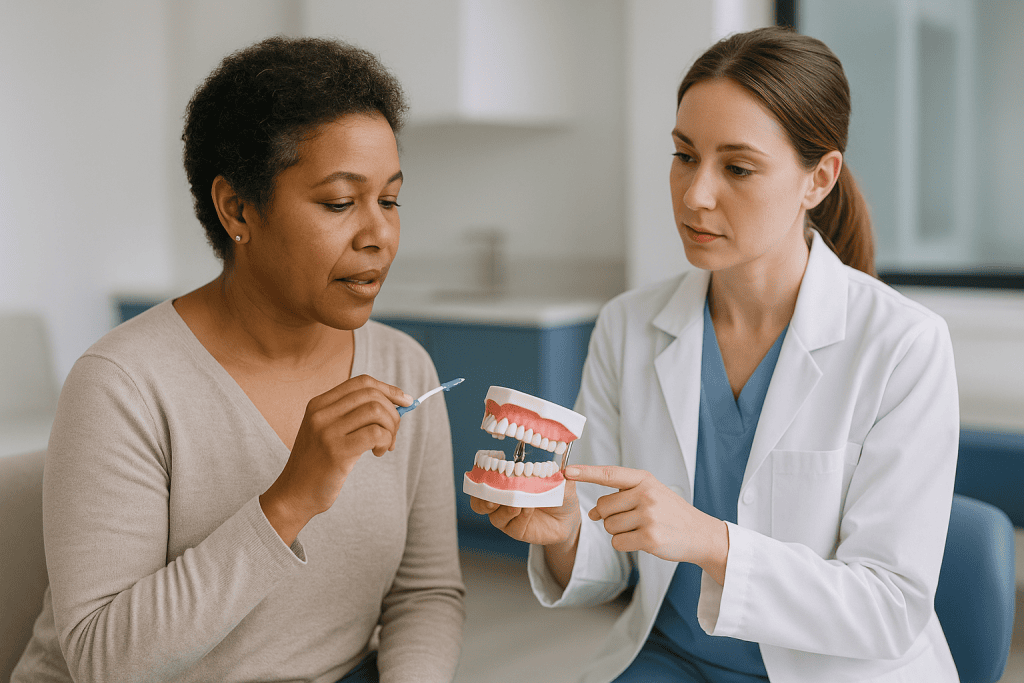
A soft or extra-soft toothbrush, manual or electric, angled so the bristles slip slightly under the gum edge, is the foundation. NHS guidance for natural teeth, two minutes twice daily including last thing at night, applies without modification. Stiff bristles and gritty whitening pastes can scratch both the crown glaze and any exposed titanium, and scratched surfaces hold plaque more stubbornly.
Between the implant and its neighbors, ordinary floss works if the gap is tight. Where the space is wider, which is common around implants, a small interdental brush sized to fit the gap without forcing cleans more thoroughly and is easier to use consistently. Some implant crowns sit above the gum with a visible undercut; a floss threader or a specially shaped floss with a stiff end lets you pass beneath the crown and hug the abutment.
A water flosser adds a helpful rinse of the pocket and is especially useful for people with limited dexterity. The evidence supports it as a supplement to mechanical cleaning rather than a replacement for it.
Metal picks and hard plastic scrapers are best left to professionals. Home use around an implant risks gouging the surface. If your hygienist recommends a particular rinse for a limited period, follow that advice for the stated time rather than adopting it indefinitely; some antiseptic rinses stain teeth with prolonged use.
Consistency beats gadgetry. One well-used brush and one interdental brush, every night, outperform a drawer full of devices used occasionally.
How do you clean an implant-supported bridge or denture?
When several implants carry a bridge or a full-arch prosthesis, the challenge shifts from cleaning around one post to cleaning under a span of teeth that never lifts out. The bridge sits a few millimeters above the gum on a series of abutments, and the tunnel beneath it is exactly where food and plaque settle.
Three tools cover most of the job. A floss threader or a long, spongy floss designed for bridges is passed under the span and drawn back and forth against each abutment. A water flosser directed along the gum line flushes debris out of the tunnel; many people with full-arch work describe it as the single change that made the difference between constant sore spots and comfortable gums. A single-tufted brush, which has a small pointed head, reaches the back of the last implant and the awkward angles near the palate.
Removable implant-retained dentures, which snap onto posts or a bar, are a different routine. The denture comes out at night and is brushed with a soft denture brush over a folded towel or basin of water so a drop does not crack it. The posts and gums are then cleaned in the mouth with a soft brush. The clips inside the denture wear over time and are replaced by your dentist; a denture that suddenly feels loose usually needs new clips rather than new implants.
Some fixed full-arch bridges are designed to be unscrewed by the dentist at maintenance visits for deep cleaning. Ask whether yours is one of them and how often that is planned. That question, more than any product, determines how manageable the long game will be.
Foods to avoid with dental implants: healing phase versus everyday life
Food advice around implants is often given as a single blunt list, which frustrates people because the sensible answer changes over time. There are really three phases, and the table below separates them.
| Phase | Usually fine | Usually asked to avoid | Why |
|---|---|---|---|
| First days after surgery | Yogurt, smoothies without seeds, soups cooled to warm, mashed vegetables, eggs | Anything hot, crunchy, spicy or requiring chewing on the site; drinking through a straw | Protecting the clot and stitches; heat and suction can disturb early healing |
| Bone-bonding months (temporary tooth or healing cap in place) | Soft cooked meats, pasta, fish, ripe fruit, bread without hard crusts | Nuts, hard candy, ice, tough crusts, sticky caramels on the implant side | The fixture is not yet fused; heavy or sticky loads can loosen it or dislodge a temporary |
| After the final crown | A normal varied diet, including apples and steak | Cracking shells, ice or bones on the implant; very sticky sweets in large amounts | Extreme point loads can chip porcelain or loosen the crown screw; sugar still feeds gum bacteria |
Mayo Clinic advises soft foods while the surgical site heals and asks patients not to use tobacco, which impairs healing. The exact length of each phase is set by your team based on how your bone is responding, not by a calendar.
Two often-missed points. Sugary and acidic snacks still matter even though the crown cannot decay, because they feed the bacteria that inflame gums and because your remaining natural teeth share the mouth. And chewing ice is the single habit hygienists most frequently ask implant patients to drop; it is a hard, cold, repeated impact on a crown that cannot flex.
Do you need a night guard for dental implants?
Not everyone does. Whether you should depends on one question your dentist can usually answer by looking at your teeth: do you clench or grind while asleep?
Bruxism is the medical term for that clenching and grinding, and Mayo Clinic notes it is often unconscious, frequently happens during sleep, and can be linked to stress, sleep disorders and certain medicines. Signs a dentist looks for include flattened or chipped tooth edges, worn enamel, jaw muscles that are tender in the morning and a history of cracked fillings.
Why it matters more with implants than with natural teeth returns to the missing ligament. A natural tooth absorbs grinding forces with a tiny cushion and gives you feedback. An implant transmits the full force straight to the crown, the retaining screw and the bone. Over months, that repeated overload is one of the recognized reasons a crown chips, a screw loosens or, less commonly, the bone at the implant neck begins to recede.
A night guard, properly called an occlusal splint, is a custom-fitted plastic tray worn over the teeth during sleep. It does not stop grinding; it redistributes the force across the whole arch and protects the surfaces. Custom guards made from an impression of your mouth fit more precisely and last longer than the boil-and-bite type sold for sports, and a poorly fitting guard can itself shift teeth or load an implant unevenly.
If you grind, the sensible sequence is to have the guard made once the final crown is in place, so it fits the new tooth, and to bring the guard to checkups so wear on it can be read like a diary of your night. If you do not grind, a guard adds nothing. Your team will tell you which group you are in.
How often should dental implants be checked? The recall schedule explained
The honest answer is that there is no single number, and any source that gives you one without knowing your mouth is guessing. NHS guidance for dental checkups sets the interval between three months and two years depending on the health of your teeth and gums and your risk of future problems. Implant maintenance follows the same logic, and most teams place implant patients toward the shorter end at least at first.
What happens at a recall visit is more specific than a routine cleaning. The hygienist or dentist looks for bleeding when a probe is gently run around the implant, measures the depth of the gum pocket and compares it with earlier readings, checks that the crown is firm and the bite is even, and inspects any night guard. At intervals your team decides, usually less often than every visit, an X-ray is taken to compare the bone level at the implant neck with the baseline image from when the crown was fitted. A slow, steady drop in that bone line, even without symptoms, is the earliest sign of trouble and the reason recall matters.
Professional cleaning around implants uses instruments that will not scratch titanium, typically plastic or titanium-tipped scalers rather than the steel ones used on enamel. This is a fair question to ask if you are seeing a new practice.
Three situations usually shorten the interval: a history of gum disease before the implant, smoking, and diabetes that is not well controlled, all of which the NIH recognizes as raising the risk of inflammation around teeth and gums. A stable mouth with excellent home care over several years may earn a longer gap. Either way, the schedule is a clinical decision that should be reviewed, not a fixed appointment card.
What is peri-implantitis, and why is it the thing that matters most?
If one idea from this article stays with you, make it this one. Implants do not fail because titanium wears out. They fail, when they fail, because the tissue around them becomes inflamed and the bone quietly recedes.
The condition has two stages. Peri-implant mucositis is inflammation of the gum around the implant without bone loss; it looks like gingivitis, with redness, swelling and bleeding on brushing, and it is reversible with improved cleaning and a professional clean. Peri-implantitis is the next step: the inflammation has reached the bone, and the bone level at the implant neck begins to drop. Once bone is lost around an implant it does not regrow on its own, and treatment becomes more involved and less predictable.
The mechanism mirrors gum disease around natural teeth. The NIH’s dental research institute describes how bacterial plaque left along the gum line triggers an immune response that, over time, destroys the fibers and bone supporting the tooth. The same cascade around an implant is faster to spread because the weaker gum seal offers less resistance, and it is harder to notice because there is no ligament to signal soreness.
Risk factors are consistent across the evidence: a history of periodontitis, smoking, poorly controlled diabetes, plaque left in place, and crowns with shapes or leftover cement that trap debris. Heavy grinding is thought to contribute in some people.
Why this ranks above every other topic here is simple. Cleaning tools, food choices, night guards and recall visits are all, in the end, strategies against this one process. A person who understands that is far better placed to keep an implant for decades than someone who treats the crown as the thing to protect.
Who is life with dental implants usually for, and who is usually asked to wait?
Implants are one of several ways to replace a missing tooth, alongside a fixed bridge anchored to neighboring teeth and a removable denture. Mayo Clinic frames the typical candidate as someone missing one or more teeth, with a fully grown jawbone, enough bone to hold the post or the ability to have a bone graft, healthy gums, no conditions that would impair bone healing, and a willingness to commit several months to the process and to avoid tobacco.
The people usually asked to wait, or to consider an alternative, fall into a few groups, and the reasons are about healing rather than judgment.
Active gum disease is treated first. Placing an implant into an inflamed mouth invites the same bacteria to colonize the new post.
Heavy smoking impairs blood flow to the gums and slows bone healing; many teams ask for a period of stopping before and after surgery, and some will not proceed while smoking continues.
Diabetes that is not well controlled slows wound healing and raises infection risk; teams often coordinate with the physician managing the diabetes before scheduling.
Certain medicines that alter bone turnover, such as the bisphosphonate class used for osteoporosis and some cancers, and previous radiotherapy to the jaw, raise the risk of poor bone healing at the surgical site. The decision here involves the prescribing doctor as well as the dentist, and the medicine is never adjusted for the sake of an implant without that conversation.
Adolescents whose jaws are still growing are generally asked to wait, because an implant does not move with growing bone and can end up sitting visibly lower than the neighboring teeth.
None of these is an absolute bar. Each is a reason for a fuller assessment and a team decision.
What is the downside of having dental implants? Risks and alternatives in plain terms
Every treatment has a cost in time, discomfort and risk, and implants are no exception. Mayo Clinic lists the recognized surgical risks: infection at the site, injury to neighboring teeth or blood vessels, nerve damage that can cause pain, numbness or tingling in the lip, chin or gums, and, for upper back implants, a post that protrudes into the sinus. These are uncommon, but they are real, and a thorough consultation names them.
Then there are the slower downsides. The treatment spans months, sometimes longer if grafting is needed. Cleaning is more involved than for a natural tooth. Components can loosen or chip and need repair. The gum around the implant demands lifelong attention against the inflammation described above. And an implant that fails leaves a bone defect that can make a second attempt more complex.
Alternatives deserve a fair hearing rather than a dismissal. A fixed bridge replaces a tooth without surgery by anchoring a false tooth to crowns on the neighbors; its trade-off is that healthy neighboring teeth are reshaped, and the span can be harder to clean beneath. A removable partial denture is the least invasive and easiest to adjust, at the cost of bulk, movement and daily removal. Leaving a gap is a legitimate choice for some back teeth, with the acknowledged risk that neighbors drift and the opposing tooth over-erupts.
Which option fits depends on the position of the gap, the state of the neighboring teeth, bone volume, general health and how much maintenance a person is realistically willing to do. That weighing is the treating team’s job, done with you, and a good team will tell you when an implant is not the best answer for your mouth.
What happens to dental implants after 20 years?
Cleveland Clinic states that with proper care an implant can last a lifetime, and long-term follow-up studies broadly support the idea that the titanium fixture, once fused, tends to stay fused. But the question people are really asking is what a twenty-year-old implant looks and feels like, and the honest picture has several layers.
The fixture is usually the least of it. Bonded bone does not un-bond on its own; it is lost only to inflammation or heavy overload. If the gums have stayed healthy, the post at twenty years is doing exactly what it did at year one.
The crown is a different matter. Porcelain and its newer ceramic cousins are hard but not indestructible. Two decades of chewing, plus any grinding, wears the biting surface, dulls the glaze and can produce small chips. Crowns are commonly replaced or refurbished during the life of an implant, and that is a maintenance event rather than a failure. The retaining screw may have been tightened or replaced once or twice along the way.
The gum line will likely have receded a little, as it does around natural teeth with age. Around a front implant this may reveal the metal collar or make the crown look slightly longer. Some people accept it; others ask for a new crown shaped to the current gum.
The surrounding mouth will have changed too. Neighboring teeth may have been filled, crowned or lost, the bite may have shifted, and an implant placed for a single gap may now be a support for a wider restoration.
The pattern across the evidence is consistent: the outcome at twenty years tracks the quality of cleaning and recall over those twenty years far more than the brand of implant or the skill of any single appointment.
At what age should you stop getting dental implants?
There is no upper age limit in mainstream guidance, and the question often rests on an assumption worth unpicking: that older bone cannot heal around an implant. The evidence does not support a fixed cutoff. What matters is the health of the bone and gums, general medical fitness for a minor surgical procedure, the ability to heal, and the capacity to maintain the implant afterward. Many people receive implants well into their eighties and beyond when those conditions are met.
Age does bring factors that a team will weigh more carefully. Bone density tends to decline, which can lengthen the bonding period or call for a graft. Medicines become more numerous; blood thinners affect surgical planning, and bone-turnover medicines, as noted earlier, require a conversation with the prescribing physician. Dry mouth, common with age and with many medicines, raises plaque levels and makes cleaning more important. Arthritis or reduced dexterity can make an interdental brush hard to manage, which is a real reason to favor a design that is easier to clean or to plan for a caregiver’s help.
The more useful question is at what point a person, at any age, is not well served by an implant. Someone who cannot realistically manage daily cleaning, cannot attend recall visits, or has a medical condition that makes healing unreliable may do better with a well-made denture or bridge. That is a conversation about circumstances, not birthdays.
At the other end of life, the limit is firmer. Jaw growth must be complete before an implant is placed, because the fixed post will not move as the surrounding bone continues to develop. The timing varies by individual and is judged from growth records and imaging rather than a set age.
What people often get wrong about living with dental implants
Some beliefs about implants are so common that correcting them is half the maintenance.
Implants are maintenance-free because they cannot get cavities. True about cavities, false about maintenance. The crown cannot decay, but the gum and bone can inflame and recede, and that process is the main way implants are lost. The daily routine is as important as it ever was, and in some ways more so.
If it does not hurt, it is fine. An implant has no ligament and few nerve endings in its immediate surroundings. Early bone loss around an implant is usually painless. Bleeding on brushing, a slightly puffy gum edge or a bad taste near the implant are worth reporting even when nothing aches.
A wobbly crown means the implant has failed. Far more often it means the small screw joining crown to fixture has loosened, or the cement has weakened. It needs prompt attention to avoid damage, but it is usually a repair, not a loss.
Metal cleaning tools clean better. Steel scalers and picks can scratch titanium and the crown margin, creating rougher surfaces that hold more plaque. Professionals use implant-safe instruments, and home care should stick to brushes and floss.
Once the crown is on, any food is fair game. Almost any. Cracking shells or ice on a ceramic crown that cannot flex is how chips happen, and sugar still feeds the bacteria that inflame gums.
Implants are forever, so checkups are optional. The fixture may well last a lifetime, but only if someone is checking the bone line and cleaning the pocket at intervals. Recall visits are the mechanism by which the phrase lasts a lifetime comes true.
Questions to ask your care team about life with dental implants
Bringing a short list to your fitting or first recall appointment turns a hurried checkup into a plan. These are the questions that tend to change what happens next.
- Which cleaning tools fit the gaps around my implant, and can you show me the angle on a model or in a mirror?
- Is my crown screw-retained or cemented, and how would I recognize it loosening?
- Do you see signs that I grind or clench, and if so, when should a guard be made and how often should it be checked?
- What recall interval are you setting for me, what would shorten or lengthen it, and when is the next baseline X-ray planned?
- Is there any pocket or gum area you are already watching, and what does it look like on the probe measurements?
- What sort of instruments are used for professional cleaning around implants here?
- If I have a fixed full-arch bridge, is it designed to be removed for deep cleaning, and how often?
- Which of my other teeth are you most concerned about, given that they share the mouth with this implant?
- Are any of my medicines or health conditions relevant to the implant’s long-term health, and should my physician be informed of the implant?
- Which changes should prompt a call between visits rather than waiting for the next appointment?
Write the answers down, particularly the pocket measurements and recall interval. Having your own record of what the gum looked like at the start lets you take part in the comparison at every future visit, rather than relying on memory or a change of practice to carry the history forward.
When to call your doctor or dentist: red-flag signs around an implant
Most of life with an implant is uneventful, and a good routine keeps it that way. A few signs, though, should prompt a call rather than a wait for the next scheduled visit.
Contact your dental team promptly if you notice bleeding from the gum around the implant when you brush or eat, a gum edge that has become red, swollen or shiny, a bad taste or pus near the crown, or a crown that feels loose, clicks or has shifted. Report any new gap opening between the crown and the gum, or metal newly visible at the neck of the implant. Persistent numbness or tingling of the lip, chin or tongue after surgery, or pain that increases rather than eases after the first few days, needs assessment.
Seek urgent care the same day if you develop facial swelling that is spreading, difficulty swallowing or breathing, a fever with a hot painful implant area, or bleeding from the site that does not stop with firm pressure. These can signal a spreading infection or a complication that should not wait.
People taking medicines that affect bone healing or blood clotting, and people with diabetes or a suppressed immune system, should have a lower threshold for calling, because problems in these groups can progress faster and are often best managed with both the dental team and the prescribing doctor involved.
None of the signs above means the implant is lost. Most, caught early, are treated with a professional clean, a tightened screw or a short course of care decided by your clinician. The point of knowing them is speed. Every decision about what to do next, from adjusting a guard to removing a crown for inspection, belongs with the team who knows your mouth, and calling early gives them the most options.
Frequently asked questions
What is the downside of having dental implants?
The main downsides are the months the process takes, the surgical risks such as infection, nerve irritation or sinus involvement listed by Mayo Clinic, and the lifelong cleaning and recall commitment needed to prevent inflammation around the post. Crowns can also chip or loosen and need repair. For some mouths a bridge or denture is a better fit, and a candid consultation weighs those alternatives rather than assuming an implant is automatically right.
What does no one tell you about dental implants?
That food traps in a small pocket where the crown meets the gum, that the crown screw can loosen and make a healthy implant feel wobbly, that you lose the bite-pressure warning a natural tooth gives, and that gums recede a little over the years and can reveal a sliver of metal collar. None of these are failures, but they shape daily habits more than the surgery itself does.
What happens to dental implants after 20 years?
If the gums have stayed healthy, the titanium post is usually doing exactly what it did in year one, since bonded bone does not un-bond without inflammation or overload. The crown, however, is a wearing part; two decades of chewing dulls, wears or chips porcelain, and crowns are commonly replaced along the way. Gum recession may make the tooth look longer. Cleveland Clinic notes implants can last a lifetime with proper care.
At what age should you stop getting dental implants?
Mainstream guidance sets no upper age limit. What matters is bone and gum health, medical fitness for minor surgery, healing capacity, medicines that affect bone or clotting, and the ability to clean and attend checkups. Many people receive implants in their eighties. The firmer limit is at the young end: the jaw must have finished growing, because a fixed post will not move with developing bone.
What are the best tools for cleaning dental implants at home?
A soft toothbrush angled slightly under the gum edge, an interdental brush sized to the gap without forcing, and floss or a threaded floss that passes beneath the crown to hug the abutment cover almost every case. A water flosser is a useful supplement, particularly for bridges or limited dexterity. Avoid metal picks, stiff bristles and gritty pastes, which can scratch titanium and porcelain and make plaque cling more.
Which foods should you avoid with dental implants after the crown is fitted?
Once the final crown is in place, a normal varied diet is usually fine, including apples and steak. The exceptions are cracking ice, shells or bones on the implant side, which can chip a ceramic crown that cannot flex, and frequent very sticky sweets, which stress the crown attachment and feed gum bacteria. Sugar still matters even though the crown itself cannot decay, because the gums and neighboring teeth can.
Do I really need a night guard for dental implants if I do not think I grind?
Only if your dentist finds evidence of clenching or grinding, such as flattened tooth edges, worn enamel, chipped restorations or morning jaw tenderness. Mayo Clinic notes bruxism is often unconscious and happens during sleep, so self-report is unreliable. An implant lacks the cushioning ligament of a tooth, so grinding forces reach the crown screw and bone directly. If you do not grind, a guard adds nothing.
How often should dental implants be professionally checked?
There is no single interval. NHS guidance for dental checkups ranges from every three months to every two years depending on risk, and implant patients are commonly placed toward the shorter end, especially with a history of gum disease, smoking or unstable diabetes. Visits include probing the gum pocket, checking the crown is firm and, at intervals your team sets, an X-ray comparing the bone level with the original baseline.
Can dental implants get gum disease?
Yes. Peri-implant mucositis is gum inflammation around the post without bone loss and is reversible with better cleaning and a professional clean. Peri-implantitis is the next stage, where inflammation reaches the bone and the bone level begins to drop; lost bone does not regrow on its own. The process mirrors periodontitis described by the NIH, driven by plaque along the gum line, and is the main reason implants are lost.
Why does my dental implant crown feel loose when the dentist says the implant is fine?
Most often the small screw connecting the crown to the fixture has backed out slightly, or the cement holding a cemented crown has weakened. The titanium post can be perfectly bonded while the crown moves or clicks. It needs prompt attention, because a loose crown lets bacteria in and can damage the screw threads, but the usual fix is tightening or re-cementing rather than replacing the implant.
References
- Cleveland Clinic: Dental implants
- NHS: How to keep your teeth clean
- NIH National Institute of Dental and Craniofacial Research: Gum disease
This article is for general information only and is not a substitute for professional medical advice. Please consult a qualified doctor about your individual situation.

More from the Blog
Zygomatic Implants vs Sinus Lift and Grafting: Two Routes for a Resorbed Upper Jaw Compared
Zygomatic implants and sinus lift with grafting are two ways to place teeth in an upper jaw that has lost too much bone. A…
What Robotic Guidance Changes in Dental Implant Surgery: Angle, Depth and Comfort
Robot assisted dental implant surgery uses a robotic arm, guided by a 3D scan and a plan drawn up in advance, to hold the…
Reading a Full Mouth Reconstruction Plan: Sequence, Materials and the Questions Worth Asking
A full mouth reconstruction treatment plan is a staged map for rebuilding most or all teeth in both jaws. It typically lists phases in…
What to Ask Before Zirconium Teeth: Tooth Reduction, Shade Choice and Adjacent Teeth
Before choosing zirconium teeth, ask how much natural tooth will be removed, whether the neighboring teeth will be touched at all, how the shade…
How an Implant-Supported Dental Bridge Spares Neighboring Teeth From Being Reshaped
An implant-supported dental bridge replaces missing teeth by anchoring the false teeth to titanium posts placed in the jawbone, rather than to crowns cemented…
Who Suits E-Max Crowns? Front Teeth, Translucency Needs and When Bite Force Argues Against Them
A lithium disilicate glass-ceramic crown, widely called an e-max crown, generally suits people restoring a front tooth or premolar where matching the translucency of…