

Limb Lengthening Recovery Stages: Distraction, Consolidation and Walking Without Aids

Key Takeaways
- Bone is lengthened at about 1 millimeter per day, so every centimeter of gain adds roughly ten days of distraction before consolidation even begins.
- Consolidation, the phase in which soft new bone hardens, commonly takes one to two months per centimeter in adults and is where most of the recovery calendar is spent.
- Walking without aids is cleared by X-ray evidence of bone bridging on multiple cortices and a limp-free gait, typically six to twelve months after adult femoral lengthening.
- Soft tissue, not bone, causes most pain and most complications; daily physical therapy during distraction exists to prevent joint contracture, which is the hardest problem to reverse.
- Complication risk rises steeply with each additional centimeter, and nearly every patient needs a second operation to remove the device once bone has matured.
- Smoking, uncontrolled diabetes, low vitamin D and older age all slow regenerate formation, which is why teams optimize these before surgery rather than during recovery.
Limb lengthening recovery time is measured in months. Bone is separated at roughly one millimeter a day, so five centimeters takes about seven weeks of distraction, followed by a consolidation phase that commonly lasts one to two months per centimeter gained. Most people walk without aids once X-rays show solid new bone, often six to twelve months after surgery, with running and impact sport later still.
The question usually arrives late at night, laptop balanced on a knee, after weeks of reading forums: not “can this be done” but “how long until I get my life back?” One reader described measuring her hallway in crutch-lengths. Another kept a calendar with two colors of ink, one for distraction days and one for the day he hoped to leave the walker in the closet. Both were really asking about limb lengthening recovery time, and both had been given wildly different answers.
That gap is not because surgeons are hiding something. It is because recovery here is not one event but a sequence: a cut bone, a slow daily pull, a long wait while new bone hardens, and a gradual return to walking that depends on what an X-ray shows rather than what a calendar says.
This explainer walks through each stage in the order you will live it, with the typical ranges published by mainstream orthopedic sources, and with equal weight given to the parts that go smoothly and the parts that often do not.
How does limb lengthening surgery actually work?
The idea is older than most people expect and rests on a single biological fact: bone that is cut and then pulled apart very slowly will fill the gap with new bone. The surgeon makes a controlled break in the femur (thigh bone) or tibia (shin bone), a step called an osteotomy, meaning a surgical cut through bone. The two ends are held by a device that can be lengthened in tiny increments. Over weeks, the gap widens and the body lays down soft new bone tissue, called regenerate, which later hardens. The whole process is known as distraction osteogenesis, which simply means “making bone by pulling.”
Two families of device do the pulling. An external fixator is a frame of rings or rails outside the leg, connected to the bone by pins or wires that pass through the skin. An internal lengthening nail is a telescoping rod placed inside the hollow center of the bone; many modern versions are motorized and extend when a magnet or remote controller is held against the leg. Johns Hopkins describes both approaches and notes that internal nails avoid the pin sites that make external frames prone to skin infection, while frames remain useful when bone shape also needs correcting or when infection is already present.
Two things are worth fixing in your mind now. First, the device does not create length by itself; your own bone does the growing, at a pace set by biology. Second, muscles, nerves, blood vessels and skin do not get cut and regrown. They are stretched, slowly, and they are the tissues that most often protest.
How long does limb lengthening take? The stages at a glance
Think of recovery as four overlapping chapters rather than one countdown. Each has its own job, its own typical duration and its own way of going wrong. MedlinePlus puts the distraction rate at about 1 millimeter per day, which anchors most of the arithmetic below; the consolidation estimates follow the widely quoted orthopedic rule of thumb that new bone needs roughly one to two months per centimeter to harden, a range Johns Hopkins and similar centers describe as typical rather than guaranteed.

| Stage | What is happening | Typical duration | Mobility |
|---|---|---|---|
| Latency | Healing response begins in the cut bone before any pulling starts | About 5 to 10 days | Hospital stay, then home with a walker or wheelchair |
| Distraction | Device lengthened in small steps; regenerate forms in the gap | Roughly 1 mm/day, so 5 cm ≈ 7 weeks, 8 cm ≈ 11 weeks | Limited or partial weight-bearing; daily physical therapy |
| Consolidation | Soft regenerate mineralizes into solid bone | Often 1 to 2 months per centimeter gained | Progressive weight-bearing as X-rays allow |
| Rehabilitation | Strength, joint range and gait retraining | Continues for months after unaided walking | Crutches to cane to none; sport later |
Put those numbers together for a common goal of 5 to 6 centimeters in the femur and you land at roughly two months of distraction plus five to twelve months of consolidation. That is why experienced teams talk in terms of a year, not a season, and why a six-month timeline to full activity is unusual rather than standard.
The stages also overlap. Regenerate at the top of the gap is already hardening while the bottom is still being stretched, and rehabilitation starts on the first day rather than after the bone heals.
Limb lengthening recovery time: what changes it for you
Two people with the same surgeon and the same device can finish months apart. The variables are not mysterious, and most are known before the operation.
The amount of length is the biggest lever. Every extra centimeter adds roughly ten days of distraction and one to two months of consolidation, so an 8-centimeter goal is not one-third longer than a 6-centimeter goal in total time; the tail of bone healing stretches out disproportionately. Beyond a certain point, which teams judge individually, soft tissues stop tolerating the stretch and complications rise sharply.
Which bone matters too. The femur is surrounded by thick muscle with a rich blood supply and generally forms regenerate faster than the tibia, whose front edge sits just under the skin. Lengthening the tibia also stretches the calf and Achilles tendon, so ankle stiffness becomes a bigger project.
Age shapes the curve. Children and adolescents heal quickly; adults heal more slowly and the pace tends to fall further after midlife. Smoking impairs blood flow to bone and is associated with slower fracture healing and higher nonunion rates in orthopedic literature, which is why many teams ask patients to stop well before surgery. Poorly controlled diabetes, low body weight, low vitamin D and certain long-term medicines can also slow regenerate formation; the NIH Office of Dietary Supplements summarizes why adequate calcium and vitamin D matter for bone mineralization.
Finally, device choice and technique influence the early weeks. Internal nails allow fewer pin-site problems and often earlier comfort, but their weight-bearing limits during distraction can be stricter than with some frames, because a hollow telescoping rod is not designed to carry full body weight until bone shares the load.
Who is usually offered limb lengthening, and who is asked to wait
Historically this was reconstructive surgery. The typical patient had a leg length discrepancy, meaning one leg measurably shorter than the other, from a congenital difference, a childhood growth-plate injury, a badly healed fracture or a bone infection. MedlinePlus lists discrepancies large enough to cause a limp, back pain or hip strain as the usual reason for lengthening rather than a shoe lift or a shortening of the longer side. Children with conditions that limit growth, such as achondroplasia, are also treated in some programs, typically in staged operations spread across years.
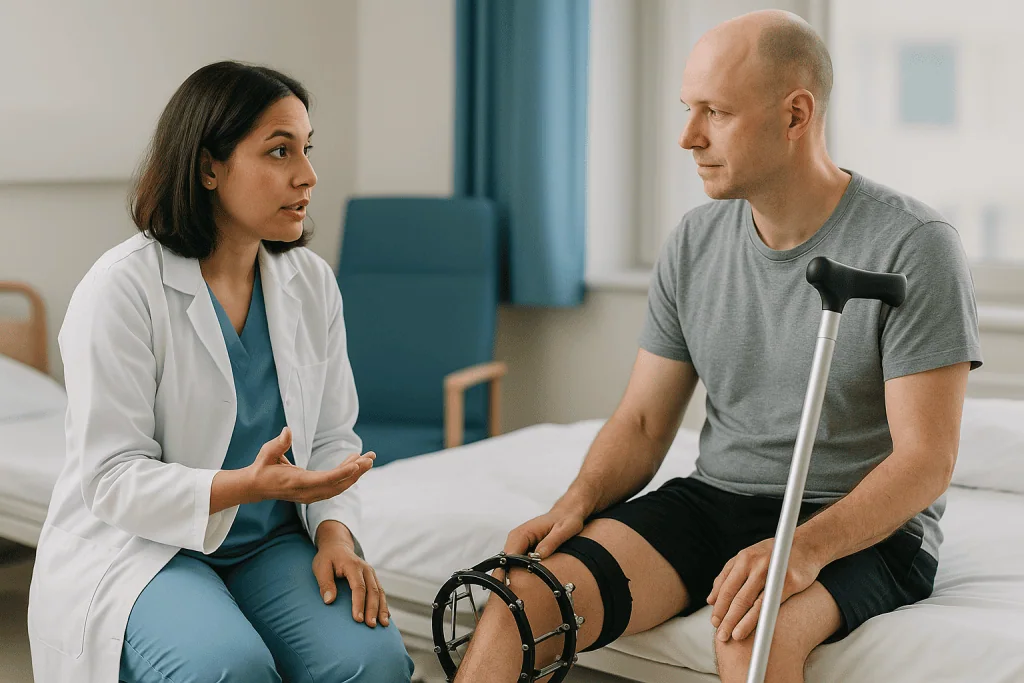
Cosmetic or stature lengthening, where both legs are lengthened in a person of typical proportion who wishes to be taller, is a newer and more debated use of the same technique. Published series in orthopedic journals report meaningful complication rates, and many centers apply stricter screening because the person starts with two healthy legs and accepts risk for a non-medical goal.
Teams commonly ask people to wait, or decline, when growth plates are still open and the planned correction would be better achieved by guided growth; when a person smokes and has not stopped; when diabetes, nutrition or bone density are not yet optimized; when there is active infection near the planned site; or when expectations about timeline, pain or final appearance are out of step with what the procedure can deliver. Psychological screening is standard in many stature programs, not as a gatekeeping insult but because a year of restricted mobility tests resilience in ways people rarely anticipate.
Alternatives are always part of the conversation: a shoe lift or orthotic for smaller discrepancies, epiphysiodesis (slowing growth of the longer leg in a child), or simply monitoring. The right path is a decision for the person and the treating team together.
The first days after surgery: the latency phase
Nothing is being lengthened yet, and that is deliberate. Latency is the pause between the osteotomy and the first turn of the device, usually five to ten days in published protocols, during which the cut bone starts the same inflammatory and early healing response it would after any fracture. Begin pulling too early and there is no biological scaffold to stretch; wait too long and the gap can heal solid before distraction starts, a problem called premature consolidation that may need another operation to re-break the bone.
Most people spend a few nights in the hospital. The first physical therapy session typically happens within a day or two: sitting at the edge of the bed, standing with a walker, learning how much weight the surgeon allows on the operated leg. That number is not arbitrary. With an internal nail, partial weight-bearing is usual during distraction because the rod itself must not carry full load; with some external frames the allowance may be more generous. Your team will give you a specific instruction, and it is one of the few rules in recovery with no room for improvisation.
Pain in this window is surgical pain, familiar to anyone who has had a major orthopedic operation: deep ache at the cut site, swelling and stiffness. Teams manage it with a layered approach that usually combines acetaminophen, anti-inflammatory medicines where safe for the person, regional nerve blocks and, for a limited period, opioid medicines, all prescribed and adjusted by the anesthesia and surgical team.
Blood clot prevention starts here. Prolonged immobility after leg surgery raises the risk of deep vein thrombosis, a clot in a deep leg vein, so the CDC-described basics apply: move early and often, use any compression or anticoagulant prescribed, and know the warning signs described later in this article.
The distraction phase: a millimeter a day, and what it feels like
Then the turning begins. Whether by adjusting struts on a frame or holding a controller against the thigh, you or a family member lengthen the device in small steps, commonly four times a day totaling about 1 millimeter, the rate MedlinePlus cites as standard. A millimeter sounds trivial. Spread across a femur, it is a daily stretch applied to every muscle, nerve and vessel between hip and knee, and by the third or fourth week the leg knows it.
Bone itself has few pain fibers; soft tissue is the loud part. People describe a deep, tightening ache that peaks in the evening, sharp twinges when a nerve is briefly irritated, and a stiffness in the knee or ankle that builds unless it is actively fought. Sleep often deteriorates for a stretch, partly from discomfort and partly from the sheer tedium of restricted movement.
Physical therapy during distraction is not optional maintenance; it is the main treatment. Sessions usually run daily or near-daily and target the specific muscles being stretched: hamstrings and quadriceps for femoral lengthening, calf and Achilles for tibial. The aim is to keep the knee straightening and bending fully and the ankle at a right angle, because a joint that stiffens now, called a contracture, can become the single hardest problem to fix later. Some teams pause or slow distraction for a few days if range is being lost or if X-rays show regenerate forming too slowly or too quickly.
X-rays every one to two weeks track the gap and the quality of new bone. A cloudy haze in the gap is good news; a clear black space with sharp bone ends is a signal to reassess the rate.
Limb lengthening consolidation phase: when the bone catches up
The day the device stops turning feels like a finish line. Clinically it is closer to halfway. The regenerate that filled the gap is soft, wet tissue with the mechanical strength of firm cheese, and consolidation is the months-long process in which it mineralizes into bone strong enough to carry you.
Surgeons track that hardening on X-ray by watching the cortices, the dense outer walls of the bone. A healed segment shows continuous cortical bone on multiple sides; a common working threshold used across orthopedic trauma and lengthening practice is bridging of at least three of four cortices before full unrestricted weight-bearing. Until then the internal nail or frame is doing much of the structural work, and overloading it invites bending, breakage or a fracture through immature regenerate.
Timing follows the healing index, the number of months of consolidation per centimeter gained. Published orthopedic descriptions, including those from Johns Hopkins, place this commonly around one to two months per centimeter in adults, faster in children and slower in smokers, older adults and tibial lengthening. A 6-centimeter femoral gain therefore often needs six to twelve months from the end of distraction to solid bone, sitting inside the total limb lengthening recovery time of roughly a year that most teams quote.
Life gets easier during this stretch even though the bone is still hardening. Daily pain usually eases once stretching stops. Therapy shifts from fighting for range to rebuilding strength and normal walking pattern, and weight-bearing is stepped up in stages as each X-ray permits. The frustrating part is that progress is invisible from the outside; the leg looks finished long before it is.
Walking after limb lengthening surgery: from walker to no aids
Walking is the milestone people actually count toward, so it helps to know that it arrives in steps rather than as a single day of freedom.
During distraction, most people use a walker or two crutches with the partial weight-bearing limit set by the surgeon. Many can manage short household distances, transfers and stairs with training, and a wheelchair is often used for longer distances rather than as a sign of failure. Once distraction ends and early consolidation shows on X-ray, teams typically allow more weight through the leg, and a common progression runs two crutches, then one crutch or a cane on the opposite side, then nothing.
The decision to drop aids is driven by three things, roughly in this order: X-ray evidence of consolidation, the surgeon’s assessment of device load limits, and whether you can walk without a limp. That last point is easy to underestimate. Months of altered gait teach the body shortcuts, such as a stiff knee or a hip hitch, and walking unaided too early tends to cement them. Physical therapists often keep a cane in hand for gait quality even after the bone would tolerate its absence.
Typical ranges reported by orthopedic centers put unaided walking somewhere in the window of six to twelve months after surgery for adult femoral lengthening of moderate amounts, earlier for children and later for larger gains or tibial procedures. Low-impact activities like cycling and swimming usually return during consolidation; running and jumping are generally deferred until bone is fully remodeled and strength is symmetric, often a year or more after surgery. Your team’s clearance, not a forum timeline, is the only one that applies to your leg.
Is limb lengthening painful? An honest account
Search results will tell you it is “the most painful surgery in the world.” That claim has no measurement behind it; pain is not ranked that way in medicine, and no guideline or systematic review awards that title. What the evidence and clinical experience do support is that limb lengthening involves a longer period of discomfort than most orthopedic procedures, because the treatment itself, the daily stretch, is the source of pain rather than a one-time injury that fades.
The pattern has a shape. Surgical pain dominates the first week and behaves like any major operation. During distraction, discomfort becomes chronic and cumulative: muscle tightness, joint stiffness and periodic nerve irritation, typically worst in the evening and after therapy. Many people describe it as more exhausting than agonizing. Once distraction stops, pain usually falls noticeably within days to weeks, and by mid-consolidation most report soreness with activity rather than constant pain.
Management follows the same multimodal principle used across modern surgery, meaning several approaches combined so no single one is pushed hard. The building blocks are acetaminophen, nonsteroidal anti-inflammatory medicines where the surgeon judges them safe for bone healing and the person’s kidneys and stomach, muscle relaxant medicines for spasm, nerve-pain medicines when nerve irritation is prominent, and short, closely supervised use of opioid medicines, all chosen and adjusted by the prescribing clinician. Non-drug tools carry real weight here: heat before stretching, ice after, sleep positioning, splints that hold the knee straight at night, and a therapist who paces sessions to what the tissue tolerates.
Two facts should be said plainly. Pain that suddenly escalates or changes character is a signal, not a stage. And people who go in expecting a year of manageable, fluctuating discomfort tend to cope better than those promised either agony or ease.
How risky is limb lengthening? Complications in plain language
Risk is where honest explainers and marketing pages part ways. Limb lengthening has one of the higher complication profiles in elective orthopedics, and published series, including systematic reviews of stature lengthening indexed in PubMed, report that a large share of patients experience at least one complication, ranging from minor and expected to serious. The exact figure depends on definitions, device and center, so treat any single percentage with caution. What follows is the list your surgeon should walk you through.
Joint stiffness and contracture are the most common problems: the knee losing full extension in femoral lengthening, the ankle drifting into a pointed position in tibial cases. Prevention is daily therapy; treatment may require splinting, slowing distraction or, in stubborn cases, a release procedure.
Nerve and vessel irritation occur because these structures are being stretched. Numbness, tingling or foot weakness usually respond to slowing the rate, but persistent nerve injury is possible.
Bone problems come in opposite pairs. Regenerate can form too slowly, called delayed consolidation or nonunion, or too fast, leading to premature consolidation. Both can mean extra surgery. New bone can also drift out of alignment, and immature regenerate can fracture under load.
Device-related risks include pin-site infection with external frames, deep infection with either approach, and mechanical failure of a nail or frame. Blood clots in the leg or lung, joint dislocation or subluxation in patients with certain hip anatomy, and chronic pain are less common but serious.
Nearly all patients face at least one further operation to remove the device once the bone has matured. Weighing this profile against the benefit is exactly the conversation the treating team owes you.
What is the best age for leg lengthening?
There is no single best age, but biology sets clear tendencies that shape how teams advise different people.
Children and adolescents heal fastest. Their regenerate mineralizes quickly, their healing index is often at the lower end of published ranges, and their joints are supple, which lowers the risk of contracture. The complication is growth itself. A discrepancy measured at age eight will be larger by skeletal maturity, so pediatric teams plan corrections around growth predictions and sometimes prefer guided growth or growth-plate procedures on the longer leg over lengthening the shorter one. MedlinePlus notes that lengthening in children is often staged, with more than one operation over the growing years, and that surgery must respect the growth plates near the knee and ankle.
Young adults, roughly from skeletal maturity into the thirties, are the largest group in stature lengthening programs. Growth is complete, so the result is final, healing remains reliable, and most can commit the year of restricted mobility that recovery demands.
With advancing age, bone healing slows and pre-existing joint wear, bone density loss and medical conditions increase. Teams may still offer lengthening for reconstructive reasons in older adults, but they typically expect longer consolidation, watch more closely for nonunion, and weigh the operation against alternatives such as a shoe lift more carefully. Smoking, diabetes and low vitamin D matter more with each decade.
Underneath age sits a more useful question: is this the right stage of life to spend a year in recovery? School terms, careers, caregiving duties and living arrangements often decide timing as much as growth plates do, and a good team will ask about them.
Do you ever fully recover from limb lengthening surgery?
For most people the honest answer is that the bone recovers completely and the rest of the leg recovers substantially, with the gap between those two depending on how much length was gained and how well soft tissue was protected.
Bone that has consolidated and remodeled is normal bone. It is not weaker, it does not have a permanent seam, and after the device is removed, usually a smaller operation once the surgeon is satisfied with healing, it behaves like any other femur or tibia. That removal is itself a recovery event, typically measured in weeks rather than months, with a short return to crutches while the empty channel fills in.
Muscles and joints are a different story. Stretched muscle regains strength with training, but larger lengthenings can leave measurable reductions in knee flexion or ankle range, and some people notice that sprinting or deep squatting never feels quite as it did. Orthopedic follow-up studies in reconstructive patients often report good function for daily life and moderate sport, with persistent stiffness or reduced athletic capacity in a minority, more often after big gains or tibial work.
Return to work depends on the job. Desk-based roles are commonly resumed, at least part-time and often remotely, during distraction once pain and sleep allow. Standing or physical jobs generally wait until consolidation supports the required load, frequently six to twelve months. Driving requires the ability to brake hard and, for most people, clearance to bear weight through the operated leg.
The realistic goal is a leg that walks, works and plays without thinking about it. Whether that arrives at nine months or eighteen, and whether it includes every activity you had before, is the conversation to have before the first cut, not after.
What people often get wrong about limb lengthening recovery
A year of forum reading produces confident beliefs, several of which reliably collide with clinical reality.
“Recovery ends when the lengthening ends.” The opposite is nearer the truth. Distraction is the shorter phase; consolidation, the quiet months of bone hardening, is where most of the calendar goes, and where impatience does the most damage.
“Six months to full recovery is achievable if you work hard.” Effort improves strength and joint range. It does not speed mineralization of regenerate, which follows biology at roughly one to two months per centimeter in adults. Six months to unaided walking can happen with smaller gains in younger people; six months to running is rare.
“Internal nails mean no physical therapy.” Nails remove pin sites, not stretched muscle. Daily therapy during distraction is standard with every device.
“Longer is just more of the same.” Complication risk climbs steeply with each added centimeter as soft tissue reaches its limit; the last two centimeters of an ambitious plan carry disproportionate risk.
“It is the most painful surgery.” No study ranks it so. It is prolonged rather than uniquely severe, and most report pain dropping sharply once distraction stops.
“Pain is normal, so all pain should be pushed through.” Expected pain is a dull, cumulative stretch. Sudden escalation, a new hot swollen area, or calf pain with breathlessness are not stages of recovery.
“Complications mean the surgery failed.” Most complications in lengthening are anticipated, monitored for and managed along the way; a slowed rate or a splint is part of the process, not a verdict.
“Once the bone heals, you are done.” Device removal is almost always a second operation, and gait retraining continues after it.
Questions to ask your care team before you decide
A good consultation should leave you able to describe your own year in advance. If it does not, these questions usually surface what is missing. Bring them written down; the appointment goes faster than you expect.
- How many centimeters are you recommending, and why that number rather than more or less? What happens to the plan if soft tissue or X-rays say stop early?
- Which bone, which device, and what is your reasoning for this combination in my case?
- What weight-bearing limit will I have during distraction, and what X-ray findings will you use to lift it?
- How often will I need physical therapy, for how many months, and can it be done near where I live?
- What is your team’s expected consolidation time for someone of my age, bone and gain, and what would make you worry it is running slow?
- Which complications do you see most often, how are they managed, and which would mean another operation?
- When is device removal usually done, and what does that recovery involve?
- What is the realistic timeline for driving, desk work, physical work, cycling and running for me specifically?
- Who do I contact at night or on a weekend if something changes, and how quickly will someone respond?
- What are my alternatives, including doing nothing, and how do they compare for my goal?
Notice that several of these ask the team to commit to criteria rather than dates. That is intentional. The most reliable surgeons speak in terms of what the X-ray must show before the next step, and they treat the calendar as an estimate. If the answers you receive are all confident numbers and no conditions, ask again.
When to call your doctor
Recovery after limb lengthening involves plenty of expected discomfort, which is exactly why the unexpected kind deserves a low threshold for calling. Your team will give you a direct number; use it rather than waiting for the next scheduled visit if any of the following appear.
Call the same day for pain that suddenly worsens or changes character, especially if it is sharp and localized rather than the familiar deep stretch; a new area of redness, warmth, swelling or discharge around a pin site or incision; a fever or chills; numbness, tingling or weakness in the foot that is new or spreading; a foot that will not pull up toward the shin; a joint that has lost range it had the day before; or any sense that the device has slipped, clicked, bent or stopped responding to adjustment.
Seek emergency care immediately for signs of a blood clot or its complications, which the CDC and Mayo Clinic describe as calf or thigh pain and swelling out of proportion to the operated leg, or sudden shortness of breath, chest pain, rapid heartbeat or coughing up blood. Do the same for a leg that becomes cold, pale or blue, for a sudden inability to bear the weight you could yesterday accompanied by a snap or give, or for heavy bleeding.
Two more situations warrant a call even though they are not emergencies: if you cannot complete distraction turns as instructed for any reason, and if mood, sleep or appetite deteriorate to the point that daily therapy is slipping. The second is common, under-reported and treatable, and your team would rather hear about it than discover it later in a stiff knee.
Frequently asked questions
How long does limb lengthening take from surgery to walking normally?
For a moderate adult femoral lengthening, most orthopedic centers quote six to twelve months from surgery to walking without aids, with running deferred to a year or more. The distraction phase runs about 1 millimeter per day, and consolidation commonly needs one to two months per centimeter gained. Larger gains, tibial lengthening, smoking and older age all extend the range.
Do you ever fully recover from limb lengthening surgery?
The bone itself typically recovers completely once consolidated and remodeled, and most people return to daily life, work and moderate sport. Some, particularly after larger lengthenings or tibial procedures, retain measurable stiffness in the knee or ankle or notice reduced capacity in sprinting or deep squatting. Protecting joint range during distraction is the biggest factor in how complete the soft-tissue recovery is.
Is limb lengthening painful compared with other surgeries?
It is prolonged rather than uniquely severe. No study ranks it as the most painful surgery; that label comes from forums, not guidelines. Surgical pain dominates the first week, then a cumulative muscle and nerve stretch builds during distraction and usually eases within days to weeks of the last adjustment. Multimodal pain management and daily therapy, guided by the treating team, keep most of it manageable.
How risky is height lengthening surgery?
Stature lengthening carries one of the higher complication profiles in elective orthopedics, and published series report a substantial share of patients experiencing at least one complication, most commonly joint stiffness, nerve irritation, pin-site or deep infection, and bone healing that is too slow or too fast. Serious problems such as blood clots, device failure and fracture are less common but real. Risk rises with each added centimeter.
What is the best age for leg lengthening?
There is no single ideal age. Children heal fastest but require planning around ongoing growth and open growth plates, so pediatric teams often stage procedures or consider guided-growth alternatives. Young adults have finished growing and generally heal reliably. Healing slows with advancing age, and coexisting joint wear or medical conditions carry more weight, so older adults are usually evaluated more cautiously.
What happens in the limb lengthening consolidation phase?
Consolidation is the period after the device stops lengthening, during which the soft regenerate in the bone gap mineralizes into solid bone. Surgeons track it on X-ray by watching for continuous cortical bone on multiple sides and step up weight-bearing as each film allows. It commonly lasts one to two months per centimeter gained in adults, and pain usually falls noticeably during this phase.
When can you start walking after limb lengthening surgery without crutches?
Crutches are usually set aside when three things line up: X-rays show bone bridging across most of the gap, the surgeon judges the device can share full load, and you can walk without a limp. That combination typically arrives six to twelve months after adult femoral lengthening, earlier in children and later after tibial or large-gain procedures. Therapists often keep a cane in hand slightly longer for gait quality.
Can you work during limb lengthening recovery?
Many people with desk-based roles resume work, often part-time or remotely, during distraction once pain and sleep allow, though daily therapy sessions and fatigue limit hours. Standing or physically demanding jobs generally wait until consolidation supports the required load, frequently six to twelve months. Driving depends on clearance to bear weight through the operated leg and the ability to brake hard.
Does the internal lengthening nail have to be removed?
In nearly all cases, yes. Once the surgeon is satisfied that the bone has consolidated and remodeled, the nail or external frame is removed in a separate, usually smaller operation. Recovery from removal is typically measured in weeks, with a brief return to crutches while the empty channel in the bone fills in. Timing is decided by the treating team based on X-rays.
What slows down bone healing after limb lengthening?
Smoking is the most consistently cited factor, because nicotine and carbon monoxide reduce blood flow to healing bone. Poorly controlled diabetes, low vitamin D or calcium intake, low body weight, older age, certain long-term medicines and lengthening the tibia rather than the femur are also associated with slower regenerate formation. Overloading the leg before X-rays permit can cause bending or fracture of immature bone.
References
This article is for general information only and is not a substitute for professional medical advice. Please consult a qualified doctor about your individual situation.

More from the Blog

Local, Regional or General? Anesthesia Options for Finger and Toe Surgery Explained
Most finger and toe operations can be done under local anesthesia, usually a digital block that numbs only the affected digit while you stay…

Who May Be a Candidate for Proximal Fibular Osteotomy When Inner-Knee Arthritis Is Mild?
Proximal fibular osteotomy is usually considered for adults whose knee osteoarthritis is confined mainly to the inner (medial) compartment, who have mild to moderate…

Knee Pain Causes: Why Knees Hurt (and Why It Differs in Women)
Knee pain in women most often comes from patellofemoral (front-of-knee) pain, osteoarthritis, tendon or bursa irritation, meniscus wear, or ligament injury. Women see certain…

Shoulder, Elbow, Wrist or Hand: How Upper Limb Surgery Is Planned for Each Joint
Upper limb surgery covers operations on the shoulder, elbow, wrist and hand, from nerve releases and tendon repairs to fracture fixation and joint replacement.…

Life After Adult Reconstruction Surgery: Why High-Impact Sport Is Limited and What Replaces It
After adult reconstruction surgery, the orthopedic term for hip and knee replacement, most care teams advise a long-term shift away from running, jumping and…

How Foot Surgery Is Performed: Bunion Correction, Fusion and Tendon Repair Step by Step
Foot surgery is usually performed as a day procedure under a nerve block, spinal or general anesthetic. The surgeon makes one or more small…