

Living With an External Fixator During Deformity Correction: Pin Care and Daily Routine
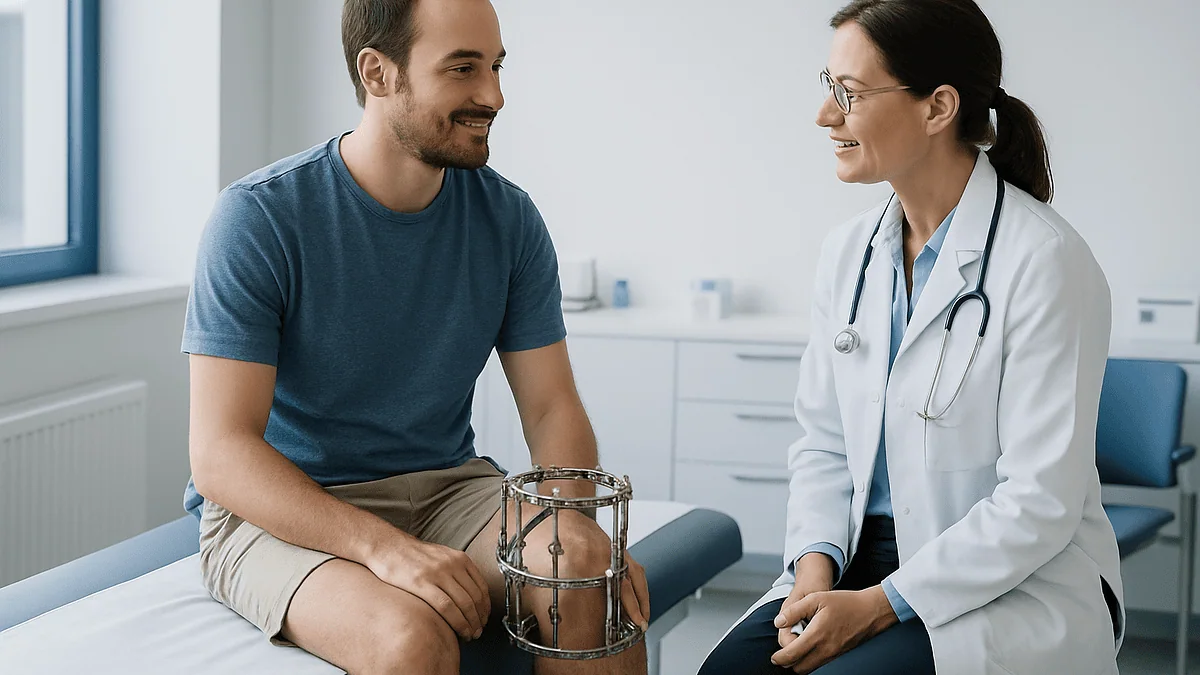
Key Takeaways
- Bone lengthening with a frame proceeds at roughly one millimeter a day, so gaining a few centimeters is measured in weeks of adjustments followed by months of consolidation.
- A Cochrane systematic review found insufficient evidence to favor any specific pin cleaning solution, dressing or frequency, which is why consistency with your own team's protocol matters more than the product.
- Pin site infection is the most commonly reported complication of external fixation; spreading redness, warmth, new pain and cloudy discharge are the signals, not dry crust alone.
- Many circular frames are designed to be walked on, and weight-bearing within surgeon-set limits may help stimulate new bone while protecting joints from stiffness.
- Doubling an adjustment after a missed turn stretches soft tissue faster than planned and can strain nerves and vessels; report the miss instead.
- New bone is still maturing when the frame comes off, and refracture is a recognized risk, so most teams stage the return to full activity with a cast or brace.
Living with an external fixator during deformity correction means learning a steady daily routine: cleaning the skin around each pin as your surgical team shows you, watching for redness or discharge, making small frame adjustments on the schedule they set, and moving as much as they allow. Most people manage this at home for months, with regular X-rays and check-ups guiding every step.
The first night home, Marcus lay on his back and stared at the ceiling because there was nowhere else to look. A metal ring encircled his shin, threaded with wires he could feel but not see, and every time he shifted, the frame tapped the bed rail like a knuckle on a door. He had signed the consent form weeks earlier. Nobody had quite explained what it would feel like to sleep beside his own scaffolding.
That gap between the surgical explanation and the lived reality is where most questions about living with an external fixator actually sit. People rarely ask how the bone is cut. They ask how to shower, whether the pins will hurt, how to get a trouser leg over a cage of steel, and what the crust around a wire is supposed to look like.
This explainer walks through those ordinary, unglamorous parts of deformity correction with a frame, and separates what the evidence supports from what circulates in forums and family advice.
What an external fixator is, and why deformity correction uses one
An external fixator is a rigid frame that sits outside the body and holds bone in position through pins or wires that pass through the skin and into the bone. In deformity correction, surgeons use it to straighten, rotate or lengthen a bone gradually rather than in one operation, because bone, nerves, blood vessels and skin tolerate slow change far better than sudden change.
The idea rests on a biological quirk. When a bone is cut and the two ends are pulled apart very slowly, the body fills the gap with new bone instead of scar. MedlinePlus describes lengthening at a rate of about one millimeter a day, which sounds trivial until you multiply it across weeks. Surgeons call this distraction osteogenesis, which simply means growing bone by stretching it.
Frames come in two broad families. Circular frames use rings connected by struts, with thin tensioned wires running through the bone; these are the ones most people picture when they hear the word Ilizarov, the surgeon who popularized the method. Monolateral frames use a single bar along one side of the limb with thicker pins. Some modern circular frames have struts that adjust with a computer-generated schedule, so a complex twist and angulation can be corrected together.
Why not a plate and screws inside the leg? For many fractures that is exactly what happens. A frame earns its place when the correction has to be gradual, when the skin is too damaged for an internal implant, when infection is present, or when length needs to be gained. It is a tool for a particular set of problems, not a better or worse option in general.
The trade is honest: more control over the bone, in exchange for months of hardware you can see and touch. Everything that follows in this article is about living well inside that trade.
How living with an external fixator actually works day to day
Strip away the engineering and a day with a frame has four recurring jobs: keep the pin sites clean, make any prescribed adjustments, move the joints above and below the frame, and notice changes early. None of them takes long. Together they shape the rhythm of the day more than any single task.
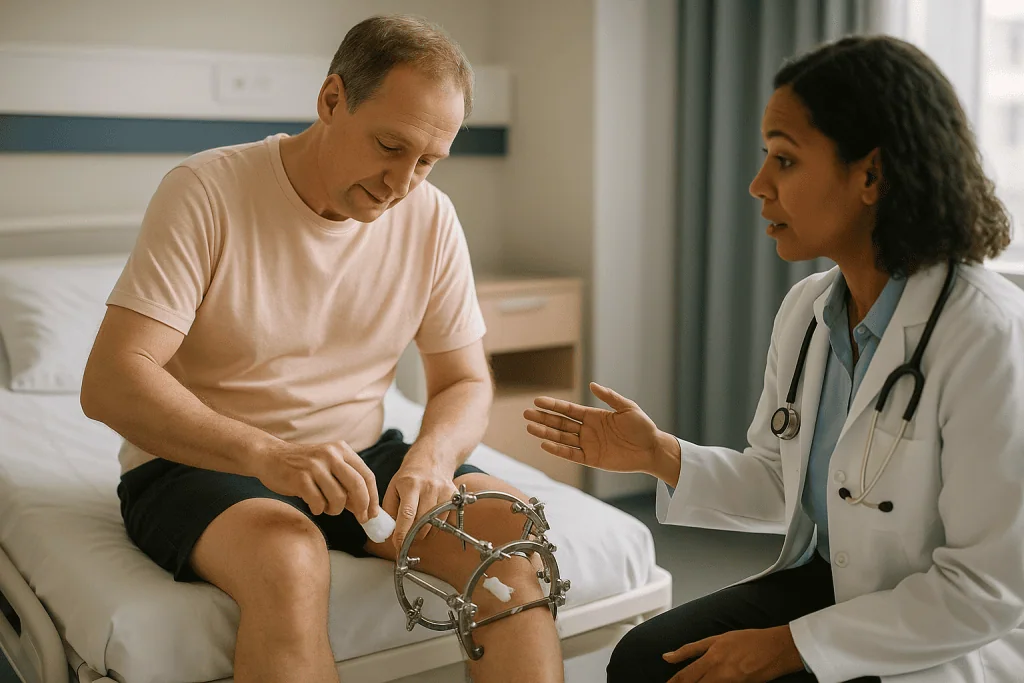
Pin care is usually a once-daily or twice-daily routine, though the exact frequency and technique vary between teams and the research does not settle which approach is best. A Cochrane systematic review of pin site care concluded there was insufficient evidence to recommend one cleaning solution, dressing or schedule over another. That uncertainty is why you will hear different instructions from different clinics, and why the right answer is whatever your own surgical team has written down.
Adjustments, when they are part of your plan, are small: turning a nut a quarter turn, or changing a strut to a number printed on a schedule. Most people do them at set times, often spread through the day so the bone is nudged rather than jolted. Missing a turn is not a disaster, but it should be reported rather than doubled up without advice.
Movement matters more than people expect. Ankles stiffen and knees lose bend when a frame sits nearby, and physical therapy exercises exist to fight that drift. Many teams also encourage some weight-bearing, because the frame is designed to carry load and because loading a healing bone tends to stimulate it.
The fourth job, noticing, is quiet. You learn what your pin sites look like on a good day so that a bad day stands out. That baseline knowledge is the single most useful thing a person with a frame can build.
Who is usually offered a frame, and who is usually asked to wait
External fixation for deformity correction tends to be offered when a bone is bent, twisted or short in a way that is causing symptoms or is expected to cause joint damage later. Typical situations include limb-length differences after childhood injury or growth-plate problems, malunited fractures where the bone healed in the wrong position, congenital deformities, and bone loss or infection where internal metal would be unwise. Johns Hopkins describes limb lengthening as an option when a discrepancy is significant enough to affect walking or joint health.
Children and adolescents are frequently candidates because their bone forms quickly and their growth can be factored into the plan. Adults are candidates too, though healing generally takes longer and surgeons plan for that.
Who is asked to wait, or steered toward another route? Several groups come up repeatedly in guideline-level discussions:
- People with active infection at the planned surgical site, until it is controlled.
- People who smoke heavily or have poorly controlled diabetes, because both slow bone and skin healing; teams often ask for a period of preparation first.
- Anyone who cannot realistically manage daily pin care and adjustments, or does not have someone who can help.
- People with untreated mental health conditions that would make months of visible hardware unusually hard to tolerate; this is about support, not exclusion.
- Those whose deformity is mild enough that shoe modification or watchful waiting is reasonable.
None of these is an absolute rule. Surgeons weigh the deformity, the person, the home situation and the alternatives, which may include internal lengthening nails, acute correction with plates, or no surgery at all. Each has its own risks, and the comparison belongs in a consultation rather than a magazine. What the evidence supports is that readiness, meaning both physical fitness for surgery and practical capacity to live with the frame, strongly shapes the experience.
How painful is an external fixator?
The honest answer has three parts, because pain with a frame changes character over time.
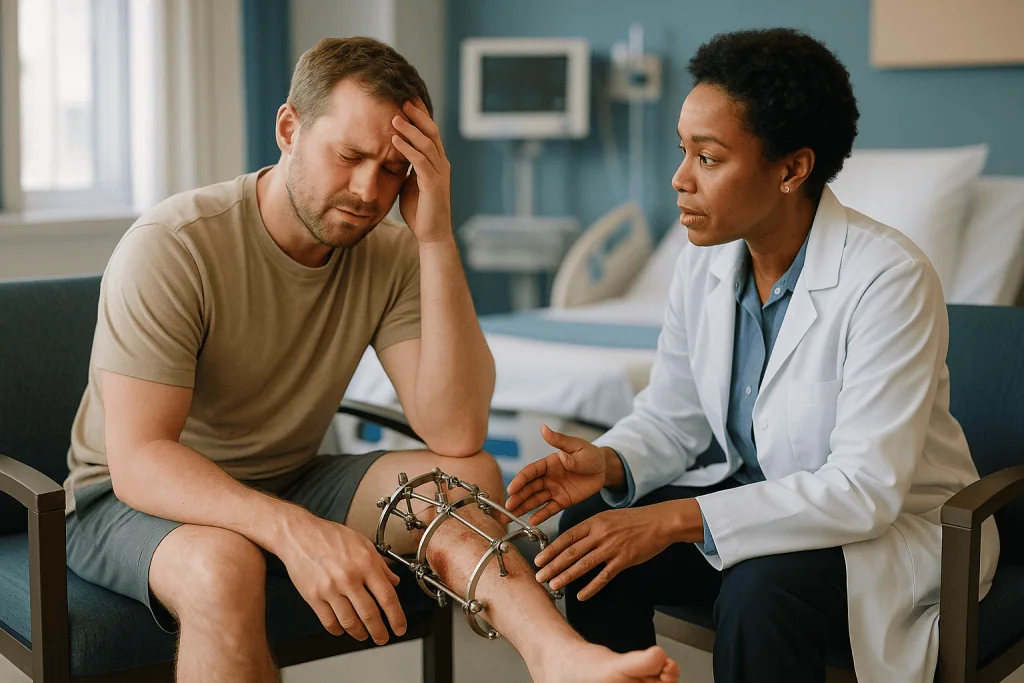
In the first days after surgery, pain comes mainly from the operation itself: the bone cut, the drilling, the swelling. This is surgical pain and it is managed like other orthopedic surgical pain, with a plan set by the hospital team and adjusted as you recover. Mayo Clinic notes that pain after a leg fracture or its treatment typically eases over the first couple of weeks as swelling settles. People who have had both a frame and an internal plate often say the early phase feels similar.
The second kind is pin site soreness. Where a pin passes through skin and muscle, the tissue moves against the metal every time you flex. Pins through thick muscle, such as the front of the thigh, tend to be more tender than pins through thin skin over the shin. This soreness usually settles as the skin matures around the pin, but a sudden increase at a single site is a signal, not background noise.
The third kind belongs to correction itself. As the bone is distracted, soft tissues stretch with it, and many people describe a deep ache or tightness, particularly at night after a day of adjustments. Muscle cramps are common during lengthening. Physical therapy stretching and pacing the day often help; if the ache becomes sharp or a joint starts to contract, surgeons may slow the rate of correction.
What does not happen: the frame is not constantly agonizing for months. Most people describe living with an external fixator as a background discomfort punctuated by bad days, rather than relentless pain. Anyone whose experience is worse than that should tell their team, because unexpected pain sometimes points to a treatable problem such as a loose pin or early infection.
External fixator pin care: what the evidence actually shows
Pin care has an unusual place in orthopedics: it is done millions of times a year, everyone agrees it matters, and the research still cannot say which method is best. The Cochrane review on pin site care found the included trials small and inconsistent, and concluded that no particular solution, dressing or frequency could be shown to reduce infection more than another. Reported infection rates in that literature varied widely, partly because studies define infection differently.
That gap is worth understanding, because it explains why advice conflicts. Some teams favor daily cleaning with saline; others use antiseptic solutions; some wrap pin sites in dressings while others leave them open once healed. Each approach has a rationale. None has decisive proof behind it.
What most protocols share, and what general wound-care principles support, are a few habits:
- Clean hands before touching pin sites. The CDC treats hand hygiene as the single most effective step against transmitting infection in any wound care.
- One clean applicator per pin, so bacteria from a troubled site are not carried to a healthy one.
- Gentle removal of crust that is loose; leave crust that is firmly adherent unless your team tells you otherwise, since scrubbing can inflame the skin.
- Inspect while you clean: color, warmth, discharge, and whether the skin is pulling or tenting against the pin.
Skin tension is a detail many people miss. When a pin sits in a spot where the skin is stretched over it, the constant pressure irritates the site and invites infection. Surgeons sometimes release the skin with a small incision or add padding to reduce that tension.
The practical conclusion is not that pin care is pointless, but that consistency with your team’s protocol matters more than the specific product. Do it the same way, at the same time, and you will notice change when it comes.
A daily routine for living with an external fixator
Routine turns a strange situation into a manageable one. The schedule below is illustrative rather than prescriptive; your own team’s written instructions override anything here, and many people shift the timing to fit school, work or caregivers.
| Time of day | Task | Why it matters |
|---|---|---|
| Morning | Hand hygiene, pin site inspection and cleaning; first adjustment if scheduled | Daylight makes redness and discharge easier to judge; a fixed time reduces missed turns |
| Midday | Physical therapy exercises for joints above and below the frame; adjustment if scheduled | Joints near a frame stiffen quickly; spreading adjustments spaces the stretch on soft tissue |
| Afternoon | Walking or weight-bearing as permitted; check frame nuts and struts for looseness | Loading may support bone formation; loose hardware can shift alignment unnoticed |
| Evening | Shower or wash per protocol; final adjustment; record adjustments and any pin changes in a notebook | A written log makes clinic visits shorter and problems traceable |
| Night | Position the limb with pillows or a foam block; elevate if swelling | Reduces frame contact with bedding and eases morning swelling |
Two habits deserve emphasis. The first is the log. Writing down each adjustment and each pin site observation sounds fussy, and within a fortnight it becomes automatic. When a surgeon asks whether a site has been red for two days or two weeks, the notebook answers.
The second is a quick hardware check. Nuts on a frame can loosen with vibration from walking. A thirty-second glance and a gentle hand around the rings each day catches this early. Never tighten or turn anything outside your written schedule; report it instead.
Build in rest. Correction is tiring in a way that surprises active people, and fatigue makes pin care sloppy.
Can you walk with an external fixator on your leg? Walking with an external fixator explained
Often, yes, and in many deformity correction plans walking is not just allowed but encouraged. A circular frame is engineered to transmit load through the rings and wires, bypassing the healing segment, so the bone can be protected while the person stands on it. Weight through the limb also appears to stimulate bone formation, which is one reason surgeons who use frames tend to push early mobility.
That said, the amount of weight you may put through the leg is a surgical decision, not a general rule. It depends on the type of frame, where the bone was cut, whether lengthening is under way, and how the X-rays look. Instructions range from touch-down weight only, with crutches doing the work, through partial weight-bearing, to walking as tolerated. Ask for the instruction in plain terms and ask when it will be reviewed.
Walking with a frame has its own mechanics. The extra weight on one side, often several pounds of metal, changes balance. A raised sole on the opposite shoe may be recommended if the frame lifts the heel or if the limb is temporarily shorter. Physical therapists teach a gait that keeps the frame from swinging into the other leg, and they teach stairs separately, because the frame can catch on a step edge.
Surfaces matter. Wet floors, loose rugs and gravel are the everyday hazards. Many people find a walker steadier than crutches in the first weeks at home, then move to crutches or a single cane as confidence grows.
Frames on the upper limb, or on a foot, follow different rules, and a thigh frame limits walking more than a shin frame because it crosses more muscle. The common thread is that movement is part of the treatment, within the limits your team sets and revises at each visit.
How do you sleep with an external fixator? Sleeping with an external fixator without dread
Sleep is the complaint that surfaces in almost every patient forum, and it is rarely mentioned in the surgical consultation. The problems are practical: the frame catches on sheets, the limb cannot roll, the pins ache after a day of adjustments, and the metal is cold.
Position comes first. Most people with a leg frame sleep on their back with the limb slightly elevated on pillows or a firm foam block shaped to cradle the frame. Elevation reduces the overnight swelling that makes mornings stiff. Side sleepers grieve their old position for a while; some manage a partial side lie with a pillow between the knees and the frame resting on a cushion, but only once the team confirms it is safe.
Bedding fights back. A lightweight duvet snags on struts; many people switch to a top sheet tucked loosely or use a frame cover, essentially a soft fabric sleeve, to keep pins from catching. A cage-like blanket support, sold for other medical uses, lifts the covers off the leg entirely. Cutting a slit in an old pillowcase and sliding it over the frame is a cheap version.
Timing of pin care and adjustments affects sleep. Doing the last adjustment several hours before bed, rather than at bedtime, gives the stretched tissue time to settle. Evening stretching from your physical therapy plan can ease the deep ache that keeps people awake.
Sleep disruption also has a psychological layer. Lying still beside hardware for months is isolating, and low mood worsens pain perception. If sleep stays poor after the first weeks, raise it at a clinic visit rather than treating it as an unavoidable tax. Sleep is part of recovery, not a luxury alongside it.
What is the most common complication associated with an external fixator? External fixator complications in perspective
Pin site infection is, by a wide margin, the most frequently reported complication of external fixation. The Cochrane review on pin site care describes infection rates that vary widely between studies because there is no single agreed definition, but it is consistently the leading problem across the literature. The reason is anatomical: every pin creates a permanent opening from the outside world to the bone, and the skin around it moves constantly.
Most pin site infections are superficial, involving the skin and immediate soft tissue. They present as increasing redness spreading outward from the pin, warmth, tenderness that is new or worse, and discharge that changes from clear to cloudy or colored. Superficial infections are usually managed with more frequent cleaning and, when a clinician judges it necessary, a short course of oral antibiotics chosen and timed by the prescribing team. Deeper infections that reach the bone are far less common and may require pin removal or repositioning.
Other complications deserve mention in neutral terms:
- Joint stiffness and contracture, especially at the ankle and knee during lengthening, which is why physical therapy is not optional.
- Pin loosening, which reduces the frame’s grip on bone and often coincides with infection.
- Delayed or slow formation of new bone in the gap, which may lead the team to adjust the rate or extend time in the frame.
- Premature consolidation, where the bone hardens before the correction is complete.
- Nerve or blood vessel irritation from pins placed near them, or from stretching during correction.
- Fracture of new bone after the frame is removed, which is why weight-bearing is often staged afterward.
Reading a list like this can feel alarming. The context is that surgical teams anticipate most of these problems, watch for them at every visit, and have established ways to respond. Your job is to report change early; theirs is to decide what it means.
Washing, clothing and getting through the door
Nobody warns you that the bathroom becomes the hardest room in the house.
Washing depends on your team’s protocol and on the state of your pin sites. Some surgeons permit showering once the surgical incisions have sealed, on the reasoning that running water over healthy pin sites is no worse than cleaning them with saline. Others ask for pin sites to be kept dry or covered until later. Baths and swimming pools are usually discouraged while the frame is on because standing water carries more bacteria to the openings. Whatever the rule, the frame should be dried gently afterward, pins included, since moisture trapped against skin softens it.
A shower chair and a handheld shower head turn a risky balancing act into a routine. Non-slip mats matter more than ever. A plastic bag over a foot frame, sealed with tape, is a common improvisation for keeping a dressing dry when the rest of the body needs washing.
Clothing is a problem of geometry. A circular frame is wider than any trouser leg. The standard fixes are loose sweatpants with the seam opened and re-closed with snaps or hook-and-loop fastening, wide-leg trousers cut and hemmed, or shorts and a long sock on the other leg. Sleeves face the same challenge with an arm frame. Several people describe buying two pairs of the same trousers and combining a wide leg from one with a normal leg from the other.
Doorways, car seats and public transport each have a first-time awkwardness. Sliding into a car back seat sideways, frame first, is easier than the front. Aisle seats on buses and planes let the frame extend. Airport security will want to see the frame and will usually swab rather than ask you to remove anything, but a letter from your team describing the hardware smooths the process.
What the first days and weeks usually look like
The arc of frame treatment has recognizable phases, and knowing the shape of it reduces the sense of drifting.
The hospital stay is typically a few days, spent controlling surgical pain, learning pin care from the nursing team, learning transfers and walking with a physical therapist, and often receiving a written adjustment schedule. Do not leave without knowing who to call and how to reach them out of hours.
The first week at home is usually the hardest. Swelling peaks, pin sites are raw and unfamiliar, and every task takes twice as long. This is normal, and it is also the period when routines are formed, so it pays to be deliberate about timing and logging.
Correction itself generally begins after a short latency, commonly a few days to a week after surgery, so the cut bone surfaces start to heal before they are pulled apart. Then the distraction phase runs at roughly the one millimeter a day described by MedlinePlus, adjusted up or down by the surgeon based on X-rays and how the soft tissues are coping. A person gaining a few centimeters of length spends weeks in this phase; a complex angular correction may take a similar span.
After the correction is complete comes consolidation, when the new bone hardens. This phase often lasts longer than the correction, and MedlinePlus notes that the whole process of lengthening and healing can extend across many months. Clinic visits and X-rays continue every few weeks throughout, so the team can see the new bone forming and decide when the frame has done its work.
For comparison, NHS guidance describes a simple broken leg healing in around six to eight weeks in adults. Frame treatment is measured on a different scale, and expecting it to be quick is the surest route to frustration.
What people often get wrong
Myths gather around visible hardware. Several are worth correcting plainly.
Crust means infection. Not on its own. Dried serous fluid forming a light crust around a pin is common and often a sign the site is sealing. Spreading redness, warmth, new pain and cloudy discharge are the signals, not crust by itself.
More antiseptic is better. The Cochrane evidence does not support any solution as superior, and strong antiseptics used aggressively can irritate skin and slow healing. Consistency with your protocol beats intensity.
If a turn is missed, do two next time. Doubling an adjustment stretches soft tissue faster than planned and can strain nerves and vessels. Report the missed turn and follow the team’s instruction.
The frame means no walking. Many frames are built to be walked on. Weight-bearing status is individual, and staying immobile when you have been cleared to load the leg may slow bone formation and stiffen joints.
Pain always means something is wrong. Ache during distraction and pin site tenderness are part of the experience. Sudden, localized or escalating pain is different and should be reported.
Once the frame is off, treatment is over. New bone is still maturing after removal, and refracture is a recognized risk. Most teams stage the return to full activity and may use a cast or brace for a period.
Children cannot cope with frames. Studies of adolescent experience with circular frames describe real challenges with body image and school, and also describe children adapting well with support. Coping is shaped by preparation and family involvement more than by age.
The pattern across these myths is the same: the frame invites all-or-nothing thinking, and the reality is graded, individual and best judged by the team that sees your X-rays.
Questions to ask your care team
A consultation goes faster when questions are written down. These are the ones people most often wish they had asked before living with an external fixator, grouped by the moment they matter.
Before surgery:
- What exactly is being corrected, and what would happen if it were left alone?
- What alternatives to a frame exist for my situation, and why is a frame preferred here?
- How long do you expect the frame to be on, as a range, and what would extend it?
- Which joints will be affected, and what physical therapy will I need?
About pin care and adjustments:
- What is your pin site protocol, in writing, including what to clean with and how often?
- What does a normal pin site look like in your experience, and what should prompt a call?
- Who does the adjustments, and what should I do if I miss one or turn the wrong way?
- Can I shower, and from when?
About daily life:
- How much weight can I put through the limb now, and when will that be reviewed?
- Can I return to school or work, and what accommodations should I request?
- Are there activities that are off limits while the frame is on?
- Whom do I contact out of hours, and how quickly should I expect a response?
About the end of treatment:
- How is frame removal done, and is it a separate operation?
- Will I need a cast, brace or restricted activity afterward, and for how long?
- What is the risk of the new bone breaking, and how is that reduced?
Bring someone with you. Frame consultations cover a lot of ground, and a second pair of ears catches the details that a tired patient forgets.
When to call your doctor
Most days with a frame are uneventful, which makes the exceptions easier to spot if you know what they are. Contact your surgical team the same day if you notice any of the following at a pin site: redness spreading more than a fingertip’s width from the pin, skin that is hot to touch, new or sharply increasing pain at one site, discharge that has turned thick, cloudy, yellow or green, or a pin that feels loose or moves when the frame is touched.
Seek urgent care, by calling emergency services or going to an emergency department, for signs that suggest deeper infection or a threat to the limb: a fever with chills, feeling generally unwell or confused, a pin site with pus tracking along the pin, a limb that becomes pale, cold, blue or numb, toes or fingers you cannot move, or swelling that is rapidly increasing and tight rather than soft. A calf that becomes swollen, warm and painful, or sudden breathlessness or chest pain, could indicate a blood clot and needs immediate assessment; prolonged reduced mobility raises that risk.
Call promptly, though less urgently, if the frame has been knocked hard and anything looks bent or misaligned, if a strut or nut has visibly moved, if you have missed adjustments and are unsure how to proceed, or if pain is interfering with sleep and function despite following the plan you were given.
Mental health belongs on this list. Months of visible hardware, disrupted sleep and restricted independence take a toll, and persistent low mood, anxiety or thoughts of harming yourself deserve the same prompt attention as a red pin site. Your team can connect you with support, and doing so is part of good care rather than a failure to cope.
When in doubt, call. Teams who use frames expect these calls and would rather hear about a false alarm than a late problem.
Frequently asked questions
How painful is an external fixator?
Pain with an external fixator changes over time: surgical pain in the first days, pin site soreness that eases as skin matures, and a deep ache or cramping during active correction. Most people describe background discomfort with occasional bad days rather than constant severe pain. A sudden increase at one pin site, or pain that disrupts sleep despite your plan, should be reported to your team.
How do you sleep with an external fixator?
Most people sleep on their back with the framed limb elevated on pillows or a shaped foam block, using a light top sheet, a frame cover or a blanket lifter to stop bedding catching on pins. Doing the last daily adjustment several hours before bed and finishing evening stretches can ease the ache. Persistent poor sleep is worth raising at a clinic visit.
Can you walk with an external fixator on your leg?
Often yes. Circular frames are built to carry load, and many surgeons encourage walking because weight through the limb may support bone formation. How much weight you may bear is an individual decision based on frame type, the correction under way and X-rays, ranging from touch-down with crutches to walking as tolerated. Ask for your limit in plain terms and when it will be reviewed.
What is the most common complication associated with an external fixator?
Pin site infection is the most frequently reported complication. Every pin creates an opening from skin to bone, and the surrounding skin moves constantly. Most infections are superficial and managed with more frequent cleaning and, when a clinician decides it is needed, antibiotics. Deeper infections are less common and may require pin removal or repositioning.
What does good external fixator pin care involve?
Clean hands, one clean applicator per pin, gentle removal of loose crust only, and daily inspection for redness, warmth, discharge and skin tension against the pin. The Cochrane review found no cleaning solution, dressing or frequency proven superior, so the specific method your surgical team writes down is the one to follow consistently.
Can you shower with an external fixator?
It depends on your team’s protocol and the condition of your pin sites. Some surgeons allow showering once incisions have sealed; others ask for sites to be kept dry or covered for longer. Baths and swimming are usually discouraged while the frame is on because standing water carries more bacteria to the openings. Dry the frame and pins gently afterward.
How long do you have to live with an external fixator for deformity correction?
It varies with the size of the correction and how quickly new bone consolidates. Lengthening proceeds at about one millimeter a day, and the consolidation phase that follows often lasts longer than the correction itself, so MedlinePlus describes the overall process as taking many months. Your surgeon will give a range and revise it based on X-rays.
What happens if I miss an adjustment on my frame?
Do not double the next adjustment to catch up. Stretching soft tissue faster than planned can strain nerves and blood vessels and increase pain. Record the missed turn in your log and contact your team for instructions; a single missed adjustment is common and easily accommodated in the schedule.
What are the main external fixator complications besides infection?
Joint stiffness and contracture near the frame, pin loosening, slow formation of new bone, premature hardening before the correction is complete, nerve or vessel irritation, and fracture of new bone after frame removal. Teams monitor for each of these at regular visits, and physical therapy and staged weight-bearing after removal are the main preventive measures.
What happens when the external fixator comes off?
Frame removal is often a short procedure, sometimes under sedation or anesthesia. The new bone is still maturing, so many teams protect the limb with a cast or brace and stage the return to full weight-bearing and sport. Joint stiffness may need continued physical therapy, and follow-up X-rays confirm the bone is remodeling as expected.
References
- MedlinePlus: Leg lengthening and shortening
- Cochrane Review (PubMed): Pin site care for preventing infections associated with external bone fixators and pins
- NHS: Broken leg
- CDC: About Hand Hygiene for Patients in Healthcare Settings
This article is for general information only and is not a substitute for professional medical advice. Please consult a qualified doctor about your individual situation.

More from the Blog

Local, Regional or General? Anesthesia Options for Finger and Toe Surgery Explained
Most finger and toe operations can be done under local anesthesia, usually a digital block that numbs only the affected digit while you stay…

Who May Be a Candidate for Proximal Fibular Osteotomy When Inner-Knee Arthritis Is Mild?
Proximal fibular osteotomy is usually considered for adults whose knee osteoarthritis is confined mainly to the inner (medial) compartment, who have mild to moderate…

Knee Pain Causes: Why Knees Hurt (and Why It Differs in Women)
Knee pain in women most often comes from patellofemoral (front-of-knee) pain, osteoarthritis, tendon or bursa irritation, meniscus wear, or ligament injury. Women see certain…

Shoulder, Elbow, Wrist or Hand: How Upper Limb Surgery Is Planned for Each Joint
Upper limb surgery covers operations on the shoulder, elbow, wrist and hand, from nerve releases and tendon repairs to fracture fixation and joint replacement.…

Life After Adult Reconstruction Surgery: Why High-Impact Sport Is Limited and What Replaces It
After adult reconstruction surgery, the orthopedic term for hip and knee replacement, most care teams advise a long-term shift away from running, jumping and…

How Foot Surgery Is Performed: Bunion Correction, Fusion and Tendon Repair Step by Step
Foot surgery is usually performed as a day procedure under a nerve block, spinal or general anesthetic. The surgeon makes one or more small…