

Long-Term Surveillance in Acromegaly: Hormone Tests, Imaging, Blood Pressure and Sleep Checks

Key Takeaways
- IGF-1 is the anchor test of acromegaly follow-up because it stays steady over 24 hours, whereas growth hormone pulses from near zero to high within a single day.
- The Endocrine Society guideline advises waiting about 12 weeks after pituitary surgery before the first definitive IGF-1 measurement and MRI, because earlier results can mislead.
- After radiotherapy, growth hormone falls over years and new pituitary hormone deficiencies can appear a decade later, so yearly hormone testing is recommended indefinitely.
- A GH receptor antagonist raises measured growth hormone while lowering IGF-1, so IGF-1 is the only valid control marker on that class of medicine.
- Sleep apnea often improves after hormonal control but frequently persists because jaw and airway bone changes are permanent, so a repeat sleep study is recommended rather than assumption.
- Colonoscopy is recommended at diagnosis, with repeat intervals set by polyp findings and how well IGF-1 stays within the age-adjusted normal range.
Acromegaly long term follow up means lifelong, scheduled checks after treatment: an age-adjusted IGF-1 blood test and often growth hormone measurement at each endocrine visit, a pituitary MRI at set intervals, and regular review of blood pressure, blood sugar, heart function, sleep apnea, joints, bones and colon health. The exact timetable is set by the treating endocrinology team based on how the condition responded to treatment.
The operation went well. The surgeon said the tumor came out cleanly, the headaches eased within a fortnight, and the rings that had been cut off two summers ago slide back on now. So why, a patient asks at the three-month visit, is there another blood test, another scan, another appointment pencilled in for next year, and the year after that?
That question sits at the heart of acromegaly long term follow up. Acromegaly is a condition in which a benign pituitary growth makes too much growth hormone for years, and the body keeps the receipts long after the hormone level falls. Some changes reverse. Others settle but do not disappear. A few can return quietly, without a single symptom to announce them.
Surveillance is not a sign that something is wrong. It is the part of treatment that notices early when something starts to drift.
What acromegaly long term follow up actually involves
Acromegaly is driven by a pituitary adenoma, a benign tumor in the pea-sized gland at the base of the brain, that releases excess growth hormone (GH). GH tells the liver to make insulin-like growth factor 1 (IGF-1), and IGF-1 is the messenger that actually thickens bone, skin, soft tissue and organs. Follow-up is built around tracking both messengers and the tissues they act on.
In practice, a surveillance visit has four moving parts. The first is a blood draw for IGF-1, usually paired with a growth hormone measurement, because these two numbers tell the team whether the disease is biochemically controlled. The second is imaging: a pituitary MRI at intervals that depend on what, if anything, is left of the tumor. The third is a systemic review, meaning blood pressure, blood sugar or HbA1c, lipids and, when indicated, an echocardiogram (an ultrasound of the heart). The fourth is a conversation about sleep, joints, mood, vision and energy, because some of the most disabling consequences of acromegaly never show up on a lab slip.
The Endocrine Society’s clinical practice guideline frames this as continuous monitoring rather than a finish line, with biochemical testing, imaging and comorbidity assessment repeated for life. The rhythm changes over time. The first year after surgery is dense with appointments; a stable, well-controlled patient in year ten may be seen once a year with a single blood test and a scan only if something prompts it.
The thing worth holding onto is this: the visits are not repetitive because the team is unsure. They are repetitive because acromegaly behaves slowly, and slow problems are caught by looking on a schedule, not by waiting for symptoms.
Acromegaly monitoring after surgery: why it does not end when the tumor is out
Transsphenoidal surgery, in which the surgeon reaches the pituitary through the nose and sphenoid sinus, is the usual first-line treatment when the tumor can be reached. It often brings GH down quickly. But the Endocrine Society guideline advises waiting at least 12 weeks before measuring IGF-1 to judge the result, because IGF-1 has a long biological half-life and can lag behind the hormone that drives it. A test done at two weeks can look worse, or better, than the true outcome.
Monitoring continues afterwards for three reasons. First, residual tumor. Larger adenomas and those that have grown sideways into the cavernous sinus, the venous channel beside the pituitary, cannot always be removed completely, and what remains can keep secreting. Second, recurrence. Even after a clean postoperative result, a small number of people see IGF-1 creep back up years later, and the only reliable way to catch this is a scheduled blood test. Third, the rest of the gland. Surgery near normal pituitary tissue can reduce output of other hormones, sometimes immediately and sometimes slowly.
What the first weeks usually look like: nasal congestion and a feeling of fullness behind the eyes for a week or two, fatigue that lifts gradually, and swelling in hands and feet that often begins to recede within days as GH falls (the Mayo Clinic notes soft-tissue changes can improve relatively early, while bone changes do not). Thirst and heavy urination in the first days can signal a temporary disturbance of the water-balance hormone vasopressin, and teams watch for it closely. Most people are given a date, typically around the 12-week mark, for the first definitive hormone check and MRI. Everything after that is calibrated to what those results show.
IGF-1 levels in acromegaly: the test that anchors every visit
If one number defines acromegaly follow-up, it is IGF-1. Unlike growth hormone, which the pituitary releases in pulses that swing from undetectable to high within a single day, IGF-1 is steady over 24 hours. A single morning sample gives a fair picture of average GH exposure over the preceding weeks.
Two details matter when you read your result. IGF-1 falls naturally with age, so laboratories report an age-adjusted reference range, and the goal set out in the Endocrine Society guideline is an IGF-1 within that normal range, not simply a lower value than last time. Second, the laboratory assay matters. Different methods can give different absolute numbers, which is why teams prefer to track a patient within one laboratory over years and are cautious about comparing a result from elsewhere.
Growth hormone is usually measured alongside. A random GH value is informative, and the guideline treats a random GH below a defined low cut-off as consistent with control. Where the two tests disagree, a glucose-suppression test is often used: you drink a measured glucose solution and GH is sampled over about two hours. In a healthy person glucose switches GH off; in active acromegaly it does not fully suppress. This test cannot be used in people treated with a GH receptor blocker, because that medicine raises measured GH while lowering IGF-1, and it loses accuracy in uncontrolled diabetes.
Discordance, where IGF-1 is normal but GH is not, or the reverse, occurs in a meaningful minority and is one of the commonest reasons a team repeats tests before changing anything. It is not a sign that someone made a mistake. It is the hormone system being untidy, which is exactly why the guideline relies on trends and on both markers rather than one snapshot.
How often is a pituitary MRI needed in long-term acromegaly care?
MRI is the imaging test of choice because it shows soft tissue at the millimeter scale and does not use ionizing radiation. The Endocrine Society guideline recommends a scan around 12 weeks after surgery, once postoperative swelling and packing material have settled enough to tell scar from residual tumor. Scanning earlier produces images that are hard to interpret and can cause unnecessary alarm.

After that baseline, the interval depends on what the scan shows and on how the hormones are behaving:
- No visible residual tumor and normal IGF-1: imaging is usually repeated only if IGF-1 rises or new symptoms appear, with some teams choosing a periodic scan every few years as reassurance.
- Visible residual tumor: scans are repeated at defined intervals, typically yearly at first, to confirm it is not growing, with the gap widening if it remains stable.
- During medical treatment: periodic MRI tracks whether the tumor is shrinking, stable or enlarging. Shrinkage is common with somatostatin analogs; it is not expected with a GH receptor blocker, so imaging continues as a safety check rather than a measure of success.
- After radiotherapy: changes unfold over years, so scans are spaced out but continued long term.
Gadolinium contrast is commonly used to sharpen the picture. Repeated exposure has prompted caution about tiny deposits in tissue, and radiology departments weigh this when deciding how often to use contrast in a lifelong surveillance program. Non-contrast scans are sometimes sufficient when the question is simply whether a known remnant has changed size.
Vision deserves a mention here. If a tumor sits near the optic chiasm, where the optic nerves cross, formal visual field testing by an eye specialist may be scheduled alongside imaging. A change in peripheral vision can precede a change on the scan.
Can pituitary surgery or radiotherapy affect other hormones years later?
Yes, and this is one of the most important and least discussed parts of long-term care. The pituitary controls the thyroid, the adrenal glands, the ovaries or testes, growth hormone itself, and water balance. Any treatment aimed at an adenoma sits millimeters from the tissue that runs these systems. Hypopituitarism is the medical term for reduced output of one or more of these hormones.
After surgery, new deficiencies most often declare themselves within the first weeks to months, which is why cortisol and thyroid function are checked early and the Endocrine Society guideline advises reassessing pituitary function after the operation. Vasopressin disturbance, causing intense thirst and large volumes of pale urine, is usually temporary but is monitored because a persistent form needs treatment.
Radiotherapy behaves differently. Whether delivered as conventional fractionated treatment over weeks or as a single focused stereotactic dose, it works slowly; the Mayo Clinic notes GH may take years to fall. During those years, normal pituitary cells are also affected, and the proportion of people who develop at least one new hormone deficiency rises steadily over time. For that reason the guideline recommends checking pituitary hormones at least yearly after radiation, indefinitely. Other long-term considerations the team weighs are small risks to vision pathways and a low but non-zero risk of second tumors in the irradiated field, which is why radiation is usually reserved for disease not controlled by surgery and medication.
What this means for you: new tiredness, feeling cold, low mood, loss of libido or lightheadedness on standing years after treatment are not simply ageing. They are worth reporting, because a hormone deficiency is both measurable and treatable, and the test is a blood sample rather than another scan.
Why blood pressure and heart checks are part of acromegaly follow-up
Growth hormone does not stop at bone. Over years it enlarges the heart muscle, stiffens arteries, encourages the kidneys to hold onto sodium and water, and worsens insulin resistance. The result, according to the Mayo Clinic and Cleveland Clinic, is that high blood pressure, cardiomyopathy (a thickened, less efficient heart muscle), arrhythmias and type 2 diabetes are among the most common complications, and cardiovascular disease has historically been a leading contributor to the excess mortality seen in untreated disease.
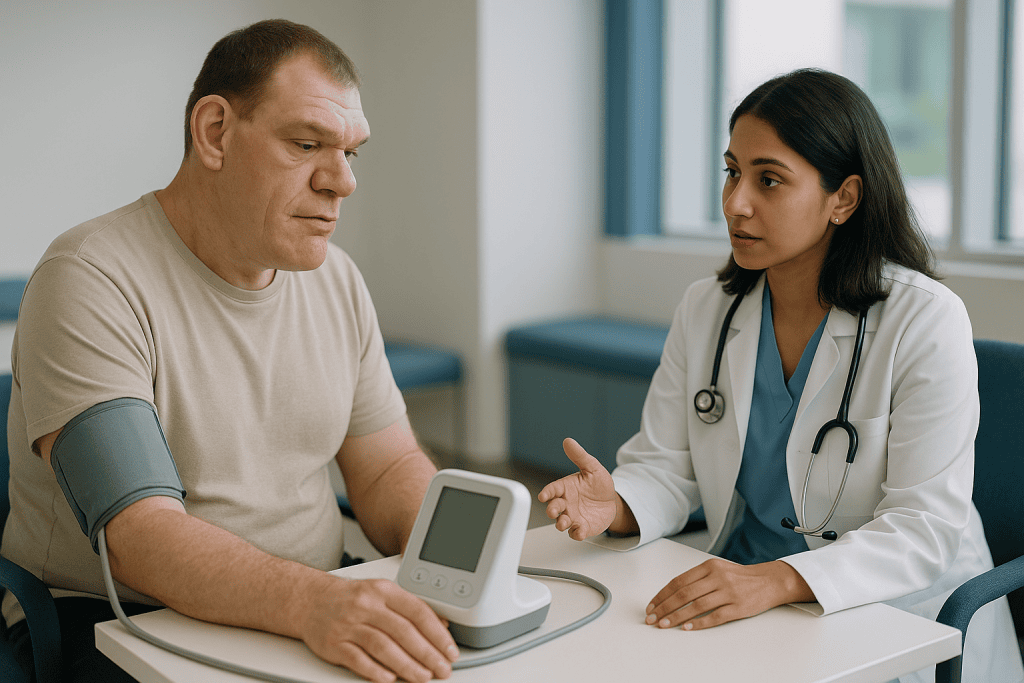
So every follow-up visit includes a blood pressure reading, and home monitoring is often encouraged because clinic readings can run high. Blood sugar is tracked with fasting glucose or HbA1c, a measure of average glucose over roughly three months. Lipids are checked periodically. An echocardiogram is recommended at diagnosis when symptoms or risk factors suggest heart involvement, and repeated if the first one is abnormal or if breathlessness, palpitations or ankle swelling develop later.
The encouraging part of the evidence is that several of these changes respond to hormonal control. Blood pressure often improves, insulin sensitivity tends to recover, and heart muscle thickening can regress at least partially once IGF-1 normalizes. The less encouraging part is that they do not always return to baseline, especially after many years of untreated disease, and some people need ongoing treatment for hypertension or diabetes regardless of how well the acromegaly itself is controlled. Those conditions are then managed the way they would be in anyone else, along American Heart Association lines, with the endocrine team and primary care sharing the task.
The practical takeaway is that a normal IGF-1 does not retire your blood pressure cuff. It simply changes the conversation from damage control to ordinary prevention.
Sleep checks: does sleep apnea improve once hormones are controlled?
Sleep apnea is the condition in which the airway repeatedly collapses during sleep, causing pauses in breathing, loud snoring and unrefreshing nights. In acromegaly it is remarkably common for two reasons. GH enlarges the tongue, the soft palate and the tissues of the throat, physically narrowing the airway (obstructive apnea). GH excess also appears to blunt the brain’s breathing drive during sleep in some people (central apnea). Both the Mayo Clinic and the Endocrine Society guideline list sleep apnea among the complications that should be actively looked for, not waited for.
What “looked for” means in practice: at diagnosis, and periodically afterwards, the team asks about snoring, witnessed pauses, morning headache and daytime sleepiness, and arranges a sleep study when the answers raise concern. A sleep study, or polysomnography, records breathing, oxygen levels and sleep stages overnight, either in a sleep laboratory or with a home monitor.
Here the evidence is genuinely mixed, and it is worth being honest about it. Soft tissue does shrink when IGF-1 normalizes, and many people report quieter nights and better energy. Yet studies following patients after successful treatment find that a substantial share still have measurable apnea, partly because the bony changes to the jaw and face are permanent and partly because weight, age and neck anatomy matter independently of hormones. For that reason the guideline suggests reassessing sleep apnea after biochemical control rather than assuming it has resolved, and anyone already using positive airway pressure therapy is generally advised to keep using it until a repeat study says otherwise.
Untreated sleep apnea raises blood pressure and strains the heart, which is exactly the system acromegaly has already burdened. Treating it is one of the clearer wins available in long-term care.
Acromegaly complications long term: joints, bones, colon and blood sugar
Some consequences of acromegaly outlast the hormone that caused them, and knowing which ones helps set realistic expectations.
Joints. Arthropathy, meaning joint disease, affects a majority of people with long-standing acromegaly. Early on, cartilage thickens and joints feel stiff and swollen; later, the altered mechanics lead to irreversible osteoarthritis in knees, hips, shoulders and spine. Hormonal control halts the process but does not rebuild cartilage, so joint pain often remains the most persistent complaint years after IGF-1 normalizes. Follow-up includes asking about it and referring to rheumatology, physiotherapy or orthopedics as needed.
Bones. Despite thicker bones on X-ray, vertebral fractures are more common than expected, because GH excess disrupts bone quality rather than quantity, and hypogonadism from pituitary damage adds to the risk. Teams may arrange spinal imaging or bone density scans, interpreting the latter with caution because enlarged bones can give falsely reassuring density readings.
Colon. IGF-1 promotes cell growth in the bowel lining, and colon polyps and colorectal cancer occur more often than in the general population. The Endocrine Society guideline recommends a colonoscopy at diagnosis, with the interval for repeat screening then based on what is found and on how well IGF-1 is controlled. Persistent elevation argues for closer intervals.
Blood sugar and other glands. Diabetes risk was covered under heart checks, but it belongs here too as a slow complication. Thyroid nodules and goiter are also more frequent, so the team may examine the neck and arrange an ultrasound if it feels enlarged.
The pattern across all of these is the same: control stops the clock, it does not rewind it. That is the strongest argument for early diagnosis and for taking the surveillance schedule seriously.
A typical acromegaly surveillance timetable at a glance
Schedules differ between teams and between people, and nothing below replaces the plan your own endocrinologist sets. It does, however, show the logic that most guideline-based programs follow. Intervals reflect the Endocrine Society clinical practice guideline and standard practice described by the Mayo Clinic and NHS.
| Check | Early phase (first year after surgery or starting treatment) | Stable, controlled disease | What prompts extra checks |
|---|---|---|---|
| IGF-1 (and usually GH) | At about 12 weeks, then every few months | Typically yearly | Returning symptoms, change of medicine, discordant results |
| Pituitary MRI | At about 12 weeks | Yearly if residual tumor; less often or symptom-driven if none | Rising IGF-1, headache, visual change |
| Other pituitary hormones | Early after surgery, then at intervals | Yearly, and lifelong after radiotherapy | Fatigue, cold intolerance, dizziness, loss of libido |
| Blood pressure, glucose or HbA1c, lipids | Each visit | Each visit, at least yearly | Any abnormal reading |
| Echocardiogram | At diagnosis if symptoms or risk factors | Repeat if abnormal or new cardiac symptoms | Breathlessness, palpitations, swelling |
| Sleep apnea assessment | Symptom screen at diagnosis; sleep study if indicated | Reassess after hormonal control | Snoring, pauses, daytime sleepiness |
| Colonoscopy | At diagnosis | Interval set by findings and IGF-1 control | Bleeding, bowel habit change |
| Visual fields | If tumor near optic pathways | As advised by eye specialist | Peripheral vision loss |
Two notes on reading the table. “Yearly” is a floor rather than a ceiling, and the right-hand column is the reason a scheduled plan stays flexible. Most of the extra checks are triggered by things you notice at home and mention at a visit, which is why the conversation part of follow-up is not a formality.
Follow-up when you are on acromegaly medication: what changes by drug class
When surgery is not possible, not complete, or not wanted, medicines take over the job of controlling GH, and the monitoring shifts to match how each class works. All decisions about starting, continuing or adjusting any of these sit with the prescribing team; what follows is mechanism and what gets watched.
Somatostatin analogs mimic a natural brake hormone and tell the tumor to release less GH. They can also shrink the tumor over months. Follow-up therefore tracks both IGF-1 and GH, plus periodic MRI to watch size. Because the same brake slows the gallbladder, gallstones are more common, and because it blunts insulin and gut hormone release, blood sugar can move in either direction, so glucose monitoring is routine.
Dopamine agonists act on a different receptor and lower GH modestly in a minority of patients. They are usually monitored with IGF-1 alone, with attention to mood and, at high cumulative exposure in other conditions, heart valve health.
GH receptor antagonists block growth hormone from docking on its receptor. GH itself rises in the blood because the pituitary is not being switched off, so GH measurement and the glucose-suppression test become meaningless; IGF-1 is the only valid marker. The tumor is not shrunk by this mechanism, so scheduled MRI continues as a safety check, and liver enzymes are measured periodically because transient rises have been reported.
Across all classes, the Endocrine Society guideline advises measuring IGF-1 several months after any change in treatment, since it takes that long for the new steady state to show. Injection-site lumps, symptoms of low blood sugar, right-upper abdominal pain or jaundice are the kinds of things to report between visits rather than save up.
Who needs closer follow-up, and who is usually asked to wait and watch
Not everyone with acromegaly follows the same path, and the intensity of surveillance is matched to the situation.
Closer follow-up is usual for people with a visible tumor remnant after surgery, because the remnant can grow or regain secretory activity. It is usual after radiotherapy, where hormone levels are still falling and new deficiencies may appear over a decade. It is usual in the first years on any medication, while the team finds the regimen that keeps IGF-1 normal, and for anyone whose GH and IGF-1 results disagree. People with established complications, such as cardiomyopathy, diabetes, significant sleep apnea or a history of colon polyps, are followed more often for those problems specifically.
Wait-and-watch, in the sense of less frequent testing, is appropriate for someone with no residual tumor on the 12-week scan, a normal age-adjusted IGF-1 and no new pituitary deficiencies; yearly blood tests may be all that is needed, with imaging reserved for a change in results.
A different kind of waiting applies at the other end of the story: the diagnosis itself. Acromegaly is most often diagnosed in middle age, and the National Institute of Diabetes and Digestive and Kidney Diseases reports a typical delay of years between first changes and diagnosis because features such as a widening jaw or thickening skin creep in so slowly. It can indeed start later in life. In older adults the tumor is sometimes smaller and the picture subtler, with diabetes or sleep apnea the first clue rather than changed facial features. Age alone does not alter the need for follow-up; it does shift the emphasis toward heart, sugar and bone health, where the stakes are highest.
What people often get wrong about acromegaly long term follow up
“The tumor is gone, so the disease is gone.” Removing the adenoma removes the source of excess GH. It does not undo the joint damage, the thickened heart muscle or the permanent changes to facial bones, and it does not guarantee against a small recurrence years later. Surveillance exists because the condition is managed and controlled over a lifetime, not switched off.
“My face has not changed, so my hormones must be fine.” Appearance lags hormones by years in both directions. IGF-1 can rise long before anything is visible, which is the whole case for a scheduled blood test.
“If I feel well I can skip the scan.” Feeling well is reassuring but incomplete. Several of the most consequential complications, including high blood pressure, rising HbA1c, colon polyps and early hypopituitarism, are silent until they are advanced.
“A normal GH test means I am controlled.” GH pulses from near zero to high within hours; a single value catching a trough proves little on its own. Teams combine random GH with IGF-1, and sometimes a suppression test, for that reason.
“Radiotherapy works straight away.” It does not. GH falls over years, and most people need medication in the interim, with hormone checks continuing long after the treatment itself ends.
“Sleep apnea disappears once hormones are normal.” Often it improves. Frequently it persists, because jaw and airway bone changes are permanent and other risk factors remain. A repeat sleep study, not an assumption, settles the question.
“Follow-up is only about the pituitary.” Much of it is about the heart, the colon, the airway and the skeleton. The endocrinologist coordinates, but cardiology, gastroenterology, sleep medicine, ophthalmology and primary care are all part of the long game.
Questions to ask your care team at follow-up
Fifteen-minute appointments move fast. Bringing a short list turns a review of numbers into a conversation about your plan.
- Which laboratory tests define control for me, and what is my current IGF-1 relative to the age-adjusted range?
- Was there residual tumor on my last MRI, and how will that affect how often I am scanned?
- Have my other pituitary hormones been checked recently, and should they be checked yearly from now on?
- If I had radiotherapy, how long will my hormones be monitored, and what symptoms of a new deficiency should I watch for?
- Do I need an echocardiogram or a repeat one, given my blood pressure and symptoms?
- Has my sleep apnea been reassessed since my hormones came under control, and should I continue my current sleep treatment?
- When is my next colonoscopy due, and what decided that interval?
- Should I have spinal imaging or a bone density scan, and how will you interpret it given my bone size?
- If I am on medication, which test is valid for me, and what side effects warrant a call rather than waiting for the next visit?
- Who coordinates my care across specialties, and whom do I contact between appointments?
- What results would make you change the plan, and what results would allow us to space visits out?
It also helps to keep a simple personal record: dates of surgery and any radiotherapy, the laboratory you use, each IGF-1 result, and MRI findings in one line each. Teams change, electronic systems do not always talk to one another, and a patient who can say “my IGF-1 has been in range on every test for six years, same lab” gives any clinician a running start. None of these questions second-guesses the plan; they help you understand it, and understanding is what keeps people coming back for the test that matters most.
When to call your doctor
Long-term follow-up is scheduled, but some things should not wait for the next appointment. Contact your endocrine team promptly if you notice a return of acromegaly features such as rings or shoes tightening again, heavier sweating, new or worsening headaches, or enlargement of the hands, feet or jaw. The same applies to new peripheral vision loss or double vision, which can indicate pressure on the optic pathways and needs timely assessment.
Symptoms that may signal a new pituitary hormone deficiency also deserve a call rather than a wait: marked tiredness, feeling persistently cold, nausea, dizziness or faintness on standing, unexplained weight change, loss of libido or changes in menstrual periods. If you take a replacement for cortisol and develop vomiting, fever or an illness that stops you keeping medicine down, follow the sick-day plan your team gave you and seek urgent care; this is one of the few true emergencies in pituitary disease.
Seek emergency care immediately for sudden severe headache with vomiting, sudden visual loss, confusion or collapse, which can indicate bleeding into the pituitary, and for chest pain, severe breathlessness, a fast irregular heartbeat, or the facial drooping, arm weakness or speech difficulty that can signal a stroke. Call also for rectal bleeding or black stools, persistent right-upper abdominal pain or yellowing of the skin or eyes while on medication, and for very heavy thirst and urination that begin suddenly.
Between visits, your team would rather hear about something that turns out to be nothing than miss something that turns out to matter. Every decision about tests, timing and treatment rests with the clinicians who know your history; this article explains the reasoning so that you can take part in it.
Frequently asked questions
What are the long-term effects of acromegaly?
The main long-term effects are high blood pressure, enlarged heart muscle, type 2 diabetes, sleep apnea, irreversible joint disease, vertebral fractures and a higher rate of colon polyps. Soft-tissue swelling and many metabolic changes improve once IGF-1 normalizes, but bone and cartilage changes do not reverse. This mix is why follow-up covers the heart, airway, bowel and skeleton, not only the pituitary.
What do the latest guidelines say about acromegaly treatment and follow-up?
Current guideline-level advice, including the Endocrine Society clinical practice guideline, recommends surgery as first-line where feasible, medication for persistent disease, and radiotherapy reserved for tumors not controlled otherwise. Follow-up relies on normalizing age-adjusted IGF-1, periodic MRI, screening for cardiac disease, diabetes, sleep apnea and colon polyps, and lifelong pituitary hormone checks after radiation. Your team applies these principles to your individual case.
Can acromegaly start later in life?
Yes. Acromegaly is most often diagnosed in middle age, and it can be recognized for the first time in people in their sixties, seventies or beyond. In older adults the tumor is sometimes smaller and the facial changes subtler, so diabetes, sleep apnea or joint pain may be the first clue. The slow pace of change explains the years-long delay to diagnosis reported by the National Institute of Diabetes and Digestive and Kidney Diseases.
What are the potential long-term side effects of pituitary surgery?
The most important long-term effect is reduced output of other pituitary hormones, which can appear soon after surgery or develop slowly. Persistent disturbance of the water-balance hormone vasopressin is uncommon but needs ongoing treatment when it occurs. Less common issues include a leak of cerebrospinal fluid, sinus problems and, rarely, visual change. These are the reasons pituitary function is reassessed after surgery and then periodically.
What is involved in acromegaly monitoring after surgery?
After surgery you can expect an IGF-1 blood test and usually a growth hormone measurement at about 12 weeks, a pituitary MRI at roughly the same time, and checks of cortisol and thyroid function. If results are normal and no tumor remains, visits typically settle to yearly blood tests. If residual tumor is seen or hormones stay high, the team discusses medication or other options and tests more often.
What should IGF-1 levels be in treated acromegaly?
The goal in guideline-based care is an IGF-1 within the normal range for your age, as reported by your laboratory, rather than simply a lower number than before. Because different assays give different values, results are best tracked within one laboratory over time. A single normal result is encouraging; a run of normal results across years is what teams rely on.
Does acromegaly affect life expectancy?
Untreated acromegaly has been associated with higher mortality, mainly from cardiovascular disease. Studies summarized in the Endocrine Society guideline indicate that when growth hormone and IGF-1 are brought under control, mortality approaches that of the general population. That evidence is the central reason for lifelong surveillance: keeping IGF-1 normal and managing blood pressure, blood sugar and sleep apnea addresses the main drivers of risk.
How often do I need an MRI after acromegaly treatment?
A scan at about 12 weeks after surgery is standard. After that, if no tumor remains and IGF-1 is normal, imaging is often repeated only when results or symptoms change, or every few years for reassurance. If residual tumor is present, or you are on medication or have had radiotherapy, scans are usually repeated at set intervals, often yearly at first and then less frequently if stable.
What are the most common acromegaly complications long term that need separate specialists?
Joint disease often needs rheumatology, physiotherapy or orthopedics; sleep apnea is managed by sleep medicine; colon polyps and screening fall to gastroenterology; heart muscle changes and arrhythmias involve cardiology; and tumors near the optic pathways call for ophthalmology. The endocrinologist usually coordinates, which is why asking who leads your overall plan is a worthwhile question at every visit.
Will my sleep apnea go away once my hormones are controlled?
It may improve, and many people notice quieter sleep and more daytime energy, but it frequently persists. Soft tissue shrinks when IGF-1 normalizes; bone changes to the jaw and face do not, and weight, age and neck anatomy matter independently. Guideline advice is to reassess with a repeat sleep study after control is achieved and to continue any current sleep treatment until that study is done.
References
This article is for general information only and is not a substitute for professional medical advice. Please consult a qualified doctor about your individual situation.

More from the Blog
Antithyroid Medicine, Radioactive Iodine or Surgery for Graves Disease: How Is It Chosen?
Graves disease is usually treated in one of three ways: antithyroid medicine that slows hormone production, radioactive iodine that shrinks overactive thyroid tissue, or…

Hypoglycemia in Type 1 Diabetes: Recognizing a Low Early and When to Seek Urgent Help
In type 1 diabetes, hypoglycemia means blood glucose below about 70 mg/dL (3.9 mmol/L). Early signs such as shakiness, sweating and sudden hunger are…

Early Warning Signs of Diabetic Ketoacidosis and When to Head to the Emergency Room
Go to the emergency room, or call emergency services, if you have diabetes and are vomiting, cannot keep fluids down, have a blood ketone…

Living With Diabetes Insipidus: Fluid Routines, Follow-Up Tests and Daily Life on Treatment
Living with diabetes insipidus usually means settling into a steady daily rhythm: drinking when genuinely thirsty, taking any prescribed vasopressin replacement exactly as directed,…
Why Do Tingling and Cramps Happen After Parathyroidectomy, and When Is a Call Needed?
Tingling and cramps after parathyroidectomy usually come from a temporary drop in blood calcium. Removing an overactive gland leaves the remaining glands sluggish, and…

How Is Adrenal Insufficiency Confirmed? Cortisol, ACTH and Stimulation Testing Explained
Adrenal insufficiency is confirmed with blood tests rather than symptoms alone. Clinicians usually start with an early-morning cortisol level, add an ACTH measurement to…