

Lung Cancer Screening: Who Qualifies for Low-Dose CT and Why It Matters
Key Takeaways
- US guidelines recommend annual low-dose CT for adults 50 to 80 with at least a 20 pack-year history who currently smoke or quit within the past 15 years.
- A pack-year is packs per day multiplied by years smoked, so two packs a day for 10 years and half a pack a day for 40 years both equal 20.
- In the 53,454-person National Lung Screening Trial, low-dose CT reduced lung cancer deaths by 20 percent compared with chest X-ray, roughly one death prevented per 320 people screened.
- A screening scan delivers about 1.4 millisieverts of radiation, roughly six months of natural background exposure and a fraction of a standard chest CT.
- Most nodules found on screening are benign, and the majority of flagged findings are resolved with a follow-up scan rather than a biopsy.
- Fewer than one in five eligible US adults are up to date on lung cancer screening, making it one of the most underused proven screening tests in American medicine.
In the United States, annual lung cancer screening with a low-dose CT scan is recommended for adults ages 50 to 80 who have at least a 20 pack-year smoking history and either still smoke or quit within the past 15 years. The scan takes only minutes, uses a fraction of a standard CT's radiation, and in large trials reduced lung cancer deaths by roughly 20 percent in high-risk adults.
The scan takes less time than brewing a pot of coffee. You lie on a table, raise your arms over your head, hold your breath for about ten seconds while a machine hums a slow circle around your chest, and you’re done. No needles, no dye, no gown drama. Yet fewer than one in five Americans who qualify for this test have actually had it.
That gap matters more than almost any other in preventive medicine, because lung cancer kills more Americans each year than colon, breast, and prostate cancers combined. It is also a disease that stays quiet. By the time it announces itself with symptoms, it has usually been growing for years.
Low-dose CT screening was built for exactly that silence. Here’s who qualifies, what the evidence honestly shows, and why the pack-year math on the eligibility form deserves five minutes of your attention.
What is low-dose CT lung cancer screening?
A low-dose CT (LDCT) is a computed tomography scan tuned to use far less radiation than a standard diagnostic chest CT. Instead of a single flat image like a chest X-ray, the scanner captures a stack of thin cross-sectional pictures, think of slicing a loaf of bread rather than photographing it from the front. A radiologist can then spot nodules as small as a few millimeters, long before anything would show up on an X-ray or cause a symptom.
The radiation dose is the part people worry about, so here are the actual numbers. A screening LDCT delivers roughly 1.4 millisieverts. A conventional chest CT runs about 7 to 8. For comparison, the average American absorbs around 3 millisieverts a year just from natural background radiation, soil, cosmic rays, the granite countertop. One screening scan is in the neighborhood of six months of simply existing on Earth.
Two other things distinguish LDCT screening from the scans you may have had for other reasons. First, it requires no intravenous contrast, so there’s nothing injected and no fasting beforehand. Second, it is a screening test, meaning it’s designed for people who feel entirely well. If you already have symptoms: a cough that won’t quit, blood when you cough: you need a diagnostic workup, not a screening appointment. The distinction sounds bureaucratic, but it changes what the radiologist looks for and how quickly things move.
Who qualifies for lung cancer screening?
The current US recommendation, issued by the US Preventive Services Task Force in 2021 and echoed by the CDC, sets three conditions. You qualify for annual LDCT screening if all of them apply:
- You are between 50 and 80 years old.
- You have a smoking history of at least 20 pack-years.
- You currently smoke, or you quit within the past 15 years.
Screening stops once 15 years have passed since quitting, or if a serious health problem would make lung surgery or treatment unrealistic, because finding a cancer you couldn’t act on offers risk without benefit.
The 2021 update was a meaningful expansion, not a tweak. The previous rules started at age 55 and required 30 pack-years. Lowering both thresholds nearly doubled the number of eligible Americans, and it did so deliberately: research showed that women and Black Americans tend to develop lung cancer at younger ages and with lighter smoking histories, so the old criteria were quietly excluding people at genuine risk.
One honest caveat: these criteria are about population-level risk, not personal worth. Never-smokers do get lung cancer, roughly 10 to 20 percent of US cases occur in people who never smoked, but current evidence hasn’t shown that screening them does more good than harm. If you have other risk factors, such as heavy radon exposure, occupational asbestos contact, or a strong family history, that’s a conversation worth having with your doctor rather than a reason to assume you’re covered or excluded.
What counts as a pack-year? The math is simpler than it sounds
Pack-years trip people up, and misestimating them is one of the most common reasons eligible people never get referred. The formula: packs smoked per day, multiplied by years of smoking. One pack a day for 20 years equals 20 pack-years. So does two packs a day for 10 years, or half a pack a day for 40.
| Daily amount | Years smoked | Pack-years | Meets 20-pack-year threshold? |
|---|---|---|---|
| 1 pack (20 cigarettes) | 20 | 20 | Yes |
| 2 packs | 10 | 20 | Yes |
| Half a pack | 40 | 20 | Yes |
| Half a pack | 30 | 15 | No |
| 1 pack | 35 | 35 | Yes |
Notice what the math rewards: honesty and addition. People who smoked heavily in their twenties, quit for a decade, then picked it up again during a stressful stretch should add the eras together. Smoking history isn’t a moral ledger: it’s a risk calculation, and gaps in between still count toward the total years smoked, not against them.
If your memory of exact amounts is fuzzy, estimate generously and let your clinician help refine it. A rough number that gets you into the conversation beats a precise one that keeps you out of it. And if you land at 18 or 19 pack-years, say so; guidelines are thresholds, but clinical judgment about your overall risk picture still has room to operate.
Why 50 to 80, and why does quitting 15 years ago disqualify you?
The cutoffs can feel arbitrary, even punitive, to someone who quit 16 years ago and still worries. They’re not arbitrary: they’re where the evidence says benefit stops clearly outweighing harm.
Lung cancer risk climbs steeply with age and cumulative smoke exposure. Below 50, and below 20 pack-years, cancers are rare enough that screening thousands of people mostly generates false alarms: follow-up scans, biopsies of harmless nodules, weeks of anxiety, occasional complications, all for very few cancers found. The balance tips negative.
The 15-year rule reflects a genuinely encouraging piece of biology. After you quit, your lung cancer risk begins a long, steady decline. It never quite returns to a never-smoker’s baseline, but somewhere past the 15-year mark, the risk drops low enough that annual scans no longer earn their keep. In a strange way, aging out of eligibility through quitting is the system telling you the quit worked.
The upper limit of 80 is about competing realities. Screening pays off when a found cancer can be treated, typically with surgery, and when the person has years of life expectancy to protect. As other health conditions accumulate, the odds shift: scans find things that would never have caused trouble, and interventions carry more risk. This is also why guidelines say screening should stop when someone develops a condition that substantially limits life expectancy, regardless of age. It’s not rationing. It’s refusing to put people through procedures that can’t help them.
What happens during a low-dose CT scan?
Expect the whole appointment to run 15 to 30 minutes, with the scan itself taking under a minute of actual imaging.
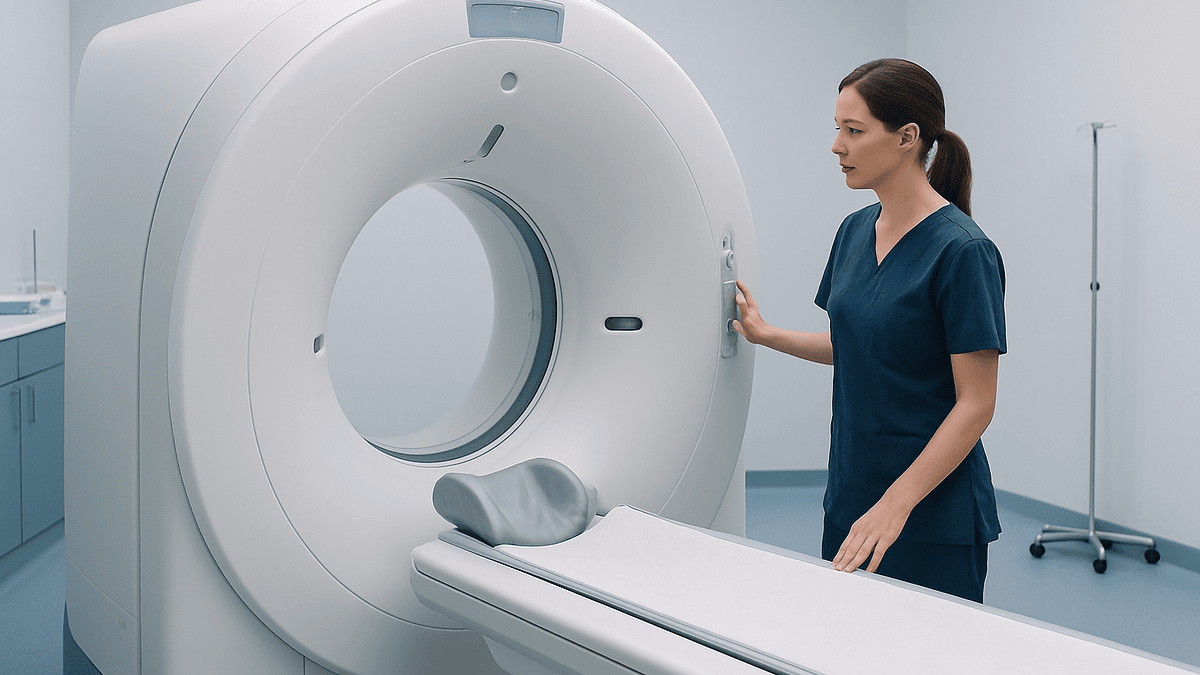
You’ll change out of anything with metal, underwire, zippers, necklaces, then lie on your back on a padded table with your arms above your head. The table slides into a wide, doughnut-shaped ring; this is not the enclosed tube people dread from MRI, and claustrophobia is rarely an issue. A technologist will ask you to hold your breath for roughly 5 to 10 seconds while the scanner rotates. That’s the hard part, and it isn’t hard.
There is no needle, no contrast dye, no sedation, and no recovery period. You drive yourself home. Most people are back at work before their coffee goes cold.
Within days, a radiologist reads the images using a standardized system called Lung-RADS, which sorts findings into categories much the way mammograms use BI-RADS. Category 1 or 2 means nothing suspicious, come back in a year. Category 3 usually means a small nodule worth rechecking in six months. Category 4 flags findings that need closer investigation, which might mean a short-interval scan, a PET scan, or a biopsy.
One practical note worth knowing in advance: because the scan images your whole chest, it sometimes reveals unrelated findings, calcium in the coronary arteries, a thyroid nodule, early emphysema. Some of these turn out to be useful information; others lead to workups you didn’t sign up for. A good pre-screening conversation covers this so nothing on the report blindsides you.
Does lung cancer screening actually save lives? What the trials showed
This is one of the better-evidenced questions in preventive medicine, and the answer rests on two large randomized trials.
The National Lung Screening Trial (NLST) enrolled 53,454 high-risk current and former smokers in the US and randomly assigned them to three annual low-dose CTs or three annual chest X-rays. Published in 2011, the result: a 20 percent relative reduction in lung cancer deaths in the CT group over roughly six and a half years of follow-up. In absolute terms, that worked out to about three fewer lung cancer deaths per 1,000 people screened, or, put another way, roughly 320 people needed to be screened to prevent one lung cancer death. For a cancer screening test, those are strong numbers.
The Dutch-Belgian NELSON trial, published in 2020, tested LDCT against no screening at all in more than 15,000 people and found a 24 percent reduction in lung cancer deaths among men at ten years, with data suggesting the benefit in women may be at least as large.
Why does it work? Stage shift. Without screening, most lung cancers are found after they’ve spread. In the screening arms of these trials, the majority were caught at an early stage, when surgery offers a realistic path forward. The scan doesn’t prevent cancer, quitting smoking does that work, but it changes when cancer is found, and with lung cancer, when is nearly everything.
Is lung cancer screening worth it? The honest trade-offs
Every screening test has a cost side of the ledger, and pretending otherwise is how medicine loses trust. Here is the full picture.
False positives are common. In the NLST, about a quarter of scans flagged something, and more than 90 percent of those flags turned out not to be cancer. Reporting standards have improved considerably since then, with modern Lung-RADS criteria, roughly one in ten baseline scans comes back positive, but if you screen annually for years, odds are decent you’ll experience at least one nervous callback. Most false positives are resolved with a repeat scan a few months later, not a biopsy.
Overdiagnosis is real but modest. Some screen-detected cancers grow so slowly they would never have caused harm. Long-term follow-up of the NLST suggests this applies to a small minority of cases, meaningful, but not the epidemic critics once feared.
Radiation accumulates. One scan is trivial; twenty annual scans are not nothing. Modeling studies still find the mortality benefit outweighs the theoretical radiation risk for eligible adults, which is precisely why eligibility criteria exist.
Anxiety has weight. Waiting three months to re-scan a six-millimeter nodule is easy to describe and hard to live through.
So is it worth it? For people who meet the criteria, the evidence says yes, clearly. The lives saved per person screened compare favorably with mammography and colon cancer screening. But it’s a genuine decision, not a formality, which is why US guidelines require a shared decision-making conversation before your first scan. Take that conversation seriously. It’s yours.
What does an abnormal result really mean?
Here is the sentence to tape to your refrigerator before your first scan: most lung nodules are not cancer. Old infections, inflammation, tiny scars, and benign growths all leave spots on a CT, and lungs that have spent decades around smoke tend to carry a few souvenirs.
What happens next depends almost entirely on size and appearance. A solid nodule under 6 millimeters, smaller than a pencil eraser, carries a very low probability of cancer, typically under 1 percent, and usually just means returning for your regular annual scan. Nodules in the 6-to-8-millimeter range often earn a repeat scan in six months to see whether anything has changed; stability over time is powerful reassurance, because cancers grow and scars don’t. Larger or irregular findings may prompt a PET scan or a biopsy sooner.
The waiting is the genuinely hard part, and it helps to reframe what a follow-up scan is: not a verdict deferred, but a measurement. Radiologists are comparing millimeters across months, and that comparison is often more informative than any single image could be.
Two practical suggestions. First, ask for your Lung-RADS category by number and what it means in plain language, ‘category 3’ communicates far more than ‘we saw a small spot.’ Second, keep your scans within a program that tracks them year over year. The real diagnostic power of screening comes from the series, not the snapshot, and prior images are the most valuable comparison a radiologist can have.
What is the 5 finger test for lung cancer?
You may have seen this on social media: press the nails of your two index fingers back to back, and if you can see a tiny diamond-shaped window of light between them, your lungs are supposedly fine. No window, the videos warn, could mean lung cancer.
The test has a real name, the Schamroth window test, and a real basis. It checks for finger clubbing, a change in which the fingertips widen and the nails curve downward, closing that diamond gap. Clubbing genuinely is associated with lung cancer, along with other chronic lung, heart, and liver conditions. The likely mechanism involves substances released in disease that increase blood flow and tissue growth in the fingertips.
Here’s what the videos leave out. Clubbing is a late sign, appearing, when it appears at all, after disease is well established. Most people with early lung cancer have completely normal fingers, and most people with clubbing don’t have lung cancer. As a screening tool, it fails in both directions: it misses nearly everyone who would benefit from early detection, and it frightens people whose fingers are simply shaped that way.
So: if you notice new clubbing, nails that have changed shape over months, fingertips that look swollen or spongy at the base of the nail, mention it to your doctor, because it deserves evaluation. But do not let a visible diamond of light talk you out of screening you qualify for. A normal Schamroth window tells you nothing about what a CT scanner could see. There is no home test, finger-based or otherwise, that substitutes for low-dose CT in high-risk adults.
What are usually the first signs of lung cancer?
The uncomfortable truth first: the most common early sign of lung cancer is nothing at all. The lungs have no pain receptors in most of their tissue, and there is generous room for a tumor to grow before it presses on anything that complains. This is the entire argument for screening, waiting for symptoms means waiting, on average, for later-stage disease.
When symptoms do emerge, mainstream sources including the NHS and Mayo Clinic consistently list these:
- A cough that lasts three weeks or more, or a long-standing ‘smoker’s cough’ that changes character
- Coughing up blood, even small streaks
- Chest or shoulder pain, especially pain that worsens with breathing or coughing
- Breathlessness during activities that used to be easy
- Persistent hoarseness
- Repeated chest infections, or a pneumonia that resolves and returns in the same spot
- Unexplained weight loss or a fatigue that sleep doesn’t fix
- Loss of appetite
Every item on that list has a dozen innocent explanations, reflux causes chronic cough, allergies cause hoarseness, and being human causes fatigue. That’s exactly why people wait, and why the pattern matters more than any single symptom. Persistence is the red thread: symptoms that arrive and stay, rather than come and go.
One pattern worth naming specifically: long-time smokers often normalize a daily cough for years. The signal isn’t the cough itself but the change, deeper, more frequent, differently timed, newly productive. You know your baseline better than anyone. Trust the deviation from it.
When should you see a doctor?
Some symptoms warrant an appointment within days, not a wait-and-see month. Make a prompt appointment if you have:
- A cough lasting more than three weeks: the NHS uses this threshold explicitly, and it’s a sensible one
- Any coughing up of blood, regardless of amount
- Chest pain that is persistent or worsens with breathing
- New, unexplained breathlessness
- Hoarseness lasting more than three weeks
- Unintentional weight loss, as a rough guide, more than 5 percent of your body weight over six to twelve months without trying
- A chest infection that doesn’t clear with treatment, or keeps returning
Seek urgent care the same day for coughing up more than a small amount of blood, sudden severe breathlessness, or chest pain accompanied by dizziness or a racing heart.
Two things deserve saying plainly. First, none of these symptoms means you have lung cancer, most people with a three-week cough have something far more ordinary. The point of the visit is to sort the ordinary from the exceptional early, when the exceptional is most treatable. A doctor will listen to your chest, likely order imaging, and often resolve the question within a week or two.
Second, if you smoke or used to, do not let embarrassment delay the appointment. Clinicians who evaluate respiratory symptoms are not in the judgment business, and stigma is a documented reason lung cancer gets diagnosed later than it should. Your symptoms deserve the same urgency anyone else’s would get, and the sooner they’re explained, the sooner you can stop carrying the question around.
How long can you live with lung cancer? Why stage changes everything
Survival statistics are averages across thousands of people, not predictions about any individual, but they tell one story with total clarity: the stage at diagnosis matters enormously.
According to US cancer registry data tracked by the National Cancer Institute, when lung cancer is found while still localized, confined to the lung, roughly six in ten people are alive five years later. When it has spread to distant organs before diagnosis, that figure falls below one in ten. Same disease, radically different trajectories, separated mostly by timing.
Historically, only about a quarter of lung cancers were caught at that localized stage, because early disease is so often silent. This is precisely the gap screening targets: in the major trials, screen-detected cancers were far more likely to be early-stage than cancers found after symptoms appeared.
It’s also worth saying that the overall outlook has genuinely improved over the past two decades. Advances in surgery, radiation techniques, and newer classes of therapy have extended survival even for advanced disease, and five-year survival figures, which by definition describe people diagnosed years ago, tend to lag behind current reality.
What no statistic can capture: your specific cancer type, its molecular features, your overall health, and your response to treatment all shape an individual course far more than a population average does. If you or someone you love receives a diagnosis, the number that matters is the one your oncology team gives you after staging is complete, not a table found at midnight online. Averages are where the conversation starts, never where it ends.
Screening and quitting smoking work better together
A worry surfaces in nearly every study of screening attitudes: does an annual scan become a permission slip? A clean result in January, the thinking goes, might make the February cigarettes feel safer.
The evidence says the opposite tends to happen. Screening visits function as what researchers call teachable moments, a yearly, concrete reminder that your lungs are being watched for a reason, and quit rates among screening participants generally match or exceed those of comparable smokers outside screening programs. England’s NHS has leaned into this deliberately: its lung health check program, which invites people ages 55 to 74 with smoking histories for assessment and low-dose CT, pairs every visit with an offer of stop-smoking support, treating the scan and the quit attempt as one intervention rather than two.
The logic holds because the two act on different parts of the problem. Screening changes when cancer is found; quitting changes whether it develops at all, along with your risk of heart attack, stroke, COPD, and a dozen other conditions a CT scanner never sees. Within a year of quitting, heart attack risk drops sharply. Within 10 to 15 years, lung cancer risk falls to roughly half that of someone who kept smoking.
And quitting is not a solo willpower test. Combining behavioral counseling with clinician-guided cessation support roughly doubles or triples success rates compared with going cold turkey alone. If you’re booking a screening appointment anyway, ask about quit support in the same breath. It is, by a wide margin, the most powerful thing on the schedule that day.
How to get screened: the conversation to start this week
If you’ve read this far and recognize yourself in the criteria, 50 to 80, 20 pack-years, still smoking or quit within 15 years, here is the practical path.
Start with your primary care clinician. US guidelines call for a shared decision-making visit before the first scan: a structured conversation covering your eligibility, the benefits and trade-offs, and what follow-up might involve. Come prepared with your pack-year estimate and your quit date if you have one. This visit isn’t a hurdle; it’s where you get to ask everything this article raised.
Cost is less of a barrier than most people assume. Because the recommendation carries the Task Force’s B grade, most private insurance plans and Medicare cover annual screening for eligible adults without cost-sharing, though it’s always worth confirming details with your plan, including any facility fees for follow-up imaging.
Choose a facility that is accredited for CT and participates in a structured lung screening program, meaning it uses Lung-RADS reporting, tracks your scans year over year, and has a clear pathway for handling findings. Your clinician’s referral will usually route you to one.
Then comes the part that separates a gesture from a strategy: come back next year. Screening’s power lives in the annual series, because comparing this year’s images against last year’s is how radiologists distinguish a stable scar from a growing problem. A single scan is a snapshot; a decade of them is surveillance. Given that fewer than one in five eligible Americans are currently up to date, simply showing up, and continuing to, puts you among the best-protected people in the highest-risk group. That’s a strange kind of distinction, but it’s one worth having.
Frequently asked questions
What is the 5 finger test for lung cancer?
It’s a social media name for the Schamroth window test, which checks for finger clubbing by pressing two index fingernails together and looking for a diamond of light between them. Clubbing can be associated with lung cancer, but it is a late sign with many other causes, and most people with early lung cancer have normal fingers. It cannot rule cancer in or out and is no substitute for low-dose CT screening in high-risk adults.
What are usually the first signs of lung cancer?
Often there are none, early lung cancer is typically silent, which is the core argument for screening. When symptoms appear, the most common are a cough lasting more than three weeks, coughing up blood, chest or shoulder pain, breathlessness, hoarseness, repeated chest infections, unexplained weight loss, and persistent fatigue. A change in a long-standing smoker’s cough is a particularly important signal worth reporting to a doctor promptly.
How long can you live with lung cancer?
It depends overwhelmingly on the stage at diagnosis. US registry data show roughly six in ten people survive five years when lung cancer is found while confined to the lung, versus fewer than one in ten when it has spread to distant organs. Cancer type, molecular features, overall health, and treatment response all shape individual outcomes, and survival has improved with newer therapies. Population averages start the conversation; your care team’s staging completes it.
Is lung cancer screening worth it?
For people who meet the eligibility criteria, the evidence strongly supports it. Two large randomized trials showed low-dose CT reduced lung cancer deaths by 20 to 24 percent in high-risk adults. The trade-offs are real, false positives, occasional overdiagnosis, cumulative radiation, and anxiety during follow-up, which is why guidelines require a shared decision-making conversation first. For adults below the risk thresholds, current evidence does not show that benefits outweigh harms.
How often should lung cancer screening be done?
Annually, as long as you remain eligible. Screening is a series, not a one-time event: comparing each year’s scan with the previous one is how radiologists distinguish stable, harmless spots from growing ones. Screening stops when 15 years have passed since you quit smoking, when you turn 81, or when a health condition would make treatment of a found cancer unrealistic. Skipping years significantly weakens the test’s value.
I quit smoking 20 years ago, should I still be screened?
Under current US guidelines, no, eligibility ends 15 years after quitting, because risk declines steadily the longer you’re smoke-free and the balance of benefit and harm eventually tips against annual scanning. Your risk never returns fully to a never-smoker’s baseline, so any new respiratory symptoms still deserve prompt evaluation. If you have additional risk factors such as heavy radon or asbestos exposure, discuss your individual situation with your doctor.
Is the radiation from a low-dose CT scan dangerous?
The dose is small, about 1.4 millisieverts per scan, roughly six months of natural background radiation and far less than a standard chest CT. Repeated annual scans do add up over decades, which is one reason screening is limited to people at high risk. Modeling studies consistently find that for eligible adults, the lives saved by early detection substantially outweigh the theoretical cancer risk from the radiation itself.
Can I get lung cancer screening if I never smoked?
Current US guidelines do not recommend it, and most insurers won’t cover it, because trials haven’t shown benefit outweighing harm in never-smokers, whose lower cancer rates mean screening mostly produces false positives. Never-smokers do develop lung cancer, about 10 to 20 percent of US cases, so persistent symptoms like a lasting cough or coughing up blood warrant diagnostic evaluation regardless of smoking history. That’s a different pathway from screening.
Why can't a chest X-ray screen for lung cancer?
Because it misses too much, too late. A chest X-ray is a single flat image in which small tumors hide behind ribs, the heart, and blood vessels, while low-dose CT captures thin cross-sectional slices that reveal nodules just a few millimeters wide. The National Lung Screening Trial tested the two head to head in over 53,000 people: CT reduced lung cancer deaths by 20 percent compared with X-ray. X-ray screening is no longer recommended.
What happens if screening finds a nodule?
Usually, watchful measurement, not a biopsy. Most screen-detected nodules are benign scars, old infections, or harmless growths. Small nodules under 6 millimeters typically just mean returning for your regular annual scan; mid-sized ones often get a repeat scan in about six months to check for growth, since stability strongly suggests a benign cause. Only larger or suspicious-looking findings move to PET imaging or biopsy. Ask for your Lung-RADS category to understand exactly where you stand.
References
This article is for general information only and is not a substitute for professional medical advice. Please consult a qualified doctor about your individual situation.

More from the Blog

Food Sensitivity Tests: Why IgG Kits Fail the Evidence Test
Food sensitivity tests that measure IgG antibodies to foods are not supported by current evidence. IgG against a food usually signals normal exposure and…

CRP and ESR: The Inflammation Blood Tests Explained
A CRP test measures C-reactive protein, a substance the liver releases within hours when the body is inflamed by infection, injury or inflammatory disease.…

Celiac Testing: The Blood Tests, the Biopsy, and Why You Must Not Go Gluten-Free First
Celiac disease is diagnosed in two steps: a blood test that looks for antibodies, most often tissue transglutaminase IgA (tTG-IgA), followed, for most adults,…

Calprotectin Stool Test: How It Separates IBS From Inflammatory Bowel Disease
Calprotectin is a protein released by white blood cells into the gut when the bowel lining is inflamed. A stool test measures it in…

FibroScan: The Liver Stiffness Test Explained
FibroScan is a painless, non-invasive scan that uses a brief vibration and ultrasound to measure how stiff the liver is, reported in kilopascals (kPa),…

The PSA Test: What Levels Mean by Age, and Why Context Is Everything
There is no single normal PSA. Commonly used age-referenced upper limits are roughly 2.5 ng/mL for men in their 40s, 3.5 in their 50s,…