

Lymph-Sparing Liposuction for Lipedema: What Happens in the Operating Room

Key Takeaways
- Lymph sparing liposuction differs from cosmetic liposuction mainly in direction and depth: blunt cannulas move lengthwise along the limb, parallel to lymphatic vessels, and stay in the deeper fat layer.
- Tumescent fluid does three jobs at once, numbing the tissue, narrowing blood vessels to limit bleeding, and hydro-dissecting fat away from nerves and lymphatics so less force is needed.
- The NHS is explicit that lipedema fat does not respond to diet or exercise like ordinary fat, which is why mechanical removal is the only method that reduces the fat itself.
- Evidence for the procedure comes from observational cohorts reporting less pain, bruising and heaviness; UK assessors judged this evidence limited in quantity and quality and recommend special governance arrangements.
- Lipedema usually requires a staged series of operations, one region per session, and the underlying condition persists afterward, so compression and lymphatic care continue for life.
- GLP-1 medicines such as semaglutide act on appetite and stomach emptying, not on fat cells, and no evidence shows they remove lipedema tissue; rapid weight change can also delay surgical planning.
Lymph sparing liposuction for lipedema is a surgical technique that removes diseased fat from the legs or arms while trying to protect the lymphatic vessels that drain fluid from the limbs. Surgeons use dilute local anesthetic fluid, blunt cannulas and strokes that follow the lymphatic pathways. It is usually considered when compression and other conservative measures no longer control pain and mobility, and the decision rests with the treating team.
She has spent years explaining her legs. To the trainer who said try harder, to the relative who said eat less, to a doctor who wrote “obesity” on a chart while her waist stayed two sizes smaller than her thighs. Now, finally, she has the word lipedema, a referral, and a surgery date. What she does not have is any clear picture of what will actually happen once the doors close behind her.
That gap is worth closing. Lymph sparing liposuction for lipedema sounds like a cosmetic procedure with a medical prefix, and much of what circulates online about it comes from marketing pages or personal forums. Neither tells you what the surgeon is doing with the cannula, why the fluid matters, or why some people are asked to wait.
This article walks through the operating room from the marker pen to the recovery bay, then through the weeks that follow, with the evidence graded honestly where it is thin.
What is lymph sparing liposuction for lipedema?
Start with the two halves of the name. Liposuction is the removal of fat through small skin incisions using a thin hollow tube, called a cannula, attached to suction. “Lymph sparing” refers to how that cannula is handled: with techniques intended to protect the lymphatic system, the network of fine vessels that collects excess tissue fluid and returns it to the bloodstream.
Why does that matter more here than in a routine cosmetic case? Because lipedema is not simply extra fat. The NHS describes it as a long-term condition in which abnormal fat builds up symmetrically in the legs, and sometimes the arms, almost always in women, often beginning at puberty, pregnancy or menopause. The tissue is tender, bruises easily and does not respond to dieting the way fat elsewhere does. Cleveland Clinic notes that untreated lipedema can, over years, strain the lymphatic system and lead to a combined picture called lipo-lymphedema, where fluid swelling is added to fat.
A lymphatic system that is already under load is a poor candidate for rough handling. Traditional liposuction, developed for healthy tissue, sometimes used firm, multidirectional strokes and sharp-tipped instruments. Applied to a lipedema limb, that approach risks tearing lymphatic channels and converting a fat problem into a permanent fluid problem.
So the lymph sparing method changes the instruments and the choreography. Cannulas are blunt and small. Strokes run lengthwise along the limb, parallel to the way lymphatic vessels travel, rather than crosswise. The tissue is first flooded with a dilute anesthetic solution that separates fat cells from surrounding structures so less force is needed. The goal is a debulked, less painful limb with its drainage intact.
Notice what is not in that definition: it is not a weight-loss operation, and it is not offered to everyone with the diagnosis. Both points come up again below.
What breaks up lipedema fat, and why diet alone rarely does?
People search this question hoping for a food, a massage or a cream. The honest answer is that nothing reliably dissolves lipedema fat except mechanical removal, and understanding why explains the whole logic of surgery.

Lipedema fat differs from ordinary subcutaneous fat in structure, not only in amount. Research summarized in a peer-reviewed review on PubMed describes enlarged fat cells, increased fragile small blood vessels (which is why bruising follows minor bumps), inflammatory changes and thickened connective tissue that gives the skin a nodular, “beans in a bag” feel. The NHS states plainly that the fat is not lost through diet or exercise in the way other fat is; women who lose weight often shrink from the waist up while the legs stay stubbornly the same.
That resistance is not a failure of willpower. It appears to be a biological property of the tissue itself, though the exact hormonal and genetic mechanisms are still being worked out. Lipedema often runs in families and flares at times of estrogen change, which supports a hormonal contribution, but no single cause is established.
What about non-surgical measures? Compression garments and manual lymphatic drainage, a specialized light-pressure massage technique performed by trained therapists, do not remove fat. What they do is manage the fluid component, reduce heaviness and aching, and protect the lymphatics. The NHS and Cleveland Clinic both place these conservative steps first, alongside movement that the joints tolerate (water exercise is often suggested because buoyancy unloads the knees) and psychological support, since the condition is frequently misdiagnosed for years.
Liposuction enters when those measures keep the fluid in check but the fat itself continues to cause pain, restrict walking, or drive the knees inward. It works because it does the one thing conservative care cannot: physically take the diseased tissue out.
Before the first incision: how the operating room is prepared
The operating room work begins while the patient is still standing. Gravity shapes a lipedema limb, so surgeons mark the treatment zones with the patient upright, typically drawing concentric contour lines over the areas of greatest thickness and marking bony landmarks, tendons and any regions to avoid. The pattern often looks like a topographic map. Photographs are taken for the medical record, not as a promise of any particular result.
Consent is confirmed again in the room. A surgical safety checklist, of the kind the WHO promotes worldwide, is run through aloud: patient identity, the planned procedure and sites, allergies, anticipated blood loss and any equipment concerns. It sounds bureaucratic; it prevents wrong-site and communication errors.
Anesthesia is the next decision, and practice varies. Many lipedema procedures are done under tumescent local anesthesia, sometimes with sedation, because the anesthetic is already delivered into the tissue as part of the technique. Larger-volume sessions or several areas may be done under general anesthesia. The anesthesia team makes this call based on the volume planned, the patient’s health, and the surgeon’s approach. Neither route is inherently “safer” for every person.
Positioning matters for both access and safety. Pressure points are padded and the limb is arranged so the surgeon can reach the front, sides and back without excessive repositioning. Because surgery time can run to a few hours and the patient may be relatively still, compression devices on the calves or other clot-prevention measures are commonly used; deep vein thrombosis, a clot in a deep leg vein, is a recognized risk after any prolonged procedure on the lower body, as Mayo Clinic’s liposuction overview notes.
Warming blankets, fluid monitoring and standard cardiac and oxygen monitoring complete the picture. Only then does the surgeon pick up the infiltration cannula.
How lymph sparing liposuction for lipedema works, step by step
The first active step is infiltration. Through a few tiny incisions, the surgeon pumps a large volume of warmed, dilute solution into the fatty layer. It usually contains a local anesthetic and a small amount of a vasoconstrictor, a medicine that narrows blood vessels to limit bleeding. The word “tumescent” simply means swollen and firm; the limb visibly plumps as the fluid spreads. This fluid numbs the area, reduces blood loss, and hydro-dissects, meaning it gently pushes fat cells apart from nerves, vessels and lymphatics so they separate with less force.
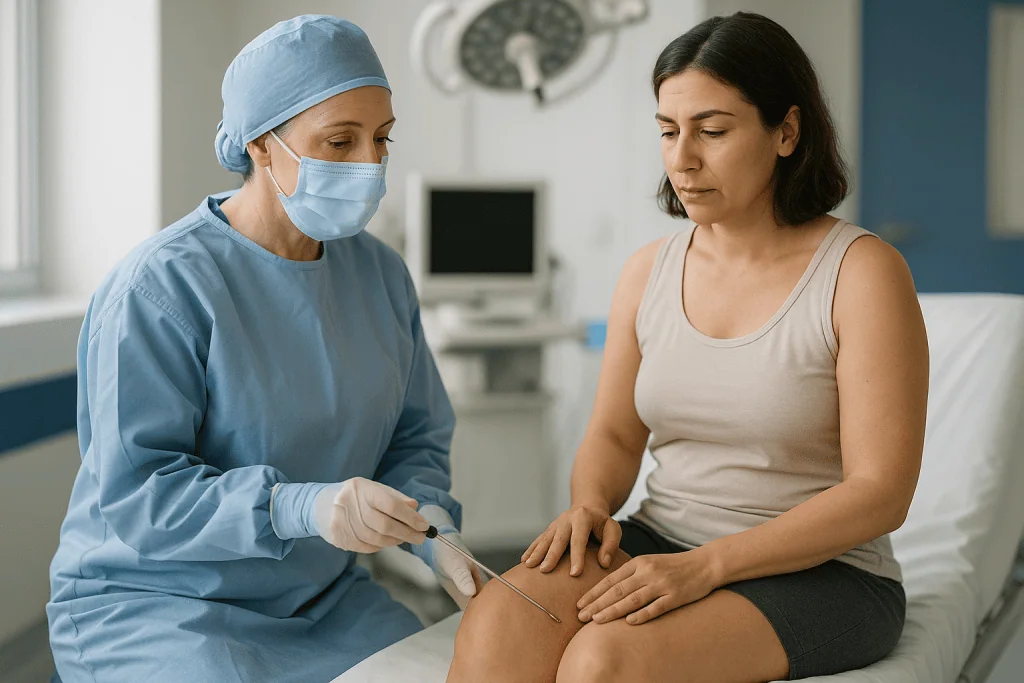
Then the surgeon waits. Depending on the solution and technique, the fluid needs time to take full effect, which is why a lipedema case feels slower at the start than a small cosmetic one.
Fat removal follows. The instruments are blunt-tipped cannulas, often narrower than those used in body-contouring liposuction. The defining move is direction: strokes run longitudinally, along the long axis of the thigh or calf, following the course of the main lymphatic collectors that travel up the inner leg. The surgeon avoids sweeping crosswise fans, avoids aggressive tunneling near the knee and groin where lymph nodes and larger collectors cluster, and keeps the cannula in the correct plane rather than scraping just under the skin.
Some surgeons add energy or fluid assistance at this stage; the next section compares those options. In all versions the aspirate, the mixture of fat and fluid drawn out, is collected in graduated canisters so volume can be tracked in real time, because total volume affects fluid balance and safety.
Throughout, the surgeon repeatedly checks contour by feel and by comparing sides. Lipedema surgery aims for a balanced, functional reduction, not maximal extraction; leaving a smooth, even layer is deliberate. Incisions are typically left open or loosely closed to allow residual fluid to drain, then the limb is dressed and placed in compression before the patient leaves the room.
Water assisted liposuction for lipedema versus other techniques
Ask three surgeons which tool they use and you may get three answers. What matters is that all lymph sparing approaches share the same principles; they differ in how the fat is loosened.
| Technique | How fat is loosened | Why some surgeons favor it for lipedema | What the evidence shows |
|---|---|---|---|
| Tumescent (manual) | Dilute fluid plus surgeon-guided blunt cannula | Long track record; full manual control of plane and direction | Largest body of observational lipedema studies |
| Water assisted (WAL) | A pulsed fan-shaped jet of fluid delivered through the cannula tip during suction | Fat is released with less mechanical force; lower total fluid load | Observational series report symptom relief; no head-to-head trials |
| Power assisted (PAL) | Cannula vibrates rapidly to ease passage | Less surgeon fatigue in fibrous tissue | General liposuction data; limited lipedema-specific data |
| Ultrasound assisted | Ultrasound energy emulsifies fat before suction | Useful in dense, fibrotic tissue | Concern about heat near lymphatics; lipedema data sparse |
Water assisted liposuction for lipedema draws a lot of interest because the fluid jet does part of the work that a firmer hand would otherwise do, and because less fluid needs to be pre-infiltrated. Those are plausible mechanistic advantages. They are not, so far, proven outcome advantages. The review literature on PubMed and the NHS summary both describe liposuction for lipedema broadly, without evidence that one device produces better long-term pain or mobility results than another.
A useful way to read the table: the technique your surgeon has performed hundreds of times, with a lymph sparing philosophy, is likely more relevant to your safety than the brand of machine. Any claim that a specific device is “the only” or “the best” method for lipedema outruns the data.
Difference between regular lipo and lipedema lipo
The instruments overlap; the purpose, planning and hands do not. Cosmetic liposuction removes normal fat from a person who is otherwise well to change a shape they dislike. Lipedema liposuction removes diseased tissue from a person with a chronic condition to relieve pain and restore function. That difference cascades through every decision.
Consider volume and staging. A cosmetic case usually targets one or two small zones. Lipedema commonly involves both legs from hip to ankle, sometimes the arms as well, and the total tissue burden can be large. Rather than attempt everything at once, surgeons typically plan a series of sessions separated by weeks to months, treating one region per session so that fluid shifts, anesthetic load and recovery stay manageable. The number of sessions depends on the extent of the disease and is set by the surgeon, not by a standard formula.
Consider the plane. Cosmetic work may include superficial passes to sculpt definition. Lipedema surgery generally stays in the deeper fat, away from the skin’s own fine lymphatic network, and avoids aggressive contouring around the knee and ankle where lymphatic vessels converge.
Consider the endpoint. Cosmetic surgeons judge success by silhouette. Lipedema surgeons judge it by whether the knees track straight, whether the inner thighs stop rubbing, whether pressure pain eases, and whether the lymphatic function measured afterward is preserved.
Consider the aftercare. A cosmetic patient may wear a garment for a few weeks and move on. A lipedema patient returns to lifelong compression and lymphatic care, because surgery treats the fat that is present but does not switch off the underlying condition.
The practical lesson: a surgeon experienced in body contouring is not automatically experienced in lipedema. Asking directly about lipedema-specific training and case experience is reasonable, and any team confident in its approach will welcome the question.
Lipedema stages and surgery: who is usually offered it, who is asked to wait
Lipedema is commonly described in stages. Cleveland Clinic outlines four: stage 1, smooth skin over an enlarged fatty layer; stage 2, uneven skin with nodules under the surface; stage 3, large overhanging folds of tissue, particularly around the knees and hips; and stage 4, lipedema combined with lymphedema, the fluid-swelling condition. Staging describes tissue change, not pain, and a person in stage 1 can hurt more than someone in stage 3.
Surgery is usually considered when three things line up. First, the diagnosis is secure; lipedema is a clinical diagnosis made by examination and history, and conditions that mimic it, including primary lymphedema and general obesity, have been considered. Second, conservative therapy has been given a genuine trial. The NHS and Cleveland Clinic both describe compression, manual lymphatic drainage, activity and weight stabilization as first steps; surgery is not typically the opening move. Third, symptoms persist despite that care: pain on pressure, heaviness, easy bruising, restricted walking or knee strain from tissue bulk.
Who is usually asked to wait? People whose weight is actively changing, because unstable weight makes planning and outcome assessment unreliable; people with uncontrolled medical conditions, particularly heart, lung, kidney or clotting disorders, given that these operations can be long and involve significant fluid shifts; people who smoke, until they have stopped, since nicotine impairs healing; and people who have not yet established compression and lymphatic care, because that care is the safety net after surgery.
Very advanced lipo-lymphedema is not an automatic exclusion, but it changes the conversation. Established lymphedema will not be reversed by fat removal, and the team will weigh whether debulking improves function enough to justify the risk in a limb whose drainage is already compromised.
None of these are rules that a patient can self-apply. They are the factors a treating team weighs, and the final call belongs to that team together with the patient.
What the evidence actually shows about liposuction for lipedema
Here is where a patient explainer has to be careful, because the enthusiasm online is louder than the data.
The available evidence consists mainly of observational cohort studies, most from European centers, in which women undergoing lymph sparing liposuction were followed over time and asked about pain, bruising, heaviness, mobility and their need for ongoing conservative therapy. A review published in a peer-reviewed journal and indexed on PubMed summarizes these series: patients consistently reported reductions in spontaneous pain and pressure tenderness, less bruising, improved mobility and reduced dependence on compression and manual drainage, with some cohorts followed for many years. Those findings are encouraging and remarkably consistent across studies.
They are also methodologically weak. There are no large randomized trials comparing surgery with continued conservative therapy. Most studies lack control groups, rely on patient-reported outcomes without blinding, and come from a small number of surgical teams. When the UK’s health technology assessors examined liposuction for chronic lipoedema, they concluded that the evidence on safety and efficacy was limited in quantity and quality and recommended that the procedure be used only with special arrangements for clinical governance, consent, and audit or research. The NHS lipoedema page reflects that cautious framing.
What does that mean for a patient? It means the direction of the evidence favors benefit for well-selected patients, while the size and durability of that benefit, and how to compare one technique with another, remain uncertain. It also means that any figure quoted to you as a success rate should be traced to a named study, and that the study should be read for who was included and how long they were followed.
Evidence gaps are not a reason to dismiss the procedure. They are a reason to have a frank conversation about expectations and to favor teams that measure and report their outcomes.
Risks of lipedema liposuction and how lymph sparing technique tries to reduce them
Every liposuction carries a set of general risks, and Mayo Clinic lists them without euphemism: contour irregularities such as dents or waviness, temporary or persistent numbness, fluid collections under the skin called seromas, infection, bleeding, injury to deeper structures, adverse reactions to anesthetic, kidney or heart strain from large fluid shifts, blood clots in the legs or lungs, and, rarely, fat embolism, in which fat enters the bloodstream and travels to the lungs.
Lipedema surgery adds specific concerns. The volumes removed are larger than in most cosmetic work, which magnifies fluid and anesthetic considerations. The tissue bruises easily by nature, so postoperative bruising is expected to be extensive. And the lymphatic system is the structure everyone is trying to protect; damage to it can worsen swelling rather than relieve it.
How does the lymph sparing approach address that last point? Several ways. Blunt cannulas push lymphatic vessels aside rather than cutting them. Longitudinal strokes run parallel to lymph collectors instead of shearing across them. Tumescent fluid creates a cushion that separates fat from delicate vessels before suction begins. Staging the operation spreads the tissue trauma over time so the lymphatics are never overwhelmed in one sitting. Compression immediately afterward limits the space in which fluid can pool. These are sound mechanistic strategies, supported by lymphatic imaging studies in small series showing preserved drainage after careful technique, though again not by large comparative trials.
Skin laxity deserves mention. When a substantial fat volume is removed from a limb that has stretched around it for years, the skin may not fully retract, particularly in later stages. Some people later consider skin-removal surgery; others accept looser skin as a trade for lighter, less painful legs. That is a preference conversation to have before surgery, not after.
Risks are not reasons for fear. They are the second half of informed consent, and a team that discusses them plainly is doing its job.
Lipedema liposuction recovery time: the first days and weeks
The picture immediately after surgery surprises people who expected to look thinner on day one. The treated limb is wrapped in dressings and compression, it is swollen with residual tumescent fluid, and that fluid, tinged pink, drains from the small incisions for the first day or two. Absorbent pads and old towels on the bed are standard advice. The leaking is normal and, in fact, helpful; it reduces the fluid the body must otherwise reabsorb.
Bruising blooms over the first week and can be dramatic in lipedema tissue because of its fragile vessels. Soreness is often described as a deep, heavy ache rather than sharp pain. Pain control is individualized by the team; this article does not cover medicines or doses, and any plan comes from the prescribing clinician.
Movement starts early. Walking within hours of surgery, short and frequent, is the single most useful thing a patient can do, because it drives lymphatic and venous flow and lowers clot risk. Prolonged bed rest is discouraged.
Compression is continuous. Mayo Clinic notes that garments are typically worn for a few weeks after liposuction to control swelling; for lipedema, most teams ask for a longer initial period, followed by a return to the patient’s usual daily compression. Swelling settles gradually rather than suddenly, and Mayo Clinic notes that the eventual shape after liposuction may not be apparent for several months as the tissue softens and residual swelling resolves.
Manual lymphatic drainage often resumes once the surgeon clears it, typically after the incisions have sealed. Return to desk work commonly happens within a week or two; return to heavier activity is staged over the following weeks according to how the limb responds. Numbness or odd sensations in the treated skin can linger for months and usually improve.
If further sessions are planned, the interval between them is set by the team and depends on how the first area recovers. Each session restarts this timeline for a new region.
Is liposuction for lipedema worth it? An honest way to weigh the question
“Worth it” is not a medical measurement. It is a personal calculation with clinical inputs, and framing it that way helps avoid both hype and needless fear.
On one side of the ledger sit the realistic potential benefits described in the observational literature: less pressure pain, less bruising, lighter legs, straighter knee alignment, easier walking, and for some, reduced reliance on daily compression and therapy sessions. For a person whose legs dictate what she can wear, how far she can walk and how she sleeps, these are not cosmetic gains; they are quality-of-life gains.
On the other side sit costs that are not financial: several operations spread over months, weeks of swelling and bruising after each, the physical risks of prolonged surgery, the possibility of loose skin, the certainty that the underlying condition remains and may progress in untreated areas, and the reality that long-term evidence is thinner than anyone would like.
A few questions sharpen the decision. What, specifically, do you want to be able to do that you cannot do now? Pain relief and mobility are goals surgery can plausibly address; a particular dress size or a symmetrical silhouette are goals it may not deliver. Has conservative care genuinely been optimized, with well-fitted compression and a therapist experienced in lipedema? Is your weight stable, and is your general health in a place that keeps surgical risk low? Do you have support at home for the recovery weeks?
People sometimes describe regret in two directions: regret at waiting years while function declined, and regret at proceeding before understanding that the legs would remain lipedema legs, only smaller. Both are avoidable with a candid consultation.
What the evidence supports is a considered decision by a person who understands the trade-offs, made with a team that treats lipedema regularly. It does not support a blanket yes or no.
Do GLP-1 weight-loss medicines like semaglutide get rid of lipedema?
Short answer: there is no evidence that they remove lipedema fat, and no major guideline recommends them as a lipedema treatment. The longer answer explains why the question keeps coming up.
GLP-1 receptor agonists, a class of medicines that includes semaglutide and tirzepatide, mimic a gut hormone. They slow stomach emptying, increase the feeling of fullness and act on appetite centers in the brain, which is why they produce meaningful weight loss in trials for obesity and improve blood sugar in type 2 diabetes. They do not act on fat cells directly, and nothing about their mechanism targets the abnormal, fibrotic, inflamed tissue that defines lipedema.
What they can do is reduce ordinary fat and overall body weight in someone who has both obesity and lipedema, a combination that is common. That may lessen the load on the joints and the lymphatic system, and it may make a subsequent surgical plan safer by stabilizing weight. Many women report that medication-driven weight loss shrinks the trunk while the legs change little, which mirrors what happens with diet: the lipedema pattern becomes more obvious, not less. Small observational reports of GLP-1 use in lipedema exist, but they are preliminary and do not show removal of lipedema tissue.
There is also a practical wrinkle. Rapid weight change is one of the factors that leads surgical teams to ask patients to wait, so starting a weight-loss medicine shortly before planned surgery is something to discuss with both the prescriber and the surgeon rather than decide alone.
Whether any medicine in this class is appropriate for a given person depends on their weight history, other conditions and goals, and that judgment belongs to the prescribing clinician. Do not start, stop or adjust any medicine based on lipedema forums. And treat any product marketed as dissolving or “melting” lipedema fat, oral or topical, with skepticism: none has evidence.
What people often get wrong about lipedema surgery
Misconceptions cluster around this operation because so few clinicians discuss it openly. Six deserve correcting.
“It is just cosmetic liposuction with a medical label.” The tools overlap, but the plane, direction, volumes, staging and aftercare differ, and the goal is function, not shape. Earlier sections lay out those differences.
“One surgery and it is done.” Lipedema commonly affects both legs fully and often the arms. Most people need a series of sessions, and even then the condition itself remains; new fat can accumulate in untreated regions, and lifelong conservative care continues.
“Surgery removes the need for compression forever.” Some studies report reduced dependence on compression and manual drainage after surgery. Reduced is not eliminated, and most teams recommend ongoing garments to protect the lymphatics.
“Any liposuction surgeon can do it.” Lymph sparing technique is a specific skill set. The NHS notes that the evidence base is limited and that the procedure should be offered under special governance arrangements; that is another way of saying experience and audit matter.
“If I just lose enough weight, I will not need it.” Weight loss helps general health and may reduce joint strain, but the NHS is explicit that lipedema fat does not respond to diet like other fat. Weight loss often makes the disproportion more visible.
“Later stage means surgery is off the table” or, its opposite, “early stage means surgery is urgent.” Neither is true. Staging describes tissue, not pain or function. The decision rests on symptoms, conservative therapy response, general health and goals, judged by the team.
A final, quieter misconception: that asking hard questions insults the surgeon. It does not. A team confident in its technique will explain it, show how it tracks outcomes, and describe what it does when things do not go to plan.
Questions to ask your care team before lymph sparing liposuction
Bring these on paper. Consultations move quickly, and the answers shape everything that follows.
- How was my lipedema diagnosis confirmed, and have lymphedema, lipo-lymphedema and other causes of leg swelling been considered?
- Which conservative measures do you want optimized before surgery, and for how long?
- Which lymph sparing technique do you use, and why that one for my tissue?
- How many lipedema cases, as distinct from cosmetic liposuction, does your team treat, and how do you track your outcomes?
- How many sessions do you anticipate for me, which areas come first, and what interval do you plan between them?
- What type of anesthesia do you recommend for my case, and who will be providing it?
- What is the maximum volume you plan to remove in one session, and what determines that limit?
- How do you protect the lymphatic system during the procedure, and do you assess lymphatic function before or after?
- What specific complications have you seen in your own patients, and how were they managed?
- What will compression, wound care and lymphatic drainage look like in the first weeks, and who coordinates them?
- What is your plan if I develop a seroma, an infection or worsening swelling?
- How will we define success for me, and what changes are unlikely?
- What is the realistic likelihood of loose skin in my case, and what are the options if it occurs?
- Who do I contact after hours, and what symptoms should prompt an immediate call?
Two further conversations belong here. If you take any regular medicines, including hormonal contraception or hormone therapy, ask the team whether they affect clot risk or bleeding around surgery; do not change anything on your own. And if weight-loss medication is part of your picture, ask both prescriber and surgeon how it fits the timeline.
Write the answers down or bring someone to take notes. Decisions this large should not rest on memory from a single appointment.
When to call your doctor after lipedema liposuction
Most recovery days feel like a slow, achy improvement. A small number of signs mean the plan needs to change quickly, and the team will want to hear from you rather than have you wait for a scheduled visit.
Call the same day, or seek emergency care, for any of the following:
- Sudden shortness of breath, chest pain or coughing up blood, which can signal a clot in the lungs or, rarely, fat embolism
- A calf or thigh that becomes newly painful, hot, hard or swollen on one side out of proportion to the other, a possible deep vein thrombosis
- Fever with chills, or spreading redness, warmth and increasing pain around an incision, suggesting infection
- Bleeding that soaks through dressings repeatedly, or a rapidly enlarging, tense, painful area under the skin
- Dizziness, fainting, confusion, a racing heart or very little urine, which can indicate fluid or blood loss, or a reaction to anesthetic
- Numbness, tingling or weakness that is getting worse rather than better, or a limb that turns pale or blue
- Persistent vomiting or inability to keep fluids down
Contact the team within a day or two, without alarm, for: a soft fluid swelling that is growing (a seroma may need drainage), a garment that is cutting in and cannot be adjusted, pain that is escalating rather than settling after the first several days, wound edges that have opened, or swelling that is markedly worse on one side after the first week.
Beyond the surgical period, longer-term red flags for anyone with lipedema include swelling that begins to involve the feet and toes, skin that stays pitted after pressure, or recurring skin infections in the legs. These can indicate developing lymphedema and warrant a review with the treating team so that lymphatic care can be adjusted.
When in doubt, call. Teams that perform this surgery expect questions in the recovery weeks, and an early phone call is far easier to manage than a late presentation.
Frequently asked questions
What did Kelly Clarkson do for her lipedema?
There is no verified public record that this singer has a lipedema diagnosis or has had lipedema treatment; much of what circulates is speculation drawn from photographs. That points to a larger lesson: lipedema cannot be diagnosed from the outside, and a celebrity’s medical choices, real or rumored, are not a treatment plan. Your own diagnosis and options come from an examination by a clinician who treats the condition.
What breaks up lipedema fat?
Only surgical removal reliably reduces lipedema fat. Diet, exercise, massage, creams and supplements do not dissolve the abnormal, fibrotic tissue, and the NHS states that lipedema fat does not respond to weight loss like other fat. Compression and manual lymphatic drainage manage the fluid and pain components and protect the lymphatics, which is why they come first, but they leave the fat itself in place.
Is liposuction for lipedema worth it?
For well-selected patients whose pain and mobility problems persist despite good conservative care, observational studies report meaningful reductions in pain, bruising and heaviness. Against that sit several staged operations, weeks of recovery after each, surgical risk, possible loose skin and a condition that continues afterward. Whether that trade is worth making is a personal decision, best reached with a team that treats lipedema regularly and reports its outcomes.
Do GLP-1 injections like semaglutide get rid of lipedema?
No. These medicines reduce appetite and slow stomach emptying, producing general weight loss, but they do not act on the abnormal tissue that defines lipedema, and no guideline recommends them for it. People who have both obesity and lipedema may lose weight from the trunk while the legs change little. Whether such a medicine suits your overall health is a decision for your prescribing clinician.
How long is lipedema liposuction recovery time?
Fluid drains from the incisions for a day or two, bruising peaks in the first week, and light activity such as desk work commonly resumes within one to two weeks. Mayo Clinic notes that compression is usually worn for a few weeks after liposuction and that swelling can take several months to fully settle. Lipedema teams often ask for longer compression, and each additional session restarts the timeline for a new area.
What is the difference between regular lipo and lipedema lipo?
Regular liposuction reshapes normal fat in a healthy person; lipedema liposuction removes diseased tissue to relieve pain and restore function. Lipedema surgery uses blunt cannulas moved lengthwise along the limb, stays in the deeper fat to protect lymphatics, involves larger volumes across several staged sessions, and is followed by lifelong compression and lymphatic care rather than a few weeks of garments.
Is water assisted liposuction better for lipedema than tumescent liposuction?
Not on current evidence. Water assisted liposuction uses a pulsed fluid jet to loosen fat with less mechanical force, which is a plausible advantage for fragile lipedema tissue, and observational series report symptom relief. There are no head-to-head trials showing better long-term pain or mobility outcomes than manual tumescent technique. A surgeon’s lymph sparing skill and experience with lipedema matter more than the device.
At which lipedema stage is surgery usually considered?
Surgery is not tied to a specific stage. Teams usually consider it when the diagnosis is secure, conservative care such as compression and manual lymphatic drainage has been genuinely tried, and pain or mobility limits persist. People with unstable weight, uncontrolled medical conditions or active smoking are often asked to wait. Advanced lipo-lymphedema changes the risk discussion but is not an automatic exclusion.
Can lipedema liposuction cause lymphedema?
It is a recognized concern, which is exactly why the lymph sparing approach exists. Rough, crosswise liposuction can tear lymphatic vessels and worsen swelling. Blunt cannulas, longitudinal strokes, tumescent cushioning, staged sessions and immediate compression all aim to preserve drainage, and small imaging studies support preserved lymphatic function after careful technique. Large comparative trials are lacking, so the risk is reduced, not zero.
Will I still need compression garments after lipedema surgery?
Most likely, yes. Some studies report that patients need less compression and fewer therapy sessions after surgery, but the underlying condition persists and the lymphatic system still benefits from support. Immediately after surgery, compression controls swelling and limits fluid pooling; longer term, most teams recommend returning to regular daily garments. Your team will set the specific plan based on how your limb recovers.
References
This article is for general information only and is not a substitute for professional medical advice. Please consult a qualified doctor about your individual situation.

More from the Blog

How Long Do Fat Grafting Results Last? Graft Take, Volume Settling and Realistic Expectations
Fat grafting results are generally considered long-lasting once the transferred fat has survived, but not all of it does. Published reviews report that roughly…

When a Thigh Lift Needs Revision: Scar Migration, Residual Laxity and Timing of a Redo
A thigh lift revision is a second operation to correct problems left after an earlier thigh lift, most often a scar that has drifted…
CoolSculpting After Pregnancy: When It Helps, When It Does Not and Why Timing Matters
Cryolipolysis, the fat-freezing treatment sold under the CoolSculpting name, can reduce small, pinchable fat pockets that persist after pregnancy, but it does not tighten…

When Compression Is No Longer Enough: How Doctors Decide Lymphedema Surgery Is the Next Step
Lymphedema surgery is usually considered only after months of consistent conservative care, including compression, decongestive therapy and skin care, has failed to control swelling,…

Cycling, Running and Tight Clothing After Labiaplasty: A Realistic Return-to-Activity Guide
Exercise after labiaplasty is usually rebuilt in stages: short walks within days, light low-impact activity often from about two weeks, and strenuous exercise, running…

Arm Liposuction Risks: Contour Unevenness, Numbness and Which Signs to Report Early
Arm liposuction risks include contour unevenness (lumps, dents or asymmetry), temporary or occasionally lasting numbness, bruising, fluid collections called seromas, infection and, rarely, blood…