

Lymphoma Chemotherapy Cycle by Cycle: Infusion Days, Rest Days and Blood Count Checks

Key Takeaways
- Most lymphoma chemotherapy cycles run on a two-, three- or four-week rhythm, with all drugs given on one or a few days and the rest of the cycle devoted to marrow recovery.
- Neutrophils usually reach their lowest point 7 to 14 days after an infusion, which is why a temperature of 100.4°F (38°C) or higher in that window is an emergency rather than something to sleep on.
- A complete blood count is drawn before every cycle, and a one-week delay because counts have not recovered is a routine safety step, not a sign that treatment is failing.
- Hemoglobin falls gradually across the whole course rather than dipping each cycle, which is why fatigue and anemia often become noticeable in the middle cycles rather than the first.
- Anti-nausea, antiviral and antibiotic medicines given alongside each cycle are preventive and work only if taken on schedule, including on days you feel entirely well.
- Hair loss, when a regimen causes it, typically begins two to four weeks after the first infusion, and regrowth usually starts within weeks of the final cycle.
Lymphoma chemotherapy is given in repeating cycles, most commonly two to four weeks long, each with one or more infusion days followed by rest days when no drugs are given. Blood counts are checked before every cycle because white cells, red cells and platelets usually reach their lowest point roughly one to two weeks after treatment. The number of cycles, their length and any delays are decided by the treating team.
The calendar on the fridge has become a different kind of document. One square is circled and labeled “Day 1.” Twenty squares later, another circle, another “Day 1.” In between, a scattering of small notes: bloods Tuesday, call nurse if fever, feel rough around here. For anyone newly diagnosed with lymphoma, that calendar is where an abstract word like “chemotherapy” turns into something you can actually plan a life around.
If you are trying to work out lymphoma chemotherapy cycles and what to expect, the first surprise is usually how much of treatment happens on days when nothing is infused at all. The second is that a single blood test, repeated before every cycle, does more to shape the schedule than almost anything else.
This explainer walks through one cycle from the infusion chair to the rest days and back again, using the language your care team uses, so that the next circled square feels less like a cliff edge and more like a step you have seen before.
Lymphoma chemotherapy cycles: what to expect and why treatment comes in rounds
A cycle is one complete unit of treatment: the day or days drugs are given, plus the recovery period that follows, before the pattern repeats. Chemotherapy is deliberately delivered this way rather than continuously, and the reason is biological rather than administrative.
Most chemotherapy drugs work by damaging cells at the moment they divide. Lymphoma cells divide often, which makes them vulnerable, but so do several healthy tissues: the bone marrow that makes blood cells, the lining of the mouth and gut, and hair follicles. A single infusion hits all of them. The rest period that follows exists so that healthy tissue, which generally repairs itself faster and more completely than cancer tissue, can recover before the next round. Lymphoma cells that survived one round are hit again before they have fully regrouped. Mayo Clinic describes this rhythm of treatment followed by recovery as the standard structure for most chemotherapy programs, with a treatment plan setting out in advance how many cycles are intended.
The word “round” and the word “cycle” are used interchangeably by most teams. What matters more is the numbering inside a cycle. Day 1 is always the first infusion day. Day 8, Day 15 and so on count forward from there, and the next Day 1 marks the start of the following cycle. When a nurse says “we’ll see you Day 1 of cycle three,” that phrase carries an exact meaning on the schedule you were given.
Not every regimen looks alike. Some give all drugs on a single day; others spread infusions across two or three days, or add a second dose partway through the cycle. Some combine intravenous drugs with tablets taken at home for several days. Your written plan, not a general article, is the authority on your own pattern. This guide describes the common shape so that plan is easier to read.
How long is a chemo cycle for lymphoma?
Two to four weeks is the range most people encounter, though the exact length depends on the regimen chosen for the specific type of lymphoma. The NHS notes that chemotherapy for non-Hodgkin lymphoma is typically given as a course lasting several months, made up of repeated cycles with breaks between them. Many of the widely used combination regimens for aggressive B-cell lymphomas run on a 21-day cycle; some Hodgkin lymphoma regimens use a 28-day cycle with drugs given on two separate days inside it; and a handful of intensive protocols use shorter, 14-day cycles supported by medicines that speed marrow recovery.
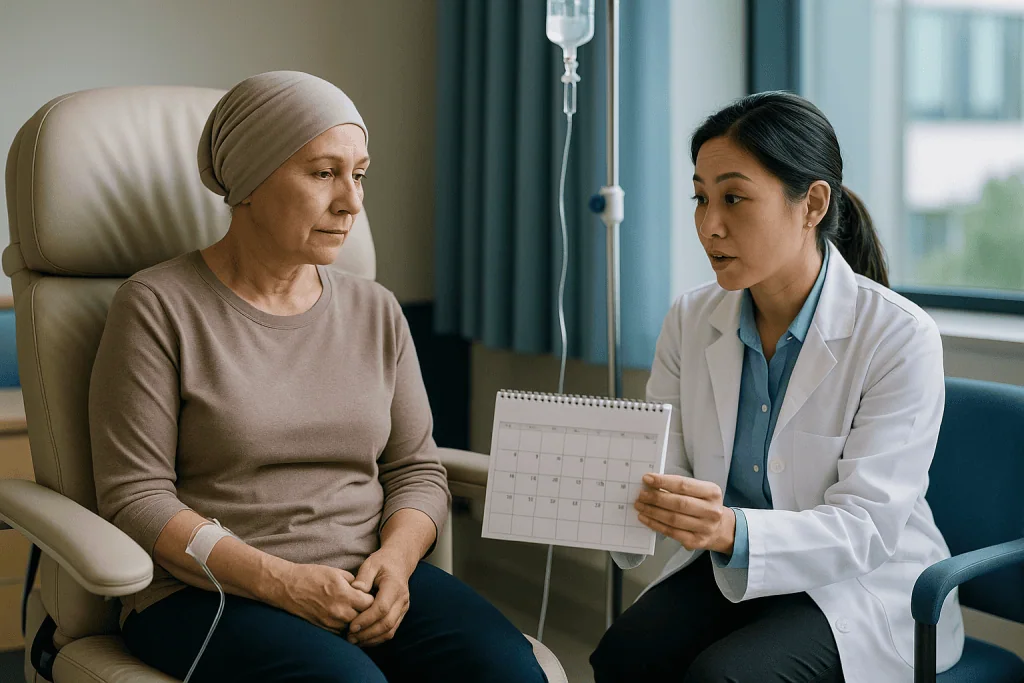
How many cycles? Again the honest answer is “it depends,” but the dependence is not arbitrary. The subtype of lymphoma, its stage, the results of imaging partway through treatment and how well the marrow is tolerating each round all feed into the count. Courses of six to eight cycles are common for many first-line lymphoma regimens, with a scan after two to four cycles used by many teams to judge whether the plan should continue unchanged. A shorter course may be paired with radiotherapy; a longer one may be chosen when early scans suggest the disease is responding more slowly.
The total span, therefore, often works out at four to six months for a standard course, with the understanding that any single cycle may be pushed back by a week if blood counts have not recovered. Those pauses are built into how oncologists think about the schedule. They are not a failure of the plan; they are the plan working as designed.
It helps to ask two questions early: how long is one of my cycles, and how many are intended before the first reassessment scan? Those two numbers turn a vague “months of chemo” into a shape you can see on the calendar.
What actually happens on infusion day
Infusion day is longer than most people expect and less dramatic than most people fear. The sequence is remarkably consistent across treatment centers.
It starts with a check-in and a blood draw, unless the blood was taken a day or two earlier. A nurse records weight, temperature, blood pressure and pulse. Weight matters because drug amounts are calculated from body size, which is one reason it is measured every cycle rather than once. Then there is a wait, often 30 to 90 minutes, while the pharmacy prepares the drugs. Chemotherapy is mixed fresh for each patient only after that day’s blood results confirm it is safe to proceed, so this wait is a safety step, not a delay.
Pre-medications come next. These are usually a combination of an anti-nausea drug and, for some regimens, an antihistamine and a steroid, given to lower the chance of an allergic-type reaction to the treatment itself. Then the drugs are run through a line, one after another, each at a set rate. Some take minutes; a large-volume infusion or a first dose of an antibody treatment may take several hours because it is started slowly and sped up only if no reaction appears. The NHS describes a typical hospital chemotherapy session as lasting anywhere from a few hours to most of a day.
Many people with lymphoma have a central line or port placed before the first cycle: a thin tube sitting in a large vein near the heart, with an access point under the skin of the chest or in the arm. It spares the smaller veins of the hand from repeated needles and irritating drugs.
People read, sleep, watch films, eat lunch. Nurses check in regularly and watch for flushing, itching, chills or breathlessness during the first infusions especially. When the last bag finishes, the line is flushed, the observations repeated, and you go home the same day in almost all outpatient regimens.
Days 1 to 3: the first stretch after infusion
The two or three days after an infusion have their own character, and it is shaped as much by the steroid pre-medication as by the chemotherapy. Steroids given on infusion day, and sometimes for a few days afterwards as part of the regimen, tend to produce a jittery, wakeful energy on the first night, a sharper appetite, and sometimes a warm flush in the face. Sleep can be poor for a night or two. Blood sugar rises in some people, which is why those with diabetes are usually asked to check more often around infusion days.
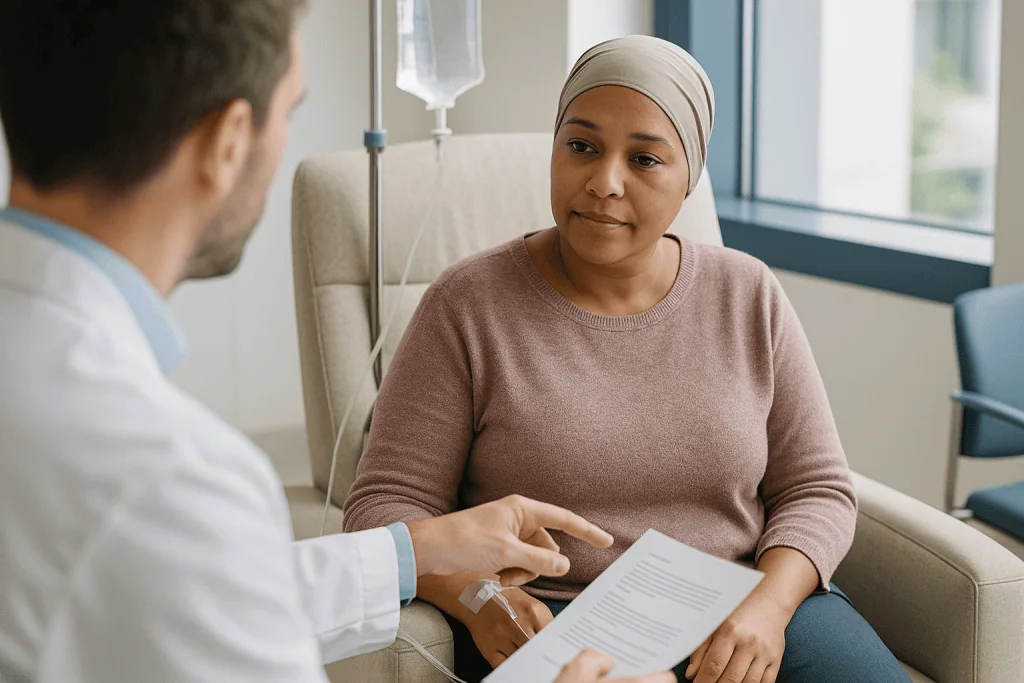
Nausea, if it arrives, most often does so within the first 24 to 72 hours. Modern anti-sickness medicines, given before the infusion and continued at home, have changed this picture dramatically compared with treatment a generation ago; the NHS lists nausea among the most common chemotherapy effects but also among the most controllable. The practical point is timing: the medicines work far better taken on the schedule you were given than taken only once sickness has started.
Fatigue tends to build rather than strike. Many people describe Day 2 or Day 3 as a heavy, leaden tiredness that lifts partly by the end of the first week and then may return as blood counts fall. Taste changes, a metallic or cardboard flavor, often start in these first days and fade over the cycle.
Hydration matters more than usual during this stretch. Several lymphoma drugs and their breakdown products leave the body through the kidneys and bladder, and drinking steadily helps flush them through. Some regimens include a drug that can irritate the bladder lining; teams give a protective medicine alongside it and ask patients to empty the bladder frequently and report any burning or blood in the urine.
Emotionally, these are also the days when the reality of treatment lands. Feeling flattened, tearful or oddly numb after the first infusion is common and is not a sign that anything is going wrong.
Neutropenia after chemotherapy: the mid-cycle dip explained
Neutropenia means having too few neutrophils, the white blood cells that form the front line against bacterial infection. It is the single most important thing to understand about the middle of a chemotherapy cycle, because it turns an ordinary fever into an emergency.
Here is the mechanism. Bone marrow constantly manufactures new blood cells to replace old ones. Chemotherapy stuns the marrow’s dividing cells on infusion day, but the neutrophils already circulating in the blood live only a day or so. For the first week you are running on stock that was made before treatment. As that stock is used up and the marrow has not yet restarted full production, the count falls. Cleveland Clinic and the National Cancer Institute both describe the low point, called the nadir, as typically arriving 7 to 14 days after a chemotherapy dose, with counts usually recovering over the following week.
During the nadir, the immune system cannot mount a normal response. Infections that a healthy body would contain, a urine infection, a chest infection, bacteria crossing from the gut into the blood, can spread quickly and quietly. The usual warning signs, pus, redness, a productive cough, may be muted because there are few white cells to produce them. That is why a temperature of 100.4°F (38°C) or higher during chemotherapy is treated as a red flag in its own right rather than something to watch overnight.
Neutropenic fever is treated in hospital with intravenous antibiotics started as soon as possible after arrival, before the source is identified. Most people who are treated promptly recover well, and knowing when the nadir is likely means you can arrange your life around it: fewer crowded rooms, no dental work, careful food hygiene, and a thermometer within reach.
Your team may also give a growth factor injection after some infusions. This is a laboratory-made version of a natural signaling protein that tells the marrow to make neutrophils faster, shortening the neutropenic window.
Why chemo rest days are treatment, not time off
People often describe the rest days with an apology, as if the fortnight between infusions were a gap in their treatment. It is the opposite. The infusion is the injury; the rest days are the repair, and the repair is what makes the next infusion possible.
Three things are happening during a well-managed rest period. The bone marrow rebuilds its population of neutrophils, red cells and platelets from stem cells that chemotherapy spared. The lining of the mouth and gut, which turns over every few days, regenerates, so mouth soreness and loose stools from the first week usually settle. And the liver and kidneys clear the last traces of the drugs and their by-products.
What the rest period is not designed to do is allow lymphoma cells to recover fully. Cancer cells are generally poorer than healthy cells at repairing DNA damage, which is the biological gap the cycle exploits. Give too short a break and healthy marrow cannot recover, making the next dose unsafe. Give too long a break and the advantage narrows. The cycle lengths used in lymphoma regimens were worked out in clinical trials precisely to sit in that window, which is why teams are reluctant to stretch or compress them casually.
Rest does not have to mean bed rest. Mayo Clinic and the NHS both note that gentle, regular activity, a daily walk being the obvious example, is associated with less fatigue during chemotherapy rather than more. The pattern many people settle into is a slow week after infusion, a cautious middle week around the nadir with attention to infection risk, and a noticeably brighter final week as counts recover, appetite returns and energy lifts just in time for the next Day 1.
That last week is worth protecting. Plan the things that matter to you, a visit, a meal out, a piece of work, for the days you are most likely to feel like yourself, and let the first week be quiet without guilt.
Blood counts before chemo: what the numbers mean
A complete blood count, often written as CBC or FBC, is drawn before every cycle and sometimes mid-cycle too. It measures the three cell lines the marrow produces. Each answers a different question about whether it is safe to proceed.
| What is measured | What it does | Typical low point after infusion | Why the team watches it |
|---|---|---|---|
| Neutrophils (a type of white cell) | Fight bacterial infection | Days 7 to 14 | Below a set threshold, the next cycle is usually delayed because infection risk is too high |
| Hemoglobin (in red cells) | Carries oxygen | Falls gradually over several cycles | Low levels cause fatigue and breathlessness; transfusion may be offered if symptomatic |
| Platelets | Form clots to stop bleeding | Days 7 to 14 | Low counts raise bruising and bleeding risk; very low counts delay treatment |
| Kidney and liver blood tests | Clear drugs from the body | Checked each cycle | Abnormal results may change which drugs or amounts are safe |
The neutrophil count is the one that most often decides the day. Each regimen has a minimum level below which infusion is postponed, usually by a week, and the count is rechecked. Cleveland Clinic explains that the marrow’s recovery pattern is highly individual, which is why the same regimen produces smooth sailing for one person and repeated one-week pauses for another.
Hemoglobin behaves differently. Red cells live around four months, so a single infusion barely dents them; the effect accumulates over a course, and anemia often appears in the middle cycles rather than the first. Platelets follow the neutrophil timing more closely.
Ask for your numbers. Most teams are glad to show you the trend across cycles, and seeing your own nadir pattern makes the schedule feel far less random.
Who is usually offered this schedule and who is asked to wait
Cycle-based chemotherapy is the standard backbone of treatment for most lymphoma subtypes, from aggressive non-Hodgkin lymphomas to classical Hodgkin lymphoma, and for many slow-growing lymphomas once they cause symptoms or begin to affect organ function. The regimen chosen depends on the specific diagnosis under the microscope, the stage, and the person’s general health.
Before the first cycle, the team checks that the body can tolerate the plan. Heart function is usually assessed with an ultrasound scan, because one class of drug used in many lymphoma regimens can weaken the heart muscle in a small proportion of people. Kidney and liver function are measured. Screening for hepatitis B and other infections is routine, since chemotherapy can reactivate dormant viruses. Fertility preservation is discussed with people who may want children in the future, ideally before the first infusion.
Being asked to wait is not the same as being turned down. Common reasons for a pause before starting include an active infection that needs treating first, dental problems that could seed bacteria during the nadir, or a heart or kidney result that prompts a different regimen. Some slow-growing lymphomas are not treated at all at first: a strategy called active monitoring, in which the disease is watched with regular checks and treatment begins only when it is needed, is recommended in NHS guidance for certain low-grade lymphomas that are not causing symptoms.
Within a course, delays of one week between cycles are frequent and expected, most often because the neutrophil count has not recovered. Longer gaps or reductions in the drug amounts may be chosen if side effects on one cycle were severe. Older adults and people with other health conditions are sometimes offered modified regimens that trade a little intensity for better tolerability.
All of these are judgment calls that sit with the hematology team, who weigh the aggressiveness of the lymphoma against the resilience of the person receiving treatment.
Lymphoma chemotherapy cycles: what to expect from side effects over the whole course
Side effects have a timeline as well as a list, and the timeline is the more useful of the two. Some effects belong to the first days of each cycle, some to the middle, and some only to the later cycles as the body’s reserves are drawn down.
Hair loss is the most visible marker. The NHS describes it as beginning typically two to four weeks after the first treatment, which for most lymphoma regimens means during or just after the second cycle. Not every regimen causes complete hair loss; some cause thinning only. Regrowth usually starts within weeks of the final cycle, sometimes with a different texture or color at first.
Mouth soreness and altered taste tend to peak around the nadir and fade before the next infusion. Constipation is common in the first days, partly from anti-nausea medicines, while loose stools may appear in the second week. Tingling or numbness in the fingers and toes, called peripheral neuropathy, is linked to one class of drug used in several lymphoma regimens; it usually builds gradually across cycles rather than appearing suddenly, and reporting it early lets the team adjust before it becomes fixed.
Fatigue almost always accumulates. People frequently say cycle one was manageable and cycle four was the hard one, not because the drugs changed but because the reserves did. Anemia contributes, as does disturbed sleep and the sheer duration of treatment.
Later cycles also bring the psychological weight of knowing exactly what is coming. Anticipatory nausea, feeling sick on the drive to the unit before any drug is given, is a recognized phenomenon and responds to the same medicines plus simple behavioral strategies.
Most of these effects are temporary and resolve in the weeks after the last cycle. A small number, notably neuropathy and effects on the heart or fertility, can persist, which is why they are discussed before treatment starts rather than after.
The drug classes used in lymphoma regimens and how each works
Most lymphoma regimens combine four or five drugs from different classes, each attacking dividing cells in a different way so that a cell resistant to one is unlikely to resist all. Knowing the classes explains most of the side-effect pattern.
Alkylating agents attach chemical groups to DNA so that the strands cannot separate to copy themselves. They are a mainstay of lymphoma treatment and are largely responsible for the marrow suppression that drives the nadir. Anthracyclines wedge themselves between DNA strands and block an enzyme cells need to untangle DNA during division; this class is why heart scans are done before treatment, because a small proportion of people develop weakening of the heart muscle that depends on cumulative exposure across the course. Vinca alkaloids poison the internal scaffolding, microtubules, that a cell uses to pull its chromosomes apart; because nerves rely on the same scaffolding to transport materials along their length, this class causes the peripheral neuropathy described above.
Steroids form part of many regimens, and not only as pre-medication. Lymphoma cells are unusually sensitive to them and die when exposed, which is why a short steroid course accompanies each cycle in several protocols. Monoclonal antibodies, given by infusion alongside chemotherapy in many B-cell lymphoma regimens, are not chemotherapy at all: they are lab-made immune proteins that lock onto a marker on the surface of B cells and flag them for destruction. The first antibody infusion is run slowly because reactions such as chills, fever and low blood pressure are most likely then.
Newer targeted drugs and immunotherapies are increasingly combined with or substituted for parts of these regimens in specific situations, and are usually given on their own cycle patterns.
Which classes appear in your regimen, and in what combination, is a decision for your hematologist based on your lymphoma’s precise type. This section is meant to translate the plan you are given, not to suggest one.
Supportive medicines that travel alongside each cycle
A modern lymphoma regimen arrives with an entourage of supporting medicines, and understanding what each one is for makes the pile of boxes on the kitchen counter less bewildering.
Anti-nausea medicines are given in layers. One class blocks a serotonin receptor in the gut and brain that chemotherapy triggers; another blocks a different signaling pathway involved in delayed nausea two to five days after infusion; steroids add a further anti-sickness effect. They are prescribed to be taken on a fixed schedule for the first few days, and the consistent advice from Mayo Clinic and the NHS is that they work best taken preventively rather than in response to sickness that has already started.
Growth factor injections, described earlier, prompt the marrow to make neutrophils faster. They are given a day or so after infusion, usually into the skin of the abdomen or thigh, and some people learn to self-inject or have a family member do it. Bone ache is a recognized side effect because the marrow is working hard.
Preventive antimicrobials are common in lymphoma treatment. An antiviral may be given throughout the course to prevent reactivation of shingles or hepatitis B; an antibiotic may be taken on set days each week to prevent a specific lung infection that people with suppressed immunity are prone to; an antifungal may be added for regimens with prolonged neutropenia. These are prescribed to be continued even when you feel well, and stopping them early undoes the protection.
A drug that protects the bladder lining, mouthwashes to reduce soreness, laxatives, and sometimes a medicine to protect against a surge of uric acid released when many lymphoma cells die at once in the first cycle round out the list.
Every one of these has a specific place in the cycle. Keeping a simple written schedule, or using the one your unit provides, prevents the most common error, which is stopping a preventive medicine because it seems unnecessary.
What people often get wrong about chemotherapy cycles
Misunderstandings about cycles cause real harm, mostly by making people slower to call for help or quicker to blame themselves. A few deserve direct correction.
“A delay means the treatment is failing.” It almost never does. A one-week postponement because neutrophils have not recovered is a safety decision about your marrow, not a verdict on your lymphoma. Delays are common enough that many regimens have written rules for them.
“Feeling well means the chemo isn’t working.” Side effects and effectiveness are not linked in this way. People who breeze through a cycle and people who struggle can have identical responses on their scans. The reverse is also true: feeling terrible is not evidence of success.
“A small fever can wait until morning.” During the nadir, a temperature of 100.4°F (38°C) or above is an emergency at any hour. The National Cancer Institute is explicit that infection in a person with a low white cell count can become life-threatening within hours.
“Rest days mean staying in bed.” Gentle activity is associated with less fatigue, not more. Bed rest for a fortnight leaves most people weaker for the next cycle.
“Everyone loses their hair on day one.” Hair loss, when it happens, typically begins two to four weeks in, and not all regimens cause it.
“Supplements or a special diet will boost the counts.” No food or over-the-counter supplement has been shown to reliably raise neutrophil counts during chemotherapy, and some supplements interact with chemotherapy drugs or affect how the liver clears them. Tell the team about anything you take.
“Once the last cycle is done, it’s over.” Counts, energy and taste usually take several weeks to normalize after the final infusion, and follow-up scans and clinic visits continue. The end of treatment is a transition rather than a finish line, and many people find the weeks after the last cycle emotionally harder than expected precisely because the structure that carried them through has gone.
Questions to ask your care team before and during the cycles
MedlinePlus keeps a patient-facing list of questions to raise before chemotherapy, and it is worth adapting it to the rhythm of cycles specifically. Bring the list to the first appointment and again whenever the plan changes; the answers often shift after the mid-course scan.
- How long is one of my cycles, on which days are drugs given, and how many cycles are intended before the first reassessment scan?
- Roughly when in each cycle do you expect my counts to be lowest, and what should I do differently during that window?
- What temperature reading should prompt a call, and which number do I ring at 3 a.m.?
- Which of my medicines are for prevention and must be continued even when I feel well?
- Will I have a central line or port, and how is it cared for at home?
- What is the plan if my counts have not recovered on Day 1 of the next cycle?
- Which side effects should I report straight away and which can wait for the next visit?
- Can I work, drive, travel or exercise during treatment, and are there days when that is unwise?
- Are there vaccinations I should have before starting, or avoid during treatment, and what about people living with me?
- How will we know whether the treatment is working, and when will that first be assessed?
- Who is my named contact, and how do I reach the team between visits?
Two habits make these conversations more productive. Keep a simple diary, one line a day, of temperature, energy, appetite and anything unusual; patterns across cycles are far more useful to your team than a vague memory of feeling unwell “sometime last week.” And bring someone with you to Day 1 appointments when you can. Infusion day is long, information arrives in bursts, and a second pair of ears catches what tiredness lets slip.
None of these questions has a single right answer. They are prompts for a discussion in which the decisions, about cycle length, delays, supportive medicines and when to stop, remain with the hematology team who know your case.
When to call your doctor during a chemotherapy cycle
The unit will give you a 24-hour number. Program it into your phone on the first day and use it without hesitation; the people who answer expect calls at inconvenient hours and would far rather hear about a borderline symptom than about a delayed one.
Call immediately, at any hour, for any of the following. A temperature of 100.4°F (38°C) or higher, or a temperature below 96.8°F (36°C), or shivering and shaking even without a measured fever, since some anti-fever medicines can mask the reading. Feeling suddenly and markedly unwell, confused, dizzy on standing, or with a racing heart, even if the thermometer is normal. Breathlessness, chest pain, or a cough producing colored sputum. Bleeding that does not stop with pressure, blood in urine or stool, or widespread pinpoint bruising. Vomiting that prevents you keeping fluids or medicines down for more than a day, or diarrhea more than four to six times in 24 hours. Redness, swelling, pain or discharge around a central line or port, or a line that will not flush. A new rash, swelling of the face or lips, or wheeze, particularly within hours of an infusion.
Some symptoms are less urgent but still warrant a call the same day rather than waiting for the next appointment: mouth ulcers that stop you eating, new tingling or numbness in fingers or toes, pain on passing urine, a persistent headache, or feeling low to a degree that frightens you.
If you cannot reach the unit and you have a fever or feel severely unwell, go to the nearest emergency department and tell the first person you meet that you are having chemotherapy and may have a low white cell count. That sentence changes how quickly you are seen and what is done first. The National Cancer Institute and Cleveland Clinic both stress that early antibiotics are the decisive factor in neutropenic infection, and early antibiotics depend on an early call.
Frequently asked questions
How long is a chemo cycle for lymphoma, and how many cycles are usual?
Cycles for lymphoma most commonly last two to four weeks, and a first-line course often runs six to eight cycles over roughly four to six months, though both figures vary with the subtype and regimen. Your team sets the number in advance and usually reviews it after a scan partway through. Any one-week delays for low blood counts are added to that span rather than shortening the course.
What are chemo rest days for, and should I stay in bed?
Rest days let bone marrow, the gut lining and other fast-dividing healthy tissues recover before the next infusion, and they are as much part of treatment as infusion day. Bed rest is not required and tends to worsen fatigue; gentle daily activity such as walking is generally encouraged. Plan quieter days early in the cycle and protect the final week, when most people feel closest to normal.
When does neutropenia after chemotherapy happen and how long does it last?
Neutrophil counts typically fall to their lowest 7 to 14 days after an infusion and recover over the following week, though the pattern is individual. During that window infection risk is highest and fever needs urgent assessment. Some regimens include a growth factor injection that shortens the neutropenic period by prompting the marrow to produce white cells faster; whether you receive one is a decision for your team.
Why are blood counts before chemo checked every single cycle?
Each infusion suppresses the marrow, and the team needs to confirm neutrophils and platelets have recovered enough for the next dose to be safe. Kidney and liver tests are checked at the same time because they clear the drugs from the body. If any value is below the regimen’s threshold, the cycle is usually delayed a week and the test repeated, which is a common and expected event.
What does an infusion day actually involve and how long does it take?
Expect check-in, a blood test or review of recent results, observations, a wait while pharmacy prepares the drugs, pre-medications, and then each drug run through a line in sequence. The whole visit commonly lasts from a few hours to most of a day, with first infusions of antibody treatments taking longest because they are started slowly. Most people go home the same day.
What is the lymphoma chemo side effects timeline across a cycle?
Nausea and steroid-related sleeplessness cluster in the first one to three days; mouth soreness, fatigue and infection risk peak around the nadir at 7 to 14 days; and energy usually improves in the final week. Hair loss, if it occurs, begins two to four weeks after the first cycle. Anemia and nerve tingling tend to build across cycles rather than appearing in the first.
Does a delayed cycle mean the chemotherapy is not working?
No. Delays are almost always about your blood counts or an infection, not about the lymphoma’s response. Whether treatment is working is judged by examination and imaging, usually a scan after two to four cycles, not by the calendar. Written rules for delays are built into most regimens precisely because they are anticipated.
Can I work or travel between chemotherapy cycles?
Many people continue some work and short travel, especially in the final week of each cycle when counts have recovered. Crowded settings and long trips are best avoided around the nadir, and any travel should be discussed with your team so that you know how to get help if you develop a fever away from home. The decision depends on your regimen, counts and how you are feeling.
Why do I have so many extra medicines alongside the chemotherapy?
Modern lymphoma regimens come with preventive medicines: anti-nausea drugs taken on a fixed schedule for the first days, antivirals and sometimes antibiotics or antifungals to prevent infections during low counts, mouthwashes, laxatives, and occasionally a growth factor injection. Most protect you only if taken as scheduled, including on days you feel well, so check with the team before stopping any of them.
What temperature should make me call the chemotherapy unit?
A reading of 100.4°F (38°C) or higher is the standard threshold used by major cancer centers, and a reading below 96.8°F (36°C), or shivering and feeling suddenly unwell without a measured fever, should also prompt an immediate call. Do not take a fever-reducing medicine and wait; ring the 24-hour number you were given or go to an emergency department and say you are on chemotherapy.
References
- NHS: Chemotherapy
- NHS: Non-Hodgkin lymphoma: Treatment
- Cleveland Clinic: Neutropenia
- MedlinePlus: Chemotherapy: what to ask your doctor
This article is for general information only and is not a substitute for professional medical advice. Please consult a qualified doctor about your individual situation.

More from the Blog

Acute Lymphocytic Leukemia in Children: How Families Are Guided Through the Care Pathway
Childhood acute lymphocytic leukemia is usually treated along a structured, risk-adapted pathway of chemotherapy phases: induction to reach remission, consolidation and intensification to deepen…

Is a Second Opinion Helpful in Multiple Myeloma? What a Specialist Review Can Add
A second opinion is generally considered reasonable and often helpful in multiple myeloma, because diagnosis, risk grouping and treatment sequencing rest on specialist interpretation…

Basal Cell Carcinoma Removal Step by Step: Local Anesthesia, Excision and Closure
Basal cell carcinoma removal is usually a same-day outpatient procedure done under local anesthetic. The clinician numbs the skin with an injection, cuts out…

Which Tests Classify Acute Lymphocytic Leukemia and Set the Risk Group Before Treatment?
Acute lymphocytic leukemia is classified with a complete blood count and blood smear, a bone marrow aspirate and biopsy, flow cytometry to identify B-cell…
How Myelogenous Leukemia Treatment Differs for Chronic and Acute Forms
Chronic myelogenous leukemia (CML) and acute myeloid leukemia (AML) are treated very differently because they behave differently. CML usually grows slowly and is driven…

When Hormone Therapy Joins Prostate Cancer Treatment: With Radiation, Before Surgery or Alone
Hormone therapy for prostate cancer is used in three main situations: alongside radiation for intermediate- and high-risk disease, where it shrinks the gland and…