

Menopause Hair Loss: The Hormone Shift Behind Thinning and What Dermatologists Recommend

Key Takeaways
- Visible female pattern hair loss affects roughly 40 percent of women by age 50, and the proportion rises after menopause as estrogen's protective effect on follicles fades.
- Pattern hair loss shows as a widening part and crown thinning with a preserved front hairline, while sudden all-over shedding two to three months after a stressor points to telogen effluvium.
- Topical minoxidil is the only treatment with approval and multiple randomised trials for women's pattern hair loss; oral minoxidil is a blood pressure medicine used off-label with mostly observational support.
- Menopausal hormone therapy has no controlled evidence for treating hair loss and is never prescribed for hair alone; some progestogen-containing regimens may worsen thinning.
- The JAK inhibitors approved between 2022 and 2024 treat autoimmune alopecia areata, not the diffuse hormonal thinning of menopause.
- Biotin supplements have no demonstrated hair benefit in people who are not deficient and can distort thyroid and cardiac blood tests, which are part of a standard hair loss workup.
Menopause hair loss is usually female pattern hair loss, also called androgenetic alopecia, unmasked when estrogen falls and androgens gain relative influence over hair follicles. It shows as gradual thinning across the crown and a widening part rather than bald patches. Topical minoxidil has the strongest trial evidence; hormone therapy and antiandrogens are less proven, and a clinician should rule out thyroid, iron and medication causes first.
It starts with the shower drain, or the hair tie that now wraps around three times instead of two. A woman in her early fifties lifts her hair in the bathroom mirror and sees more scalp at the part than she remembers. She has not changed her shampoo. She has, however, stopped having periods.
The topic is spiking in search for a specific reason. As of 2025, short videos praising a decades-old blood pressure medicine, oral minoxidil, as a midlife “hair fix” have gathered tens of millions of views, while a second wave of posts blames shedding on rapid weight loss from newer diabetes and obesity injections. Both trends have sent women typing menopause hair loss into a search bar, often at 2 a.m.
This guide separates what dermatology research has actually measured from what a confident creator asserted on camera: the hormone biology, the honest success rates, and the signs that mean a clinic visit should not wait.
Why is menopause hair loss trending, and what changed recently?
Three dated developments explain the current noise, and only one of them is new science.
The first is a medicine that has been around since the disco era. Oral minoxidil was approved in the United States in 1979 to lower blood pressure; its hair-growing side effect was noticed almost immediately and led to the topical version. Since widespread media coverage in 2022, dermatologists have increasingly prescribed the oral form off-label for pattern hair loss, and patient guides from Harvard Health now discuss it alongside the topical foam. Off-label means a licensed medicine used for a purpose its regulator never evaluated. The evidence base, covered later in this article, remains mostly observational.
The second development is a genuine approval story that has been misread. Between 2022 and 2024, regulators approved a new class of oral medicines, JAK inhibitors, for severe alopecia areata. That is an autoimmune condition that produces smooth, coin-shaped bald patches. It is not the diffuse crown thinning of menopause, and no JAK inhibitor is approved for female pattern hair loss. Social posts routinely blur the two.
The third is the weight-loss drug effect. Rapid weight reduction of any kind can trigger telogen effluvium, a temporary shedding that begins roughly two to three months after a physical stress. Because many women starting these medicines are also perimenopausal, the two causes get tangled, and the hormone story takes the blame for something that may be nutritional and self-limiting.
One more fact worth dating: the FDA first warned in 2017, and repeated the warning in 2019, that high-intake biotin supplements can distort common laboratory tests, including those for thyroid function and heart attack markers. That matters here because biotin is the single most marketed “menopause hair” ingredient, and thyroid testing is part of any proper hair loss workup.
What is androgenetic alopecia, and why does menopause bring it out?
Androgenetic alopecia is hair loss driven by a genetic sensitivity of scalp follicles to androgens, the group of hormones that includes testosterone. In women it is often called female pattern hair loss, and the two terms describe the same condition.
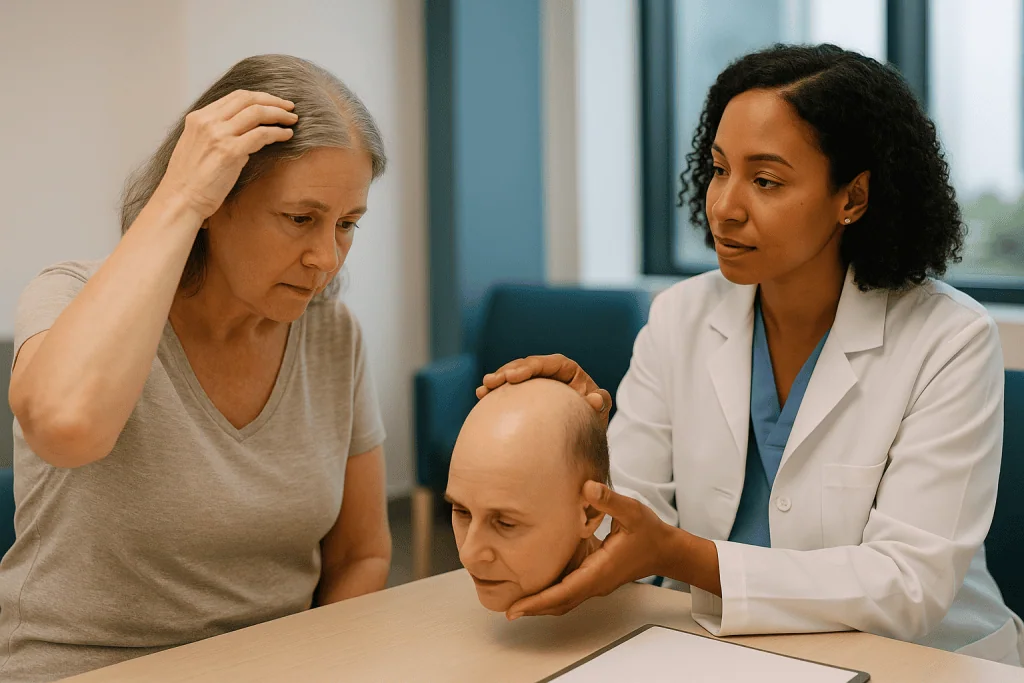
The follicle does not die. It shrinks. Over successive growth cycles, a follicle that once produced a thick, pigmented, long-growing hair begins to produce a finer, shorter, paler one, a process dermatologists call miniaturization. Picture a garden hose slowly replaced by a drinking straw: water still flows, but far less of it. Enough miniaturized follicles side by side, and the scalp shows through.
Why does menopause matter if the follicle sensitivity was always there? Because for decades, estrogen acted as a counterweight. Estrogen prolongs the growth phase of hair and appears to blunt the local effect of androgens on the follicle. When ovarian estrogen production falls sharply across the menopause transition, androgen levels do not drop by the same proportion. The ratio tips. Follicles that were genetically primed to miniaturize finally receive the signal without the brake.
The statistics bear this out. Cleveland Clinic and Mayo Clinic both note that visible pattern hair loss affects a minority of women in their twenties but roughly 40 percent by age 50, with the curve steepening after menopause. Family history is the strongest single predictor; a mother or father with thinning hair raises the odds considerably, although the inheritance is polygenic rather than a single “baldness gene.”
Two reassurances follow from the biology. Female pattern hair loss is not a sign of illness elsewhere in the body, and it almost never progresses to complete baldness. The frontal hairline is usually preserved, which is one reason the condition looks different from the receding pattern seen in men.
The hormone shift behind thinning: estrogen, androgens and the hair cycle
Every scalp hair runs on a timer. The growth phase, anagen, lasts 2–6 years and determines how long the hair can get. A brief transition phase of a few weeks follows, then a resting phase, telogen, of about three months, after which the hair is released and a new one begins. On a healthy scalp around 85 to 90 percent of the roughly 100,000 follicles are growing at any moment, and losing 50 to 100 hairs a day is simply the resting hairs completing their schedule.
Hormones adjust that timer. Estrogen lengthens anagen, which is why hair often feels unusually full during pregnancy and sheds dramatically a few months after delivery when estrogen plunges. Androgens, acting through a more potent derivative called dihydrotestosterone (DHT), shorten anagen in sensitive follicles and drive the miniaturization described above. An enzyme in the skin, 5-alpha-reductase, converts testosterone into DHT right at the follicle.
The menopause transition therefore delivers a double adjustment. Shorter growth phases mean each hair is shed sooner and regrows thinner. More follicles sit in telogen at the same time, so daily shedding can creep above the usual range even though no single event triggered it.
Thyroid hormone is the third player, and it is frequently overlooked. Both an underactive and an overactive thyroid can push follicles prematurely into rest, producing diffuse shedding that mimics or amplifies pattern loss. Thyroid disorders cluster in midlife women, which is why guideline-level workups check thyroid function before attributing everything to the ovaries.
The practical takeaway from the biology: menopause rarely creates hair loss from nothing. It removes a protective hormone from a follicle that was already listening for an androgen signal, and it does so at a life stage when thyroid changes, iron stores and new medicines may be shifting too.
What could be causing hair thinning on the top of my head?
Location is diagnostic. Where hair thins tells a dermatologist almost as much as a blood test.

Thinning concentrated on the top of the head, with a part that looks wider than it used to, is the classic distribution of female pattern hair loss. Dermatologists grade it with the Ludwig scale, which runs from a subtly widened part (grade I) to a visibly see-through crown (grade III) while the front hairline stays intact. A related “Christmas tree” pattern shows the part widening toward the front like the outline of a fir. If you can photograph your part today and compare it with a photo from five years ago, you have performed a basic version of the same assessment.
Thinning that is everywhere at once, with handfuls in the brush and no particular focal point, points instead to telogen effluvium. Common triggers in midlife include surgery, a febrile illness, crash dieting or rapid weight loss, a new medicine, significant emotional stress, iron deficiency and thyroid imbalance. The shedding typically starts two to three months after the trigger and resolves within six months once the cause is corrected.
Smooth, completely bald circles, sometimes with short broken hairs at the edges, suggest alopecia areata. Thinning along the temples and the frontal hairline, especially with lost eyebrows and a band of shiny, pale skin, raises concern for frontal fibrosing alopecia, a scarring condition that disproportionately affects postmenopausal women and needs early specialist care.
Thinning at the hairline from years of tight ponytails, braids or extensions is traction alopecia, which can become permanent if the pulling continues.
These patterns overlap. A woman can have mild pattern loss for years and only notice it when a bout of telogen effluvium thins the surrounding hair and exposes the crown. That combination is probably the single most common story in a midlife hair clinic.
Is it really menopause? Other causes of hair loss after menopause
Blaming hormones is tempting because the timing fits so neatly. Clinicians resist that temptation for a reason: several treatable causes produce identical shedding, and missing them means missing a fix.
Iron deficiency sits at the top of the list. Heavy or irregular bleeding during perimenopause can drain iron stores well before anemia appears on a routine blood count. Ferritin, the blood marker of stored iron, is the test that matters, and many dermatologists aim for a comfortably normal level rather than merely a value above the laboratory cutoff. The NIH Office of Dietary Supplements is candid that evidence for iron supplementation improving hair in women who are not deficient is weak, so the test should come before the tablet.
Thyroid disease, discussed above, is the second routine check. Vitamin D deficiency has been associated with several hair disorders in observational studies, though trials showing that correcting it regrows hair are lacking.
Medicines deserve a careful review. Hair shedding is a listed side effect of some blood pressure medicines, mood stabilizers, anticoagulants, retinoids and certain cholesterol drugs, and the shedding often begins months after the prescription started, which obscures the link. Never stop a prescribed medicine on suspicion; bring the list to the prescriber and ask.
Rapid weight loss, whether through surgery, strict dieting or newer injectable obesity medicines, reliably triggers telogen effluvium through calorie and protein deficit. Hair is metabolically expendable, and the body deprioritizes it first.
Finally, scalp conditions such as seborrheic dermatitis, psoriasis or a fungal infection inflame the skin around follicles and can accelerate shedding. Itching, scaling or redness alongside thinning is a clue that the scalp itself, not the hormones, needs attention.
A good consultation runs through this list in minutes. Skipping it in favor of a hormone narrative is the most frequent error in online advice.
How dermatologists diagnose female pattern hair loss
The workup is less mysterious than people fear, and most of it happens in the first appointment.
History comes first: when the thinning started, whether it was sudden or gradual, what happened in the three months before, family patterns, menstrual changes, diet, new medicines and styling habits. A dermatologist will also ask about symptoms of thyroid imbalance, such as temperature intolerance, weight change or palpitations.
The examination then follows a sequence. The hair pull test involves grasping a small bundle of about 50 to 60 hairs and tugging gently; releasing more than a few suggests active shedding rather than slow pattern loss. Dermoscopy, a handheld magnifier with polarized light, lets the clinician see variation in hair shaft diameter, the hallmark of miniaturization, along with the yellow dots and broken hairs that distinguish other diagnoses. Part-width comparison between the crown and the back of the scalp is a quick, reliable sign, because pattern loss spares the occipital region.
Blood tests are chosen rather than scattershot. A full blood count, ferritin, thyroid function and often vitamin D cover the common reversible causes. Androgen levels are checked when there are other signs of androgen excess, such as new facial hair, acne or a deepening voice, because that combination warrants looking for an underlying endocrine cause rather than assuming ordinary menopause.
A scalp biopsy, a tiny punch of skin taken under local anesthetic, is reserved for uncertain cases, particularly when a scarring alopecia is possible. Early detection there changes outcomes, because scarred follicles do not recover.
What a diagnosis delivers is realistic expectation-setting. Pattern hair loss is chronic and slowly progressive; the aim of treatment is to slow miniaturization and thicken what remains, and clinicians usually describe success as stabilization first and modest regrowth second. Knowing that at the outset prevents the cycle of trying a product for six weeks, declaring it a failure and buying the next one.
What the evidence actually says: grading the treatments
Evidence comes in tiers, and hair loss advice rarely tells you which tier it is quoting. Here is the honest ladder for midlife women with pattern hair loss.
Strong evidence (multiple randomised, placebo-controlled trials): topical minoxidil. It is the only treatment with an approved indication for women’s pattern hair loss, and trials consistently show increased hair counts and shaft thickness at 24 to 48 weeks compared with placebo, with results reversing if treatment stops. Mayo Clinic and the NHS both list it as the first-line option.
Moderate evidence (smaller trials, some sham-controlled): low-level laser devices, which have regulatory clearance for pattern hair loss and show modest density gains in trials of a few months, and microneedling used alongside minoxidil, where small trials suggest the combination outperforms minoxidil alone.
Emerging or observational evidence: oral minoxidil, supported by large retrospective case series and a limited number of small randomised trials; spironolactone, an antiandrogen with decades of observational use but few controlled trials in women; finasteride, approved for men, with mixed and mostly small trials in postmenopausal women; and platelet-rich plasma injections, where trials exist but differ so much in technique that pooled conclusions are shaky.
Weak or absent evidence: menopausal hormone therapy for hair specifically, biotin in people who are not deficient, collagen, most “hair vitamins,” scalp cooling or detox treatments, and the current crop of exosome and stem cell cosmetic injectables, which are not approved for hair loss in the United States and should not be purchased or self-administered.
Two cautions apply across the ladder. Trials almost never run longer than a year, while the condition lasts decades, so long-term comparisons are expert opinion rather than data. And most trials measure hair counts per square centimeter, a laboratory outcome that does not always translate into a difference you can see in the mirror. A treatment can be statistically effective and cosmetically modest at the same time.
Menopause hair loss treatments compared
The table below summarizes the options a dermatologist is likely to discuss, their regulatory status for women’s pattern hair loss, how strong the supporting evidence is, and the side effects that trials and guidelines most often report. It is a map for a conversation, not a menu; every choice here belongs with the treating clinician.
| Option | Status for women’s pattern hair loss | Evidence strength | Typical time to judge | Commonly reported side effects |
|---|---|---|---|---|
| Topical minoxidil | Approved, available without prescription | Strong: multiple randomised trials | 4–6 months | Scalp irritation, early shedding, unwanted facial hair if it spreads |
| Oral minoxidil | Approved for blood pressure; off-label for hair | Emerging: large case series, few small trials | 6 months | Unwanted body hair, ankle swelling, fast heartbeat, dizziness |
| Spironolactone | Off-label | Observational, limited trials | 6–12 months | Frequent urination, dizziness, breast tenderness, potassium changes |
| Finasteride | Approved for men; off-label in postmenopausal women | Mixed small trials | 12 months | Headache, mood changes, lowered libido; harmful in pregnancy |
| Menopausal hormone therapy | Approved for menopause symptoms, not hair | Weak for hair | Not a hair treatment | Depends on formulation; discussed with prescriber |
| Low-level laser devices | Cleared devices available | Moderate: sham-controlled trials | 6 months | Scalp warmth, dryness |
| Platelet-rich plasma | Procedure, no approval required | Mixed small trials | 6 months after a series | Pain, swelling, bruising at injection sites |
| Exosomes, stem cell injectables | Not approved for hair loss | No controlled human trials | Not applicable | Unknown; not for sale or self-use |
Notice the pattern in the time column. Nothing works in weeks, because the hair cycle itself takes months to turn over. A product that promises visible density in 30 days is making a claim the biology cannot support.
Notice too that side effect lists lengthen as treatments move from topical to systemic. That trade-off, more reach for more risk, is exactly the judgment a clinician makes with your full medical history in front of them.
Minoxidil for menopause hair loss: what the trials show
Minoxidil remains the anchor of evidence-based care, and it earns the position by being studied rather than by being new.
How it works is still incompletely understood. It widens blood vessels, which is why it was first a blood pressure medicine, but its hair effect seems to come from prolonging the growth phase and enlarging miniaturized follicles, likely through its action on potassium channels in the follicle and a boost to local growth factors. It does not block androgens, so it treats the shrunken follicle without addressing the hormonal signal; that is one reason stopping it allows the process to resume within months.
The topical trial record is the strongest in the field. Randomised studies in women show statistically greater hair counts and thicker shafts than placebo by 24 weeks, with continued improvement to 48 weeks. The foam formulation was cleared for women in 2014, and both Mayo Clinic and the NHS describe topical minoxidil as the standard first choice. Two realities deserve plain statement. First, around a third of women see cosmetically meaningful regrowth, a larger share see slowed loss, and some see little change; there is no reliable way to predict which group you will join. Second, an increase in shedding during the first two months is common and reflects old resting hairs being pushed out ahead of new growth; it is not a sign the treatment is failing.
The oral form is where the viral claims live. Oral minoxidil is approved only as a blood pressure medicine, and its use for hair is off-label. Published support comes mainly from retrospective series involving thousands of patients, which report good tolerability and density gains, plus a small number of randomised trials suggesting comparable results to the topical form. Observational data cannot rule out selection bias, and the systemic side effects in the table above are real. Whether the oral route is appropriate for a particular woman, especially one with heart or kidney conditions, is a decision for the prescribing clinician, never for a comment section.
Does hormone therapy help menopause hair loss?
It is the most logical question in the entire topic. If falling estrogen unmasked the thinning, would replacing estrogen reverse it?
The honest answer is that the evidence does not support hormone therapy as a hair treatment. Menopausal hormone therapy is prescribed for hot flashes, night sweats, genitourinary symptoms and bone protection in appropriate candidates, and hair loss does not appear among its approved or guideline-endorsed indications. Harvard Health and Cleveland Clinic note that some women report thicker hair on treatment, that others report no change, and that a minority, particularly those on regimens containing certain progestogens with androgen-like activity, report worsening. Controlled trials designed to measure hair outcomes are essentially absent.
So the position dermatologists and menopause specialists generally take is this: hormone therapy may be worth discussing for its established benefits, and if a woman is already taking it, the formulation can be reviewed with hair in mind, but nobody should start or continue it to treat hair alone. The risk-benefit calculation involves breast, cardiovascular and clotting considerations that are entirely individual.
Antiandrogens address the other side of the ratio. Spironolactone, a diuretic that also blocks androgen receptors, has been used off-label for women’s pattern hair loss for decades; the supporting literature is mostly observational, with small trials suggesting stabilization in many patients over a year. Finasteride blocks the enzyme that makes DHT and is approved for men. In postmenopausal women the trials are small and inconsistent, with some showing improvement and others showing none, and it must never be used by anyone who could become pregnant because of the risk to a male fetus.
Whether either antiandrogen fits a given woman depends on blood pressure, kidney function, other medicines and personal risk tolerance. The evidence can inform the conversation; the decision rests with the treating clinician.
What are some new hair loss treatments available?
Innovation is real in this field, but much of what is marketed as new is either repurposed, unproven or aimed at a different disease.
The headline approvals of recent years, the JAK inhibitors, are genuinely transformative for severe alopecia areata, the autoimmune form. They calm the immune attack on follicles and can restore hair in a condition that previously had few reliable options. They are not studied or approved for pattern hair loss, carry significant immune-related risks, and are not relevant to the typical menopause presentation. Seeing them in a headline about “hair loss breakthroughs” is where much of the confusion begins.
Low-level laser therapy, delivered by combs, caps and helmets, is the most accessible of the newer physical treatments. Sham-controlled trials over 16 to 26 weeks show modest increases in hair density, and the main cost is time, since sessions run several times a week indefinitely. Microneedling, in which fine needles create controlled micro-injuries to stimulate growth factor release, has shown promise in small trials when combined with topical minoxidil; evidence for it alone is thinner.
Platelet-rich plasma involves drawing a patient’s blood, concentrating the platelets and injecting them into the scalp. Trials exist and several are positive, but preparation methods, injection schedules and outcome measures vary so widely that the field lacks a standardized protocol, and effects appear to fade without maintenance sessions.
Exosome and stem cell injectables sit at the frontier of marketing rather than science. These products are not approved for hair loss in the United States, controlled human trials are lacking, and regulators have issued warnings about unlicensed clinics. They are not for sale as medicines and not for self-use.
Hair transplantation, moving follicles from the dense back of the scalp to the thinning crown, remains the only way to add permanent new follicles. Women with diffuse thinning are sometimes poor candidates because the donor area is affected too, which is a surgical judgment made in person.
Home remedies for hair loss: what actually works
The home remedy aisle is long and the evidence is short, but it is not empty. A few measures are worth doing; most are worth skipping.
Protein and overall nutrition come first. Hair is almost entirely keratin, a protein, and a sustained shortfall in protein or calories pushes follicles into rest. Women in midlife frequently under-eat protein, and correcting that is low-risk and biologically sound, even though trials specifically measuring hair outcomes are scarce.
Iron and vitamin D should be corrected if a blood test shows deficiency, and not otherwise. The NIH Office of Dietary Supplements states plainly that biotin supplementation has no demonstrated benefit for hair in people without a deficiency, and true biotin deficiency is rare in anyone eating a varied diet. The lab interference problem described earlier makes routine biotin use actively unhelpful during a workup.
Rosemary oil is the viral darling. One small trial in men with pattern hair loss found similar hair count changes with rosemary oil and topical minoxidil after six months. That is a single study in a different population, and it has not been replicated in women; dermatologists classify the evidence as preliminary. Scalp massage has a comparable story: tiny studies suggest increased hair thickness over months, plausibly through mechanical stretching of follicle cells, with no downside beyond time.
Gentle handling matters more than any oil. Loosening ponytails, cutting back on heat and chemical processing, using a wide-toothed comb on wet hair and spacing out tight styles reduce breakage and prevent traction damage, which can otherwise be mistaken for worsening pattern loss.
Products that do not earn their shelf space include collagen powders, caffeine shampoos, onion juice, castor oil and most multi-ingredient “hair, skin and nails” formulas; evidence for each is absent or confined to manufacturer-funded studies. None of them is dangerous, but each delays the step that helps, which is a proper diagnosis.
Common myths about menopause hair loss
The viral claims cluster into a handful of recurring errors. Correcting them is faster than debunking each video.
Myth: Menopause means my hair will keep falling out until I am bald. Female pattern hair loss is progressive but almost never total. The frontal hairline is typically preserved and the back of the scalp stays dense. Many women stabilize for years with treatment.
Myth: Shedding more than 100 hairs a day proves something is wrong. The 50-to-100 figure is an average, not a ceiling, and it rises with hair density, washing frequency and the season. What matters is a sustained change from your own baseline, especially if the part is widening.
Myth: Hormone therapy will fix it. As covered above, controlled evidence for hair benefit is lacking, and some regimens can worsen thinning. It is prescribed for other reasons, with hair at most a secondary consideration.
Myth: The new hair loss pills on the news are for me. The recently approved JAK inhibitors treat alopecia areata, an autoimmune disease with bald patches, not the diffuse crown thinning of menopause.
Myth: Oral minoxidil is a harmless vitamin-like fix. It is a prescription blood pressure medicine used off-label, with systemic side effects including swelling and heart rate changes, and its hair evidence is mostly observational.
Myth: Biotin gummies thicken menopausal hair. No benefit has been shown in people who are not deficient, and high intake can produce false laboratory results, including on thyroid tests.
Myth: Washing less often saves hair. Hairs in the resting phase will fall regardless; washing simply releases them in one place. Skipping washes can worsen scalp conditions that genuinely do accelerate shedding.
Myth: It is purely cosmetic, so doctors will not take it seriously. Dermatology treats pattern hair loss as a medical condition with a defined workup, and its effect on mood and self-image is a recognized reason to seek care.
Living with thinning hair: care, styling and confidence
Treatment works on a timescale of months. Styling works on a timescale of minutes, and the two are not in competition.
Volume starts with the cut. Shorter layers, a blunt bob or a style that sits at or above the shoulder reduces the weight pulling hair flat against the scalp and makes density read higher. A side part shifts hair across the crown; changing the direction of the part every few weeks prevents a permanent gap from settling in. Many stylists are quietly expert at this and will discuss it frankly if asked.
Products can help without any biological claim. Volumizing mousse at the roots, dry shampoo for lift, and keratin fiber powders that cling to existing hairs and shade the scalp are legitimate cosmetic tools; a tinted scalp spray in a shade matched to the hair makes a widened part far less visible in photographs and overhead light. Toppers, partial hairpieces that clip in at the crown, have improved enormously in realism and are widely used by women who prefer not to announce a medical treatment to the world.
Scalp health deserves daily attention. A thinning crown gets more sun, so a hat or a scalp sunscreen matters outdoors. Washing regularly with a mild shampoo and treating any flaking with a medicated antidandruff product keeps inflammation down.
The emotional side is not trivial. Studies of women with pattern hair loss consistently find higher rates of anxiety and lower self-esteem than in matched controls, and that burden is often dismissed because the condition is not dangerous. Mentioning the distress to a clinician is appropriate, and support groups for hair loss exist in most regions. Hair is bound up with identity in ways that have nothing to do with vanity; acknowledging that is part of good care.
Photograph your part in consistent light every three months. It is the most reliable progress tracker you own, and it beats the mirror, which lies in both directions.
When to see a doctor
Gradual thinning at the crown over a year or two, with a widening part and no other symptoms, is the typical menopause pattern and can reasonably prompt a routine appointment to confirm the diagnosis and discuss options. Several presentations should move that appointment up.
- Sudden shedding, with noticeably more hair in the brush or drain for more than a few weeks, especially after an illness, surgery, significant weight loss or a new medicine.
- Smooth, completely bald patches, which suggest alopecia areata rather than pattern loss.
- Thinning at the frontal hairline or temples, loss of eyebrow hair, or a band of pale, shiny skin at the hairline, which can indicate a scarring alopecia that needs early specialist care to preserve follicles.
- Itching, burning, pain, scaling, pus or redness of the scalp alongside the thinning.
- New facial or body hair, acne, a deepening voice or irregular bleeding alongside scalp thinning, which together point to an androgen imbalance that warrants endocrine evaluation.
- Fatigue, cold intolerance, palpitations, unexplained weight change or constipation, which raise the possibility of thyroid or iron problems.
- Any hair loss that is affecting your mood, sleep or willingness to go out; distress is a legitimate reason to seek help.
Bring a list of every prescription medicine, over-the-counter product and supplement you take, including hair vitamins, and stop none of them on your own. If you take biotin, tell the clinician before blood tests are drawn, since it can distort results.
Every treatment decision discussed in this article, from topical minoxidil to antiandrogens to hormone therapy, carries individual trade-offs that depend on your medical history. The evidence summarized here is meant to prepare you for that conversation; the prescribing clinician makes the call with you, in person, with your results in hand.
Frequently asked questions
What is androgenetic alopecia?
Androgenetic alopecia is hair loss caused by a genetic sensitivity of scalp follicles to androgens, the hormone group that includes testosterone. Affected follicles gradually shrink and produce finer, shorter hairs, a process called miniaturization. In women it is known as female pattern hair loss and typically appears as crown thinning with a widening part. Menopause unmasks it because falling estrogen removes a hormonal counterweight the follicles had relied on.
What could be causing hair thinning on the top of my head after menopause?
Thinning centered on the top of the head with a preserved front hairline is the classic pattern of female pattern hair loss, the most common cause in midlife. It can be amplified by telogen effluvium from stress, illness, rapid weight loss or new medicines, and by iron deficiency or thyroid imbalance. A dermatologist can distinguish these with a scalp exam, a pull test and a few targeted blood tests.
What are some home remedies for hair loss that have real evidence?
Adequate protein, correcting a proven iron or vitamin D deficiency, gentle handling to avoid breakage and traction, and keeping the scalp free of inflammation are the measures with a sound biological or clinical basis. Rosemary oil and scalp massage have small, preliminary studies but no replication in women with pattern loss. Biotin, collagen and multi-ingredient hair supplements lack evidence in people who are not deficient.
What are some new hair loss treatments available?
Low-level laser devices, microneedling combined with minoxidil, and platelet-rich plasma injections are the newer options with at least some trial support for pattern hair loss, though the evidence is modest and mixed. JAK inhibitors approved since 2022 are for autoimmune alopecia areata, not pattern loss. Exosome and stem cell injectables are not approved for hair loss and are not for sale or self-use.
Does hair loss after menopause grow back on its own?
Shedding caused by a temporary trigger such as illness, surgery or rapid weight loss usually regrows within six to twelve months once the cause resolves. Female pattern hair loss does not reverse spontaneously; it is chronic and slowly progressive, though it rarely leads to complete baldness. Treatment aims to stabilize the process and thicken existing hair, with any regrowth taking at least four to six months to judge.
Does hormone replacement therapy stop menopause hair loss?
No controlled trials show that menopausal hormone therapy treats hair loss, and it is not prescribed for that purpose. Some women on it report fuller hair, others no change, and regimens containing certain progestogens with androgen-like activity may worsen thinning. Hormone therapy decisions rest on hot flashes, bone health and individual risk, discussed with the prescribing clinician; hair is at most a secondary consideration.
Is oral minoxidil approved for women's hair loss?
No. Oral minoxidil is approved as a blood pressure medicine, and its use for hair loss is off-label. Support comes mainly from large retrospective case series and a few small randomised trials, which is weaker evidence than the topical form has. It can cause unwanted body hair, swelling, dizziness and a fast heartbeat. Whether it is appropriate for an individual is a decision for the prescribing clinician.
Should I take biotin for female pattern hair loss?
The NIH Office of Dietary Supplements reports no demonstrated hair benefit from biotin in people without a deficiency, and true deficiency is rare on a varied diet. High biotin intake can also produce false results on thyroid and cardiac blood tests, which the FDA has warned about since 2017. If you take it, tell your clinician before blood tests, and discuss whether it serves any purpose.
How many hairs a day is normal to lose?
Losing about 50 to 100 hairs a day is normal; these are hairs completing their three-month resting phase before a new one grows. The figure varies with hair density, washing frequency and season, so a single heavy shower is not alarming. A sustained rise from your usual baseline for several weeks, or a part that is visibly widening in photographs, is the signal worth raising with a doctor.
How long before I know if a hair loss treatment is working?
Plan on four to six months for topical minoxidil and six to twelve months for antiandrogens or procedures before judging results, because the hair cycle itself takes months to turn over. A temporary increase in shedding during the first two months of minoxidil is expected. Photograph your part in consistent light every three months; it tracks change more reliably than daily mirror checks.
References
This article is for general information only and is not a substitute for professional medical advice. Please consult a qualified doctor about your individual situation.

More from the Blog

Perimenopause Periods: Heavier, Closer, Longer: What Is Normal and What Needs Checking
Perimenopause periods commonly become irregular in the years before menopause: cycles may shorten to 21–24 days, then lengthen, and flow can be heavier or…

What Causes Hot Flashes? The Brain’s Thermostat Explained, and Triggers Beyond Menopause
Hot flashes are caused by a narrowed temperature-control range in the hypothalamus, the brain's thermostat. When estrogen falls during perimenopause and menopause, nerve cells…

Early Menopause Symptoms: The Signs Before 45 and Why an Early Diagnosis Matters
Early menopause means periods stop permanently before age 45; before 40 it is called premature menopause or primary ovarian insufficiency. The first signs are…

The Menopause Diet: Protein, Calcium, Fiber and the Foods That Help Symptoms
A menopause diet is not a single plan. The best evidence supports a Mediterranean-style pattern: adequate protein spread across the day, about 1,200 mg…

Estrogen Dominance: Is It Real? What Doctors Say About the Popular Diagnosis
Estrogen dominance is not a recognized medical diagnosis. The term describes a theory that estrogen is too high relative to progesterone, but no accepted…

Genitourinary Syndrome of Menopause: The Under-Diagnosed Condition Behind Dryness, UTIs and Pain
Genitourinary syndrome of menopause (GSM) is the collection of vulvar, vaginal and urinary changes caused by falling estrogen after menopause, including dryness, burning, pain…