

Microneedling on Darker Skin Tones: Why Dermatologists Adjust Depth and Pre-Treatment
Key Takeaways
- Microneedling uses no heat or light, which is why it is often preferred over ablative lasers for Fitzpatrick types IV to VI, where melanin absorbs laser energy strongly.
- Post-inflammatory hyperpigmentation, a brown discoloration after healing rather than a scar, is the most frequently reported side effect in darker skin and can persist for months.
- Dermatologists typically start darker skin at a shallower needle depth with fewer passes and a gentler endpoint, treating the first session as a test of the skin's pigment tendency.
- Pre-treatment priming with daily broad-spectrum sunscreen and clinician-directed pigment inhibitors usually begins weeks before the first session, not after it.
- Radiofrequency microneedling adds heat into the dermis, raising pigment risk on darker skin, and is generally avoided in people with implanted electronic devices or a strong keloid history.
- Redness after needling often looks dusky or brown rather than pink on deeper skin tones, so a new, spreading or deepening patch beyond the first few days should prompt a call to your clinician.
Microneedling can be performed on darker skin tones, and it is often chosen over many lasers because it does not target pigment directly. The main risk is post-inflammatory hyperpigmentation, so dermatologists typically use shallower, more conservative needle depths, fewer passes, pigment-calming skin preparation beforehand and strict sun protection afterward. Suitability, settings and timing remain individual decisions for the treating clinician.
She had already done the hard part. The acne that followed her through her twenties was finally quiet, and what remained was the record of it: a scatter of shallow pits along both cheeks and a few darker patches that refused to fade. A friend with lighter skin had raved about her results from a needling device. The first clinic she called said, cheerfully, that it works on everyone. The second, a dermatology practice, asked her to come in for a consultation first, talked about her skin type for twenty minutes and sent her home with a plan that began weeks before any needle touched her face.
That second conversation is the one worth understanding. Microneedling for dark skin is not a different procedure, but it is a different plan, and the gap between the two phone calls explains most of the disappointing stories people post online.
This explainer walks through what the needles actually do, why melanin-rich skin reacts in its own way, how depth and preparation get adjusted, and which signs after a session mean a phone call to your care team rather than another week of waiting.
What is skin needling on the face, and what actually happens under the needles?
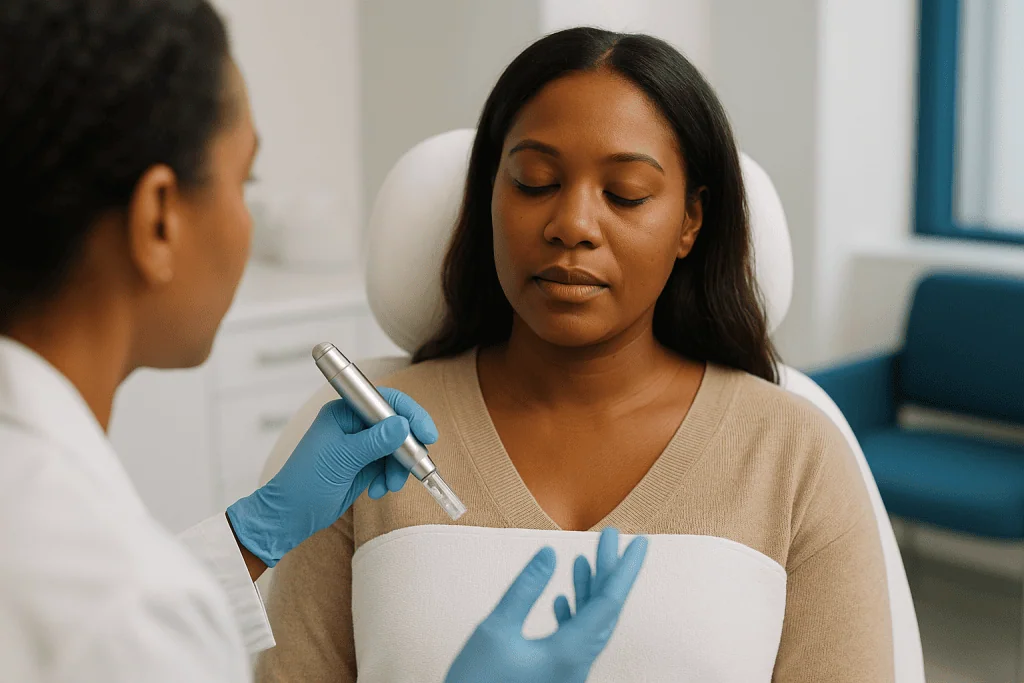
Skin needling, usually called microneedling, is a procedure in which a device studded with very fine, short needles is passed over the skin to create thousands of tiny, controlled punctures. The device may be a hand-held roller or a motorized pen with a cartridge of needles that moves up and down many times a second. Nothing is injected and nothing is removed; the entire effect comes from the injury itself.
That sounds counterintuitive, so it helps to picture the layers. The epidermis is the thin outer sheet of skin that holds your pigment-producing cells. Beneath it sits the dermis, the thicker layer of collagen and elastin that gives skin its structure. Each needle puncture passes through the epidermis and nicks the dermis, and the body responds the way it does to any small wound: it sends in inflammatory cells, lays down fresh collagen and remodels the area over the following weeks. Cleveland Clinic describes this as the core mechanism, and it is why the technique is sometimes called collagen induction therapy.
Because the punctures are narrow and the surface between them stays intact, the skin barrier recovers quickly. There is no sheet of skin peeled away, as with a deeper chemical peel, and no heat delivered into tissue, as with an ablative laser. Those two facts matter enormously for darker skin, and they come up again and again in this article.
What a session looks like in the room is fairly ordinary. A numbing cream is applied and left to work. The clinician cleans the skin, sets the needle depth for the area being treated, and moves the device across the face in overlapping passes. Pinpoint bleeding is expected. The whole treatment portion is typically measured in minutes rather than hours, with most of the appointment spent on preparation and aftercare instructions.
Why does microneedling for dark skin need a different plan?
The answer sits in a single cell type. Melanocytes are the cells in the epidermis that make melanin, the pigment that gives skin its color. In darker skin, melanocytes are not more numerous, but they are more active and they package pigment into larger, more durable granules. Those same cells are also more reactive to inflammation. When the skin is injured, they can respond by overproducing pigment, which is how a scrape, a pimple or a burn on deeper skin so often leaves a brown mark that outlasts the original injury by months.
Dermatologists describe skin tone using the Fitzpatrick scale, a six-step classification based on how skin responds to sun exposure, from type I (always burns, never tans) to type VI (deeply pigmented, never burns). Types IV through VI are the groups where post-inflammatory pigment changes are most common. Cleveland Clinic lists darker skin as a known risk factor for hyperpigmentation after injury or inflammation of any kind.
Microneedling is, by design, a controlled injury. So the question a dermatologist is really asking during a consultation is not whether the device works on darker skin. It does, and the procedure is widely used across all skin types. The question is how to provoke enough of a healing response to remodel scars or texture without tipping the melanocytes into a pigment response that undoes the benefit.
That reframing drives every adjustment covered below: the shallower default depth, the lighter pressure, the fewer passes per area, the weeks of pigment-calming preparation, and the strictness about sunscreen afterward. None of these steps is exotic. They are simply the ordinary rules of treating inflammation-prone skin, applied to a procedure that deliberately causes inflammation.
Is microneedling safe for Black skin? What the evidence actually shows
Yes, with the right technique, and this is one of the better-supported claims in facial aesthetics for darker skin. The reason is mechanical rather than magical. Many energy-based treatments work by sending light or heat that is absorbed by a target in the skin; melanin absorbs a great deal of that energy, which is why some lasers carry a higher risk of burns, blistering and lasting pigment change in deeper skin tones. Microneedling delivers no light and no heat. The needles are indifferent to color.
Published reviews of microneedling in skin of color, indexed in the NIH PubMed database, have reported its use for acne scarring, enlarged pores, melasma and general texture in Fitzpatrick types IV to VI, with post-inflammatory hyperpigmentation appearing as the most frequently reported adverse effect and usually described as temporary. That is the honest summary: the procedure is considered appropriate for Black, South Asian, East Asian, Hispanic, Middle Eastern and mixed-heritage skin, and the dominant risk is a pigment change that tends to settle over time but can take months to do so.
What the evidence does not support is a blanket promise. Study sizes in this area are often small, follow-up periods vary, and the technique differs between devices and operators. No reputable source quotes a guaranteed improvement figure for darker skin, and this article will not either.
Two practical points follow. First, the operator’s experience with deeper skin tones matters more than the device brand, because judgment about depth and endpoints is where safety lives. Second, “safe” is always conditional on the preparation and aftercare described later. A session performed well on unprimed, sun-exposed skin can still produce the very marks a patient hoped to erase.
Microneedling hyperpigmentation risk: why PIH is the complication everyone plans around
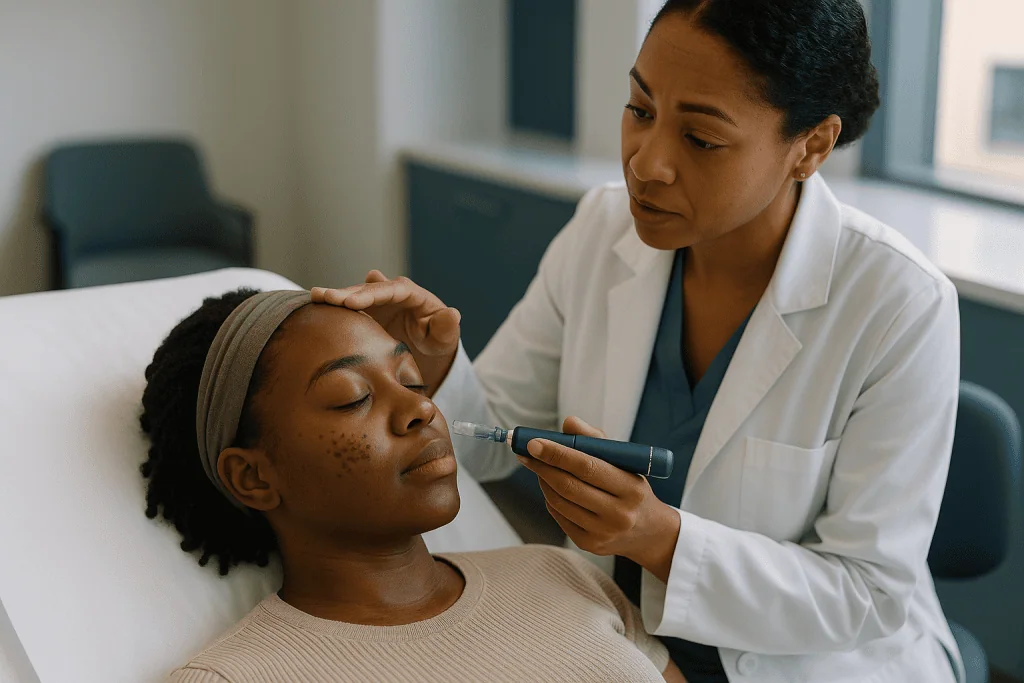
Post-inflammatory hyperpigmentation, usually shortened to PIH, is the darkening of skin that develops after any injury or inflammation has healed. It is not a scar. The skin’s structure is intact; the color has simply changed because melanocytes released extra pigment into the surrounding cells during the healing phase. On lighter skin, this often looks pink or faintly tan and fades quickly. On darker skin, it can be distinctly brown, gray-brown or almost black, and Cleveland Clinic notes it can persist for months and in some cases longer, particularly when pigment has dropped into the deeper dermis where the body clears it slowly.
Microneedling creates the exact conditions that trigger PIH: inflammation, barrier disruption and, in the days afterward, skin that is temporarily more vulnerable to ultraviolet light. Several factors raise the odds further:
- Deeper needle settings or heavier pressure than the skin needs.
- Repeated passes over the same area, which multiplies the inflammatory load.
- Treating skin that is already inflamed, for example active acne or recent sunburn.
- Sun exposure in the weeks before or after a session.
- Skipping the pigment-calming preparation described in the next sections.
- Picking at the fine crusts that can form, which reopens healing punctures.
There is a second, rarer pigment problem in the opposite direction. Hypopigmentation is a loss of color, leaving patches lighter than the surrounding skin. It is more often associated with heat-based treatments than with plain needling, but any excessive injury can cause it, and lighter patches on dark skin are harder to disguise and slower to recover than dark ones. This is part of why dermatologists treat “more aggressive” as a risk, not a bonus, on deeper skin tones.
The practical lesson is that PIH risk is manageable, but only before the fact. Once a patch appears, the options are slower: time, strict photoprotection and, where a clinician judges it appropriate, topical agents that slow pigment production.
Why do dermatologists adjust needle depth on darker skin tones?
Needle depth is the main dial a clinician can turn, and it is set in millimeters. Devices allow the needles to be shortened or lengthened, and consumer summaries such as Cleveland Clinic’s describe needle lengths ranging from fractions of a millimeter to a few millimeters depending on the goal. The deeper the needle, the deeper the wound, the greater the collagen response and, inevitably, the greater the inflammation.
On darker skin, that trade-off is weighed differently. A clinician treating a lighter-skinned patient with deep boxcar acne scars may choose a more aggressive setting because the pigment risk is modest. For a patient with Fitzpatrick type V skin and the same scars, many dermatologists will begin with a more conservative depth, observe how the skin responds over a full healing cycle, and only then consider going deeper at a later session. The first treatment doubles as a test of the skin’s tendency to pigment.
Depth is not the only variable. Dermatologists also adjust:
- Pressure. Lighter hand pressure reduces the chance of needles dragging and creating linear micro-tears rather than clean punctures.
- Number of passes. Fewer overlapping passes over any one region limits cumulative trauma.
- Treatment endpoint. On lighter skin, uniform pinpoint bleeding is a common stopping sign. On deeper tones, many clinicians stop at an earlier, gentler endpoint.
- Area-by-area settings. Thin skin around the eyes and over bony areas is treated more shallowly than the cheeks.
There is a cost to caution: shallower, gentler sessions may mean more sessions to reach the same textural result, and some scars may improve less than they would with an aggressive approach. Dermatologists generally judge that a slower, pigment-safe path is the better bargain, because a brown patch across the cheek is harder to live with than a scar that improved slightly less. Your clinician will explain where they have set that balance for your skin.
What does pre-treatment involve before the first session?
This is the step that separated the two phone calls in the opening story. Pre-treatment, sometimes called priming, means spending a period of weeks before the first session calming the skin and quieting the melanocytes so they are less likely to overreact to the needles. It is routine in dermatology before chemical peels and laser on darker skin, and most clinicians apply the same logic to microneedling.
Priming typically includes several elements, all directed by the treating clinician:
- Daily broad-spectrum sunscreen. Ultraviolet light is the strongest external trigger for pigment production. The NHS recommends a broad-spectrum product with a high SPF and reapplication when outdoors, and clinicians generally want this habit established well before treatment, not started the day after.
- Topical agents that slow pigment production. A clinician may prescribe or recommend a tyrosinase inhibitor, which is a topical medicine that blocks the enzyme melanocytes use to make melanin. Hydroquinone is the best-known example; azelaic acid and some vitamin C preparations work on related pathways. These are mentioned here for mechanism only, and whether any of them suits you, and for how long, is a decision for your prescribing clinician.
- Topical retinoids. Vitamin A derivatives speed up cell turnover and can help pigment clear, but they also make skin more fragile, so clinicians commonly ask patients to pause them for a few days before and after needling.
- Treating active inflammation first. Active acne, eczema flares or irritated skin raise PIH risk and are usually settled before a session is booked.
Priming also has a diagnostic role. If a patient’s skin pigments easily even in response to a mild topical irritation during the priming period, that tells the clinician to be more conservative with depth, or occasionally to suggest an alternative. Think of pre-treatment as the rehearsal that reveals how the skin will perform on the night.
Microneedling vs laser for dark skin: how do the options compare?
Patients rarely arrive asking about microneedling alone. They want to know why a friend had laser, whether a peel would be faster, or if a serum could do the job. The table below summarizes how the common options for texture, scarring and uneven tone differ on deeper skin tones. It is a general comparison drawn from mainstream clinical guidance, not a ranking, and the right choice depends on the specific concern, the skin’s history and the clinician’s assessment.
| Option | How it works | Main consideration on darker skin |
|---|---|---|
| Microneedling | Mechanical micro-punctures trigger collagen remodeling; no heat or light | PIH is the main risk; managed with shallower depth, priming and sun protection |
| Radiofrequency microneedling | Needles deliver heat into the dermis to tighten and remodel | Added heat raises pigment risk; insulated needles and conservative energy are commonly used |
| Ablative lasers | Remove or vaporize the outer skin layers with light energy | Melanin absorbs energy strongly; higher risk of burns and lasting pigment change |
| Non-ablative fractional lasers | Heat columns in the dermis without removing the surface | Lower risk than ablative, but still requires pigment-aware settings |
| Superficial chemical peels | Acids loosen the outer layers to promote renewal | Light peels are widely used on dark skin; deeper peels carry significant pigment risk |
| Topical treatment alone | Retinoids, pigment inhibitors, sunscreen | Lowest risk; slower and limited for established scars |
The pattern is clear enough. Treatments that work through heat or light carry more pigment risk as skin gets darker, which is why microneedling and light peels are so often where a dermatologist starts. Cleveland Clinic notes microneedling may be considered for people with darker skin tones where certain lasers carry greater risk. That is a statement about relative risk, not a promise of superior results, and for some scar types a carefully set laser remains a reasonable option in experienced hands.
Who is microneedling for dark skin usually offered to, and who is asked to wait?
The typical candidate is an adult with a textural concern: atrophic acne scars, which are the indented kind; enlarged pores; fine lines; stretch marks; or uneven surface tone. Microneedling is also used in melasma, the patchy brown facial pigmentation MedlinePlus describes as common in women and linked to hormones and sun, usually alongside topical treatment rather than instead of it. In each case the goal is remodeling of the skin’s structure, which the needles can influence, rather than erasing color, which they cannot do on their own.
A dermatologist will usually ask someone to wait, or to consider a different path, in several situations:
- Active skin infection or inflammation in the treatment area, including active acne, cold sores, eczema flares or rosacea flares. Needling inflamed skin raises both infection and PIH risk.
- A history of keloids or hypertrophic scars. Keloids are raised, overgrown scars that extend beyond the original wound. Mayo Clinic notes they are more common in people with Black, Asian or Hispanic heritage. Because needling is a wound, a strong keloid tendency is a reason for real caution.
- Recent oral isotretinoin. This acne medicine affects wound healing, and clinicians typically ask for a waiting period after a course before any resurfacing procedure. The interval is set by the prescriber.
- Recent sunburn or a tan, both of which signal recently stimulated melanocytes.
- Pregnancy or breastfeeding, mainly because the topical priming agents and numbing creams are not well studied in these groups.
- Bleeding disorders or anticoagulant use, where pinpoint bleeding may be harder to control; the prescribing clinician weighs this.
- Unrealistic expectations, particularly a belief that one session will remove scars or that the procedure lightens skin tone overall. It does neither.
Being asked to wait is not a rejection. More often it means the clinician wants a flare settled, a priming period completed, or a medication interval respected, so that the first session has the best chance of healing cleanly.
RF microneedling on dark skin: who should avoid it?
Radiofrequency microneedling, usually shortened to RF microneedling, uses the same needles as the standard procedure but passes an electrical current through them to heat the dermis directly. The heat is intended to tighten tissue and stimulate more collagen than needling alone. For patients with laxity or deeper scars, that extra effect is the appeal. For patients with darker skin, the heat is also the catch.
Heat is an inflammatory trigger in its own right, and it reaches the epidermis as well as the dermis. Many RF devices address this with insulated needles, which deliver energy only from the tip so the pigmented upper layers are heated less, and clinicians typically use lower energy settings on deeper skin tones. Even so, published case reports in the medical literature describe pigment changes and, less commonly, small burns or textural marks after RF needling, and the risk is generally regarded as higher than with plain needling on dark skin.
Dermatologists usually advise against RF microneedling, or at least counsel much greater caution, in the following groups:
- People with a strong personal history of PIH or keloids, where any additional inflammatory load is unwelcome.
- Anyone with active infection, inflammation or sunburn in the area.
- People with implanted electronic devices such as pacemakers or defibrillators, because radiofrequency current can interfere with them; the cardiology team’s view is essential.
- People with metal implants in the treatment field, depending on device guidance.
- Those who are pregnant, for the same reasons that apply to standard needling.
- People with poorly controlled diabetes or other conditions that impair wound healing.
Whether RF offers enough extra benefit to justify the extra pigment risk on a particular patient’s skin is precisely the kind of judgment the treating clinician makes, often after seeing how the skin handled plain needling first. Asking that question directly, and asking what settings and needle type the clinician uses for deeper skin tones, is a reasonable part of the consultation.
What do the days and weeks after a session usually look like?
The first thing many patients notice is that redness reads differently on darker skin. Rather than the bright pink that lighter skin shows, the treated area may look deeper, dusky or slightly purple-brown, and it can be harder to tell at a glance whether the skin is simply healing or starting to pigment. This is normal, and it is one reason clinicians give specific timelines rather than telling patients to watch for “redness.”
Cleveland Clinic describes a typical course along these lines:
- First day or two: the skin feels warm, tight and sensitive, much like a mild sunburn. Pinpoint crusts may form where the needles entered. Swelling is usually mild.
- Days three to five: warmth fades and the surface can feel dry or faintly rough as the micro-crusts shed. Flaking is common. Picking or scrubbing is the single most avoidable cause of problems in this window.
- The following weeks: the skin looks settled, but the real work is happening underneath, as new collagen is laid down and remodeled. Textural change is gradual and is generally judged after a series of sessions rather than after one.
Aftercare on darker skin is stricter than the general version. Broad-spectrum sunscreen every morning is non-negotiable, and clinicians often ask patients to stay out of direct sun entirely for the first week or more. Active ingredients such as retinoids, exfoliating acids and the pigment inhibitors used for priming are usually paused for a few days and then restarted on the clinician’s instruction. Gentle cleansing, a bland moisturizer and no makeup for the first day are typical requests.
Sessions are usually spaced several weeks apart to let one healing cycle finish before the next begins; the exact interval and number of sessions are set by the clinician based on the concern and on how the skin responded last time. A patient whose skin stayed even after the first session may be offered a modestly deeper second one. A patient who developed a faint patch will likely have the plan slowed down instead.
Does microneedling age you faster?
No mainstream evidence supports the idea that properly performed microneedling accelerates skin aging, and the mechanism argues the other way. The procedure is used precisely because controlled dermal injury stimulates new collagen, and loss of collagen is one of the central features of skin aging. Cleveland Clinic describes fine lines and texture among the common reasons people seek the treatment.
Where does the worry come from? Three places, and each contains a grain of truth worth separating from the myth.
The first is overtreatment. Skin that is needled too deeply, too often, or without enough recovery time between sessions is being asked to heal constantly, and chronic inflammation is genuinely damaging to skin over time. That is an argument for conservative settings and sensible intervals, not against the procedure. It also reinforces why dermatologists treating darker skin resist the temptation to go aggressive.
The second is sun exposure during recovery. Freshly needled skin has a temporarily weakened barrier, and ultraviolet light during that period does real damage, including pigment and, over the long run, the collagen breakdown that drives photoaging. Someone who needles their skin and then spends the weekend outdoors without protection may well end up with skin that looks worse, but the sun did that, not the needles.
The third is the appearance in the first week. Dryness, flaking and a dusky tone can make skin look temporarily older, and on darker skin that phase is more visible. It resolves as the barrier recovers.
What the evidence does not show is a long-term benefit guaranteed for everyone. Collagen gains after needling are modest, build over several sessions, and are not permanent in the sense of stopping the normal aging process. A clinician will describe realistic expectations: smoother texture and softer lines in many people, maintained with occasional sessions, rather than a reversal of age.
What people often get wrong about microneedling on darker skin
The online conversation about microneedling for Black and brown skin swings between two extremes: either it is dangerous and should be avoided, or it works for everyone and the only variable is finding a good deal. Both are wrong, and the most common specific misunderstandings deserve a direct correction.
“Dark skin can’t be microneedled.” It can, and it is one of the resurfacing options dermatologists reach for first on deeper skin tones because it uses no heat or light. The caveat is technique, not eligibility.
“Deeper needles mean better results.” Deeper needles mean more inflammation. On darker skin, that translates into more pigment risk with no guarantee of proportionally better remodeling. Dermatologists increasingly favor a staged approach, starting shallow and adjusting.
“Microneedling will lighten my skin or remove dark spots.” The needles do not remove pigment. In melasma and PIH, needling is sometimes used alongside topical pigment inhibitors, possibly by helping them penetrate, but on its own it can worsen dark patches rather than clear them.
“Numbing cream means it’s a light treatment.” Numbing addresses comfort; it says nothing about depth or risk. Patients sometimes assume a painless session must have been gentle. The settings, not the sensation, determine the inflammatory load.
“If I don’t see pink, it didn’t work.” On darker skin, post-treatment redness often looks dusky or brown rather than pink. Judging a session by color is unreliable; the clinician’s endpoint during treatment is what matters.
“One session is enough.” Consumer guidance from Cleveland Clinic and others consistently describes a series of sessions. On darker skin the series may be longer because each session is gentler.
“Any aesthetician can do it.” Regulations on who may perform microneedling vary by place. More important than title is experience with Fitzpatrick types IV to VI, a clear plan for priming, and a protocol for what happens if pigment appears. Those are reasonable questions to ask anyone, regardless of credential.
At-home dermarollers: why the stakes are different on deeper skin tones
Home rollers are inexpensive, widely sold and heavily promoted, and the question of whether they are a reasonable shortcut comes up in nearly every consultation. The honest answer is that home devices and professional treatment are not the same procedure, and on darker skin the differences cut in a specific direction.
Most home rollers use very short needles that barely pass the outer epidermis. Cleveland Clinic notes that these devices generally cannot reach the depth needed for meaningful collagen remodeling, so their benefit, if any, is limited to a temporary boost in the absorption of skincare products. That ceiling matters: a patient hoping to soften acne scars with a home roller is unlikely to get there, however diligent they are.
The risks, on the other hand, are not scaled down as neatly as the benefit. Several problems are more likely at home than in a clinic:
- Infection. Rollers are hard to sterilize properly, and reused rollers can introduce bacteria into freshly opened skin. Cleveland Clinic highlights infection as a particular concern with home use.
- Dragging and micro-tears. A roller’s needles enter at an angle and exit at an angle, creating small tears rather than clean punctures, especially with uneven pressure. Tears mean more inflammation, which on dark skin means more PIH risk.
- Overuse. Without a clinician setting intervals, it is easy to roll too often and keep the skin in a state of low-grade inflammation.
- Driving the wrong products in. Rolling before applying an unsuitable serum, an exfoliating acid or a product with fragrance can cause irritant reactions that would not happen on intact skin, and irritation on deeper tones tends to leave marks.
- No priming, no plan. The pre-treatment steps that protect darker skin in a clinic setting are usually skipped entirely at home.
None of this makes home rolling catastrophic for most people. It does mean that for someone with pigment-prone skin, the realistic trade is a small chance of benefit against a meaningful chance of marks. If you are using or considering a home device, mentioning it at your consultation lets the clinician factor it into the plan and advise on hygiene and frequency.
Questions to ask your care team
A good consultation is a two-way exchange, and patients with darker skin have a particular interest in making sure the plan has been built around their skin rather than adapted from a default. The questions below are not a test for the clinician; they are prompts that tend to surface the information that matters most.
- What Fitzpatrick type do you consider my skin, and how does that change your settings?
- How much of your microneedling work is on skin types IV to VI, and what has your experience with pigment changes been?
- What needle depth and how many passes do you plan for my first session, and why?
- What priming do you want me to do before the first session, for how long, and which products should I pause beforehand?
- Are any of the topical agents you are suggesting prescription medicines, and what should I know about using them?
- Is the concern I have, whether scars, pores or pigmentation, one that microneedling realistically addresses, or would a different approach suit it better?
- If you are offering radiofrequency microneedling, what needle type and energy do you use on darker skin, and why do you think the extra heat is worth it in my case?
- What does normal healing look like on my skin tone, and what would make you want to see me sooner?
- If I develop a dark patch after a session, what is your plan for managing it?
- How many sessions do you anticipate, how far apart, and at what point would you reassess whether to continue?
- What is your policy on treating me if I have had recent sun exposure or a flare of acne or eczema?
- Is there anything in my medical history, including medicines, keloid tendency or bleeding issues, that changes the plan?
Write the answers down. The value of these questions is partly in the answers themselves and partly in watching how the clinician responds: a thoughtful, specific reply about priming and depth is a reassuring sign that darker skin is a routine part of their practice rather than an afterthought.
When to call your doctor
Most of what happens after microneedling is expected and resolves on its own: warmth, tightness, dusky redness, mild swelling and a few days of flaking. The signs below are different. They are not emergencies in most cases, but they are reasons to contact the clinician who treated you, or your doctor, rather than waiting to see what happens.
- Signs of infection: increasing pain, spreading redness or warmth, swelling that worsens after the second day, pus, yellow crusting, or a fever. Freshly needled skin is a potential entry point for bacteria.
- A cluster of small blisters, especially around the mouth or nose, which may indicate reactivation of the cold sore virus, something clinicians try to prevent in people with a history of it.
- Dark patches that are new, spreading or deepening beyond the first few days, particularly if they follow the pattern of the treatment passes. Early review allows the clinician to adjust the plan and, where appropriate, start managing pigment sooner.
- Light or white patches appearing in the treated area, which may signal pigment loss and warrant prompt assessment.
- Raised, thickened or itchy scarring developing in the weeks after a session. Mayo Clinic notes keloids can take months to form, so this deserves attention even if it appears late.
- Persistent lines, grid marks or texture changes that do not fade with the rest of the redness.
- A widespread rash, facial swelling, hives, or difficulty breathing after a numbing cream or aftercare product, which may indicate an allergic reaction. Breathing difficulty or swelling of the lips, tongue or throat is a medical emergency and needs urgent care.
When in doubt, a photograph in natural light sent to your care team is often enough for them to tell you whether what you see is routine healing on darker skin or something they want to look at. Every judgment about the next step, whether that is reassurance, a prescription, a pause in the series or a change of approach, belongs with the clinician who knows your skin and your history.
Frequently asked questions
Is microneedling safe for African American skin?
Microneedling is widely used on African American and other deeply pigmented skin and is often chosen because it does not rely on heat or light, which melanin absorbs. The main risk is post-inflammatory hyperpigmentation, so clinicians typically use shallower depths, fewer passes, pigment-calming preparation and strict sun protection. Safety depends on technique and aftercare, and suitability is assessed individually by the treating clinician.
Does microneedling age you faster?
No mainstream evidence suggests properly performed microneedling speeds up skin aging; it is used because controlled injury stimulates collagen, which declines with age. Problems arise from overtreatment, inadequate recovery between sessions, or sun exposure while the skin barrier is healing, all of which cause inflammation and photodamage. Conservative settings, sensible intervals and daily sunscreen are the safeguards, and results are gradual rather than dramatic.
Who should avoid RF microneedling?
Radiofrequency microneedling is generally avoided in people with implanted electronic devices such as pacemakers, active skin infection or inflammation, recent sunburn, pregnancy, poorly controlled conditions that impair healing, and a strong history of keloids or post-inflammatory hyperpigmentation. On darker skin the added heat raises pigment risk, so clinicians often prefer plain needling first and decide about radiofrequency case by case.
What is skin needling on the face?
Skin needling, or microneedling, is a procedure in which a roller or motorized pen with very fine needles creates thousands of tiny controlled punctures in the skin. The body responds by producing new collagen and remodeling the area, which can soften acne scars, enlarged pores and fine lines over a series of sessions. Nothing is injected or removed; the effect comes from the healing response itself.
Is microneedling safe for Black skin with acne scars?
Microneedling is one of the standard options dermatologists consider for indented acne scars on Black skin, provided active acne has been settled first. Because the procedure causes inflammation, clinicians usually prime the skin beforehand, begin with conservative depth and build gradually across several sessions. Deep scars may improve more slowly with this cautious approach, but the trade-off reduces the risk of new dark marks.
What is the microneedling hyperpigmentation risk on darker skin?
Post-inflammatory hyperpigmentation is the most commonly reported side effect of microneedling in skin of color. It appears as brown or gray-brown patches after healing and usually fades over time, though it can take months. Risk rises with deeper settings, repeated passes, treating inflamed skin, sun exposure and skipping preparation. Priming, conservative technique and diligent sunscreen are the main ways clinicians reduce it.
Microneedling vs laser for dark skin: which is lower risk?
Plain microneedling is generally regarded as lower risk than ablative lasers on darker skin because it uses no light energy for melanin to absorb. Non-ablative fractional lasers and radiofrequency devices sit between the two, depending on settings and operator experience. None is risk-free, and for some scar types a carefully set laser remains reasonable. The treating clinician weighs the specific concern against the skin’s pigment history.
Can RF microneedling be done on dark skin at all?
Radiofrequency microneedling can be performed on darker skin, and many devices use insulated needles so heat is delivered deeper in the dermis and away from the pigmented upper layers. Clinicians typically use lower energy and conservative passes. The pigment risk is still considered higher than with plain needling, so whether the extra tightening effect justifies it is a judgment made per patient.
How long do dark marks after microneedling last?
Post-inflammatory hyperpigmentation after microneedling usually settles gradually, and consumer guidance notes that such marks can take months to fade, longer when pigment has dropped into the deeper dermis. Strict daily sun protection and, where a clinician advises, topical agents that slow pigment production can support clearance. Any new or spreading patch should be reviewed by the treating clinician rather than waited out.
Should I use a home dermaroller if I have darker skin?
Home rollers use very short needles that generally cannot reach the depth needed for collagen remodeling, so their benefit is limited, while risks such as infection from poorly sterilized devices, micro-tears from rolling and overuse remain. On pigment-prone skin those risks translate into dark marks. If you use one, mention it at your consultation so the clinician can advise on hygiene and frequency.
References
- Cleveland Clinic: Microneedling
- Cleveland Clinic: Hyperpigmentation
- NHS: Scars
- NHS: Sunscreen and sun safety
This article is for general information only and is not a substitute for professional medical advice. Please consult a qualified doctor about your individual situation.
Add us as a Preferred Source to see more of our trusted health content across Google Search, AI Overviews and Discover.

More from the Blog

Reconstructive Surgery Abroad: Stay Length, Follow-Up and Flying Home Safely
After reconstructive surgery abroad, travel-health guidance advises staying near the operating team until wounds have been checked and any drains removed: often about a…

Cryotherapy for Children: Comfort, Preparation and Which Lesions Are Treated This Way
Cryotherapy for children is the controlled freezing of a skin lesion, usually with liquid nitrogen, to destroy wart tissue and trigger an immune response.…

Laser Resurfacing Recovery Timeline: Swelling, Peeling, Crusting and the Return of Makeup
After ablative laser resurfacing, the treated skin is typically raw, swollen and weeping for the first few days, then peels and crusts as new…
How a Carbon Peel Session Works: The Carbon Layer, the Laser Pass and the Feeling of Warmth
A carbon laser peel works in two steps. A thin layer of liquid carbon is painted onto cleansed skin, left to dry and settle…

The First Day After Masseter Botox: Why You Avoid Rubbing, Saunas and Lying Face Down
On the first day after masseter Botox, clinicians usually ask you to avoid rubbing or massaging the jaw, saunas and other strong heat, and…
Who Is a Candidate for Plexr Eyelid Tightening and Why Isotretinoin Use Changes the Plan
Plasma eyelid tightening, often searched as Plexr, usually suits adults with mild to moderate loose skin on the upper or lower eyelids, realistic expectations…