

Monsplasty Recovery: Swelling, Compression and When Normal Activity Can Resume

Key Takeaways
- Cleveland Clinic frames monsplasty recovery as roughly one to two weeks to desk work and four to six weeks to strenuous activity, with swelling settling over weeks to months.
- The mons pubis swells more than most surgical sites because gravity drains fluid downward into loose fatty tissue, so day three often looks worse than day one.
- A compression garment manages fluid and holds tightened tissue in place; it should feel firm, not painful, and is typically worn continuously for the first weeks.
- Monsplasty is not a tummy tuck: it addresses only the pubic mound and does not repair abdominal muscles, which is why its stand-alone recovery is lighter.
- Scars look their worst between one and three months, then fade over a year; sun protection and avoiding tension on the incision are the two interventions with the clearest rationale.
- Removed skin and fat do not return, but weight gain, pregnancy and aging can change the remaining tissue, so results are described as long-lasting rather than permanent.
Monsplasty recovery time is usually measured in weeks, not days. Most people are up and walking the same day, back to a desk job within about one to two weeks, and cleared for strenuous exercise after roughly four to six weeks, according to Cleveland Clinic. Swelling in the pubic area settles slowly over weeks to a few months, so the final contour is typically judged closer to six months to a year.
The garment arrives folded in a plastic sleeve, looks like a pair of cycling shorts made of something far less forgiving, and comes with an instruction most people did not expect: wear this around the clock. That small moment, standing in the kitchen holding the compression shorts, is often when the real question lands. Not whether to have the operation, but what the weeks after it actually feel like.
Monsplasty recovery time is a search people run late at night, usually after a consultation that covered the surgery in detail and the aftermath in a sentence. The pubic mound is an awkward place to heal. It swells more than you would think, it sits exactly where waistbands and seatbelts press, and it moves every time you sit, stand, or walk to the bathroom.
This explainer covers what the published patient guidance actually says about the timeline, why the swelling behaves the way it does, what the compression garment is doing, and how surgeons typically stage the return to normal life.
What actually happens during a monsplasty
A monsplasty is an operation that removes excess skin and fatty tissue from the mons pubis, the soft, rounded mound of tissue that sits over the pubic bone just above the genitals. Surgeons sometimes call it a pubic lift, because the goal is to flatten and lift an area that has stretched or sagged, most often after significant weight loss, pregnancy, or with age.
The procedure is usually done under general anesthesia or local anesthesia with sedation, and Cleveland Clinic describes it as an outpatient operation in most cases, meaning you go home the same day. The surgeon makes a horizontal incision low on the mons, typically positioned so that it hides within the natural crease or beneath underwear. Through that incision, loose skin is trimmed, excess fat is removed either directly or with liposuction, and the remaining tissue is tightened and anchored to deeper structures so it does not simply slide back down.
Liposuction alone, without removing skin, is a related option for people whose main concern is fullness rather than sagging. It uses a thin hollow tube, called a cannula, to suction out fat through very small punctures. The trade-off is that liposuction cannot tighten skin that has already lost its elasticity, which is why many people with loose tissue are offered excision instead.
Monsplasty is frequently performed at the same time as a tummy tuck, because the incisions can be joined and the whole lower abdomen contoured in one operation. When it is done alone, the surgery is shorter and the recovery typically lighter, though the pubic area still swells generously and still needs time.
Stitches are often dissolvable. Some surgeons place a small drain for a few days to remove fluid; others rely on compression alone. Either way, you leave the operating room with a dressing, a garment, and a set of instructions that shape the next six weeks.
Monsplasty recovery time: what the first six weeks usually look like
Published patient guidance from Cleveland Clinic frames monsplasty recovery in broad phases rather than exact dates, and that is the honest way to read it. Your surgeon’s plan will be tuned to how much tissue was removed, whether liposuction was added, and whether a tummy tuck was done at the same time.
| Phase | What is typical | What usually helps |
|---|---|---|
| Days 1 to 3 | Peak soreness, tightness and early swelling; short walks around the house | Compression garment, resting semi-reclined, prescribed pain plan |
| Days 4 to 14 | Swelling often at its most visible; bruising may spread into the thighs or labia; many return to desk work by the end of this window | Continued garment wear, loose clothing, avoiding bending and lifting |
| Weeks 2 to 6 | Steady easing of swelling; incision closing and firming; light activity expanded gradually | Scar care as instructed, gradual walking increase |
| Weeks 6 to 12 | Most cleared for strenuous exercise; residual firmness and numbness common | Return to gym under surgeon’s guidance |
| Months 3 to 12 | Final contour emerges as deep swelling resolves; scar softens and fades | Patience; scar protection from sun |
Cleveland Clinic notes that most people return to work within about one to two weeks and are asked to avoid strenuous activity for around four to six weeks. NHS guidance for tummy tuck, the closest widely published comparator, gives a similar frame of roughly six weeks before full recovery.
The table describes a typical arc, not a schedule you must hit. Healing that runs a week slower than this is common and is not a sign that something has gone wrong.
Monsplasty swelling: how long it lasts and why the mons swells so much
The mons pubis swells more dramatically than almost any other cosmetic surgery site, and there is a straightforward anatomical reason. The tissue here is loose, fatty, and sits at the lowest point of the trunk when you are upright. Fluid that leaks from disturbed small blood vessels and lymphatic channels during surgery drains downhill, and downhill is exactly where the mons sits. Gravity, in other words, works against you for the first couple of weeks.
Lymphatic channels are the fine vessels that carry excess tissue fluid back into the circulation. Surgery interrupts some of them, and they take weeks to re-route. Until they do, fluid pools. That is why swelling often looks worse on day three or four than it did leaving the recovery room, and why it can spread into the labia or the upper thighs. Cleveland Clinic lists swelling and bruising as expected effects that settle over weeks, with some residual fullness lasting months.
The pattern is usually a rise, a plateau, and a long slow fall. The most visible swelling generally softens within a few weeks. Deeper firmness, a woody or lumpy feel under the skin, can linger for several months as the tissue remodels. NHS guidance on liposuction, which often accompanies monsplasty, warns that it can take up to six months for the area to settle fully, and that is a reasonable expectation for the mons as well.
Two things genuinely help. Wearing the compression garment as directed gives displaced fluid somewhere to go other than the mons. Walking regularly, even short laps of the house, keeps the calf and thigh muscles pumping fluid upward. Lying flat all day feels restful but tends to leave the swelling exactly where it is.
Uneven swelling, with one side fuller than the other, is common early and usually evens out. A sudden increase in one area, especially with tightness or warmth, is a different matter and belongs in the red-flag section below.
How painful is monsplasty recovery?
Most people describe the first few days as tight, sore and bruised rather than sharply painful, and the sensation changes with movement. Sitting up from lying down, standing from a chair, and the first steps after resting tend to pull on the incision line. Once you are up and walking, it usually eases. Coughing, sneezing and laughing are the moments people remember, because the mons sits directly over muscles that tense during those actions.

Pain is typically at its worst in the first 48 to 72 hours and then steps down noticeably over the first week. Surgeons commonly send people home with a short course of prescription pain relief for the first days, then transition to over-the-counter options. The choice, the duration and the switch-over are decisions for your prescribing clinician, who knows your medical history and what else you take.
Numbness is at least as common as pain. Small sensory nerves in the skin are cut or stretched during surgery, and the mons and upper labia can feel wooden, tingly or oddly absent for weeks to months. Cleveland Clinic describes numbness as an expected effect that usually improves as nerves recover, though a small patch of permanent altered sensation is possible.
Where does monsplasty sit on the scale of plastic surgery recoveries? When performed alone, it is generally considered one of the lighter recoveries. It does not tighten abdominal muscles the way a full tummy tuck does, and it is that muscle repair, not the skin work, that drives the most demanding recoveries. Surgeons and patients frequently rank full abdominoplasty and combined body-lift procedures among the hardest cosmetic recoveries, because every breath and every change of position uses the repaired core. A stand-alone monsplasty spares you that.
Pain that climbs after day three instead of falling, or pain concentrated on one side, is not part of the normal curve.
Monsplasty compression garment: what it does and how long you wear it
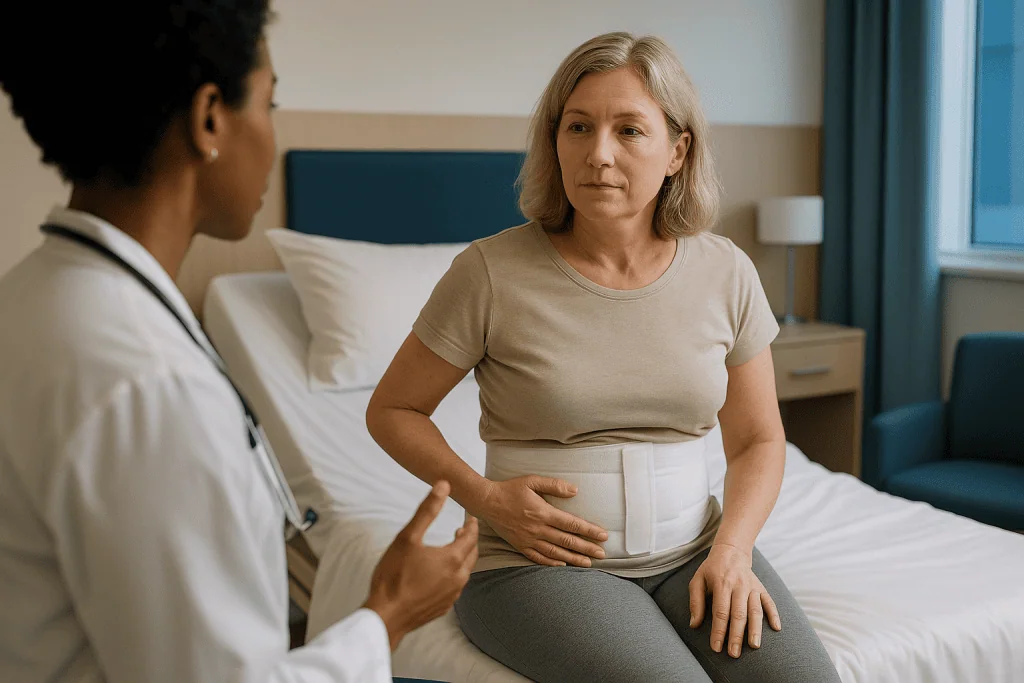
A compression garment is an elasticated, firm-fitting piece of clothing, usually shorts or a girdle, that applies steady pressure to a surgical area. After monsplasty it does three jobs at once. It limits the space into which fluid can pool, reducing swelling. It holds the freshly tightened tissue in the position the surgeon placed it while internal healing anchors it there. It also supports the incision, which makes moving around less uncomfortable.
Cleveland Clinic lists compression as a standard part of monsplasty aftercare. Typical instructions are to wear it continuously, including during sleep, for the first few weeks, removing it only to shower and to check the skin, then to step down to daytime-only wear for a further period. The exact schedule varies by surgeon and by how much liposuction was done, so follow the plan you were given rather than a general figure.
Fit matters more than brand. The garment should feel snug and supportive, not painful, and it should not dig into the groin creases or leave deep red grooves. Compression that is too tight can restrict circulation and cause skin breakdown; compression that is too loose does very little. If the garment becomes noticeably looser as swelling drops, tell your team, who may suggest moving to a smaller size.
A few practical points make the weeks easier. Wash and dry the garment as instructed, and have a second one if your surgeon permits, so one is always clean. Wear a thin cotton layer under it if the seams irritate the incision. Take it off to shower, pat the area dry, and put it back on within a short window rather than leaving it off for hours.
Compression does not speed healing in the cellular sense. It manages the environment so the healing that is happening anyway produces a smoother result.
Who monsplasty is usually for, and who is usually asked to wait
Monsplasty is most often considered by adults who have loose, sagging or bulging tissue over the pubic bone that does not change with weight or exercise. The classic situations are significant weight loss, where skin has stretched beyond its ability to snap back, and the changes that follow pregnancy or aging. Some people are bothered by how the area looks in clothing; others by practical problems such as chafing, skin irritation in the fold, or difficulty with hygiene.
Good candidates, in the language of most published guidance, are at a stable weight, do not smoke, and have no uncontrolled medical conditions that impair healing. Weight stability matters because the mons responds to weight change; a result achieved at one weight will shift if that weight changes substantially.
Several groups are typically asked to wait or to reconsider. People still actively losing weight are usually encouraged to reach a plateau first, so the surgeon is working with the final shape. Anyone planning a pregnancy is often advised to defer, because pregnancy stretches exactly this tissue. Smokers are commonly asked to stop for a period before and after surgery, since nicotine narrows small blood vessels and is strongly associated with wound-healing problems in every type of surgery. Poorly controlled diabetes, active skin infection in the area, and conditions that affect clotting all warrant a careful conversation before any date is set.
There is also a psychological dimension that responsible surgeons take seriously. The mons is an intimate area, and expectations about how it should look are shaped by images that are often not representative. A good consultation includes an honest discussion of what surgery can and cannot change and whether the concern is one that surgery addresses.
Whether you are a candidate is a decision made with your treating team, not from a checklist.
Is monsplasty a tummy tuck? Monsplasty vs tummy tuck explained
No. A monsplasty and a tummy tuck are different operations that happen to be neighbors. A tummy tuck, or abdominoplasty, removes excess skin and fat from the abdomen and usually tightens the separated abdominal muscles beneath. Mayo Clinic describes its incision as running horizontally across the lower abdomen, often from hip to hip, with a second incision around the navel when the upper abdomen is involved. A monsplasty confines itself to the pubic mound below that line and does not touch the abdominal muscles.
The confusion arises because the two are so often combined. A tummy tuck that flattens the abdomen but leaves a full or sagging mons can look unfinished, and the mons can even appear more prominent once the tissue above it is tightened. Many surgeons therefore address the mons as part of the tummy tuck plan, and the incisions merge into one line.
The recovery implications are significant. A stand-alone monsplasty is an outpatient operation with a recovery Cleveland Clinic frames as one to two weeks to desk work and four to six weeks to strenuous activity. A full tummy tuck involves muscle repair, and NHS guidance describes a recovery of up to six weeks for most daily activities, with an initial period where standing fully upright is difficult and walking is stooped. Combine them and you are following the tummy tuck timeline, not the monsplasty one.
People who search for one often need the other, or both, and sometimes neither. Someone with a modest mons bulge and firm skin may be better served by liposuction alone. Someone with significant abdominal laxity and a small mons concern may need the tummy tuck and find the mons improves as a side effect. Sorting out which tissue is actually responsible for what you see is the surgeon’s job during examination, and it is worth asking them to explain their reasoning.
Monsplasty scar healing: what the incision looks like month by month
A monsplasty scar is a horizontal line low on the pubic mound, usually within or just above the natural crease where the mons meets the genital area. Surgeons place it to sit beneath underwear and swimwear, though exact position depends on how much skin is removed. Its length is proportional to the amount of skin excised.
Scars follow a predictable biological sequence, and knowing it prevents unnecessary alarm. In the first two to three weeks the incision is closed, slightly raised and pink or red. This is inflammation doing its job: blood vessels open up to deliver the cells that lay down new collagen. From roughly one to three months the scar often looks its worst, thicker, redder and sometimes itchy, as collagen production peaks. From three months onward the scar remodels; collagen fibers reorganize, blood vessels retreat, and the line flattens and fades toward a pale, soft mark. Mayo Clinic’s guidance on tummy tuck scars applies directly: they fade considerably but never disappear entirely, and the maturation process continues for a year or more.
Care in the early weeks follows general surgical wound principles described by MedlinePlus: keep the incision clean and dry, avoid soaking it until your team clears you, watch for signs of infection, and do not pick at scabs or dissolving stitch ends. Once the incision is fully closed, many surgeons suggest gentle massage and silicone-based scar products, though evidence for topical scar treatments is modest and your team will advise what they use.
Sun protection is the intervention with the clearest rationale. Ultraviolet light darkens immature scars, and a scar that is pigmented is far more noticeable than one that is pale. The mons is rarely sun-exposed, but swimwear and beach holidays in the first year are worth planning around.
Scars widen when they are pulled. This is one more reason the lifting and bending restrictions matter in the early weeks.
When normal activity can resume: walking, driving, work, exercise and intimacy
Return to activity is staged, and each stage is really about protecting the incision and letting the internal tightening bed in. The typical framework below reflects Cleveland Clinic guidance for monsplasty and NHS guidance for comparable lower-abdominal surgery; your surgeon’s version takes priority.
- Walking begins the same day, in short indoor laps. It is the single most useful activity for reducing swelling and lowering the risk of blood clots in the legs.
- Showering is usually permitted within a day or two once dressings allow; baths, pools and hot tubs wait until the incision is fully sealed, often several weeks.
- Driving resumes when you can brake sharply without pain, are off prescription pain medicines that impair alertness, and can wear a seatbelt comfortably across the lower abdomen. For many this is around one to two weeks.
- Desk work is typically possible within one to two weeks. Jobs involving lifting, bending or prolonged standing often need closer to four to six weeks.
- Lifting is usually limited to light household items for the first several weeks. Picking up small children needs specific discussion with your surgeon.
- Strenuous exercise, including running, cycling and weight training, generally waits four to six weeks. Cycling in particular loads the mons directly and may be delayed further.
- Sexual activity is commonly deferred for four to six weeks, until the incision is fully healed and swelling has eased enough for comfort. Friction and pressure on the mons before that point risk opening the wound.
Numbness complicates the return to intimacy more than pain does. Altered sensation over the mons and upper labia can persist for months, and some people find early contact feels strange rather than painful. That usually improves as nerves recover, and it is a legitimate topic to raise with your surgeon rather than something to simply wait out silently.
None of these figures are targets. They are the ranges at which most people are cleared, and being cleared at week seven rather than week five says nothing about your final result.
Bathroom, hygiene and everyday logistics in the first two weeks
The practical questions rarely make it into consultations, yet they occupy most of the first fortnight. The incision sits centimeters from the urethra and genitals, so ordinary hygiene needs a little thought.
Urination is not affected by the surgery itself, but swelling of the mons and labia can change the direction of the stream for a few days and make wiping awkward. Patting rather than wiping, using a hand-held shower or a squeeze bottle of water for rinsing, and drying the incision gently afterwards all help. Some surgeons advise a barrier dressing over the incision during toilet use in the first days; follow what you were given.
Bowel movements deserve planning. Prescription pain medicines commonly cause constipation, and straining on the toilet tenses exactly the muscles you are trying to rest. Drinking plenty of water, eating fiber, and walking all help. If constipation becomes a problem, ask your team what they recommend rather than reaching for whatever is in the cabinet.
Clothing should be loose, soft and high-waisted or low-waisted enough to avoid a seam sitting on the incision. Many people live in the compression garment plus a long shirt or dress for two weeks. Underwear, if worn under the garment, should be cotton and seamless across the front.
Sleeping semi-reclined with pillows under the knees takes tension off the mons and is the position most surgeons suggest for the first week. Side sleeping is usually fine once it feels comfortable; stomach sleeping waits.
Menstruation during recovery is common and manageable. Pads are typically preferred over tampons in the early days simply because insertion means handling a swollen area; pads should be changed frequently to keep the incision dry. If a period is due within the first week, mention it to your team in advance.
How long will monsplasty results last?
The honest answer is that monsplasty removes tissue permanently, but the tissue that remains keeps aging and keeps responding to your weight. Skin that has been excised does not come back. The fat cells that were removed do not regenerate. What can change is the volume of the fat cells left behind and the elasticity of the remaining skin.
Mayo Clinic’s guidance on tummy tuck durability applies almost word for word to the mons: results are long-lasting provided weight stays stable, and significant weight gain or a future pregnancy can stretch the area again. The mons is unusually sensitive to weight because it is one of the body’s preferential fat storage sites for many people, particularly after weight loss when other areas have shrunk.
Aging works more slowly. Collagen and elastin in the skin decline gradually, and tissue everywhere in the body descends a little over decades. A monsplasty done at forty will still look better at sixty than the untreated mons would have, but it will not look the way it did at six months post-surgery. This is not failure; it is biology, and it is the same reason every cosmetic procedure is described as long-lasting rather than permanent.
Hormonal shifts, including menopause, can change fat distribution and skin quality and may subtly alter the area. So can substantial changes in the tissue above it; a later tummy tuck or weight loss in the abdomen can make the mons appear different by comparison even if it has not changed.
Weight stability is the variable you control. A study-grade percentage for how many people retain their result at a given number of years does not exist in the mainstream literature for monsplasty specifically, and any figure quoted to you should come with its source attached.
Risks, complications and how they shape recovery
Every operation carries risk, and describing it plainly is part of informed consent. Cleveland Clinic lists the main complications of monsplasty as bleeding, infection, poor wound healing, fluid collection under the skin, changes in sensation, asymmetry, and scarring that is wider or thicker than expected. Each of these, if it happens, extends recovery and sometimes requires further treatment.
A seroma is a pocket of clear fluid that collects under the skin where tissue was removed. It is the most common complication after liposuction and excisional body contouring and is one reason compression is used so diligently. Small seromas often resolve on their own; larger ones may need to be drained with a needle in the clinic, sometimes more than once.
A hematoma is a collection of blood rather than fluid. It typically presents early, within the first day or two, as one-sided swelling that is firm, tense and painful. It may need urgent evaluation and occasionally a return to the operating room.
Wound healing problems are more likely at the ends of the incision and in people who smoke, have diabetes, or have very tight closures. A small area that separates or takes longer to close is usually managed with dressings and patience rather than further surgery.
Blood clots in the deep veins of the legs are a risk after any surgery involving anesthesia and reduced mobility. Mayo Clinic lists one-sided calf swelling, pain, warmth and skin color change as signs of deep vein thrombosis; sudden breathlessness or chest pain can signal a clot that has traveled to the lungs and is an emergency. Early walking is the most accessible preventive measure you have.
Alternatives to surgery exist and are worth understanding. Liposuction alone suits some. Weight management changes the mons for many, though it cannot tighten stretched skin. Choosing to do nothing is always an option, and a good surgeon will say so.
What people often get wrong about monsplasty recovery time
The myths around this recovery are consistent enough to be worth naming directly.
Myth: swelling at two weeks means the surgery did not work. The mons at two weeks frequently looks fuller than it did before surgery. This is fluid, not fat, and it follows the rise-and-fall pattern described earlier. Judging the result before three months is judging a work in progress.
Myth: more compression is better. Compression that is painfully tight or leaves deep marks restricts blood flow to skin that is already healing under stress. The garment should be firm, not punishing. Doubling up garments without being told to is not a shortcut.
Myth: resting completely is the safest choice. Lying flat all day slows the fluid clearance that reduces swelling and raises the risk of leg clots. Short, frequent walks are part of the treatment, not a threat to it.
Myth: the incision should be dry and untouched for weeks. Guidance from MedlinePlus on closed surgical wounds supports gentle cleaning and showering once your team clears it. A wound kept damp under an unchanged dressing is more at risk than one that is cleaned and patted dry.
Myth: numbness means nerve damage that will not recover. Temporary numbness after skin surgery is the norm, and sensation typically returns over months as small nerves regrow. Permanent patches occur but are the exception.
Myth: the six-week clearance is when you are healed. Six weeks is when most people are strong enough for full activity. Scars mature for a year, deep firmness resolves over months, and the final shape is a six-to-twelve-month judgment.
Myth: everyone follows the same timeline. Combined procedures, liposuction volume, age, smoking status and general health all shift the curve. Compare yourself to your surgeon’s plan, not to a forum.
Questions to ask your care team before and after monsplasty
A good consultation is a two-way conversation, and the questions below tend to produce answers that genuinely change how prepared you feel. They are grouped by when they are most useful.
- Which tissue is responsible for what I see: skin, fat, or both? Would liposuction alone address it, or is excision needed?
- Will the incision be joined to a tummy tuck incision, or stand alone? Where exactly will it sit relative to underwear and swimwear?
- Will a drain be used? If so, who removes it and when?
- What is your specific compression schedule, and when do I step down from continuous wear?
- When may I shower, and when may I bathe or swim?
- What is your plan for pain relief in the first days, and what should I stop taking beforehand? Which of my current medicines or supplements affect bleeding or healing?
- How will constipation be managed if it occurs?
- What is your threshold for calling the clinic versus going to an emergency department?
- When do you expect me to return to desk work, driving, exercise, and sexual activity, given my particular plan?
- What does a seroma or hematoma look like, and how would you treat one?
- What is your approach to scar care once the incision is closed?
- How will future weight change or pregnancy affect the result?
- What follow-up visits are scheduled, and how do I reach the team after hours?
Write the answers down or ask permission to record them. The days immediately after surgery are not the moment to try to remember whether bathing was allowed at two weeks or four.
If any answer is a number, a percentage or a promise, it is reasonable to ask where it comes from. Guideline-level guidance describes ranges. Individual surgeons see their own patterns. Both are useful; neither is a guarantee.
When to call your doctor: red flags after monsplasty
Most monsplasty recoveries are uneventful, and most worries turn out to be normal healing. A short list of signs should prompt a same-day call to your surgical team, and a few warrant emergency care.
Call your team the same day if you notice increasing redness spreading from the incision, warmth over the area, pus or cloudy drainage, or a fever. CDC guidance on surgical site infection lists these as the core warning signs, and infections caught early are far easier to manage. Call as well for swelling that suddenly increases on one side, becomes tense and hard, or is accompanied by escalating pain after the third day, since this may indicate bleeding or fluid collection under the skin. An incision that opens, even partially, or bleeding that soaks through a dressing, also needs prompt review. Difficulty urinating or an inability to pass urine should not wait until morning.
Seek emergency care immediately for chest pain, sudden shortness of breath, coughing up blood, or fainting, which can indicate a blood clot that has traveled to the lungs. Pain, swelling, warmth or color change in one calf, as Mayo Clinic describes for deep vein thrombosis, requires urgent same-day assessment. Confusion, a racing heartbeat, or feeling very unwell with fever are signs of a spreading infection and are emergencies.
When in doubt, call. Surgical teams would far rather hear about ten normal recoveries than miss one complication, and a phone call at day five costs nothing. Keep the after-hours number somewhere you will find it, and make sure whoever is helping you at home knows where it is too. Every decision about what a symptom means and what to do about it belongs with the team who performed your surgery.
Frequently asked questions
How painful is monsplasty recovery?
Most people describe tightness, soreness and bruising rather than severe pain, peaking in the first two to three days and easing over the first week. Movements that tense the lower abdomen, such as sitting up, coughing or laughing, are the uncomfortable moments. Numbness over the mons is as common as pain and can last months. Your prescribing clinician decides the pain-relief plan; pain that worsens after day three warrants a call.
How long does monsplasty swelling last?
Visible swelling typically softens within a few weeks, while deeper firmness can persist for several months as tissue remodels. Cleveland Clinic describes swelling as an expected effect that settles over weeks, and NHS liposuction guidance allows up to six months for full settling. Swelling often peaks around day three to five, spreads into the labia or thighs, and may be uneven early. Compression and regular walking help fluid clear.
How long do you wear a compression garment after monsplasty?
Most surgeons ask for continuous wear, including overnight, for the first few weeks, removed only for showering, then daytime wear for a further period. The exact schedule depends on how much liposuction was done and your surgeon’s protocol, so follow your written instructions. The garment should feel supportive rather than painful; deep grooves in the skin or groin pain mean the fit needs adjusting.
Is monsplasty a tummy tuck?
No. A tummy tuck removes abdominal skin and fat and usually tightens the abdominal muscles beneath, while a monsplasty addresses only the pubic mound below and leaves muscles untouched. The two are often combined because a flattened abdomen can make an untreated mons look more prominent. Recovery differs significantly: stand-alone monsplasty is lighter, while a combined procedure follows the longer tummy tuck timeline described by NHS guidance.
What does monsplasty vs tummy tuck recovery look like side by side?
Stand-alone monsplasty is outpatient surgery with a return to desk work in about one to two weeks and strenuous activity at four to six weeks, per Cleveland Clinic. A full tummy tuck involves muscle repair, an initial period of stooped walking, and up to six weeks before most daily activities resume, per NHS guidance. Combining them means following the tummy tuck timeline rather than the shorter monsplasty one.
How long does monsplasty scar healing take?
Scars take about a year to mature. The incision is sealed within two to three weeks, looks thickest and reddest between one and three months, then flattens and fades from three months onward. Mayo Clinic notes that body-contouring scars fade considerably but never disappear completely. Keeping tension off the incision early, protecting it from sun, and following your team’s scar-care plan give the best chance of a fine, pale line.
What is the hardest plastic surgery to recover from?
Full abdominoplasty and combined body-lift procedures are generally considered among the most demanding cosmetic recoveries, because repairing the abdominal muscles means every breath, cough and change of position uses the surgical site. A stand-alone monsplasty does not involve muscle repair and is usually regarded as one of the lighter recoveries. Individual experience varies with health, the extent of surgery and whether procedures are combined.
How long will monsplasty results last?
Skin and fat that are removed do not return, so the change is permanent in that sense, but the remaining tissue continues to respond to weight change, pregnancy and aging. Mayo Clinic describes comparable body-contouring results as long-lasting when weight stays stable. The mons is a preferential fat-storage site for many people, so significant weight gain can restore fullness. No mainstream study gives a reliable percentage for result retention over time.
When can I have sex after monsplasty?
Most surgeons advise waiting around four to six weeks, until the incision is fully healed and swelling has eased enough for comfort, because pressure and friction on the mons can open the wound or worsen swelling. Numbness over the mons and upper labia may make early contact feel unusual rather than painful, and this generally improves over months as nerves recover. Ask your surgeon for clearance specific to your case.
When can I drive and go back to work after monsplasty?
Driving usually resumes when you can brake hard without pain, wear a seatbelt comfortably and are no longer taking prescription pain medicines that affect alertness, often around one to two weeks. Cleveland Clinic notes most people return to work within one to two weeks for desk roles. Jobs involving lifting, bending or long standing typically wait closer to four to six weeks. Your surgeon confirms timing at follow-up.
References
This article is for general information only and is not a substitute for professional medical advice. Please consult a qualified doctor about your individual situation.

More from the Blog

Fat Transfer Breast Augmentation: Who Is a Candidate and Who Needs Implants Instead
Fat transfer breast augmentation uses a person's own fat, harvested by liposuction and injected into the breast, and typically adds a modest amount of…

Questions to Ask Before Aesthetic Genital Surgery: Technique Choice, Scars and Follow-Up
Before aesthetic genital surgery, ask which technique the surgeon proposes and why it suits your anatomy, where the incisions and scars will sit, how…

Buttock Lift Recovery: Sitting Rules, Compression and the Weeks Until Swelling Settles
Buttock lift recovery usually means several weeks of protecting the surgical site: avoiding direct pressure on the buttocks, wearing a compression garment as directed,…

Who Is a Candidate for Lipedema Liposuction? What Surgeons Assess Beyond the Diagnosis
A candidate for lipedema surgery is usually someone with a clinically confirmed diagnosis whose pain, heaviness or reduced mobility persists despite months of conservative…

What to Expect in the Days After CoolSculpting: Tenderness, Numbness and Normal Activity
In the days after cryolipolysis, the fat-freezing procedure marketed as CoolSculpting, most people notice redness, swelling, tenderness, bruising and numbness in the treated area.…

What Happens During Body Contouring Surgery: Markings, Anesthesia and Operating Time
During body contouring surgery, the surgeon first draws the planned incisions and areas of fat removal on your skin while you stand, an anesthesia…