

Tummy Tuck Scars: Placement, Healing Stages and Realistic Long-Term Appearance
Key Takeaways
- Tummy tuck scars never disappear, but they typically mature into a thin, pale, flat line over 12 to 24 months.
- A full abdominoplasty leaves two scars, the hip-to-hip line and a circle around the repositioned navel, and the navel scar is the one a crop top actually reveals.
- Scars often look their worst around months two to six, when peak collagen production makes them redder and more raised; that phase is normal, not a failed result.
- Silicone sheets and gels have the strongest evidence of any over-the-counter option for flattening and softening scars, while vitamin E has not been shown to help and can irritate skin.
- New scar tissue pigments easily in sunlight, so a year of diligent sun protection helps prevent permanent darkening of the line.
- Keloid risk is higher in people of African, Asian, and Hispanic ancestry and in anyone with a personal or family keloid history, information a surgeon should have before the operation.
Tummy tuck scars are permanent, but they typically fade substantially over time. The main scar runs low across the abdomen from hip to hip, usually placed below the underwear line, with a second small scar around the navel. Scars look red and raised for several months, then gradually flatten and lighten, reaching their mature, pale appearance roughly one to two years after surgery.
There’s a moment, usually in a fitting room about a year out, when a woman lifts her shirt, looks down, and traces a thin silvery line just above her waistband. Not gone. Not glaring. Just there: a quiet receipt for a decision she made twelve months earlier.
That moment is worth thinking about before surgery, not after. Abdominoplasty removes a wide ellipse of skin and fat and often tightens the abdominal muscles, and there is no version of that operation without an incision long enough to do the job. What surgeons can control is where the line sits, how much tension pulls on it, and how it’s cared for while it matures. What biology controls is everything else.
So instead of the usual promises about scars “disappearing,” here is the honest version: what the scar looks like at two weeks, six months, five years, and a decade, and what the evidence says actually helps along the way.
Where exactly does the tummy tuck scar go?
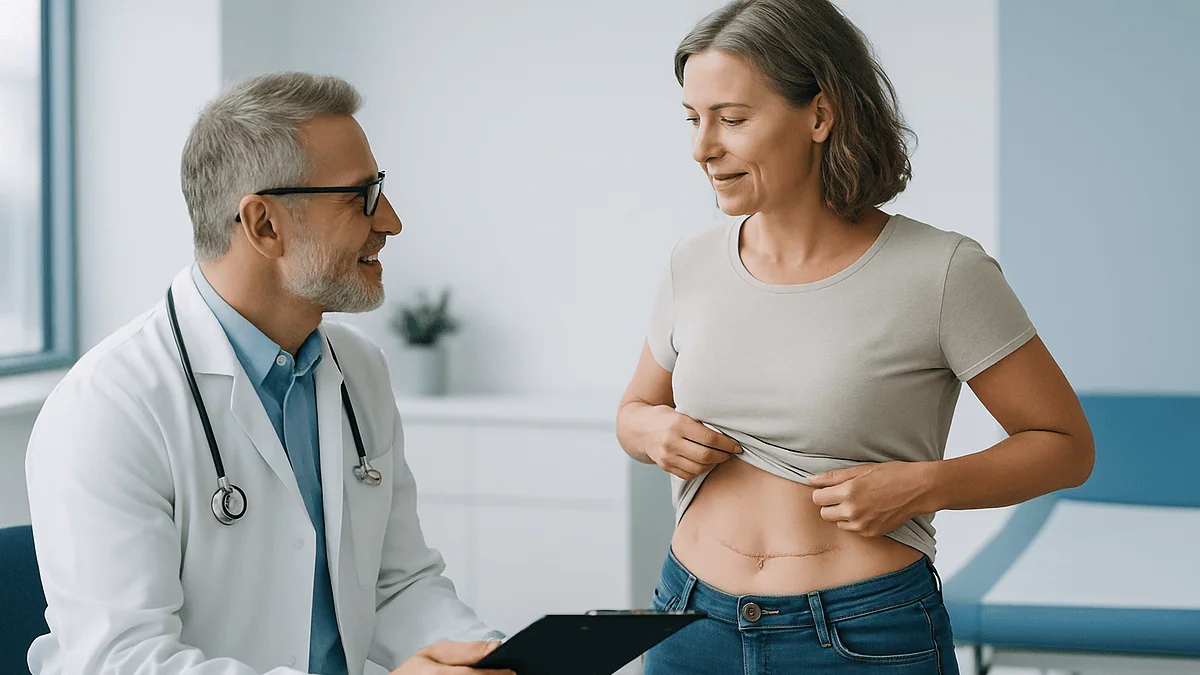
The main incision runs horizontally across the lower abdomen, typically from one hip bone to the other, curving gently like a smile. According to Mayo Clinic, surgeons place it along the natural crease just above the pubic area, low enough, ideally, to sit beneath most underwear and swimsuit lines. In a full abdominoplasty there is almost always a second, much smaller scar: a circle around the navel, because the belly button is repositioned when the skin above it is pulled down.
Placement is not improvised in the operating room. Surgeons mark the incision line while the patient stands, often asking them to bring the underwear or swimwear style they actually wear, so the final line hides where it matters to that person. A centimeter of planning here changes years of visibility later.
Not every operation leaves the same map. A mini tummy tuck, which addresses only the area below the navel, produces a shorter horizontal scar and usually no navel scar at all. An extended tummy tuck carries the line around the hips toward the back. A fleur-de-lis technique, used most often after major weight loss, adds a vertical scar running up the midline, creating an inverted-T. That vertical limb cannot hide under a waistband, which is exactly why surgeons reserve it for cases where horizontal skin excess alone can’t be corrected.
Ask to see your planned incision drawn on your own body before you consent. It’s the single most concrete conversation you can have about your future scar.
Do tummy tuck scars ever go away completely?
No, and any answer that hedges on this is doing you a disservice. Scar tissue is structurally different from the skin it replaces. As MedlinePlus explains, scars form when the deeper layer of skin is damaged and the body fills the gap with new collagen; that collagen is laid down in dense parallel bundles rather than the flexible basket-weave pattern of normal skin. Scar tissue also lacks hair follicles and sweat glands, which is partly why a mature scar looks smooth and slightly shiny.
What scars do very reliably is fade. The NHS notes that most surgical scars follow a predictable arc: red or dark and slightly raised at first, then progressively flatter, paler, and softer over one to two years. A well-healed tummy tuck scar at maturity is typically a thin, flat line a shade lighter than the surrounding skin, visible if you look for it, easy to miss if you don’t.
The more useful question, in this writer’s view, isn’t “will it disappear?” but “will it be a good scar in a good place?” Those two variables, quality and location, determine whether a scar becomes part of the background of your body or a daily frustration. Both are heavily influenced by surgical technique, wound tension, your genetics, and the first year of aftercare, which is where the rest of this article earns its keep.
What do the scars look like right after surgery?
Expect the incision to look worse before it looks better: that’s normal biology, not a complication. In the first two weeks the line is typically red or pink, slightly raised, firm to the touch, and framed by swelling and bruising. Dressings or surgical tape cover it; some patients also have thin drainage tubes for the first several days, each of which leaves its own tiny mark that usually fades to near-invisibility.
A few sensations catch people off guard:
- Tightness. Because skin has been removed, many patients walk slightly hunched for the first week or so. Standing fully upright comes gradually.
- Itching. Healing wounds itch as nerve endings regenerate. Scratching a fresh incision is off the table, so ask your surgical team what’s safe for relief.
- Numbness. The skin between the navel and the scar is often numb because small sensory nerves are divided during surgery. Mayo Clinic notes that changed sensation in this area is common; feeling typically returns over months, though a strip of permanent numbness near the scar is possible.
At this stage the scar tells you almost nothing about its final appearance. Judging a two-week-old incision is like judging a house by its scaffolding. The redness, firmness, and ridging you see are the active construction phase, collagen being produced faster than it’s organized. The remodeling that determines the long-term look hasn’t meaningfully started yet.
How do tummy tuck scars change over the first year?
Scar healing runs on a slower clock than most people expect, and knowing the schedule prevents a lot of unnecessary worry. Many patients panic around month two or three, when the scar looks redder and more raised than it did at week three. That’s not regression: it’s the proliferative phase, when the body is pumping out collagen at maximum speed. The refinement comes later, during remodeling, which continues for a year or more.
| Timeframe | Typical appearance | What’s happening underneath |
|---|---|---|
| Weeks 1–2 | Red or dark line, swollen, possibly crusted at edges | Inflammation; the wound edges knit together |
| Weeks 3–8 | Redder, firmer, often more raised than before | Peak collagen production; blood vessels crowd the area |
| Months 3–6 | Redness slowly dulls; ridge begins to flatten | Remodeling starts; disorganized collagen is replaced |
| Months 6–12 | Pink fading toward skin tone; softer, flatter | Excess blood vessels recede; collagen realigns |
| Years 1–2 | Thin, pale, flat line: the mature scar | Remodeling winds down; appearance stabilizes |
Individual timelines vary with age, genetics, skin tone, and wound tension, and the NHS notes some scars take up to two full years to reach maturity. The practical takeaway: don’t evaluate your result, and certainly don’t pursue revision, based on how the scar looks at month four. The scar you’ll live with is the one you see after the first anniversary, give or take.
What do tummy tuck scars look like after 5 years?
By year five, the scar has been fully mature for years and has settled into its long-term identity. For most people who healed without complications, that means a thin, flat line that is paler than the surrounding skin, often described as silvery or white on lighter skin tones, and sometimes lighter or darker than baseline on deeper skin tones. The redness of the first year is long gone, because the extra blood vessels that fed the healing wound have receded.
A few realistic details worth knowing:
- It won’t tan to match. Mature scar tissue handles pigment differently than normal skin, so a scar often stands out more after sun exposure, not less: the surrounding skin darkens while the scar doesn’t keep pace.
- Width varies. Scars that healed under tension, or in people whose skin stretches easily, may have widened into a broader, flatter band rather than a fine line. This is cosmetic, not dangerous, and it’s the most common reason people consider revision.
- Texture is usually smooth. Lumpiness and firmness along the line typically resolve during remodeling; a five-year-old scar generally feels soft and moves with the skin.
Here’s the honest framing: at five years, most tummy tuck scars are visible to their owner in the mirror and invisible to nearly everyone else, hidden beneath underwear, unnoticed at the beach unless someone is looking. Whether that trade feels worth it is deeply personal, which is why the pre-surgery conversation matters more than any post-surgery product.
What happens 10 years after a tummy tuck?
A decade out, the scar itself is old news. It stopped changing years ago and will look at ten years essentially as it did at two: a stable, pale line. The interesting story at the ten-year mark isn’t the scar; it’s the body around it.
Mayo Clinic notes that tummy tuck results are generally long-lasting provided weight stays stable. The internal muscle repair, the stitching that corrects separated abdominal muscles, is typically durable. But surgery doesn’t pause biology:
- Weight fluctuation is the biggest variable. Significant weight gain stretches the abdominal skin, and it can widen or distort the scar along with it. Substantial loss can create new laxity above or around the original result.
- Pregnancy after abdominoplasty is possible and generally considered safe to the pregnancy itself, but it can stretch both the skin and the repaired muscles, undoing part of the contour. This is why many surgeons suggest completing childbearing first.
- Ordinary aging continues. Skin loses collagen and elastin over time, so the abdomen at 55 won’t look exactly as it did at 45, surgery or no surgery.
One reassuring point: a mature scar that suddenly changes a decade later, becoming raised, painful, itchy, or developing a lump, is not part of normal aging and deserves a medical evaluation. Stable scars stay stable; new behavior in old scar tissue is a reason to get checked, not to wait and see.
Why do some people scar worse than others?
Two patients can have the same surgeon, the same technique, and the same aftercare, and end up with visibly different scars. The gap is mostly biology, and it helps to know which risk factors apply to you before surgery rather than after.
- Genetics. The strongest predictor of how you’ll scar is how you’ve scarred before. Look at old marks from cuts, surgeries, or piercings; your body tends to repeat itself.
- Wound tension. Scars stretched by pull from surrounding skin tend to widen and thicken. The lower abdomen after skin removal is, by definition, a higher-tension zone, one reason technique and postoperative support matter.
- Age. Counterintuitively, younger skin often produces more aggressive, redder, thicker scars because it mounts a more robust healing response. Older skin frequently forms finer scars, though it heals more slowly.
- Smoking and nicotine. Nicotine constricts the small blood vessels a healing wound depends on. Mayo Clinic flags smoking as a significant risk factor for wound-healing complications after abdominoplasty, which is why surgeons require quitting well before surgery.
- Medical conditions. Diabetes, poor nutrition, and anything that impairs circulation or immunity slows healing and worsens scar quality.
- Wound complications. Infection or a wound that partially opens and heals on its own almost always produces a wider, more irregular scar than one that healed cleanly.
You can’t change your genetics. You can absolutely change the smoking, the nutrition, and how faithfully you follow wound-care instructions, and those levers are worth more than any cream sold afterward.
Does skin tone affect how the scar heals?
Yes, in ways worth discussing openly with a surgeon before the operation. Melanin-rich skin heals just as well structurally, but it responds differently in two respects: pigment and raised scarring.
On pigment: skin with more melanin is more prone to post-inflammatory changes, meaning the healed scar and the skin immediately around it may turn darker than baseline (hyperpigmentation) or lighter (hypopigmentation). These changes often soften over months to years, but they can be long-lasting, and sun exposure makes darkening worse, which raises the stakes on sun protection during the first year.
On raised scarring: Cleveland Clinic notes that keloids, scars that grow beyond the original wound boundary, occur more often in people of African, Asian, and Hispanic ancestry, and risk climbs steeply with a personal or family history of keloids. Hypertrophic scars, which are raised and thick but stay within the wound’s borders, can affect any skin tone and are more common where tension is high.
None of this means people with darker skin shouldn’t consider abdominoplasty; it means the pre-surgery conversation should be more specific. A history of keloids after minor injuries, earlobe piercings are the classic tell, is genuinely important information for your surgeon, who may adjust technique, closure methods, and follow-up plans accordingly. What the evidence doesn’t support is fatalism: many patients with deep skin tones heal with fine, well-camouflaged lines, especially when risk factors were identified early and managed deliberately.
What actually helps a scar heal well?
Strip away the marketing and the evidence-supported list is short, cheap, and mostly about discipline rather than products.
- Follow the wound-care plan exactly. The first six weeks decide more about your scar than the next six years. Keep the incision clean, keep dressings on as directed, and don’t test your surgeon’s activity restrictions, lifting and straining put tension right where you don’t want it.
- Don’t smoke, before or after. This is the single most controllable risk factor for poor healing.
- Protect the scar from sun for at least a year. New scar tissue burns and pigments easily. The NHS advises covering healing scars or using high-SPF sun protection; a scar that darkens from early sun exposure can stay darker permanently.
- Consider silicone sheets or silicone gel. Among over-the-counter options, silicone has the most consistent evidence for helping flatten and soften scars and reducing the risk of raised scarring, likely by hydrating the scar surface and calming collagen overproduction. It requires patience, typically months of daily use once the wound has fully closed.
- Scar massage, once cleared. The evidence here is mixed, but the practice is low-risk, may soften firm tissue, and many surgical teams recommend it after full closure. Ask yours when and how.
- Eat like someone rebuilding tissue. Adequate protein and overall nutrition support collagen production; healing is a construction project, and construction needs materials.
Notice what’s not on the list: nothing exotic, nothing expensive. Timing and consistency beat product sophistication every time.
Do scar creams and oils really work?
Here’s where the wellness aisle and the evidence part ways. The honest summary: no cream, oil, or serum erases a scar, and most popular options have weaker science behind them than their packaging suggests.
Silicone-based products, sheets and gels, are the exception, with the most consistent supporting evidence among things you can buy without a prescription. They’re widely recommended by dermatology and surgical organizations for both fresh scars and raised scars.
Vitamin E, despite decades of folklore, has not been shown in good studies to improve surgical scar appearance, and in some people it causes contact dermatitis, skin irritation that can actively worsen the healing environment. Onion-extract gels, another drugstore staple, have produced mixed and modest results in studies; some trials show slight improvement, others show none. Plain moisturizers won’t remodel collagen, but they do reduce itching and tightness, which has real value in the uncomfortable early months.
Beyond the drugstore, clinicians have genuinely effective tools for problem scars: laser treatments can reduce persistent redness and improve texture, and raised or keloid scars can be treated with injections that soften and flatten the overgrown tissue, sometimes combined with silicone or pressure therapy. These are medical treatments delivered by professionals: an important distinction from anything in a squeeze tube.
A useful rule of thumb: if a product promises to make scars “vanish,” it’s marketing. If it promises to modestly improve softness, flatness, and color over months of consistent use, it might be describing silicone.
The scar nobody talks about: your belly button
Ask people to picture a tummy tuck scar and they’ll draw the hip-to-hip line. Almost no one pictures the second scar, the one around the navel, yet it’s often the one visible in a crop top or bikini, sitting right in the middle of the abdomen where no waistband can hide it.
Here’s why it exists. In a full abdominoplasty, the skin between the navel and the pubic area is removed and the skin above is pulled downward. The belly button itself stays anchored to the abdominal wall by its stalk; the surgeon cuts a new opening in the repositioned skin and stitches the navel into it. The result is a fine circular or oval scar tracing the rim of the belly button.
What determines how natural it looks:
- Technique. Surgeons vary in how they shape the new opening and where they place stitches; some tuck the scar just inside the navel’s natural shadow, where it’s nearly impossible to spot.
- Healing behavior. The navel scar can thicken or contract, occasionally making the belly button look small, tight, or unnaturally round. Early raised healing here follows the same maturation timeline as the main scar.
- Shape expectations. A post-surgery navel rarely looks identical to the original. “Natural-looking” is achievable; “unchanged” is not.
When reviewing a surgeon’s before-and-after photos, zoom in on the belly buttons, not just the silhouettes. Experienced eyes consider the navel one of the clearest signatures of surgical skill, and it’s the scar you’re most likely to see in daily life.
What do people wish they knew before getting a tummy tuck?
Search forums and post-surgery communities and the same regrets-that-aren’t-quite-regrets appear again and again. Few people say they wish they hadn’t done it; many say they wish someone had been blunter about the details.
- The scar is longer than most people imagine. Hip to hip means hip to hip. Patients who pictured a discreet six-inch line are often startled at the first dressing change. Seeing the incision drawn on your body beforehand prevents this shock entirely.
- Recovery is measured in months, not weeks. Walking bent forward the first week, no heavy lifting for six or more weeks, and swelling that fluctuates, often worse by evening, for three to six months. The flat result you paid for hides behind that swelling for a while.
- Numbness is strange and persistent. A hand resting on your own lower abdomen and feeling nothing is disorienting. Sensation usually improves over months; a permanent numb strip near the scar is possible.
- The scar’s ugly phase is long. Months two through six, when the line is at its reddest and most raised, test everyone’s patience. Knowing the timeline in advance turns panic into monitoring.
- Weight stability is part of the deal. The result assumes roughly the body you had on surgery day. Future pregnancy or significant weight change can stretch both skin and scar.
None of these are reasons to avoid the surgery. They’re reasons to schedule it with open eyes, and to build recovery time into real life, not into wishful thinking.
Can scar revision or 'scar removal' fix a bad result?
Start with the vocabulary problem: “scar removal” doesn’t exist. Any procedure that cuts out a scar creates a new incision, which heals into a new scar. What revision surgery offers is a trade, exchanging a wide, irregular, or poorly positioned scar for a fresh one closed under better conditions, with the hope that round two heals finer than round one.
That hope is often reasonable. Scars that widened because of early wound complications, infection, or excessive tension frequently do better the second time, when the wound can be closed cleanly without those handicaps. Revision can also reposition a scar that sits higher than intended or smooth out puckered sections at the ends of the incision: the small standing folds sometimes called dog ears.
Less invasive options address specific complaints without new incisions. Laser treatments can fade stubborn redness and refine texture. Raised or keloid scars may respond to clinician-administered injections that flatten thickened tissue, often used alongside silicone or pressure therapy. Microneedling and similar resurfacing approaches have growing but still modest evidence for texture improvement.
Two honest caveats. First, timing: most surgeons won’t revise a scar before it fully matures, because a scar that looks disappointing at six months may look acceptable at eighteen, operating early means operating on a moving target. Second, expectations: revision improves scars; it does not produce scarless skin. If your revision consultation ends with a promise of invisibility, that’s your cue to seek a second opinion.
When should you see a doctor about your scar?
Most of what a healing tummy tuck scar does, itching, tightness, redness that waxes and wanes, temporary lumpy firmness, is normal remodeling. But some signs mean the incision needs professional eyes, and quickly.
Contact your surgical team promptly if you notice:
- Spreading redness, increasing warmth, or worsening pain around the incision, especially with fever or chills, which suggest infection
- Cloudy, foul-smelling, or increasing drainage from any part of the wound
- A section of the incision opening or the edges pulling apart
- A growing, sloshing, or balloon-like swelling under the skin, which can indicate a fluid collection called a seroma
- Sudden severe abdominal pain, shortness of breath, or one-sided leg swelling and pain: these need emergency evaluation, as leg-vein clots are a known risk after abdominal surgery
Schedule a non-urgent visit if:
- The scar keeps thickening or growing beyond the original incision line after the early months, possible keloid formation, which responds best to early treatment
- The scar remains intensely red, painful, or itchy well past the first year
- A long-stable, years-old scar suddenly changes: new lumps, pain, or texture shifts warrant examination rather than waiting
A good rule: your surgical team would rather answer an unnecessary call than miss a real problem. Every reputable practice builds follow-up visits into the first year precisely because early intervention, for infection, fluid collections, or aggressive scarring, consistently produces better long-term scars than delayed treatment.
Frequently asked questions
Do scars from a tummy tuck go away?
No, tummy tuck scars are permanent, but they fade dramatically. Scar tissue is structurally different from normal skin, so the line never vanishes entirely. Over one to two years it typically changes from a red, raised ridge to a thin, flat, pale line that sits below most underwear and swimwear. Good surgical placement, low wound tension, sun protection, and consistent early care all influence how faint the final scar becomes.
What do tummy tuck scars look like after 5 years?
At five years, most well-healed tummy tuck scars are thin, flat, pale lines, often silvery or white on lighter skin, sometimes lighter or darker than baseline on deeper skin tones. Scars that healed under tension may have widened into a broader band. Mature scars don’t tan like surrounding skin, so they can stand out more after sun exposure. For most people the scar is visible up close but hidden by ordinary underwear.
What happens 10 years after a tummy tuck?
The scar itself is stable by ten years and looks much as it did at two. What changes is the body around it: significant weight gain can stretch the skin and widen the scar, pregnancy can re-separate repaired muscles, and normal aging loosens skin over time. With stable weight, results are generally long-lasting. Any sudden change in an old scar, new lumps, pain, or growth, should be medically evaluated.
What do people wish they knew before getting a tummy tuck?
The most common surprises are the scar’s true length, genuinely hip to hip, the months-long recovery with fluctuating swelling, persistent numbness in the lower abdomen, and how red and raised the scar looks between months two and six. Patients also underestimate how much future weight changes or pregnancy can affect the result. Seeing the planned incision drawn on your own body before surgery prevents the biggest shock.
How long do tummy tuck scars stay red?
Typically six to twelve months, sometimes longer. Redness comes from extra blood vessels feeding the healing wound, and it often peaks around two to three months before slowly receding. Most scars fade to pink by the end of the first year and reach their pale, mature color by year two. Redness that intensifies with spreading warmth, pain, or fever is different: that pattern suggests infection and needs prompt medical attention.
Will my tummy tuck scar stretch if I gain weight?
It can. Significant weight gain stretches abdominal skin, and the scar stretches with it, often becoming wider or more irregular. Weight stability is one of the strongest predictors of a lasting result, which is why surgeons generally recommend being at or near a stable, maintainable weight before surgery. Modest everyday fluctuations of a few pounds won’t meaningfully change a mature scar; large sustained gains might.
Is numbness around the scar normal?
Yes. Small sensory nerves in the lower abdominal skin are divided during surgery, so numbness between the navel and the incision is very common. Sensation usually returns gradually over months as nerves regenerate, though a strip of reduced or absent feeling near the scar can be permanent in some people. Numbness alone isn’t worrisome; numbness combined with worsening pain, spreading redness, or wound changes should be reported to your surgical team.
When can I start scar treatment after a tummy tuck?
Only after the incision has fully closed and your surgical team clears you, typically a few weeks after surgery. Applying silicone sheets or gels, starting scar massage, or using any product on an open or scabbed wound can cause irritation or infection. Once cleared, silicone products are usually used daily for several months, and sun protection should continue for at least the first year while the scar matures.
What if my tummy tuck scar becomes raised or keloid?
See your surgeon or a dermatologist early, raised scars respond best to prompt treatment. Hypertrophic scars stay within the incision’s borders and often improve with silicone therapy and time; keloids grow beyond the original wound and typically need clinician-administered treatments such as injections that flatten thickened tissue, sometimes combined with pressure or silicone. Keloid risk is higher with darker skin tones and a personal or family history of keloids.
Can a bad tummy tuck scar be surgically fixed?
It can often be improved, but never removed. Scar revision excises the old scar and closes the wound under better conditions, trading a wide or irregular scar for a hopefully finer new one. Lasers can reduce lingering redness and improve texture without new incisions. Most surgeons wait until the scar fully matures, usually at least a year, before revising, because scars frequently improve on their own during that window.
References
This article is for general information only and is not a substitute for professional medical advice. Please consult a qualified doctor about your individual situation.

More from the Blog

Brazilian Tummy Tuck vs BBL: Two Very Different Procedures Behind Similar Names
A "Brazilian tummy tuck" is a marketing name for an abdominoplasty, an operation that removes loose abdominal skin, tightens the muscle wall and often…
How Long Do Mommy Makeover Results Last? Weight, Future Pregnancy and Aging Explained
Mommy makeover results typically last many years, but they are not frozen in time. Tummy tuck and liposuction changes hold best when weight stays…

Who Is a Candidate for an Arm Lift? Loose Upper-Arm Skin, Weight Stability and Skin Quality
An arm lift candidate is usually an adult whose upper-arm looseness comes mainly from excess skin rather than fat alone, whose weight has held…

Is CoolSculpting for Weight Loss? Why It Only Suits Pinchable Fat and a Stable Weight
No. CoolSculpting, the brand name for a technique called cryolipolysis, is not a weight loss treatment. It cools a small, pinchable pocket of fat…
J Plasma vs Tummy Tuck: When Skin Tightening Energy Is Enough and When It Is Not
Energy-based skin tightening, including helium plasma devices sold under the J Plasma name, heats the underside of the skin to shrink mild to moderate…

How a Buttock Lift Is Performed: Where the Incision Runs and How Tissue Is Lifted
A buttock lift is performed under general anesthesia. The surgeon marks and removes a crescent of loose skin and fat along the upper buttock,…