

Neck and Face Lift Warning Signs: Hematoma, Numbness and Swelling That Needs a Call

Key Takeaways
- Hematoma is the most common complication of face lift surgery and usually develops within the first 24 hours, which is why one-sided swelling or escalating pain on the first night should be reported immediately.
- Patchy numbness of the cheeks, ears and neck is expected and typically improves over months, whereas new weakness of a smile, lip, eyebrow or eyelid is a warning sign that needs a same-day assessment.
- Swelling and bruising usually peak around the second day and remain visible for roughly two to three weeks, so a face that worsens after it had started to improve is telling you something has changed.
- Infection tends to appear later than bleeding, often from the third day onward, and shows as spreading redness, warmth, cloudy drainage, a foul smell or fever.
- Nicotine in any form constricts small blood vessels and is a major risk factor for skin loss behind the ears and along the hairline, which is why teams ask for a nicotine-free period before and after surgery.
- One-leg swelling or calf pain, and especially sudden breathlessness or chest pain, are whole-body red flags after any general anesthetic and belong to emergency services rather than the surgeon's office.
After a neck and face lift, the warning signs that need a same-day call are sudden swelling or tightness on one side, pain that keeps climbing despite your prescribed plan, a firm or purple area under the skin, spreading redness or fever, wound edges turning pale or dark, and new drooping or weakness on one side of the face. Chest pain, breathlessness or calf pain need emergency care.
It is a little after two in the morning, the second night home. The bandage has been off since the afternoon visit, the cold pack has gone soft, and a woman who was told to “expect some swelling” is standing at the bathroom mirror trying to decide whether the left side of her jaw looks fuller than the right, or whether she is simply tired and looking too hard.
That moment, more than the operation itself, is where facelift complications warning signs either get caught early or get talked away until morning. Most people who have this surgery never face a serious problem. A small number do, and the ones that matter most, a collecting pocket of blood, a nerve that is not behaving, skin that is not getting enough blood, tend to announce themselves in the first day or two, and they reward a quick phone call over a long wait.
This explainer is about knowing the difference between what healing normally looks like and what needs a voice on the other end of the line, without drama and without guesswork.
How a neck and face lift actually works
A face lift, sometimes written rhytidectomy, is an operation that lifts and repositions the sagging soft tissue of the lower face and neck rather than simply pulling skin tight. According to Mayo Clinic, the surgeon makes an incision that usually begins in the hairline near the temple, runs in front of and around the ear, and may continue into the lower scalp; a neck lift often adds a short incision beneath the chin.
Underneath the skin sits a fibrous layer the surgeon calls the SMAS, short for superficial musculoaponeurotic system, which is the sheet of tissue that connects facial muscles to skin. Most modern techniques lift and secure this layer, then redrape the skin over it and trim the excess. Fat may be moved or removed from the jowls and neck, and the paired neck muscles under the chin may be tightened.
Why does this matter for warning signs? Because the surgeon has lifted skin off a wide area, creating a thin space where blood or fluid can collect. Small sensory nerves running through the skin are stretched or cut, which is why numbness is expected. Deeper branches of the facial nerve, which move the muscles of expression, sit just beneath the working layer, which is why weakness is watched for. The skin edges near the ear have the longest distance to travel for their blood supply, which is why they are the first place healing problems show up.
Mayo Clinic notes the procedure can be done under general anesthesia or under sedation with local anesthetic, and that a thin drainage tube is sometimes placed behind the ear to draw off excess blood or fluid. Understanding that map of what was disturbed, and where, turns a vague instruction to “watch for problems” into something specific you can actually do.
Facelift complications warning signs: what is normal in week one and what is not
The honest answer is that early recovery looks alarming to anyone who has not seen it before. Both cheeks swell, bruising migrates down the neck and sometimes toward the chest, the skin in front of the ears feels wooden, and the whole face feels as if it belongs to someone else. None of that is a complication. The skill is in noticing the pattern that breaks symmetry or keeps getting worse when everything else is settling.
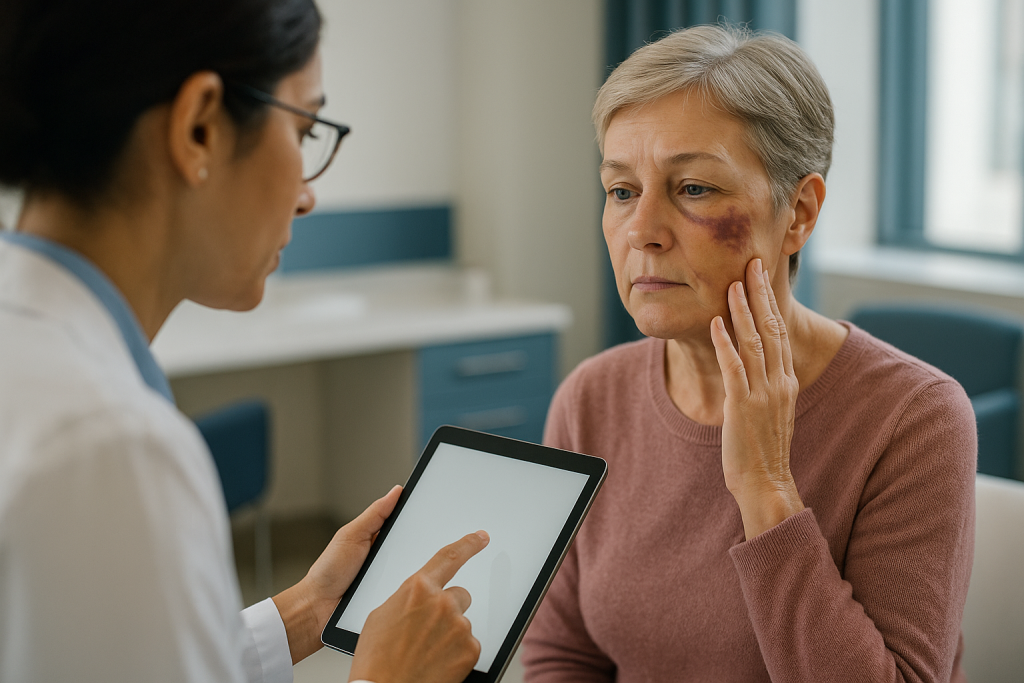
The table below is a starting point, not a diagnostic tool. Your own team’s written instructions take priority over anything here.
| What you notice | Usually part of healing | Call the team the same day |
|---|---|---|
| Swelling | Both sides, peaks over the first couple of days, then slowly eases | One side suddenly larger, tight or shiny, or swelling that grows by the hour |
| Pain | Tightness and soreness controlled by the prescribed plan | Escalating pain on one side, pain that wakes you, or pain out of step with the other side |
| Skin color | Yellow, green or purple bruising that fades over weeks | A firm purple or dark red dome, or skin edges turning white, gray or black |
| Numbness | Patchy numbness of cheeks, ears and neck | New inability to move part of the face, a lopsided smile or an eye that will not close |
| Temperature | Feeling warm and puffy in the face | Fever, chills, or a wound that is hot, red and leaking cloudy fluid |
| Wound edges | Slight crusting along the incision | Gaping edges, spreading redness or a foul smell |
Mayo Clinic describes the expected course as several days of swelling and bruising that is at its worst around day two, followed by steady improvement. Anything that runs against that direction of travel is worth a phone call, even if it turns out to be nothing.
Facelift hematoma symptoms: why the first 24 hours matter most
A hematoma is a collection of blood that pools under the skin after a vessel that was sealed during surgery begins to bleed again. Mayo Clinic identifies it as the most common complication of face lift surgery and states that it usually develops within the first 24 hours after the operation. That single fact explains why teams keep a close eye on the first night and why many patients are asked to have an adult with them.
The symptoms are rarely subtle once they are underway. The classic picture is swelling on one side that appears quickly, often within an hour, with the skin becoming tense, shiny and sometimes purple as the pocket fills. Pain tends to be the loudest signal: it is disproportionate, one-sided, and does not respond to the pain plan that was working an hour earlier. Some people describe a sensation of pressure or fullness under the ear or along the jaw before any visible change. Bleeding through the dressing, or a drain that suddenly fills with fresh red blood, points the same way.
The reason this is treated as urgent, rather than something to review at the next appointment, is mechanical. The skin has been lifted and is relying on a thin blood supply; a pocket of blood pushes it upward, stretches it and compresses the vessels feeding it. Left in place, that pressure can starve the overlying skin and lead to tissue loss and worse scarring. Mayo Clinic notes that a hematoma is treated promptly, generally by returning to the operating room to remove the blood and stop the bleeding.
Small collections are sometimes managed less invasively at the surgeon’s discretion. The decision is entirely the treating team’s. Your job is narrower and simpler: notice one-sided change or escalating pain, and make the call rather than waiting to see whether morning brings improvement.
What raises hematoma risk, and what the team does about it
Bleeding after surgery is not random bad luck. Several factors are well described in surgical guidance, and knowing them helps you understand the instructions you were given before and after the operation.

Blood pressure is the one most within reach. A spike in blood pressure in the hours after surgery, whether from pain, nausea, anxiety, straining or coughing, can reopen small vessels that were sealed while pressure was low on the operating table. This is why teams are strict about pain control, nausea management and keeping the head elevated, and why people with a history of high blood pressure are usually asked to have it well controlled before a date is set. Mayo Clinic lists uncontrolled blood pressure as a factor that can increase surgical risk in this setting.
Medicines and supplements that thin the blood or interfere with platelet function are the second major factor. Mayo Clinic and the NHS both advise that these be discussed with the surgical team well in advance, and that nothing be stopped or restarted without explicit instruction from the prescribing clinician. More on that in a later section.
Activity matters too. Bending, lifting, straining, vigorous coughing and even animated conversation in the first days raise pressure in the head and neck. Alcohol dilates blood vessels. Heat, whether from a hot shower, a heating pad or a sauna, does the same. Instructions to keep the head raised, avoid heavy lifting and skip alcohol are not about caution for its own sake; they are about keeping pressure inside those freshly sealed vessels low.
From the team’s side, meticulous control of bleeding before closing, careful blood pressure management in recovery, and sometimes a drain or a light compression dressing are the standard tools. None of them removes risk entirely, which is why your own early recognition remains part of the safety system.
Numbness after facelift: sensory nerves versus movement nerves
Almost everyone has numbness after a face lift, and almost everyone is unsettled by it. The key is that there are two very different kinds of nerve at play, and they carry very different meanings.
Sensory nerves are the fine branches that carry feeling from the skin to the brain. When skin is lifted off the face and neck, these small branches are stretched or cut. The result is patchy numbness, tingling or a wooden feeling over the cheeks, in front of the ears and along the neck, sometimes with odd sensations such as itching or sharp zaps as fibers regrow. Mayo Clinic describes this loss of sensation as expected and notes it typically improves over months, though in some people a small area near the ear or incision remains permanently altered.
One particular sensory nerve, the great auricular nerve, runs up the side of the neck to supply feeling to the lower ear. It sits in the surgical field, and numbness of the earlobe is a recognized possibility that the surgeon will usually mention in advance.
Motor nerves are a different matter. The facial nerve and its branches move the muscles of expression. Mayo Clinic lists nerve injury as a risk that can affect either sensation or muscle movement, describing temporary paralysis of a muscle leading to an uneven facial appearance that can last from a few months to a year, with permanent injury being uncommon. The branches most often discussed are the one that lifts the eyebrow and the one that pulls down the corner of the lower lip.
What this means practically: numbness alone is not a warning sign. New weakness is. If one side of the smile does not rise, the lower lip pulls to one side when you show your teeth, an eyebrow will not lift, or an eye will not fully close, tell the team the same day. Even when weakness turns out to be temporary, the team needs to document it, protect the eye if closure is affected, and plan follow-up.
Facelift swelling timeline: what the days and weeks usually look like
Recovery has a shape, and knowing that shape is what lets you spot the outlier. The figures below are typical ranges drawn from Mayo Clinic and NHS guidance; your own pace may differ, and your surgeon’s timeline overrides these.
The first two days. Swelling and bruising build and, according to Mayo Clinic, are usually at their worst around the second day. If a drain was placed, it is commonly removed within the first day or two, and the initial bulky dressing is often replaced with something lighter. The face feels tight and heavy, and sleeping propped up on several pillows is standard advice.
The first week. Swelling begins to recede, bruising turns from purple to green and yellow and drifts downward with gravity. Stitches or clips are typically removed over the first week to ten days, sometimes in stages. Mayo Clinic notes that the incision lines may still be pink and that numbness is prominent at this point.
Weeks two to four. Both Mayo Clinic and the NHS describe visible bruising and swelling lasting roughly two to three weeks, with many people feeling comfortable in public, sometimes with makeup, toward the end of that window. Return to non-strenuous work often falls in the range of two to four weeks, again according to those sources.
Months two to six and beyond. Residual firmness, mild asymmetry and altered sensation continue to soften. The NHS notes it can take several months for the face to fully settle, and Mayo Clinic describes scars maturing and fading over many months.
The warning sign hidden in this timeline is direction, not speed. Slow but steady improvement is normal. A face that was getting better and then, on day four or day nine, becomes more swollen, more painful or more red on one side, is telling you something has changed. That reversal is the cue to call.
Signs of infection after facelift, and why they usually appear later than bleeding
Infection after a face lift is uncommon, largely because the face has a rich blood supply, but it does happen and it follows its own schedule. Where a hematoma tends to show itself in the first day, infection usually declares itself later, often from the third day onward, once bacteria have had time to multiply in the wound.
MedlinePlus, the National Library of Medicine’s patient resource, lists the recognized features of a surgical wound infection: redness that spreads outward from the incision rather than staying at its edge, warmth over the area, increasing pain or tenderness, swelling that is firm, and drainage that is cloudy, yellow or green rather than thin and pink. A fever, chills, or simply feeling unwell in a way that is new are systemic signs that the body is responding to infection. The CDC describes surgical site infections as those that develop at or near the incision within the weeks following an operation, which is why your team will ask about the wound at every early appointment.
Around the ears, where incisions run through hair and behind skin folds, it can be difficult to see clearly. A mirror held by someone else, or a phone photograph, is often more useful than craning your neck. Smell is a legitimate clue: a wound that has developed a foul odor deserves a call even if it looks unremarkable.
What the team does depends on what they find. A collection of fluid may be drained. Antibiotics, medicines that kill or slow bacteria, may be started if infection is confirmed or strongly suspected, with the choice and duration entirely a matter for the prescribing clinician. What you should not do is start leftover antibiotics from a cupboard, apply creams that were not recommended, or wait several days hoping it settles. Early infection is far easier to manage than one that has spread beneath the lifted skin.
Skin that struggles to heal: pale edges, dark patches and open wounds
Skin necrosis is the medical term for skin that dies because it did not receive enough blood. It is one of the less discussed complications of face lift surgery and one of the more important to recognize early, because there is a window in which pressure can be relieved and circulation supported before tissue is lost.
The mechanism follows directly from the anatomy of the operation. When skin is lifted and redraped, the edges farthest from their blood supply, typically behind the ear and along the lower hairline, are living on the thinnest margin. Anything that reduces flow to those edges, such as a hematoma pressing from below, excessive tension in the closure, tight dressings, cold exposure or the vessel-narrowing effect of nicotine, can tip them from struggling to failing.
Both Mayo Clinic and the NHS single out smoking as a major risk factor for poor wound healing and skin loss after a face lift, and Mayo Clinic advises stopping well before surgery and remaining off nicotine through recovery. That guidance extends to vaping and nicotine patches, since it is nicotine itself, not only smoke, that constricts small blood vessels.
The early appearance is subtle: a wound edge that looks paler than the surrounding skin, or a patch that is dusky, mottled or deeper purple than ordinary bruising and does not blanch when gently pressed. Over days it may darken toward gray, brown or black and develop a leathery crust. A separate but related problem is wound dehiscence, the medical word for incision edges pulling apart. This is most likely where tension is highest, again behind the ear, and may be noticed as a small gap that weeps fluid.
Report any of these changes the same day. Small areas often heal on their own with careful wound care directed by the team, sometimes leaving a wider scar that can be addressed later. Larger areas need active management, and the earlier that starts, the more tissue is preserved. Do not remove crusts, apply heat, or try to close a gap yourself.
Whole-body red flags: clots, breathing and chest symptoms
Not every danger after a face lift lives in the face. Any operation performed under general anesthesia, lasting several hours, and followed by days of reduced activity carries a risk of blood clots forming in the deep veins of the legs. The medical term is deep vein thrombosis, often shortened to DVT. MedlinePlus describes the typical features as swelling of one leg, pain or tenderness in the calf that may feel like a cramp, warmth, and redness or a change in skin color over the affected area.
The reason this matters beyond the leg is that a clot can break free and travel to the lungs, a pulmonary embolism. MedlinePlus lists sudden shortness of breath, chest pain that sharpens with a deep breath or cough, rapid heartbeat, coughing up blood, lightheadedness or fainting as the warning features. These are not same-day-phone-call symptoms; they are emergency symptoms, and the right response is emergency services, not the surgeon’s office.
Prevention is largely about movement and hydration, which is why teams ask people to walk around the house from the first day even while keeping the head elevated at rest, to drink fluids, and to avoid sitting motionless for long stretches. Some patients are fitted with compression stockings or inflatable leg sleeves during surgery, and a small number, based on individual risk, may be prescribed a short course of a blood-thinning medicine by the surgical team. Whether that applies to you is a decision for the team, made against your own history.
Two other whole-body signs deserve mention. Persistent vomiting in the first day is not only miserable but raises blood pressure and, with it, hematoma risk, so it should be reported rather than endured. A fever that appears without any obvious wound change still needs a call, because infection can sit in the chest, urinary tract or elsewhere after any anesthetic. Face lift recovery is a whole-person recovery, and the body’s other systems deserve the same attention as the mirror.
Who a neck and face lift is usually for, and who is usually asked to wait
A face lift is an elective operation, which means there is time to get the conditions right before it happens, and a good surgical team will use that time. Mayo Clinic describes the typical candidate as a person with sagging skin of the mid-face, deep folds beside the nose and mouth, jowls along the jawline, and loose skin or fat under the chin, who is in good general health with realistic expectations about what surgery can and cannot change.
People are commonly asked to wait, or occasionally advised against surgery altogether, in several situations. Uncontrolled high blood pressure, for the hematoma reasons already described, is one. Current smoking or nicotine use is another, given its effect on skin survival; many teams ask for a nicotine-free period both before and after surgery. A history of bleeding problems or clotting disorders, unstable diabetes, active skin infection, and certain medicines that cannot safely be paused all prompt a slower, more collaborative planning process with the person’s other doctors. The NHS also emphasizes psychological readiness and advises against proceeding when the decision is being driven by a recent life crisis or by pressure from others.
It is worth knowing that there are less invasive options, and a neutral team will lay them out. Non-surgical approaches such as injectable treatments, energy-based skin tightening and skin resurfacing address different problems and produce different, generally more modest and shorter-lived, results. Mayo Clinic notes that a face lift does not treat superficial wrinkles, sun damage or uneven skin color, so some people are better served by other procedures or by a combination. Whether surgery is the right tool, and whether now is the right moment, is a judgment the treating team makes with you, weighing the anatomy in front of them against your health, your goals and your appetite for downtime.
Medicines, supplements and bleeding: what your team will ask about
The pre-operative medicine conversation is one of the least glamorous and most protective parts of face lift planning. Because bleeding under the skin is the leading early complication, anything that makes blood clot more slowly is relevant, and the list is longer than most people expect.
Anticoagulants are medicines that slow the chemical cascade of clotting; they are prescribed for conditions such as atrial fibrillation or previous clots. Antiplatelet medicines, of which aspirin is the most familiar generic example, make platelets less sticky. Non-steroidal anti-inflammatory drugs, a class that includes several common over-the-counter pain relievers, also affect platelet function for a period after each dose. Mayo Clinic advises that all of these be reviewed with the surgical team beforehand, and, critically, that any change be directed by the clinician who prescribed them, because stopping some of these medicines carries its own serious risks.
Supplements are the blind spot. Several herbal products and high-dose vitamins are believed to affect bleeding, and the NIH Office of Dietary Supplements notes that supplement interactions with surgery and medicines are frequently under-reported by patients simply because people do not think of them as drugs. Bring the actual bottles, or a photograph of the labels, to the pre-operative appointment.
Two further categories matter after surgery. Pain medicines are usually chosen by the team partly on the basis of their effect on bleeding, so substituting a different product from home without asking is not a trivial change. And any medicine that raises blood pressure, or any missed dose of a medicine that controls it, can push pressure into a range that reopens vessels.
The house rule here is simple to state and worth following literally: do not start, stop, pause or swap any medicine or supplement around your surgery without a direct instruction from the prescribing clinician or the surgical team, and tell them everything you take, including the things that seem harmless.
What people often get wrong about facelift complications warning signs
“If it were serious, it would hurt more.” Pain is a reliable signal for hematoma, but it is a poor one for skin that is losing its blood supply, which is often numb, and for early infection, which can begin with color change rather than discomfort. Look as well as feel.
“Swelling on both sides means everything is fine.” Usually true, but a large hematoma can sometimes develop on both sides, and generalized swelling that worsens after it had started to improve is a change in direction that still warrants a call.
“Numbness means a nerve was cut and the damage is permanent.” Sensory numbness is expected and, per Mayo Clinic, typically improves over months. Weakness of movement is the finding that needs urgent attention, and even that is more often temporary than permanent.
“I should wait until the morning appointment so I don’t bother anyone.” Surgical teams build after-hours contact into their care precisely because hematoma is a first-night event. A call that turns out to be unnecessary costs a few minutes. A hematoma left overnight can cost skin.
“A cold pack or a tighter bandage will sort it out.” Cold and compression are for ordinary swelling under the team’s instructions. Applied to a suspected hematoma or to skin that is already pale, extra pressure can worsen the blood supply problem. Call first.
“Bruising that tracks down to the chest means bleeding has spread somewhere dangerous.” Bruising follows gravity as it resolves, and its downward drift over the first week is expected. A new, firm, tense area is a different thing from a soft, colorful stain that is fading.
“Complications mean the surgeon did something wrong.” Hematoma, nerve irritation and delayed healing are recognized risks of the operation itself, listed in every mainstream patient resource. What distinguishes a good outcome is often how quickly a problem is recognized and how promptly it is managed, and you are half of that equation.
Questions to ask your care team before and after surgery
The best time to learn how your team wants to hear about problems is before you have one. Written instructions vary between surgeons, and the specifics of yours matter more than any general article. These questions tend to produce the most useful answers.
- Who exactly do I call after hours if I notice one-sided swelling or increasing pain, and what number do I use? Is there a different route for weekends?
- What does a hematoma look and feel like in your experience, and at what point do you want to hear from me rather than wait?
- Will I have a drain, and what should the fluid look like as it changes from the first hours to the first days?
- Which of my current medicines and supplements need to be discussed with the doctors who prescribe them, and who will coordinate that conversation?
- How should I manage my blood pressure and nausea in the first 48 hours, and what should I do if either gets out of hand?
- How will I know the difference between expected numbness and weakness that you need to assess? Is there a simple check you would like me to do in the mirror?
- Where are the incision areas most likely to struggle with healing, and what early color changes should prompt a call?
- What activity is allowed on day one, day three and week two, and what specifically should I avoid because it raises pressure in my head and neck?
- If I develop a fever with no obvious wound change, do you want to know, or should I contact my primary care physician?
- When are my follow-up appointments, and how do I get an earlier one if something changes between them?
Write the answers down or ask a companion to. Anesthesia and the first days of recovery are not the moment to rely on memory, and a short list taped beside the bathroom mirror is worth more than any amount of reassurance you cannot recall at two in the morning.
When to call your doctor
Call your surgical team the same day, including out of hours, if you notice any of the following. Do not wait for the next scheduled appointment.
- Swelling that is clearly larger, tighter or shinier on one side, or swelling anywhere that is growing by the hour.
- Pain that keeps escalating, is concentrated on one side, or is no longer controlled by the plan that was working earlier.
- A firm dome or a dark purple, tense area under the skin, fresh red blood soaking a dressing, or a drain that suddenly fills with bright red blood.
- Any part of the face that has stopped moving: a smile that does not rise on one side, a lower lip pulling sideways, an eyebrow that will not lift, or an eye that will not fully close.
- Incision edges or nearby skin turning white, gray, dusky, brown or black, or wound edges pulling apart.
- Spreading redness, warmth, cloudy or foul-smelling drainage, or a fever or chills.
- Persistent vomiting that you cannot keep down, since it drives up blood pressure.
- Swelling, pain, warmth or color change in one calf or leg.
Call emergency services, rather than the office, for sudden shortness of breath, chest pain, coughing up blood, fainting, a rapidly swelling face or neck that is affecting your breathing or swallowing, or heavy bleeding that does not slow with gentle pressure. These are the signs MedlinePlus and Mayo Clinic describe for pulmonary embolism, airway compromise and uncontrolled hemorrhage, and minutes matter.
A final word on hesitation. People who have chosen an elective operation sometimes feel they have forfeited the right to complain, or that a call will reveal them as anxious. Neither is true. Every mainstream guideline on post-operative care rests on the same principle: the patient is the first observer, and early reporting is the single most effective safety tool available. Your team would far rather examine a face that turns out to be healing normally than be called too late. The decision about what to do next belongs to them; the decision to pick up the phone belongs to you.
Frequently asked questions
What are the first facelift hematoma symptoms I would notice?
Usually a rapid, one-sided swelling with skin that turns tense, shiny and sometimes purple, accompanied by pain that is out of proportion to the other side and stops responding to your pain plan. Some people feel pressure under the ear or along the jaw before anything is visible. Fresh red blood on a dressing or in a drain points the same way. Mayo Clinic notes most hematomas develop within 24 hours.
Is numbness after facelift permanent?
For most people, no. Sensory numbness comes from small skin nerves that are stretched or cut when the skin is lifted, and Mayo Clinic describes it as improving over months as fibers regrow. A small area near the ear or incision can remain permanently altered in some people. Numbness alone is not a warning sign; new weakness of facial movement is, and should be reported the same day.
What is a normal facelift swelling timeline?
Swelling and bruising typically build over the first two days, peak around day two, and then recede steadily, with visible bruising lasting roughly two to three weeks according to Mayo Clinic and the NHS. Residual firmness and mild asymmetry can take several months to settle. The important pattern is direction: slow improvement is normal, while swelling that reverses and worsens on one side needs a call.
What are the signs of infection after facelift surgery?
MedlinePlus lists spreading redness beyond the incision edge, warmth, increasing tenderness, firm swelling, and drainage that is cloudy, yellow or green. Fever, chills or feeling generally unwell are systemic signs. A foul smell from the wound is also a legitimate reason to call. Infection usually appears from around the third day onward, later than bleeding, and is far easier to manage when reported early.
How do I tell a hematoma from ordinary bruising?
Ordinary bruising is soft, flat, colorful and follows gravity downward over the first week as it fades. A hematoma is a firm or tense collection under the skin, usually on one side, that appears quickly and is painful or pressure-like. Bruising improves day by day; a hematoma tends to grow by the hour. When you are unsure, describe both the feel and the timing to your team.
Can one side of my face be weak after a facelift and still recover?
Yes. Mayo Clinic describes temporary weakness of a facial muscle after face lift surgery, causing an uneven appearance that can last from a few months to a year, with permanent injury being uncommon. Even so, new weakness should be reported the same day so the team can examine you, protect the eye if closure is affected, and arrange follow-up. Recovery is monitored, not assumed.
Why does my surgeon care so much about blood pressure after surgery?
Because a spike in blood pressure in the hours after a face lift can reopen small vessels that were sealed while pressure was low on the operating table, and that is the mechanism behind many hematomas. Pain, nausea, straining, coughing and anxiety all raise pressure. Keeping the head elevated, controlling pain and nausea, and avoiding lifting, alcohol and heat are all aimed at keeping those vessels closed.
Should I stop my blood thinner or aspirin before a facelift?
Not on your own. Anticoagulants and antiplatelet medicines do raise bleeding risk, and Mayo Clinic advises reviewing them with the surgical team in advance, but stopping some of them carries its own serious risks. Any change must be directed by the clinician who prescribed the medicine, in coordination with the surgeon. Bring a full list of medicines and supplements, including herbal products, to the pre-operative appointment.
What does skin necrosis look like early after a facelift?
Early on it is subtle: a wound edge or patch of skin, most often behind the ear or along the hairline, that looks paler than surrounding skin or is dusky and mottled and does not blanch when gently pressed. Over days it can darken toward gray or black and crust. Report any of these changes the same day, and do not apply heat, pressure or remove crusts yourself.
When is a facelift complication an emergency rather than a phone call?
Sudden shortness of breath, chest pain, coughing up blood or fainting suggest a clot in the lungs and need emergency services. So does swelling of the face or neck that is affecting breathing or swallowing, or heavy bleeding that does not slow with gentle pressure. One-sided swelling, escalating pain, wound color change, fever or new facial weakness are urgent same-day calls to the surgical team.
References
- NHS: Facelift, what it involves, recovery and risks
- MedlinePlus: Surgical wound infection, treatment and signs
- MedlinePlus: Deep vein thrombosis
- CDC: About surgical site infections
This article is for general information only and is not a substitute for professional medical advice. Please consult a qualified doctor about your individual situation.

More from the Blog

Do Facial Augmentation Results Last? Implants vs Fat Transfer Over the Years
Facial augmentation results vary by method. Solid cheek and chin implants are designed to stay in place indefinitely and usually keep their shape for…

Preparing for Face Aesthetics Surgery: Blood Tests, Anesthesia Review and Medicine Changes
Preparing for facial surgery usually means a pre-assessment visit where blood tests check clotting, blood count and kidney function, an anesthesia review covers your…

Supporting Someone After a Neck and Face Lift: Drains, Dressings and the First Days Home
In the first days after a neck and face lift, a helper's main tasks are keeping the head raised, emptying and recording any drains,…

Facial Augmentation With Fat Transfer or Implants: Which Option Suits Which Face?
Facial fat transfer uses a person's own fat, taken by gentle liposuction and injected into the face, to add soft, natural-looking volume; facial implants…

How Surgeons Sequence Combined Face Aesthetics Procedures: One Operation or Several?
Surgeons combine facial procedures in one operation when the areas heal on a similar timetable, the patient is medically well, and total anesthesia time…

How Surgeons Sequence Combined Face Aesthetics Procedures: One Operation or Several?
Surgeons may combine facial procedures such as a facelift, eyelid surgery and fat grafting in one operation when a person is healthy, does not…