

Night Guard for Bruxism: How the Splint Is Made, Fitted and Adjusted at Follow-Ups

Key Takeaways
- A night guard protects teeth from grinding force but does not reliably reduce how often you grind; Mayo Clinic describes splints as preventing damage, not eliminating the behavior.
- A correct fit clicks on with light pressure, does not rock, meets the opposing teeth evenly on both sides, and has no edges the tongue keeps finding.
- Hard acrylic is the only common material a dentist can fine-tune with articulating paper, which is why it dominates for people with visible wear or extensive dental work.
- Boil-and-bite guards capture rough tooth outlines without occlusal balancing or an examination, making them a reasonable stopgap and a poor long-term substitute.
- New fillings or crowns, heat exposure, gradual tooth movement and surface wear are the four usual reasons a guard stops fitting, and forcing it on can loosen restorations.
- Stress, anxiety, sleep problems and certain medicines are listed by the NHS and Mayo Clinic as contributors to grinding, so a guard works best alongside attention to those causes.
A night guard for bruxism is a custom splint, usually hard acrylic, made from an impression or digital scan of your teeth and worn during sleep to protect enamel and ease jaw muscle load. At the fitting, the dentist checks that it seats snugly without rocking, marks and smooths high spots so both sides touch evenly, then rechecks fit and wear at follow-up visits. It protects teeth; it does not stop grinding itself.
The clue was on the pillow, not in the mouth. A small chip of enamel, hard as a grain of sand, that a reader found one morning after months of waking with a jaw that felt like it had been clenched around a doorknob all night. Her dentist looked at the flattened edges of her front teeth, the tiny cracks catching the light, and said the word she had half-expected: bruxism.
What followed was a night guard fitting, and it was not the five-minute errand she imagined. There was an impression, a wait, a second appointment with colored paper between her teeth, a dentist smoothing acrylic with a small handpiece, and a check a few weeks later when a sore spot had appeared near a molar. Each step had a reason.
This explainer walks through those reasons: how the splint is made, what a correct fit feels like, why the adjustment visit matters as much as the first one, and what to do when a guard stops feeling right.
What a night guard actually does, and what it does not
Bruxism is the medical term for grinding, gnashing or clenching the teeth, most often during sleep and usually without the person knowing. The Mayo Clinic classifies sleep bruxism as a sleep-related movement disorder, which is the first thing worth absorbing: the behavior lives in the nervous system, not in the teeth. A night guard sits between the teeth, so it can protect the teeth. It cannot reach the nervous system.
Think of it as a helmet rather than a brake. When the jaw muscles fire at night, enamel-on-enamel contact is what wears cusps flat, chips edges and stresses fillings and crowns. A splint absorbs that contact on a replaceable layer of acrylic instead. Many people also report less morning jaw stiffness, which is plausible: a smooth, flat surface gives the muscles less to lock onto, and the slightly opened bite changes how they load. The evidence for that muscle-relief effect is more mixed than the evidence for tooth protection, and honest clinicians say so.
What the guard will not reliably do is reduce the number of grinding episodes. Mayo Clinic notes that splints and mouth guards are designed to keep teeth separated and prevent damage caused by clenching and grinding; it does not describe them as stopping the habit. Some people grind less with a guard in, some grind exactly as much, and a few clench harder for a while as the jaw explores the new object.
That framing matters for expectations at the night guard fitting. You are being fitted for a protective device that must be comfortable enough to wear every night for years. The fitting is where that comfort is engineered, and the follow-up is where it is confirmed.
How the night guard fitting appointment works, step by step
A custom night guard usually takes two visits, sometimes three. The first is about capturing your mouth accurately; the second is about making the finished splint sit and function correctly.
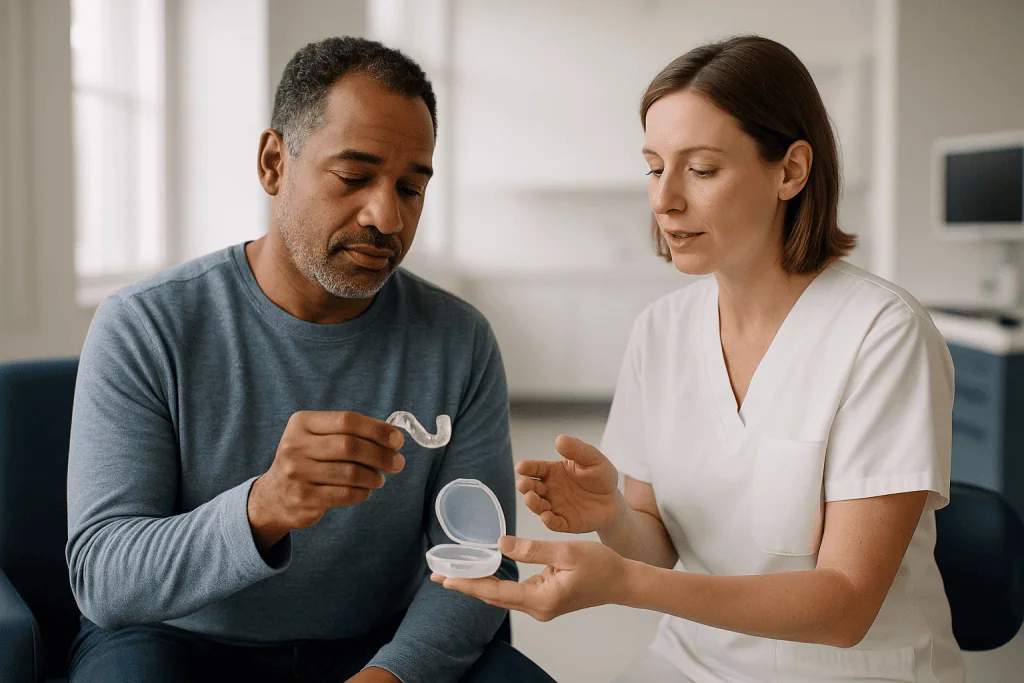
At the first visit, the dentist examines wear patterns, checks the temporomandibular joint (the hinge just in front of each ear where the lower jaw meets the skull), presses the chewing muscles for tenderness, and decides whether an upper or lower guard suits you. Then comes the impression. Traditionally this is a soft putty in a tray held over the teeth until it sets, which takes a few minutes and produces a negative mold. Increasingly it is a digital intraoral scan, a small wand that photographs the teeth thousands of times a second and builds a three-dimensional model on screen. Either way, a bite registration follows: you close gently onto a wafer or scanned position so the laboratory knows how your jaws relate.
The second visit is the fitting proper. The dentist seats the guard and checks retention, meaning it clicks into place and does not rock or lift when you open. Then articulating paper, a thin colored strip that leaves marks wherever teeth touch, goes between the guard and the opposing teeth. You tap and slide. Dark marks show where contact is heavy; blank areas show where teeth float. The dentist grinds the heavy spots down with an acrylic bur, re-marks, and repeats until contacts are even across both sides. Rough edges are polished so the tongue and cheeks stop noticing them.
You leave with cleaning instructions and a plan to return. That return visit is not optional politeness; it is part of the fitting.
From impression to laboratory: how the splint is made
Between the two appointments, the guard is fabricated, and knowing how explains why fit can drift.
With a putty impression, the laboratory pours dental stone into the mold to create an exact replica of your teeth. With a digital scan, the model is printed or milled. Onto that model the technician builds the splint. For a hard guard, a sheet of clear acrylic is heated and vacuum-formed over the model, or acrylic is processed in a mold, then trimmed to cover the biting surfaces and a few millimeters of gum-side tooth. For a dual-laminate guard, a softer inner layer is bonded to a hard outer shell. The bite registration lets the technician mount the upper and lower models on an articulator, a hinged device that mimics jaw movement, so the guard’s surface can be shaped to meet the opposing teeth evenly before you ever wear it.
Two decisions are made here that you should understand. The first is thickness. Thicker acrylic lasts longer against heavy grinding but feels bulkier and opens the bite more. The second is coverage. Most guards cover every tooth in one arch; partial guards that cover only front teeth exist but can allow back teeth to drift, which is why many dentists avoid them for long-term use.
Upper versus lower comes down to anatomy and comfort. Upper guards are more common because the palate offers stable support and the device stays out of the tongue’s way. Lower guards suit people with a strong gag reflex, some with breathing concerns, or those whose upper teeth carry extensive crowns. Neither is inherently superior; the treating dentist chooses based on your mouth.
Every one of these stages introduces a tiny tolerance. Stone expands fractionally as it sets; acrylic shrinks fractionally as it cools. The fitting visit exists to cancel those out.
How should a night guard fit? The signs of a correct seat
People ask this question because the sensations are unfamiliar and no one told them what normal is. Here is what dentists look and feel for.
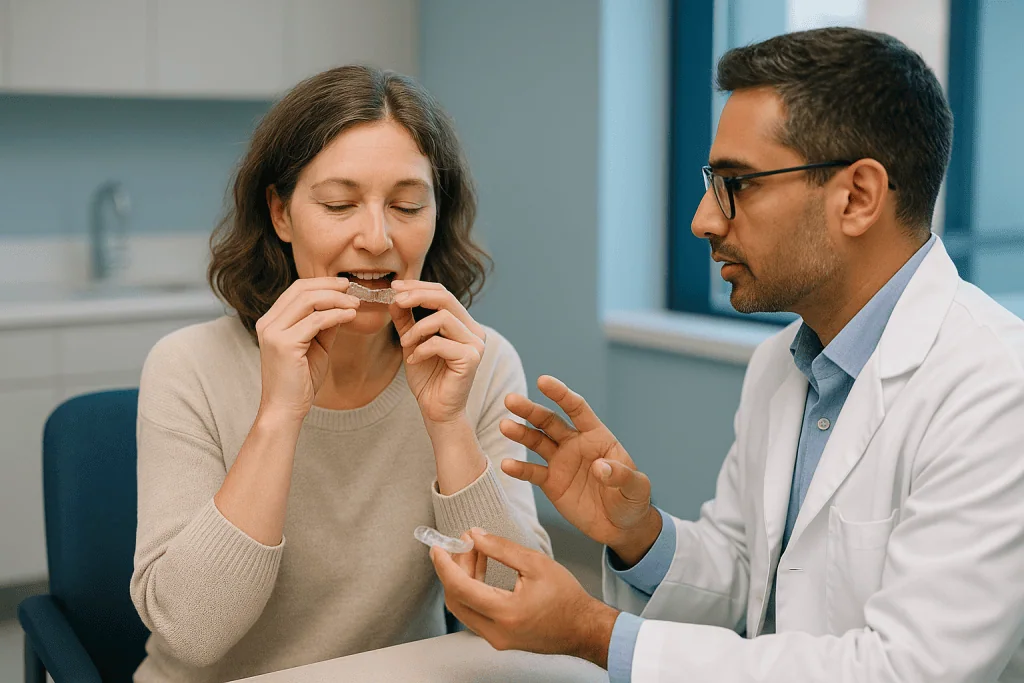
Retention first. A well-fitted guard slides on with light finger pressure, gives a faint click as it passes the widest part of the teeth, and stays put when you open wide or run your tongue over it. You should not need to bite it into place, and it should not fall out if you tilt your head forward with your mouth open. It also should not require a struggle to remove; if you are prying at it with fingernails, it is too tight and will stress the acrylic and your gums.
Second, even contact. When you close, the opposing teeth should meet the guard at roughly the same moment on the left and right, back and front. If one molar hits first and the rest of the arch hovers, that single tooth carries the whole force of your night muscles, which is exactly the situation the guard was meant to prevent. Over weeks, a lone high spot can leave a tooth tender to cold or to tapping.
Third, no pressure points. Firm is fine; pinching is not. A guard that blanches the gum where it meets the teeth, or presses on the soft tissue behind the front teeth, will produce a sore spot within days. Mild speech change and extra saliva in the first nights are expected; ongoing pain is not.
Fourth, smooth edges. The tongue is a relentless inspector. Any ledge or rough border becomes an irritation, and irritation is why guards end up in a drawer.
A fit that meets all four is comfortable enough to forget. That, not snugness for its own sake, is the goal of any night guard fitting.
Hard, soft or dual-laminate: what the material changes
Cleveland Clinic describes night guards as available in hard, soft and layered forms, and the choice is not cosmetic. Material determines how the guard wears, how it feels and how it can be adjusted.
| Type | Made from | Best matched to | Trade-offs the dentist weighs |
|---|---|---|---|
| Hard acrylic | Rigid clear resin, lab-processed to a model | Moderate to heavy grinders; anyone with crowns or extensive dental work to protect | Precise adjustment with a bur is possible; feels bulkier at first; cracks rather than tears |
| Soft (flexible) | Pliable thermoplastic | Light clenchers; people who cannot tolerate rigid acrylic | Comfortable quickly; wears through faster; contacts cannot be refined with articulating paper; some people chew on the give |
| Dual-laminate | Soft inner layer bonded to a hard outer shell | People who want cushioning against the teeth with a durable biting surface | Adjustable outer layer; thicker overall; bond can separate over years |
| Boil-and-bite (over the counter) | Thermoplastic softened in hot water and pressed onto the teeth at home | Short-term or trial use | Approximate fit; bulky; no occlusal balancing; wears quickly; not tied to a clinical exam |
Notice the pattern in the right-hand column. Hard acrylic is the material dentists can actually fine-tune, which is why it dominates when bruxism is doing visible damage. Soft guards feel kinder on night one, but a softer surface gives the jaw something springy to work against, and some patients find they clench more, not less. Dual-laminate splits the difference and is popular for that reason.
The decision should follow the examination: how flat the cusps are, how many restorations need protecting, whether joint symptoms are present, and how much bulk you can tolerate. Your dentist may also factor in a gag reflex or a small mouth. There is no single correct material, only the one matched to your mouth and habits.
Does a night guard need to be fitted? Custom versus boil and bite night guard
The honest answer is that any barrier between the teeth offers some protection, and a custom guard offers protection that is accurate, balanced and monitored. The difference shows up in three places.
Fit. A boil and bite night guard is softened in hot water and molded by your own bite at the bathroom sink. The result captures the outlines of the teeth but not the fine detail of an impression or scan, and it is not trimmed by anyone. The material is thick, so the bite opens more than necessary, and it tends to loosen as it warms in the mouth overnight. A custom guard is built on an exact model, trimmed to your gumline and refined at the chair.
Balance. Over-the-counter guards have no occlusal adjustment, the process of marking and smoothing contact points so both sides of the jaw share the load. Whatever surface the thermoplastic happened to form is what you sleep on. If it is high on one side, the jaw muscles work unevenly, and some people wake with more soreness than they started with.
Oversight. The larger point is that a custom night guard fitting comes attached to an examination. Bruxism can coexist with sleep apnea, medication side effects, reflux and jaw joint disorders, all of which the NHS and Mayo Clinic list among contributors or associated conditions. A dentist who sees your wear pattern can raise those questions; a package on a shelf cannot.
None of this makes over-the-counter guards useless. Dentists sometimes suggest one as a stopgap while a custom splint is being made, or to see whether a person tolerates wearing anything at all. Where they fall short is as a long-term substitute, particularly for heavy grinders or anyone with crowns, implants or a history of jaw pain.
Who a night guard is usually for, and who is usually asked to wait
Mayo Clinic is candid that in many cases bruxism needs no treatment at all: mild grinding that causes no symptoms or damage is often simply observed. A splint enters the conversation when the grinding is leaving evidence.
The people who most often benefit are adults with visible wear facets, chipped or cracked teeth, worn or repeatedly failing fillings, or crowns and veneers worth protecting from night-time force. Waking with jaw muscle ache, temple headaches or teeth that feel loose in the morning also pushes dentists toward a guard. People who have had extensive restorative dentistry are frequently offered one regardless of symptoms, because the cost of protecting new work is small next to the cost of redoing it.
Some people are asked to wait or to try something else first. Children are the clearest example. Mayo Clinic notes that bruxism is common in children and often stops on its own as adult teeth come in; a rigid guard on a growing mouth can also interfere with tooth eruption, so dentists tend to monitor rather than splint unless damage is significant. Anyone in the middle of orthodontic treatment usually waits, because teeth are moving and a guard made this month will not fit next month; braces-friendly options are handled by the orthodontist. People with active gum infection, untreated decay or a loose tooth typically have those addressed first, since a guard can trap bacteria against inflamed tissue or lever a compromised tooth.
A third group needs a different device entirely. If snoring, witnessed pauses in breathing or heavy daytime sleepiness accompany the grinding, the dentist may suggest evaluation for sleep apnea before making a guard, because an ordinary splint can sit awkwardly with an airway problem. Whether you fall into any of these groups is a judgment for the treating team, made in the chair with your teeth in view.
Getting used to a night guard: what the first weeks usually look like
Nobody sleeps with a mouthful of acrylic comfortably on night one. Knowing the typical arc helps you tell adaptation from a problem.
The first few nights bring extra saliva, a sense of fullness, and a bite that feels slightly propped open. Some people wake to find the guard on the pillow, tossed out by the tongue during sleep. Speech sounds a little thick if you talk with it in. All of this is the mouth cataloguing a foreign object, and it usually fades as the brain stops flagging the sensation. Dentists commonly suggest wearing the guard for a short stretch while reading or watching television before bed during this period, so that the mouth meets it while you are awake and can register that it does not hurt.
Over the following weeks, two things tend to happen. The guard becomes forgettable, and the teeth may feel odd for a minute after removal in the morning, as if they do not quite meet. That transient sensation, sometimes described as the bite feeling off, is common with any splint and resolves as the teeth settle back into their usual contacts within a short time. If it does not resolve within the morning, or if a tooth stays tender, note it for the follow-up.
What should not happen is escalating pain. A sore spot on the gum that worsens each night, a specific tooth that aches with cold, or jaw joint pain that is new since the guard arrived are all signs of a high spot or an over-tight edge, and each is adjustable. Do not sand or trim the guard yourself; acrylic removed cannot be put back, and the contact you eliminate may be one the dentist deliberately created.
Most dental teams schedule the first follow-up within a few weeks precisely because these issues surface in that window.
The follow-up visit: how a night guard is adjusted
If the fitting is where the guard is born, the follow-up is where it grows up. Here is what a good adjustment visit involves, and why it is the part of the process this article would defend most strongly.
The dentist starts with your report. Where does it press? Which side feels heavier? Did anything change in the morning bite? Then the guard comes out for inspection. Fresh acrylic shows shiny wear facets wherever the opposing teeth have been working overnight, and those facets are a map of your grinding: their size, location and direction tell the dentist how you move your jaw in sleep. Sometimes that map reveals a lateral grinding pattern the initial articulating-paper check, done with you tapping gently while awake, could not have shown.
The guard goes back in, articulating paper goes between, and the dentist repeats the marking sequence: tap, slide side to side, slide forward. Heavy marks are reduced with a bur in strokes of a fraction of a millimeter; a high spot rarely needs more than that. A pressure sore on the gum is traced to the corresponding edge of the guard, which is relieved and polished. If the guard has loosened, small amounts of acrylic can be added inside to restore retention; if it has tightened because of a recent filling, the area is eased. The whole procedure is painless and typically brief.
Two things to watch for at this visit. First, the dentist should re-examine your teeth and muscles, not just the splint, because a guard that is protecting teeth beautifully may still coexist with worsening muscle pain that needs a different approach. Second, a clear plan for the next check should be set. Cleveland Clinic advises bringing your guard to regular dental visits so it can be assessed for fit and wear; the guard is a living device, and its check-ups belong on the same calendar as yours.
My night guard doesn't fit anymore: causes and what to do
A guard that fitted perfectly in the chair and now rocks, pinches or refuses to seat is one of the most common reasons people go back. The causes fall into a handful of categories, and almost all are fixable.
Dental work is the leading culprit. A new filling, crown or even a small bonding repair changes the shape of a tooth, and a guard molded to the old shape will sit high or refuse to go on. Tell your dentist you wear a guard before any restorative work; often the guard can be adjusted in the same visit, and occasionally it must be remade.
Heat is the second. Acrylic and thermoplastics warp if left in a hot car, rinsed under hot water or run through a dishwasher. A warped guard can look normal and still fail to seat. Cool water only, always.
Tooth movement is the third and the most easily missed. Teeth shift slightly throughout adult life, especially after gum disease or tooth loss, and a guard that was snug can loosen over years. The reverse also happens: a guard that has not been worn for months may feel tight because the teeth have drifted a fraction without its nightly influence.
Wear is the fourth. Heavy grinders can thin the biting surface until it cracks or perforates; once there is a hole, the guard no longer protects the tooth beneath it.
Whatever the cause, the response is the same. Stop forcing the guard; a splint jammed onto teeth can lever a crown loose or bruise the gum. Do not heat it to reshape it or trim it with household tools. Book an adjustment. The dentist will diagnose which of the four has happened and decide between refitting, relining with fresh acrylic, or making a new impression. That decision depends on what changed in your mouth, which is why it stays with the treating team.
Cleaning, storage and knowing when a guard needs replacing
A night guard spends a third of each day in a warm, wet, bacteria-rich environment. Caring for it is straightforward, but the habits matter because a neglected guard becomes both unpleasant and a source of gum irritation.
Rinse it under cool running water every morning and brush it gently with a soft toothbrush. Ordinary toothpaste is abrasive enough to scratch acrylic over time, and scratches harbor plaque, so many dentists suggest a mild soap or a cleaner intended for dental appliances instead. Let it dry fully before it goes into its case; a damp guard sealed in plastic grows an odor within days. The case itself should be ventilated and cleaned regularly, and kept away from pets, who find acrylic irresistible.
Never soak a guard in hot water, mouthwash containing alcohol, or bleach. Heat warps it; alcohol dries and clouds it; bleach degrades it. If a white film builds up, your dentist can clean it professionally with an ultrasonic bath.
Replacement is a judgment call rather than a fixed schedule, and it is made by looking at the guard. Signs that its useful life is ending include a crack you can see or feel with a fingernail, a biting surface worn thin enough to flex or with a visible hole, persistent cloudiness or roughness that cleaning does not remove, and a fit that can no longer be corrected by adjustment. Heavy grinders wear through guards faster than light clenchers, which is one reason material choice at the original night guard fitting matters. Bring the guard to every dental check-up so wear can be tracked, and keep the old one for a night or two after a replacement arrives in case the new one needs a first adjustment.
What people often get wrong about night guards
Some myths are harmless; a few lead to damaged teeth or abandoned treatment. These are the ones worth correcting.
A guard will stop me grinding. It will not, or at least not reliably. It protects the teeth from the grinding. Mayo Clinic frames splints as preventing damage, not as eliminating the behavior, and treating the guard as a barrier rather than a solution keeps expectations realistic.
Tighter means better. A guard that must be forced on is stressing the acrylic, the gums and any crowns it snaps over. Correct retention is a light click, not a wrestling match.
Soft is always more comfortable, so soft is better. Soft feels friendlier on night one, but its give can invite chewing, and it cannot be balanced with articulating paper. For heavy grinders, hard or dual-laminate usually protects better.
If it feels off, I can trim it myself. Acrylic removed at the kitchen table cannot be restored, and the spot you sand may be a contact the dentist deliberately shaped. Self-trimming is the fastest route to a guard that needs remaking.
A guard from a shelf is the same thing, just cheaper to get. The over-the-counter version captures rough outlines without occlusal balancing or an examination. It is a reasonable stopgap and a poor long-term substitute.
Once it fits, it fits forever. Dental work, tooth movement, heat and wear all change fit. Regular checks are part of owning one.
Wearing it means I do not need to address stress or sleep. The NHS lists stress, anxiety and sleep problems among the common contributors to grinding. The guard shields the teeth while those are worked on; it does not replace that work.
Beyond the splint: what else the evidence supports for bruxism
Because the guard is a helmet and not a brake, most treatment plans pair it with something aimed at the grinding itself. The mainstream options are modest in number and honest in their limits.
Stress management comes first in both NHS and Mayo Clinic guidance. Relaxation techniques, exercise, and, where anxiety is significant, talking therapies such as cognitive behavioral therapy are suggested because psychological arousal is one of the best-established contributors to sleep bruxism. The evidence that these reduce grinding is moderate rather than strong, but they carry little risk and help sleep quality generally.
Sleep hygiene overlaps with that. Mayo Clinic lists limiting alcohol and caffeine, particularly in the evening, and avoiding tobacco, since all are associated with more grinding. Treating an underlying sleep disorder, especially obstructive sleep apnea, can change bruxism substantially when the two coexist, which is why dentists ask about snoring.
Habit awareness addresses daytime clenching. Noticing when the teeth are together during the day and consciously resting the jaw with lips closed and teeth apart is a simple exercise many dentists teach; it will not touch sleep grinding directly, but daytime clenching loads the same muscles.
Medicines have a small role. Mayo Clinic notes that muscle relaxants are sometimes used short term before bedtime, that botulinum toxin injections into the chewing muscles may be considered for severe cases that have not responded to other measures, and that medicines for anxiety or stress may help when those drive the grinding. It also notes that some antidepressants can themselves cause bruxism, so a review of current medicines belongs in the conversation. All of these are decisions for the prescribing clinician, weighed against side effects and the modest evidence base.
Dental correction of a misaligned bite is occasionally proposed, but Mayo Clinic describes it as reserved for severe wear that has affected chewing, not as a routine remedy for grinding.
Questions to ask your care team about a night guard
A fitting goes better when you arrive knowing what to ask. These questions cover the decisions that most affect comfort and longevity, and none of them should trouble a dentist to answer.
- What evidence of grinding do you see in my mouth, and how severe is it?
- Are you recommending hard acrylic, soft or dual-laminate, and what about my teeth or habits led to that choice?
- Upper or lower arch, and why for me?
- Will the guard cover all my teeth, and if not, what is the reason?
- How thick will it be, and how much will it open my bite?
- Do I have any fillings, crowns or dental work coming up that should be finished before the impression is taken?
- What should the first week feel like, and which sensations mean I should call rather than wait?
- When is my first adjustment visit, and what will you check at it?
- How should I clean and store it, and what should I never do to it?
- How will we know when it needs relining or replacing?
- Should I be evaluated for sleep apnea, given my snoring or daytime tiredness?
- Are any of my current medicines known to contribute to grinding?
- What else, beyond the guard, do you suggest I work on for the grinding itself?
Two of these deserve emphasis. The question about upcoming dental work saves the frustration of a guard that no longer fits a month after it arrives. The question about the first adjustment visit ensures that the follow-up is scheduled rather than left to chance. If a proposed plan does not include a follow-up, it is reasonable to ask for one.
Write the answers down. Guards last years, and the reasoning behind material and arch choice is useful to have on hand when a replacement is eventually discussed.
When to call your doctor or dentist
Most issues with a night guard are comfort problems that an adjustment resolves. A few situations deserve a prompt call rather than waiting for the scheduled visit.
Call your dentist promptly if a specific tooth becomes increasingly tender to cold, pressure or tapping after you start wearing the guard; a persistent high spot can inflame the tissue inside the tooth. Call if a gum sore worsens night after night, bleeds, or develops a white or yellow patch. Call if the guard cracks, develops a hole or sharp edge, or no longer seats, and do not keep wearing a damaged one. Call if you notice a crown or filling has loosened, or if a tooth feels mobile in the morning.
Seek urgent dental or medical care for jaw pain accompanied by inability to open or close the mouth fully, a jaw that locks or clicks painfully and does not release, sudden facial swelling, fever with mouth pain, or a broken piece of guard that you may have swallowed or inhaled during sleep. Inhalation of a fragment, in particular, warrants same-day medical assessment.
Beyond the guard, tell your doctor if grinding comes with loud snoring, pauses in breathing witnessed by a partner, gasping awakenings or marked daytime sleepiness; these are features that prompt evaluation for sleep apnea, a condition with cardiovascular consequences that a splint does not address. Persistent morning headaches, ear pain without infection, or facial pain that spreads should also be reviewed, because temporomandibular disorders and other causes of facial pain can mimic or accompany bruxism.
Every one of these decisions, from a small adjustment to a referral for a sleep study, sits with your treating team. Your job is to report what you notice accurately and early. Theirs is to work out what it means.
Frequently asked questions
How is a night mouth guard supposed to fit?
A night guard should slide on with light finger pressure, click gently into place and stay put when you open wide, without rocking or needing to be bitten down. When you close, teeth should meet it evenly on both sides at the same moment. Firm is normal; pinching, gum blanching or a single tooth hitting first are not, and each is something the dentist can adjust at the chair.
How should a night guard fit differently on the upper versus the lower teeth?
The principles are identical: snug retention, even contacts and smooth edges. An upper guard uses the palate for extra stability and sits out of the tongue’s way, so it is more common. A lower guard leaves the palate free and suits people with a strong gag reflex or extensive upper crowns. Which arch you receive is a clinical decision based on your anatomy, restorations and comfort, not a matter of one being better.
Does a night guard need to be fitted by a dentist?
Any barrier offers some protection, but a dentist-fitted guard is built on an exact model, trimmed to your gumline and balanced with articulating paper so both sides share the load, and it comes with an examination that can pick up related problems such as sleep apnea or jaw joint disorders. Over-the-counter options skip all of that. They can serve as a short-term stopgap while a custom splint is made.
How much does it cost to get fitted for a night guard?
We do not publish prices, because they vary widely with material, laboratory, region and dental insurance, and a figure here would mislead more than inform. The variables that influence the amount are the type of guard, whether digital scanning is used, how many adjustment visits are included, and your coverage. Ask the dental office for an itemized estimate before the impression appointment, and ask whether follow-up adjustments are included.
Is a boil and bite night guard good enough for bruxism?
For light clenching or as a temporary measure, it may offer some protection. For heavy grinding, or for anyone with crowns, implants or jaw pain, it is generally not recommended long term because the fit is approximate, the material is bulky and wears quickly, and no one balances the biting surface. It also bypasses the dental examination that would identify wear patterns and related conditions.
How long does getting used to a night guard take?
The first few nights typically bring extra saliva, a full feeling and occasionally a guard that ends up on the pillow. These sensations fade as the mouth stops registering the device, and most people find it forgettable within weeks, though the exact time varies. Wearing it briefly while awake before bed can speed adaptation. Escalating pain, a tender tooth or a worsening gum sore are not part of adjustment and should prompt a call.
My night guard isn't fitting properly. What should I do?
Stop forcing it on, do not heat or trim it yourself, and book an adjustment. The usual causes are recent dental work changing a tooth’s shape, warping from hot water or a hot car, gradual tooth movement, or wear that has thinned or cracked the surface. Your dentist will identify which has happened and decide between adjusting, relining with fresh acrylic or taking a new impression.
Why does my night guard not fit anymore after a filling?
A filling or crown changes the shape of the tooth, and the guard was molded to the old shape, so it now sits high or will not seat at that spot. This is expected rather than a fault. Tell your dentist you wear a guard before any restorative work; often the guard can be eased at the same visit. If the change is large, a new impression may be needed.
Will a night guard stop me grinding my teeth?
Usually not. Mayo Clinic describes splints as devices that keep the teeth apart to prevent damage from clenching and grinding, not as treatments that eliminate the behavior, which originates in the nervous system during sleep. Some people grind less with a guard in, some grind the same amount. Reducing the grinding itself involves addressing contributors such as stress, sleep problems, alcohol, caffeine and certain medicines with your care team.
Can a night guard make jaw pain worse?
It can if it is poorly balanced, so that one side carries more force, or if it is too thick or too tight for your jaw. Well-fitted guards more often ease morning stiffness, though the evidence for muscle relief is more mixed than for tooth protection. New or worsening joint pain, clicking, or difficulty opening after starting a guard should be reported promptly so the fit can be checked and other causes considered.
References
- NHS: Teeth grinding (bruxism)
- Cleveland Clinic: Teeth Grinding (Bruxism)
- Cleveland Clinic: Mouthguards
- MedlinePlus: Bruxism
This article is for general information only and is not a substitute for professional medical advice. Please consult a qualified doctor about your individual situation.

More from the Blog

Fitting a Space Maintainer: How the Band Is Cemented and How Long the Visit Takes
A space maintainer fitting for a child is usually completed across two short dental visits. At the first, the dentist fits a separator or…

Before Committing to an Aesthetic Dentistry Plan: What to Ask the Cosmetic Dentist
Before agreeing to any aesthetic dental plan, ask the cosmetic dentist whether your gums and teeth are healthy enough to treat, how much natural…

Is Gum Disease Contagious or Hereditary, and Does Vaping Cause It?
Gum disease is not contagious in the way a cold is, though the bacteria involved can pass between people through saliva; disease develops only…
Is Sensitivity After a Dental Filling Normal? When a Bite Adjustment Helps
Mild sensitivity to cold, sweets, or pressure is common after a dental filling and usually fades over days to a few weeks as the…

Tooth Decay Treatment in Older Adults: Root Cavities, Dry Mouth and Medication Effects
Cavities in older adults are common and treatable at any age. They often form on exposed root surfaces, which are softer than enamel, and…

Life After a Root Canal: Why the Crown Matters and How to Chew on the Tooth Safely
A crown after a root canal protects a tooth that is now hollowed, dry and more brittle, especially a back tooth that takes heavy…