

Non-Surgical Facelift vs Surgical Facelift: What Each Treats and Where Each Stops

Key Takeaways
- A surgical facelift works on the SMAS, the deep supporting layer of the face, which is the only structure that can lift a true jowl or loose neck; no injectable, device or thread reaches it.
- Non-surgical treatments address volume loss, expression lines and skin quality, and surgery does none of those, so the two are often complementary rather than rival options.
- The NHS describes botulinum toxin effects lasting around three to four months and dermal fillers around six to eighteen months, while Mayo Clinic gives roughly ten years as a common expectation for a facelift.
- Hyaluronic acid filler is the only common option that can be deliberately reversed, using an injected enzyme called hyaluronidase.
- Hematoma is the most common serious early complication of facelift surgery, and vascular occlusion, which can rarely cause skin loss or blindness, is the serious risk of filler, so practitioner training matters more than product choice.
- Smoking, uncontrolled blood pressure and blood-thinning medicines or supplements raise surgical risk, and the treating team, not the patient alone, should decide how to manage them before any procedure.
A surgical facelift repositions sagging deeper facial tissue and removes excess skin, so it treats jowls, a slack jawline and loose neck skin. Non-surgical options such as injectables, energy-based skin tightening and thread lifts restore lost volume, soften lines and modestly firm skin, but they cannot lift heavy, descended tissue. Neither approach stops aging, and the right choice depends on what has actually changed in your face.
The mirror in the elevator is the cruel one. Overhead light, no warning, and there it is: a jawline that used to be a line and is now more of a suggestion. A woman in her late fifties described it to me as the moment she stopped asking whether to do something and started asking what.
That is the real question behind every search for non surgical vs surgical facelift. Not which is better, but which one addresses the thing you are actually seeing. A drooping cheek and a fine line at the corner of the mouth look like the same problem from three feet away. They are not the same problem to the tissue underneath, and they do not respond to the same tools.
What follows is an attempt to map that honestly: what an operation can move, what a needle or a device can change, and where each one runs out of road.
Non surgical vs surgical facelift: what each is designed to do
Start with the anatomy, because the marketing usually skips it. A face ages in three layers at once. Skin loses collagen and elasticity. The fat pads beneath it shrink and slide downward. The deeper supporting sheet of muscle and connective tissue, called the SMAS (the superficial musculoaponeurotic system, a firm layer that acts like a hammock for the face), loosens and descends. Bone recedes a little too, especially around the eyes and jaw.
A surgical facelift, formally a rhytidectomy (the medical term for surgery that lifts the face), is built for the third layer. According to Mayo Clinic, the operation lifts and tightens the deep tissue and removes or redrapes excess skin to address sagging in the lower face and neck. Its job is gravity: jowls, a soft jawline, loose neck skin, deep folds that form because tissue has fallen rather than because it has thinned.
Non-surgical treatments are aimed at the first two layers. Injectable fillers replace volume that has drained away. Botulinum toxin (a purified protein that temporarily relaxes the muscles it is injected into) softens lines carved by expression. Energy devices try to coax skin into producing new collagen. Threads attempt a small repositioning of soft tissue without an incision.
Put plainly, surgery lifts what has dropped; non-surgical work refills, relaxes and refines. That distinction sounds academic until you realize how many people are disappointed because they asked one tool to do the other’s job. A cheek that has slid an inch does not go back up because you filled the hollow it left behind. And a person with fine skin crinkling but a firm jawline may find surgery changes very little of what bothered them.
How a surgical facelift works: what actually happens in the operating room
Most people picture skin being pulled tight. Modern technique is closer to the opposite. The surgeon makes incisions that typically begin in the hairline near the temple, travel around the ear and end in the lower scalp, as described by Mayo Clinic and MedlinePlus. The skin is lifted away from the deeper layers so the surgeon can reach the SMAS.
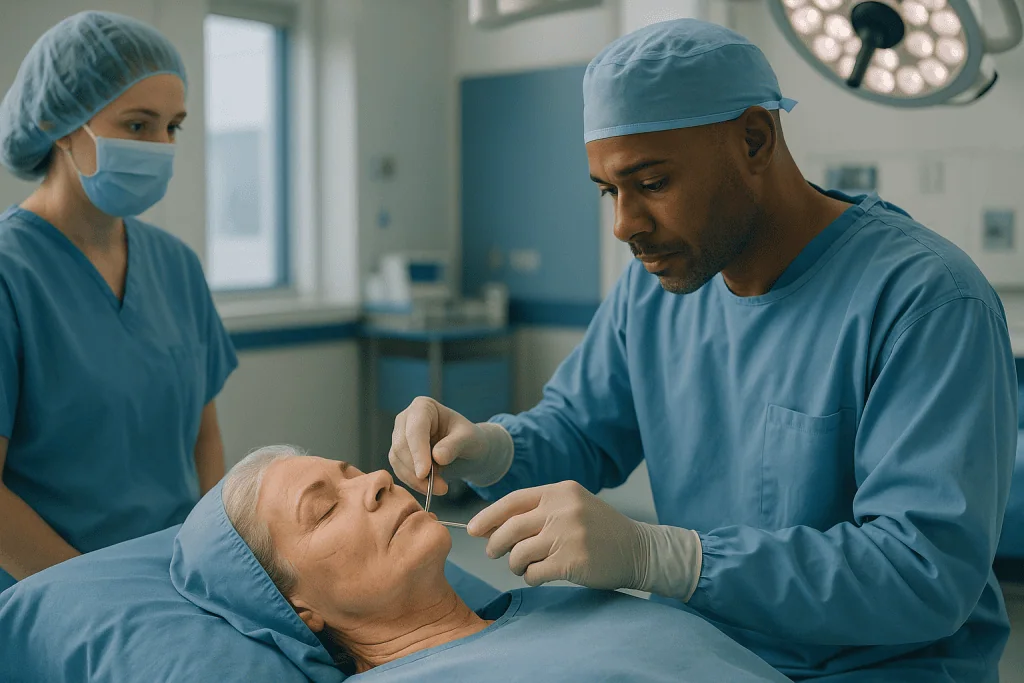
That deeper layer is then repositioned and secured, either by folding and stitching it (a technique called plication) or by releasing and moving it (a SMAS lift or deep-plane lift). This is the part that treats jowls, because jowls are the SMAS and fat sliding down over the jaw. Once the foundation sits higher, the skin is laid back over it and only the genuine excess is trimmed. Pulling the skin alone, without moving the layer beneath, is what produced the wind-tunnel look of earlier decades, and it does not hold.
A facelift addressing the neck often adds a small incision under the chin so the surgeon can tighten the platysma (the thin sheet of muscle that runs from jaw to collarbone and creates vertical neck bands when it loosens) and remove fat if needed. The eyelids, brow and mid-face are separate operations that may or may not be combined, which is one reason two people can both say they had a facelift and mean quite different things.
The procedure is done under general anesthesia or deep sedation with local anesthetic, and Mayo Clinic notes it may involve an overnight hospital stay. Small drainage tubes are sometimes placed to reduce fluid collection, and the head is wrapped in a dressing. None of this is minor. It is real surgery, with the recovery and risk profile that implies, in exchange for treating a layer nothing else can reach.
Non-surgical facelift options: what is actually on the menu
The phrase non-surgical facelift is a category, not a procedure. When a practitioner uses it, they usually mean some combination of the following, and it is worth knowing which is which before you sit in the chair.
- Botulinum toxin injections. A neuromodulator (a substance that changes how nerves signal muscles) that relaxes the muscles behind frown lines, crow’s feet and forehead creases. NHS guidance describes effects lasting around three to four months.
- Dermal fillers. Most are hyaluronic acid (a sugar-like molecule the body already makes, which binds water). Injected into cheeks, temples, jawline or folds to restore volume. The NHS puts typical duration at roughly six to eighteen months.
- Biostimulatory injectables. Materials designed to prompt the body to make its own collagen over months rather than adding volume immediately.
- Energy-based skin tightening. Radiofrequency, focused ultrasound and some lasers heat the deeper skin to trigger a healing response and new collagen.
- Thread lifts. Dissolvable barbed sutures placed under the skin to gently reposition tissue and, in theory, stimulate collagen as they break down.
- Resurfacing. Chemical peels, microneedling and ablative or fractional lasers that improve texture, pigmentation and fine lines rather than lift.
Notice what is missing from that list: anything that moves the SMAS. Every item works at or just beneath the skin, or by filling space, or by relaxing a muscle. That is not a criticism. Those are the layers most people in their thirties and forties are actually seeing change in. It is simply the boundary of the toolkit, and an honest consultation should draw it for you.
Which of these is right, if any, depends on the specific finding. Hollow temples call for a different answer than a heavy neck, and a good clinician will say so even when the answer is that their office does not offer what you need.
How non-surgical treatments work under the skin
Each option has a mechanism, and the mechanism predicts both what it can do and how long it lasts.

Botulinum toxin blocks the release of a chemical messenger at the junction between nerve and muscle. The muscle cannot contract fully, so the skin above it stops folding. Lines that exist only when you move fade quickly; lines that have been etched in at rest soften more slowly, if at all. The nerve gradually sprouts new connections, which is why the effect wears off over the months the NHS describes.
Hyaluronic acid filler is a physical presence. It occupies space and pulls in water, so it plumps a hollow or props up a fold from beneath. Over time the body’s own enzymes break it down. Because it can also be dissolved deliberately with an injected enzyme called hyaluronidase, it is considered reversible in a way most other treatments are not.
Energy devices rely on controlled injury. Radiofrequency passes electrical energy through tissue, and focused ultrasound concentrates sound waves at a set depth; both create heat that makes collagen fibers contract slightly and signals cells to build more over the following weeks and months. The tightening is real but modest, and the evidence base consists largely of smaller studies with varying endpoints, so results are described honestly as improvement rather than lift.
Thread lifts are mechanical. Tiny cones or barbs on the suture catch soft tissue so it can be nudged upward and anchored. The threads dissolve over months, and what remains is whatever scar-tissue support formed around them. High-quality long-term data are limited, and NHS-linked patient information treats them as a temporary measure.
Resurfacing treatments remove or injure the outer skin so it regenerates more evenly. They are the only non-surgical tools that improve surface quality, which surgery does not touch at all.
Where each approach stops: the honest limits
Every treatment has a ceiling, and the most useful thing a consultation can do is tell you where it is.
Non-surgical work stops at true descent. Once the SMAS and the fat pads have slid far enough to form a jowl that hangs below the jaw, or a neck where skin and muscle drape in visible bands, no amount of filler, energy or threads will put that tissue back where it was. Filler placed to disguise a jowl often makes the lower face heavier. Skin tightening devices can firm slightly loose skin but cannot shorten skin that has become genuinely excessive. Threads can shift tissue a small amount and, per the limited evidence, tend to settle within months.
Surgery stops at the surface. A facelift does nothing for sun damage, uneven pigmentation, fine crepe-paper texture or the small vertical lines around the mouth, and Mayo Clinic is explicit that it will not change skin quality. It also does not restore volume; a face that is deflated as well as fallen may look tighter after surgery but still gaunt, which is why surgeons commonly add fat grafting or later filler. Frown lines from expression persist because the muscles that make them are untouched.
Both stop at time. Mayo Clinic notes a facelift is not permanent and that skin may begin to sag again, giving a rough expectation of around ten years before many people feel the change has caught up with them. Non-surgical results fade on the timelines already described. Neither slows the underlying biology.
And both stop at expectation. No procedure reliably makes a person look like someone else, or like a photo from twenty years ago, or unrecognizable in a good way. The realistic aim is to look like a well-rested version of yourself. Anyone promising more is describing an outcome, not the evidence.
Who each approach is usually for, and who is asked to wait
Candidacy is less about age than about findings and health, though the two travel together.
Non-surgical treatments generally suit people whose main concerns are volume loss, expression lines, early or mild skin laxity and surface texture. That often describes people in their thirties to fifties, but a seventy-year-old with firm structure and sun-damaged skin may be an excellent candidate for resurfacing and a poor one for anything else. The NHS advises that fillers and botulinum toxin are not recommended during pregnancy or breastfeeding, and people with active skin infection at the treatment site, certain neuromuscular conditions, or a history of severe allergic reaction are usually asked to wait or steered elsewhere.
Surgical candidates are typically people with moderate to significant sagging of the lower face and neck who are healthy enough for anesthesia and a multi-week recovery. Mayo Clinic lists factors that raise complication risk: medicines or supplements that thin the blood, uncontrolled high blood pressure, diabetes, smoking and significant weight fluctuation. Surgeons commonly ask smokers to stop for a period before and after the operation because nicotine constricts blood vessels and raises the chance of skin not healing. People planning major weight loss are usually advised to reach a stable weight first, since losing weight afterward can loosen the result.
Both pathways involve a conversation about mental health and motivation. Guidance from the NHS on cosmetic procedures encourages a cooling-off period and cautions against deciding while under pressure from others or during a life crisis. A reputable clinician will screen for body dysmorphic disorder (a condition in which perceived flaws cause distress out of proportion to their visibility) and may recommend support rather than treatment.
Who decides? The treating team, with you, after examination. An article can describe patterns; it cannot look at your face.
Non surgical vs surgical facelift at a glance
Sometimes a table says it faster than paragraphs. The entries below reflect general descriptions from Mayo Clinic, MedlinePlus and NHS patient guidance rather than promises about any individual.
| Question | Non-surgical facelift | Surgical facelift |
|---|---|---|
| Main target | Volume loss, expression lines, mild laxity, skin texture | Sagging of deep tissue: jowls, jawline, neck |
| What it physically does | Fills, relaxes muscle, heats tissue to build collagen, or nudges tissue with threads | Repositions and secures the SMAS, tightens neck muscle, removes excess skin |
| Anesthesia | Usually none or topical/local | General anesthesia or sedation with local |
| Downtime | Hours to a few days; bruising possible | Around two weeks before most people return to work; swelling settles over weeks to months |
| Typical duration of effect | Toxin about 3 to 4 months; fillers about 6 to 18 months (NHS) | Not permanent; roughly ten years is a common expectation (Mayo Clinic) |
| Reversible? | Hyaluronic acid filler can be dissolved; toxin wears off; others are not reversible | No |
| Scars | None or pinpoint marks | Incisions hidden in hairline and around the ear |
| Improves skin surface? | Yes, if resurfacing is included | No |
| Lifts a true jowl or neck? | No | Yes |
| Serious risks | Rare vascular blockage from filler, infection, asymmetry, lumps | Hematoma, nerve injury, skin loss, infection, anesthesia risks |
Two things stand out. The columns are not competitors so much as neighbors, each covering ground the other cannot. And the trade is fairly consistent: shorter downtime and reversibility on one side, deeper and longer-lasting structural change on the other. Read the row that matches what you see in the mirror, not the row that sounds easier.
How long non surgical facelift lasts compared with surgery
Duration is where expectations most often go wrong, so it deserves its own space.
Botulinum toxin is the shortest-lived of the common options. The NHS describes effects generally lasting around three or four months, after which movement returns and lines gradually reappear. Some people find that with repeated treatment the muscle weakens somewhat and intervals lengthen, but that is a pattern rather than a rule.
Hyaluronic acid fillers sit in the middle. The NHS gives a range of roughly six to eighteen months, and the spread is real: a firmer product placed deep on the cheekbone tends to outlast a soft product in the highly mobile lip. Biostimulatory injectables are often described as lasting longer because they prompt collagen rather than adding a substance that is broken down, but the studies supporting specific durations are manufacturer-linked and modest in size.
Energy-based tightening is harder to pin down. The collagen response builds over two to six months and then declines as normal aging continues. Practitioners frequently describe results as lasting a year or two, but the published evidence is thin enough that any figure should be treated as an estimate, not a guarantee. Threads dissolve over months, and lifting effect is generally described as temporary in NHS-linked information.
Surgery lasts longest. Mayo Clinic states that a facelift is not permanent and that results generally hold for around ten years as the face continues to age. Crucially, aging does not restart from zero; the face keeps moving from a higher baseline, which is why people who have had surgery still look different from their untreated selves years later even when they feel the effect has faded.
One caution about all these numbers: they describe how long the change is visible, not how long you will be satisfied. Those are related but not identical, and only the second one matters to you.
Liquid facelift vs facelift: same goal, different tools
The term liquid facelift shows up in almost every search on this topic, and it deserves a plain definition. It means a coordinated set of injections, usually filler in several areas plus botulinum toxin, planned together to give an overall refreshed appearance rather than treating one line at a time. The word facelift in the name is aspirational; nothing is lifted in the surgical sense.
What a liquid approach does well is address deflation. Filler along the cheekbone, in the temples and beneath the eyes can restore the convex contours that read as youthful and, in doing so, take some visual weight off the lower face. Toxin softens the frown and the crow’s feet. For a person whose face has thinned but not fallen, this can be a genuinely good match, and it comes with the reversibility advantage that hyaluronic acid offers.
What it does poorly is disguise descent. When filler is used to prop up a sagging cheek or camouflage a jowl, the volume required grows with each visit, and faces can begin to look uniformly full rather than lifted. Clinicians sometimes call this overfilled or filler fatigue. It is one of the most common reasons people eventually seek a surgical opinion, having spent years addressing the wrong layer.
The comparison, then, is not liquid versus surgical as rivals. A liquid plan is often the right first step for a deflated face and a poor substitute for a fallen one. Some surgeons use filler after a facelift to restore volume that surgery cannot, and some injectors send patients for surgical consultation when the anatomy has outgrown what a needle can do. The useful question is not which is superior but which layer your face is asking about, and the NHS reminder that these products carry their own risks applies regardless of how the procedure is named.
What the following days and weeks usually look like
Recovery is where the two paths diverge most in daily life, and where planning matters.
After injectables, most people leave the appointment and return to ordinary activities the same day. Small bumps at injection sites settle within hours; bruising, if it happens, can take up to a week or two to fade. The NHS notes that fillers can cause temporary swelling, redness and tenderness, and advises avoiding strenuous exercise, alcohol and heat for a short period afterward. Toxin takes several days to begin working and roughly two weeks to reach full effect, so the mirror on day one tells you almost nothing. Energy treatments can leave skin pink and mildly swollen for a day or two, with the collagen response arriving gradually over months. Thread lifts commonly involve several days of tenderness, some puckering that smooths out, and advice to avoid wide facial movements while the tissue settles.
Surgery is a different calendar. Mayo Clinic describes a bandage around the face immediately afterward, sometimes with small drainage tubes removed within the first day or two. Swelling and bruising peak in the first few days and are often at their most alarming around day two or three; this is expected. Stitches are typically removed within about a week. Most people feel presentable enough to return to work and social life after around two weeks, according to both NHS and Mayo Clinic guidance, though visible bruising can be covered with makeup once incisions have healed. Numbness of the cheeks and ears is common and usually improves over weeks to months. Residual swelling and a sense of tightness can persist for several months, and the final contour is generally judged at about six months to a year.
None of these timelines is a promise. They describe what is typical, and your team will give you a plan specific to what was done.
Risks and complications, side by side
Neither pathway is risk-free, and the risks differ in kind, not just size.
Surgical risks are those of any operation plus a few specific to the face. Mayo Clinic lists hematoma (a collection of blood under the skin that can require urgent drainage), which is the most common serious early complication and the reason blood pressure control and avoiding blood-thinning medicines matter beforehand. Nerve injury can affect facial movement or sensation; most is temporary, but permanent weakness is possible. Skin along the incision can lose its blood supply and fail to heal, a risk markedly higher in smokers. Scars can widen or thicken, hairline position can shift, and asymmetry may occur. Infection, anesthesia reactions and blood clots in the legs are general surgical risks that apply here too.
Injectable risks are usually milder but include one that is rare and serious. The NHS describes common side effects of fillers as bruising, swelling, redness, lumps and, occasionally, infection or the filler moving from where it was placed. The serious event is vascular occlusion, where filler enters or compresses a blood vessel and cuts off blood supply to skin or, in very rare cases, the eye, which can cause blindness. This is why training and anatomical knowledge matter far more than the product used. Botulinum toxin side effects listed by the NHS include a drooping eyelid or brow, a frozen or uneven expression, headache and flu-like symptoms; these wear off as the toxin does.
Energy devices can cause burns, blistering, changes in skin color and, with focused ultrasound, temporary nerve tingling or fat loss in the treated area. Threads can become visible or palpable, cause dimpling, migrate or, uncommonly, become infected.
Across all of these, the evidence points to the same modifiers: the practitioner’s training, the setting, the patient’s health and the honesty of the pre-treatment conversation.
Is a non surgical facelift worth it? Thinking about value without a price tag
This article deliberately gives no prices, and not just because they vary so widely. Cost is the wrong first question. The better one is whether the treatment being proposed can change the thing you have noticed, and by how much.
Consider two people who both ask about non-surgical options. The first is forty-two with hollowing under the eyes and temples, some frown lines and firm skin. For her, injectables target the actual problem, results appear within days, and the changes are reversible if she dislikes them. Worth it, in the sense that the tool matches the task, is a reasonable conclusion for her to reach with her clinician.
The second is sixty-three with a jowl that folds over the jawline and neck bands that show when she talks. Filler will not lift that. Energy treatments might tighten skin slightly. Threads may shift it a little for a while. She may spend several years on repeated non-surgical treatment, feel modestly better each time, and still see the jowl. For her, the honest answer is that non-surgical work is worth it only if she understands she is buying maintenance and softening, not correction.
A useful test: ask the clinician to point on your face to what will change and what will not, and to describe the change as a percentage of what you see rather than as an adjective. Ask what the evidence base for that specific device or product looks like, and whether the studies were independent. Ask how many treatments the plan assumes and over what period. If the answers are vague, the value is unknown, whatever the number on the estimate.
Value also includes what you avoid. Reversibility, no anesthesia and same-day return to life are real benefits. So is treating the correct layer once rather than the wrong one repeatedly. Weighing those is a decision for you and your treating team, not for a search result.
What people often get wrong
A few misconceptions come up so consistently that correcting them is half the consultation.
Non-surgical treatments delay the need for surgery. There is no good evidence that filler, toxin or energy devices slow the descent of the SMAS. They can make the face look better along the way, and toxin may reduce the deepening of expression lines by limiting movement, but the deep tissue keeps sliding on its own schedule. People who believe they are preventing a facelift are usually postponing the decision, which is legitimate, but different.
A facelift makes you look pulled. That look comes from tightening skin without repositioning the layer beneath, a technique largely abandoned. Modern deep-layer approaches described by Mayo Clinic move the foundation and let the skin follow, which is why well-done results are often unnoticed by other people.
Fillers stretch the skin and make sagging worse. Hyaluronic acid filler in appropriate volumes is broken down by the body and does not permanently stretch skin. What does cause a heavy, altered look is chronic overfilling to compensate for descent, which is a planning problem rather than a property of the product.
Threads are a facelift without surgery. They are a temporary, modest repositioning with a limited evidence base. NHS-linked information treats them as short-term, and they are not an alternative for someone with a true jowl or neck laxity.
Results are permanent. Nothing here is. Mayo Clinic is explicit that a facelift does not stop aging, and every non-surgical effect fades on the timelines the NHS describes.
Age decides the treatment. Findings do. Two people of the same age can need opposite things.
Any practitioner is fine for injectables. Vascular occlusion and blindness are rare but real, and anatomical training is the main protection. Ask who is holding the needle and what their qualifications are.
Questions to ask your care team
A good consultation is a two-way examination. These questions tend to surface the information that matters, whichever path is under discussion.
- Looking at my face specifically, which layer is changing most: skin, volume or deep support? What is the evidence for that assessment?
- Which of my concerns will this treatment change, which will it not touch, and roughly how much difference should I expect in each?
- What would you recommend if I were your family member with the same findings, and what would you tell me to skip?
- What are your qualifications and how many of this exact procedure do you perform in a typical month?
- What are the serious complications, how often do they occur in published data, and what is the plan if one happens to me, including after hours?
- For injectables: is this product reversible, and do you keep the enzyme to dissolve it on site?
- For surgery: where will incisions sit, what anesthesia is planned, who provides it, and where will I recover?
- What is the realistic timeline for swelling, bruising, numbness and final result, and what would make you worried during that period?
- How long is the effect expected to last for someone with my anatomy, and what does maintenance involve?
- Which of my medicines, supplements or health conditions change my risk, and who should I talk to about them before deciding anything?
- What should I stop doing beforehand, such as smoking, and for how long?
- Do I have a cooling-off period before committing, and can I see written information to take home?
- If a non-surgical plan does not achieve what I want, at what point would you suggest a surgical opinion, or the reverse?
Write the answers down. A clinician who welcomes these questions and answers them in specifics is telling you something reassuring about how the procedure itself will be handled. Do not change or stop any prescribed medicine on your own in preparation; that conversation belongs with the prescriber.
When to call your doctor
Most recovery from either path is uneventful, but a small number of signs need same-day attention, and knowing them beforehand removes the guesswork.
After a surgical facelift, contact the surgical team or seek urgent care for sudden, one-sided swelling or pain in the face or neck, especially in the first two days, because this can indicate a hematoma that needs draining, as Mayo Clinic notes. Do the same for a fever, spreading redness, warmth or pus around an incision, skin that turns dark, dusky or pale along the flap, chest pain or shortness of breath, calf pain or swelling in one leg, new weakness of one side of the face that was not present immediately after surgery, or bleeding that does not stop with gentle pressure.
After injectable filler, treat as an emergency any blanching (skin turning white or mottled), severe or escalating pain, or a dusky purple or grey patch of skin near the injected area, particularly if it appears during or within hours of the treatment. Any change in vision, eye pain or a drooping eyelid with visual symptoms is a call-for-help-now situation because of the rare risk of filler affecting blood flow to the eye described by the NHS. Signs of allergic reaction such as difficulty breathing, swelling of the lips or throat, or widespread hives also need emergency care.
After botulinum toxin, seek advice for trouble swallowing, speaking or breathing, generalized muscle weakness, or a drooping eyelid, even though the last of these is usually temporary. After energy treatments or threads, call for blistering, worsening pain, fever, spreading redness or a thread that becomes visible or breaks through the skin.
When in doubt, call. Every one of these teams would rather hear from you about something that turns out to be normal swelling than not hear about something that was not.
Frequently asked questions
Is a non surgical facelift worth it?
It can be, when the treatment matches the change in your face. Injectables and energy devices address volume loss, expression lines and mild skin laxity well, with little downtime and, for hyaluronic acid filler, the option to reverse. They are a poor match for jowls or neck sagging, which involve deeper tissue they cannot move. Ask your clinician to point to exactly what will and will not change before deciding.
What is the most effective non surgical facelift option?
There is no single most effective option, because each tool targets a different problem. Filler is effective for hollowing, botulinum toxin for lines made by expression, resurfacing for texture and pigment, and energy devices for mild laxity. Effectiveness depends on choosing the tool that matches your finding, and the independent evidence for energy devices and threads is more limited than for injectables.
How long does a non surgical facelift last?
It depends on which treatments are included. NHS guidance describes botulinum toxin effects lasting around three to four months and dermal fillers roughly six to eighteen months, with firmer products in less mobile areas tending toward the longer end. Energy-based tightening and thread lifts are generally described as lasting months to a year or two, though the evidence for precise durations is modest and results vary between people.
Liquid facelift vs facelift: which one do I need?
A liquid facelift is a coordinated set of filler and botulinum toxin injections and suits a face that has lost volume but not dropped. A surgical facelift repositions deep tissue and suits jowls, a slack jawline and loose neck skin. Many people benefit from one, some from both at different times, and an examination by a qualified clinician is the only reliable way to tell which layer is changing in your case.
Can non-surgical treatments delay the need for a facelift?
There is no good evidence that they slow the descent of the deep facial tissue that surgery treats. They can improve appearance in the meantime, and toxin may limit the deepening of expression lines by reducing movement, but the SMAS continues to loosen at its own pace. Non-surgical care postpones the decision rather than the anatomy, which is a legitimate choice as long as it is understood that way.
Does a surgical facelift stop aging?
No. Mayo Clinic states that a facelift is not permanent and that the face continues to age afterward, with skin potentially sagging again over roughly a decade. The operation resets the position of deep tissue and removes excess skin, so aging resumes from a higher starting point rather than stopping. It also does not change skin texture, sun damage or expression lines, which need different treatments if they bother you.
What is the difference between a mini facelift and a full facelift?
A mini facelift uses shorter incisions and addresses milder sagging of the lower cheek and jawline, usually without extensive neck work. A full facelift extends incisions around the ear and into the scalp and typically includes tightening the neck muscle and removing more skin. Which is appropriate depends on how far tissue has descended, and the surgeon decides based on examination rather than on the patient’s preference for a smaller operation.
Can you combine non-surgical treatments with a facelift?
Yes, and it is common. Surgery lifts descended tissue but does not restore lost volume or improve skin quality, so surgeons often add fat grafting during the operation or suggest filler, botulinum toxin or resurfacing afterward. Timing matters, since swelling must settle before the face can be assessed, so any combination plan should come from the surgical team rather than being arranged separately.
What does the cost of a facelift depend on, and why are no prices given here?
This article does not quote prices because they vary so widely that any figure would mislead. Cost depends on the extent of the procedure, whether neck or eyelid work is included, the type of anesthesia, the facility, the practitioner’s qualifications and the region. For non-surgical care, the number of treatments assumed over time matters as much as any single session. Ask for a written, itemized estimate and what follow-up it includes.
At what age should someone consider a facelift?
Age is a poor guide; findings are what matter. Surgeons generally consider a facelift when there is moderate to significant sagging of the lower face and neck that troubles the person and cannot be addressed by less invasive means, which often but not always occurs from the fifties onward. Health, smoking status, blood pressure and stable weight influence candidacy more than birth year, and the decision rests with the treating team after examination.
References
This article is for general information only and is not a substitute for professional medical advice. Please consult a qualified doctor about your individual situation.

More from the Blog

What to Tell Your Doctor Before Botox: Past Treatments, Pregnancy and Blood Thinners
Before Botox, tell your doctor about every previous botulinum toxin treatment and how you responded, including medical uses such as migraine or sweating; all…

Preparing for Skin Graft Surgery: Wound Assessment, Infection Control and Stopping Smoking
Preparing for skin graft surgery centers on three things the evidence consistently supports: a wound bed that is clean, well supplied with blood and…

Fibroblast Treatment Risks Explained: Pigment Changes, Scarring and Skin Types at Higher Risk
Fibroblast treatment risks come mainly from the controlled burn the plasma pen creates on the skin surface. The most common problems are post-inflammatory dark…

Why Dermatologists Prescribe a Priming Cream Before Pigmentation Laser Treatment
Dermatologists often prescribe a priming cream before laser pigmentation treatment to quiet the pigment-producing cells in the skin, so the laser's heat is less…

Microsurgery Risks Explained: Why Blood Flow Is Watched Hourly in the First Days
Microsurgery complications most often involve the tiny reconnected blood vessels that feed transplanted tissue, called a flap. A clot in the artery or vein…

Scar Treatment Results: What Realistic Improvement Looks Like and Why Sessions Repeat
Realistic scar treatment results mean a scar that is flatter, softer, paler and less noticeable, not a scar that vanishes. Scar tissue is permanent,…