

Orchitis That Is Not Settling: When to Call Your Urologist About Fever or Worsening Swelling

Key Takeaways
- The CDC's treatment guidelines set 72 hours as the point at which orchitis or epididymitis that has not improved on antibiotics should be re-evaluated for a wrong diagnosis or wrong drug.
- Pain and fever should ease within days of effective treatment, but the NHS notes swelling can take up to two weeks to settle, so a still-enlarged testicle that is less painful is usually healing normally.
- Sexually transmitted organisms dominate in sexually active men under about 35, while gut bacteria such as E. coli are the usual cause in older men and after urinary procedures, which is why age changes the antibiotic class chosen.
- Sudden, severe testicular pain with vomiting may be torsion rather than infection, and Cleveland Clinic reports the best chance of saving the testicle when surgery happens within about six hours.
- Mumps orchitis typically appears four to seven days after salivary gland swelling and does not respond to antibiotics, so a stalled course in someone with a recent viral illness may reflect the wrong target rather than treatment failure.
- A rebound fever after initial improvement, a new soft fluid-filled area, or redness spreading toward the groin are the classic signs of a scrotal abscess, which often needs drainage rather than more antibiotics alone.
Orchitis that is not getting better usually deserves a same-day call to your urologist or the clinician who prescribed treatment. Bacterial epididymo-orchitis typically begins to ease within about 72 hours of starting antibiotics; persistent or new fever, spreading redness, rapidly increasing swelling, severe or sudden pain, nausea, or trouble passing urine can signal an abscess, a wrong diagnosis, or testicular torsion, which needs emergency care.
Day four. The antibiotics are half gone, the bag of frozen peas has become a permanent fixture on the sofa, and the testicle that was supposed to be calming down is, if anything, tighter and hotter than it was on Monday. The thermometer reads higher than it did this morning. He has already searched the phrase orchitis not getting better twice and closed the tab both times, because the answers ranged from “give it time” to something alarming about surgery.
That gap between reassurance and panic is exactly where this article lives. Most people with orchitis, an inflammation of one or both testicles, do improve steadily once the right treatment starts. A meaningful minority do not, and the reasons are specific, knowable, and worth acting on early rather than late.
What follows is a plain-language map of the expected timeline, the signals that separate slow healing from real trouble, and the moments when the right move is not another day of waiting but a phone call.
Orchitis not getting better: what "not settling" actually means
Recovery from orchitis is rarely a straight line, so the first job is to define the difference between slow and stuck. Orchitis is inflammation of the testicle itself. In adults it most often travels alongside epididymitis, inflammation of the epididymis, the coiled tube behind the testicle that stores sperm; clinicians call the combined picture epididymo-orchitis.
When the cause is bacterial and treatment is well matched to the organism, the trend should turn within a few days. The CDC’s sexually transmitted infections treatment guidelines state that failure to improve within 72 hours of starting therapy requires re-evaluation of both the diagnosis and the treatment. That is a useful yardstick: not a promise that everything vanishes in three days, but an expectation that pain and fever should be heading the right direction by then.
“Not settling” therefore covers several distinct situations, and they carry different weight:
- Pain and fever that have not budged at all by day three or four of antibiotics.
- Symptoms that improved and then rebounded, often with a new spike in temperature.
- Swelling that keeps enlarging, or skin that turns dusky, shiny or increasingly red.
- Pain that changes character, becoming sudden, severe or accompanied by vomiting.
The first pattern may simply mean the wrong antibiotic class or a viral cause. The last pattern can mean a surgical emergency. Both belong with your urologist, but the urgency differs, and the sections that follow are designed to help you tell them apart and describe them clearly when you call.
What actually happens inside the testicle during orchitis
Picture the testicle as a tightly packed organ wrapped in a firm, fibrous capsule called the tunica albuginea. That capsule is excellent at protecting delicate sperm-producing tissue, and terrible at accommodating swelling. When infection or inflammation drives fluid and immune cells into the tissue, pressure rises inside a space that cannot stretch much. That pressure is a large part of why orchitis hurts so intensely and why a dull, heavy ache can become a sharp one quickly.
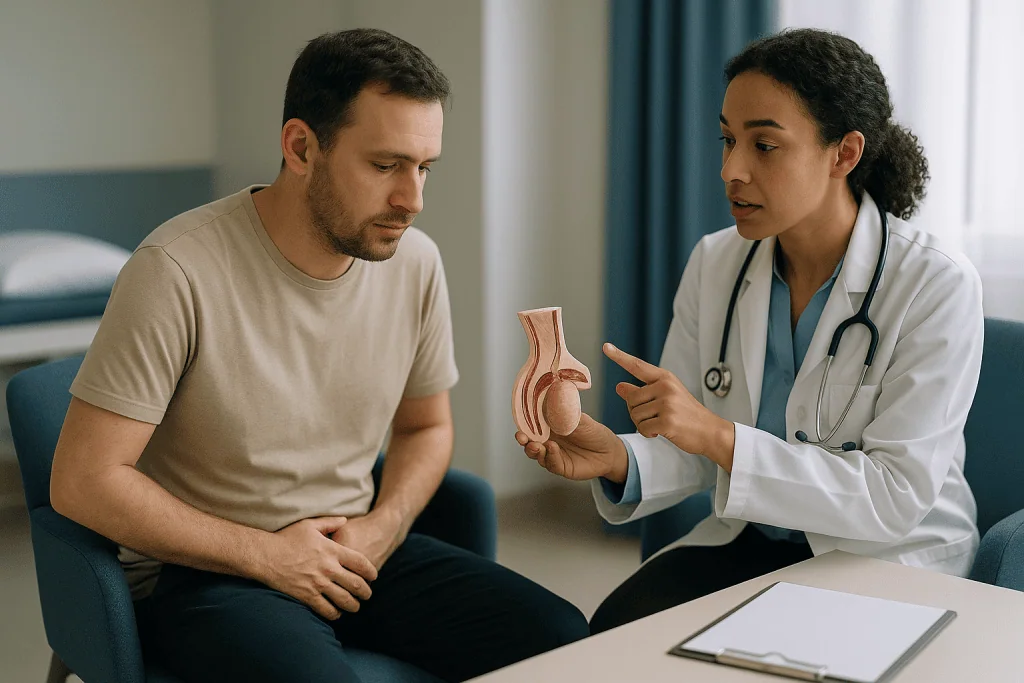
In bacterial cases, organisms usually arrive by climbing backward along the urinary and reproductive tract: from the urethra, through the vas deferens, into the epididymis, and finally into the testicle. According to the CDC, sexually transmitted organisms such as Chlamydia trachomatis and Neisseria gonorrhoeae are the most common causes in sexually active men under about 35, while gut bacteria such as Escherichia coli dominate in older men, in those who have had recent urinary procedures, and in men with prostate enlargement or a blockage that lets urine pool.
Viral orchitis behaves differently. The mumps virus reaches the testicle through the bloodstream rather than the urinary tract, which is why it can appear in someone with no urinary symptoms at all. Mayo Clinic notes that mumps orchitis typically develops four to seven days after the salivary glands swell.
Why does this plumbing lesson matter when things are not improving? Because the route of infection points to the likely organism, and the likely organism determines whether the antibiotic class you were given can work. A treatment aimed at sexually transmitted bacteria may do little against a gut organism, and no antibiotic touches a virus. Your urologist reasons backward along that same path when a case stalls.
How long does orchitis last, and when should it start improving?
Two clocks run at once, and confusing them causes needless worry. The first clock measures pain and fever, and it should move quickly. The NHS advises that with appropriate antibiotics for epididymitis and epididymo-orchitis, pain usually starts to ease within a few days. The CDC sets its formal checkpoint at 72 hours: if nothing has improved by then, the plan needs a second look.
The second clock measures swelling and firmness, and it is slow. The NHS notes that it can take up to two weeks for the swelling to go down, and some men describe a residual firmness or tenderness in the epididymis for longer than that. A testicle that is still larger than its partner on day ten but is less painful, cooler to the touch and no longer growing is behaving normally.
Antibiotic courses in the CDC regimens run for about ten days, and the guidance emphasizes completing the course even when symptoms fade early, because incomplete treatment is one route to relapse. The prescribing clinician decides the exact plan; the point here is that feeling better on day five does not mean the infection is gone on day five.
Mumps orchitis follows its own arc. Mayo Clinic describes the testicular swelling as generally settling over one to two weeks with rest and supportive care, since no antibiotic changes the course of a viral infection.
So the honest answer to how long orchitis lasts is: pain days, swelling weeks, and antibiotics roughly ten days when bacteria are the cause. If your experience departs sharply from that shape, particularly on the pain-and-fever clock, that is the moment to pick up the phone rather than the calendar.
Why is my epididymo-orchitis not improving on antibiotics?
When a course of antibiotics fails to make a dent, one of a short list of explanations is usually responsible. Working through it is exactly what your urologist will do, and understanding the list makes the conversation faster.

The organism does not match the drug. Empiric treatment, meaning treatment started before test results return, is an educated guess based on age and risk factors. If a man in his fifties was treated for sexually transmitted organisms but the culprit is a gut bacterium, or vice versa, the first choice may simply miss. Urine cultures and urethral swabs taken at the first visit often resolve this, which is one reason to ask whether those results are back.
The bacterium is resistant. Antimicrobial resistance is increasingly common in urinary organisms. A culture with sensitivity testing tells the clinician which classes still work.
It was never bacterial. Viral orchitis, most often from mumps, does not respond to antibiotics. A history of parotid swelling, or incomplete mumps vaccination, raises this possibility.
An abscess has formed. Pus walled off inside or around the testicle is poorly reached by antibiotics circulating in the blood. This is one of the most important things a scrotal ultrasound can find in a case that is not improving.
The diagnosis was wrong from the start. Testicular torsion, a twisted spermatic cord cutting off blood supply, can be mistaken for infection, and it does not respond to any medicine.
Less commonly, tuberculosis, a non-infectious inflammatory process, or a tumor can present with a swollen, painful testicle that stubbornly refuses to behave like a routine infection. None of these are diagnoses to make at home. All of them are reasons an unresponsive case should be re-examined rather than simply given more time.
Fever after antibiotics for orchitis: what it can signal
Fever is the body’s most honest progress report during an infection, and its pattern matters more than any single reading. Three patterns come up when orchitis is not getting better.
The first is a fever that never broke. If temperature has stayed elevated through the first three days of antibiotics, the CDC’s 72-hour rule applies directly: the working diagnosis or the drug needs revisiting. Persistent fever with a scrotum that is also enlarging is a stronger signal still.
The second is a fever that returned. Someone who felt cooler and more comfortable on day three and then spiked again on day six may be dealing with an abscess, with a relapse after a missed dose or an unfinished course, or with a second problem layered on the first. A rebound fever is worth reporting the same day.
The third is fever with systemic signs: shaking chills, a racing heart, feeling faint on standing, confusion, or breathlessness. These can indicate that infection has spread beyond the scrotum into the bloodstream, a condition called sepsis. MedlinePlus lists the spread of infection as a recognized complication of orchitis, and this cluster warrants emergency care rather than a routine appointment.
A practical note on measurement. Fever-reducing medicines, which many people take for the pain, will blunt the thermometer reading for several hours. If you are tracking temperature to judge whether treatment is working, note what you took and when, and mention it to the clinician. A “normal” reading two hours after a painkiller tells them less than a reading taken before the next one.
Fever without pain relief, fever that returns, or fever with chills and confusion: three different messages, one shared instruction to speak to your care team promptly.
Swollen testicle getting worse: settling versus spreading
Swelling that is still present is not the same as swelling that is getting worse, and a few observable features separate the two. The table below summarizes what clinicians generally consider an expected course against what they treat as a warning, drawing on NHS, Mayo Clinic and CDC descriptions of epididymo-orchitis and its complications.
| Feature | Usually part of normal recovery | Reason to call promptly |
|---|---|---|
| Size | Still enlarged, but stable or shrinking after the first few days | Enlarging day over day, or a rapid increase over hours |
| Skin | Mild redness fading over the first week | Redness spreading up the groin or onto the abdomen, shiny or dusky skin, blistering, or a foul smell |
| Texture | Firm, tender epididymis softening gradually over up to two weeks | A new fluctuant (fluid-filled, boggy) area, or a hard lump that persists after inflammation settles |
| Pain | Dull ache easing with support and rest | Sudden severe pain, pain spreading to the abdomen, or pain with vomiting |
| Fever | Falling within about 72 hours of appropriate antibiotics | Persistent beyond 72 hours, or returning after improvement |
| Urination | Burning improving alongside other symptoms | Unable to pass urine, or passing very little |
A useful home habit is to compare against a fixed reference rather than memory. Standing in the same light at the same time each morning, or having a partner note the appearance, catches gradual change that daily glances miss. Spreading redness with a crackling feel under the skin or grey patches is a particular emergency; it can indicate a rapidly progressing soft-tissue infection of the perineum that surgeons treat urgently. It is rare, but it is exactly the kind of change that should never wait for the next scheduled visit.
Could it be torsion instead? The emergency that mimics orchitis
Of every possibility on the list, testicular torsion is the one that makes urologists want the phone answered fast. Torsion happens when the spermatic cord, the bundle of blood vessels and the vas deferens that suspends the testicle, twists on itself and strangles the blood supply. Cleveland Clinic notes that it is most common between ages 12 and 18, though it can occur at any age, and that surgery within about six hours of symptom onset gives the best chance of saving the testicle.
The overlap with orchitis is real. Both produce a swollen, exquisitely tender testicle. Both can cause nausea. Both may push the testicle into a higher position. The differences lie in tempo and history. Torsion pain classically arrives suddenly, often waking someone from sleep or striking after minor exertion, and reaches severe intensity within minutes to an hour. Orchitis pain more often builds over a day or two and comes with urinary burning, discharge, or a preceding illness.
Clinicians sometimes check the cremasteric reflex, a normal upward twitch of the testicle when the inner thigh is stroked; its absence raises suspicion for torsion. A Doppler ultrasound, which shows blood flow, is the standard imaging test. Neither is something to attempt to interpret at home.
The reason torsion belongs in an article about orchitis that is not getting better is uncomfortable but important: intermittent torsion, where the cord twists and untwists, can be misread as infection, and a man treated for orchitis whose pain suddenly escalates may be experiencing a completed twist. Antibiotics will do nothing for a testicle with no blood supply. Sudden severe pain, especially with vomiting, is a reason to go to an emergency department rather than wait for a call back.
Mumps orchitis and other viral causes: why antibiotics may do nothing
A man in his twenties who was not fully vaccinated as a child, or who has recently been around a mumps outbreak, can develop orchitis that no antibiotic will touch, and the mismatch can look like treatment failure when it is really a wrong target.
Mumps is a viral infection best known for swelling of the parotid glands in front of the ears. Mayo Clinic describes orchitis as a recognized complication in males who contract mumps after puberty, with testicular swelling typically appearing four to seven days after the glands enlarge. The NHS lists orchitis among the more common complications of mumps in adult men and notes that it usually affects one testicle, though both can be involved.
Because the cause is viral, treatment is supportive: rest, scrotal support, cold compresses, and pain relief chosen with the clinician. Symptoms generally ease over one to two weeks. Antibiotics are sometimes started before the viral cause is clear, and a man who then reads that his infection “should respond in 72 hours” may reasonably conclude something has gone wrong. What has happened instead is that the diagnosis has clarified.
Other viruses can occasionally inflame the testicle, and orchitis has been reported after some viral illnesses beyond mumps, but mumps remains the classic example and the one clinicians ask about first. A history of gland swelling, or of a sick contact, changes the conversation immediately.
The vaccination point deserves plain statement. The measles, mumps and rubella vaccine is the established preventive measure against mumps and its complications, and the CDC and NHS both list it as routine childhood immunization. Adults unsure of their status can ask their clinician to check records; whether to vaccinate is a decision for that conversation, not for this page.
Who is usually managed at home, and who is usually asked to come in
Most orchitis does not require a hospital bed, and the decision about where care happens rests with the treating team. Still, guidelines and clinical practice describe recognizable groups.
Home management is typical when someone is otherwise well, can take oral medicines and keep fluids down, has no urinary retention, has a confirmed or highly likely bacterial or viral cause with a matching plan, and has a way to be reassessed if things change. The NHS and Mayo Clinic both describe rest, scrotal elevation, cold packs and pain relief as the backbone of care alongside any antibiotic.
Being asked to come in, whether for urgent clinic review, imaging or admission, is more likely in these circumstances:
- No improvement by roughly 72 hours, the CDC’s re-evaluation threshold.
- High or persistent fever, chills, or signs of dehydration or low blood pressure.
- Rapidly increasing swelling or any suspicion of an abscess on examination.
- Inability to pass urine, which may require a catheter and points to an underlying blockage.
- Diabetes, immune suppression, recent urinary tract surgery or instrumentation, or a known abnormality of the urinary tract.
- Any feature suggestive of torsion, which goes straight to emergency assessment.
Older men and those with prostate enlargement often need a slightly different lens, because their orchitis frequently reflects a urinary drainage problem that will keep causing infections until addressed. Younger men with a sexually transmitted cause are usually advised on partner notification and testing, since re-infection is a common reason for apparent relapse.
The phrase “asked to wait” has a specific meaning here. It rarely means being told to ignore symptoms. It usually means being asked to continue the current plan for a defined period with clear instructions on what would change that plan. If those instructions were never given, asking for them is entirely reasonable.
What tests your urologist may order when orchitis is not getting better
A stalled case is a puzzle with a limited number of pieces, and the work-up reflects that. Understanding what each test is looking for helps the visit feel less like a black box.
Scrotal ultrasound with Doppler. This is the workhorse. Sound waves build an image of the testicle and epididymis, and the Doppler component maps blood flow. It can show an abscess, a fluid collection around the testicle called a hydrocele, absent or reduced blood flow suggesting torsion, or a mass that does not fit infection. Mayo Clinic lists ultrasound as the key imaging test for distinguishing orchitis from torsion.
Urine tests. A dipstick and microscopy look for white cells and bacteria; a culture grows the organism and tests which antibiotic classes affect it. If a culture was sent at the first visit, results are often back by the time treatment is being questioned.
Tests for sexually transmitted infections. The CDC recommends testing for chlamydia and gonorrhea in men with epididymitis who are at risk, usually with a urine or urethral sample that detects the organisms’ genetic material.
Blood tests. A white cell count and inflammatory markers gauge how much the body is fighting; blood cultures may be drawn if sepsis is a concern. Mumps antibodies can be checked when a viral cause is suspected.
Examination. Underrated but essential: a careful re-examination of the abdomen, groin and prostate, and a check of whether the bladder is emptying. A tender, enlarged prostate can indicate that the infection has a wider footprint than the scrotum.
None of these tests is painful beyond the discomfort of examining an already sore area, and the results shape everything that follows: a change of antibiotic class, drainage of an abscess, or surgery if the picture turns out to be torsion.
Complications: abscess, tissue damage, and the fertility question
The honest reason to act on orchitis that is not getting better is that untreated or undertreated infection has consequences beyond a longer stretch on the sofa. MedlinePlus and Mayo Clinic list a consistent set of complications, and each has a mechanism worth knowing.
Scrotal abscess. When the immune system walls off infection, it creates a pocket of pus that antibiotics penetrate poorly. Abscesses tend to present as a fluctuant area, persistent fever, and pain that fails to ease. Treatment often involves drainage, either through the skin under imaging guidance or surgically, alongside antibiotics. The treating surgeon decides which approach fits the size and location.
Testicular atrophy. Sustained pressure and inflammation inside the rigid capsule can damage sperm-producing tissue, leaving the testicle smaller than before once swelling resolves. Mayo Clinic identifies shrinkage of the affected testicle as a recognized outcome, particularly after mumps orchitis.
Chronic pain or epididymitis. Some men are left with lingering aching or firmness in the epididymis for months. It is usually not dangerous, but it is a reason for follow-up.
Fertility. This is the question men most often want to ask and least often do. Mayo Clinic notes that orchitis, especially when both testicles are involved, can in some cases lead to reduced fertility. Infertility after orchitis affecting only one side is uncommon, since the unaffected testicle continues to function. Anyone concerned can ask about semen analysis after full recovery; the timing and interpretation belong with the clinician.
Spread of infection. Rarely, bacteria reach the bloodstream, or infection extends into surrounding perineal tissue. Both are emergencies, and both are far more likely when a deteriorating case is left to run.
Early re-evaluation is the lever that reduces every item on this list.
What the next days and weeks usually look like after re-evaluation
Once a stalled case has been reassessed, the path forward tends to follow one of a few recognizable shapes, and knowing them in advance takes some of the fear out of the unknown.
If the problem was a mismatched antibiotic class or a resistant organism, the clinician changes therapy based on culture results. Pain and fever are then expected to respond on a similar clock to the first attempt: meaningful improvement within a few days, with the CDC’s 72-hour checkpoint applying again. Swelling continues to take its slower course of up to two weeks, per the NHS, counted from when effective treatment began rather than from the original diagnosis.
If ultrasound shows an abscess, drainage is arranged. Afterward, a drain or dressing may remain for a short period, and follow-up imaging may be scheduled to confirm the cavity has closed. Antibiotics typically continue through this phase; duration is the surgeon’s call.
If the cause is mumps, the plan shifts to supportive care and the calendar stretches to one to two weeks of gradual settling, according to Mayo Clinic, with a later check to assess testicular size.
If torsion is found, surgery happens the same day, and recovery follows the surgical team’s instructions on activity, wound care and return to work.
Across all these paths, a few practical points recur. Scrotal support, whether snug underwear or an athletic supporter, genuinely reduces the pull on inflamed tissue. Sexual activity is usually paused until treatment is complete and, for sexually transmitted causes, until partners have been treated, following CDC guidance. A follow-up appointment after the course finishes is common practice, both to confirm resolution and to examine for any residual lump that needs its own evaluation.
What people often get wrong about orchitis
Some beliefs about orchitis are harmless. Others cost days that matter. These are the ones clinicians hear most.
“Orchitis is always a sexually transmitted infection.” In sexually active men under about 35 it often is, per the CDC. In older men, in boys, and after urinary procedures, the usual culprits are gut bacteria that have nothing to do with sexual contact. Mumps is not sexually transmitted at all. Assuming an STI can lead to shame that delays care and to a treatment aimed at the wrong organism.
“If the antibiotic has not worked in two days, it is the wrong one.” Two days is early. The CDC’s threshold is 72 hours, and even then the instruction is to re-evaluate rather than to assume failure. Stopping a course early on one’s own initiative can create the relapse it was meant to avoid.
“The swelling should be gone by the time the tablets run out.” The NHS puts swelling resolution at up to two weeks, and residual firmness can outlast that. A testicle that is still large but no longer painful is healing, not failing.
“Once the pain settles, the infection is gone.” Symptom relief typically precedes bacterial clearance. The prescribed course exists for a reason, and the prescribing clinician is the person to consult about any change.
“A swollen testicle is embarrassing but never dangerous.” Torsion, abscess and sepsis all begin with a swollen testicle. Embarrassment is understandable; it should never set the timetable.
“It will affect my fertility for certain.” Mayo Clinic describes reduced fertility as a possible complication, most relevant when both testicles are affected or treatment is delayed. It is not an inevitability, and it is a fair question to raise at follow-up rather than to carry alone.
Questions to ask your care team
A short list, written down before the appointment, turns a hurried visit into a useful one. These are the questions that tend to change what happens next.
- What do you think is causing this, and how confident are you? Has anything about my case made you consider torsion, an abscess, or a viral cause?
- Were cultures or swabs taken at my first visit, and are the results back? Do they change the antibiotic choice?
- By what day should I expect my pain and fever to improve on this plan, and what exactly should I do if they have not?
- Do I need an ultrasound, and if I already had one, does it need repeating?
- Is there any sign that my bladder is not emptying properly, and could an underlying urinary problem be driving this?
- If this is a sexually transmitted infection, what should my partner or partners do, and when is it safe to resume sexual activity?
- Which symptoms mean I should call your office, and which mean I should go straight to an emergency department?
- What should the testicle feel like at two weeks, and when do you want to examine it again?
- Should I have any follow-up test, such as a semen analysis, once this has fully settled?
- Is there anything about my other medical conditions or medicines that changes how you are managing this?
One more, often skipped: “Can you write down the plan?” A single line stating the working diagnosis, the treatment, the expected timeline, and the red flags is the most valuable piece of paper a patient can leave with. It also makes any later call to an on-call clinician who has never met you far more productive, because you can tell them precisely where the plan stood and where it departed.
When to call your doctor: red-flag signs
Two levels of urgency apply, and both leave the decision with your treating team once you have made contact.
Go to an emergency department now, or call emergency services, if you notice any of the following:
- Sudden, severe testicular pain, especially with nausea or vomiting, which may indicate torsion. Cleveland Clinic notes that outcomes are best when surgery occurs within about six hours.
- Fever with shaking chills, a racing heartbeat, confusion, breathlessness, or feeling faint, which can signal sepsis.
- Rapidly spreading redness, dusky or grey skin, blistering, a crackling feel under the skin, or a foul odor from the scrotum or perineum.
- Inability to pass urine.
Call your urologist or prescribing clinician the same day if:
- Pain and fever have not begun to improve after about 72 hours of antibiotics, the CDC’s re-evaluation threshold.
- Symptoms improved and then returned, particularly a rebound fever.
- Swelling is increasing rather than stabilizing, or you notice a new soft, fluid-filled area.
- You are unable to keep medicines or fluids down.
- You develop new pain in the lower abdomen or back, or blood in the urine or semen.
- You have diabetes, a weakened immune system, or a recent urinary procedure and are not clearly improving.
A brief word on the in-between. Many men hesitate because the change feels small: a little more swelling, a temperature a fraction higher. Clinicians would rather hear about a small change on day four than a large one on day seven. Describe what has changed, when it changed, and what you have taken; let the team judge urgency. If you cannot reach your usual clinician and any emergency feature is present, go to the emergency department. Nothing in this article replaces that examination, and every treatment decision belongs to the clinician who can see, feel and scan the testicle in front of them.
Frequently asked questions
How long does orchitis last before I should worry?
Pain and fever from bacterial orchitis usually begin easing within about 72 hours of appropriate antibiotics, the checkpoint the CDC uses for re-evaluation. Swelling is slower and can take up to two weeks to settle according to the NHS. Worry less about lingering size and more about direction: no improvement by day three, worsening at any point, or new severe pain are the reasons to call.
Why is my epididymo-orchitis not improving after a week of antibiotics?
The most common reasons are an antibiotic class that does not match the organism, a resistant bacterium, an abscess that antibiotics cannot reach, or a viral cause such as mumps that antibiotics do not affect. Less often the diagnosis itself was wrong. A week without improvement is well past the CDC’s 72-hour re-evaluation point and warrants prompt review, usually including an ultrasound and culture results.
Is a fever after antibiotics for orchitis normal?
A falling fever in the first two to three days is expected. A fever that persists beyond about 72 hours, or one that returns after improving, is not part of a normal course and should be reported the same day, since it can indicate an abscess, a resistant organism, or relapse. Fever with chills, confusion or a racing heart needs emergency assessment for possible sepsis.
Is a swollen testicle getting worse always a sign of infection spreading?
No, but it is always a reason to be examined. Worsening swelling can reflect an abscess forming, a fluid collection around the testicle, an infection not responding to treatment, or torsion. It can also occasionally point to a problem that is not infection at all. Ultrasound distinguishes these quickly, which is why increasing size, rather than stable size, is the feature clinicians ask patients to watch.
How do I know if it is orchitis or testicular torsion?
You often cannot tell at home, which is why sudden severe pain gets emergency care. Torsion pain typically starts abruptly and peaks within an hour, frequently with vomiting and without urinary symptoms; orchitis pain tends to build over a day or two alongside burning or discharge. Cleveland Clinic notes torsion is most common at ages 12 to 18 and is best treated surgically within about six hours.
Can orchitis come back after treatment?
Yes. Relapse can follow an incomplete antibiotic course, re-infection from an untreated sexual partner, or an underlying urinary problem such as prostate enlargement that keeps allowing bacteria to pool. The CDC advises partner treatment for sexually transmitted causes, and urologists often look for a drainage issue in older men with repeated episodes. Recurrent orchitis is a reason for further evaluation rather than a repeat prescription alone.
Will orchitis affect my fertility?
It can, but it is not inevitable. Mayo Clinic lists reduced fertility as a possible complication, mainly when both testicles are involved, when treatment is delayed, or after mumps orchitis that leaves the testicle smaller. Orchitis on one side rarely causes infertility because the other testicle continues to function. If you are concerned, ask your clinician about a semen analysis once you have fully recovered.
Do I need an ultrasound if my orchitis is not settling?
Usually the treating clinician will want one. Scrotal ultrasound with Doppler shows blood flow and can identify an abscess, a hydrocele, absent flow suggesting torsion, or a mass that does not fit infection. It is painless apart from pressure on a tender area and often changes management directly, for example by prompting drainage or a switch in antibiotic class based on what it reveals.
What can I do at home while waiting to be seen?
Rest, keep the scrotum supported and elevated with snug underwear or an athletic supporter, and apply a wrapped cold pack for short periods, as the NHS and Mayo Clinic describe. Continue any prescribed medicines as directed unless your clinician tells you otherwise, drink fluids, and avoid sexual activity. Record your temperature, pain and swelling changes so you can describe them precisely.
Can orchitis be caused by something other than infection?
Occasionally. Inflammation can follow injury, and rarely a tumor, tuberculosis or a non-infectious inflammatory condition presents as a swollen, painful testicle that does not behave like a routine infection. These possibilities are part of why a case that fails to respond to antibiotics is re-examined and imaged rather than simply given a longer course. The treating team, not a home assessment, sorts these out.
References
- MedlinePlus Medical Encyclopedia: Orchitis
- NHS: Epididymitis
- CDC Sexually Transmitted Infections Treatment Guidelines: Epididymitis
- Cleveland Clinic: Testicular Torsion
This article is for general information only and is not a substitute for professional medical advice. Please consult a qualified doctor about your individual situation.

More from the Blog

Chronic Prostatitis Day to Day: Fluids, Bladder Irritants and Sticking With the Plan
Living with chronic prostatitis usually means managing symptoms that have lasted three months or more rather than waiting for a single fix. Day to…

How to Read a Urine Flow Test Curve: Peak Flow, Voided Volume and What Shapes Suggest
A uroflowmetry curve plots how fast urine leaves the body, second by second. Readers look at three things together: the peak flow rate (Qmax),…

Bladder Problems After Childbirth: What Is Common, What Is Treated and When to Get Help
Bladder problems after childbirth are common and usually improve. Leaking with coughing or exercise, sudden urgency, and difficulty emptying can follow the stretching of…

Helping a Loved One With a Nephrostomy Tube: Dressings, Drainage Bags and the First Night Home
Most people can go home with a nephrostomy tube once the site is stable, and family members can safely help with dressings, bag emptying…

TURP Recovery Week by Week: Catheter Days, Bladder Flushing and Getting Back to Normal Routines
After a TURP, most men spend one to three days in hospital with a catheter and bladder flushing, then go home once they can…

After a Renal Angiogram: Puncture Site Rest, Fluids and When Normal Activity Resumes
Recovery after a renal angiogram is usually short. Most people lie flat for several hours so the artery puncture can seal, drink fluids to…