

Osgood-Schlatter: The Knee Pain of Growing Athletes
Key Takeaways
- Osgood-Schlatter is inflammation of the growth center at the top of the shinbone where the patellar tendon attaches, not a tear or a fracture.
- It peaks between ages 10 and 15, during growth spurts, and affects both knees in roughly a quarter to a third of cases.
- Pain typically resolves within one to two years once the growth center fuses, while the bony bump often remains permanently but painlessly.
- Current expert guidance favors reducing jumping and sprinting load while keeping the child active, rather than months of complete rest or casting.
- Quadriceps flexibility and hip and thigh strengthening are the one element of care that may change knee mechanics, supported so far by cohort studies rather than large randomized trials.
- Sudden onset with a pop, joint locking, night pain, fever or pain at rest are red flags for a different diagnosis and warrant prompt medical assessment.
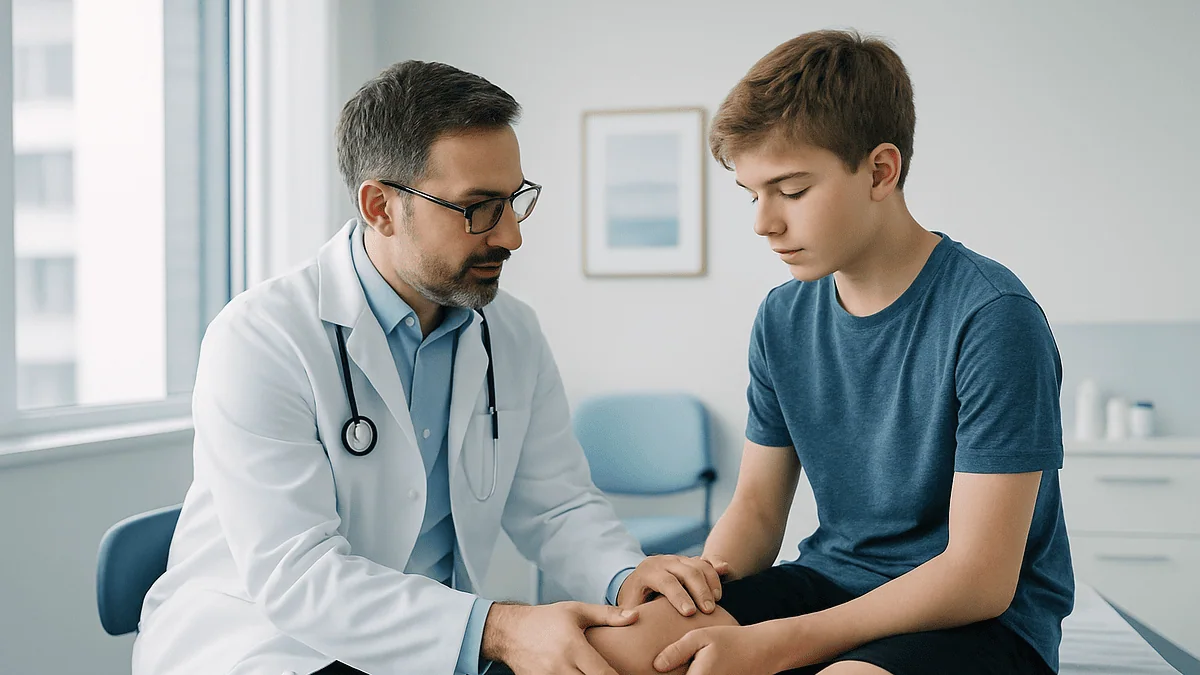
Osgood-Schlatter is a common overuse injury in growing children and teenagers, most often between ages 10 and 15, in which the patellar tendon tugs on the still-soft growth area just below the kneecap, causing pain, swelling and a tender bump. It is not dangerous, and symptoms usually settle once growth finishes. Management centers on adjusting activity, pain relief, ice and quadriceps and hamstring flexibility and strength work guided by a clinician.
The video is twelve seconds long. A fourteen-year-old pulls up her soccer sock, points to a marble-sized lump below her kneecap and asks the camera, half laughing, whether her “growth plate is tearing off.” Millions of views later, as of September 2026, the comments have become a free-for-all: massage it away, rest for a year, it is a calcium problem, it is permanent. Pediatric sports clinicians have spent the fall sports season fielding the fallout.
The bump has a name that sounds far more alarming than the condition deserves. Osgood-Schlatter, described by two surgeons in 1903, is one of the most frequent causes of knee pain in young athletes, and it is also one of the most misunderstood. The internet has turned a self-limiting growth-related irritation into something that reads like a fracture.
This guide walks through what is actually happening under that sock, what the research can and cannot tell us, and how to help a kid keep moving without making the knee worse.
What is osgood schlatter, and what is actually happening in the knee?
Start with the anatomy, because the mechanism explains almost everything that follows. The large thigh muscle group at the front of the leg, the quadriceps, narrows into the patellar tendon, a thick cord that runs over the kneecap and anchors onto a small bony knob at the top of the shinbone. That knob is the tibial tuberosity, and in a child it is not solid bone yet.
During growth, the tuberosity is an apophysis: a secondary growth center where new bone is laid down, softer than mature bone and connected to the shin by cartilage. Every sprint, jump and hard kick makes the quadriceps yank on that tendon, and the tendon yanks on the apophysis. Thousands of repetitions a week can irritate the cartilage, trigger inflammation and, over time, prompt the body to lay down extra bone at the site. The result is pain, tenderness and the characteristic bump.
Doctors file this under traction apophysitis, which in plain language means a growth center inflamed by repeated pulling. The Mayo Clinic notes it usually appears during growth spurts, roughly ages 10 to 15, slightly earlier in girls than in boys because girls tend to mature sooner. It is not an infection, not arthritis and not a tear of the tendon.
One detail worth holding onto: the problem is a mismatch of timing. Bones lengthen in bursts, and muscles and tendons catch up more slowly, so a growing athlete can spend months with tight quadriceps pulling on a soft, overloaded anchor point. That timing mismatch is also why the condition fades on its own once the apophysis fuses into solid bone.
Why do people get Osgood-Schlatter? The risk factors that matter most
Not every active twelve-year-old develops a painful shin bump, so what tips the balance? The research points to a handful of consistent contributors, and none of them is a nutritional deficiency.
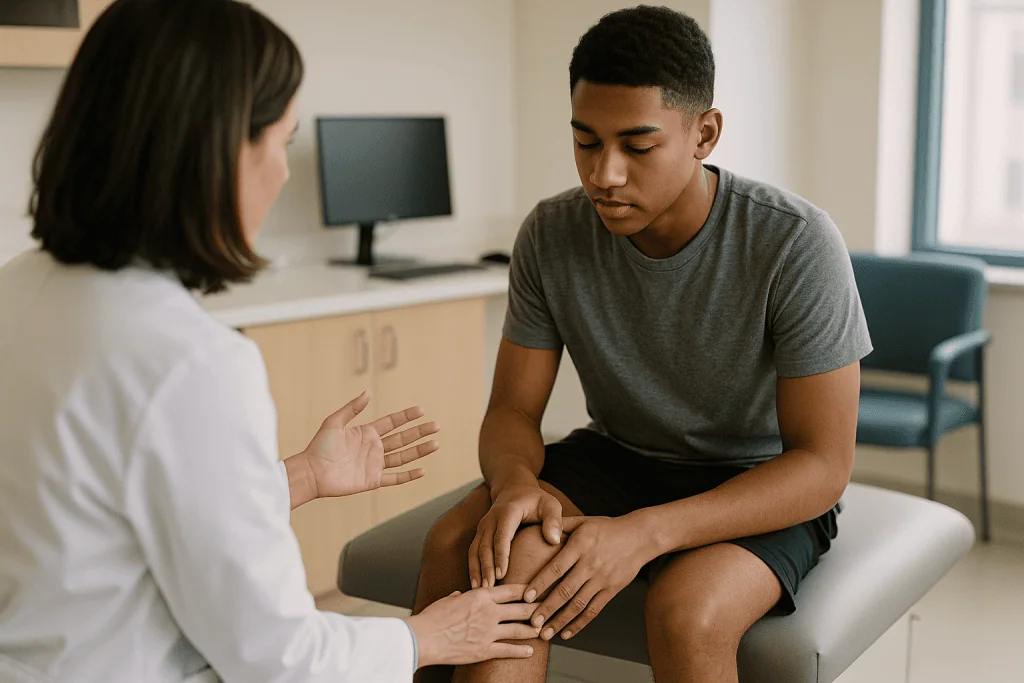
Growth itself is the first ingredient. The condition clusters tightly around the adolescent growth spurt because that is when the tibial tuberosity is at its most vulnerable and the quadriceps is at its tightest relative to bone length. Cleveland Clinic describes it as a condition of “growing kids,” and that is not a figure of speech.
Load is the second. Sports built on running, cutting, jumping and kicking, such as soccer, basketball, volleyball, gymnastics, figure skating and ballet, dominate the case series. A child who plays one of these sports year-round, or on two teams at once, accumulates far more tendon pulls than a child with an off-season. Observational data repeatedly link early single-sport specialization to overuse injuries in general, and Osgood-Schlatter fits that pattern.
Flexibility is the third. Tight quadriceps and hamstrings increase the resting tension on the patellar tendon, so the apophysis is under strain even before a practice starts. Some clinicians also point to weakness in the hip and core muscles, which can shift extra work onto the knee, though this evidence is more preliminary.
Sex and side round out the picture. Boys are affected somewhat more often, likely reflecting historical sports participation, and the gap is narrowing. Roughly one in four to one in three affected children feel it in both knees, according to MedlinePlus, which makes sense when both legs are doing the same growing and the same training.
Osgood schlatter disease symptoms: what the knee is telling you
Parents usually notice two things first: a limp after practice and a child who winces when kneeling. The pattern of symptoms is distinctive enough that experienced clinicians often make the diagnosis from the story and a hands-on exam alone.
The pain sits in one specific spot, the bony prominence a few finger-widths below the kneecap, rather than deep inside the joint. Pressing on it hurts. Straightening the knee against resistance hurts. Climbing stairs, squatting, jumping and running hurt, and sitting still with the knee bent for a long car ride can ache too. Walking on flat ground is often fine.
Swelling and warmth over the tuberosity come and go with activity. Over weeks to months a firm bump develops, which the body builds by adding bone in response to the repeated pull. The bump is not a tumor and not a loose piece of bone in most cases; it is the apophysis itself, enlarged.
Symptoms tend to flare during heavy training blocks and settle during breaks. According to the NHS, the pain usually eases with rest and returns with sport, a rhythm that distinguishes it from inflammatory conditions, which hurt most in the morning or at rest.
What you should not see is reassuring in its own way. The knee should not lock, give way or feel unstable. There should be no fever, no redness spreading beyond the bump, no night pain that wakes the child, and no pain in a child who is not yet growing or has finished growing. Those features point elsewhere and are covered later in this article.
What changed recently in how Osgood-Schlatter is managed
The condition has not changed in a century; the advice around it has. Three shifts explain why the current viral conversation feels so different from what a parent might remember from their own youth.
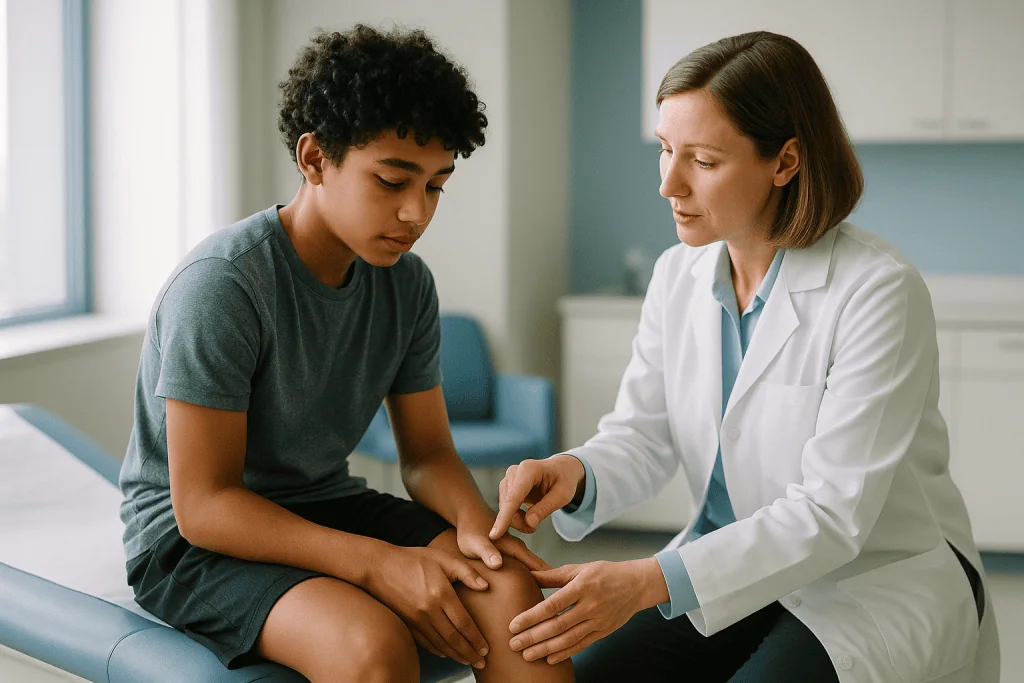
First, the retreat from total rest. For decades the standard instruction was to stop sport entirely until pain disappeared, sometimes for months. Over the past decade, Danish researchers in particular have tested a different approach: cut the aggravating load, keep the child active within a pain-tolerance limit, and add structured quadriceps and hip strengthening. A 2020 prospective cohort study of adolescents following a 12-week activity-modification and strengthening program reported that most participants rated themselves improved and had returned to sport by the end of the program. It was a single-arm study without a control group, so it shows feasibility and promise rather than proof of superiority, but it has reshaped clinical practice.
Second, a more honest timeline. Mayo Clinic and Cleveland Clinic patient pages now state plainly that symptoms can last months and may recur until growth finishes, replacing the older “it goes away in a few weeks” message that left families feeling they had failed.
Third, an updated view of casts and injections. Immobilization in a cast, once common, is now reserved for unusual cases because it weakens the quadriceps the child needs for recovery. Steroid injections into the area are generally avoided over concerns about tendon damage, a position echoed by MedlinePlus.
The viral claims arrive on top of this quieter evolution. The bump that an older coach would have said to “rest away” is now something clinicians would rather train around.
What the evidence actually says, graded by strength
Here is where honesty matters more than reassurance. Osgood-Schlatter is common, but it is also benign, which means it has rarely attracted the large randomized trials that reshape care for serious disease. Most of what we know sits at the lower rungs of the evidence ladder.
The natural history is the best-established fact. Decades of observational follow-up, summarized by MedlinePlus, Mayo Clinic and the NHS, agree that pain resolves in the large majority of children once the tibial tuberosity fuses, typically within one to two years of symptom onset. A visible bump may remain permanently in a sizable minority. This is strong observational evidence, consistent across countries and eras.
Activity modification plus strengthening rests on moderate but incomplete evidence: prospective cohort studies and clinical consensus, not head-to-head randomized trials against rest alone. It is biologically sensible, it is safe, and it keeps children active, which is why expert guidance favors it.
Ice, over-the-counter pain relief and stretching are supported by expert opinion and by their track record in other tendon-related overuse conditions rather than by trials specific to Osgood-Schlatter. They are reasonable, low-risk measures.
Patellar tendon straps and padded knee sleeves have small studies and a great deal of anecdote. Some athletes report meaningful relief; the mechanism, redistributing the pull on the tuberosity, is plausible but unproven.
Surgery to remove a residual bone fragment in adults who remain symptomatic after growth is supported by case series only. It is uncommon and not a treatment for growing children.
The bottom line a careful clinician would give: we are confident about what the condition is and how it ends, moderately confident about how to shorten the uncomfortable middle, and appropriately humble about the gadgets.
Can Osgood-Schlatter go away on its own?
Yes, and for most children it does, though the word “go away” needs unpacking because pain and bump follow different timelines.
The pain is tied to an open growth center. When the apophysis fuses to the shinbone, usually in the mid to late teens, the soft target for the tendon’s pull disappears and the inflammation has no reason to continue. Mayo Clinic puts the typical duration at weeks to months, with the possibility of flare-ups until the growth spurt ends. In practice many families describe roughly a year of on-and-off symptoms, worse in season, better in summer.
The bump is different. Extra bone, once laid down, does not reabsorb. A proportion of adults who had Osgood-Schlatter as teenagers carry a painless prominence below the kneecap for life. It is a souvenir rather than a problem, though kneeling on hard floors may stay uncomfortable for some.
Two factors shape how quickly symptoms fade. The first is how far along the child is in growth; a sixteen-year-old near skeletal maturity will likely be done sooner than an eleven-year-old at the start of a spurt. The second is load management. Children who keep hammering the knee through a painful season tend to hurt longer, not because they are causing permanent harm but because they keep re-irritating the same spot.
A small minority, estimated in older case series at well under one in ten, continue to have pain into adulthood, usually because a separate fragment of bone, called an ossicle, formed within the tendon and keeps rubbing. That group is discussed in the adult section below. For everyone else, time is the most reliable treatment, and the goal of everything in between is simply to make the waiting comfortable.
How do you treat Osgood-Schlatter's disease at home?
The honest answer is that home management is the treatment for most children, with a clinician setting the plan and checking progress. Nothing here speeds up bone maturation; everything here reduces irritation while maturation does its work.
Modify, do not abolish. The modern approach, reflected on Cleveland Clinic and NHS pages, is to reduce the specific activities that provoke pain, especially jumping, sprinting and deep kneeling, while keeping the child moving. Many clinicians use a simple pain scale: activity that keeps discomfort mild and settles by the next morning is acceptable; activity that leaves the child limping the following day is too much and should be scaled back for a while.
Cool the spot. Ice wrapped in a thin towel over the bump for a short period after activity can ease swelling and soreness. Direct ice on skin is not advised.
Pain relief when needed. Over-the-counter options such as ibuprofen or acetaminophen are commonly used for flare-ups. Any use in a child should follow the product label and the advice of a pharmacist or the child’s doctor, and ongoing daily use is a conversation for the clinician rather than a household decision.
Protect the knee from pressure. A padded sleeve or gel pad can make kneeling in school or on the field less painful.
Address flexibility and strength, covered in the next section, because this is the one element that may change the mechanics rather than just the symptoms.
What to avoid: casting at home with braces that lock the knee, aggressive massage of the bump, and any “treatment” that promises to shrink the bone. None of these are supported, and immobilization in particular weakens the muscles the child needs.
Osgood schlatter exercises: stretching and strengthening that help
If one piece of the home plan deserves a parent’s attention, it is this one. Tight quadriceps pull harder on the tibial tuberosity, and weak hips let the knee absorb force it should be sharing. Exercises target both. The specific program should come from a physical therapist or sports clinician who has examined the child, because technique and progression matter; what follows explains the logic.
Flexibility first. Gentle quadriceps stretches, such as standing on one leg and drawing the other heel toward the buttock while holding something for balance, lengthen the muscle that is doing the pulling. Hamstring and calf stretches reduce the overall tension around the knee. Stretching should feel like a pull in the thigh, never a sharp pain at the bump.
Strength second. Research programs, including the Danish cohort work mentioned earlier, have emphasized straight-leg raises, wall sits held at a comfortable knee angle, bridges for the gluteal muscles, and side-lying leg lifts for the hip stabilizers. Resistance builds slowly over weeks. Exercises that load a deeply bent knee, such as full squats or lunges, are typically introduced later, once pain allows.
Why strength and not just rest? A stronger quadriceps absorbs landing forces through the muscle belly rather than transmitting them straight to the tendon’s anchor. Stronger hips reduce the inward collapse of the knee that increases strain during cutting and landing. The theory is sound and the early data are encouraging, even if the field still lacks large randomized trials.
Consistency beats intensity. A short routine most days outperforms an exhausting session once a week, and a child who learns these movements at twelve carries a protective habit into the years when other overuse injuries become more likely.
Does an osgood schlatter knee brace or strap actually help?
Walk into any youth soccer tournament and you will see them: narrow black straps cinched just below the kneecap. The patellar tendon strap, sometimes called an infrapatellar strap, is the most popular gadget for Osgood-Schlatter, and its appeal is easy to understand. It is cheap, visible and feels like doing something.
The idea is mechanical. By compressing the patellar tendon above the tuberosity, the strap is meant to change the angle and distribute the force of the tendon’s pull, so less of it lands on the irritated apophysis. Some athletes report immediate relief during activity; others notice no difference. Small studies in related conditions such as patellar tendinopathy suggest modest changes in tendon strain, but trials specific to children with Osgood-Schlatter are sparse and small. The honest grade is expert opinion plus anecdote.
A padded knee sleeve works on a different principle. It does not alter mechanics; it cushions the bump against contact, which matters for volleyball players who dive, wrestlers who kneel and goalkeepers who land on the knee. For that purpose the evidence is common sense rather than clinical trial, and it is hard to argue with.
What a brace cannot do is replace load management or strengthening. A strap worn through an unchanged, high-volume season tends to disappoint. Used alongside the other measures, it may let a child finish a practice more comfortably, which is a reasonable goal.
Two cautions. A strap pulled too tight can cause its own pressure pain or skin irritation, and rigid braces that restrict knee bending are not recommended because they encourage the muscle weakness that prolongs recovery. A clinician or therapist can advise on fit and on whether a strap suits the child’s sport.
Should my child keep playing? A sport-by-sport look at knee load
Few decisions torment sporting families more than this one. The reassuring part: continuing to play does not cause permanent harm to the growth plate in the way a true fracture would. The practical part: some activities provoke far more pain than others, and smart substitution keeps a child fit and connected to the team while the knee calms down. The table below reflects general clinical experience rather than trial data, and the right plan for an individual child comes from the treating clinician.
| Activity | Load on the tibial tuberosity | Typical guidance during a flare |
|---|---|---|
| Swimming (freestyle, backstroke) | Low | Usually fine; breaststroke kick may irritate |
| Cycling on flat ground | Low to moderate | Often tolerated; raise the saddle to reduce deep knee bend |
| Jogging on soft surfaces | Moderate | Short, flat runs if pain stays mild |
| Soccer, basketball, volleyball | High (sprinting, cutting, jumping) | Reduce volume; limit jumping drills; keep skills work |
| Gymnastics, dance with deep pliés | High (repeated deep flexion, landings) | Modify landings and kneeling; conditioning continues |
| Kneeling sports (wrestling, goalkeeping) | High contact pressure | Padded protection; shorten kneeling time |
Notice the pattern. Pain tracks with explosive knee extension and with direct pressure, not with movement in general. A child who swaps two of five weekly soccer sessions for swimming or cycling during a bad month often maintains fitness and shortens the flare.
Coaches matter here. A short conversation explaining that the player needs modified jumping drills, not a season on the bench, usually lands well, because the alternative of a limping athlete helps no one.
What can be mistaken for Osgood-Schlatter?
Knee pain in a growing athlete has a long differential, and the shin bump has a few look-alikes worth knowing because some of them need different care.
Sinding-Larsen-Johansson syndrome is the closest cousin: the same traction mechanism, but at the lower tip of the kneecap rather than the shinbone. The pain sits an inch or two higher. Management is nearly identical, so confusion here is low-stakes.
Patellofemoral pain, often called runner’s knee, produces a diffuse ache behind or around the kneecap that worsens with stairs and prolonged sitting. There is no bump and no single tender spot on the shin. The exercise approach overlaps, but the emphasis shifts toward hip and kneecap tracking.
A tibial tuberosity avulsion fracture is the serious one. In a late-adolescent athlete, a single violent jump or landing can tear the apophysis away from the shin. The clue is a sudden event: one moment, one pop, immediate inability to straighten the knee or walk. This is an emergency, not an overuse condition.
Patellar tendinopathy, or jumper’s knee, affects the tendon itself rather than its anchor and is more typical once growth is complete. Tenderness is along the tendon, not on the bone.
Bone infection (osteomyelitis) and bone tumors are rare but important to exclude when something does not fit: fever, night pain, pain at rest, redness spreading up the shin, unexplained weight loss, or a child outside the typical age range. Mayo Clinic notes that X-rays are not always needed for a classic presentation, but they become essential when red flags appear.
The practical lesson: a tender bump in a growing athlete whose pain tracks with sport is almost always Osgood-Schlatter. A knee that hurts at rest, hurts at night or hurt after a single bad landing is a different conversation.
Osgood schlatter in adults: when the bump outlives the teenage years
Scroll the comments under any viral clip and you will find adults insisting their Osgood-Schlatter “never went away.” Some are describing a painless bump; a smaller number are describing genuine ongoing pain. Both deserve a clear answer.
The painless bump is common and harmless. The extra bone laid down during adolescence stays, and a prominent tibial tuberosity is a frequent incidental finding in adults who played hard as teenagers. It needs no treatment. Kneeling on it may be uncomfortable, and a gel pad solves that for most people.
Persistent pain in adulthood usually has a specific explanation. In a minority of cases, a fragment of bone formed inside the patellar tendon during the active phase and never fused with the shin. This loose piece, called an ossicle, can irritate the tendon and the small fluid-filled cushion beneath it, producing pain with kneeling, squatting and heavy loading long after growth has finished. Imaging such as an X-ray or ultrasound can identify it.
Treatment in adults follows the same logic as in children: load management, quadriceps and hip strengthening, padding and short-term pain relief. For those who remain limited despite months of conservative care, surgical removal of the ossicle is an option supported by case series rather than randomized trials. Outcomes in those series are generally favorable, with the caveat that selection bias is built into any surgical case series.
Adults who develop a new pain below the kneecap without a teenage history should not assume it is late Osgood-Schlatter. Patellar tendinopathy and bursitis are far more likely, and the distinction matters for how the problem is managed. A clinician who examines the knee can usually sort it out quickly.
Common myths about Osgood-Schlatter, corrected
Viral health content thrives on vivid, wrong explanations. These are the ones currently circulating, with what the evidence supports instead.
Myth: the growth plate is tearing off. In Osgood-Schlatter the apophysis is irritated and inflamed, not detached. A true avulsion is a sudden traumatic event with immediate loss of function, a different and rare diagnosis. Chronic activity-related pain with a gradually developing bump is not a tear.
Myth: you can massage the bump away. The bump is bone. No amount of rubbing dissolves bone, and vigorous massage over an inflamed apophysis tends to make it angrier. Gentle soft-tissue work on the quadriceps above the knee is a different matter and may ease muscle tension.
Myth: stop all sport for a year. Current expert guidance favors modifying load, not eliminating it. Prolonged complete rest weakens the quadriceps, delays return and costs a child the social and emotional benefits of their team, without evidence that it shortens the course.
Myth: it is caused by low calcium or vitamin D. There is no credible evidence linking Osgood-Schlatter to a nutritional deficiency. It is a mechanical overload problem in a growing skeleton. A balanced diet matters for bone health generally, but supplements do not treat this condition.
Myth: surgery is usually needed. Surgery is reserved for the small minority of skeletally mature patients with a persistent symptomatic ossicle. It is not performed on growing children for this condition.
Myth: the bump means permanent damage. A residual prominence is cosmetic and painless for nearly everyone. The joint itself is unaffected, and there is no established link to later arthritis.
Myth: a brace fixes it. A strap may ease symptoms during play. It does not change the underlying growth process or substitute for load management and strengthening.
When to see a doctor about knee pain in a growing athlete
Most children with Osgood-Schlatter benefit from at least one visit to a pediatrician, family doctor or sports medicine clinician, both to confirm the diagnosis and to set a sensible plan. Beyond that, certain features call for prompt attention rather than watchful waiting.
See a clinician soon if:
- Pain began suddenly with a specific jump, fall or collision, especially with a pop, inability to straighten the knee or difficulty bearing weight
- The knee locks, catches, gives way or feels unstable
- Swelling involves the whole joint rather than just the bump
- Pain is present at rest or wakes the child at night
- There is fever, spreading redness or warmth up the shin, or the child seems unwell
- The child is younger than about 8 or has clearly finished growing, which makes Osgood-Schlatter less likely
- Symptoms have not improved after several months of a consistent management plan
- Pain is severe enough to cause a persistent limp or to stop daily activities, not just sport
A clinician will examine both knees, assess growth stage and flexibility, and decide whether an X-ray is needed. Imaging is often unnecessary for a textbook presentation, according to Mayo Clinic, but it is valuable when the story does not fit.
Medication decisions belong with the prescribing clinician or pharmacist. That includes how long a child should take over-the-counter pain relievers, whether any other medicine is appropriate, and the general recommendation against steroid injections at the tuberosity. Families should not stop or change any medicine a child already takes without discussing it with the prescriber.
A physical therapy referral is reasonable for any child whose symptoms linger, who plays at a high volume, or whose family wants a structured exercise program rather than a printout. The goal of the visit is not to find something alarming; it is to confirm something reassuring and leave with a plan.
Frequently asked questions
Can Osgood-Schlatter go away completely?
The pain almost always goes away once growth finishes, usually within one to two years of symptoms starting. The bump below the kneecap is extra bone and often stays for life, though it is painless for nearly everyone. A small minority of adults keep some discomfort because a separate bone fragment formed in the tendon, and that situation can be assessed and managed by a clinician.
Why do people get Osgood-Schlatter in the first place?
It develops when a growing child’s quadriceps repeatedly pulls on the still-soft growth center at the top of the shinbone, irritating it. Growth spurts, high volumes of running, jumping and kicking sports, and tight thigh muscles all increase the strain. It is a mechanical overload problem of a developing skeleton, not an infection, injury to the joint or nutritional deficiency.
What are the main osgood schlatter disease symptoms to look for?
The hallmark is pain and tenderness at one spot a few finger-widths below the kneecap, worse with running, jumping, squatting, stairs and kneeling, and better with rest. Swelling and a firm bump develop at that spot over time. The knee should not lock, give way, hurt at night or be accompanied by fever; those features point to something else.
How do you treat Osgood-Schlatter's disease without stopping sport entirely?
Clinicians now favor modifying activity rather than stopping it: reduce jumping and sprinting volume, swap some sessions for swimming or cycling, ice the bump after activity, and follow a quadriceps stretching and hip strengthening program set by a therapist. Over-the-counter pain relief can be used for flare-ups under label and clinician guidance. A padded sleeve helps with kneeling.
Which osgood schlatter exercises are safe to do at home?
Gentle quadriceps, hamstring and calf stretches plus straight-leg raises, bridges, wall sits at a comfortable angle and side-lying hip lifts are the usual starting points. Stretches should pull in the thigh, never hurt at the bump, and strength work progresses slowly over weeks. A physical therapist should set the specific program and check technique, since a few sessions of coaching prevent most mistakes.
Does an osgood schlatter knee brace or strap work?
A patellar tendon strap may ease pain during activity by redistributing the tendon’s pull, and some athletes find it helpful while others notice nothing. Evidence is limited to small studies and anecdote. A padded sleeve protects the bump from kneeling and contact. Neither replaces load management or strengthening, and rigid braces that lock the knee are not recommended.
What can be mistaken for Osgood-Schlatter?
Sinding-Larsen-Johansson syndrome (the same problem at the bottom of the kneecap), patellofemoral pain, patellar tendinopathy, a sudden avulsion fracture of the tibial tuberosity, and rarely bone infection or tumor. The key distinctions are location of tenderness, whether onset was sudden, and whether there is night pain, fever or joint locking. A clinical exam, sometimes with an X-ray, sorts these out.
Can you get osgood schlatter in adults?
The active condition occurs only while the growth center is open, so it does not begin in adults. Adults can have a leftover painless bump, or ongoing pain from a bone fragment that formed in the tendon during adolescence. New knee pain in an adult without a teenage history is more likely patellar tendinopathy or bursitis and should be examined rather than assumed.
Do children with Osgood-Schlatter need an X-ray?
Not always. For a typical presentation, a growing athlete with activity-related pain and tenderness at the tibial tuberosity, many clinicians diagnose from the history and exam. An X-ray becomes important when the story does not fit: sudden traumatic onset, pain at rest or at night, fever, a child outside the usual age range, or symptoms that fail to improve over several months.
Will Osgood-Schlatter cause arthritis or long-term knee damage?
There is no established link between Osgood-Schlatter and later arthritis. The condition affects the tendon’s anchor point on the shinbone, not the joint surfaces or cartilage inside the knee. Long-term consequences are generally limited to a residual bump and, in a minority, discomfort when kneeling. Children who manage symptoms sensibly and keep their muscles strong typically have normal knee function as adults.
References
- Osgood-Schlatter disease (MedlinePlus Medical Encyclopedia)
- Osgood-Schlatter Disease (Cleveland Clinic)
This article is for general information only and is not a substitute for professional medical advice. Please consult a qualified doctor about your individual situation.

More from the Blog

How Parents Can Support a Child in Intensive Care After Pediatric Cardiac Surgery
Parents in the PICU after a child's heart surgery help most by being a steady, familiar presence: talking and singing in a normal voice,…
Head Lice: What Works Now That Resistance Is Common
Head lice in the United States are now widely resistant to over-the-counter permethrin and pyrethrin products, so a failed first treatment usually reflects resistance…
Night Terrors in Toddlers: What They Are and Are Not
No. Night terrors in toddlers are not a sign of mental illness. They are a common parasomnia, a partial arousal from deep sleep in…

Pediatric Physical Therapy vs Occupational Therapy: Which Skills Does Each One Work On?
Pediatric physical therapy mainly works on how a child moves through space: strength, balance, posture, walking and other large-muscle skills. Pediatric occupational therapy works…
Going Home After Neonatal Sepsis Treatment: Discharge Criteria and Development Reviews
Babies usually go home after neonatal sepsis once the treating team is satisfied that the infection is controlled, the antibiotic course is complete or…

Preparing Your Child for Pediatric Plastic Surgery: Evaluations, Tests and Talking It Through
Preparing a child for plastic surgery usually means a consultation with the surgical team, a separate anesthesia assessment, and only the tests the child's…