

Posture Exercises That Hold: What Actually Changes How You Stand
Key Takeaways
- An adult head weighs about 10 to 12 pounds, and every inch it drifts forward multiplies the workload on your neck and upper-back muscles, which is why forward head posture fatigues you by afternoon.
- Stretching changes your posture for hours; strengthening changes it for good, combined programs consistently outperform either alone in studies of forward head and rounded shoulders.
- Expect awareness in about a week, easier standing in two to three weeks, and visible change around six to twelve weeks of exercises done two to three times weekly.
- Research has found no single 'perfect' alignment that prevents pain; sustained static positions and low daily movement are stronger culprits than any snapshot of how you stand.
- For desk workers, breaking up sitting every 30 to 45 minutes and raising the screen to eye level often matters more than the workout itself, because the chair holds you 97 percent of the day.
- A posture change accompanied by numbness, night pain, height loss, or a rapidly progressing curve warrants a medical assessment before starting any exercise program.
Lasting posture change comes from strengthening the muscles that hold you upright, the mid-back, deep neck, core, and hips, combined with mobility work for tight chest and hip tissue and frequent position changes during the day. Stretching alone fades within hours. Most people notice easier, taller standing after roughly six to twelve weeks of targeted exercises done two to three times a week.
It usually happens in an elevator, or in the thumbnail of a video call: you catch your own reflection and your head is somewhere out in front of your chest, shoulders curled like parentheses. You straighten up. Thirty seconds later, you’re back where you started.
That thirty seconds is the whole story. Posture isn’t a decision: it’s an endurance event your muscles run all day, and the ones that lost the habit of working can’t suddenly hold a shift they haven’t trained for. Which is why every well-meaning “sit up straight” from a parent, teacher, or app notification has roughly the shelf life of a sneeze.
The good news is that the fix is refreshingly unglamorous. A handful of well-chosen movements, done consistently for a couple of months, genuinely changes what your resting position feels like. Here’s what the evidence supports, what it doesn’t, and where the popular advice quietly falls apart.
Why "stand up straight" has never worked
Consciously correcting your posture works for exactly as long as you’re thinking about it, and nobody thinks about their shoulder blades through a budget meeting. The muscles that hold you upright, particularly the deep neck flexors and the mid-back muscles between your shoulder blades, are endurance workers. When they’re deconditioned, they fatigue in seconds, and your body quietly sags back into whatever position costs the least effort. Usually that’s the slump, because the slump lets you hang on ligaments and joint structures instead of working muscle.
There’s also simple physics involved. An adult head weighs roughly 10 to 12 pounds. Held over the shoulders, that load travels efficiently down the spine. Drift it forward, the classic laptop lean, and the muscles of the neck and upper back have to work like a crane arm holding a bowling ball away from the body. The further forward the head sits, the harder they strain, and the faster they give up.
So the honest framing is this: you cannot willpower your way into better posture any more than you could willpower your way through a marathon without training. Cues and reminders have a role, they interrupt long static holds, which matters, but the resting position your body defaults to is a reflection of strength, tissue length, and habit. Change those three things and the reflection in the elevator changes too, without you having to police it.
What actually changes how you stand
Strip away the gadget marketing and three levers remain, and research on exercise programs consistently points to all of them working together rather than any one alone.
The first is muscular endurance. Your mid-back (rhomboids and lower trapezius), the deep muscles at the front of your neck, your trunk, and your hip extensors are the scaffolding of upright standing. Strengthening programs targeting these areas over 8 to 12 weeks have been shown to measurably reduce forward head position and rounded-shoulder angles in adults, not dramatically overnight, but reliably.
The second is mobility where tissue has adapted to your habits. Sit reaching forward for years and the chest muscles and hip flexors gradually accommodate to that shortened position, while the upper spine stiffens into a rounded shape. Stretching the front of the chest and hips, and restoring extension through the mid-spine, gives your body access to a taller position. Strengthening then teaches it to hold that position.
The third is environment and habitthe least glamorous lever and, for desk workers, arguably the most powerful. A screen below eye level, a chair without support, a phone held at your waist: these decide your posture for eight hours a day, no matter what you do in a twenty-minute workout. Mayo Clinic’s guidance on posture emphasizes exactly this: how you set up and vary your positions through the day, not just how you exercise.
Is there such a thing as perfect posture?
Probably not, at least, not the ruler-straight ideal from old classroom posters. Researchers have looked hard for a single alignment that reliably prevents back or neck pain, and the evidence hasn’t cooperated. People with textbook posture get pain; people with visibly rounded shoulders often don’t. What the evidence does support is that sustained, static positions and low overall movement are harder on the body than any particular snapshot of alignment.
Physical therapists sometimes compress this into a phrase worth taping to your monitor: your best posture is your next posture. A body that shifts, stands, leans, and moves through the day distributes load across many tissues. A body frozen in one position, even a “good” one, concentrates load on the same few structures for hours.
That doesn’t make posture exercises pointless. Far from it. A stronger mid-back and a more mobile chest make upright positions comfortable instead of effortful, which means you actually use them. Better postural capacity also matters for practical things: breathing mechanics, comfortable reaching overhead, and, as Harvard Health notes, balance and steadiness as we age, since your head position influences your center of gravity.
The useful mental shift: stop chasing a pose and start building capacity. Train the muscles that give you options, loosen the tissues that take options away, and then vary your positions freely. That’s the version of “good posture” the evidence can stand behind.
Can I correct years of bad posture?
In most cases, yes, with an important distinction. Posture problems come in two flavors: habitual and structural. Habitual patterns, forward head, rounded shoulders, the desk slump, are driven by muscle endurance, tissue tightness, and repetition. These respond to exercise at essentially any age. Studies of strengthening and mobility programs have found measurable improvements in head and shoulder alignment in adults across the age spectrum, including older adults whose habits had decades of practice. The muscle you build at 60 works the same way as the muscle you build at 25; it just asks for a bit more patience.
Structural changes are a different category. A spinal curve that has become fixed, from vertebral changes, significant scoliosis, or compression fractures related to bone thinning, won’t straighten with wall angels. Even here, exercise still earns its keep: strengthening the back extensor muscles can help prevent a fixed curve from progressing, improve function, and support balance. But the goal shifts from reversal to protection, and that’s a conversation to have with a clinician rather than a video tutorial.
A quick self-test for the difference: stand tall deliberately, lift your chest, draw your head back. If you can reach a noticeably taller position, it just feels effortful or unfamiliar, your pattern is largely habitual and very trainable. If the shape doesn’t change no matter how you try, get it assessed before building a program around it.
How to correct posture in 7 days? The honest timeline
Seven days will not rebuild muscle, physiology doesn’t negotiate on that. Meaningful strength gains come first from your nervous system learning to recruit muscles more efficiently (the first few weeks) and then from actual muscle adaptation, which takes roughly six weeks and beyond. Anyone promising a transformed spine by next Sunday is selling something.
What a focused week can deliver is real, just smaller than the headlines suggest:
- Awareness. After a few days of chin tucks and wall work, you notice the slump within seconds instead of hours. That alone changes how much of your day is spent in end-range positions.
- Reduced stiffness. Daily chest and hip-flexor stretching, plus gentle mid-back extension, often makes standing tall feel easier within days, not because you’re stronger, but because tight tissue has stopped pulling you forward quite so insistently.
- Skill. Movements like the chin tuck are coordination first, strength second. A week of practice makes the “tall” position findable on demand, which is the prerequisite for holding it later.
Think of week one as learning the route and weeks two through twelve as building the engine. If you keep at it, the sequence most people report is: easier by feel around weeks two to three, visibly different to others around weeks six to eight, and a new default, the position you fall into without thinking, somewhere past the two-month mark.
How to fix bad posture in 5 minutes (and what that really buys you)
Five minutes won’t remodel anything, but it makes a genuinely useful reseta way to interrupt the slow creep into a slump that happens during long sitting. Used two or three times through a workday, it’s the difference between holding one position for eight hours and holding it for ninety minutes at a stretch. Here’s a sequence that covers the usual trouble spots:
- Chin tucks: 10 slow reps. Sitting or standing tall, glide your head straight back (making a brief double chin) without tilting up or down. Hold two seconds, release.
- Doorway chest stretch: 30 seconds per side. Forearm on a door frame, elbow at shoulder height, step gently through until you feel a stretch across the front of the chest. Comfortable stretch, never pain.
- Wall slides: 10 reps. Back against a wall, arms in a goalpost position, slide them slowly up and down while keeping forearms as close to the wall as you comfortably can.
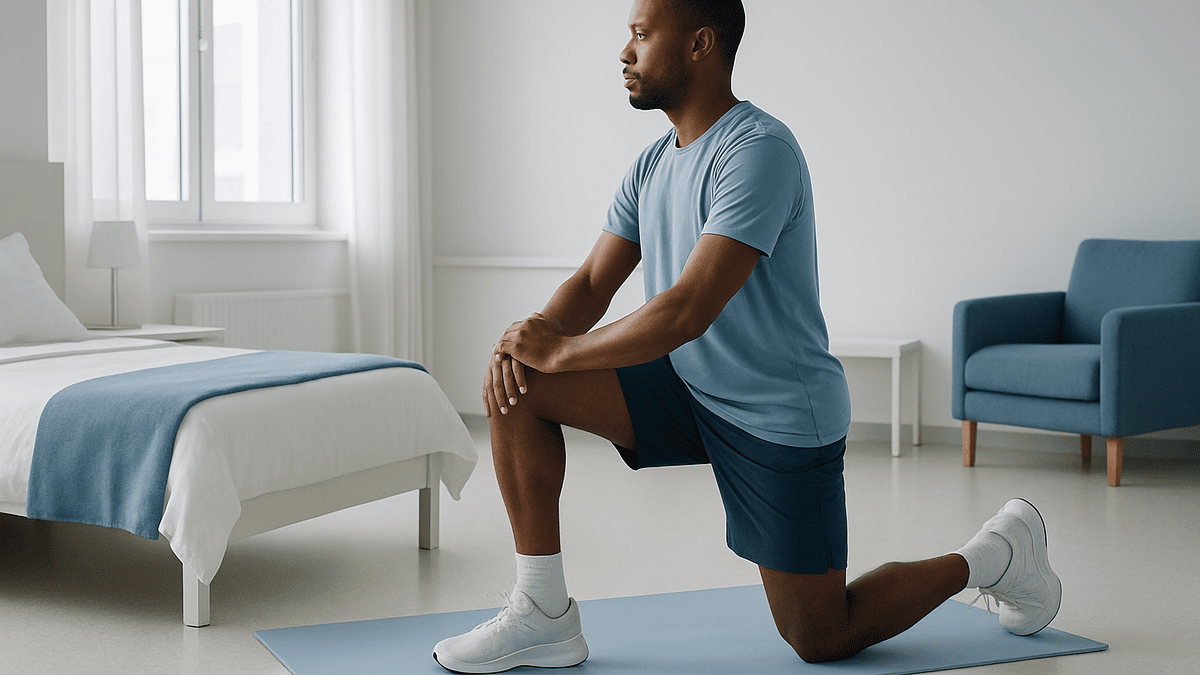
- Standing hip-flexor stretch: 30 seconds per side. Split stance, back knee soft, tuck your pelvis slightly under and shift forward until the front of the rear hip stretches.
- One minute of walking. Ideally somewhere your eyes can look at the horizon instead of a screen.
The honest label for this routine: maintenance, not correction. Pair it with the strengthening work below and the five minutes becomes the glue between sessions rather than the whole plan.
What are four signs of poor posture?
You don’t need a clinic to spot the classic patterns. Stand relaxed, not corrected, in front of a mirror or ask someone to take a side-on photo, and look for these four:
- Forward head. From the side, your ear canal should sit roughly over the middle of your shoulder. If your ear is noticeably ahead of it, your neck muscles are running that crane-arm workload all day.
- Rounded shoulders. With arms hanging naturally, glance at your hands. Palms facing your thighs suggests a neutral shoulder position; knuckles facing mostly forward suggests the shoulders have rolled inward.
- An exaggerated low-back arch. A pelvis tipped forward deepens the lumbar curve and pushes the abdomen out, often paired with tight hip flexors from long sitting.
- Visible asymmetry. One shoulder consistently higher, a head that tilts to one side, or one shoulder blade sitting more prominently than the other, worth attention, especially in adolescents, where it can be an early sign of scoliosis.
The body often reports these patterns before the mirror does. Neck and upper-back tension by late afternoon, tension-type headaches, jaw tightness, or feeling oddly tired after a day of sitting are common companions of sustained poor positioning. A simple check: stand with your heels, buttocks, and upper back against a wall. If getting the back of your head to touch the wall without tilting your chin up takes real effort, forward head posture has likely set in.
Rounded shoulders exercises that actually reverse the slump
Rounded shoulders are a tug-of-war you’re losing on both ends: the chest muscles at the front have adaptively shortened from years of reaching forward, while the mid-back muscles that should anchor the shoulder blades have lengthened and weakened. Effective rounded shoulders exercises therefore always come in pairs, release the front, strengthen the back. Doing only one is why so many people stretch daily for months and stay slumped.
Release the front:
- Doorway pec stretch30 seconds each side, one to two times daily. Elbow at shoulder height; try a second round with the elbow slightly higher to bias different fibers.
- Thoracic extension over a rolled towel or foam rollerlie back with the roll across your mid-back (never the lower back or neck), support your head, and let the upper spine gently extend for 30 to 60 seconds.
Strengthen the back:
- Band pull-apartsarms straight ahead at shoulder height, pull a light resistance band apart until it touches your chest, squeezing the shoulder blades together. Three sets of 12 to 15, most days.
- Rowsany variation: band, cable, or bent-over. Lead the pull with your shoulder blades, not your elbows.
- Prone Y-T-Wlying face down, lift your arms into a Y, then T, then W shape, thumbs toward the ceiling, holding each for two to three seconds. Two sets of six of each letter.
Expect the stretches to feel good immediately and the strengthening to feel humbling, light resistance, real fatigue. That fatigue is precisely the endurance you’ve been missing.
The core six: exercises for better posture, head to hips
If you keep only six movements, keep these. Together they cover the full chain that holds you upright, deep neck, mid-back, trunk, and hips, which matters because posture fails as a system, not one muscle at a time. A strong mid-back can’t rescue a pelvis that tips forward, and vice versa.
| Exercise | What it trains | Starting dose |
|---|---|---|
| Chin tuck | Deep neck flexors; counters forward head | 2 × 10, daily |
| Wall angel / wall slide | Mid-back strength + shoulder mobility | 2 × 8, daily |
| Band pull-apart or row | Rhomboids and lower trapezius | 3 × 12, 3× per week |
| Bird dog | Trunk endurance and control | 2 × 8 per side, 3× per week |
| Glute bridge | Hip extensors; counters pelvic tilt | 2 × 12, 3× per week |
| Half-kneeling hip-flexor stretch | Front-of-hip mobility | 30 sec per side, daily |
Two form notes save most of the common mistakes. On the bird dog, imagine balancing a mug of coffee on your lower back: the point is a still trunk, not high-kicking limbs. On the glute bridge, push through your heels and finish the lift with your buttocks, not by arching your lower back; if your hamstrings cramp, move your feet slightly closer to your hips. Everything on this list should be effortful by the last two reps and pain-free throughout. Sharp pain, numbness, or tingling is a stop sign, not a challenge.
Posture correction exercises if you sit all day
Here’s the uncomfortable math of desk life: a diligent 30-minute posture workout occupies about 3 percent of your waking day. The chair gets the other 97 percent. Posture correction exercises still matter enormously, they build the capacity, but for desk workers, the day itself has to become part of the program or the chair wins by sheer volume.
Three changes carry most of the weight:
- Break up sitting every 30 to 45 minutes. It doesn’t need to be exercise, stand for a phone call, walk to refill water, do ten wall slides. The interruption of the static position is the medicine. Public health guidance from the NHS and others has converged on this point: reduce prolonged sitting, in any way that fits your life.
- Raise your screen to eye level. A laptop on a desk guarantees a downward gaze and a forward head. A stand plus separate keyboard, or a stack of sturdy books, fixes in ten seconds what no exercise can out-train.
- Anchor exercises to things that already happen. Habit research consistently shows that new behaviors stick when tied to existing cues. Chin tucks while the kettle boils. Pull-aparts after the last meeting of the morning. The doorway stretch every time you pass a particular door frame. Willpower is a terrible scheduler; door frames are excellent ones.
None of this requires a standing desk, though alternating sitting and standing helps if you have one, standing rigidly for eight hours is just a different static position, not a cure.
How often, how hard, how long: the dose that holds
Programs that produce measurable posture change in research share a recognizable shape, and it’s less demanding than most people fear.
Frequency: strengthening work two to three times per week, with mobility work, the chest, hip, and mid-back stretches, done daily or near-daily, since five minutes of stretching costs almost nothing and stiffness returns quickly without it.
Intensity: lighter than a typical gym session. Postural muscles are endurance workers, so higher repetitions (12 to 15) with lighter resistance match the job description better than heavy triples. The last few reps should feel genuinely effortful; the set should never produce sharp pain.
Duration: plan for 8 to 12 weeks before judging results, because that’s the window where studies typically find meaningful change in head and shoulder alignment. Take a relaxed side-on photo before you start and again at week six: the camera notices changes the mirror has grown used to, and it’s far more motivating than trying to remember how you used to stand.
Afterward: the gains hold only as long as some stimulus continues. That doesn’t mean training hard forever, one or two brief maintenance sessions a week, plus the daily habit anchors, keeps the new default in place. Stop entirely and return to ten hours of daily sitting, and the old pattern reasserts itself over a few months. Muscles are honest that way: they keep exactly what you keep asking of them.
Stretching vs. strengthening: which matters more?
If forced to choose, choose strengthening, but the evidence says you shouldn’t choose. Studies of people with forward head and rounded shoulders have generally found that combined programs, pairing stretches for shortened front-body tissue with strengthening for the lengthened back-body muscles, outperform either approach alone. The two do different jobs, and each covers the other’s blind spot.
Stretching changes what positions are available. A chest that has shortened over years physically limits how far the shoulders can sit back; ten minutes of rows won’t fix what tissue length won’t allow. But stretching’s effects on resting posture are temporary, measured in hours, which is why the stretch-only crowd feels wonderful at 9 a.m. and slumped by 3 p.m.
Strengthening changes what positions are affordable. Once the mid-back and deep neck muscles have the endurance to hold a taller position through a workday, that position stops being a conscious project and starts being the path of least resistance. This is the durable half of the equation, and it’s the half most posture content skips because bands and repetition photograph less serenely than stretching.
A practical split for a 20-minute session: roughly five minutes of mobility work up front (doorway stretch, hip flexors, thoracic extension) to open the door, then fifteen minutes of strengthening (rows or pull-aparts, wall angels, bird dogs, bridges) to walk through it. Daily five-minute stretch breaks between sessions keep the door from swinging shut.
Does bad posture actually cause pain? What the evidence really shows
Less directly than the internet suggests. Large studies have struggled to find a tidy line from any specific standing or sitting alignment to future back or neck pain, plenty of people with pronounced slouches report no pain, and plenty of upright people do. That finding surprised researchers too, and it’s worth sitting with, because a lot of posture marketing depends on you not knowing it.
What the evidence more consistently supports is subtler. Sustained positions of any kind, low daily movement, and poor muscular endurance are associated with discomfort: the neck and shoulder ache that builds through a desk day, tension-type headaches, the stiffness that greets you when you finally stand up. Forward head posture in particular has been linked with neck muscle overactivity and tension symptoms in some studies. The pattern that emerges: it’s less about the shape you make and more about how long you’re stuck making it, and whether your muscles can afford the position at all.
This is quietly liberating. It means an afternoon of slouching on the couch hasn’t damaged you, and it means the goal of posture exercises isn’t to achieve a protective pose: it’s to build the strength and mobility that let you move in and out of many positions comfortably. It also means pain deserves its own attention. Persistent neck or back pain isn’t proof of bad posture, and exercises alone aren’t guaranteed to resolve it, which brings us to the next section.
When to see a doctor about your posture
Most posture concerns are habitual and safe to address with the exercises above. A subset deserves professional eyes first, because posture change is occasionally a messenger for something else. See a doctor or physical therapist if any of the following applies:
- Pain with nerve signs. Numbness, tingling, or weakness running into an arm or leg, alongside neck or back symptoms.
- A posture change you didn’t choose. A curve, hump, or lean that appeared or progressed noticeably, especially in adolescents (one shoulder blade more prominent, uneven waist) or in adults with measurable height loss, which can signal vertebral compression related to bone thinning.
- Pain that doesn’t behave. Back or neck pain that persists beyond a few weeks despite sensible activity, wakes you at night, or is severe and constant regardless of position.
- Pain after a fall or accident, at any age, sooner rather than later if you’re over 65 or have a history of osteoporosis.
- New balance problems, unexplained weight loss, or fever accompanying back symptoms.
- Exercises that consistently provoke sharp pain rather than muscle effort, even after adjusting form and load.
None of these automatically means something serious, most turn out to be manageable, but they change the order of operations. Assessment first, program second. A physical therapist can also be worth a visit without any red flags at all: a single session often catches the form errors and missing pieces that keep home programs from working, and it turns a generic routine into one built for your specific pattern.
Frequently asked questions
Can I correct years of bad posture?
Usually, yes, habitual patterns like forward head and rounded shoulders respond to strengthening and mobility work at essentially any age, because muscles adapt whether you’re 25 or 75. The exception is structural change, such as a fixed spinal curve or compression fractures, where the goal shifts from reversal to preventing progression and protecting function. A quick test: if you can deliberately stand noticeably taller, even with effort, your pattern is largely trainable.
How long does it take to fix posture with exercises?
Plan on roughly six to twelve weeks of strengthening two to three times a week, plus near-daily five-minute mobility work, before your resting position genuinely shifts. Early gains, better awareness, less stiffness, easier tall standing, often arrive within one to three weeks, but those come from your nervous system and looser tissue, not new muscle. Take a side-on photo before starting; the camera tracks progress far better than memory.
Is it possible to correct posture in 7 days?
Not in the sense of rebuilding your resting position, muscle adaptation simply takes longer than a week. What seven focused days can deliver is real awareness (you catch the slump in seconds instead of hours), reduced chest and hip stiffness from daily stretching, and the skill of finding a tall position on demand. Treat week one as learning the route; weeks two through twelve build the engine that holds it.
Can 5 minutes a day really improve my posture?
Five minutes works as a reset, not a rebuild. A short sequence, chin tucks, a doorway chest stretch, wall slides, a hip-flexor stretch, and a brief walk, interrupts long static sitting, which the evidence suggests matters more than any single alignment. Repeated two or three times through a workday, it meaningfully reduces stiffness. For lasting change in how you stand, pair it with strengthening sessions two to three times weekly.
What are four signs of poor posture?
The four classic signs are a forward head (your ear sits ahead of your shoulder when viewed from the side), rounded shoulders (knuckles face forward when your arms hang relaxed), an exaggerated lower-back arch from a forward-tipped pelvis, and visible asymmetry such as one shoulder sitting higher. Common companions include afternoon neck tension, tension-type headaches, and jaw tightness. A relaxed side-on photo reveals these patterns more honestly than a mirror.
Do posture correctors and braces work?
Not as a standalone fix. A brace holds you in position passively, which can be a useful short-term awareness cue, but it doesn’t build the muscular endurance that keeps you upright once it comes off, and worn constantly, it may let those muscles do even less work. If you use one, treat it as a temporary reminder for limited hours while you build strength through exercises, not as a substitute for them.
How do I fix rounded shoulders if I sit at a desk all day?
Work both ends of the tug-of-war: stretch the shortened chest (doorway stretch, 30 seconds per side, daily) and strengthen the weakened mid-back (band pull-aparts or rows, three sets of 12 to 15, three times weekly). Then change the day itself, raise your screen to eye level and break up sitting every 30 to 45 minutes. Exercises build capacity, but eight unbroken hours of reaching forward will out-vote any twenty-minute routine.
Is slouching actually bad for my spine?
Occasional slouching isn’t damaging, research hasn’t found that any single sitting position injures a healthy spine. The problems come from staying in one position for hours and from muscles too deconditioned to afford alternatives, which is associated with neck tension, headaches, and end-of-day aches. The practical rule physical therapists use: your best posture is your next posture. Move often, build strength, and let the slouch be one option among many rather than your only one.
What is the best sleeping position for posture?
Back or side sleeping generally supports neutral alignment best. Back sleepers need a pillow low enough that the head isn’t pushed forward: the same forward-head position you’re trying to untrain. Side sleepers do well with a pillow thick enough to keep the neck level with the spine, plus a pillow between the knees to keep the hips stacked. Stomach sleeping forces hours of neck rotation, so it’s the position most worth phasing out if you have neck symptoms.
Should I do posture exercises every day?
Split the program: mobility work daily, strengthening two to three times a week. The stretches, chest, hip flexors, mid-back extension, cost about five minutes and their effects fade within hours, so daily repetition earns its keep. Strengthening muscles need roughly 48 hours between sessions to adapt, so more isn’t better there. Stop and reassess if any exercise produces sharp pain, numbness, or tingling rather than honest muscle effort.
References
- MedlinePlus: Guide to Good Posture
- NHS: Common posture mistakes and fixes
- Cleveland Clinic: Back Health and Posture
This article is for general information only and is not a substitute for professional medical advice. Please consult a qualified doctor about your individual situation.

More from the Blog

Compression Boots: What Pneumatic Recovery Devices Do, and What Trials Show
Compression boots are inflatable leg sleeves that squeeze the limbs in a rhythmic pattern, a technique called intermittent pneumatic compression. Small randomized trials in…

Dynamic Stretching: Why Warm-Ups Changed and What to Do Now
Dynamic stretching means moving joints and muscles through their range of motion, leg swings, walking lunges, arm circles, instead of holding a stretch in…
Dead Bug and Bird Dog: The Two Core Exercises Physiotherapists Prescribe Most
The dead bug exercise is a floor-based core drill: you lie on your back, arms and knees raised, and slowly lower the opposite arm…

Reformer Pilates vs Mat Pilates vs Yoga: What Each Builds and Who It Suits
Reformer Pilates uses a sliding carriage and adjustable springs to add resistance and support to Pilates movements, so it tends to build more measurable…

Resistance Bands vs Weights: What the Research Says About Building Muscle at Home
Resistance bands can build muscle and strength at home, and the best available evidence, a 2019 meta-analysis of randomized trials, found no significant difference…

Full-Body vs Push-Pull-Legs: Choosing a Training Split by How Often You Can Train
Choose a training split by how many days you can reliably lift. With two or three sessions a week, a full body workout lets…