

Resistance Bands vs Weights: What the Research Says About Building Muscle at Home

Key Takeaways
- A 2019 meta-analysis of eight controlled trials found no statistically significant difference in upper- or lower-body strength gains between elastic bands and conventional weights over eight to twelve weeks.
- Band tension rises as the material stretches, so a movement loads hardest at its end range, which suits presses and rows and suits squats less well.
- Lighter loads produce comparable muscle growth to heavier loads when sets are taken within about two repetitions of failure, which is the zone bands naturally occupy.
- Color codes for band thickness are not standardized across manufacturers, so actual resistance must be judged by feel and by the maker's stated tension range.
- WHO and CDC guidelines recommend muscle-strengthening activity for all major muscle groups on at least two days a week and list bands, weights and body weight as equivalent options.
- No trial has followed band-only training in experienced lifters beyond a few months, so claims about long-term ceilings in either direction are extrapolation, not evidence.
Resistance bands can build muscle and strength at home, and the best available evidence, a 2019 meta-analysis of randomized trials, found no significant difference in strength gains between elastic and conventional weight training when effort was matched. The catch is progression: bands must be made harder over time, and the research on long-term muscle size is smaller and shorter than the research on free weights.
A physical therapist I know keeps a drawer of resistance bands in three colors and a single kettlebell that has not moved in a year. Her patients use the bands; she uses the bands; the kettlebell collects dust. That small scene captures why this question is everywhere right now: search interest in resistance bands has climbed through 2026 on the back of gear roundups, apartment-friendly training and a viral claim that bands build muscle ‘just as well as weights.’
As of September 2026, the loudest voices are product lists. They tell you which band to buy and almost nothing about whether the body cares what is pulling against it. That is the more interesting question, and the one with actual data behind it.
This piece walks through the trials, the physiology and the honest gaps, then gets practical about choosing, progressing and staying out of trouble.
What changed recently in the resistance bands conversation
Nothing dramatic happened in a laboratory this year. What changed is the framing. Three older facts have collided with a very current shopping mood, and the mix has made a modest piece of equipment feel new.
The first fact dates to November 2020, when the World Health Organization updated its global physical activity guidelines and gave muscle-strengthening activity equal billing with aerobic exercise, recommending it for all major muscle groups on two or more days a week for adults. The guidance names elastic bands alongside weights and body weight as legitimate ways to load a muscle. The CDC’s current adult activity pages, refreshed in 2024, carry the same two-day minimum and the same tool-agnostic language.
The second fact is a 2019 systematic review and meta-analysis in SAGE Open Medicine. A systematic review is a structured search of every relevant study; a meta-analysis pools their numbers into one estimate. That paper found no meaningful strength difference between elastic and conventional resistance training, and it has been quoted, screenshotted and occasionally overstated in social clips throughout 2026.
The third fact is cultural. Best-of lists for 2026 are ranking bands the way they once ranked treadmills, and remote work has kept a lot of training in living rooms. Mayo Clinic’s strength training overview, which is updated on a rolling basis, now treats bands as a first-line option rather than a rehab afterthought.
So the honest headline is this: the science did not shift in 2026, the conversation did. That makes it a good moment to read the studies rather than the product blurbs.
Do resistance bands actually work for building muscle?
Yes, with a condition attached that most viral posts skip.

Muscle does not have eyes. It responds to mechanical tension, the pulling force running through its fibers while it contracts, and to the fatigue that builds when a set is taken close to the point where another repetition would fail. Whether that tension comes from iron, a stretched loop of latex or your own body weight on a staircase is, physiologically, a detail. This is why the WHO, the CDC and the NHS all list bands, weights and body-weight moves together under ‘muscle-strengthening activity’ without ranking them.
The condition is dose. A band that feels hard in week one will feel easy in week six, because the whole point of training is that you adapt. Free weights make the next step obvious: pick up the heavier dumbbell. Bands ask you to be deliberate, shortening the band, doubling it, moving to a thicker one or slowing the movement. When people say bands ‘stopped working,’ they usually mean the load stopped changing.
Within that frame, the results in controlled studies are encouraging. Randomized trials, in which people are assigned by chance to a band group or a weight group so the two are comparable, have shown similar strength gains across upper and lower body over eight to twelve weeks. Trials in older adults using bands alone show measurable improvements in leg strength and everyday function such as chair rises and walking speed.
What the studies show less clearly is the ceiling. Almost every band trial runs for a few months and recruits beginners or older adults. Whether a band-only program can keep an experienced lifter growing for years is not something the literature can currently answer, and it is worth saying so plainly.
How muscle grows, and why the tool matters less than the effort
Muscle growth, or hypertrophy, is the increase in the cross-sectional size of muscle fibers in response to repeated loading. The signal that starts it is tension, and the rule that keeps it going is progressive overload: gradually asking the muscle to do more than it did last time.
Here is the piece that matters for bands. Research on training load has repeatedly found that lighter loads produce comparable muscle growth to heavier loads as long as sets are carried close to failure. Lifting something heavy for five repetitions and lifting something moderate for twenty repetitions recruit the full pool of muscle fibers by the end of the set, because as the early fibers tire, the body calls up the rest. The heavy option builds more maximal strength; both options build tissue.
Bands sit naturally in the moderate-load, higher-repetition zone. A set of banded rows taken to the point where two more good repetitions would be all you have left, a state coaches call ‘two reps in reserve,’ delivers the fatigue signal that drives growth. That is not a compromise; it is a legitimate branch of the evidence.
Two other variables matter more than the equipment. Weekly volume, the total number of hard sets a muscle receives, correlates with growth up to a point. And frequency, hitting each muscle at least twice a week, is what the WHO and CDC minimums are built around.
Diet and recovery finish the picture. Muscle is protein, and adults who train need enough of it, along with sleep, for the repair process to run. Mayo Clinic’s guidance is blunt that rest days are part of the program, not a break from it.
Put simply: the band is a tension delivery device. The plan is what builds the muscle.
What the evidence actually says, graded by strength
Evidence comes in tiers, and it helps to name them. Randomized controlled trials, or RCTs, are the strongest single-study design because chance assignment removes most bias. Meta-analyses pool RCTs. Observational studies watch people who chose their own exercise and are weaker. Expert opinion sits at the bottom.
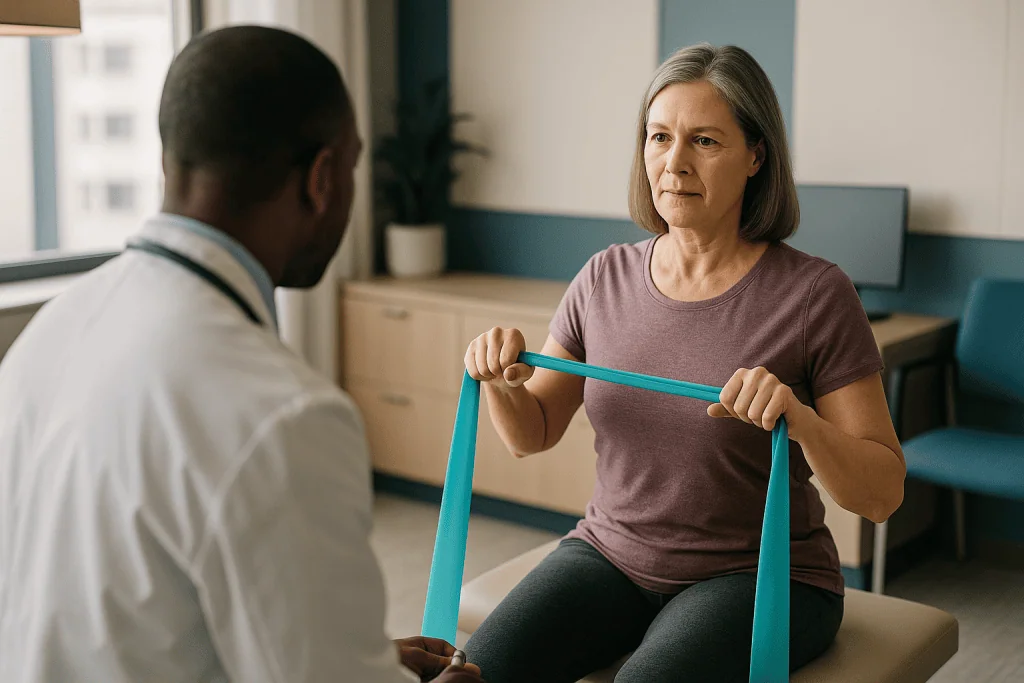
Strength gains: moderate evidence, reasonably consistent. The 2019 SAGE Open Medicine meta-analysis pooled eight randomized or controlled trials comparing elastic resistance with conventional weights. For both upper-limb and lower-limb strength the pooled difference was small and not statistically significant, meaning the data could not distinguish the two methods. Interventions lasted roughly eight to twelve weeks, and participants were mostly untrained adults or older adults. That population detail limits how far the finding stretches.
Muscle size: lower-quality evidence, promising direction. Fewer trials have measured muscle thickness or cross-sectional area directly, and those that have are small, short and often use bands as the sole method rather than head-to-head against weights. The direction is favorable, the certainty is not high.
Functional outcomes in older adults: moderate evidence. Multiple RCTs of band programs in people over 60 report gains in chair-stand tests, gait speed and balance, which is why the NHS strength and flexibility guidance uses band-based moves in its home programs.
Long-term and advanced training: essentially no direct evidence. No trial has followed band-only training in experienced lifters beyond a few months. Claims about elite results from bands alone are extrapolation.
The fair summary: for beginners, older adults and anyone training at home, bands have solid backing for strength and function, moderate backing for muscle size, and an unanswered question about the very long game.
Resistance bands vs dumbbells: how the load curve differs
Pick up a dumbbell and it weighs the same at the bottom of a curl as at the top. Stretch a band and the story changes with every inch.
Bands provide variable resistance, meaning the force rises as the material lengthens. At the start of a movement the band may offer very little; at the end, with the elastic near full stretch, it may offer several times more. Engineers call this an ascending resistance curve, and it has real consequences for how a set feels and which part of the muscle’s range does the work.
For many exercises the ascending curve is helpful. In a standing row or a press, the joint is mechanically strongest near the end of the movement, so the band asks the most where you can give the most. Some strength coaches deliberately add bands to barbells for exactly this reason.
For other exercises it is a limitation. A squat is hardest at the bottom, where a band is slack. A biceps curl with a band underfoot loads the top of the curl heavily and the bottom barely at all. Dumbbells, by contrast, stress the whole arc more evenly, and gravity does not care where you anchor it.
Bands also lose a familiar feedback signal. A dumbbell labeled 10 kilograms gives you an unambiguous number to beat. A band’s actual tension depends on its thickness, how far it is stretched, its age and even the room temperature. Consistency in setup, standing on the same spot and using the same grip, matters more with bands than most people realize.
Neither curve is ‘correct.’ A well-built plan uses each where it shines and accepts the trade-offs where it does not.
Resistance bands vs weights: a side-by-side summary
The table below distills the comparison for someone deciding what to keep in a small apartment. It is intentionally free of brands and prices; the evidence does not distinguish between makers, only between methods.
| Factor | Resistance bands | Free weights | What the evidence says |
|---|---|---|---|
| Strength gains (8–12 weeks, beginners) | Comparable | Comparable | 2019 meta-analysis: no significant difference |
| Muscle growth | Likely, with progression | Well established | Bands: small, short trials; weights: decades of data |
| Load pattern | Rises through the movement | Constant | Mechanical fact; favors different exercises |
| Measuring progress | Indirect (band grade, length, reps) | Direct (kilograms) | Practical difference, not a physiological one |
| Joint stress at end range | Higher on stretched end | Depends on exercise | Clinical observation; watch shoulders |
| Portability and storage | Fits in a pocket | Needs floor space | Self-evident |
| Older adults and rehab | Strong track record | Effective, less studied at home | Multiple RCTs favor band feasibility |
| Ceiling for advanced lifters | Unknown | Very high | No long-term band-only trials exist |
Two rows deserve a second look. The ‘measuring progress’ row is where most home programs quietly fail, because without a number that goes up, people drift into doing the same thing for months. The ‘ceiling’ row is where honesty matters most: the absence of long-term band trials is not evidence that bands stop working, but it is not evidence that they keep working either.
If you can own both, own both. If you can own one and you are a beginner training at home, the evidence does not punish you for choosing bands.
Which type of resistance band is best?
Best for what? Bands are not one product but at least five, and each solves a different problem.
Flat therapy bands are thin sheets of latex or a latex-free polymer, usually color-coded by thickness. They excel at small, controlled movements for shoulders, hips and rehabilitation, which is why physical therapists reach for them first. Their weakness is heavy lower-body work; the tension tops out early.
Tube bands with handles feel closest to dumbbell training. The handles allow presses, rows and curls with a familiar grip, and the tubes can be anchored in a door frame with a padded strap. Tubes wear at the point where they meet the handle, so inspection matters.
Large loop bands, sometimes called power bands, are continuous flat loops thick enough to assist a pull-up or add load to a squat or deadlift pattern. They carry the highest tension of any band type and are the most plausible tool for someone who wants to keep progressing lower-body strength without a barbell.
Mini loops sit around the thighs or ankles for hip and glute work such as lateral walks and clamshells. Fabric versions grip the skin better and do not roll, which older adults often prefer.
Figure-eight bands and other novelty shapes exist; the evidence base does not distinguish them from the categories above.
A reasonable home kit is a set of large loops in three or four thicknesses, one pair of mini loops and a door anchor. That combination covers push, pull, squat and hinge patterns with room to progress. Latex allergy is worth knowing about before buying; latex-free versions perform similarly and are widely available.
Best resistance bands for beginners: how to choose without a brand name
The most useful answer to ‘what is the best resistance band to start with’ is a set, not a single band. Muscles in the legs are several times stronger than muscles in the shoulders, and one band cannot serve both.
Start by thinking in terms of the movements you will do rather than the colors on the packaging. Color codes are not standardized across manufacturers, so a ‘medium’ from one maker may be a ‘light’ from another. What you want is a light band for shoulders and rotator cuff work, a medium band for rows and presses, and a heavy band for squats, hinges and glute bridges. Most sets sold as three-to-five-piece bundles land roughly there.
Check three things when the box arrives. Look for a manufacturer statement of tension range; a band that lists its resistance in a range at a given stretch is more useful than one that lists only a color. Look at the seam or splice on loop bands, since a lumpy or visible joint is where failure starts. And check the material: natural latex has the best stretch and durability, but latex-free versions are the right call for anyone with an allergy.
A door anchor, a padded strap with a foam plug that sits on the hinge side of a closed door, turns a single loop into a cable machine. The NHS home strength routines and Cleveland Clinic exercise guides both assume this kind of setup for rows and chest presses.
What you do not need at the start: handles, ankle cuffs, bars or apps. Those can come later if you find yourself wanting more variety. The first three months are about consistency and learning what a hard set feels like.
How to make resistance bands progressive so gains keep coming
Progressive overload is the non-negotiable rule of building muscle, and it is the rule bands make easiest to break. Here are the levers, in the order most people should pull them.
Add repetitions. If eight rows felt hard last week, aim for nine or ten this week with the same band and stance. Keep a note on your phone; memory is unreliable and flattering.
Shorten the band. Standing wider on a loop, gripping further down a tube or wrapping the band once around your hand increases the stretch and therefore the tension. This is the finest adjustment bands offer and the one most people forget.
Slow the lowering phase. The eccentric portion of a lift, when the muscle lengthens under load, is a strong stimulus for growth. Counting three or four seconds on the way back gives the same band a new job.
Double up. Two lighter bands stacked behave like one heavier band and let you make smaller jumps than moving to the next thickness.
Move up a band. When you can do twelve to fifteen clean repetitions with two in reserve, the band is no longer the limiting factor. Go thicker and drop the repetitions back to eight or so.
Add a set. Weekly volume drives growth; adding a third or fourth set to a movement is a legitimate progression when band thickness is maxed out.
Cycle through these over weeks, not days. A simple structure is to hold the band constant for three to four weeks while adding repetitions, then step up and reset. Mayo Clinic’s advice to allow at least one full day between sessions for the same muscle group still applies; progression works only if recovery is allowed to happen.
Resistance band exercises that cover the whole body
A complete program needs four movement patterns: a push, a pull, a squat and a hip hinge. Add something for the trunk and something for the smaller muscles around the hips and shoulders and you have covered what the WHO and CDC mean by ‘all major muscle groups.’
The list below is a framework, not a prescription. A physical therapist or qualified trainer can adjust it for your history.
- Push: band chest press anchored in a door, or an overhead press with the loop under both feet.
- Pull: seated or standing row from a door anchor; a single-arm row to expose side-to-side differences.
- Squat: a loop under the feet and over the shoulders, or a goblet-style hold of a doubled band.
- Hinge: band deadlift standing on the loop and pulling to hip height, or a glute bridge with a loop across the hips.
- Hips: mini-loop lateral walks and clamshells for the gluteus medius, the muscle on the side of the hip that keeps the pelvis level when you walk.
- Shoulders: external rotation with a light band, elbows tucked, for the rotator cuff.
- Trunk: Pallof press, standing sideways to an anchor and pressing the band straight out to resist rotation.
Two to three sets of eight to fifteen repetitions per movement, two or three times a week, matches the range used in most of the trials discussed above. A session built this way takes about thirty minutes.
Form cues that matter more with bands than with weights: keep the band taut at the start position so there is tension through the whole range, control the return rather than letting the band snap you back, and anchor loops at a height that keeps the line of pull aligned with the joint you are working.
Who benefits most from resistance bands
The evidence is not evenly distributed across people, and knowing where it is strongest helps you judge how much to trust it for your own situation.
Older adults have the deepest research base. Muscle mass declines by roughly three to eight percent per decade after age 30 and the loss accelerates after 60, a process called sarcopenia. Randomized trials of band-based programs in this age group consistently show gains in leg strength, chair-rise ability and walking speed, outcomes that map directly onto independence and fall risk. The NHS and Harvard Health both highlight strength work as the single most protective habit for later-life mobility, and bands are the tool most older adults will actually use at home.
People recovering from injury or surgery benefit from the low starting load and the gentle beginning of the resistance curve. This is why therapy bands are a staple in rehabilitation clinics. The specific program, however, belongs to the treating clinician, who knows what the healing tissue can tolerate.
Beginners and returning exercisers get most of the early gains from any consistent load, and bands remove the intimidation factor of a weight room.
Frequent travelers and people in small homes gain from the obvious practical fact that a full set fits in a jacket pocket.
Experienced lifters are the group for whom the evidence is thinnest. Bands can add variety, help with warm-ups and support accessory work, but a strength athlete chasing a heavy squat has no trial data suggesting bands alone will get them there.
People with a latex allergy, skin conditions on the hands or significant joint instability should choose materials and movements with a clinician’s input.
Common myths about resistance bands, corrected
Viral fitness content runs on strong claims, and bands have attracted a few in each direction. Here is what the evidence supports and what it does not.
Myth: bands are only for rehab and older people. The 2019 meta-analysis included healthy adults and found strength gains matching conventional weights over eight to twelve weeks. Bands started in clinics, but the physiology of tension does not check your age.
Myth: bands build muscle exactly as well as weights, full stop. The strength data supports ‘comparable’ for beginners in short trials. Muscle-size data is sparser, and there are no long-term studies in trained people. ‘Exactly as well’ is an overstatement of what has actually been measured.
Myth: you cannot build muscle with light resistance. Training-load research shows that lighter loads produce similar hypertrophy to heavier loads when sets are taken close to failure. Bands live in that zone.
Myth: bands are safer than weights. Bands do not fall on your foot, but they do snap, and the highest tension arrives at the end of the movement when joints are most extended. Shoulder irritation from overhead band work is a common clinical complaint. Different risks, not fewer.
Myth: the color tells you the resistance. Color codes vary by manufacturer and are not regulated. Actual tension depends on thickness, stretch distance and age of the material.
Myth: bands ‘tone’ while weights ‘bulk.’ Toning is not a physiological process; visible muscle definition is a combination of muscle size and the fat over it. Both tools build muscle. Neither, on its own, changes body fat.
The consistent thread is that the truth sits between the enthusiasts and the skeptics. Bands are a real training tool with real evidence and real limits.
Safety with resistance bands: snapping, latex, anchors and joints
The injury profile of bands is small but specific, and almost all of it is preventable with habits that take seconds.
Inspect before every session. Run the band through your fingers and look for nicks, cracks, discoloration or thinning, especially at handle joints and seams. Latex degrades with sunlight, heat and time; a band stored on a sunny windowsill ages far faster than one in a drawer. Replace anything that looks tired. The most frequently reported band injury is a snapped band striking the face or eye.
Anchor deliberately. Door anchors go on the hinge side of a door that closes toward you, so the door cannot swing open mid-set. Never anchor to a doorknob, a piece of furniture that can tip, or anything sharp. Wrapping a band around a rough edge is the second most common cause of failure.
Respect the end of the range. Because tension peaks when the band is longest, the shoulder in an overhead press or the elbow at the top of a curl is under the most load at the moment it is most extended. Stop each movement a fraction short of full lockout and keep the shoulder blades set during pulls.
Mind your footing. A loop that slips off a shoe becomes a projectile. Stand on the flat, wide part of the band with the whole foot, and wear shoes with tread.
Know your skin. Latex allergy can cause itching, hives or, rarely, more serious reactions. Latex-free polymer bands exist for this reason.
Warm up. Mayo Clinic recommends five to ten minutes of light movement before strength work. Cold muscle and a fully stretched band are a poor combination.
None of this makes bands dangerous. It makes them equipment, and equipment deserves a glance before use.
When to see a doctor
Strength training is one of the safest activities most adults can take up, and bands lower the barrier further. Even so, there are moments when the right move is a phone call rather than another set.
Before you start, talk to your clinician if you have a heart condition, uncontrolled blood pressure, a recent surgery, osteoporosis, a joint replacement, a hernia, diabetes with nerve or eye complications, or you are pregnant. None of these rule out band training; each changes how it should be built, and that judgment belongs to the person who knows your history.
Stop and seek care promptly if you experience chest pain or pressure, pain spreading to the arm, jaw or back, sudden shortness of breath out of proportion to the effort, dizziness or fainting, or an irregular heartbeat during or after exercise. These are red flags regardless of the equipment involved.
Book an appointment if a joint swells, locks or gives way; if pain is sharp rather than the dull ache of worked muscle; if pain lasts more than a few days or wakes you at night; if you notice numbness, tingling or weakness in a limb; or if a band snaps and strikes your eye, which warrants same-day evaluation even if vision seems fine.
Ask for guidance if you are recovering from injury and unsure which movements are appropriate, if progress has stalled for months despite honest effort, or if you are training to manage a diagnosed condition such as osteoporosis or a fall history. A physical therapist can tailor band selection and range of motion to the specific tissue involved.
Any decision about exercising alongside a medical condition or prescribed treatment should be made with, not instead of, your treating clinician.
Frequently asked questions
Do resistance bands actually work for building muscle?
Yes, when the load is progressed over time. Muscle responds to tension and effort, not to the material providing it, and randomized trials show strength gains from bands comparable to weights over eight to twelve weeks. The evidence for muscle size is smaller and shorter, so the honest answer is ‘yes for strength, likely for growth, unproven for the long term in advanced lifters.’
Do resistance bands build muscle as well as dumbbells?
For beginners over a few months, the pooled trial data cannot distinguish the two for strength. Dumbbells offer constant load through the whole movement and an exact number to progress, which makes overload easier to track. Bands need deliberate progression through repetitions, stretch distance and thickness. Neither is ‘better’ in the studies; they are different tools with different practical demands.
What is the best resistance band to start with?
A set rather than a single band, because legs are far stronger than shoulders. Most people do well with a light band for shoulder work, a medium for rows and presses and a heavy for squats and hinges, plus a door anchor. Choose latex-free if you have a latex allergy, and look for a stated tension range rather than relying on color alone.
Which type of resistance band is best?
It depends on the job. Flat therapy bands suit small controlled movements and rehabilitation. Large loop bands carry the most tension and best support squats, hinges and assisted pull-ups. Tube bands with handles feel closest to dumbbell training. Mini loops target hips and glutes. A home kit built around large loops in several thicknesses plus mini loops covers most needs.
What are the best resistance band exercises for a full-body workout?
Cover four patterns: a push such as a door-anchored chest press, a pull such as a row, a squat with the loop under the feet and over the shoulders, and a hinge such as a band deadlift or glute bridge. Add mini-loop lateral walks for the hips and light-band external rotation for the shoulders. Two to three sets of eight to fifteen repetitions matches the trial protocols.
How often should I train with resistance bands?
WHO and CDC guidance calls for muscle-strengthening activity for all major muscle groups on two or more days a week. Most band trials used two or three sessions weekly with a rest day between sessions for the same muscles. More frequent sessions can work if volume per session drops, but the two-day minimum is the evidence-backed floor.
Can older adults build muscle with resistance bands?
Yes, and this is the group with the strongest evidence. Multiple randomized trials in adults over 60 show improved leg strength, chair-rise ability, walking speed and balance after band programs of roughly eight to sixteen weeks. Because muscle loss accelerates after 60, this kind of training is among the most protective habits for independence. Anyone with osteoporosis or a recent fall should involve a clinician in program design.
Why do my resistance bands feel like they stopped working?
Almost always because the load stopped changing. Muscles adapt within weeks, so a band that was hard in January is easy by March unless you add repetitions, shorten the band, slow the lowering phase, stack two bands or move up a thickness. Keeping a simple log of band, stance and repetitions is the single most effective fix.
Are resistance bands safe for shoulders and joints?
Generally, with one caveat. Band tension peaks at the end of the movement, which is when the shoulder or elbow is most extended, and overhead band work is a common source of irritation. Stopping just short of full lockout, keeping the shoulder blades set during pulls and using a lighter band for rotator cuff work reduces that risk. Sharp or persistent joint pain warrants a clinician’s review.
How do I know when to replace a resistance band?
Replace it at the first sign of cracking, nicks, thinning, sticky texture or fading, especially at handle joints and seams. Latex degrades with sunlight, heat and time, so storage matters as much as use. A band that has visibly changed color or lost its snap is past its useful life, and a snapped band striking the face is the most frequently reported band injury.
References
This article is for general information only and is not a substitute for professional medical advice. Please consult a qualified doctor about your individual situation.

More from the Blog

Full-Body vs Push-Pull-Legs: Choosing a Training Split by How Often You Can Train
Choose a training split by how many days you can reliably lift. With two or three sessions a week, a full body workout lets…

DOMS: Why Muscles Hurt Two Days Later and What Actually Speeds Recovery
DOMS, or delayed onset muscle soreness, is muscle pain that peaks 24–72 hours after unfamiliar or intense exercise, especially movements that lengthen a muscle…
How to Do a Pull-Up: A Progression That Works for Beginners
To do a pull-up, hang from a bar with palms facing away and hands slightly wider than your shoulders, pull your shoulder blades down…

Calisthenics: How Bodyweight Training Builds Strength, and Where It Hits a Ceiling
Calisthenics builds strength by loading muscles with your own body weight and progressing through harder leverage, such as moving from incline push-ups to full…

Romanian Deadlift Form: The Hip Hinge That Protects Your Back When Done Right
A Romanian deadlift is a hip-hinge exercise: you hold a barbell or dumbbells, keep knees slightly bent and back neutral, and push your hips…

Walking Pads and Incline Walking: What Desk-Walking Does for Steps, Blood Sugar and Backs
A walking pad is a slim, low-speed treadmill built for slow walking under a standing desk. Used consistently, it adds real steps and light…