

Preparing for Finger or Toe Surgery: Blood Thinners, Imaging and Arranging Help

Key Takeaways
- Anticoagulants and antiplatelets are never stopped on your own initiative before finger or toe surgery; the prescribing clinician and surgeon jointly decide, and many minor digit operations proceed with the medicine continued.
- The NHS puts a trigger finger release at roughly twenty minutes of operating time, but the full visit with check-in, anesthesia and recovery typically fills half a day.
- If sedation or general anesthesia is planned, standard NHS fasting guidance is about six hours without food and two hours without clear fluids, though your own instructions override this.
- Trigger finger, ganglion cysts and ingrown nails are diagnosed by examination; X-rays are mainly used when bone alignment matters, and MRI is reserved for genuine uncertainty.
- Elevating the hand above the heart or the foot above the hip does more to reduce throbbing and swelling in the first days than most people expect from any medicine.
- Early gentle movement, as permitted by the surgeon, prevents the stiffness that is the commonest reason people are unhappy after tendon or soft-tissue surgery on a digit.
Preparing for finger or toe surgery usually involves a medication review with the team that prescribes your blood thinners, any imaging the surgeon needs to confirm the plan, clear fasting instructions if sedation or general anesthesia is planned, and practical arrangements at home: a ride, help with one-handed or off-your-feet tasks, and a raised position for the limb. Your treating team confirms every step for your situation.
The pre-op phone call lasts nine minutes, and the questions come fast. Are you on a blood thinner? Any X-rays in the last year? Who is driving you home? Most people facing a small operation on a finger or a toe have never thought about any of it. The joint has been locking, or the nail has been infected for months, and the surgery itself sounds almost casual: twenty minutes, a numb hand, home by lunch.
Then reality arrives. A pharmacist wants to know exactly which anticoagulant you take. The clinic asks whether the ultrasound from your rheumatologist was ever sent over. You realize that buttoning a shirt, opening a jar and walking the dog all use the very part that will be bandaged.
Good finger surgery preparation is mostly about those unglamorous details. This guide walks through what usually happens with medicines, imaging, fasting and help at home, and where the evidence is honest about what is known and what is simply a clinic’s routine.
What does finger surgery preparation actually involve?
Strip away the paperwork and finger surgery preparation comes down to four jobs. The team needs to know what you take, what your hand or foot looks like inside, how you will be kept comfortable during the operation, and how you will manage afterward with one hand or one foot temporarily out of service.
The medication job is the one that trips people up. Anticoagulants, medicines that slow the blood’s clotting cascade, and antiplatelets, medicines that make platelets less sticky, both raise bleeding during any cut. Small procedures on digits bleed less than a hip replacement, so the balance is different, but someone still has to make the call, and it should never be you alone. The NHS is explicit that people should not stop an anticoagulant before a procedure without speaking to the prescribing clinician.
The imaging job is often already done. A plain X-ray taken when the problem was first diagnosed may be all the surgeon needs. Sometimes a fresh view is requested, particularly for a joint that has changed or a toe that has drifted.
The anesthesia job varies with the operation. Many finger and toe procedures use local anesthetic alone, so fasting rules may not apply. If sedation or a general anesthetic is planned, the NHS describes a standard pattern: no solid food for about six hours beforehand and only clear fluids until about two hours before. Your own instructions may differ, and those instructions win.
The home job is the quietest and, in practice, the one people regret skipping. A ride home is not optional after sedation. Someone to help with meals, lids and laces for the first days makes recovery calmer. Elevation, keeping the hand above the heart or the foot above the hip, does more for swelling and throbbing than most people expect.
None of these jobs is difficult. The trick is knowing they exist before the nine-minute phone call.
What actually happens during finger or toe surgery, in plain language
Most operations on digits are small, targeted repairs. Take trigger finger release, one of the most common. A tendon that bends the finger runs through a snug tunnel called the A1 pulley, a band of tissue near the base of the finger. When the tendon swells or the tunnel tightens, the finger catches or locks. The surgeon makes a short cut in the palm and divides the pulley so the tendon glides freely. The NHS puts the operation itself at roughly twenty minutes.
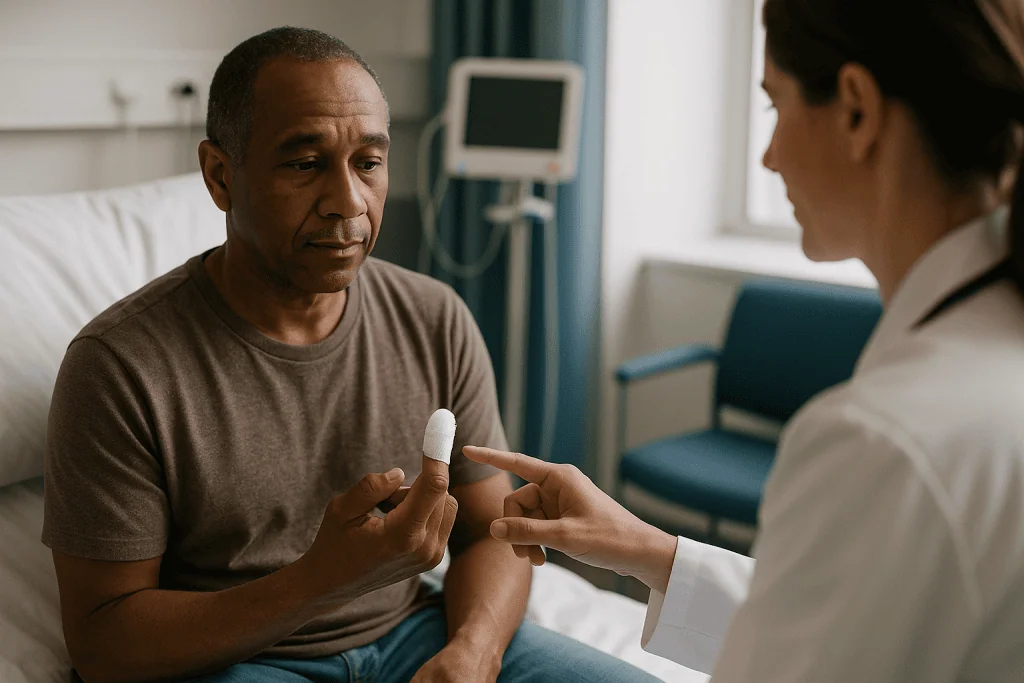
A toe has its own versions. Hammertoe correction straightens a toe bent at the middle joint, often by removing a sliver of bone or releasing a tight tendon. Nail-bed procedures for a recurring ingrown toenail remove the edge of the nail and sometimes the growing root beneath it. Bunion surgery is larger, realigning bone at the base of the big toe, and preparation for it is closer to full foot surgery than to a nail procedure.
Whatever the operation, the sequence is familiar. Skin is cleaned with antiseptic. The digit or limb is numbed with an injection of local anesthetic. A tight band called a tourniquet may be inflated on the arm or ankle to keep the field clear of blood, though many hand surgeons now operate without one using a technique known as wide-awake local anesthesia, where a small amount of adrenaline mixed into the anesthetic narrows nearby vessels instead. You may feel pressure or tugging but not sharp pain; that sensation is the cue to speak up, because more anesthetic can be given.
Closing takes a few stitches. A bulky dressing goes on, sometimes with a small splint. Then you sit up, and the recovery clock starts.
Who is usually offered finger or toe surgery, and who is usually asked to wait?
Surgery on a digit is rarely the first move. For trigger finger, the Mayo Clinic describes a ladder that starts with rest, a splint worn at night, stretching and anti-inflammatory measures, then a steroid injection into the tendon sheath, with surgery reserved for fingers that keep locking despite those steps or that are locked in a bent position. The same pattern holds for many toe problems: padding, footwear changes and nail care first, an operation when the problem keeps returning or interferes with walking.
People are usually offered surgery when three things line up. The diagnosis is clear on examination and, where relevant, imaging. Simpler measures have been given a fair trial. And the problem is affecting function, not just appearance.
Being asked to wait is common, and it is not a rejection. Surgeons and anesthesiologists typically want to pause when:
- There is an active infection anywhere in the body, or broken, inflamed skin at the operation site, because bacteria introduced during surgery are the main route to a wound infection.
- Blood sugar is running high in someone with diabetes, since poorly controlled glucose slows healing and raises infection risk. The team may ask for a recent HbA1c, a blood test reflecting average glucose over about three months.
- A recent heart attack, stroke or stent means the cardiology team has asked that antiplatelet medicines not be interrupted for now.
- A pregnancy makes elective surgery something to schedule around.
- You are still healing from another operation or a fracture in the same limb.
Smoking is the wait-and-improve factor that gets the most attention. Nicotine narrows the tiny vessels that feed healing skin, and the NHS advises stopping before any operation because smokers have more wound and chest complications. Even a short smoke-free stretch helps, and the team can point you toward support.
The decision to proceed, delay or choose a different treatment always rests with the surgeon and anesthesiologist, with your goals in the room.
Blood thinners before hand surgery: what usually happens and who decides
This is the question people lose sleep over, so here is the honest shape of it. A blood thinner exists because something else in your body is a clotting risk: an irregular heart rhythm called atrial fibrillation, a past deep vein thrombosis, a mechanical heart valve, a coronary stent. Stopping the medicine lowers bleeding at the wound but nudges up the risk the medicine was protecting against. Continuing it does the reverse. Small operations on digits sit at the low-bleeding end of surgery, which is why many are done with the medicine continued or only briefly adjusted. MedlinePlus and the NHS both stress that any change must come from the prescriber, never from a patient reading a leaflet.

| Medicine class | How it works | What usually happens before minor digit surgery |
|---|---|---|
| Vitamin K antagonist (warfarin) | Blocks the liver’s production of several clotting factors; effect builds and fades over days | Sometimes continued with a recent INR check, sometimes paused several days beforehand per the NHS; the prescriber decides and may arrange bridging |
| Direct oral anticoagulants (apixaban, rivaroxaban, dabigatran and similar) | Block a single clotting protein directly; effect comes on and wears off within a day or two | Often held for a short, defined window set by the prescriber, based on kidney function and bleeding risk of the procedure |
| Antiplatelets (aspirin, clopidogrel and similar) | Make platelets less able to clump at a cut | Aspirin is frequently continued; newer antiplatelets after a recent stent are usually not interrupted without cardiology input |
| Injectable anticoagulants (heparins) | Speed up the body’s own clot-blocking protein | Timing of the last injection is set by the prescribing team |
INR is a blood test that measures how long blood takes to clot on warfarin. The surgeon and the prescriber, sometimes with an anticoagulation clinic in the loop, weigh your individual clot risk against the procedure. Expect to be asked why you take the medicine, when you last had a clot or cardiac event, and whether you have ever bled unusually. Bring an up-to-date list, including the generic names.
Which other medicines and supplements come up before finger or toe surgery?
Blood thinners get the headlines, but the pre-op nurse will ask about everything, and several ordinary items matter more than people expect.
Diabetes medicines are the first. If you are fasting for sedation or a general anesthetic, some glucose-lowering medicines need their timing adjusted to avoid a low. Insulin users are usually given a specific plan. The instruction comes from the anesthesia team or your diabetes clinician, not from a general rule of thumb.
Over-the-counter pain relievers matter because of what is in them. Nonsteroidal anti-inflammatory drugs, the class that includes ibuprofen and naproxen, mildly reduce platelet function. Some surgeons ask that they be paused before larger procedures; for a small digit operation many do not. Acetaminophen does not affect clotting and is often used afterward. Say what you take so the team can tell you which applies.
Supplements are the quiet ones. Fish oil, high-dose vitamin E, garlic, ginkgo and ginger have all been associated in the literature with increased bleeding tendency, though the evidence is mixed and mostly from small studies. The NIH Office of Dietary Supplements notes these possible interactions, and most anesthesia teams simply ask that supplements be listed and, in many cases, stopped for a short period beforehand. Herbal remedies bought online are worth mentioning by name; nobody will judge you.
Steroid tablets, immune-suppressing medicines for rheumatoid arthritis or psoriasis, and biologic injections all influence infection risk and wound healing. Rheumatology and surgery teams often coordinate timing around an infusion cycle rather than stopping treatment.
Two practical points. First, keep taking your usual medicines unless someone tells you otherwise; blood pressure tablets in particular are normally continued on the morning of surgery with a sip of water. Second, bring the actual bottles or a pharmacy printout to the pre-op visit. Memory is unreliable when someone is asking about a purple tablet you have taken for eleven years.
Do you need imaging before finger surgery? X-rays, ultrasound and MRI explained
For most digit operations, imaging is about confirming the plan rather than making the diagnosis. Trigger finger, for instance, is diagnosed by examination; the Mayo Clinic notes that elaborate testing is not needed because the catching tendon can be felt and seen. Many people have their release without a single picture.
Plain X-rays are the workhorse when bone is involved. They show joint spacing, bone spurs, a healed fracture that has set at an angle, or the drift of a toe at its base joint. Surgeons planning a hammertoe or bunion correction typically want weight-bearing X-rays of the foot, meaning views taken while you stand, because the alignment changes when the foot carries load. Radiation dose from a hand or foot X-ray is tiny, roughly comparable to a few days of natural background exposure, according to standard radiology references cited by MedlinePlus.
Ultrasound uses sound waves and no radiation. It shows soft tissue in motion: a thickened tendon sheath, a cyst pressing on a nerve, a tendon that has partly torn. It is often used when the diagnosis is uncertain or when an injection is being guided to the right spot.
MRI is reserved for the unusual. Suspected ligament rupture in the thumb, a possible tumor, or bone infection would justify it. For an ordinary locking finger or an ingrown nail, it adds cost, time and anxiety without changing the operation.
Three practical questions worth asking: Does the surgeon already have the images from when I was diagnosed? Are they recent enough? And will anything be repeated on the day? Films taken months earlier are frequently fine for soft-tissue problems and sometimes outdated for bony ones. If images were taken elsewhere, request that the report and the pictures be sent ahead; a disc or a portal link saves a wasted appointment.
Preparing for hand surgery: local anesthetic, sedation or general anesthesia?
Anesthesia shapes your whole day more than the operation does, and preparing for hand surgery means knowing which kind you are having.
Local anesthetic alone is the most common choice for a single finger or toe. The medicine is injected around the nerves at the base of the digit or into the palm, numbing the area within minutes. You stay fully awake, can talk with the team, and in the wide-awake approach can even be asked to bend the finger during the operation so the surgeon can see the tendon glide. There is usually no fasting, you can often drive yourself home if the operative hand is not needed for the car, and you avoid the grogginess and nausea some people get after sedation. The trade-off is the injection itself, which stings for a few seconds.
Regional anesthesia numbs the whole arm or leg through an injection near a nerve cluster, often guided by ultrasound. The limb feels heavy and absent for several hours. It is used for larger procedures or when a tourniquet on the upper arm would be uncomfortable under local alone.
Sedation adds a medicine through a vein that makes you relaxed and sleepy, sometimes with no memory of the procedure, while you keep breathing on your own. General anesthesia puts you fully asleep with a breathing device. Both carry the NHS fasting rules of about six hours for food and two for clear fluids, both require an escort home, and both mean no driving, alcohol or important decisions for the rest of the day.
Which one you get depends on the operation, your health, and preference. People with severe anxiety, a strong needle phobia, or a procedure on several digits at once may be steered toward sedation. The anesthesiologist decides with you, and the pre-op assessment is the moment to raise fears rather than the morning of surgery.
What not to do before hand surgery
The list of things to avoid is short, but each item has a reason behind it, and knowing the reason makes the rule easier to keep.
Do not stop or start a prescription medicine on your own. Anticoagulants and antiplatelets are the obvious case, but abruptly stopping a beta blocker or a steroid can be dangerous in its own right. Every change goes through the prescriber.
Do not eat or drink past the fasting time if sedation or general anesthesia is planned. Food in the stomach during anesthesia can be regurgitated and inhaled. If you are having local anesthetic only, ask whether fasting applies; many teams prefer you to have eaten so you are not lightheaded from an empty stomach during the injections.
Do not apply creams, lotions or nail polish to the operative hand or foot on the day. Antiseptic works better on clean, dry skin, and polish hides the nail-bed color that tells the team the digit has good blood flow. Remove rings from the operative side; swelling can turn a loose ring into a tourniquet.
Do not shave the area yourself. Razors leave micro-cuts where bacteria settle. If hair removal is needed, the team clips it in the room.
Do not smoke or use nicotine products in the run-up. The NHS links smoking to slower wound healing and higher complication rates, and the effect on the small vessels of a fingertip or toe is immediate.
Do not drink alcohol the night before. It interferes with anesthesia, thins the blood slightly and leaves you dehydrated.
Do not arrive alone if you are having anything beyond local anesthetic. Clinics will delay or cancel if there is no responsible adult to take you home.
And do not skip the shower. Washing with ordinary soap the night before and the morning of surgery reduces bacterial load on the skin, which is why most pre-op leaflets ask for it.
How long does finger surgery take, and is there a worst day of the week?
The operation itself is brief. The NHS gives around twenty minutes for a trigger finger release, and similar single-digit procedures such as a mucous cyst removal or nail-bed ablation fall in the same range. Hammertoe correction and bunion surgery take longer because bone is being cut and fixed, and the surgeon will give an estimate for the specific procedure planned.
The day is not brief. Arrival, checking in, the anesthesia conversation, marking the site, waiting for your slot, the operation, then recovery and dressing instructions typically stretch a twenty-minute procedure into a half-day visit. Bring a book, a charger and, if you are fasting, patience.
People ask whether a particular weekday is riskier. The research on a weekday or weekend effect comes mostly from major inpatient surgery, where after-hours staffing patterns may matter; it does not translate cleanly to a planned, daytime, minor digit operation. For your purposes, the day of the week is a logistics question, not a safety one. Consider three things. Who can help you at home for the first two or three days? When is your surgeon’s clinic open if you have a concern? And if a dressing change or stitch removal is scheduled roughly two weeks later, does that date land somewhere you can get to?
A Friday operation gives you a weekend of built-in rest but means your first business-day question waits until Monday. A Tuesday operation means the clinic is reachable in the days you are most likely to phone. Neither is wrong. Pick the one that matches your support and your work, then stop worrying about it.
One more timing point: if you have both hands scheduled for the same problem, most surgeons prefer to stage them weeks apart so you always have one working hand. Ask how that will be sequenced.
Arranging help at home: the checklist people actually skip
MedlinePlus has a plainly titled page on getting your home ready after a hospital stay, and its advice scales down neatly to a bandaged hand or foot. The theme is simple: decide now what you will not be able to do, and solve it before you are one-handed.
For a hand operation, the dominant hand is the real question. If the operative side is your writing, cooking and phone hand, expect a few days of clumsy substitution. Pre-open jars, medicine bottles and packaging. Set out clothes with elastic waists and front zips; laces and small buttons are surprisingly defeating. Move frequently used items to counter height so you are not reaching or lifting with the wrong hand. Charge devices and consider voice-to-text.
For a toe operation, the issue is weight-bearing and keeping the foot up. Many people go home in a stiff-soled post-op shoe and are asked to walk only as needed for the first days. Clear the floor of rugs and cables. Put a chair in the shower if balancing on one foot is hard. Plan where you will sit with the foot raised on pillows above hip level, and keep water, remote and phone within reach of that spot.
Arrange the ride. If you are having sedation or general anesthesia, an adult must take you home and ideally stay the first night. Even after local anesthetic, driving with a numb, bulky-dressed hand is unsafe and may void your insurance. The NHS is direct on this: do not drive until you can control the vehicle comfortably, including an emergency stop.
Think about work and caregiving. Lifting a toddler, typing all day or standing at a till are all affected. Ask the surgeon for a realistic range for your job and tell your employer before the operation, not after.
Finally, stock the freezer. Nobody wants to chop onions with a splint on.
How bad is the pain after finger surgery, and what do the first days look like?
Pain after finger surgery is usually described as an ache or throbbing rather than sharp pain, and it is at its worst in the first couple of days, when the local anesthetic has fully worn off and swelling is peaking. The Mayo Clinic describes soreness after trigger finger release that settles over days to a few weeks. The fingertips and toes are dense with nerve endings, which is why even a small wound there can feel disproportionately tender.
Three things do most of the work in those early days. Elevation reduces the pooling of fluid that causes throbbing; a hand rested on pillows above the heart, or a foot raised above the hip, is worth more than any tablet. Cold applied over the dressing, never directly on skin, for short spells reduces swelling. And gentle movement of the joints the surgeon has cleared for motion keeps stiffness from setting in; for trigger finger release, the NHS notes you can usually move the finger straight away.
Medicines are the third layer, not the first. Most people manage with the non-opioid options the surgeon suggests: acetaminophen and, if the team agrees it is safe for you, an anti-inflammatory. Opioids are rarely needed for single-digit surgery and, when prescribed, are meant for a very short window. The prescriber sets what you take and when; this article deliberately does not.
Expect a numb or tingly fingertip for some hours after the operation. If a nerve block was used, the whole limb may be dead weight until evening, so protect it from knocks and heat. A little blood spotting on the outer dressing is normal. Steadily spreading blood, a dressing that feels tight as the swelling builds, or pain that climbs instead of easing after the second day are the signals to call.
The honest summary: uncomfortable, manageable, and better each morning.
What the following weeks usually look like: dressings, movement, work and driving
Recovery from a small digit operation follows a recognizable arc, though every surgeon has a preferred routine and yours overrides anything written here.
The first week is about protecting the wound. The bulky dressing usually stays on for a few days and is then reduced to a light covering. Keep it dry; a plastic bag sealed at the wrist or ankle works for showering. Elevation continues whenever you are resting. Gentle bending and straightening of the operated finger, if permitted, prevents the tendon from scarring to its surroundings.
The second week typically brings the wound check. Non-dissolving stitches are commonly removed around this point, according to NHS guidance on trigger finger release, and the scar can then be gently massaged with plain moisturizer once fully closed. Some people are referred to a hand therapist for exercises, especially after joint or tendon surgery.
Weeks two to six are the return-to-function phase. Desk work often resumes within days if the other hand can carry the load; manual work that involves gripping, vibration or heavy lifting waits longer. The NHS suggests the finger may feel tender and the scar sensitive for several weeks after a trigger finger release, with full comfort and strength returning over a few months in some people. For toe surgery, a post-op shoe is usually worn until the surgeon confirms the bone or soft tissue is stable; bunion correction takes considerably longer than a nail or hammertoe procedure.
Driving returns when you can grip the wheel, change gear and brake without hesitation. There is no fixed day; the NHS advises checking with your surgeon and your insurer.
Swelling in a fingertip or toe can linger for months, and that alone is not a problem. What matters is the direction of travel: less stiffness, less tenderness, more use, week by week.
What people often get wrong about finger surgery preparation
Myth: stop the blood thinner a week before, just to be safe. Safe for the wound, perhaps, but not for the heart or the veins the medicine is protecting. Unplanned interruptions of anticoagulation are associated with clots and strokes, which is why MedlinePlus and the NHS insist the prescriber sets any pause. Many minor digit operations proceed with the medicine continued.
Myth: it is a small operation, so the day will be short. The operation is short. The visit is not. Half a day is realistic once check-in, anesthesia, waiting and recovery are included.
Myth: local anesthetic means I can do everything I normally would afterward. A numb, bandaged hand cannot grip a steering wheel or catch a fall. Plan the ride and the first evening regardless of anesthesia type.
Myth: keeping the finger completely still is safest. For most tendon and soft-tissue procedures the opposite is true; early gentle movement, as the surgeon allows, prevents the stiffness that is the commonest reason people are unhappy with the result. The NHS notes movement is usually encouraged from day one after trigger finger release.
Myth: a bit of pain means something has gone wrong. Throbbing for the first two or three days is expected. Pain that worsens after that, or a dressing that becomes tight, is the pattern to report.
Myth: I need an MRI before any hand surgery. Trigger finger, ganglion cysts and ingrown nails are diagnosed clinically. MRI is for uncertainty, not routine.
Myth: supplements are natural, so they do not matter. Fish oil, ginkgo and high-dose vitamin E are all flagged by the NIH Office of Dietary Supplements for possible effects on bleeding. List them.
Myth: smoking only matters for big operations. Fingertips and toes have the smallest blood vessels in the body and the least reserve. Nicotine hurts them most.
Questions to ask your care team before finger or toe surgery
Write these down and bring them; the pre-op visit moves quickly and it is easy to leave with a folder of leaflets and none of your own questions answered.
- Which type of anesthesia are you planning, and does that mean I need to fast?
- I take a blood thinner or antiplatelet for a specific reason. Who is deciding whether it continues, and have they spoken to the clinician who prescribes it?
- Are there any of my regular medicines or supplements you want paused, and for how long? Who will tell me when to restart?
- Do you already have my X-rays or scan, and are they recent enough for the plan?
- What exactly will you do during the operation, and what would make you change the plan once you are inside?
- What are the realistic alternatives if I decide not to have surgery now, and what happens if I wait?
- What are the specific risks for this procedure on this digit, including nerve injury, stiffness, infection and recurrence?
- Will there be a splint or a post-op shoe, and for roughly how long?
- When can I move the finger or put weight on the foot, and are there exercises I should start straight away?
- How will I manage pain, and what should I use before reaching for anything stronger?
- When is the wound check, and who removes the stitches?
- What is a realistic range for returning to my particular job and to driving?
- Who do I call if something worries me in the evening or over a weekend, and what number?
- If both hands or both feet need treatment, how will you sequence them?
Two habits help. Ask the team to repeat the answer if you did not follow it, and bring someone with you to listen. People typically remember only a fraction of what is said in a medical appointment, and the person in the second chair remembers a different fraction.
Every one of these questions has an answer that is specific to you. That is the point.
When to call your doctor after finger or toe surgery
Most recoveries from digit surgery are uneventful, but a short list of warning signs should prompt a same-day call to the surgical team or, out of hours, the number you were given at discharge.
Call promptly if you notice:
- Bleeding that soaks through the dressing and keeps spreading despite firm pressure and elevation for several minutes.
- A fingertip or toe that turns white, blue or dusky, or feels cold compared with its neighbors, which can signal compromised blood flow under a tight dressing or from swelling.
- Numbness or tingling that persists well beyond the expected wearing-off of the anesthetic, or new weakness in the digit.
- Pain that steadily worsens after the second or third day rather than easing, or pain out of proportion to what you were told to expect.
- Increasing redness spreading away from the wound, warmth, swelling that keeps growing, pus or a foul smell, or red streaks running up the hand, arm, foot or leg. These are infection signs, and early treatment matters.
- A temperature above 38°C (100.4°F), chills or feeling generally unwell.
- A dressing or splint that feels progressively tighter, or that you cannot loosen safely.
- The wound edges opening, or stitches coming out early.
Seek emergency care immediately if you develop chest pain, sudden breathlessness, a swollen, painful calf, sudden weakness or facial drooping, or difficulty speaking. These are rare after minor surgery but are more relevant if a blood thinner was paused, and they need urgent assessment.
A more general rule: if something feels wrong and you cannot explain it, call. Surgical teams would far rather answer a question about a normal dressing than see a preventable infection a week later. Nobody on the other end of the phone will think you are overreacting, and the decision about what to do next belongs with them.
Frequently asked questions
How bad is the pain after finger surgery?
Pain after finger surgery is usually a throbbing ache that peaks in the first couple of days and settles over the following weeks, according to the Mayo Clinic. Fingertips are packed with nerve endings, so even small wounds feel tender. Elevation, cold over the dressing and the non-opioid medicines your surgeon suggests manage it for most people. Pain that worsens after day two or three, rather than easing, should be reported.
What not to do before hand surgery?
Do not stop or start any prescription medicine without the prescriber’s instruction, do not eat or drink past your fasting time if sedation or general anesthesia is planned, and do not smoke, drink alcohol or shave the operative area. Skip creams and nail polish on the operative hand, remove rings, and never arrive without a ride if you are having anything beyond local anesthetic.
How long does finger surgery take?
A single-digit operation such as trigger finger release takes around twenty minutes, according to the NHS. Procedures that cut and fix bone, such as hammertoe or bunion correction, take longer and the surgeon will give a specific estimate. The visit itself, including check-in, anesthesia, waiting and recovery, commonly fills half a day, so plan for that rather than the operating time.
Do I have to stop my blood thinner before finger surgery?
Not necessarily, and never on your own. MedlinePlus and the NHS both stress that any pause in an anticoagulant or antiplatelet must be decided by the clinician who prescribes it, weighing your clot risk against the bleeding risk of the procedure. Minor finger and toe operations bleed little, so many are done with the medicine continued or only briefly adjusted. Bring an up-to-date list of everything you take.
Will I need an X-ray or MRI before finger surgery?
Often not. Trigger finger, ganglion cysts and nail problems are diagnosed by examination, and the Mayo Clinic notes elaborate testing is unnecessary for trigger finger. X-rays are requested when bone alignment or joint damage matters, as in hammertoe or bunion surgery. Ultrasound helps when soft-tissue diagnosis is uncertain. MRI is reserved for suspected ligament rupture, tumor or infection.
What is the worst day of the week to have finger surgery?
There is no evidence-based worst day for a planned, daytime, minor digit operation; research on weekday effects comes from major inpatient surgery and does not translate to this setting. Treat the day as a logistics choice: who can help at home for the first two or three days, when your surgeon’s clinic is reachable, and where the wound check roughly two weeks later will fall.
Do I need to fast before finger surgery under local anesthetic?
Usually not, though you should confirm with your team. Fasting rules exist for sedation and general anesthesia, where the NHS describes about six hours without food and two without clear fluids. Under local anesthetic alone you stay awake and breathing normally, and many clinics prefer you have eaten so you are not lightheaded during the injections. Your written instructions take priority over any general rule.
Can I drive home after finger or toe surgery?
Not after sedation or general anesthesia, when a responsible adult must take you home. After local anesthetic alone, driving is still unwise on the day because a numb, bulky-dressed hand cannot grip the wheel or react to an emergency, and a post-op shoe affects braking. The NHS advises returning to driving only when you can control the vehicle fully and after checking with your surgeon and insurer.
How long is recovery from trigger finger surgery?
The NHS notes you can usually move the finger straight away, with stitches typically removed within about two weeks if they are not dissolving. Tenderness and scar sensitivity often last several weeks, and full comfort and strength can take a few months for some people. Desk work may resume within days; gripping or heavy manual work waits longer, on a timeline set by your surgeon.
What supplements should I mention before hand surgery?
Mention everything, but especially fish oil, high-dose vitamin E, garlic, ginkgo and ginger, which the NIH Office of Dietary Supplements flags for possible effects on bleeding, though the evidence is mixed and mostly from small studies. Herbal remedies bought online belong on the list too. Most anesthesia teams ask that supplements be paused for a short period beforehand; they will tell you which and when.
References
- NHS: Having an operation (surgery): Preparation
- NHS: Trigger finger
- MedlinePlus: Blood Thinners
- NHS: Anticoagulant medicines
This article is for general information only and is not a substitute for professional medical advice. Please consult a qualified doctor about your individual situation.

More from the Blog

How Closed Reduction Works: Realigning a Broken Bone Without an Incision
A closed reduction procedure realigns a displaced broken bone by hand, without cutting the skin. After pain control, usually a local anesthetic, sedation or…

Knuckle and Joint Cracking: The Physics and Whether It Harms Joints
Knuckle cracking is the sound of a gas cavity forming in the lubricating fluid of a joint when the joint surfaces are pulled apart.…

What a Nerve Conduction Study Shows Before Cubital Tunnel Surgery and Why It Matters
A nerve conduction study before cubital tunnel surgery measures how fast and how strongly electrical signals travel along the ulnar nerve as it passes…

Hip Arthritis Pain: Where It Is Felt, How It Differs from Back Pain and What Helps
Hip arthritis pain is most often felt deep in the groin or the front of the thigh, and it can travel to the buttock…

How Do You Know You Need a Hip Replacement? The Functional Signs
You may need a hip replacement when arthritis pain in the groin or thigh persists despite several months of nonsurgical care and begins limiting…

Foot Surgery When You Have Diabetes: Wound Healing, Blood Sugar and Extra Precautions
Foot surgery with diabetes is often appropriate, but it carries higher risks of slow wound healing, infection and nerve-related complications. Surgeons usually ask for…