

PRP for Hair Loss Myths: One Session, Instant Regrowth and Other Misconceptions Corrected
Key Takeaways
- Clinical practice and trials use a series of PRP sessions, typically monthly at first with maintenance afterward, which is why a single session has no evidence behind it.
- Because most people shed 50 to 100 hairs a day and follicles rest for months before regrowing, hair treatments are judged at around six months, not six weeks.
- PRP contains concentrated platelets and growth factors from your own blood, not stem cells, and cannot create follicles where none remain.
- The evidence for PRP in pattern hair loss is cautiously positive but limited by small trials and no standard preparation method, so it is not a first-line guideline recommendation.
- The NIH Office of Dietary Supplements finds insufficient evidence that biotin improves hair growth in people who are not deficient, and high intake can distort some lab tests.
- Scalp cooling during chemotherapy has evidence for reducing hair loss, while PRP is not appropriate during active cancer treatment.
PRP for hair loss is a series of scalp injections using a concentrate of a person's own platelets, not a single-visit fix. Published protocols typically involve several sessions spaced about a month apart, with maintenance afterward, and visible change, if it comes, usually appears over months because hair grows in slow cycles. Evidence is promising but mixed, and it works best as one part of a plan agreed with a dermatologist.
She had three photos lined up on her phone: a wedding two years ago, a windy beach shot last summer, and this morning’s part line under the bathroom light. The gap between them had a name she didn’t want to say out loud. What she wanted was a shortcut, and a cousin had sworn by “one PRP session” that supposedly sprouted new hair in weeks.
That story is where most prp for hair loss myths begin. Platelet-rich plasma, or PRP, is a real procedure with a real evidence base. It also has a rhythm that no social media clip captures: a series of visits, a wait measured in hair cycles rather than days, and results that range from meaningful to modest depending on the person and the cause of the thinning.
This guide separates what the research actually supports from what gets repeated in waiting rooms and group chats, so the conversation with your dermatologist starts from facts.
What is PRP for hair loss, and what actually happens in the chair?
Platelet-rich plasma is a portion of your own blood in which platelets, the small cell fragments that help blood clot, have been concentrated well above their normal level. Those platelets carry growth factors, which are signaling proteins that tell nearby cells to repair, divide and grow blood vessels.
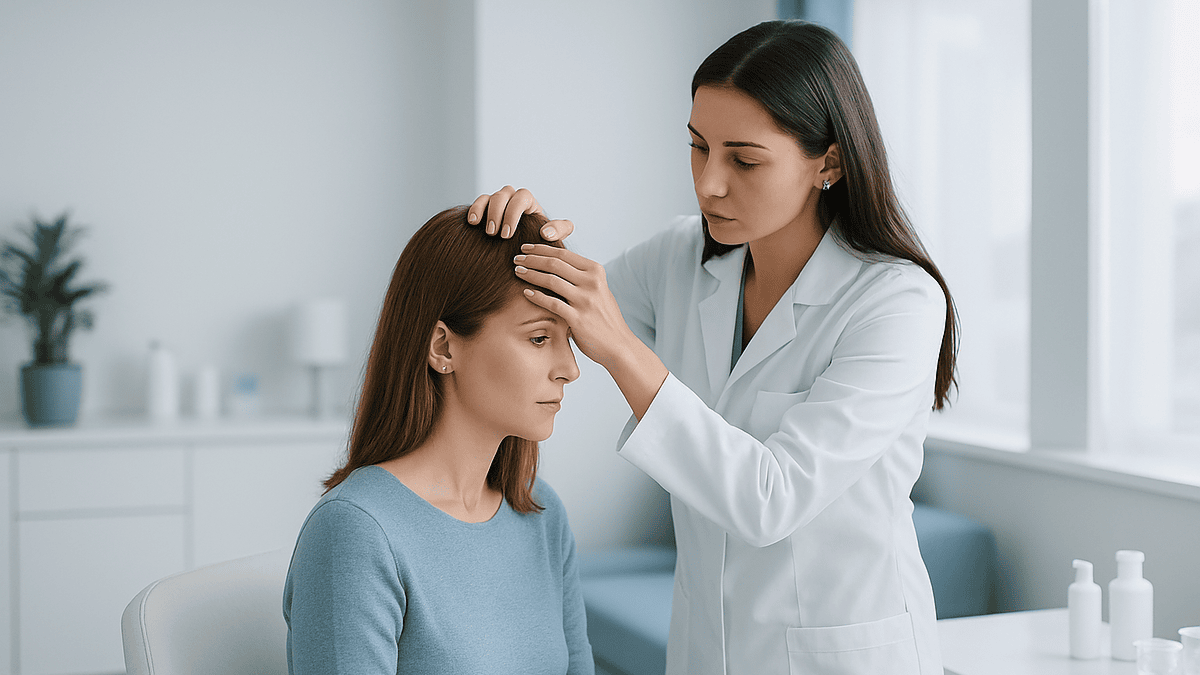
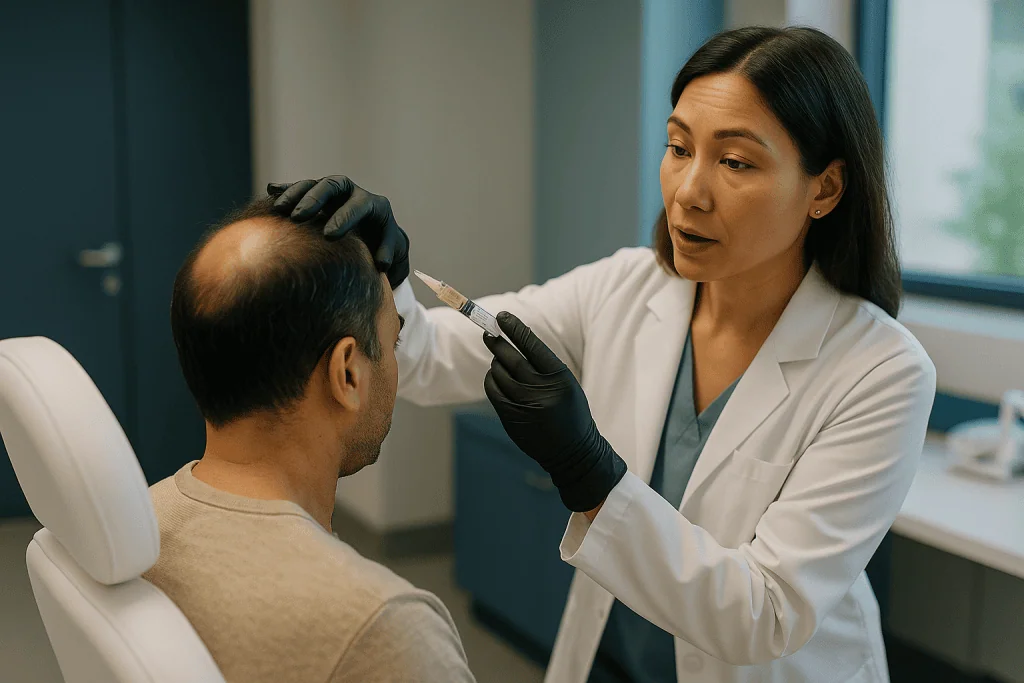
The visit itself is less dramatic than the name suggests. A clinician draws blood from your arm, much like a routine lab test. The tube goes into a centrifuge, a machine that spins fast enough to separate blood into layers by weight: red cells at the bottom, a thin platelet-rich layer in the middle, and lighter plasma on top. The platelet-rich fraction is drawn into a syringe. After the scalp is cleaned, and often numbed with a topical anesthetic, the plasma is injected in a grid of small, shallow injections across the thinning area, usually the crown or the frontal hairline.
The working theory, as Cleveland Clinic describes it, is that growth factors delivered to the base of the follicle may prolong the growing phase of the hair cycle and improve blood supply to follicles that have been shrinking. That word “may” matters. Researchers are still mapping exactly which growth factors do what, and preparation methods vary from one practice to the next.
A session typically takes under an hour from blood draw to final injection. You leave with a scalp that may feel tight or tender and, usually, with a schedule for the next visit. The procedure is a course, not an event, and that single fact dismantles the two biggest misconceptions in the title.
Myth one: a single PRP session is enough
The one-and-done story travels well because it is simple. Biology is not. Follicles respond to growth factors over time, and a single exposure does not reset years of gradual shrinking.

Cleveland Clinic describes the usual pattern in clinical practice as a series of injections given roughly once a month for about three months, followed by maintenance sessions every few months once initial treatment is complete. Research protocols indexed on PubMed vary, but nearly all of them use multiple sessions rather than one, which is why claims about a solitary miracle appointment do not line up with the way the therapy has actually been studied.
Why repeat it? Hair follicles cycle through phases: growth, a brief transition, and rest before the hair sheds and a new one begins. At any moment, follicles across your scalp sit at different points in that cycle. Repeated sessions aim to reach follicles as they enter a receptive window rather than catching only the fraction that happens to be ready on a single day.
Maintenance exists for a related reason. Pattern hair loss is driven by an ongoing hormonal signal, not a one-time injury. If that signal continues, the gains from any treatment tend to fade when the treatment stops. The same is true of topical and oral medicines for hair loss, as Mayo Clinic notes, and PRP appears to follow the pattern.
Someone who had one session, saw nothing, and concluded that “PRP doesn’t work” has not really tested it. Someone who had one session and reports a thick new hairline has almost certainly experienced something else: natural variation in shedding, a change in styling or lighting, or a parallel treatment they forgot to mention.
Myth two: PRP gives instant regrowth
Hair is slow. That is the whole answer, but it deserves explaining, because the instant-regrowth myth leads people to quit good plans early or to blame themselves when the mirror has not changed by week three.
According to Mayo Clinic, most people shed roughly 50 to 100 hairs a day as part of normal cycling, and the follicles that shed those hairs rest for months before producing a new strand. Any treatment that works by nudging follicles back into a growth phase can only show results at the pace a new hair emerges and lengthens. Mayo Clinic’s guidance on the topical hair-loss medicine minoxidil states that it takes at least six months of use before regrowth can be assessed, and PRP studies generally evaluate outcomes on a similar scale.
There is a twist that catches people off guard. Some patients notice slightly more shedding in the first weeks after starting any hair treatment. The leading explanation is that resting follicles are being pushed to release their old, thin hair so a new growth phase can begin. It feels like going backward. In many cases it is the opposite, though it should still be mentioned to your clinician so nothing else is missed.
What a realistic early sign looks like: less hair in the shower drain, a part line that seems a fraction narrower, fine short hairs along the hairline that catch the light. These are quiet changes. Standardized photographs taken by the clinic under the same lighting are far more reliable than memory, and a good practice will take them before the first session so there is something honest to compare against later.
Does PRP work for hair loss? What the evidence actually shows
Here is the honest summary: the evidence is encouraging, uneven in quality, and not yet strong enough for PRP to be a first-line recommendation in major clinical guidelines.
Most published trials, which can be found through PubMed, study androgenetic alopecia, the common inherited pattern hair loss that affects both men and women. Across these trials, many report increases in hair density and hair shaft thickness in treated areas compared with placebo saline injections. Systematic reviews that pool these studies tend to reach a cautiously positive conclusion while flagging the same limitations every time: small numbers of participants, short follow-up, and no agreed standard for how PRP is prepared, how concentrated the platelets are, or how often injections are given.
That lack of standardization is the core scientific problem. Two clinics can both say “PRP” and deliver preparations that differ several-fold in platelet concentration, with or without certain blood components, injected at different depths and intervals. When the intervention itself is a moving target, it becomes difficult to say which version a given trial result applies to.
Mayo Clinic lists PRP among treatments under study for hair loss and notes that more research is needed to confirm its effectiveness, which is a fair reflection of where the field sits. The NHS, in its hair loss guidance, centers established options and does not present PRP as a standard treatment.
What this means for a reader: PRP is neither a scam nor a proven breakthrough. It is a plausible, reasonably well tolerated therapy with moderate supporting evidence, most relevant for early pattern thinning, and best judged on your own standardized photos over months rather than on anyone’s testimonial.
Who PRP for hair loss is usually for, and who is usually asked to wait
The strongest candidates share a profile: pattern hair loss that is early or moderate, with follicles that have thinned but not disappeared. PRP aims to strengthen struggling follicles. It cannot build a follicle where none remains, so a smooth, long-bald area is not the right target, and a clinician who suggests otherwise is selling hope rather than describing biology.
Dermatologists also consider the cause carefully before offering it. Mayo Clinic describes several distinct types of hair loss, and they respond to different approaches. Telogen effluvium, a diffuse shedding triggered by illness, surgery, childbirth, or sudden stress, often resolves on its own once the trigger has passed, which is why a careful history sometimes matters more than any procedure. Alopecia areata, an autoimmune condition producing round patches, is usually managed differently, and scarring forms of hair loss, where inflammation has replaced follicles with scar tissue, are generally not candidates at all.
Some people are asked to wait or are advised against PRP. Common reasons include an active scalp infection or skin disease at the injection site, a low platelet count or a bleeding disorder, current blood-thinning medicines that would need the prescriber’s input, cancer treatment in progress, pregnancy, and uncontrolled chronic illness that affects healing. Because PRP uses your own blood, allergic reactions to the product itself are not a concern, but the quality of the platelets you supply can be influenced by overall health and by certain medicines.
The decision belongs to a clinician who has examined your scalp, ideally with a handheld magnifier called a dermatoscope, and has asked about family history, medicines, recent illnesses, and lab results where relevant. If a provider offers PRP before asking why your hair is falling out, that sequence is the warning sign.
What people often get wrong about PRP for hair loss
Beyond the headline myths, a cluster of smaller misunderstandings shapes expectations. The table sets the common claim beside what the evidence supports.
| Common claim | What the evidence and mainstream guidance actually say |
|---|---|
| One session is enough | Clinical practice and trials use a series of sessions, typically monthly at first, then maintenance (Cleveland Clinic) |
| New hair appears within weeks | Hair cycles are slow; regrowth from any treatment is judged over months (Mayo Clinic) |
| PRP uses stem cells | PRP contains concentrated platelets and growth factors, not stem cells |
| Results are permanent | Pattern hair loss is ongoing; gains tend to fade without maintenance |
| It regrows hair on long-bald scalp | PRP supports existing follicles; it cannot create new ones |
| More shedding means it failed | Early shedding can reflect follicles cycling into a new growth phase; report it anyway |
| It replaces medicine or transplant | Most clinicians position it as an add-on, not a substitute |
The stem cell confusion deserves a direct correction because it is marketed hard. Platelets are cell fragments without a nucleus. They cannot become new tissue. The growth factors they release may encourage your own follicle cells to behave more vigorously, but nothing is being transplanted or regenerated from scratch.
Another quiet error is comparing results between people. A man in his late twenties with early crown thinning and a woman in her fifties with diffuse thinning after menopause are different patients with different follicle reserves. Her neighbor’s dramatic result tells her almost nothing about her own likely response, and a clinician who frames PRP that way is being appropriately honest rather than discouraging.
How many PRP sessions for hair, and what is a reasonable schedule?
Because no national guideline fixes a PRP schedule, people often hear wildly different numbers and assume someone is wrong. The spread reflects genuine uncertainty rather than dishonesty, but the common pattern is clearer than it looks.
Cleveland Clinic describes the usual approach as an initial series given about once a month for roughly three months, then maintenance injections every few months to hold whatever gains were achieved. Published trials cluster around the same structure, with some using slightly longer intervals between the initial sessions. Fewer than three sessions is rarely studied, which is another reason the single-visit claim has no evidence behind it.
Maintenance frequency is where practices diverge most. Some clinicians reassess after the initial series and set a maintenance interval based on your photographs; others propose a fixed calendar. Neither approach is proven superior. What matters is that the plan has a built-in checkpoint where you and your clinician look at standardized images and decide, together, whether continuing makes sense.
A fair question to raise before you begin: what happens if there is no visible change after the initial series? Reasonable answers include reconsidering the diagnosis, adding or adjusting an established medicine through the prescribing clinician, or stopping PRP altogether. An answer that amounts to “just keep going” without a review point is a reason to seek a second opinion.
Keep in mind that more is not better in any linear way. Injecting more frequently than the follicle cycle can respond to adds discomfort and cost without a demonstrated benefit, and no trial has shown that doubling the number of sessions doubles the result. Treat the schedule as a hypothesis to be tested on your own scalp, not a rule carved in stone.
Why is my hair so thin? The causes a clinician checks first
PRP is an answer to one specific question, so the first job is confirming it is the right question. Thinning hair has many causes, and several are both common and reversible without any injection.
Mayo Clinic groups the main drivers into a handful of categories. Hereditary pattern loss is the most frequent, showing up as a receding hairline and thinning crown in men and a widening part in women, driven by follicle sensitivity to androgens, the hormones that gradually shrink follicles until the hairs they produce are fine and short. Hormonal and medical conditions, including thyroid disorders, pregnancy and menopause, and the autoimmune condition alopecia areata, form a second group. Medicines and supplements used for cancer, arthritis, depression, heart problems, gout and high blood pressure can contribute. Severe physical or emotional stress can produce diffuse shedding months after the event. Tight hairstyles and harsh chemical treatments can damage follicles through traction and inflammation.
Nutrition belongs on the list too. Iron deficiency and inadequate protein intake are recognized contributors, and both are detectable with simple blood tests. The NHS notes that most hair loss does not need treatment and is either temporary or a normal part of aging, which is a useful counterweight to the pressure to act immediately.
A thorough evaluation usually includes a careful history, a scalp examination with magnification, sometimes a gentle pull test to gauge how readily hairs release, and blood tests when the pattern suggests a medical cause. Occasionally a small scalp biopsy settles an ambiguous picture.
Only after that groundwork does PRP enter the conversation, and only for the subset of people whose thinning is the kind it has been studied in.
PRP hair treatment results timeline: what the days and weeks after a session look like
The first evening is usually uneventful. Scalp tenderness, mild swelling at injection sites and a feeling of tightness are common and tend to settle over a day or two. Small bruises can appear where needles entered, particularly along the hairline where the skin is thin. Some clinics ask you to skip washing your hair for a short period and to avoid vigorous exercise, saunas and direct sun on the day of treatment; follow the specific instructions you were given rather than general advice.
Over the first couple of weeks, nothing visible happens to the hair itself. This is the stretch where the instant-regrowth myth does the most damage, because it is where people decide the treatment has failed. Some notice a brief increase in shedding, discussed earlier, which is worth mentioning at the next visit even though it is often expected.
During the initial series, the second and third sessions usually feel familiar and are often quicker because the clinic has your baseline. Standardized photographs should be repeated at the same angles and lighting.
The window where change becomes assessable, if it occurs, aligns with the general principle Mayo Clinic applies to hair regrowth treatments: judgment at around six months rather than earlier. Changes tend to be subtle before they are obvious: a less visible scalp through the part, slightly thicker-feeling hair when you run your fingers through it, fine new hairs along the margins. Dramatic transformation is not the norm in trials and should not be the yardstick.
After the initial series, the plan shifts to observation and maintenance decisions. Keep your own notes about shedding, styling changes, new medicines and illnesses, because any of these can shift the picture independently of the injections.
PRP hair treatment side effects and risks: what is common and what is rare
Because PRP is drawn from your own blood, the risk profile is narrower than for many injectable treatments, but “narrow” is not “none”, and a clear-eyed account helps you weigh it.
Common, short-lived effects include pain during and shortly after the injections, tenderness, a sensation of pressure or tightness, mild swelling, redness and pinpoint bruising. Headache on the day of treatment is reported by some people. These generally fade within a few days without specific care beyond what your clinician advises.
Less common effects include a temporary increase in shedding during the early phase, small firm lumps where plasma pooled under the skin, and itching as sites heal. Rare but important risks are the ones that apply to any injection through skin: infection at the injection site, bleeding, nerve irritation and, very rarely, injury to a small blood vessel. Cleveland Clinic lists infection, nerve injury and pain at the injection site among the recognized risks of PRP injections generally.
Two practical points reduce risk. First, the preparation should be handled under sterile technique, with your blood processed in a closed system and never mixed with anyone else’s. Second, your full medicine and supplement list, including blood thinners, anti-inflammatory painkillers and herbal products that affect clotting, should be reviewed beforehand; any change to a prescribed medicine is a decision for the prescriber, not something to do on your own before a cosmetic visit.
Fainting or light-headedness during the blood draw happens to some people and is harmless if anticipated; eating beforehand and telling staff about any history of fainting helps. Allergic reaction to the PRP itself is not expected, though reactions to topical anesthetics or antiseptics are possible and worth flagging if you have a known sensitivity.
Does PRP replace hair loss medicines or a hair transplant?
No, and understanding why clarifies where PRP fits.
Established medicines for pattern hair loss work on specific mechanisms. The topical medicine minoxidil is thought to prolong the growth phase and widen blood vessels around follicles; Mayo Clinic notes that it must be used continuously and assessed over at least six months. The oral medicine finasteride, used in men, blocks the enzyme that converts testosterone into dihydrotestosterone, the hormone most responsible for follicle shrinkage in pattern loss. Whether either is appropriate, and for whom, is a decision for a prescribing clinician who knows your history, and nothing in this article should be read as encouragement to start, stop or change one.
PRP addresses the follicle from a different direction, supplying growth factors locally. Many dermatologists therefore position it as a complement rather than a competitor, and a number of trials have studied it in combination with established treatment rather than instead of it. There is no high-quality evidence that PRP alone matches the effect of a well-established medicine, so swapping one for the other on the strength of a myth would be a step away from the evidence, not toward it.
Hair transplantation is a different category altogether. It moves living follicles from a dense area, usually the back of the head, into thin or bald zones. It is the only approach that adds follicles to an area that has none. PRP is sometimes used alongside transplant surgery with the goal of supporting grafts and surrounding native hair, though the strength of evidence for that specific use is still limited. A surgeon and dermatologist working together are the right people to judge whether a combination makes sense for a given scalp.
How to get thicker hair: home remedies, supplements and what the evidence says
Many people pursuing PRP are also stirring rosemary oil into shampoo, swallowing gummies and massaging their scalp nightly. Sorting these by evidence saves money and prevents disappointment.
The strongest home-based lever is removing harm. Mayo Clinic advises being gentle with hair: avoiding tight braids, buns and ponytails that pull on follicles, limiting hot tools and harsh chemical treatments, using a wide-toothed comb, and protecting hair from sun. None of this regrows hair, but it stops a fixable cause of breakage and traction loss that can masquerade as thinning.
Nutrition matters when there is a deficiency and does little when there is not. Adequate protein and iron support normal growth, and a clinician can test for iron deficiency if your history suggests it. Biotin is the most marketed hair supplement, yet the NIH Office of Dietary Supplements states that there is insufficient evidence to support biotin supplementation for hair growth in people who are not deficient, and that true deficiency is rare. The same source warns that high biotin intake can interfere with certain laboratory tests, including some used to diagnose heart attacks, which is a safety reason to tell every clinician what you take.
Essential oils, onion juice, caffeine shampoos and scalp massage have small or low-quality studies behind them. Some show modest effects in limited trials; none has the body of evidence needed for a confident claim. They are generally harmless for most people, though oils can irritate skin, and they should never delay evaluation of an unexplained change.
A fair summary: lifestyle care protects what you have, deficiencies deserve testing and correction under supervision, and the supplement aisle is better at selling thickness than delivering it.
How to keep your hair during chemo, and where PRP does not belong
This question arrives from a different place than the rest, and it deserves a careful answer rather than a sales pitch.
Chemotherapy causes hair loss because the drugs target rapidly dividing cells, and the cells at the base of the hair follicle divide quickly. Mayo Clinic explains that hair typically begins to fall out within a few weeks of starting treatment, that not every drug or dose causes it, and that regrowth usually begins within several months after treatment ends, sometimes with a temporary change in texture or color.
The one intervention with reasonable evidence for reducing chemotherapy hair loss is scalp cooling. A tightly fitted cap chilled before, during and after each infusion narrows the scalp’s blood vessels, lowering the amount of drug that reaches follicles. Mayo Clinic notes that it does not work for everyone or for every treatment regimen and can cause headache and discomfort from cold, so the oncology team decides whether it is suitable.
PRP is not a treatment for chemotherapy-related hair loss, and it is not appropriate during active cancer treatment. Blood counts, including platelets, are often lowered by chemotherapy, infection risk from any injection is higher, and there is no evidence that growth factors help follicles survive cytotoxic drugs. Anyone who has finished treatment and still has thinning months later should raise it with their oncologist first, because some medicines used after chemotherapy, such as hormonal therapies, can themselves affect hair.
Practical comfort measures matter more than they sound: a soft brush, a gentle shampoo, a satin pillowcase, sun protection for an exposed scalp, and planning head coverings before hair falls so the moment feels chosen rather than forced. The NHS chemotherapy guidance covers these supports and encourages speaking with the care team about them.
Questions to ask your care team before starting PRP for hair loss
A good consultation should leave you with answers to these, and the quality of the answers tells you a great deal about the practice.
- What is my diagnosis, and how did you reach it? Was a scalp examination with magnification done, and do I need blood tests to rule out thyroid, iron or other medical causes?
- Is my type and stage of hair loss the kind PRP has been studied in, and what did those studies show for people like me?
- How many sessions are in the initial series, what maintenance do you suggest, and at what point will we review photos and decide whether to continue?
- How is the PRP prepared here, and how do you ensure sterile handling of my blood?
- Will you take standardized baseline photographs under consistent lighting so change can be measured rather than remembered?
- Which of my medicines or supplements should the prescribing clinician review before treatment?
- What side effects should I expect in the first days, and what would prompt you to want to see me sooner?
- How does PRP fit with established medicines or, if relevant, with hair transplantation? Would you recommend one of those instead, or alongside?
- What happens if there is no visible change after the initial series?
- What is your plan if I develop an infection, unusual pain or rapid new shedding?
Bring your photos, a complete list of what you take, and a note of any major illness or life stress in the past year. Pay attention to whether the clinician is willing to say that PRP may not be right for you; that willingness is the clearest sign of someone practicing from evidence rather than from a sales target. If answers are vague on diagnosis but detailed on packages, consider a second opinion from a board-certified dermatologist.
When to call your doctor
Most reactions to PRP are mild and brief, and most hair thinning is not dangerous. A short list of situations still warrants prompt contact rather than waiting for the next scheduled visit.
After a PRP session, call the treating clinic the same day if you notice spreading redness, warmth or swelling around injection sites, pus or an unusual discharge, fever or chills, pain that is severe or worsening after the first day rather than easing, or numbness, tingling or weakness in the scalp or face that does not resolve within hours. Seek urgent care for signs of an allergic reaction to an anesthetic or antiseptic, such as hives, swelling of the lips or face, wheezing or difficulty breathing.
Separately from any procedure, see a doctor without delay if hair loss is sudden and heavy, comes out in clumps or distinct patches, is accompanied by scalp pain, burning, scaling or sores, or occurs alongside other changes such as unexplained weight change, fatigue, irregular periods, excess facial or body hair, or new acne. Mayo Clinic advises seeing a doctor for sudden or patchy hair loss, for shedding more than usual when combing or washing, and for hair loss in a child, since these patterns can point to a medical cause that needs its own treatment.
People on blood thinners or with a known bleeding disorder should contact their prescriber if bleeding from an injection site persists or large bruises develop. Anyone currently receiving cancer treatment who is approached about PRP should discuss it with their oncology team before agreeing to anything.
None of these signs is a reason to self-diagnose. They are reasons to let the people responsible for your care take a look and decide the next step with you.
Frequently asked questions
Does PRP work for hair loss, or is it just hype?
PRP has moderate supporting evidence for early to moderate pattern hair loss, with many trials reporting improved density compared with saline, but studies are small and preparation methods vary. Mayo Clinic lists it among treatments still under study. It is neither a proven breakthrough nor a scam, and results should be judged on your own standardized photos over months.
How many PRP sessions for hair are usually needed?
Cleveland Clinic describes a typical course as injections about once a month for roughly three months, followed by maintenance every few months. Fewer than three sessions has rarely been studied. Your clinician should set a review point after the initial series to decide, using photographs, whether continuing makes sense for you.
What is a realistic PRP hair treatment results timeline?
Visible change, if it occurs, usually becomes assessable around six months, in line with the general timeline Mayo Clinic gives for hair regrowth treatments. The first weeks show nothing, and some people notice brief extra shedding. Early signs are subtle: less hair in the drain, a slightly narrower part, fine new hairs at the margins.
What are the most common PRP hair treatment side effects?
Tenderness, pressure, mild swelling, redness and small bruises at injection sites are common and usually settle within days. Headache and brief increased shedding can occur. Rare risks include infection, bleeding and nerve irritation. Because the plasma is your own, allergy to PRP itself is not expected, though topical anesthetics or antiseptics can cause reactions.
Why is my hair so thin all of a sudden?
Sudden diffuse thinning often reflects telogen effluvium, a shedding phase that follows illness, surgery, childbirth or significant stress by a few months and frequently resolves on its own. Thyroid problems, iron deficiency and certain medicines are other causes Mayo Clinic lists. A dermatologist can distinguish these from pattern loss before any treatment is considered.
Is PRP the same as stem cell therapy for hair?
No. PRP is a concentrate of platelets, which are cell fragments without a nucleus, together with the growth factors they release. It contains no stem cells and cannot generate new tissue. Marketing that blurs the two is inaccurate. The theory is that growth factors encourage your existing follicle cells to behave more vigorously.
Can PRP regrow hair on a completely bald area?
PRP supports follicles that are thinning but still present; it cannot create follicles where they have been lost or replaced by scar tissue. Long-bald, smooth areas are not appropriate targets. Hair transplantation is the only approach that adds follicles to such areas, and a surgeon can advise whether that is suitable.
What are some home remedies for hair fall and regrowth that actually help?
The best-supported home measures protect existing hair: avoiding tight styles, limiting heat and harsh chemicals, and gentle handling, as Mayo Clinic advises. Correcting a diagnosed iron or protein deficiency helps when present. Oils, onion juice and scalp massage have only small, low-quality studies behind them and should not delay medical evaluation.
How to keep your hair during chemo?
Scalp cooling, a chilled cap worn around each infusion, is the measure with reasonable evidence for reducing chemotherapy hair loss, though Mayo Clinic notes it does not work for everyone or every regimen. Gentle hair care and planning head coverings help with comfort. PRP is not a treatment for chemotherapy hair loss and is not appropriate during active treatment.
How to get thicker hair without medicine or procedures?
Thickness is largely set by genetics and follicle health, so no routine dramatically changes it. Protecting hair from traction, heat and chemical damage reduces breakage, which makes hair look fuller. Adequate protein and iron support normal growth. The NIH finds insufficient evidence for biotin supplements in people who are not deficient.
This article is for general information only and is not a substitute for professional medical advice. Please consult a qualified doctor about your individual situation.

More from the Blog
Second Hair Transplants: When a Touch-Up Makes Sense and How Many You Can Have
A second hair transplant can make sense when hair loss has progressed around a first procedure, when you want more density, or when an…
Temple Hair Transplants and Hairline Design: The Details That Make It Look Real
A temple hair transplant moves individual follicles, almost always single-hair grafts, into the temple recessions and temporal points to rebuild a receded hairline. A…
How Prior Radiation or Tumor Surgery Shapes a Scalp Reconstruction Plan
Prior radiation or tumor surgery changes a scalp reconstruction plan because irradiated skin heals more slowly, has fewer working blood vessels, and may sit…
The First Two Weeks After a Hair Operation: Swelling, Scabs and Milestones Day by Day
In the first two weeks after a hair operation, most people move through three overlapping stages: forehead swelling that peaks around days two to…
Which Female Hair Transplant Side Effects Are Normal? Redness, Scabbing and Swelling Explained
After a female hair transplant, mild redness, pinpoint scabs over each graft, tightness and swelling that drifts toward the forehead are expected in the…
Getting Ready for a Beard Transplant: Skin Checks, Mapping the Beard Line and What to Pause
Beard transplant preparation usually spans several weeks and has three parts: a skin check of the face and donor scalp for active acne, folliculitis,…