

Pulmonary Disease Treatment for International Patients: Tests, Follow-Up and Care Back Home

Key Takeaways
- Chronic lung conditions are managed over years, so a consultation abroad is only useful if a named clinician at home agrees to continue monitoring with the same test numbers in hand.
- Spirometry reports the FEV1 and FVC values and their ratio; asking for those figures with dates, rather than only a written interpretation, lets future tests be compared directly.
- Stopping smoking is the intervention most clearly shown to slow lung function decline in COPD, which is why guidelines place it ahead of any inhaler at the mild stage.
- Pulmonary rehabilitation typically runs at least six weeks with two supervised sessions a week and improves exercise capacity and quality of life, so it usually has to be completed at home.
- Travel longer than about four hours raises clot risk, and a recent flare-up, an unstable oxygen requirement or an unresolved pneumothorax are standard reasons a team asks a patient to delay flying.
- Stem cell treatments advertised for COPD or pulmonary fibrosis are not established therapies outside regulated clinical trials, and mainstream medical bodies do not recommend them.
Pulmonary disease treatment for international patients works best when it is planned as an ongoing partnership rather than a single trip. Lung conditions such as COPD, asthma and pulmonary fibrosis are usually managed over years, so the treating team abroad and the doctor at home need shared test results, a written action plan, continuity of prescriptions and an agreed schedule for follow-up, with air travel timed only after a fitness-to-fly check.
A retired teacher sits in a borrowed apartment three time zones from her kitchen, a folder of spirometry printouts on the table and a question she keeps turning over: what happens when I go home? She came for a second opinion on worsening breathlessness. The clinic visit went well. The part nobody explained clearly was pulmonary disease treatment abroad follow up, the months of inhalers, oxygen checks and lung function tests that start once the suitcase is unpacked.
That gap is the real story of lung care across borders. Unlike a hernia repair or a cataract operation, a chronic lung condition does not end at discharge. It is managed, adjusted and re-measured, often for the rest of a person’s life. The quality of that long tail depends less on where the first appointment happened and more on how carefully two medical teams are connected.
This explainer walks through what the tests mean, how treatment actually works, who is typically asked to wait before traveling, and how to build a follow-up plan that survives the flight home.
Why pulmonary disease treatment abroad follow up is different from a one-visit procedure
Most people picture medical travel as a defined event with a beginning and an end. Lung disease rarely cooperates with that picture. The World Health Organization describes chronic obstructive pulmonary disease (COPD) as a progressive condition that caused an estimated 3.5 million deaths worldwide in a single recent year, and it lists it among the leading causes of death globally. Progressive means the disease changes over time, which is exactly why a single consultation can never be the whole treatment.
Consider what a lung specialist actually does across a year of care. Breathing tests are repeated to see whether airflow is holding steady or slipping. Inhaler technique is checked, because a well-chosen medicine delivered badly behaves like no medicine at all. Oxygen levels are measured at rest, on exertion and sometimes overnight. Vaccination status is reviewed. Flare-ups are logged, and each one may prompt a small change in the plan. None of that fits inside a ten-day trip.
So the central question for an international patient is not only “which treatment?” but “who will carry this forward?” The answer, in nearly every good pathway, is a shared arrangement: the team you saw abroad documents the diagnosis, the reasoning and the plan in plain language, and a doctor at home agrees to take over the monitoring. Without that handover, patients drift. Prescriptions run out, test intervals stretch, and the first sign of trouble becomes an emergency room visit instead of a scheduled adjustment.
The rest of this article treats follow-up as the main event, because in lung medicine it is. Every test, every medicine class and every travel decision described below is framed around one practical goal: making sure that care at home is as informed as care abroad, and that decisions always rest with the clinicians who know your lungs.
What are some common diseases that affect the lungs?
When people search for lung treatment overseas, they are usually dealing with one of a short list of conditions, each with its own tempo and follow-up needs.

COPD is the most frequent. It is an umbrella term for long-term airflow obstruction, most often from emphysema (damaged air sacs) and chronic bronchitis (persistently inflamed airways). Smoking is the leading cause in high-income countries, while indoor smoke from cooking fuels matters greatly elsewhere, as the WHO notes. Asthma is different in character: the airways narrow and then open again in response to triggers, and treatment aims at preventing those swings. Pulmonary fibrosis describes scarring of lung tissue that stiffens the lungs and makes oxygen transfer harder; idiopathic pulmonary fibrosis is the form with no identified cause. Bronchiectasis involves permanently widened airways that trap mucus and invite recurrent infection.
Infections form a second group. Pneumonia and tuberculosis can leave lasting damage and need structured follow-up to confirm clearance. Lung cancer sits in a category of its own, with staging scans and multidisciplinary review driving every step. Pulmonary hypertension, raised blood pressure in the lung arteries, is rare but demanding, because it is tracked with echocardiograms and specialized catheter measurements rather than simple breathing tests. Sleep apnea, where breathing pauses during sleep, is technically a disorder of the upper airway but is commonly managed by respiratory teams and relies on equipment that must work reliably at home.
Why does the list matter for follow-up? Because the monitoring schedule is dictated by the disease. An asthma review may be mostly about symptoms and inhaler use. A fibrosis review hinges on repeated lung volume tests and sometimes high-resolution CT scans. A cancer pathway runs on imaging dates that cannot slip. Knowing which disease you are managing tells you what your home doctor will need to measure, and how often. MedlinePlus and the NHS both publish plain-language overviews of each of these conditions if you want to read further before your appointment.
Lung function tests explained: what actually happens in the clinic
The first morning of a pulmonary assessment feels less like medicine and more like a fitness test for your chest. Here is what the main investigations involve, and what each one tells the team.
Spirometry is the backbone. You take the deepest breath you can and blow into a tube as hard and as long as possible, usually three times to get consistent readings. The machine records how much air you move out in the first second (FEV1) and the total volume you can exhale (FVC). As the Cleveland Clinic explains, the ratio between those two numbers helps distinguish obstructive disease, where air gets out slowly, from restrictive disease, where the lungs cannot fill fully. The test is often repeated after an inhaled bronchodilator, a medicine that relaxes airway muscle, to see how much the narrowing reverses.
Pulse oximetry clips to a fingertip and estimates how saturated your blood is with oxygen. A six-minute walk test adds exertion: you walk at your own pace along a corridor while a nurse tracks distance and oxygen levels. This matters for travel, because oxygen that holds steady at rest can drop with effort or at altitude. An arterial blood gas, a small sample drawn from an artery at the wrist, gives precise oxygen and carbon dioxide values when the picture is unclear.
Imaging rounds out the workup. A chest X-ray screens for obvious changes; a CT scan shows fine detail such as emphysema distribution or fibrotic patterns. Some patients have full lung volume measurements in a sealed booth, or a diffusion test that measures how easily gas crosses from air sacs into blood.
Ask for the raw numbers, not just the interpretation. FEV1 as a percentage of predicted, resting saturation, walk distance and the date of each test are the figures your home doctor will compare against months later. A diagnosis letter without them is a story missing its data.
How pulmonary disease treatment works: medicines by class, oxygen and rehabilitation
Lung treatment is built from a few mechanisms, and understanding them makes follow-up conversations far less mystifying.
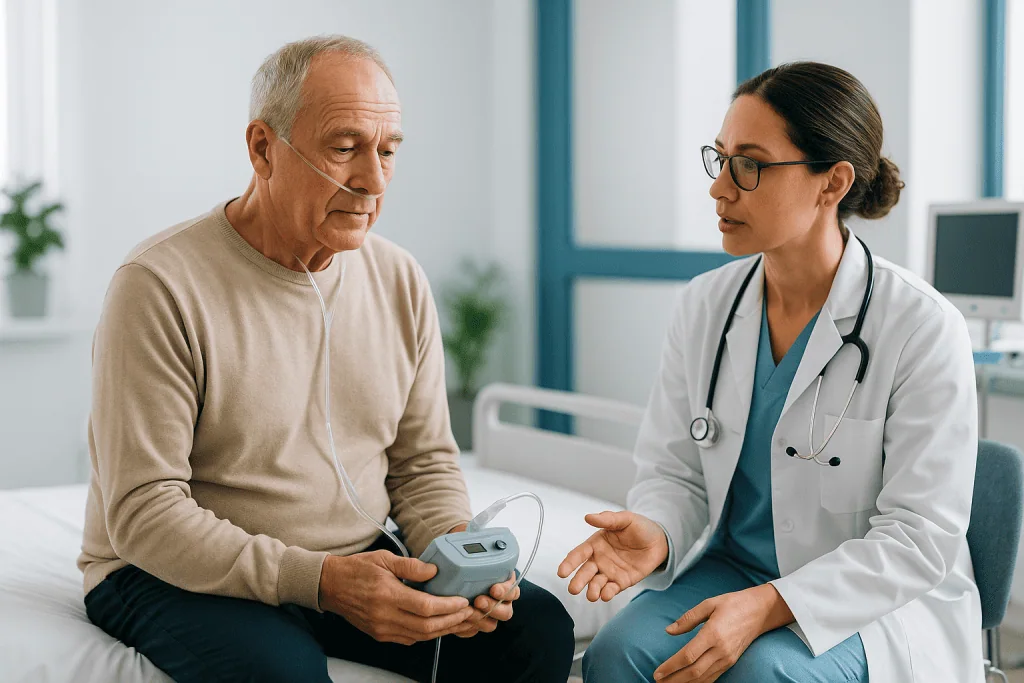
Bronchodilators relax the smooth muscle wrapped around the airways so air moves more freely. Short-acting versions work within minutes and are used for relief; long-acting versions are taken regularly to keep airways open through the day. The NHS describes both as core inhaled treatments for COPD. Inhaled corticosteroids reduce inflammation in the airway lining and are central to asthma control; in COPD they are added selectively, typically for people with frequent flare-ups, a judgment the prescribing clinician makes from your history and tests. Mucolytics thin sticky sputum. For pulmonary fibrosis, antifibrotic medicines aim to slow scarring rather than reverse it. Severe asthma may be treated with biologic injections that target specific inflammatory pathways.
What every one of these shares is a delay between starting and judging. Long-acting inhalers and antifibrotics are assessed over weeks to months, which is why a treating team abroad can prescribe with confidence but cannot complete the evaluation. That evaluation belongs to whoever sees you next.
Oxygen therapy is prescribed when blood oxygen stays persistently low, and it is measured, not guessed. Long-term oxygen is usually recommended only after repeated readings confirm the need, as Mayo Clinic notes, because unnecessary oxygen brings its own hazards. Non-invasive ventilation, a mask that supports breathing overnight, is used in selected people with high carbon dioxide levels.
Then there is the intervention with the strongest evidence for daily life: pulmonary rehabilitation, a supervised program of exercise, education and breathing techniques that the NIH’s National Heart, Lung, and Blood Institute credits with improving exercise capacity and quality of life. Surgical options, such as lung volume reduction or transplantation, exist for narrowly defined groups and are decided by multidisciplinary teams.
Nothing here is a menu to choose from. Each component is matched to your test results, your flare-up history and your other health conditions by the clinicians treating you, and changed only by them.
Who is usually offered lung treatment away from home, and who is asked to wait
Not everyone with a lung condition is a sensible candidate for care far from home, and good teams say so plainly before anyone books a flight.
The people who most often benefit from a consultation elsewhere are those with a diagnostic puzzle: unexplained breathlessness after a normal local workup, suspected interstitial lung disease needing specialist imaging review, or a rare condition such as pulmonary hypertension where expertise is concentrated in a few centers. Second opinions on a treatment plan that has stalled also fall into this group. In each case the value lies in clarity and a documented plan that can be executed back home.
Who is typically asked to wait? Anyone in the middle of an exacerbation, the medical word for a flare-up with worsening breathlessness, cough or sputum. The NHS describes exacerbations as events that can take weeks to settle, and traveling during one is both risky and pointless, since tests done then reflect the flare rather than the baseline. People with resting oxygen levels that are low or unstable are generally held until a fitness-to-fly assessment confirms they can tolerate cabin conditions, with or without supplemental oxygen. Recent pneumothorax, a collapsed lung, is a well-known reason to defer flying until the treating team confirms the lung has fully re-expanded on imaging. Active, untreated infection, including suspected tuberculosis, rules out travel for public health reasons as well as personal ones.
A third group sits in between: people whose condition is stable but who have no doctor at home willing to take over monitoring. For them, the sensible step is to arrange that relationship first. A consultation abroad without a receiving clinician is a plan with no second half.
These are typical patterns, not rules. The decision about whether and when a given person should travel for care, and what preparation is needed, rests with the clinicians who have examined them.
How is mild COPD treated, and why the answer is mostly not medicine
People are often surprised, sometimes a little deflated, when a specialist reviews their early-stage COPD and the headline recommendation is not a new prescription.
The NHS treatment guidance for COPD puts stopping smoking first, and the ordering is deliberate. Smoking cessation is the one intervention shown to slow the rate at which lung function declines in COPD; medicines ease symptoms and reduce flare-ups but do not change the trajectory in the same way. For someone who still smokes, every other treatment is secondary to this one. Support usually combines behavioral counseling with nicotine replacement or other cessation medicines, chosen with a clinician. Mild COPD is treated similarly wherever you are: the principles are international.
The second pillar at the mild stage is a short-acting bronchodilator inhaler, used when symptoms call for it rather than on a fixed schedule. Regular long-acting inhalers are generally introduced when breathlessness persists despite that, or when flare-ups begin to recur, judgments the prescribing clinician makes at review. The NHS and Mayo Clinic both describe this stepwise approach.
Third comes vaccination. Influenza, pneumococcal and COVID-19 vaccines reduce the risk of the infections that trigger many exacerbations, and the NHS recommends them for people with COPD. Fourth is physical activity, formalized as pulmonary rehabilitation when breathlessness limits daily life, and encouraged as ordinary walking before then.
What about scans and repeated tests at the mild stage? Spirometry is typically repeated periodically to track change, and more often if symptoms shift. Routine CT scanning is not standard for mild COPD unless there is another reason, such as lung cancer screening eligibility, which is decided on age and smoking history.
For international patients, this is reassuring. Mild COPD treatment travels well. Everything on the list can be continued by a primary care doctor at home, provided the diagnosis, the spirometry numbers and the reasoning are written down and handed over.
What a pulmonary rehabilitation program involves and why it anchors follow-up
If one element of lung care is routinely underused, it is pulmonary rehabilitation. The name sounds like physiotherapy for an injury. It is closer to a structured training course for living with limited breath.
A typical program, as described by the NHS, runs for at least six weeks with two supervised group sessions a week, each combining exercise and education. The exercise part is tailored: walking, cycling on a stationary bike, light resistance work, all paced so that breathlessness is pushed but not frightening. Oxygen levels are monitored throughout. The education part covers inhaler technique, breathing strategies such as pursed-lip breathing, energy conservation, nutrition, managing anxiety and recognizing early signs of a flare-up.
The mechanism is worth understanding, because it explains why rehabilitation helps even when the lungs themselves do not improve. Breathlessness drives inactivity; inactivity weakens leg and breathing muscles; weak muscles demand more oxygen for the same task, which worsens breathlessness. Training breaks that spiral. The NIH’s National Heart, Lung, and Blood Institute reports that rehabilitation improves exercise capacity and quality of life and may reduce hospital admissions, which is why guidelines recommend it for most people with symptomatic COPD and for many with fibrosis, bronchiectasis or pulmonary hypertension.
Here is the catch for international patients. A six-week program cannot be completed during a short visit, and the benefit fades without ongoing activity. Practical answers include starting assessment abroad and enrolling in a program at home, or asking the treating team for a written home exercise plan with clear safety thresholds for oxygen saturation and symptoms. Some regions offer remote or app-supported programs; whether these suit you is a question for your clinicians.
Treat rehabilitation referral as a line item in your discharge letter, as important as any prescription. Of everything a lung team can offer, it is the intervention most likely to change what you can do on an ordinary Tuesday.
Tests, treatments and follow-up intervals: a summary table
Lung care generates a lot of moving parts. The table below gathers the common ones in one place, with the caveat that intervals are typical patterns described in mainstream guidance, not fixed rules; your treating team sets your schedule.
| Element | What it measures or does | Who usually repeats it | Typical pattern |
|---|---|---|---|
| Spirometry | Airflow (FEV1, FVC) and reversibility | Home clinic or specialist | At diagnosis, then periodically or when symptoms change |
| Pulse oximetry | Blood oxygen saturation, at rest and on exertion | Any clinic; sometimes self-monitored | Every review; more often if oxygen is prescribed |
| Six-minute walk test | Exercise tolerance and oxygen drop with effort | Specialist or rehab team | Before rehab, before flying, at major reviews |
| Chest imaging | Structural change, infection, scarring | Specialist | As indicated by condition; routine for fibrosis and cancer pathways |
| Inhaler technique check | Whether medicine reaches the lungs | Nurse, pharmacist or doctor | Every review |
| Vaccination review | Protection against infection triggers | Primary care | Seasonal and as recommended |
| Pulmonary rehabilitation | Exercise capacity, education | Rehab program at home | At least 6 weeks, twice weekly (NHS) |
| Action plan review | Flare-up recognition and steps | Any clinician | After each exacerbation |
Two patterns stand out. First, most of the repeating work happens in primary care or a rehabilitation setting, not in a specialist center. That is good news for an international patient, because it means the heavy lifting of follow-up can be done close to home. Second, the elements that are easiest to neglect, inhaler technique and the action plan, are also the ones most tightly linked to avoiding emergency admissions.
Use the table as a conversation starter. Before leaving the clinic abroad, go down each row and ask who is responsible for it once you are home, and whether that person already knows.
The first days and weeks after a lung treatment visit: what usually happens
The period right after an assessment or treatment change follows a recognizable rhythm, even though the details vary with the condition.
In the first few days, the main task is settling into any new or adjusted inhalers. Long-acting bronchodilators begin to open the airways within hours to days, but their full effect on daily breathlessness is judged over weeks, which is why clinicians ask you not to draw conclusions early. Side effects such as a dry mouth, tremor or a hoarse voice from inhaled steroids sometimes appear in this window; most are manageable with technique adjustments such as rinsing after use, but any that trouble you belong in a message to the prescribing team rather than in a decision to stop.
If a flare-up was treated, recovery stretches longer. The NHS notes that symptoms after an exacerbation can take several weeks to return to baseline, and that some people do not fully recover their previous level. This is the period when relapse is most likely, so a scheduled check within a few weeks is standard practice in many guidelines.
For those starting oxygen, the early weeks involve learning the equipment, confirming that the prescribed flow keeps saturations in the target range during daily activities, and arranging a home supplier. For people starting antifibrotic medicines, regular blood tests to monitor the liver are usually scheduled by the prescribing team.
By the end of the first month, a typical patient has had at least one contact with a clinician, has an inhaler technique confirmed, and knows what their action plan says to do if symptoms worsen. If any of those three things has not happened, the follow-up chain has a gap.
Across all of it, two habits matter most: keeping a simple diary of symptoms, activity and any rescue inhaler use, and keeping appointments even on good days. Lung disease is quiet when it is controlled, and quiet is exactly when monitoring pays off.
Flying with COPD or other lung disease: fitness to fly, oxygen and clot prevention
The flight home is the single moment where an international patient’s lung condition and the physics of air travel collide, so it deserves its own planning.
Aircraft cabins are pressurized, but not to sea level. The air inside has less oxygen than at ground level, which healthy lungs barely notice and compromised lungs may notice a great deal. A fitness-to-fly assessment is the structured way of finding out. It usually starts with resting oximetry and a review of recent flare-ups and oxygen needs. If results are borderline, a hypoxic challenge test, in which you breathe a reduced-oxygen mixture for a set period while saturation is tracked, estimates how you would cope at cruising altitude. From that, the team decides whether in-flight oxygen is needed. Airlines require advance notice and documentation for oxygen, and portable concentrators must be approved models, so this cannot be left to the week of departure.
Certain situations typically mean waiting. A recent pneumothorax needs documented full re-expansion before flying. An exacerbation that has not settled, or a new oxygen requirement that has not been stabilized, are standard reasons to postpone. Your treating team sets these timings for you.
Then there is clotting. The CDC notes that travel lasting longer than about four hours raises the risk of deep vein thrombosis, a clot in a leg vein that can travel to the lungs. Recent illness and reduced mobility add to that risk. The basics apply to everyone: stand and walk the aisle regularly, flex the calves while seated, drink water, and avoid sedatives. Whether compression stockings or a preventive anticoagulant medicine are appropriate for you is an individual decision for your clinicians, particularly if you have had a clot before.
Finally, carry your inhalers and any oxygen prescription in hand luggage, along with a copy of your discharge summary. If something goes wrong mid-journey, the cabin crew and any airport medical staff will need to know what you have and what you take.
Building a pulmonary disease treatment abroad follow up plan with your home doctor
The handover between two medical teams is where most international lung care either succeeds or quietly fails. Here is what a workable plan contains, element by element.
Start with the document. Ask the treating team for a discharge summary that includes the diagnosis, the test results with dates and numeric values, the medicines by generic name with the reason for each, the follow-up intervals they recommend, and the specific triggers that should prompt contact. Request it in a language your home doctor reads. Imaging should be provided as files on a disc or secure link, not only as a written report, because a local radiologist may want to compare future scans directly.
Next, identify the receiving clinician before you leave. For COPD, asthma and stable bronchiectasis, a primary care doctor with access to spirometry can take over most monitoring, as the NHS pathway assumes. For fibrosis, pulmonary hypertension or cancer, a local specialist is needed, and a referral letter from the treating team speeds that along.
Then address prescriptions. Medicines are sold under different brand names and sometimes different inhaler devices in different countries. A generic name on the summary lets a pharmacist at home match it; a device change may require a new technique check. Never let a supply run out on the assumption that a substitute will be easy to find.
Agree how the two teams will communicate. Some centers offer remote consultations for review; others prefer to receive updates by letter. Either way, you are the courier, so keep your own copy of everything.
Last, write the action plan into the arrangement. The home doctor should know what the treating team advised for early flare-up symptoms, including whether a standby course of medicine was provided and the circumstances under which it is to be started. That single shared understanding prevents more emergency visits than any test.
Managing flare-ups after you return: the exacerbation action plan
An exacerbation is the event that lung follow-up is designed to catch. The word simply means a sustained worsening of symptoms beyond the usual day-to-day variation: more breathlessness, more cough, a change in sputum color or volume, often triggered by a viral or bacterial infection or by air pollution.
Why do they matter so much? Because each one carries a risk of hospital admission and, as the NHS explains, recovery can take weeks and may not be complete. Repeated flare-ups are associated with faster decline in lung function. Preventing them, and treating them early when they happen, is therefore the practical heart of long-term management.
A written action plan turns that principle into instructions. It typically describes three zones. In the first, you are at your baseline and continue regular treatment. In the second, early worsening, the plan specifies steps such as increasing use of the relief inhaler within limits set by your clinician, and may describe when to start a standby course of oral steroid or antibiotic that your treating team has already prescribed for this purpose. In the third, severe symptoms, the plan says to seek urgent care. The decision to issue standby medicines, and the thresholds for using them, belong entirely to the prescribing clinician; the plan records their decision so you do not have to make it alone at two in the morning.
For an international patient, the plan has an extra job: it bridges the gap if your home doctor is not yet fully familiar with your case. Keep it with your medicines. Show it to any clinician you see. Update it after every flare-up, because each one teaches something about your own early warning signs.
Prevention runs alongside: vaccinations, hand hygiene during respiratory virus seasons, avoiding smoke and heavy pollution days where possible, and keeping up the activity that rehabilitation started. None of it is glamorous. All of it is evidence-based.
What people often get wrong about lung disease treatment and follow-up
Lung medicine attracts a particular set of misunderstandings, several of them amplified by the way treatment abroad is marketed. Correcting them protects both health and money.
The first is that a treatment exists somewhere that reverses COPD or fibrosis. Stem cell therapies are advertised for both, often to international patients. Mainstream medical bodies, including the NIH, do not regard these as established treatments for chronic lung disease outside properly regulated clinical trials, and the evidence to date does not show that they restore lung function. A clinic offering a stem cell “treatment” for COPD as a paid service is offering something unproven.
The second is that inhalers are all alike. Devices differ in how they release medicine and how you must breathe to receive it, and the NHS stresses that poor technique is a common reason treatment seems to fail. A switch of device at home, forced by availability, deserves a technique check.
The third is that oxygen is a cure-all for breathlessness. Oxygen treats low blood oxygen, which is a specific measured problem. Many breathless people have normal saturations and gain nothing from oxygen while taking on its hazards, including fire risk and, in some, a dangerous rise in carbon dioxide. That is why it is prescribed on numbers.
The fourth is that feeling well means monitoring can lapse. Lung function can decline without obvious symptoms until a threshold is crossed. Scheduled spirometry exists precisely to see what you cannot feel.
The fifth, and most relevant to travel, is that a specialist opinion abroad replaces care at home. It does not. It informs it. The daily and monthly work of managing a lung condition happens where you live, with the people who can see you in person when something changes.
A sixth deserves a sentence: it is never too late to stop smoking. Lung function decline slows after quitting at any age, which is the most hopeful fact in this entire article.
Questions to ask your care team before and after treatment
Good appointments are shaped by good questions. These are drawn from what pulmonary teams report patients most often wish they had asked, grouped by the moment you will need them.
Before any treatment decision abroad, ask: What is the diagnosis, and how confident are you? Which test result supports it most? What would you expect to happen with no change in treatment, and with the change you are proposing? What are the alternatives, including doing nothing new for now? What are the main risks of what you recommend, and how will I know if one is happening?
About the plan itself, ask: Which of these medicines are for daily use and which are for relief? What is each one for, in one sentence? Over what period will we judge whether it is working? Should I be referred for pulmonary rehabilitation, and where can I do it at home? Do I need oxygen, and if so, what measurements led to that?
About going home, ask: Will you write a summary that my home doctor can act on, with the actual test numbers? Can I have my imaging as files? What follow-up intervals do you recommend, and who should do each test? What should prompt me to contact a doctor early? Is there a written action plan for flare-ups, and have you included any standby medicines in it?
About travel, ask: Am I fit to fly, and did you base that on a test? Do I need in-flight oxygen, and what documentation does the airline require? How soon after this treatment is it reasonable to travel, and what would make you want me to wait? Is there anything about clot prevention specific to me?
Write the answers down or ask permission to record them. A folder of answers is the most portable medical device you will own.
When to call your doctor: red-flag signs after lung treatment
Most of lung care is slow and scheduled. A small number of situations are neither, and knowing them is part of the treatment.
Seek emergency care immediately, by calling local emergency services, if you have severe breathlessness that makes it hard to speak in full sentences, blue or gray lips or fingertips, chest pain that is new or crushing, confusion or unusual drowsiness, or coughing up more than a small streak of blood. Sudden sharp chest pain with breathlessness, especially after a flight or a period of inactivity, may signal a pulmonary embolism, a clot in the lung, and needs urgent assessment. A sudden collapse of a lung can present the same way. A fast heartbeat with breathlessness that does not settle with rest belongs on this list too.
Contact your doctor the same day, or sooner if it worsens, if your breathlessness or cough has been clearly worse than usual for more than a day or two, if sputum has changed color or increased, if you have a fever, if you are needing your relief inhaler far more often than your action plan allows, if your home oximeter readings have fallen below the range your team set, or if swelling appears in one calf or ankle. New or worsening side effects from a recently started medicine also warrant a call rather than a decision to stop on your own.
If you are still abroad when any of this happens, use the contact number the treating team gave you and, for emergencies, the local emergency service. If you are home, your action plan should say who to call first.
These lists are prompts, not a self-diagnosis tool. Any symptom that worries you is reason enough to ask. Every judgment about what to do next, including whether to adjust treatment, rests with the clinicians caring for you.
Frequently asked questions
What does COPD follow up after treatment usually look like?
It usually means periodic spirometry, oximetry at each review, an inhaler technique check, vaccination updates and a refreshed action plan after any flare-up, mostly delivered through primary care. The NHS pathway assumes a general practice can do most of this. The treating team abroad sets suggested intervals in the discharge summary; the home doctor adjusts them as your condition evolves, and either may refer you to a specialist if something changes.
What is a breathing club?
A breathing club is a peer support group for people living with long-term lung conditions, often run by a lung charity or hospital respiratory team. Meetings typically combine gentle group exercise, talks from nurses or physiotherapists, and time to share practical tips on inhalers, breathlessness and daily life. They are not a substitute for pulmonary rehabilitation, but many people join one after a program ends to keep active and connected.
What are some common diseases that affect the lungs?
The most common chronic ones are COPD, asthma, bronchiectasis and pulmonary fibrosis, alongside infections such as pneumonia and tuberculosis. Lung cancer, pulmonary hypertension and sleep apnea are also managed by respiratory teams. Each has a different follow-up pattern: asthma reviews focus on symptoms and inhaler use, fibrosis relies on repeated lung function tests and scans, and cancer pathways run on fixed imaging schedules set by a multidisciplinary team.
How is mild COPD treated?
Mild COPD is treated primarily by stopping smoking, using a short-acting bronchodilator inhaler for relief when needed, keeping vaccinations current and staying physically active, as the NHS describes. Regular long-acting inhalers are usually added only if symptoms persist or flare-ups recur, a decision for the prescribing clinician. Because all of these can be continued by a primary care doctor, mild COPD management transfers well between countries.
What are the common symptoms of COPD that doctors look for?
Clinicians look for breathlessness that is worse with activity, a persistent cough, regular sputum production, wheeze and more frequent chest infections, usually in someone with a history of smoking or smoke exposure. Symptoms alone do not make the diagnosis; spirometry showing airflow obstruction is required, which is why a breathing test rather than a symptom list is the first step whenever COPD is suspected.
How soon after lung treatment is it safe to fly home?
There is no single interval; it depends on the condition and what was done. Teams generally ask people to wait until any flare-up has settled, any new oxygen need is stable, and, after a pneumothorax, imaging confirms full re-expansion. A fitness-to-fly assessment, sometimes including a hypoxic challenge test, guides the decision. The treating clinicians set the timing for each individual, and airlines require advance documentation for in-flight oxygen.
Can I keep my inhalers from abroad when I get home?
Usually yes, but the same medicine may be sold under a different name or in a different inhaler device in your country. A discharge summary listing generic names lets a pharmacist match them, and a device change should be followed by a technique check, since poor technique is a common reason treatment seems to stop working. Discuss any substitution with the prescribing clinician rather than stopping or switching on your own.
Do stem cell treatments work for COPD or pulmonary fibrosis?
Current evidence does not show that stem cell treatments restore lung function in COPD or pulmonary fibrosis, and mainstream medical bodies do not regard them as established therapies outside regulated clinical trials. Clinics offering them as paid services to international patients are offering an unproven intervention. If you are interested in research, ask your treating team about registered trials, which have safety oversight and do not charge for the experimental treatment.
What should be in my discharge summary for the doctor at home?
It should contain the diagnosis and the reasoning behind it, the actual test values with dates, medicines by generic name with the purpose of each, recommended follow-up intervals, a flare-up action plan including any standby medicines, and imaging as files rather than only reports. Ask for it in a language your home doctor reads. Keep your own copy and carry it in hand luggage when you travel.
What are the warning signs of a blood clot after a long flight?
Swelling, pain or warmth in one calf or thigh can indicate a deep vein thrombosis, and sudden breathlessness, sharp chest pain worse on breathing in, a racing heart or coughing up blood can indicate a clot that has reached the lungs. The CDC notes that travel over about four hours raises the risk. Any of these symptoms needs urgent medical assessment, particularly in someone with lung disease or recent illness.
References
- NHS: Chronic obstructive pulmonary disease (COPD) – Treatment
- WHO: Chronic obstructive pulmonary disease (COPD) fact sheet
- NIH NHLBI: Pulmonary Rehabilitation
- Cleveland Clinic: Spirometry
This article is for general information only and is not a substitute for professional medical advice. Please consult a qualified doctor about your individual situation.

More from the Blog

Can Pulmonary Edema Come Back? Warning Signs After Discharge and When to Seek Care
Yes, pulmonary edema can come back, and whether it does depends almost entirely on its cause. When the trigger was a weak or stiff…

Pain After Robotic Lung Surgery: Why Small Incisions Still Ache and How It Is Managed Safely
Pain after robotic lung surgery is common even though the incisions are small, because the ports pass between ribs where the intercostal nerves run,…

Emphysema With Heart Disease: How Pulmonologists and Cardiologists Coordinate Your Care
Emphysema and heart disease frequently occur together because they share causes such as smoking and chronic inflammation, and each can worsen the other. Coordinated…

Viral vs Bacterial Lung Infection: How the Difference Shapes Your Treatment Plan
Viral and bacterial lung infections can feel almost identical, but they are managed differently. Viral infections, which cause most bronchitis and many pneumonias, are…

Blood Thinners Before Pleural Effusion Drainage: What Your Team Checks and Why Timing Matters
Thoracentesis is generally classed as a low-bleeding-risk procedure, so many people continue their blood thinners, but the decision depends on which medicine you take,…

How Is Asthma Treatment Planned for Children? What Specialists Consider for Growing Lungs
Asthma treatment for children is planned in steps. Specialists first confirm the pattern of symptoms, using breathing tests once a child is old enough,…