

Questions to Ask at Your Eczema Consultation: Treatment Steps, Maintenance and When to Return

Key Takeaways
- Atopic eczema affects around 1 in 5 children and about 1 in 12 adults in the UK according to the NHS, so the plan you agree at a consultation shapes years, not weeks.
- Emollients are the maintenance treatment used every day, while topical anti-inflammatory creams are the rescue for flares; stopping the rescue cream the moment skin looks better is a common reason flares rebound.
- The "3 minute rule" is a memory aid for moisturizing onto still-damp skin after bathing; the habit is evidence-based, the exact minute is not.
- Contact dermatitis, psoriasis, fungal infection, scabies and, rarely, cutaneous T-cell lymphoma can mimic eczema, which is why a rash that ignores months of treatment deserves a fresh look.
- Observational studies show a small association between severe atopic dermatitis and lymphoma, partly explained by misdiagnosis; long-term follow-up has not confirmed a causal link with topical calcineurin inhibitors used as directed.
- Clusters of painful punched-out blisters spreading across eczema, especially with fever, may signal eczema herpeticum and need same-day medical care.
At an eczema consultation, the most useful questions cover four areas: what type of eczema you have and what may be driving it, which treatment step you are starting on and how it works, how to keep skin calm between flares, and exactly when to come back or seek urgent care. Write your questions down beforehand and confirm the plan in writing before you leave.
The appointment is at 10:40. By 10:20 the person waiting outside the dermatology suite has already stopped scratching twice, checked the photos of last week’s flare on their phone, and quietly rehearsed a sentence that begins with “I know it’s just eczema, but.” Twelve minutes later they walk out with a prescription, a leaflet and the sinking feeling that they forgot to ask the one thing they actually came for.
That gap between what you meant to say and what got said is the real reason to plan the questions to ask a dermatologist about eczema before you sit down. Eczema is common and chronic, which means the plan you leave with will shape months of ordinary evenings: bath, cream, sleep, repeat.
This explainer walks through how a consultation usually runs, how treatment is stepped up and back down, what maintenance really means, and the signs that should send you back sooner rather than later. Take what fits, and bring it with you.
Why the questions to ask a dermatologist about eczema shape your whole plan
Eczema is not a one-visit problem. The NHS estimates that atopic eczema affects around 1 in 5 children and about 1 in 12 adults in the UK, and for many of them it comes and goes over years rather than weeks. A consultation is therefore less like fixing a broken bone and more like agreeing the rules of a long game. The questions you ask decide whether you leave understanding those rules or merely holding a tube.
Atopic eczema, also called atopic dermatitis, is a long-term condition in which the skin barrier leaks moisture and the immune system over-reacts to ordinary triggers, producing dry, itchy, inflamed patches. “Atopic” simply means a tendency toward allergic-type reactions, which is why asthma and hay fever often run in the same families.
Clinicians see dozens of eczema patients a week and tend to compress the plan into shorthand: “moisturize plenty, use the steroid for the flare, come back if it isn’t settling.” Each phrase hides a decision you will have to make at home. How much is plenty? What counts as a flare? How long is “isn’t settling”? A prepared patient turns shorthand into instructions they can actually follow.
There is a second benefit. Eczema care is stepped: treatment is escalated when a lower step fails and stepped back down when the skin calms. If you understand which step you are on, you can report accurately at the next visit instead of guessing. That accuracy, more than any single cream, is what lets a treating team adjust the plan with confidence.
Evidence from patient-guidance bodies is consistent on one point: written action plans and clear review dates improve how reliably people use treatment. Start there.
Eczema appointment: what to expect in the room
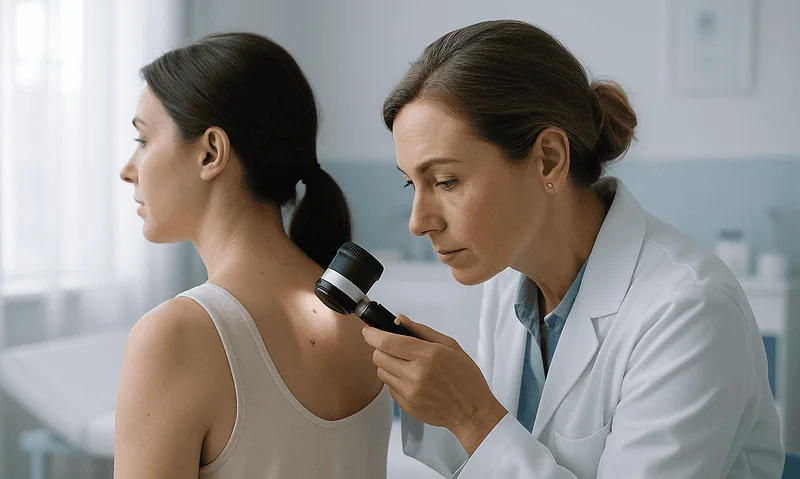
Most first consultations follow a predictable arc, even when they feel rushed. The clinician will ask when the rash began, where it sits, what makes it worse, what you have already tried, and how it affects sleep, work or school. They will want to know about asthma, hay fever, food allergy and eczema in close relatives, because the atopic tendency clusters in families.
The examination comes next. Eczema is usually diagnosed by looking, not by a blood test. Mayo Clinic notes that clinicians typically diagnose atopic dermatitis from the skin’s appearance and your history, and only reach for further tests when something does not fit. In adults the creases of the elbows and knees, the hands, eyelids and neck are common sites; in infants the face and outer limbs are typical.
Tests, when used, tend to answer a specific question. A skin swab checks for bacterial infection when patches are weeping or crusted. Patch testing, in which small amounts of common contact allergens are taped to the back for two days and read at set intervals, helps when a clinician suspects that a soap, fragrance, metal or preservative is fuelling the rash. A skin biopsy, removing a tiny sample for the microscope, is reserved for cases where another diagnosis is possible.
Then the plan. You should leave knowing three things: the name of what you have, the treatment step you are starting on and how to use it, and the point at which you should return. If any of those is missing, ask before you stand up.
Bring photos of flares, a list of every product that touches your skin, and any earlier prescriptions. Clinicians can read a tube label far faster than a description of “the white one.”
How eczema treatment steps actually work
Think of eczema treatment as a staircase. Each step is added to, rather than replacing, the ones below it, and you move down again as the skin settles.
The ground floor is emollients: moisturizers designed to trap water in the skin and patch the leaky barrier. They contain no active drug, which is why they are used every day regardless of whether a flare is present. NHS guidance describes them as the most important part of treatment for dry skin conditions, and the evidence base for regular emollient use reducing flare frequency is the strongest in the whole field.
The first step up is topical corticosteroids: anti-inflammatory creams or ointments that dampen the immune signals driving redness and itch. They come in a range of potencies, and the clinician matches potency to the body site and severity. Used as directed for the duration of a flare, they are considered safe and effective; the concerns people hear about relate mainly to prolonged, unsupervised use of strong preparations on delicate skin.
Alongside or instead of steroids sit topical calcineurin inhibitors, non-steroid creams that quiet an immune messenger called calcineurin. They are often chosen for the face and skin folds where steroid thinning is a bigger worry.
Above that lies phototherapy, controlled exposure to narrow-band ultraviolet light in a clinic, typically for several sessions a week over a course of weeks. It reduces inflammation in the skin without a body-wide drug.
The top steps are systemic treatments, meaning medicines that act throughout the body: conventional immunosuppressants such as methotrexate or ciclosporin, injectable biologics such as dupilumab that block specific inflammatory signals, and oral JAK inhibitors that interrupt signalling inside immune cells. Which of these, if any, is right for you is a decision for the prescribing clinician, weighing benefit against monitoring needs and side effects.
Who is usually offered stronger treatment, and who is asked to wait
Escalation is not a reward for persistence; it follows a pattern of failure at the step below. Most guidance, including the NHS pathway, expects a genuine trial of regular emollients plus appropriately potent topical steroids before anything stronger is considered. “Genuine” matters. A surprising number of people are stepped up when the real problem was a steroid used for two days then stopped because the skin looked better.
People commonly offered specialist-level treatment include those whose eczema covers a large area of skin, those with frequent flares despite good topical use, those with repeated skin infections, those whose sleep or mental health is being eroded, and children whose growth or schooling is affected. Eczema that sits stubbornly on the hands or face, where potent steroids are hard to use for long, also tends to prompt earlier referral.
Who is asked to wait? Anyone whose topical regimen has not really been tested, whose flare is likely driven by an identifiable trigger that has not yet been removed, or whose skin has an untreated infection muddying the picture. Waiting here is not dismissal; it is the clinician making sure that the next step will be judged against a fair baseline.
Pregnancy, plans for pregnancy, a history of certain infections or cancers, and some heart or liver conditions can all narrow the systemic options, which is why the pre-treatment conversation often involves blood tests and a frank review of your medical history.
Ask directly: “What would need to be true for me to move up a step, and what would need to be true to come back down?” A clear answer to both halves tells you the plan is being actively managed rather than left to drift.
What will a dermatologist do for severe eczema? Severe eczema treatment options explained
Severe eczema is generally defined by its reach and its cost: widespread inflamed skin, relentless itch, disturbed sleep, cracked or infected areas, and daily life bent around the condition. When someone arrives in that state, a dermatologist’s first job is often not to add a new drug but to find out why the existing ones stopped working.
That means checking for infection. Eczematous skin is frequently colonised by the bacterium Staphylococcus aureus, which can itself drive inflammation; a swab and, if needed, a course of antibiotics may calm a flare that no steroid seemed to touch. It means reviewing technique: how much emollient is really going on, whether the steroid is being applied to all affected skin, and whether an irritating product has crept back into the bathroom.
It may mean patch testing, because an unrecognised contact allergy to a fragrance, preservative or even an ingredient in a prescribed cream can keep eczema smouldering indefinitely.
If those checks come back clean, the conversation turns to escalation. Options a dermatologist may raise include a supervised course of phototherapy; a short, monitored course of an oral immunosuppressant to break the cycle; or longer-term targeted therapy with a biologic or a JAK inhibitor. Each carries its own monitoring requirements, from regular blood tests with conventional immunosuppressants to eye-symptom checks with some biologics. Mayo Clinic’s treatment overview describes these as options for moderate to severe disease that has not responded to topical care, chosen case by case.
Wet-wrap therapy, in which emollient and prescribed cream are sealed under damp then dry bandages for a period, is sometimes used in clinic or taught for home use to break an intense flare, particularly in children.
None of these is a promise. Ask what response the team would expect to see, and by when, so that the decision to continue or switch is made against a shared yardstick.
Eczema treatment steps at a glance
The table below summarises the staircase described above. It is a map for conversation, not a menu; the treating team decides which steps apply to you and in what order.
| Step | What it is | How it works | Typical role | A question worth asking |
|---|---|---|---|---|
| Emollients | Moisturizing creams, ointments, lotions | Trap water and patch the skin barrier | Every day, flare or not, for everyone | “How much and how often, in practical terms?” |
| Topical corticosteroids | Anti-inflammatory creams in graded potencies | Dampen the immune signals behind redness and itch | Flares; sometimes planned maintenance on trouble spots | “Which potency goes where, and for how long?” |
| Topical calcineurin inhibitors | Non-steroid immune-calming creams | Block an immune messenger in skin cells | Face, eyelids, folds; steroid-sparing | “Why this instead of, or alongside, a steroid?” |
| Phototherapy | Clinic-based narrow-band UV light | Reduces inflammation in the skin directly | Widespread eczema not settling with topicals | “How many sessions, and what does it commit me to?” |
| Conventional immunosuppressants | Oral medicines such as methotrexate or ciclosporin | Broadly damp down immune activity | Severe disease; often time-limited with blood monitoring | “What monitoring is needed and what are the stopping rules?” |
| Biologics and JAK inhibitors | Targeted injectable or oral medicines | Block specific inflammatory pathways | Moderate to severe disease unresponsive to the above | “How will we judge whether it is working?” |
Two patterns are worth noticing. First, the lower steps never disappear: someone on a biologic still moisturizes daily. Second, the questions in the right-hand column all ask about mechanics and review points, not about which product is “best.” That is deliberate. Guidance from NHS and Mayo Clinic frames eczema care as a sequence of reviewed trials rather than a search for a single winning treatment, and the most useful thing you can carry out of the room is a clear sense of where you sit on the staircase and what would move you.
What is the 3 minute rule for eczema, and does the timing really matter?
The “3 minute rule” is a piece of patient folklore with a sensible core: after a bath or shower, pat the skin dry and apply moisturizer within about three minutes, while the skin is still slightly damp. The idea is that water has just soaked into the outer skin layer and an emollient applied promptly seals it in before it evaporates.
Is the number three magic? No. There is no trial showing that minute four is too late. What the evidence does support, and what Mayo Clinic and NHS self-care guidance both describe, is moisturizing soon after bathing onto skin that is still moist, and doing so consistently. The rule is a memory aid for that habit. If it helps you build the routine, use it; if your bathroom logistics mean five minutes, the skin will not know the difference.
The more important bathing points get less attention. Lukewarm rather than hot water, because heat strips skin oils and provokes itch. Short baths or showers rather than long soaks. A soap-free wash or an emollient used as a cleanser instead of foaming products, which the NHS specifically advises for eczema-prone skin. Patting rather than rubbing dry. Applying emollient in the direction of hair growth to reduce blocked follicles.
One practical detail people rarely ask about: the order of creams. If you have been given both an emollient and a prescribed anti-inflammatory cream for the same area, ask which goes on first and how long to leave between them. Different teams give different advice, and either approach is defensible, but you should follow one consistently rather than mixing them into a paste.
Raise the rule at your consultation as a question rather than a fact: “Does the three-minute idea fit how you want me to use these products?”
What is mostly mistaken for eczema?
“Eczema” is often used as a catch-all for any red, itchy patch, which is exactly why a specialist examination matters. Several conditions imitate it, and some need entirely different treatment.
Contact dermatitis is the most frequent look-alike, and the boundary is blurry because a person with atopic eczema can also develop it. Irritant contact dermatitis follows repeated exposure to soaps, solvents or wet work; allergic contact dermatitis is a true immune reaction to a specific substance such as nickel, fragrance or a preservative. Patch testing separates these from atopic disease.
Psoriasis produces thicker, more sharply edged plaques with silvery scale, often on the elbows, knees and scalp, and tends to itch less. Seborrheic dermatitis favours the scalp, eyebrows and sides of the nose with greasy, yellowish scale. Fungal infections such as ringworm form a ring with a clearer centre and worsen when treated with steroid creams alone, which is a classic clue. Scabies, a mite infestation, causes intense night-time itch with tiny burrows, particularly on the wrists and between the fingers, and spreads through households.
Less commonly, a persistent eczema-like rash in an adult that does not respond to standard care turns out to be cutaneous T-cell lymphoma, a slow-growing skin lymphoma. This is rare, but it is the main reason dermatologists take a biopsy when “eczema” behaves oddly.
None of this is an invitation to diagnose yourself from a list. The point is different: if a rash has been treated as eczema for months without a clear response, one of the most valuable questions to ask a dermatologist about eczema is simply, “How confident are we that this is eczema, and what else have you considered?” A good clinician welcomes it.
Is eczema linked to lymphoma? What the evidence shows
This question surfaces in nearly every online eczema forum, usually after someone has read the safety information for a topical calcineurin inhibitor. It deserves a calm, accurate answer.
Large observational studies have reported a small statistical association between atopic dermatitis, particularly severe disease, and lymphoma. Association is not cause, and several explanations compete. Part of the signal is misdiagnosis: cutaneous T-cell lymphoma can look like eczema for years before being recognised, so some “eczema patients who developed lymphoma” had lymphoma from the start. Part may reflect chronic immune activation itself. And part may relate to long-term use of systemic immunosuppressants in the most severe cases, since broad immune suppression is a recognised lymphoma risk factor in other settings.
Topical calcineurin inhibitors carry a regulatory boxed warning about a theoretical cancer risk, based on animal data and case reports rather than on demonstrated harm in people using them as directed. Follow-up studies over many years have not confirmed a causal link at the exposures used for eczema, and Mayo Clinic describes these medicines as an established option for eczema on the face and folds, used with routine sun protection.
Newer targeted treatments, biologics and JAK inhibitors, have their own safety profiles. JAK inhibitors in particular carry warnings about serious infections, blood clots and malignancy drawn from studies in other conditions and other patient groups, which is why prescribers assess individual risk factors before starting them.
What should you take from this? The absolute risk for any individual with eczema remains low, the strongest signal is confined to severe long-standing disease, and the practical safeguard is the one your dermatologist already applies: reassess any eczema that behaves atypically. Ask, “Given my history, is there anything about my eczema that makes you want to look more closely?” and let the treating team answer for your case.
What the first weeks after your eczema appointment usually look like
The first fortnight after a consultation is when most plans quietly fall apart, so it helps to know what “normal” feels like.
In the first few days you are building a routine: emollient in generous amounts across all dry skin, usually more than once a day, and the prescribed anti-inflammatory applied to actively inflamed patches as directed. Skin often feels greasier than you expect; that is the emollient doing its job. Itch typically eases before redness fades, and the skin may look slightly worse before it looks better as dry scale lifts.
Toward the end of the first week, most flares treated with an appropriate topical steroid begin to settle visibly. NHS treatment guidance frames topical steroid use as continuing until the flare has cleared and, in some plans, for a short period beyond, rather than stopping the day the skin looks acceptable. That instruction is easy to miss and important to confirm, because stopping too early is one of the commonest reasons a flare rebounds.
By the two-to-four-week mark, if things are going well, you should be able to step back to emollient-only maintenance on most areas. If the skin is not improving, is spreading, or is becoming weepy or crusted, that is not a failure on your part; it is information the clinician needs, and it is the moment the plan said to return.
People starting phototherapy or systemic treatment have a different rhythm: clinic visits, blood tests, and response usually judged over months rather than weeks. Ask in advance how many appointments the course involves and how you will know it is working, so that the waiting feels planned rather than open-ended.
Keep a simple diary: date, itch out of ten, what you applied, how you slept. Four lines a day. It will be the most useful thing in the room at your review.
Eczema maintenance: keeping skin calm between flares
Maintenance is the part of eczema care nobody finds exciting, and it is where the long-term difference is made. The goal is to lengthen the calm stretches and shorten the flares, not to achieve skin that never reacts.
Daily emollient use is the foundation, on a schedule that fits your life rather than an ideal one. Ointments hold water best but feel heavy; creams and lotions are lighter and more acceptable in daytime. Many people use a lighter product in the morning and a richer one at night. Ask whether a pump dispenser is available, because scooping from tubs can introduce bacteria.
Trigger management is individual. Common contributors described by NHS and Mayo Clinic include soaps and detergents, wool and synthetic fabrics against the skin, overheating and sweat, low humidity, dust mite exposure, stress and, in some children, specific foods. Elimination diets without evidence of allergy are not recommended and can cause harm; if food is suspected, ask for proper allergy assessment rather than experimenting alone.
Some people are offered a planned “weekend” or intermittent schedule of anti-inflammatory cream on the sites that always flare, applied on set days even when the skin looks clear. This proactive approach has trial support for reducing flare frequency and is a legitimate question to raise: “Would a maintenance schedule on my usual trouble spots make sense for me?”
Itch control is maintenance too. Keeping nails short, cool compresses, cotton clothing and bedding, and a cooler bedroom all reduce night-time scratching. Sedating antihistamines do not treat eczema itself; if they are suggested, it is usually for short-term sleep rather than the rash.
Finally, ask what a “good year” would look like for someone with your pattern. A realistic target agreed with the treating team is more motivating than a vague hope of clear skin.
What people often get wrong about eczema
Eczema attracts myths the way dry skin attracts wool fibres. Correcting a few of them before your consultation frees up time for questions that matter.
“Steroid creams thin the skin, so use as little as possible.” Skin thinning is a real effect of prolonged, unsupervised use of potent steroids, especially on the face and folds. It is not a typical outcome of using the prescribed potency for the duration of a flare. Under-treating is far more common than over-treating, and it prolongs inflammation.
“Eczema is caused by an allergy, so find the allergen and it stops.” Atopic eczema is driven primarily by a genetically leaky skin barrier and an over-responsive immune system. Allergens and irritants can worsen it, but removing them rarely switches it off. Contact allergy is a separate problem, identified by patch testing.
“It’s contagious.” It is not. Infected eczema can shed bacteria, but the eczema itself cannot be caught.
“Children always grow out of it.” Many do improve substantially through childhood, and NHS guidance notes that symptoms often ease with age, but a proportion continue into adult life or relapse later. Nobody can promise which group a child falls into.
“Natural means safe.” Plant oils, essential oils and herbal creams can contain potent contact allergens and irritants. Some traditional remedies have been found to contain undeclared steroids. Tell your clinician about everything you use.
“Moisturizer is optional once the flare is gone.” The opposite. Emollients are the maintenance treatment; the anti-inflammatory is the rescue.
“Diet changes fix eczema.” Evidence for dietary elimination in people without proven food allergy is weak, and restrictive diets in children carry nutritional risk. Ask for assessment before removing food groups.
Bring the myth you half-believe to the appointment and ask about it directly. It is a better use of a minute than pretending you never wondered.
Questions to ask your dermatologist about eczema: a working list
Choose the six or seven that matter most to you. Nobody gets through all of these in one visit, and a good consultation is a conversation, not an interrogation.
About the diagnosis
- Which type of eczema do you think this is, and how confident are you?
- Is there anything about my rash that makes you want to test for something else?
- Would patch testing tell us anything useful?
About the treatment step
- Which step of treatment am I starting on, and why this one?
- For each cream: where does it go, how much, how often, and for how long?
- In what order do I apply the emollient and the prescribed cream?
- What side effects should I watch for, and which would make you want to know straight away?
About maintenance
- Once the flare settles, what does my daily routine look like?
- Would a planned maintenance schedule on my usual flare sites help me?
- Which of my products, fabrics or habits would you change first?
About escalation
- What would need to happen for you to move me up a step?
- If we did, what are the realistic options for someone with my history, and what monitoring would each need?
- How will we judge whether a stronger treatment is working, and by when?
About returning
- When is my planned review, and what should I bring to it?
- What signs mean I should come back before then?
- What signs mean I should seek urgent care the same day?
- Who do I contact between appointments if something changes?
Write the answers down, or ask whether the plan can be summarised on paper or in your patient record. Repeat the key instructions back in your own words before leaving; it takes fifteen seconds and catches most misunderstandings.
When to call your doctor: red flags and when to return
Most eczema follow-up is planned rather than urgent, but a few situations should not wait for the next scheduled review.
Seek same-day care if you or your child develops clusters of small, painful, punched-out blisters or sores spreading quickly across eczema, particularly with fever, feeling unwell or swollen glands. This pattern can indicate eczema herpeticum, a herpes simplex infection of eczematous skin that both NHS and Mayo Clinic classify as a medical emergency requiring prompt antiviral treatment. Sores near the eyes make it more urgent still.
Call promptly, within a day or two, if patches become hot, increasingly painful, weep clear or yellow fluid, or develop honey-coloured crusts, which suggest bacterial infection. Do the same for a fever with a worsening rash, for eczema that is spreading rapidly despite treatment, or for eyelid eczema accompanied by eye pain, light sensitivity or changes in vision.
Book an earlier review when treatment that was working has stopped working, when a flare has not begun to settle within the window your clinician described, when itch is regularly costing you sleep, when you notice mood changes linked to your skin, or when side effects of a treatment are troubling you. Do not stop a prescribed medicine on your own because of side effects; report them and let the prescriber decide.
For anyone on systemic treatment, contact the team about any new infection, unexplained bruising, breathlessness, chest pain, calf swelling or persistent eye symptoms, and keep all monitoring blood tests.
A reasonable rule for the grey zone: if the skin is behaving in a way the plan did not describe, that is itself a reason to get in touch. Eczema care works best as a partnership with the treating team, and the team can only adjust what it knows about. Every decision about changing, adding or stopping treatment sits with them; your job is to bring accurate information and the questions that matter to you.
Frequently asked questions
What are the most important questions to ask a dermatologist about eczema?
Ask what type of eczema you have and how confident the diagnosis is, which treatment step you are starting on and exactly how to use each product, what your daily maintenance routine should be once the flare settles, what would prompt moving up a step, and which signs mean you should return early or seek same-day care. Write the answers down and repeat the key instructions back before you leave.
What is the 3 minute rule for eczema?
The 3 minute rule is a popular tip to apply moisturizer within about three minutes of bathing, while skin is still slightly damp, so the emollient seals in water before it evaporates. Guidance from NHS and Mayo Clinic supports moisturizing soon after washing onto damp skin, but no study shows three minutes is a hard cut-off. Treat it as a habit-builder rather than a rule that fails at minute four.
What is mostly mistaken for eczema?
Contact dermatitis is the most common look-alike, followed by psoriasis, seborrheic dermatitis, fungal infections such as ringworm, and scabies. Rarely, a persistent eczema-like rash in an adult turns out to be cutaneous T-cell lymphoma. Clinicians distinguish these by examination, sometimes patch testing, a skin swab or a biopsy. If a rash has not responded to months of eczema treatment, ask what else has been considered.
Is eczema linked to lymphoma?
Large observational studies have found a small statistical association between severe, long-standing atopic dermatitis and lymphoma. Part of this reflects skin lymphomas initially misdiagnosed as eczema, and part may relate to chronic inflammation or long-term systemic immunosuppression. Topical calcineurin inhibitors carry a precautionary warning, but long-term studies have not shown a causal link when they are used as directed. Individual risk remains low; discuss your own history with your dermatologist.
What will a dermatologist do for severe eczema?
A dermatologist will usually first check why current treatment is failing: swabbing for infection, reviewing how creams are actually being used, and considering patch testing for hidden contact allergy. If those are addressed and eczema remains severe, options may include phototherapy, a monitored course of an oral immunosuppressant, or targeted biologic or JAK inhibitor therapy, each with its own monitoring. The choice is made case by case by the prescribing team.
When should I see a dermatologist for eczema rather than my family doctor?
Referral is commonly considered when eczema is widespread, flares frequently despite regular emollients and appropriately used topical steroids, keeps becoming infected, badly disrupts sleep or mental health, affects a child’s growth or schooling, or when the diagnosis is uncertain. Suspected contact allergy needing patch testing is another reason. Your family doctor can usually manage milder eczema and will refer when the pattern suggests specialist input would change the plan.
How do I talk to a dermatologist about eczema if I feel rushed?
Lead with your single most important concern in the first sentence, bring photos of flares and a list of every product you use, and hand over a short written list of questions. Ask the clinician to confirm the plan in writing or in your record, and repeat the key instructions back in your own words. If time runs out, ask who to contact between appointments and when the planned review will be.
What should I expect at an eczema appointment?
Expect questions about when the rash started, where it appears, triggers, previous treatments, sleep and family history of asthma, hay fever or eczema, followed by a skin examination. Diagnosis is usually made by looking; swabs, patch tests or a biopsy are used only when something does not fit. You should leave knowing your diagnosis, the treatment step you are starting on, how to use each product, and when to return.
Do steroid creams for eczema thin the skin?
Skin thinning is a recognised effect of prolonged, unsupervised use of potent topical steroids, particularly on the face and skin folds. It is not a typical outcome of using the prescribed potency on the prescribed area for the duration of a flare, which is how guidelines such as those from the NHS recommend they be used. Under-treatment is the more common problem. Raise any concern with your prescriber rather than reducing use on your own.
How long does it take for eczema treatment to work?
Timelines depend on the step. With regular emollients and an appropriately potent topical steroid, itch often eases within days and visible flares usually begin to settle over the first one to two weeks, with a planned review typically within a few weeks. Phototherapy and systemic treatments are judged over months, not weeks. Your clinician should give you a specific review window for your plan; if the skin is not following it, get in touch.
References
- NHS: Atopic eczema, overview
- NHS: Atopic eczema, treatment
- MedlinePlus: Eczema
- NIH NIAMS: Atopic dermatitis
This article is for general information only and is not a substitute for professional medical advice. Please consult a qualified doctor about your individual situation.

More from the Blog

Double Cleansing and Oil Cleansing: Who Benefits and Who Is Over-Washing
Double cleansing means washing the face twice in a row: first with an oil or balm that dissolves sunscreen, makeup and sebum, then with…

Puffy Eyes and Eye Bags: Fluid, Fat or Skin? How the Cause Decides the Fix
Puffy eyes come from one of three things: fluid pooling in the thin eyelid tissue, orbital fat pushing forward as the tissue holding it…
How to Exfoliate: The Right Way for Your Skin Type
To exfoliate safely, match the method to your skin type: a soft washcloth or gentle chemical exfoliant for dry or sensitive skin, and an…

Acute vs Chronic Urticaria: How the Six-Week Line Changes the Way Hives Are Investigated
Acute urticaria is hives that settle within six weeks; chronic urticaria is hives that keep appearing, on most days, for longer than six weeks.…

Seborrheic Dermatitis in Babies and Adults: How Cradle Cap and Adult Flares Are Approached
Cradle cap and adult seborrheic dermatitis are the same inflammatory skin condition seen at two different ages. In babies it shows as greasy, yellowish…

Seborrheic Keratosis and Cherry Angiomas: The Harmless Growths of Adult Skin
Seborrheic keratosis and cherry angiomas are two of the most common benign skin growths in adults, and neither is cancer nor a sign of…