

Questions to Ask Before Pelvic Organ Prolapse Surgery: Mesh, Approaches and Recovery

Key Takeaways
- Prolapse surgery rebuilds the support layer under an organ rather than moving the organ, which is why the repair remains subject to aging tissue, coughing, constipation and lifting.
- Transvaginal mesh and abdominal sacrocolpopexy mesh are different procedures with different evidence; the 2016 Cochrane review found vaginal mesh exposure in about 12 in 100 people, with roughly 8 in 100 needing further surgery.
- About 19 in 100 people were aware of prolapse again one to three years after native tissue repair in the Cochrane review, and the front (bladder) wall is the compartment most likely to recur.
- A large bladder bulge can hide stress incontinence, so ask whether your pre-operative assessment tested for leakage and what the plan is if it appears after repair.
- Removing the uterus does not by itself repair the failed ligaments, and uterine-preserving suspension is an established alternative to discuss.
- NHS guidance describes roughly six weeks of avoiding heavy lifting, strenuous exercise and intercourse after prolapse surgery, with the exact timeline set by your surgeon.
Before pelvic organ prolapse surgery, ask which compartments will be repaired, whether the plan uses your own tissue or mesh and why, whether the uterus is removed or preserved, how hidden bladder leakage will be handled, how the surgeon defines success and recurrence, what recovery typically involves, and which non-surgical options remain. The final choice rests with you and your treating team, based on your anatomy, health and goals.
The leaflet is folded into quarters in her handbag, softened at the creases from being read on the bus. She has an appointment in nine days, a surgeon’s name she can barely pronounce, and a single sentence she keeps circling: “You may be offered a repair with or without mesh.” She has already read too much online, most of it frightening, some of it contradictory, none of it about her.
This is the moment most people reach with pelvic organ prolapse: the bulge is real, the pessary was tried or declined, and an operation is on the table. What is missing is not information. It is the right prolapse surgery questions, asked in the right order, to the right person.
What follows is the conversation a good urogynecologist, a gynecologist who specializes in pelvic floor problems, would want you to have before you sign anything. It covers approaches, mesh, the uterus, leakage, recovery and the honest odds of a bulge returning, in language you can take into the room.
What actually happens during prolapse surgery?
Pelvic organ prolapse means one or more pelvic organs, the bladder, uterus, rectum or the top of the vagina, has slipped from its usual position and is pressing into or bulging out of the vagina. Surgery does not relocate an organ. It rebuilds support. The surgeon identifies which layer of the pelvic floor has stretched or torn, then shortens, stitches or reinforces that layer so the organ above it sits higher.
Most repairs are done through the vagina, leaving no visible scar. A cystocele, the medical term for a bladder bulging into the front vaginal wall, is repaired by opening the vaginal skin, folding the stretched connective tissue with sutures and closing again. A rectocele, where the rectum pushes into the back wall, is handled the same way from the other side. When the top of the vagina or the uterus has dropped, the surgeon may anchor it to a strong ligament deep in the pelvis, or reach it through small abdominal incisions with a laparoscope, a thin camera, to suspend it higher.
You will usually have a general anesthetic or a spinal anesthetic, which numbs you from the waist down. A catheter, a soft tube that drains the bladder, is often left in for a few hours to a day, and some surgeons place a vaginal pack, a length of gauze that presses gently on the repair overnight. The NHS notes that people may go home the same day or after a short stay, depending on what was repaired and how they recover from the anesthetic.
Which layers get repaired, through which route, and with what material: those three variables shape almost every question worth asking.
Who is usually offered surgery, and who is asked to wait?
Surgery is usually reserved for prolapse that bothers you. That sounds obvious, but it matters: a bulge found on a routine exam that causes no symptoms is generally watched, not operated on. Mayo Clinic and the NHS both describe a stepped approach in which pelvic floor muscle training and a pessary come before an operation for most people.

A pessary is a removable silicone device placed in the vagina to hold the prolapse up. It is not a consolation prize. Many people use one long term, and others try one for a few months to judge how much better they would feel if the bulge were gone. Pelvic floor training, ideally with a specialist physiotherapist, can ease symptoms of milder prolapse and is often recommended before and after surgery regardless.
Surgery tends to be discussed when the prolapse reaches beyond the vaginal opening, when it interferes with emptying the bladder or bowel, when a pessary cannot be fitted or is not tolerated, or when someone has weighed the options and prefers a definitive repair.
People commonly asked to wait include those who plan further pregnancies, because childbirth can undo a repair; those with a chronic cough, uncontrolled constipation or heavy lifting demands that would strain fresh stitches; those with untreated vaginal thinning after menopause, which surgeons often address first so the tissue heals well; and anyone whose general health makes an anesthetic riskier than the prolapse itself. Smoking cessation and blood sugar control before surgery are routinely requested for the same reason.
Waiting is not failing. It is the clinician making sure the repair has the best possible ground to hold.
Native tissue, mesh or closure: what the surgical approaches mean
Three ideas cover almost every operation you will hear about. A native tissue repair uses your own connective tissue and stitches, with nothing added. A mesh repair adds a permanent synthetic material to reinforce the support. An obliterative procedure, called colpocleisis, closes off most of the vaginal canal to hold everything in place; it is reserved for people who do not want future vaginal intercourse and often want a shorter operation.
Route is the other axis. Vaginal operations are shorter, with no abdominal cuts. Abdominal operations, now usually laparoscopic or robot-assisted (the robot is an instrument the surgeon controls, not an autonomous device), give a different angle on the top of the vagina and are the standard way to place mesh, in a procedure called sacrocolpopexy, which anchors the vaginal apex to a ligament over the tailbone.
| Approach | What is repaired | Material | Typical route | Trade-off commonly discussed |
|---|---|---|---|---|
| Anterior or posterior colporrhaphy | Bladder or rectal bulge | Your own tissue | Vaginal | Same wall may bulge again over the years |
| Vaginal vault or uterine suspension | Top of vagina or uterus | Your own ligaments, stitches | Vaginal | Depends on ligament strength; may accompany hysterectomy |
| Sacrocolpopexy or sacrohysteropexy | Top of vagina or uterus | Synthetic mesh | Laparoscopic, robotic or open | Longer operation; mesh complications uncommon but permanent material |
| Colpocleisis | Vaginal canal closed | Your own tissue | Vaginal | Ends vaginal intercourse; shorter anesthetic |
Ask your surgeon which row describes your plan, and which rows were considered and set aside. The reasoning is often more informative than the choice itself, because it tells you what your surgeon sees in your anatomy that a leaflet cannot.
Vaginal mesh for prolapse: what the evidence actually shows
Mesh is where most people’s anxiety lives, so it deserves a plain account. Two very different uses share the name. Mesh placed through the vagina to reinforce the front or back wall has been withdrawn or heavily restricted in several countries after complications emerged. Mesh placed through the abdomen to suspend the top of the vagina in a sacrocolpopexy remains a standard, guideline-supported operation in most settings. Conflating the two is the most common misunderstanding in this field.
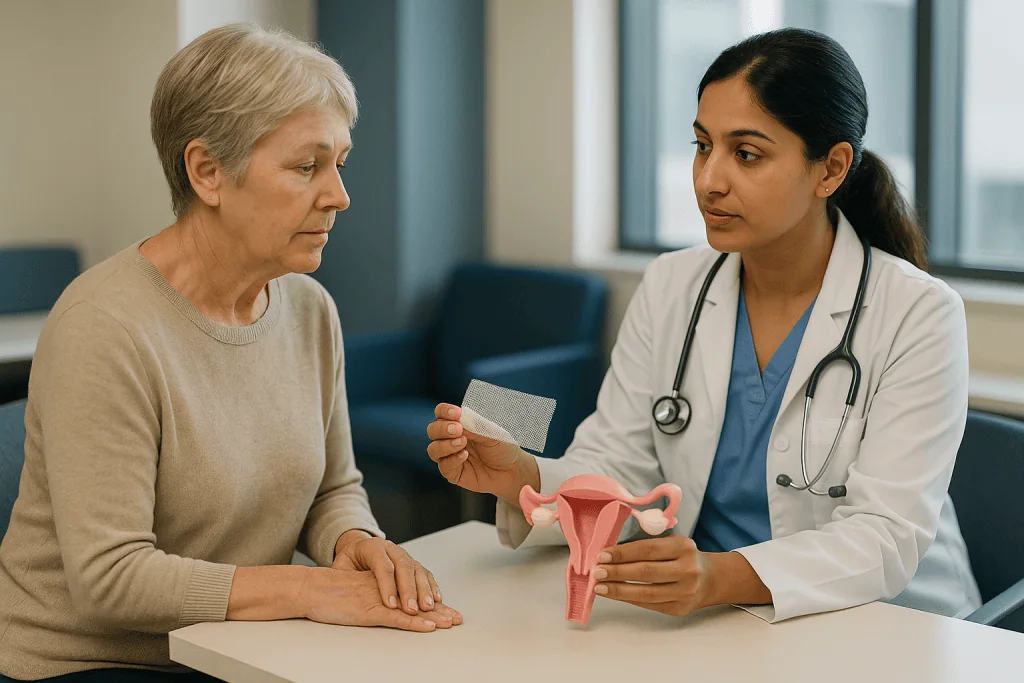
The Cochrane systematic review of transvaginal mesh versus native tissue repair (Maher and colleagues, 2016) found that vaginal mesh lowered the chance of being aware of prolapse again at one to three years: roughly 19 in 100 people after native tissue repair compared with about 10 to 15 in 100 after mesh. It also lowered repeat surgery for prolapse itself. But mesh exposure, where the material erodes through the vaginal skin, occurred in about 12 in 100, and around 8 in 100 needed a further operation to deal with it. Bladder injury during the operation and new stress incontinence afterward were also more common. When the review added up all repeat operations, the mesh group had more. The authors concluded the added benefit did not justify routine use of transvaginal mesh, a judgment regulators broadly echoed.
The NHS now describes vaginal mesh for prolapse as something offered only in exceptional circumstances with detailed consent. Abdominal sacrocolpopexy mesh rests on a different evidence base with lower exposure rates, though not zero. If mesh of any kind is proposed, ask which type, by which route, why over a native tissue option, and how the surgeon monitors and manages mesh if problems arise years later.
Prolapse surgery questions about the uterus: remove it or keep it?
If your uterus has dropped, you will be asked a question many people did not expect: do you want to keep it? For decades a vaginal hysterectomy, removal of the uterus through the vagina, was bundled into prolapse surgery almost automatically. That is changing. Uterine-sparing procedures, called hysteropexy, re-suspend the uterus and cervix using stitches or abdominal mesh, and the evidence so far does not show that removing the uterus by itself produces a more durable repair.
What is being removed matters. The uterus is not the cause of prolapse; failed ligaments and connective tissue are. Taking the uterus out removes weight and lets the surgeon reach the ligaments more directly, but it also creates a raw vaginal cuff that must be suspended in turn, which is why the top of the vagina can itself prolapse years after a hysterectomy done for other reasons.
Reasons a surgeon may recommend removal include an enlarged uterus with fibroids, abnormal bleeding, cervical screening abnormalities, a strong family history of gynecologic cancer, or a wish to avoid future uterine problems. Reasons to preserve it include a shorter operation, a personal sense of bodily integrity, or, for premenopausal people, hormonal considerations even when pregnancy is not planned.
Ask specifically: would my repair be different if we kept the uterus, and does your team perform uterine-sparing suspension routinely? A surgeon who mainly performs one operation may reasonably recommend it; hearing that openly helps you judge whether a second opinion would add information. There is no single right answer, and mainstream guidance leaves the choice with the informed patient and the treating team.
Should bladder leakage be treated in the same operation?
Prolapse and stress urinary incontinence, leaking urine on coughing, laughing or lifting, share the same worn support system, so they often travel together. The awkward part is that they can also hide each other. A large bladder bulge can kink the urethra, the tube urine leaves through, and mask leakage. Once the bulge is repaired and the kink released, leakage may appear for the first time. The Cochrane review recorded new stress incontinence after prolapse repair in a meaningful minority, more often after mesh repairs.
Because of this, your team may suggest testing before surgery. Urodynamics is a clinic test that measures how the bladder fills and empties, sometimes with the prolapse gently held up to reveal hidden leakage. A simpler cough test with the bulge supported gives similar information in many cases.
Then comes a genuine decision with three honest paths. One is a combined operation: prolapse repair plus a continence procedure under the same anesthetic. Two is a staged plan: repair the prolapse, see whether leakage develops, treat it later only if needed. Three is pelvic floor training first, which some people find sufficient. Each path has a cost. Combining adds operating time and its own risks, including difficulty emptying the bladder afterward. Staging risks a second operation.
Questions worth asking: did my assessment show hidden leakage, what is your usual practice when it does, what continence procedure would you use and does it involve a sling made of mesh, and how would trouble emptying be managed? Slings for incontinence are a separate topic with their own evidence and controversies, so make sure you know which device, if any, is being proposed.
Prolapse surgery risks: how to read the consent form
Every consent form lists the same worries, so it helps to sort them into categories rather than reading a wall of risks. General surgical risks come first: bleeding, infection at the wound or in the urine, blood clots in the leg or lung, and reactions to anesthesia. These apply to almost any operation and are lowered by early walking, breathing exercises and, where prescribed, clot-prevention measures your team will explain.
Procedure-specific risks are the more useful conversation. Bladder or bowel injury can happen because these organs lie against the tissue being repaired; the Cochrane review found bladder injury more common in vaginal mesh operations than native tissue repairs. Difficulty emptying the bladder in the first days is common and usually settles, but a small number of people go home with a catheter or learn to pass one themselves for a while. Pain during intercourse can be new or worse after a repair, particularly if the vagina is narrowed more than intended, and is more frequent after posterior wall surgery.
Material-specific risks belong to mesh: exposure, infection, chronic pelvic pain and, rarely, erosion into the bladder or bowel. These can appear years later, which is why mesh complications are described as uncommon but lifelong.
Then there is the risk no form emphasizes enough: the prolapse coming back, or a different wall giving way once the repaired one is firm. That deserves its own section.
A useful framing question is not “what are the risks” but “which of these have you seen in your own patients in recent years, and how did you manage them?” Experienced surgeons expect it and usually answer in specifics.
What is the bladder prolapse surgery success rate, honestly?
People type this question into search engines constantly, and the honest answer is that a single number does not exist, because “success” has at least three definitions that give three different figures.
Anatomic success means the exam looks good at follow-up. Symptomatic success means you no longer feel a bulge. Reoperation-free success means you have not needed another operation. Studies using anatomic criteria report the lowest numbers, because a small, silent bulge counts as failure. Symptom-based studies report higher ones. This is why one source can call bladder prolapse surgery frequently unsuccessful and another call it reliably effective while reading the same trials.
The most quotable evidence again comes from the Cochrane review: about 19 in 100 people were aware of prolapse one to three years after native tissue repair. Put the other way, roughly four in five were not, within that window. Longer follow-up shows more recurrences, and the front wall, where the bladder sits, is the compartment most likely to bulge again.
What raises recurrence risk is well described in mainstream sources: more advanced prolapse before surgery, younger age at repair (more years to fail), weak levator muscles, obesity, chronic straining, and a previous repair. What lowers it is less certain, though treating constipation and cough, avoiding heavy lifting during healing, and pelvic floor training are consistently recommended.
Ask your surgeon how they define success, what their own follow-up shows, and how they would approach a recurrence. Be wary of any fixed success percentage offered without a definition and a time point attached; that usually means the number was borrowed rather than measured.
What do the first days after prolapse surgery look like?
The first few days are less about the repair and more about plumbing and pressure. You will likely wake with a catheter, and perhaps a vaginal pack. Both usually come out within a day. Before you leave, nurses check that you can empty your bladder and often measure the residual, the urine left behind, with a small scanner. If it is high, the catheter may go back in for a short period; this is common and rarely means anything went wrong.
Discomfort is usually described as a heavy, bruised ache in the pelvis rather than sharp pain, plus soreness at any abdominal incisions. Your team will give you a pain plan; how you follow it is their call, so use their written instructions rather than a friend’s memory.
Expect vaginal bleeding or a pink-brown discharge for several weeks. The NHS describes this as normal, with heavier bleeding, an offensive smell or fever being reasons to call. Stitches inside the vagina dissolve on their own and may appear as small threads when they do.
Two habits matter enormously in the first week. Walking short distances several times a day reduces clot risk and helps the bowel wake up. Avoiding straining on the toilet protects the repair; a stool softener is routinely advised by surgical teams, and a footstool that raises your knees makes emptying easier without pushing.
Fatigue often surprises people. Anesthetic, blood loss and disrupted sleep add up, and resting is part of healing, not laziness. Plan for someone to help with meals, stairs and lifting for at least the first several days.
Prolapse surgery recovery time: weeks one to six, and what not to do
Ask ten people about prolapse surgery recovery time and you will get ten calendars. The NHS gives the most useful anchor: most people need around six weeks before returning to normal activity, and heavy lifting and strenuous exercise should be avoided for that period, sometimes longer for physically demanding jobs. Return to less physical work is often possible earlier, and the NHS advises discussing your specific job with your surgeon.
By the third week you are usually off the sofa but not off the leash. Walking daily, driving if you can brake sharply without pain, showering normally and light household tasks are typically fine. A three-week check-in with yourself is useful: is bleeding lighter than at week one, is the bladder emptying without effort, is pain reducing week on week? If the answer to any of these is no, that is worth a phone call rather than waiting for the six-week appointment.
What not to do during healing applies whether or not you have surgery, because it is really a list of things that load the pelvic floor: lifting anything heavy, leaving a persistent cough untreated, straining on the toilet, high-impact exercise such as running or jumping, and standing for very long periods early on. Intercourse and inserting anything into the vagina are usually deferred until your surgeon confirms the repair has healed, commonly around six weeks in NHS guidance.
Recovery is rarely a straight line. A better week followed by a tired, achy one after doing more is normal. Pelvic floor exercises, once your team clears you, help the muscles take over the work the stitches did at the start.
Failed prolapse surgery symptoms: what recurrence actually feels like
The word “failed” is heavier than the reality. Sometimes a repair recurs; sometimes a different compartment gives way; sometimes the repair is intact but a new problem, such as leakage or pain, has appeared. All three are usually manageable, and none is a verdict on you.
The most recognizable sign of recurrence is the one that brought you to surgery: a sensation of something coming down, or a bulge you can feel, especially at the end of the day or after activity. Dragging pelvic heaviness, needing to press on the vagina or perineum to start urinating or empty the bowel, and a slow or split urine stream point the same way. These usually develop gradually over months or years, not days, which is why a follow-up a year or more after surgery has value.
Symptoms that suggest something other than recurrence deserve prompt attention rather than watchful waiting: persistent or worsening pain during intercourse, a partner feeling something sharp, vaginal bleeding well after healing, discharge with an odor, recurrent urinary infections, or new pain that does not settle. After a mesh procedure, these can signal exposure or erosion and are exactly what the surgeon will want to examine.
Assessment is straightforward: an examination while you bear down, sometimes standing; a bladder scan for residual urine; and, if mesh is involved, a careful look and occasionally imaging. Options after a recurrence include the same non-surgical measures as before, a pessary, or a repeat operation, often by a different route or suspension point. Repeat surgery is more complex, which is one reason getting the first plan right, and asking about it in detail, matters.
What people often get wrong about prolapse surgery
Myth: surgery puts the organs back. Repair rebuilds support; the organs sit higher because the shelf beneath them is firmer, and that shelf is living tissue that keeps aging.
Myth: all mesh is dangerous, or all mesh is banned. Transvaginal mesh for prolapse has been restricted in many countries because of the complications summarized in the Cochrane review; abdominal mesh for sacrocolpopexy remains a standard operation with a different risk profile. Ask which is meant.
Myth: a hysterectomy fixes prolapse. Removing the uterus does not repair the ligaments that failed, and the top of the vagina can prolapse afterward.
Myth: if the exam is perfect a year later, it is fixed for life. Prolapse repair is more like a joint replacement than an appendectomy: durable for many people, yet subject to wear, weight, cough, constipation and time.
Myth: pelvic floor exercises are pointless once you have had surgery. Mainstream guidance recommends them before and after, because strong muscles unload the repaired tissue.
Myth: you will never lift your grandchildren again. Lifting restrictions apply to the healing window, around six weeks in NHS guidance; afterward, sensible technique and avoiding straining are what is advised, not a lifetime ban.
Myth: pain during sex after surgery means the operation went wrong. Discomfort in the early months is common as tissue softens; persistent pain should be assessed, but it is not proof of a failed repair.
Myth: the biggest operation is the best one. Larger procedures carry more risk and longer recovery, and the evidence does not show that more surgery equals more durability for everyone. The right operation is the one matched to your anatomy, health and goals.
Prolapse surgery questions to ask your care team
Bring these written down; a consultation moves fast and the answers are worth recording.
- Which compartments are prolapsed, and which will you repair? If only one, what happens to the others?
- Is this a native tissue repair, or does it involve mesh? If mesh, is it vaginal or abdominal, and why is it preferred over a non-mesh alternative for me?
- Do you recommend removing my uterus or preserving it, and how would the operation differ each way?
- Did my assessment show hidden stress incontinence? What is your usual plan when it does?
- How do you define success, and what does your own follow-up show at one, three and five years?
- Which complications have you seen in your own practice, and how were they managed?
- If the prolapse recurs, what would a second operation likely involve?
- What could I do in the months before surgery to improve healing: constipation, cough, vaginal tissue health, weight, smoking?
- How long will I be in hospital, and what determines discharge?
- Exactly what should I avoid, and for how long: lifting, driving, work, intercourse, exercise?
- Who do I call, day or night, if something worries me at home?
- If I chose a pessary or physiotherapy instead, what would you expect over the next few years?
Two further questions are worth the slight awkwardness. First: how many of this specific operation do you perform each year? Volume is one recognized marker of experience, though not the only one. Second: would you be comfortable if I sought a second opinion? A clinician confident in the plan will say yes without hesitation, and hearing the same reasoning twice, or hearing it differ, is information you cannot get any other way. Neither question is a challenge; both are part of informed consent.
When to call your doctor
Most recoveries are uneventful, and most calls to the ward end in reassurance. Make the call anyway. Nurses and surgeons would far rather hear from you at nine in the evening than see you in the emergency department at three in the morning.
Seek urgent care, or emergency services if severe, for: heavy vaginal bleeding that soaks a pad in an hour or passes clots; fever with chills; a swollen, painful or warm calf, or sudden breathlessness or chest pain, which can signal a blood clot; inability to pass urine for several hours despite feeling the need; severe or rapidly worsening abdominal or pelvic pain; or fainting.
Call your surgical team within a day for: discharge that becomes foul-smelling or green; redness, spreading warmth or oozing at abdominal incisions; burning or urgency suggesting a urinary infection; new leakage of urine or stool; persistent nausea or inability to keep fluids down; or pain that is climbing rather than easing week to week.
In the months and years afterward, arrange a review for a returning bulge or heaviness, new or worsening pain during intercourse, a partner reporting something sharp or rough, bleeding after intercourse, or recurrent urinary infections. After any mesh procedure these are the signs surgeons specifically want to examine, ideally by a clinician familiar with mesh assessment.
None of these signs means the operation has failed. They mean a person who has just had pelvic surgery is being sensible. Keep the contact numbers you were given somewhere visible, and if you are unsure whether something counts, that uncertainty is itself a reason to ring.
Frequently asked questions
What are the common symptoms of failed prolapse surgery?
The most common sign is the return of a bulge or a dragging, something-coming-down feeling, usually developing gradually over months or years. Needing to press on the vagina to empty the bladder or bowel, a slow or split urine stream, new pain during intercourse, persistent discharge, or recurrent urinary infections also warrant review. After a mesh procedure, these symptoms should be examined promptly by a clinician familiar with mesh.
What not to do with pelvic prolapse?
Avoid anything that repeatedly loads the pelvic floor: heavy lifting, straining on the toilet, leaving a chronic cough untreated, high-impact exercise such as running or jumping, and prolonged standing when symptoms are worse. These apply before surgery and during healing afterward. Treating constipation and building pelvic floor strength with a physiotherapist are consistently recommended by the NHS and Mayo Clinic, whether or not you choose an operation.
What should I do 3 weeks after prolapse surgery?
At three weeks most people are walking daily, doing light household tasks and, if they can brake sharply without pain, driving again. Heavy lifting, strenuous exercise and intercourse are still typically deferred until around six weeks in NHS guidance. Check that bleeding is lighter than at week one, the bladder empties easily and pain is easing; if any of these is not true, call your surgical team rather than waiting.
What is the success rate of bladder prolapse surgery?
No single figure exists, because success can mean a normal exam, no bulge symptoms, or no further surgery, and each gives a different number. The 2016 Cochrane review found about 19 in 100 people were aware of prolapse again one to three years after native tissue repair, meaning roughly four in five were not within that window. Recurrence rises with longer follow-up, and the bladder wall recurs most often.
Is vaginal mesh for prolapse still used?
Rarely, and only with detailed consent in most health systems. The NHS describes transvaginal mesh for prolapse as an option for exceptional circumstances after the Cochrane review showed mesh exposure in about 12 in 100 people and more total repeat operations than native tissue repair. Mesh placed through the abdomen for sacrocolpopexy is a separate, still-standard operation with a lower exposure rate, so always ask which type is meant.
Do I need a hysterectomy for prolapse surgery?
Not necessarily. Removing the uterus does not repair the ligaments that failed, and uterine-sparing procedures called hysteropexy re-suspend the uterus using stitches or abdominal mesh. Current evidence does not show that hysterectomy alone makes a repair more durable. Surgeons may still recommend removal for fibroids, abnormal bleeding, screening abnormalities or cancer risk. The decision is yours to make with your treating team after hearing both options.
How long is prolapse surgery recovery time?
NHS guidance describes around six weeks before returning to normal activity, with heavy lifting, strenuous exercise and intercourse avoided for that period and sometimes longer for physically demanding work. Hospital stays range from same-day discharge to a short admission depending on the procedure. Fatigue and light vaginal discharge for several weeks are expected. Your surgeon sets the timeline for your specific operation and job.
Can prolapse come back after surgery?
Yes. Repaired tissue continues to age and to bear the same loads that caused the original prolapse, and a different compartment can bulge once the repaired one is firm. Risk is higher with advanced prolapse before surgery, younger age at repair, obesity, chronic straining and previous repairs. Managing constipation and cough, avoiding heavy lifting during healing, and pelvic floor training are the measures mainstream sources recommend to lower the chance.
Should I have incontinence surgery at the same time as prolapse repair?
It depends on whether hidden stress incontinence was found when your prolapse was held up during testing, and on your surgeon’s usual practice. Combining procedures avoids a second operation but adds time, risk and a chance of difficulty emptying the bladder. Staging avoids unnecessary surgery if leakage never appears. Ask what any continence procedure would involve, including whether it uses a mesh sling, before deciding with your team.
What are the alternatives to prolapse surgery?
The main alternatives are watchful waiting when symptoms are mild, supervised pelvic floor muscle training, and a pessary, a removable silicone device that supports the prolapse from inside the vagina. Mayo Clinic and the NHS describe these as first steps for most people, and many use them long term. Lifestyle measures such as treating constipation, managing cough and weight also help. Surgery is usually considered when these do not control bothersome symptoms.
References
- NHS: Pelvic organ prolapse, treatment
- Cleveland Clinic: Pelvic organ prolapse
- MedlinePlus: Pelvic floor disorders
This article is for general information only and is not a substitute for professional medical advice. Please consult a qualified doctor about your individual situation.

More from the Blog

What Size of Ovarian Cyst Is Dangerous? Centimetres, Millimetres and What They Mean
There is no single size at which an ovarian cyst becomes dangerous. Most cysts are small, fluid-filled and disappear on their own within a…

Pelvic Ultrasound vs Hormone Tests in PCOS: Why Diagnosis Needs More Than One Finding
Neither a pelvic ultrasound nor a blood test can diagnose PCOS on its own. Clinicians use the Rotterdam approach, which requires at least two…

Endometriosis Treatment in Steps: Hormonal Medicine, Pain Care and When Surgery Is Added
Endometriosis treatment options are usually built in steps. Most people start with pain care, often anti-inflammatory medicines, and hormonal medicine that lowers estrogen's effect…

How Fast Ovarian Cysts Grow: Typical Timelines, Warning Signs and When to Treat
Most ovarian cysts are functional cysts that form during a normal menstrual cycle, reach roughly 2 to 5 centimeters, and shrink or disappear within…

What the Robot Actually Changes in a Robotic Hysterectomy: Precision, Incisions and Recovery
In a robotic hysterectomy the robot does not operate on its own. The surgeon sits at a console a few feet from the patient…

Cystectomy vs Oophorectomy: Removing the Cyst or the Ovary and How Surgeons Decide
A cystectomy removes only the cyst and leaves the ovary in place; an oophorectomy removes the whole ovary, sometimes with the fallopian tube. Surgeons…