

Questions to Ask Before Robotic Hair Surgery: Who Places the Grafts and How Results Are Checked
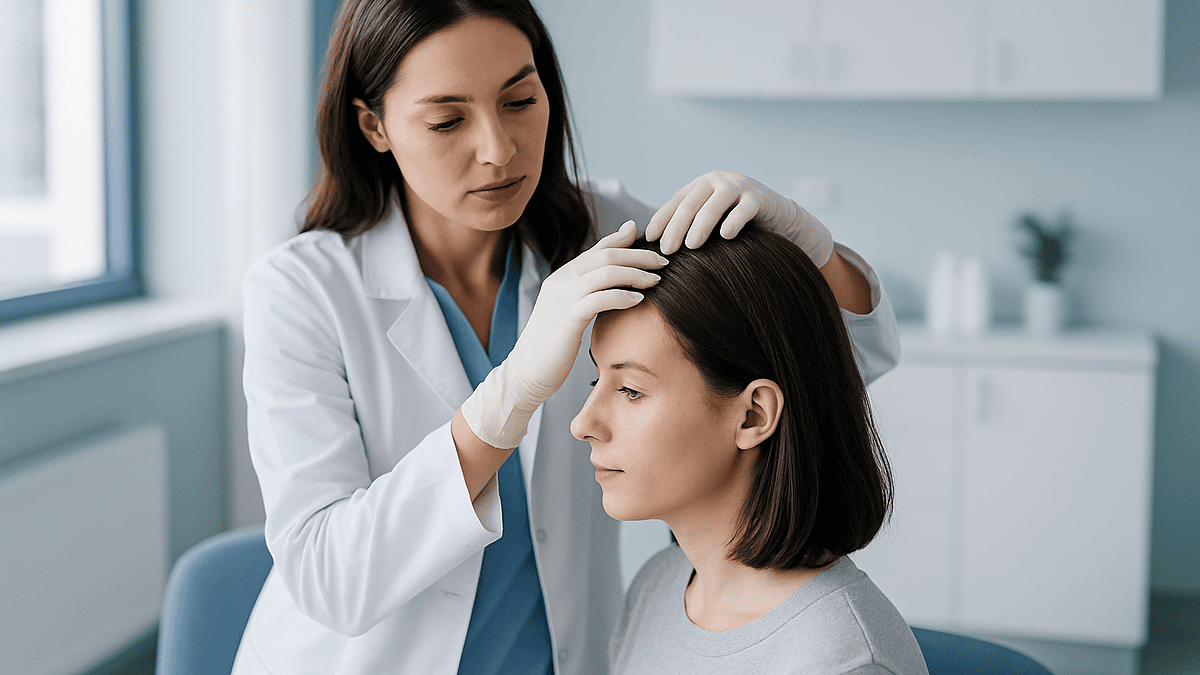
Key Takeaways
- In robotic hair surgery the robot harvests follicular units and in some systems makes recipient sites; sorting, storing and placing grafts are done by hand, usually by technicians under surgeon supervision.
- Published comparisons of robotic and manual FUE mostly measure harvesting speed and transection rate, not long-term growth or appearance, so no guideline body ranks the robot as superior.
- Transplanted hairs typically shed two to three weeks after surgery as an expected phase, with new growth beginning around three to four months and most visible growth by six to nine months, per MedlinePlus and Cleveland Clinic.
- Ask for a written record of grafts harvested, total hairs counted and grafts placed per zone; it is the only objective baseline for judging the result at twelve months.
- Standardized photography and repeat scalp hair counts from marked spots are the two methods a careful team uses to check results, and you should be shown your own images side by side.
- Surgery redistributes a finite donor supply and does not stop loss in surrounding native hair, so a long-term medical plan agreed with a prescribing clinician matters as much as the procedure itself.
Before robotic hair surgery, ask who performs each stage: the robot usually harvests follicular units, but a surgeon or trained technicians still make recipient sites and place grafts by hand. Ask how many people will be in the room, how graft counts and out-of-body time are recorded, and how results will be checked, ideally with standardized photographs and follow-up at set intervals.
The consultation is nearly over when the surgeon mentions, almost in passing, that a robot will do part of the operation. The patient nods. On the drive home the obvious question finally surfaces: part of it? Which part? And who does the rest?
That gap is where most of the useful questions to ask about robotic hair surgery live. The word “robotic” tends to pull attention toward the machine, when the outcome depends at least as much on the hands that sort, store and place thousands of tiny grafts over several hours, and on whether anyone measures what grew back a year later.
This explainer walks through what the robot actually does, what it does not do, who is typically in the room, how a careful team documents results, and the specific questions that turn a glossy consultation into an informed decision. The decision itself always rests with you and your treating team.
What robotic hair surgery actually does, step by step
A hair transplant moves hair from one part of your scalp to another. Surgeons call the part that keeps its hair the donor area, usually the back and sides, because those follicles are less sensitive to the hormones that drive hereditary thinning. The hair is moved in follicular units: natural clusters of one to four hairs that grow together from a single opening in the skin.
There are two established ways to collect those units. In follicular unit transplantation, often shortened to FUT, a strip of scalp is removed and divided under a microscope. In follicular unit extraction, or FUE, each unit is punched out individually with a tiny circular blade, leaving small dot scars rather than a line. Both approaches are described by Cleveland Clinic and the NHS as standard options.
Robotic hair surgery is a form of FUE. A camera-guided robotic arm photographs the shaved donor area, maps the angle and depth of each follicular unit, and drives a small punch to free the unit from the surrounding skin. The intended advantage is consistency: the arm does not tire during a session that Cleveland Clinic notes can run between four and eight hours, and the software tracks which units it has already taken so the donor area is thinned evenly.
What happens next is where many patients are surprised. The freed grafts are lifted out by hand, inspected, sorted by hair count and kept in a chilled holding solution. Some robotic systems can also create the recipient sites, the tiny incisions in the thinning area where grafts will sit, according to a plan the surgeon approves beforehand. The grafts themselves, in nearly every setting, are placed by people using forceps or implanter pens. The robot harvests. Humans plant.
Who places the hair grafts? The question most people forget to ask
Graft placement is slow, repetitive, close-focus work, and it is often the longest stage of the day. A graft that is squeezed too hard, allowed to dry, or seated at the wrong angle may not survive or may grow in a direction that looks unnatural. Those risks have nothing to do with the robot and everything to do with the placing team.
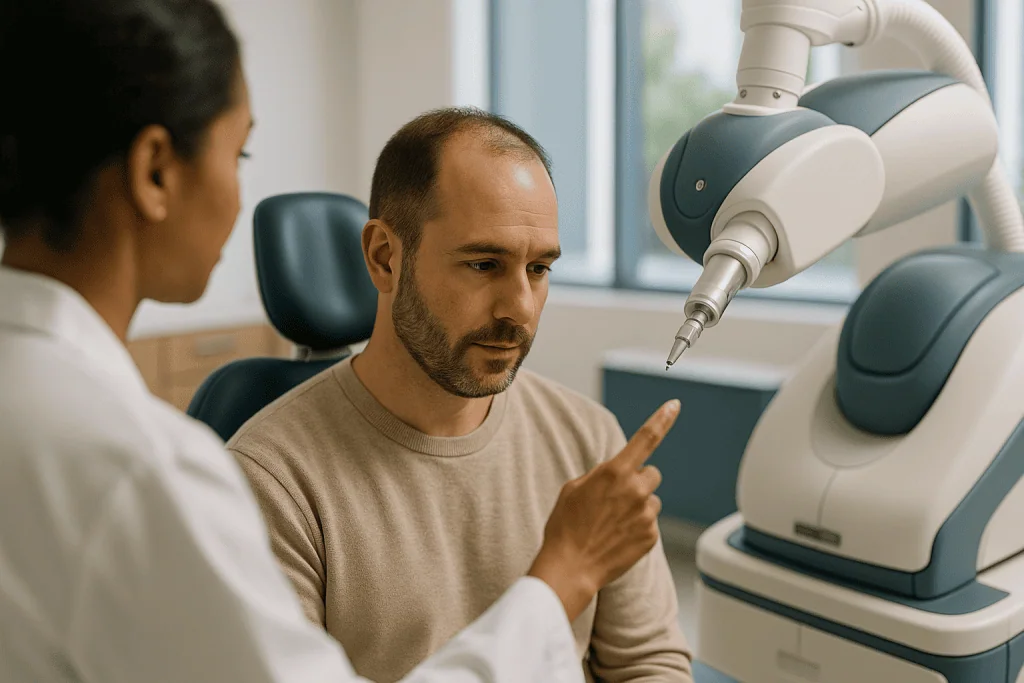
In many practices the surgeon designs the hairline, oversees or performs the harvest and creates the recipient sites, while trained technicians load and place the grafts. In others the surgeon places some or all of them personally. Neither model is inherently wrong, but you are entitled to know which one you are buying into, and the honest answer is rarely volunteered unless you ask.
Useful follow-up questions include how long each technician has been placing grafts, how many will work on you at once, whether the same people stay for the whole session, and who checks their work before you leave. Ask, too, how the team limits the time grafts spend outside the body. Follicles are living tissue; the longer they wait between harvest and placement, the more stress they experience. A team that can describe its handling protocol in plain terms, including holding temperature and how grafts are kept moist, has usually thought about it.
One more question worth raising: if the surgeon is not placing the grafts, is the surgeon physically present throughout, or supervising from another room? A good answer is specific. A vague answer is itself information.
Robotic FUE vs manual FUE: what the evidence actually shows
The marketing around robotic hair surgery can sound as if the machine itself produces better hair. The published evidence is narrower than that. Studies comparing robotic and manual FUE have mostly measured harvesting metrics: how many follicular units are collected per hour, how many are damaged (transected) by the punch, and how evenly the donor area is thinned. On those measures, robotic systems in experienced hands have generally performed within the range reported for skilled manual surgeons. That is a reasonable result, not a breakthrough.
Where the evidence runs thin is in what patients actually care about: how much hair grows, how natural it looks, and how satisfied people are a year or more later. Those outcomes depend on candidate selection, hairline design, graft handling and placement, none of which the robot controls. No major guideline body treats robotic harvesting as the preferred method; the NHS, Mayo Clinic and Cleveland Clinic describe hair transplantation in general terms without endorsing one harvesting tool over another.
Practical differences do exist. Robotic systems usually require the donor area to be shaved short so the camera can see individual units, which some patients would rather avoid. Current systems work best on straight or slightly wavy dark hair against lighter skin, because the imaging relies on contrast; tightly curled hair, which curves beneath the skin surface, can be harder for an automated punch to follow. A surgeon who knows the system well will tell you whether your hair type suits it.
The fair summary: robotic FUE is one legitimate way to harvest grafts, with consistency as its main theoretical strength. It does not replace surgical judgment, and it has not been shown to produce superior final results.
Who robotic hair surgery is usually for, and who is asked to wait
Hair transplantation of any kind works by redistribution, not creation. It suits people who have a stable, predictable pattern of loss and a donor area dense enough to cover the thinning zones without becoming visibly sparse itself. The most common candidate is an adult with hereditary pattern hair loss, which Mayo Clinic identifies as the leading cause of hair loss in both men and women.

Robotic harvesting adds its own selection filters. Because the camera needs to identify each follicular unit, the technique tends to be offered to people whose hair contrast and texture suit automated imaging, and who are comfortable shaving the donor area. People with very light or grey hair are sometimes asked to dye it temporarily before the session so the system can see it; that is a detail worth asking about in advance rather than discovering on the day.
Several groups are commonly asked to wait or to consider other options first. Young adults whose pattern has not yet declared itself risk a hairline that looks fine now and stranded later, as surrounding hair continues to recede. People with active, inflammatory or scarring forms of hair loss, such as some autoimmune conditions, may lose transplanted hair to the same process, so dermatologists usually want the disease controlled before anyone talks about surgery. Diffuse thinning that affects the donor area as well leaves little to move.
Medical factors matter too. Uncontrolled diabetes, bleeding disorders, certain blood thinners, heavy smoking and some skin conditions can affect healing and graft survival; MedlinePlus lists bleeding, infection and poor wound healing among the general risks of the procedure. A thorough preoperative review is a sign the team is thinking about you rather than the booking.
Why a medical workup should come before any cosmetic decision
It is tempting to treat a hair transplant as a purely cosmetic purchase, like choosing a haircut with permanent consequences. The scalp disagrees. Hair loss is sometimes the visible edge of something medical, and transplanting into a scalp that is still losing hair for an untreated reason can waste grafts and donor supply that cannot be replaced.
The NHS and Mayo Clinic both describe causes of hair loss beyond heredity: thyroid disorders, iron deficiency, significant weight loss or illness that triggers shedding months later, scalp infections, hormonal changes, and medicines used for conditions ranging from blood pressure to depression. A pattern that looks like hereditary thinning can occasionally be alopecia areata or a scarring alopecia, which behave differently and may continue to destroy follicles, including freshly moved ones.
A sensible preoperative pathway therefore includes a history of how the loss began and progressed, a look at the scalp under magnification, and, when the picture is unclear, blood tests or a small skin biopsy. Ask whether the person who assessed you is a physician who diagnoses hair disorders or a sales consultant who measures heads. Both roles exist in this field, and they are not interchangeable.
Ask, too, whether anyone has discussed medicine to slow further loss. Surgery moves hair; it does not stop the underlying process in the surrounding area. Many surgeons recommend that patients discuss long-term medical management with a dermatologist or their own doctor before surgery so that the transplanted frame is not left standing alone in five years. That conversation, including whether any medicine is appropriate for you, belongs with a prescribing clinician.
Questions to ask about robotic hair surgery: the team in the room
Think of the operating day as a relay. The baton passes from the surgeon who plans, to the robot that harvests, to the technicians who sort, to whoever creates recipient sites, to the people who place the grafts, and finally to whoever checks the result before the dressing goes on. Each handoff is a place where quality can be preserved or lost. The questions below map onto those handoffs.
On planning: who draws the hairline, and will that person be present on the day? Will you see and approve the design in a mirror before any anesthetic is given? How does the plan account for hair you are likely to lose in the next decade?
On harvesting: who operates the robot, and how many procedures have they performed with it? What transection rate does the team typically record, meaning the proportion of grafts damaged during extraction, and do they measure it on every case? Is the harvest plan limited to protect the appearance of the donor area?
On recipient sites: are they made by the surgeon, by a technician, or by the robot following the surgeon’s plan? Who checks angle and direction against your existing hair?
On placement: who places the grafts, how many people, for how long, and under what supervision? How are grafts stored while they wait, and how is total out-of-body time kept short?
On record-keeping: will you receive a written account of how many follicular units were harvested, how many hairs that represents, and how many were placed in each zone? That document is the baseline against which any future result can honestly be judged.
How are hair transplant results measured, and why that matters before you book
A result you cannot measure is a result you have to take on faith. Reputable teams measure in two ways: by counting what went in, and by documenting what came out.
Counting what went in starts with the harvest. The robot’s software logs each attempted extraction, and technicians sort the lifted grafts under magnification, recording how many contain one, two, three or four hairs. Multiplying gives a total hair count, which is a more honest figure than graft count alone because a thousand single-hair grafts cover far less than a thousand three-hair grafts. Ask for both numbers.
Documenting what came out relies on standardized photography: the same camera, lighting, distance, head position and hair length at each visit, so that changes reflect hair and not shadows. Some teams add trichoscopy, a magnified scalp photograph from a marked spot that allows hairs to be counted per square centimeter before surgery and again at follow-up. Others use digital density mapping. The method matters less than consistency; the question is whether they do it at all, and whether you will be shown your own images side by side.
Be wary of outcome promises expressed as percentages. Graft survival varies with handling, individual biology, scalp blood supply and what is counted as survival. MedlinePlus offers a general orientation that most people see around 60 percent of new growth by six to nine months, with the full picture taking longer, but no clinic can guarantee your figure in advance. What a good team can promise is that they will look, record what they see, and tell you honestly whether the result matched the plan.
Who does what on the day: a plain summary table
Roles vary between practices, and the point of the table is not to prescribe one model but to give you a checklist for finding out which model you are being offered. Fill in the right-hand column during your consultation; blanks are themselves worth asking about.
| Stage | Who typically does it | What to ask |
|---|---|---|
| Diagnosis and candidacy | Physician, ideally with hair-disorder experience | Was another cause of loss ruled out? Is my pattern stable? |
| Hairline and density design | Surgeon | Will I approve the design before anesthetic? How does it allow for future loss? |
| Donor harvesting | Robotic arm, operated and supervised by surgeon or trained operator | Who runs the robot? What transection rate do you record? |
| Graft sorting and storage | Technicians under magnification | How are grafts kept cool and moist? How long out of the body? |
| Recipient site creation | Surgeon, technician, or robot following surgeon’s plan | Who sets angle and direction? Who checks it? |
| Graft placement | Technicians and/or surgeon | How many placers, how experienced, who supervises in the room? |
| Results documentation | Surgeon or clinical team | Standardized photos? Hair counts? Follow-up at which intervals? |
Two patterns are worth noticing as you fill this in. First, the robot appears in only one or two rows; everything else is human. Second, the final row is the one most often left empty. A team that cannot describe how it checks its own results is asking you to be the only person who ever evaluates the outcome, and you are the least objective judge available.
What the first days and weeks after robotic hair surgery usually look like
The procedure itself is performed under local anesthetic, with most people awake and going home the same day, as the NHS describes. Expect a long sitting: several hours in a chair with breaks, while the harvesting, sorting and placement proceed in sequence.
The first week is about protecting the grafts. The recipient area develops small crusts around each graft, the donor area has hundreds of pinpoint wounds, and both can be tender. Swelling of the forehead is common for a few days and sometimes drifts down toward the eyes before settling. Cleveland Clinic and MedlinePlus both describe a recovery during which the scalp feels tight and sore, and the team will give specific instructions about sleeping position, washing, avoiding sweat and sun, and when hats are allowed. Following those instructions closely is one of the few parts of the outcome entirely in your hands.
Around the second to third week, something alarming and entirely normal happens: the transplanted hairs fall out. MedlinePlus notes that this shedding, sometimes called shock loss, is expected; the follicle beneath remains and enters a resting phase. Some existing hairs near the recipient sites may also shed temporarily. Patients who were not warned about this often panic and assume the surgery failed. Ask your team to describe it in advance so you recognize it.
Numbness or altered sensation in the donor or recipient area can linger for weeks and occasionally months. Itching is common as the scalp heals. Small pimples may appear as new hairs push through, sometimes trapped beneath the skin. Each of these is a reason to call the team for reassurance rather than a reason to despair, and the distinction between expected healing and genuine warning signs is covered later in this article.
Months three to twelve: the slow reveal and how follow-up should work
Hair grows about a centimeter a month, and newly placed follicles spend their first months resting before they begin. Cleveland Clinic describes new growth starting roughly three to four months after surgery, fine and sometimes lighter in color at first, then thickening. MedlinePlus frames the midpoint as six to nine months, when most people see the majority of their new growth, with maturation continuing beyond that.
This timeline shapes what sensible follow-up looks like. A single check at one week to inspect healing is the minimum. A visit or standardized photographs at around six months gives an early read on growth. A review at twelve months, with the same photographic setup used before surgery, is the honest point at which to compare plan with reality. Some teams extend to eighteen months for people with slower growth or longer hair.
What should happen at those visits? Someone should look at your scalp directly, not just the photos. The donor area should be checked for evenness and for any visible thinning or scarring. The recipient area should be assessed for density, direction and hairline naturalness. If trichoscopy or density mapping was done before surgery, it should be repeated at the same spots. You should be shown your own images side by side and asked what you think, and your view should be recorded.
Ask before you book how many follow-up visits are included, whether they are in person or remote, and what happens if growth is uneven. An area that grew less than planned can sometimes be addressed with a smaller second session, but that is a conversation for the twelve-month mark, not the third month, when the result is still largely invisible.
Risks and complications of robotic hair surgery, in plain language
Hair transplantation is a surgical procedure with a long safety record, but it is still surgery. MedlinePlus lists the general risks: bleeding, infection, pain, scarring, and the possibility that transplanted hair does not take. The NHS adds that results can look unnatural if grafts are poorly placed and that the procedure may not give the coverage a person hoped for.
Specific to FUE, including the robotic form, is the donor area. Each extraction leaves a tiny round scar. Individually invisible, they become noticeable if too many units are taken from one region, leaving a moth-eaten look when the hair is cut short. Robotic systems are designed to spread the harvest, but the limit on how much can safely be taken is a surgical judgment. Overharvesting is one of the most common long-term regrets in this field, partly because it cannot be undone.
In the recipient area, risks include folliculitis, meaning inflamed or infected hair follicles that look like pimples; small cysts where a graft was buried too deep; and grafts placed at angles that do not match surrounding hair. Prolonged numbness happens when small nerves are disturbed. Rarely, a patch of scalp loses blood supply and heals poorly.
Then there is the risk that is not a complication at all: continued loss of the hair that was never transplanted. Surgery does not alter the biology of the surrounding scalp. Without a plan for the native hair, the frame may remain while the picture inside it fades. This is why a candid surgeon spends as much time on what happens over the next decade as on what happens on the day. Ask them to.
Alternatives to surgery: what medicines and other options actually do
Surgery is not the only route, and for many people it is not the first one. Mayo Clinic describes two medicines with the strongest evidence for hereditary pattern hair loss. Topical minoxidil is applied to the scalp and appears to prolong the growth phase of the hair cycle and widen miniaturized follicles; Mayo notes that it typically needs at least six months of consistent use before any effect is visible and must be continued to maintain benefit. Oral finasteride, used in men, blocks the enzyme that converts testosterone into dihydrotestosterone, the hormone that shrinks genetically sensitive follicles; it, too, works over months rather than weeks. Whether either is appropriate for you, including any side effects relevant to your health, is a decision for a prescribing clinician.
Other approaches sit on weaker ground. Mayo Clinic describes low-level laser devices as having small studies suggesting improved density with a need for more research. Platelet-rich plasma injections and various supplements are widely advertised; Harvard Health notes that evidence for several newer treatments remains limited or mixed, and no major guideline currently establishes them as proven. A team that presents these as reliable add-ons is presenting hope as evidence.
Non-medical options deserve a mention without embarrassment. Camouflage products, hairpieces and a shorter haircut change appearance immediately, reversibly and without donor-area consequences. Scalp micropigmentation, a form of cosmetic tattooing, creates the look of short stubble.
The point of listing these is not to steer anyone away from surgery. It is that a team confident in its surgical results will discuss alternatives freely, because informed patients tend to be satisfied patients. If alternatives are waved away, ask why.
What people often get wrong about robotic hair surgery
The first misunderstanding is that the robot performs the operation. It performs the harvest, and in some systems makes recipient sites. Sorting, storing and placing grafts remain human tasks, and they occupy most of the day.
The second is that “robotic” means better results. The evidence supports consistency in harvesting, not superior growth or appearance. Final outcome depends on candidate selection, design, handling and placement, which the robot does not control.
The third is that the hair that grows is new. It is your own hair, moved. The donor supply is finite; what is taken from the back cannot be taken again, so planning across a lifetime matters more than filling a hairline today.
The fourth is that transplanted hair falling out at two or three weeks means failure. MedlinePlus describes this shedding as an expected phase; the follicle rests and regrows over the following months.
The fifth is that results can be judged at three months. At that point most follicles are only beginning to produce fine hair. Twelve months is the fairer checkpoint.
The sixth is that surgery stops hair loss. It does not. Surrounding native hair continues on its genetic course unless managed medically, which is why the long-term plan is as important as the procedure.
The seventh is that a high graft count is the goal. Quality of placement, hair count per graft and donor preservation matter more than a large number on an invoice. A team proud of placing more grafts than anyone else may simply be taking more than it should.
The eighth, and quietest, is that asking detailed questions is rude. It is not. It is the single most reliable way to tell a careful team from a confident one.
Robotic hair transplant questions to ask your care team before you decide
The best questions are specific, answerable and about process rather than promise. “Will it look natural?” invites reassurance. “Who sets the angle of each recipient site, and who checks it?” invites information. Below are questions that reliably reveal how a team actually works.
- Who diagnosed my hair loss, and has any other cause been ruled out?
- Is my pattern stable enough to plan around, and what will the surrounding hair look like in ten years?
- Who draws my hairline, and will I approve it in a mirror before anesthetic?
- Who operates the robot, how many cases have they done with it, and what transection rate do you record?
- Does the robot create my recipient sites, or does a person? Who checks angle and direction?
- Who places my grafts, how many people, how experienced, and is the surgeon in the room throughout?
- How are grafts stored and how long do they typically spend outside the body?
- Will I receive a written record of grafts harvested, hairs counted and grafts placed by zone?
- How do you document results: standardized photographs, hair counts, both? Will I see my own images side by side?
- What follow-up is included, at which intervals, and who conducts it?
- What is your plan for my native hair, and should I speak to a dermatologist about medical management first?
- What would make you decline to operate on me?
That last question is often the most telling. A surgeon who can describe the patients they turn away has a standard. One who cannot may not. Write the answers down, take them home, and compare them against a second opinion if you can. The decision is yours and your treating team’s, and good questions are how you make it together rather than on trust alone.
When to call your doctor after robotic hair surgery
Most recovery symptoms are expected and settle on their own: tightness, mild soreness, crusting around grafts, forehead swelling in the first days, itching, and the shedding of transplanted hairs around the second to third week. Your team should tell you what to expect and how to reach them out of hours. Use that number without hesitation if something feels wrong; a quick call that turns out to be nothing is far better than a delayed one.
Contact your surgical team the same day if you notice bleeding that does not stop with gentle pressure after several minutes; spreading redness, warmth or swelling around the donor or recipient area; pus or a foul-smelling discharge; pain that worsens rather than eases after the first few days or is not relieved by the measures your team recommended; a fever or feeling generally unwell with chills; or a patch of scalp that turns dark, dusky or unusually pale, which can signal compromised blood supply. Many small pimples appearing together across the recipient area, especially if painful, also warrant a look, because folliculitis is treatable and better managed early.
Seek emergency care immediately for signs of a severe allergic reaction, such as swelling of the lips, tongue or throat, difficulty breathing, or widespread hives, and for any sudden chest pain, severe breathlessness, or symptoms suggesting a clot or heart problem, which are rare but possible after any procedure involving several hours of sitting.
Beyond the acute period, ask for an earlier review if the donor area looks patchy once hair regrows, if growth in the recipient area is markedly uneven beyond nine to twelve months, or if you develop new, rapid hair loss elsewhere, which may point to a condition needing its own diagnosis. Your treating team is the right place for every one of these conversations, and no article replaces them.
Frequently asked questions
Who actually places the grafts in a robotic hair transplant?
In nearly all robotic hair transplants, people place the grafts, not the robot. The robotic arm harvests follicular units from the donor area and, in some systems, creates recipient sites. Trained technicians, the surgeon, or both then insert each graft by hand using forceps or implanter pens. Ask how many placers will work on you, how experienced they are, and whether the surgeon stays in the room throughout.
How are hair transplant results measured after surgery?
Careful teams measure results by counting what went in and photographing what came out. Harvest records show how many grafts and total hairs were moved. Standardized photographs, taken with identical lighting, distance and head position before surgery and at follow-up, show change objectively. Some practices add magnified scalp hair counts from marked spots. Ask which methods your team uses and whether you will see your own comparison images.
Robotic FUE vs manual FUE: which gives better results?
Neither has been shown to give better final results. Studies comparing robotic and manual FUE mainly report harvesting measures such as speed and the proportion of grafts damaged during extraction, where experienced robotic use performs within the range of skilled manual surgeons. Growth and appearance depend on candidate selection, design, handling and placement, which the robot does not control. Major sources such as the NHS and Mayo Clinic do not favor either tool.
How can I ask better questions before robotic hair surgery?
Ask about process rather than promise. Questions beginning with who, how many and how often tend to produce information, while questions like “will it look natural?” tend to produce reassurance. Write your questions down beforehand, record the answers, and ask for specifics whenever a reply is vague. Comparing answers from two consultations is one of the simplest ways to spot which team has genuinely thought about each stage.
What makes a good question for a hair transplant surgeon?
A good question is specific, answerable and reveals something about how the team works. “Who sets the angle of each recipient site and who checks it?” is good because it has a factual answer. “What transection rate do you record?” is good because it tests whether they measure at all. “What would make you decline to operate on me?” is good because it reveals whether the practice has standards it applies to itself.
What are the different types of questions I should ask about robotic hair surgery?
Think in four groups. Diagnostic questions check whether another cause of hair loss has been ruled out and whether your pattern is stable. Team questions ask who performs each stage, from design to placement. Process questions cover graft storage, out-of-body time and transection rate. Outcome questions ask how results are documented, when follow-up happens, and what the long-term plan is for the hair that was not transplanted.
Is it normal for transplanted hair to fall out after a few weeks?
Yes. MedlinePlus describes shedding of transplanted hairs around two to three weeks after surgery as an expected phase, sometimes called shock loss. The follicle beneath survives and rests before producing new hair, typically starting around three to four months according to Cleveland Clinic. Some nearby native hairs may also shed temporarily. If you were not warned about this, call your team for reassurance rather than assuming the procedure failed.
Does a hair transplant stop hair loss?
No. A transplant moves existing follicles from a resistant donor area into thinning zones; it does not change the biology of the surrounding native hair, which continues on its genetic course. That is why many surgeons encourage patients to discuss long-term medical management with a dermatologist or prescribing clinician before surgery. Without a plan for native hair, a transplanted hairline can be left standing while the hair behind it thins.
Who is usually asked to wait before having robotic hair surgery?
Young adults whose pattern of loss has not yet stabilized, people with active inflammatory or scarring hair disorders, and those with diffuse thinning that affects the donor area are commonly asked to wait or consider alternatives. Medical factors such as uncontrolled diabetes, bleeding disorders or certain medicines can also delay surgery. Robotic systems additionally work best with hair that photographs clearly against the scalp, so hair color and texture may affect suitability.
What follow-up should a hair transplant clinic offer?
At minimum, a check within the first week to inspect healing, a review or standardized photographs at around six months, and a twelve-month assessment that compares the same photographic views taken before surgery. Some teams extend follow-up to eighteen months. Each visit should include direct examination of the donor and recipient areas, repeat hair counts if they were done before surgery, and an honest discussion of whether the result matched the plan.
References
This article is for general information only and is not a substitute for professional medical advice. Please consult a qualified doctor about your individual situation.

More from the Blog
Why the Cause of Hair Loss Sets the Plan: Tests Before Non-Surgical Hair Restoration
Before non-surgical hair restoration, clinicians usually confirm the cause first: a history and scalp examination, a gentle pull test, magnified scalp imaging (trichoscopy), and…
Who Is a Candidate for Laser Hair Therapy? Early Thinning vs Long-Standing Bald Areas
A laser hair therapy candidate is usually an adult with early to moderate hereditary (pattern) thinning, where follicles have shrunk but are still alive,…
How Scalp Micropigmentation Is Done: Pigment Dots, Session Spacing and Matching Your Hair Shade
Scalp micropigmentation is a cosmetic tattooing technique in which a trained practitioner deposits thousands of tiny pigment dots into the upper layer of the…
Hair Transplant Repair for International Patients: Photo Review, Staged Sessions and Follow-Up
Hair transplant repair for international patients usually begins with a remote photo review, followed by an in-person examination that checks the donor area, scar…
Hair Transplants for a Receding Hairline: Timing, Design and Realistic Density
A hair transplant can restore a receding hairline by moving follicles from the back of the scalp, where hair is genetically resistant to balding,…

Norwood 5: Planning Coverage When the Bridge Is Going
Norwood 5 describes advanced male pattern hair loss in which the band of hair separating the receded hairline from the thinning crown, the so-called…