

Questions to Ask Before Strabismus Surgery: Glasses First, Injections and What Surgery Adds

Key Takeaways
- Glasses can fully straighten an inward turn caused by focusing effort in long-sighted children, which is why a prescription usually comes before any talk of surgery.
- Eye muscle surgery changes where the eyes rest but does not improve sight in either eye, so glasses and amblyopia treatment are often still needed afterward.
- Botulinum toxin injection weakens one muscle for around three months, and in some people that window is enough for the brain to hold the eyes straight after the effect fades.
- The most common disappointment after strabismus surgery is under- or over-correction rather than harm to vision, and further surgery is sometimes needed.
- Adjustable sutures let a surgeon fine-tune alignment while an adult is awake, but they are not suitable for young children.
- A squint that persists beyond about three months of age in a baby, or appears new in an adult with double vision, should be assessed promptly rather than watched.
Before agreeing to strabismus surgery, ask why non-surgical steps such as glasses, patching, prisms or botulinum toxin injections are or are not enough for you, what the operation changes and cannot change, how alignment is planned and adjusted, what recovery and second procedures might involve, and which warning signs need urgent review. Your treating eye team should answer each point before you decide.
The clinic corridor smells faintly of hand sanitizer, and a mother is turning a pair of tiny pink glasses over in her hands. Her daughter, four, has worn them for eight months. One eye still drifts inward when she is tired. The orthoptist has just used the word surgery, and the mother’s first reaction is not fear exactly, more a scramble: what should I be asking right now?
That scramble is familiar to adults too. A man in his fifties whose eyes stopped working together after a small stroke, a teenager whose outward drift has become the thing she notices in every photograph. The questions to ask about strabismus surgery are surprisingly similar across all of them, and most of the good ones are about what comes before the operation rather than the operation itself.
This explainer walks through those questions in the order a careful clinician would: what glasses can do, where injections fit, what surgery adds, and how to tell a normal recovery from one that needs a phone call.
Why questions to ask about strabismus surgery should start with the eyes, not the operating room
Strabismus is the medical name for a squint: the two eyes do not point at the same place at the same time. One eye may turn in, out, up or down, constantly or only sometimes. It is common in young children and can also appear for the first time in adulthood after injury, thyroid eye disease, stroke or nerve problems.
The temptation, once surgery is mentioned, is to fixate on the procedure: who does it, how long it takes, what the scar looks like. Those matter, but the more useful early questions are diagnostic. What kind of strabismus is this? Is the drift constant or intermittent? Is it linked to focusing effort, so that glasses might straighten it? Does the brain still use both eyes together, or has it learned to ignore one?
The answers shape everything downstream. A child whose inward turn disappears behind the right lenses may never need an operation. An adult with double vision from a weak nerve may be offered a temporary injection before anyone talks about muscles and sutures. Surgery adds something specific: it physically changes where the eyes rest. It does not change how well each eye sees, and it cannot on its own teach a brain that has switched one eye off to switch it back on.
Holding that distinction in mind turns a frightening word into a set of practical questions. What are we trying to achieve, cosmetic alignment, comfortable single vision, or both? What has already been tried? What would happen if we waited three months? A good care team welcomes these questions, because they are the same ones the team is asking itself.
What is strabismus and why does it matter beyond appearance?
Six small muscles attach to the outside of each eyeball and pull it in different directions, the way reins steer a horse. Alignment depends on those muscles receiving matched signals from the brain and on both eyes having a reason to lock onto the same target. When either side of that arrangement fails, one eye wanders.

In children the stakes are developmental. A young brain that receives two mismatched pictures does not tolerate the confusion for long. It suppresses the image from the wandering eye, and if that suppression continues through the years when vision is still being wired, the ignored eye can lose sharpness permanently. This is amblyopia, often called lazy eye: reduced vision in an eye that is structurally healthy because the brain stopped using it. The National Eye Institute describes amblyopia as the most common cause of vision loss in children and notes that treatment works best when started early in childhood, which is why pediatric eye teams move quickly on a new squint.
Children also risk losing binocular vision, the ability to fuse two slightly different pictures into one three-dimensional view. Depth perception, catching a ball, judging a kerb: these are easier with two cooperating eyes.
Adults have a different problem. Their visual system is mature, so a new misalignment usually produces diplopia, or double vision, rather than suppression. Reading becomes exhausting, driving feels unsafe, and many people tilt or turn the head to find the one position where the images merge. Social effects are real as well; eye contact is how humans signal attention, and a visibly turned eye can make conversation awkward for both parties.
So the question is rarely whether strabismus matters. It is which of these consequences applies to you, and which treatment addresses it.
Glasses first: why lenses are often the first strabismus treatment
Ask a pediatric ophthalmologist why the first appointment ends with a prescription rather than a surgery date, and the answer usually involves focusing effort. Many children are long-sighted. To see clearly up close, their eyes have to work hard to focus, and that focusing effort is neurologically linked to the eyes turning inward. In some children the link is too strong, and the eyes cross whenever they concentrate. This pattern is called accommodative esotropia: an inward turn driven by focusing.
Glasses that correct the long-sightedness remove the extra effort, and the eyes can straighten on their own. The NHS lists glasses as a first-line treatment for squint precisely because, in this group, they address the cause rather than the symptom. A child whose eyes are straight in glasses and turn only when the glasses come off is not a failure of treatment; that is the treatment working.
Questions worth asking at this stage include: what refraction did you find, and how confident are you in it? In young children the measurement is often taken after dilating drops relax the focusing muscle, so the full prescription can be revealed. Does the turn disappear completely in the glasses, or only partly? A residual turn that persists even with the right lenses is one of the more common reasons surgery is later discussed.
Adults should ask the same question in a different form. An uncorrected prescription, a change in prescription, or a mismatch between the two eyes can all unmask a latent squint that had been controlled for decades. Sorting the lenses out first is not delay; it is measurement. Surgeons plan how far to move a muscle based on the angle of the turn, and that angle is only meaningful once the optical picture is stable.
Patching, prisms and eye exercises: what else comes before surgery?
Three other non-surgical tools appear regularly in strabismus care, and each is often misunderstood.
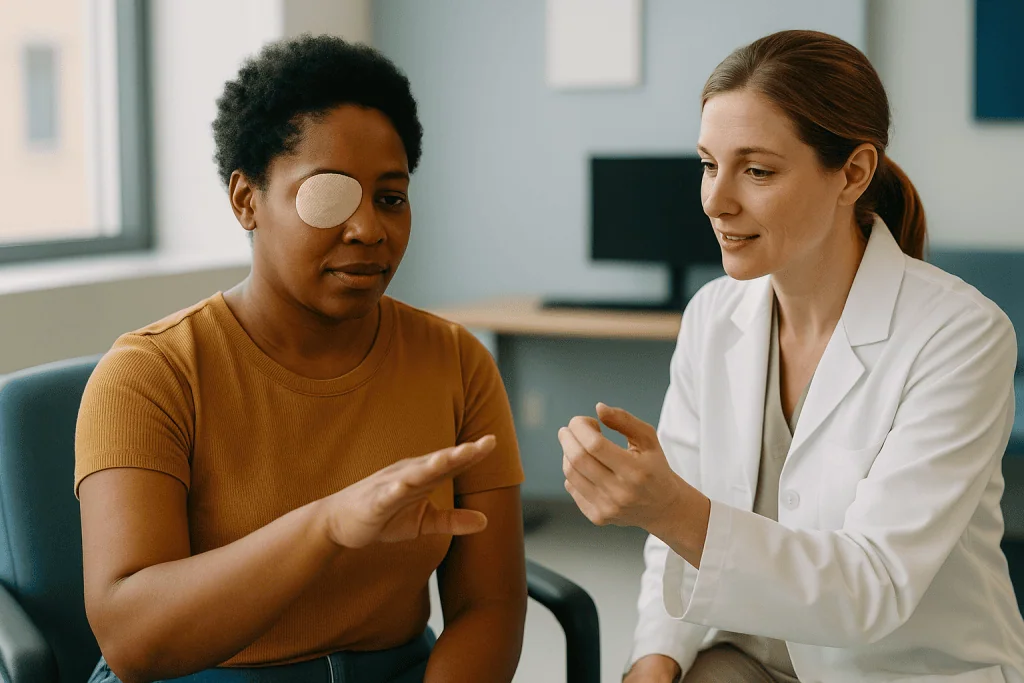
Patching treats amblyopia, not the squint itself. Covering the stronger eye for set periods forces the brain to use the weaker one, rebuilding the neural connections that suppression has weakened. The Mayo Clinic describes patching and blurring drops as standard ways of encouraging the weaker eye to work. It is common for a child to complete a course of patching before surgery so that both eyes have the best possible vision when they are finally aligned. Parents sometimes hope patching will straighten the eye. Occasionally an intermittent squint improves as vision improves, but that is not its purpose, and a good team will say so.
Prisms are wedge-shaped lenses, either ground into glasses or applied as a thin plastic film, that bend light so the brain receives a single image despite the misalignment. They do not move the eye; they move the picture. Prisms are particularly useful for adults with small angles of double vision, or as a temporary measure while a nerve palsy is expected to recover on its own. Ask whether a prism trial makes sense before committing to anything permanent.
Eye exercises, sometimes called orthoptic exercises or vision therapy, have a narrow evidence base. The NHS notes they can help some people with certain types of squint, mainly those with a weakness in converging the eyes for near tasks. They are not effective for large constant turns, and no exercise program can lengthen or shorten a muscle. If someone promises to fix a constant childhood squint with exercises alone, that promise runs ahead of the evidence.
The fair summary: these tools set the stage. They protect vision and buy time, and in some people they are all that is needed. When the eyes still do not meet, the conversation moves on.
Botulinum toxin for strabismus: how the injection works and how long it lasts
Botulinum toxin is a purified protein that temporarily blocks the signal between a nerve and a muscle, weakening that muscle for a limited time. In strabismus care it is injected, usually under a brief anesthetic in children and with numbing drops in many adults, into one of the muscles pulling the eye in the wrong direction. With that muscle relaxed, its opposite number gains the upper hand and the eye drifts toward the center.
Two features define the injection. First, it is reversible. The NHS notes that the effect wears off after around three months. Second, it is not necessarily temporary in its results. In some people, especially when the brain still has the capacity to fuse images, three months of straighter alignment is enough for the visual system to relearn cooperation and hold the eyes in place after the drug has gone. In others the turn returns and the injection is repeated or surgery follows.
Where does it fit? Clinicians often consider it for smaller angles, for a recent nerve palsy where the underlying weakness may recover and a permanent operation would be premature, for adults who want to test how single vision feels before committing, and for some infants as an early intervention. It can also be used alongside surgery to fine-tune a result.
The trade-offs are worth asking about directly. Because the toxin spreads a little, the neighboring muscle that lifts the eyelid can be weakened, producing a temporary droop called ptosis. The eye can overcorrect and turn the other way for a while. Double vision can worsen before it improves. None of these is dangerous in the usual sense, but they are disruptive, and anyone taking a driving test or presenting at work next month deserves to know.
Decisions about whether injection is appropriate, and how many times it might be repeated, sit with the treating team, who weigh the angle, the cause and the person’s goals.
How does strabismus surgery actually work?
Eye muscle surgery does not touch the eyeball’s interior. The surgeon works on the outside, on the muscles and their attachments, through a small opening in the conjunctiva, the thin transparent membrane covering the white of the eye. There is no skin incision and no visible scar in the usual sense, though the white may look red for a while.
Two basic maneuvers do most of the work. A recession weakens a muscle by detaching it from its original insertion and reattaching it slightly further back on the eyeball, so it pulls with less leverage. A resection strengthens a muscle by removing a short segment and reattaching the shortened muscle to the same spot, so it pulls tighter. An eye turning inward, for example, might be treated by recessing the inner muscle, resecting the outer one, or both. The surgeon calculates how many millimeters to move each muscle from the measured angle of the turn, using tables built from long clinical experience.
MedlinePlus describes the procedure as usually performed under general anesthesia in children, meaning the child is fully asleep, while adults may have a general or a local anesthetic with sedation. The NHS notes the operation usually takes less than an hour and most people go home the same day.
Adults are sometimes offered adjustable sutures. The muscle is reattached with a knot that can be loosened or tightened once the person is awake, typically the same day or the next morning, while they look at a target and report what they see. This allows a small correction to the initial result. It is not suitable for young children, who cannot cooperate with the adjustment.
Which eye is operated on can surprise people. Surgeons sometimes work on the straight-looking eye, or on both, because alignment is a relationship between two eyes rather than a fault in one. Asking why a particular muscle plan was chosen is entirely reasonable.
Who is strabismus surgery usually for, and who is usually asked to wait?
Surgery tends to be offered when a misalignment is constant or frequent, is not corrected by the right glasses, and is either threatening binocular development in a child or causing double vision, head posture problems or significant distress in an adult. Cleveland Clinic frames the goals as improving alignment, restoring the chance of the eyes working together and relieving symptoms; appearance is a legitimate goal too, and adults should not feel they need to hide that reason.
Timing in children is a genuine judgment call. For infants with a large constant inward turn present from the first months, many teams favor operating early to give the developing brain a window to learn fusion. For intermittent outward turns that a child can control much of the time, teams often watch, treat any amblyopia, and operate only if control deteriorates. Families are sometimes frustrated by waiting, but the reasoning is sound: an intermittent squint may be better managed than an overcorrected one.
Who is asked to wait? Anyone whose prescription has just changed, because the angle needs to be measured in stable glasses. Anyone whose squint is new and linked to a nerve palsy, thyroid eye disease or a recent neurological event, because the turn may still be evolving and a permanent operation on a moving target invites a second one. Anyone with active amblyopia treatment under way, because aligning eyes of very unequal vision may not deliver the binocular benefit hoped for. Anyone with uncontrolled medical conditions that make anesthesia riskier.
Strabismus surgery in adults deserves its own word. There is a persistent idea that adult squints are cosmetic only and not worth treating. Mainstream sources including Cleveland Clinic and Johns Hopkins are clear that adults can benefit both functionally and socially, and that age itself is not a barrier. What changes with age is the expectation: an adult brain that has suppressed one eye for fifty years may gain straight-looking eyes without gaining depth perception. Knowing which outcome is realistic for you is one of the core questions to ask.
Glasses, injections or surgery: how the options compare
Lining the options up side by side helps clarify what each one can and cannot do. Notice that they are rarely rivals. Most people who have surgery have already worn glasses, and many who have injections later have surgery or vice versa. The table summarizes mainstream guidance from the NHS, MedlinePlus and Cleveland Clinic; individual plans vary, and the treating team decides which path fits a particular eye.
| Option | What it changes | Best suited to | Main limitations | Reversible? |
|---|---|---|---|---|
| Glasses | Removes focusing effort or corrects unequal vision so the eyes can align on their own | Long-sighted children with an inward turn linked to focusing; adults with uncorrected refractive error | Does nothing for turns not driven by focusing; eyes may still drift without the glasses | Yes |
| Patching | Improves vision in the weaker eye | Children with amblyopia, before or after alignment | Does not straighten the eyes; needs consistent daily use | Yes |
| Prisms | Bends light so the brain sees one image despite the turn | Adults with smaller angles of double vision; temporary use during nerve recovery | Eye position unchanged; thick prisms blur and distort | Yes |
| Botulinum toxin injection | Temporarily weakens one muscle so the eye recenters | Smaller angles, evolving nerve palsies, trial of single vision, some infants | Effect wears off after around three months (NHS); possible temporary eyelid droop or overcorrection | Wears off |
| Muscle surgery | Permanently repositions or shortens muscles to change resting alignment | Constant or frequent turns not corrected by glasses; double vision or head posture problems | Does not improve sight in either eye; may need a second procedure; anesthesia required | No, though adjustments and further surgery are possible |
One column deserves a second look: what each option changes. Only glasses and patching act on vision itself. Injection and surgery act on position. That single distinction resolves a large share of misunderstandings about why a child still needs glasses after an operation, or why an adult’s straightened eyes have not restored three-dimensional sight.
How painful is strabismus surgery?
Most people are relieved by the honest answer. The operation itself is not felt: children are asleep under general anesthesia, and adults are either asleep or numbed and sedated. Afterward, MedlinePlus and the NHS describe the eye as sore, red and gritty rather than sharply painful, and the discomfort is generally managed with the simple pain relief your team recommends. Which product and how much is a decision for the prescribing clinician, not for a magazine article.
The character of the soreness surprises some adults. It is often described as a pulling or foreign-body sensation, like an eyelash that will not shift, made worse by moving the eye to the extremes of gaze. A dull ache around the eye and a mild headache are common in the first day or two. Bright light can be uncomfortable, so sunglasses help outdoors. Some people notice a small amount of blood-tinged tear fluid on the pillow the first night; the NHS lists this as expected.
Children frequently look worse than they feel. A vividly red eye on a three-year-old who is cheerfully eating breakfast is a common sight on the morning after surgery. Nausea from the anesthetic is a more frequent complaint than eye pain in this age group, and pediatric anesthetists plan for it.
Adults who have adjustable sutures should ask what the adjustment feels like. Numbing drops are used, and the sensation is usually described as pressure and pulling rather than pain, but it is an odd experience to have someone reposition your eye while you are awake, and knowing in advance helps.
Two things are not normal and belong in the red-flag category discussed later: pain that steadily worsens rather than eases after the first day, and pain accompanied by a sudden drop in vision. Those warrant a same-day call.
What can go wrong with strabismus surgery? The risks in plain language
Any informed decision needs the downside laid out without drama. MedlinePlus describes eye muscle repair as generally safe, and the serious complications are uncommon. Here is what the consent conversation should cover.
The most frequent disappointment is not a complication at all in the surgical sense: the alignment is not quite right. The eyes may remain slightly turned, or swing past straight into an overcorrection. Muscle surgery is planned from measurements of a living, changing system, and MedlinePlus notes that further surgery is sometimes needed. Asking your team how they would approach a residual or reversed turn, and what proportion of their patients in your category have needed a second operation, is fair and useful. Be wary of anyone who says it never happens.
Double vision after surgery is common in the early days as the brain adapts to a new eye position. In adults with a long-standing turn it can occasionally persist, because the brain had learned to suppress one image in the old position and must learn again in the new one. Prisms or further adjustment may be needed.
Infection of the surface tissues is rare and usually responds to treatment; infection inside the eye is very rare but serious. Bleeding, scarring of the conjunctiva that leaves a small pink patch, a lumpy or visible suture, and a slipped or lost muscle that needs re-exploration are all recognized surgical risks. Perforation of the eyeball wall by the needle during suturing is uncommon but described, which is why surgeons check the retina during the operation.
General anesthesia carries its own small risks, discussed separately by the anesthetist. Children and adults with heart, breathing or neuromuscular conditions should raise these early.
Strabismus surgery risks are, in the aggregate, mostly about imperfect results rather than harm to vision. That framing is not meant to reassure; it is meant to focus your questions where the real uncertainty lies.
Strabismus surgery recovery time: what the following days and weeks usually look like
Recovery from eye muscle surgery is short compared with many operations, but it has a rhythm worth knowing.
The first day is about rest and reassurance. Most people go home within hours, according to the NHS, with the eye red, watery and swollen. Vision is blurry from lubricant drops and the anesthetic. Children are often drowsy and clingy; adults are advised not to drive and to have someone with them. Drops or ointment to reduce inflammation and prevent infection are usually prescribed; how often and for how long is set by the surgical team and printed on your discharge sheet.
Days two to seven bring gradual improvement. Soreness eases, the eyelid swelling settles, and the redness begins to fade from the edges inward. MedlinePlus notes that children can typically return to normal daily activities within a few days, though school and nursery often ask for a short absence while the eye is weepy. Adults with desk jobs often return within the first week; those doing dusty or physical work usually wait longer on their surgeon’s advice. Double vision, if present, often improves during this window as the brain adapts.
The redness itself lingers. The NHS describes it as lasting several weeks, and adults are sometimes surprised that a pink eye is still visible at a wedding three weeks later. The final alignment is also not judged in the first days; swelling and healing muscles need time to settle before the team assesses whether the target was reached.
Do’s and don’ts after strabismus surgery are broadly consistent across sources:
- Do use the prescribed drops exactly as instructed and finish the course.
- Do wash hands before touching the face; a clean flannel is fine for wiping crusting from closed lids.
- Do wear sunglasses outdoors and keep follow-up appointments, where alignment and healing are checked.
- Don’t rub the eye, however itchy; healing sutures dislike friction.
- Don’t swim or use hot tubs until cleared by the surgeon, typically a matter of weeks per NHS guidance, because pool water carries infection risk.
- Don’t let shampoo, soap or makeup into the eye during the early healing period.
- Don’t drive until vision is clear, any double vision has resolved and your team agrees.
Is strabismus surgery worth the risk? An honest way to weigh it
Nobody can answer this for another person, but there is a structured way to think about it.
Start by naming the problem precisely. Is it double vision that makes reading impossible? A head tilt causing neck pain? A child’s brain at risk of never learning binocular vision? Discomfort with eye contact that has shaped career choices? Each of these is a legitimate reason, and each has a different likelihood of being helped by realignment. Double vision in a recent nerve palsy may resolve on its own, which changes the calculus. A constant infant squint has a developmental window that will not reopen, which changes it the other way.
Then ask what the realistic best case is for your category. For a child with intact vision in both eyes, the best case is straight eyes and a real chance of stereopsis, the technical term for three-dimensional depth perception from two eyes. For an adult with lifelong suppression, the best case is straight eyes, a wider useful field of view and easier social interaction, but probably not new depth perception. Cleveland Clinic and Johns Hopkins both note that adults gain functional as well as cosmetic benefit, and that is true, but the shape of the benefit varies.
Set that against the downside, which for most people is the possibility of an imperfect result and a second operation rather than harm. Weigh the anesthetic risk in light of your general health. Consider the alternative of doing nothing: an intermittent squint may stay stable for decades; a constant one in a young child will not sort itself out.
Finally, ask about your team’s approach if the first result falls short. A team that discusses reoperation openly is a team planning for reality. The decision then belongs to you and them together, and it is entirely acceptable to take it home and come back.
What people often get wrong about strabismus surgery
Some myths circulate so widely that they deserve individual correction.
Children will grow out of it. True squints, meaning the eyes are genuinely misaligned rather than appearing so because of a wide nasal bridge in a baby, do not resolve with growth. The NHS advises that a squint persisting beyond about three months of age should be assessed. Waiting for a child to outgrow a constant turn risks amblyopia that is far harder to treat later.
Surgery fixes the vision. It does not. MedlinePlus is explicit that eye muscle repair does not improve poor vision in a weak eye. Glasses are usually still needed afterward, and any amblyopia still needs its own treatment. Alignment and acuity are different problems with different tools.
The surgeon removes the eye to operate. This one persists in playgrounds and online forums. The eye stays exactly where it is; the surgeon works on muscles at its surface through the conjunctiva.
One operation, straight eyes for life. Sometimes, but not reliably. Alignment can drift years later as the visual system, the prescription and the muscles change. MedlinePlus notes that more than one procedure is sometimes needed. Thinking of surgery as a strong intervention within a long-term relationship with an eye team is more accurate than thinking of it as a single fix.
Adult squints are purely cosmetic and not worth treating. Adults gain functional benefits including relief of double vision, a wider field of view and easier communication, and both Cleveland Clinic and Johns Hopkins describe adult surgery as a routine, worthwhile option.
Exercises can replace surgery. For a narrow group with convergence weakness, exercises help. For constant turns and large angles, no exercise changes muscle length. Anyone selling a program that claims otherwise should be asked for their evidence.
Injections are a lesser treatment. Botulinum toxin is a different tool, not a weaker one, suited to different situations and sometimes producing lasting alignment on its own.
Questions to ask about strabismus surgery: a list for your care team
Take these to your appointment, and do not be embarrassed to read from the page. Clinicians generally prefer a prepared patient to a silent one who calls the next day.
About the diagnosis and alternatives:
- What type of strabismus is this, and what do you think is causing it?
- Has the prescription been fully checked, and does the turn change with glasses on and off?
- Is there amblyopia, and should it be treated before alignment is addressed?
- Would prisms or a botulinum toxin injection be reasonable to try first, and why or why not in my case?
- What is likely to happen if we wait three or six months?
About the operation:
- Which muscles do you plan to operate on, on which eye, and why that plan?
- Will adjustable sutures be used, and what does adjustment involve?
- What type of anesthesia, and who will I speak to about its risks?
- How will you know during surgery whether the alignment is on target?
About outcomes and risks:
- What is the realistic best result for someone in my category: straight eyes, single vision, depth perception, or some of these?
- How often do people with my kind of turn need a second procedure, and how would you approach that?
- What are the specific risks in my case, given my age and health?
- Will I still need glasses afterward?
About recovery:
- What will the eye look and feel like on day one, day seven and week four?
- When can I or my child return to school, work, driving, swimming and sport?
- Which symptoms should prompt an urgent call, and what number do I ring out of hours?
- When is the first follow-up, and when will the alignment be finally assessed?
Write the answers down or ask permission to record them. Under stress, most people retain only a fraction of what is said in a consultation, and the details of drop schedules and warning signs are exactly the parts that matter most later.
When to call your doctor after strabismus surgery or injection
Redness, watering, grittiness and mild ache are expected in the first days after eye muscle surgery, and a temporary eyelid droop or overcorrection can follow a botulinum toxin injection. The signs below are different. They suggest infection, bleeding, a problem with a muscle attachment or a reaction to anesthesia, and they need same-day contact with your surgical team or emergency care if the team cannot be reached.
- Pain that steadily worsens after the first day or two instead of easing, or pain that is severe and not relieved by the pain relief your team advised.
- A sudden or progressive drop in vision in either eye, beyond the mild blur from drops.
- Increasing redness, swelling or heat around the eye, or eyelids so swollen the eye will not open.
- Thick yellow or green discharge, as opposed to clear or slightly blood-tinged watering.
- New or worsening double vision several days after surgery when it had been improving, or an eye that suddenly cannot move in one direction, which can signal a slipped muscle.
- Fever, persistent vomiting, difficulty breathing or unusual drowsiness in a child in the hours after general anesthesia.
- A flash of light, a curtain across part of the vision, or a shower of new floaters, which are retinal warning signs.
- Any symptom that frightens you and that your discharge sheet does not describe.
Before surgery, separate red flags apply to a squint itself. A new misalignment in an adult, particularly with double vision, headache, drooping eyelid, unequal pupils, weakness, numbness or difficulty speaking, can indicate a stroke, aneurysm or nerve compression and should be treated as an emergency. A new squint in a child alongside a white reflection in the pupil on photographs, a bulging eye or a head that is held persistently tilted also needs prompt review. The NHS advises that a squint in a baby that persists beyond about three months of age, or that appears at any later age, should be checked rather than watched. In every case, the treating team makes the call on what happens next; your job is simply to make the call.
Frequently asked questions
Is strabismus surgery worth the risk?
For many people with a constant or frequent misalignment that glasses cannot correct, mainstream sources describe eye muscle surgery as generally safe with benefits that can include single vision, relief of head posture, a wider field of view and easier social interaction. The main downside is an imperfect result needing a second procedure rather than harm to vision. Whether that balance favors surgery for you depends on your type of squint, age and goals, and is a decision to make with your treating team.
How painful is strabismus surgery?
The operation itself is not felt because it is done under general anesthesia or local anesthetic with sedation. Afterward the eye is typically sore, red and gritty rather than sharply painful, often described as a pulling or foreign-body feeling, with a dull ache and light sensitivity for a day or two. Simple pain relief as advised by your team usually manages it. Pain that worsens rather than eases, or comes with reduced vision, is a warning sign that needs a same-day call.
What are the do's and don'ts after strabismus surgery?
Do use the prescribed drops as instructed, wash hands before touching the face, wear sunglasses outdoors and attend follow-up. Don’t rub the eye, swim or use hot tubs until cleared by your surgeon, let soap or makeup into the eye during early healing, or drive until vision is clear and double vision has settled. Most children return to normal activities within a few days according to MedlinePlus, though redness can persist for several weeks.
What can go wrong with strabismus surgery?
The most frequent problem is alignment that is not quite right, either residual turn or overcorrection, which may need adjustment or a second operation. Temporary double vision is common as the brain adapts. Less common risks include surface infection, bleeding, a visible suture or scar, a slipped muscle needing re-exploration and, rarely, perforation of the eye wall or infection inside the eye. Anesthesia carries its own small risks discussed separately by the anesthetist.
Is strabismus surgery in adults worth doing, or is it only cosmetic?
Adult strabismus surgery is a routine option with functional as well as cosmetic benefits, according to Cleveland Clinic and Johns Hopkins. It can relieve double vision, improve head posture, widen the useful field of view and make eye contact easier. What adults should ask about is realistic expectation: someone who has suppressed one eye since childhood may gain straight eyes without gaining three-dimensional depth perception, because that skill is learned early in life.
How long does botulinum toxin for strabismus last?
The NHS states that the effect of a botulinum toxin injection into an eye muscle wears off after around three months. In some people the eyes stay straighter after that because the visual system has relearned to work together during the window; in others the turn returns and the injection is repeated or surgery is considered. Temporary eyelid droop or overcorrection can occur while the drug is active. The treating clinician decides whether injection suits a particular case.
What is the typical strabismus surgery recovery time?
The NHS notes that most people go home the same day after an operation that usually takes less than an hour. Soreness and swelling settle over the first week, and MedlinePlus reports that children typically resume normal activities within a few days. Redness of the white of the eye can last several weeks, and the final alignment is judged only after healing has settled. Swimming and contact sports are usually restricted for a period set by the surgeon.
Will my child still need glasses after strabismus surgery?
Usually yes, if glasses were needed before. Eye muscle surgery repositions the muscles to change where the eyes rest; it does not alter the eye’s focusing power or improve vision in a weak eye, as MedlinePlus makes clear. Children with long-sightedness or amblyopia continue their glasses and any patching afterward. Surgeons often plan the operation for the alignment measured with glasses on, so wearing them consistently after surgery is part of getting the intended result.
Why is the surgeon operating on my good eye?
Because alignment is a relationship between two eyes rather than a defect in one. The brain usually fixes with the preferred eye and the other drifts, but the muscle imbalance can be corrected on either side or both. Surgeons choose the plan that best matches the measured angle, the pattern of the turn in different gaze directions and the condition of the muscles. Asking why a particular eye and muscle combination was chosen is a reasonable question.
Can eye exercises or vision therapy replace strabismus surgery?
Only for a narrow group. The NHS notes that eye exercises can help some people with certain squints, mainly those with weakness in converging the eyes for near work. They do not help constant or large-angle turns, because no exercise changes the length or attachment of a muscle. If a squint is constant, or a child’s binocular development is at risk, exercises are not an evidence-based substitute, and claims that they are should be treated with caution.
References
- NHS: Squint
- MedlinePlus: Eye muscle repair
- MedlinePlus: Strabismus
- Cleveland Clinic: Strabismus (Crossed Eyes)
This article is for general information only and is not a substitute for professional medical advice. Please consult a qualified doctor about your individual situation.

More from the Blog
Who Is Steered Toward LASEK PRK? Thin Corneas, Contact Sports and Dry Eye Explained
LASEK and PRK are surface laser treatments that reshape the cornea without cutting a flap, so eye surgeons often suggest them for people whose…
Preparing for Vitrectomy: Fasting, Medication Review and Arranging Help for the First Days
Preparing for vitrectomy usually means attending a pre-operative assessment, following the fasting instructions your surgical team gives you, reviewing every medicine and supplement with…
Booking an Eye Examination Abroad: Which Records to Carry and How Results Travel Home
For an eye exam for international patients, carry your current glasses or contact lens prescription, recent visual acuity and eye pressure readings, any retinal…

Conjunctivitis in Contact Lens Wearers: Why Your Doctor Treats It More Cautiously
Doctors treat conjunctivitis in contact lens wearers more cautiously because a lens can trap germs against the eye and can mask an early corneal…

How PRK Surgery Is Done: Removing the Surface Layer, Reshaping and the Bandage Lens
PRK surgery is done in three steps. After numbing drops, the surgeon removes the cornea's thin outer skin, the epithelium, using a soft brush,…

What Smart Lens Surgery Can and Cannot Do for Near, Middle and Distance Vision
Smart lens surgery is a marketing name for replacing the eye's natural lens with a multifocal, trifocal or extended-depth-of-focus intraocular lens. It can restore…