

Wavefront and Topography-Guided Lasers for Astigmatism: What the Technology Adds
Key Takeaways
- A glasses prescription describes astigmatism with only two numbers, cylinder and axis, while a wavefront or topography map captures the specific shape of your eye that the laser will reshape.
- Wavefront-optimized LASIK does not measure your higher-order aberrations; it applies a population-based profile, whereas wavefront-guided LASIK plans around your own aberrometer scan.
- Pooled randomized trials show comparable chart vision across LASIK profiles, with guided treatments offering small and inconsistent advantages in night-vision quality rather than a different class of result.
- Topography-guided treatment maps the corneal surface alone, which can be more reliable than a wavefront scan when dry eye or pupil size degrades the measurement.
- Large astigmatism corrections are unforgiving of axis error, so iris registration that compensates for eye rotation when you lie down is one of the better-justified features of modern platforms.
- Mayo Clinic puts the usual healing and stabilization window at about two to three months, which is why surgeons typically wait before judging residual astigmatism or planning an enhancement.
Wavefront-guided LASIK for astigmatism uses a detailed map of how light travels through your whole eye to shape the laser treatment, while topography-guided LASIK maps the corneal surface itself. Both aim to correct astigmatism more precisely than a standard glasses-prescription treatment. Current evidence shows modest, sometimes measurable differences in night-vision quality, not a different category of result. Suitability always depends on an individual eye examination.
The consultation ends with a brochure fanned across the desk. Three columns, three laser platforms, a dozen phrases that sound like physics homework: aberrometry, higher-order aberrations, corneal topography. You came in with one question, whether your astigmatism can be treated, and you leave with a harder one: does the fancier map actually change what your eye does at night on a wet road?
That is the right question to ask, and it is answered more honestly by evidence than by marketing. Wavefront guided LASIK astigmatism treatment, along with its topography-guided cousin, was built to solve a specific problem: a glasses prescription describes your eye in only two numbers, yet no eye is that simple.
This explainer walks through what each technology measures, what it adds for astigmatism specifically, where the research shows a real but modest advantage, and where it does not. The decision about which approach suits your eye, if any, stays with the surgeon examining it.
What astigmatism is, and why a laser needs a map
Astigmatism is a focusing error caused by an eye that is not perfectly round. Instead of a basketball, the front surface curves more like the back of a spoon, steeper in one direction than the other. Light entering through that uneven curve lands on the retina as a smear rather than a point, so edges look stretched or doubled at every distance. Mayo Clinic describes it as one of the most common refractive errors, often present from birth and frequently paired with nearsightedness or farsightedness.
A glasses prescription captures astigmatism with two numbers: the cylinder, meaning how much extra focusing power is needed, and the axis, meaning the direction of the steep curve measured in degrees. Those two numbers are enough for a lens sitting in a frame. They are a blunt instrument for a laser removing microscopic layers of tissue.
Here is the gap. Two people can share an identical prescription, say minus two with one unit of cylinder at 90 degrees, and yet have corneas with different shapes, different pupil sizes, and different tiny irregularities in the lens behind the cornea. A standard treatment applies the same pattern to both. A guided treatment first asks what this particular eye looks like, then tailors the pattern.
The distinction matters most for astigmatism because the correction is directional. A spherical error, plain nearsightedness, is corrected by flattening the cornea evenly. Astigmatism requires flattening more along one meridian than another, so any error in locating the axis costs some of the benefit. Every mapping technology discussed below is, in part, a better way of finding and holding that axis.
How wavefront guided LASIK for astigmatism actually works
Picture a flat sheet of light entering a perfect eye. By the time it reaches the retina it should still be flat. In a real eye it arrives rippled, bent slightly more in some spots than others. That rippled sheet is the wavefront, and a device called an aberrometer measures its shape by bouncing a harmless beam off the retina and recording how the returning light has been distorted on its way out.

The distortions sort into two families. Lower-order aberrations are the ones your optometrist already measures: nearsightedness, farsightedness and regular astigmatism. Higher-order aberrations are finer irregularities, with names like coma and spherical aberration, that glasses cannot correct. They are often blamed for glare, halos and starbursts around headlights, symptoms that worsen when the pupil widens in dim light.
Wavefront-guided LASIK, sometimes called custom LASIK, feeds the whole map, lower and higher order together, into the laser’s treatment plan. The laser then removes slightly more tissue where the wavefront lags and slightly less where it leads, in principle smoothing the eye’s entire optical system rather than only its prescription.
The mechanics of the operation are otherwise familiar. A thin flap is created on the surface of the cornea, lifted aside, the excimer laser reshapes the underlying tissue in seconds, and the flap is laid back without stitches. MedlinePlus notes the laser works by vaporizing tissue with ultraviolet light rather than cutting it, which is why the reshaping can be so fine.
One practical limit deserves a plain statement: the wavefront map is only as good as the measurement. Dry eye, a small pupil on the day of testing, or an unsteady gaze can degrade it. Surgeons typically repeat the scan and compare it with the manifest refraction, the prescription found with a trial frame, before trusting it.
Wavefront guided vs wavefront optimized: what is the real difference?
These two labels are the source of more confusion than any other pair in refractive surgery, partly because they sound interchangeable and partly because clinics rarely explain them.
Wavefront-optimized LASIK does not measure your higher-order aberrations at all. It takes your ordinary prescription and applies a treatment profile that has been pre-shaped, using population averages, to avoid creating a specific side effect. Conventional flat laser treatments tend to induce spherical aberration, because they flatten the center of the cornea more than the periphery. An optimized profile compensates for this by adding extra pulses toward the edge of the treatment zone, keeping the cornea’s natural curve more intact. It is a smarter standard treatment, not a personalized one.
Wavefront-guided LASIK, by contrast, begins with your aberrometer map and attempts to correct the irregularities it finds, including ones unique to your eye.
So which performs better for astigmatism? Randomized comparisons have found both approaches deliver similar sharpness on a standard eye chart. Where guided treatment has shown an edge, it has usually been in eyes that started with larger amounts of higher-order aberration, and in measures of night-vision quality rather than daytime acuity. For an eye with little higher-order error to begin with, there is simply less for the guided approach to fix, and the two converge.
That nuance is why a reasonable surgeon may recommend an optimized treatment for one patient and a guided one for another. The deciding factor is the map, not the price tag or the newer-sounding name.
What does topography guided LASIK add for astigmatism?
Topography is a map of the cornea’s surface alone. A device projects rings of light onto the eye and reads how they reflect, building a contour chart that looks like a weather map, with colors marking steep and flat zones. Unlike the wavefront, which captures the whole eye’s optical path including the lens, topography sees only the front window.
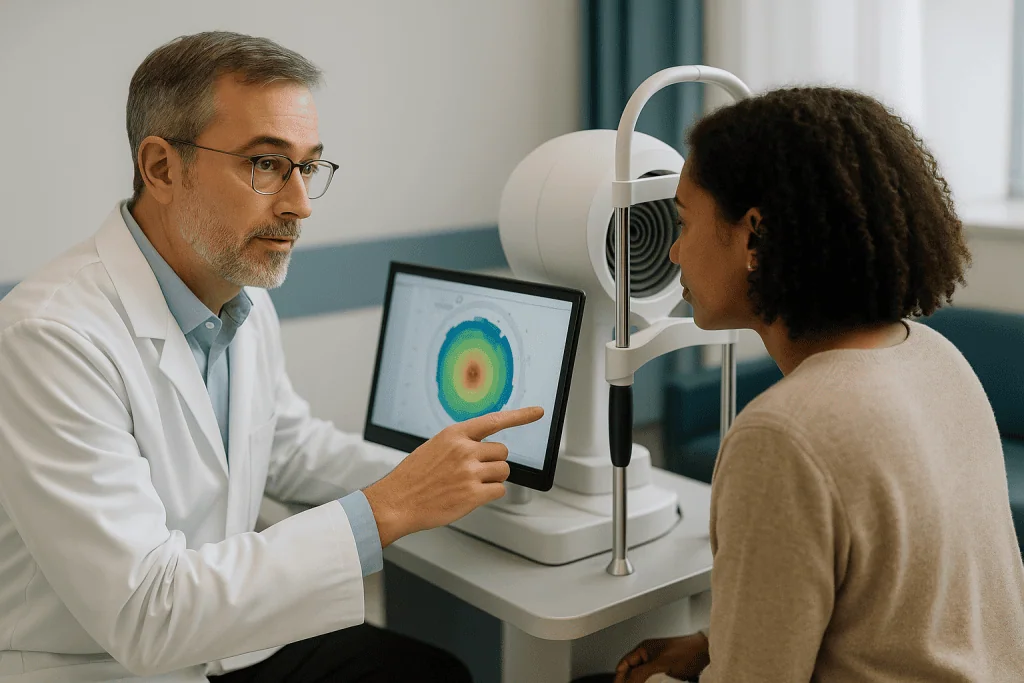
For astigmatism, that narrower view can be a strength. Most astigmatism lives in the cornea, and the corneal surface is exactly what the laser reshapes. Topography can also be measured reliably regardless of pupil size or lens clarity, which makes it useful when a wavefront scan is noisy.
Topography-guided treatment plans the laser pattern to smooth surface irregularities directly. It was first developed for eyes with distorted corneas, such as those with scars or previous surgery, and later applied to routine astigmatism. Surgeons who favor it argue that correcting the shape where the error originates gives a cleaner result along the astigmatic axis.
There is a wrinkle, and it is an honest one. Because topography ignores the lens, a surgeon planning a topography-guided treatment must decide how much of the measured corneal astigmatism to treat versus how much of the glasses prescription to treat, and the two do not always agree. Several planning methods exist for reconciling them, and this is an area of active debate among refractive surgeons rather than settled science.
In practice, many modern lasers can run either approach, and the choice is made eye by eye. Someone with regular astigmatism, a clear lens and a good-quality wavefront scan may do equally well with any of the three profiles. Someone whose corneal map and prescription disagree, or whose cornea is mildly irregular, is the patient for whom the technology choice carries more weight.
Custom LASIK for astigmatism versus standard LASIK: what the word "custom" buys
People frequently ask what separates advanced custom wavefront LASIK from standard LASIK, and the frank answer is: the input data, and little else about the operation itself.
Standard, or conventional, LASIK programs the laser with the same three numbers printed on your glasses prescription: sphere, cylinder and axis. The treatment pattern is a fixed mathematical shape scaled to those numbers. It has corrected astigmatism successfully for decades and remains in use.
Custom LASIK is an umbrella term, usually meaning wavefront-guided, that adds a fourth input: the aberrometer map. The laser still creates a flap, still reshapes with the same ultraviolet pulses, still takes a similar amount of time. What changes is that the pattern of pulses is individualized.
Three concrete consequences follow from that extra data.
- The treatment accounts for higher-order aberrations, which standard LASIK can leave in place or slightly worsen.
- The treatment zone is often matched to your measured pupil size, which matters for night vision because a small zone inside a large pupil produces halos.
- Eye-tracking and registration, which align the laser with the iris pattern recorded during mapping, are typically bundled with custom platforms. For astigmatism this helps compensate for cyclotorsion, the slight rotation of the eye that happens when you lie down, which can shift the astigmatic axis by a few degrees.
What “custom” does not buy is a guarantee. Cleveland Clinic lists the same core risks for all forms of LASIK: dry eye, glare and halos, under- or over-correction, and the possibility of needing glasses for some tasks. The extra precision narrows the odds of certain visual-quality complaints; it does not remove them.
Is there a best LASIK for astigmatism? What the evidence actually shows
Search engines are full of this question and the honest reply disappoints anyone hoping for a single winner.
Systematic reviews pooling randomized trials of wavefront-guided against wavefront-optimized or conventional LASIK have generally found that all approaches achieve comparable distance vision on the standard chart. The guided treatments have sometimes shown small advantages in secondary outcomes: slightly lower residual higher-order aberrations, slightly better contrast sensitivity, fewer reports of night glare in some studies. The effect sizes are modest and not consistent across every trial, which is the signal of a real but small difference rather than a transformative one.
For astigmatism specifically, evidence is thinner and more mixed. Some trials of topography-guided treatment report a tighter cluster of post-operative astigmatism results than conventional treatment, meaning fewer eyes left with residual cylinder. Other comparisons find no meaningful separation once the surgeon’s planning method is accounted for.
What this means for a patient reads simply. If your eye is regular, your pupil average and your higher-order aberrations low, the technology label is unlikely to change your outcome much, and a reputable surgeon may say so. If your eye carries unusual aberrations, a large pupil, or a cornea whose map disagrees with your prescription, the guided options have a clearer rationale.
The phrase to treat with skepticism is “best for astigmatism” attached to any single machine. Lasers are tools; outcomes depend on measurement quality, surgical planning, and the suitability of the eye. The treating team, with your scans in front of them, is the only party positioned to say which tool fits.
Who is usually a candidate for wavefront guided LASIK astigmatism treatment, and who is asked to wait
Candidacy for guided LASIK follows the same gate as any LASIK, with a few additional checks tied to the mapping itself.
Mayo Clinic and the NHS describe the general requirements in similar terms: adult age, a prescription that has been stable for at least a year or two, a cornea thick enough to leave a safe margin after reshaping, healthy eye surface without significant dry eye, and no eye disease such as keratoconus, glaucoma or cataract that would make results unpredictable. Pregnancy and breastfeeding, uncontrolled diabetes, and autoimmune conditions that impair healing are common reasons to postpone.
Guided treatments add one requirement: a trustworthy map. If the aberrometer cannot capture a clean reading, because the tear film is unstable or the pupil will not dilate well, the surgeon may recommend an optimized or conventional profile instead, or delay surgery until the surface is treated.
Astigmatism itself imposes limits. Lasers treat regular astigmatism, where the steep and flat meridians sit at right angles. Irregular astigmatism, where the cornea is warped unevenly, is a different problem and often a sign of keratoconus, a condition in which the cornea progressively thins and bulges. LASIK on such a cornea can accelerate the weakening, which is why screening topography is mandatory before any laser treatment. Very large amounts of astigmatism may exceed what a laser can safely correct given corneal thickness, and a lens-based procedure may be discussed instead.
Patients asked to wait are usually not being refused outright. A prescription still drifting in the early twenties, a bout of dry eye after a new contact lens, or borderline corneal thickness often resolves into a clearer decision a year later. The surgeon’s role is to say when, not merely whether.
Side by side: conventional, wavefront-optimized, wavefront-guided and topography-guided
The table below summarizes what each approach measures and what it is designed to do. It is a map of the concepts, not a ranking.
| Approach | What it measures | What it corrects | Where it tends to be chosen |
|---|---|---|---|
| Conventional LASIK | Glasses prescription only (sphere, cylinder, axis) | Lower-order errors: nearsightedness, farsightedness, regular astigmatism | Regular eyes with low aberrations; older platforms |
| Wavefront-optimized | Glasses prescription, with a population-based profile | Lower-order errors while limiting induced spherical aberration | Most routine corrections; eyes with low baseline aberration |
| Wavefront-guided (custom) | Full-eye aberrometry map | Lower- and higher-order aberrations unique to the eye | Eyes with measurable higher-order aberration, large pupils, night-vision complaints |
| Topography-guided | Corneal surface contour map | Corneal shape irregularities and corneal astigmatism | Corneal-dominant astigmatism; mildly irregular surfaces; some retreatments |
Two caveats keep this table honest. First, the categories overlap in practice: many platforms combine optimized profiles with eye tracking, and some surgeons blend topography and wavefront data in a single plan. Second, the column labelled “where it tends to be chosen” reflects clinical reasoning, not evidence that one approach produces better acuity in those situations. Trials, as noted earlier, show modest and inconsistent differences.
The most useful way to read the table is as a set of questions to carry into a consultation: which map was taken of my eye, what did it show, and why does that lead to this profile rather than another?
What the first days and weeks after guided LASIK usually look like
The timeline after a guided treatment is the same as after any LASIK, because the healing tissue does not know which map planned it.
In the first hours, Mayo Clinic describes burning, itching or a gritty feeling, watery eyes and blurred vision, with some discomfort expected and strong pain unusual. Most people are advised to go home and sleep, often with protective shields to prevent rubbing. Vision is typically hazy that evening and markedly clearer by the next morning, though not yet stable.
Over the first week, the flap seals and the surface epithelium smooths. Lubricating drops are usually prescribed liberally; the prescribing clinician sets the schedule. Screens and reading are generally allowed as tolerated, while swimming, eye makeup and contact sports are restricted for a period the surgeon specifies, because the flap can be dislodged by direct trauma in the early weeks.
Mayo Clinic notes that it usually takes about two to three months for the eye to heal and vision to stabilize, and that fluctuation during that window is ordinary. Dry eye is the most common complaint and tends to improve across those months; the NHS lists it among the usual temporary effects, alongside glare and halos.
Astigmatism has one recovery quirk worth knowing. Because its correction is directional, mild residual blur in the first weeks sometimes reflects temporary surface irregularity rather than a planning error. Surgeons typically wait until the refraction has settled, often around the three-month mark, before judging whether an enhancement, a small secondary laser treatment, would help.
Follow-up visits usually fall at one day, one week, one month and three months, varying by practice. Keeping them is part of the treatment, not an optional courtesy.
Can wavefront guided LASIK treat high astigmatism?
Lasik for high astigmatism is a frequent search, and the answer depends on what “high” means and on the cornea carrying it.
Modern excimer lasers are approved to correct a range of cylinder that covers most everyday prescriptions. The practical ceiling for any individual eye is set less by the laser’s software than by two anatomical facts: how much corneal tissue can be safely removed, and how regular the astigmatism is. Correcting astigmatism removes tissue along the steep meridian; the larger the cylinder, the deeper the ablation, and a cornea must retain enough thickness afterward to stay structurally sound.
Guided mapping helps high astigmatism in a specific way. Large astigmatic corrections are unforgiving of axis error. A treatment rotated even a few degrees from the true axis leaves residual cylinder and can introduce new aberrations. Wavefront and topography systems, paired with iris registration that locks the laser to the eye’s rotational position, reduce that risk. This is one of the more defensible claims for the technology, because the geometry is straightforward.
What mapping cannot do is make an irregular cornea regular enough for routine LASIK. High astigmatism that is also asymmetric on topography raises suspicion of early keratoconus, and in that setting LASIK is generally avoided. Surgeons may discuss alternatives such as surface laser treatment on a smaller scale, corneal cross-linking to stabilize the cornea first, or an implantable lens with a built-in astigmatism correction, which corrects without removing corneal tissue.
The honest message: guided LASIK extends the precision available for large, regular astigmatism, but the decision rests on the thickness and shape measurements of your specific cornea, read by the treating team.
What happens 20 years after LASIK?
The question behind this one is usually whether the correction lasts, and whether the eye pays a price later.
The reshaping itself is permanent: tissue removed by the laser does not grow back. Long-term follow-up studies of LASIK patients, now spanning decades, report that the corneal correction remains largely stable in most eyes, with a minority showing gradual regression, a slow drift back toward the original prescription, usually small.
What LASIK does not stop is the rest of the eye aging. Presbyopia, the stiffening of the lens that makes near focus harder from the mid-forties onward, arrives on schedule regardless of surgery; people who had LASIK in their twenties commonly need reading glasses in their forties, exactly as they would have otherwise. Cataract develops later still, and the Cleveland Clinic notes that cataract surgery remains possible after LASIK, though the calculations for the replacement lens are more complex because the cornea’s shape has been altered. Keeping a copy of your pre-LASIK measurements is a practical kindness to your future surgeon.
Dry eye deserves a plain word. For most, the dryness common in early months settles within the first year. A smaller group reports persistent symptoms, and the NHS and Mayo Clinic both list long-term dry eye among recognized risks.
Night-vision symptoms generally follow the opposite arc, improving as the brain adapts and the cornea settles. Whether wavefront-guided treatment reduces the long-term rate of these complaints compared with other profiles is not firmly established; the comparative trials mostly follow patients for months, not decades.
Routine eye examinations continue after LASIK for the same reasons they did before: glaucoma, retinal health and cataract screening do not depend on whether you wear glasses.
Risks and alternatives, in neutral clinical language
Every form of LASIK shares a risk profile, and mapping technology shifts a few probabilities without rewriting the list.
The NHS and Mayo Clinic describe the common temporary effects as dry eyes, glare, halos, light sensitivity and fluctuating vision, usually settling over weeks to months. Less common but recognized complications include under- or over-correction requiring enhancement, flap problems such as wrinkles or inflammation beneath the flap, infection, and in rare cases corneal ectasia, a progressive weakening and bulging of the cornea. Astigmatism can be induced as well as corrected, typically from flap irregularity or decentered treatment. A small number of people describe a lasting loss of best-corrected vision, meaning they see less sharply even with glasses than before surgery.
Guided profiles are intended to lower the chance of induced higher-order aberrations and night-vision complaints, and iris registration is intended to reduce axis error for astigmatism. Neither affects the risk of infection, flap complications or ectasia, which depend on surgical technique and corneal screening.
Alternatives exist, and a thorough consultation names them unprompted.
- Surface laser treatment (PRK, or photorefractive keratectomy) reshapes the cornea without a flap, with slower recovery but no flap-related risks; it can also be wavefront- or topography-guided.
- Lenticule extraction removes a small disc of corneal tissue through a tiny incision, with its own evidence base for astigmatism.
- Implantable lenses, placed inside the eye, correct astigmatism without removing corneal tissue and suit some thin or high-prescription corneas.
- Glasses and toric contact lenses remain fully valid choices, and for some eyes the safest.
Which of these fits is a clinical judgment made with your scans, not a decision a general article can make.
What people often get wrong about wavefront and topography-guided lasers
Several durable myths cling to this topic. Each has a kernel of truth and a misleading conclusion.
“Custom LASIK gives you better than 20/20 vision.” Early marketing leaned on this. Trials do show a subset of eyes reaching sharper-than-average chart lines after guided treatment, but so do eyes after conventional treatment; the ceiling is set mostly by the retina and brain, not the cornea. Guided treatment aims at quality of vision, especially in dim light, not a superhuman eye chart.
“Wavefront-optimized is a cheaper version of wavefront-guided.” They are different strategies. Optimized is a refined standard profile; guided is individualized. For many eyes the results are indistinguishable.
“Astigmatism can’t be treated with LASIK.” Regular astigmatism has been laser-corrected for decades. The restriction applies to irregular astigmatism and to corneas too thin for the needed correction.
“Topography-guided is only for damaged corneas.” It began there, but is now also used for routine astigmatism when the corneal map is the more reliable guide.
“The newest laser is automatically the safest.” Safety depends far more on candidate screening and surgical experience than on the model year of the machine.
“If my night vision is bad after surgery, the wrong technology was used.” Early halos are common after every approach and usually fade across the first months. Persistent symptoms deserve assessment, but the cause may be residual refractive error, dry eye or pupil size rather than the treatment profile.
“Once treated, astigmatism is gone forever.” The laser correction is permanent, yet the lens can develop its own astigmatism with age, and a cataract can introduce new error decades later.
Questions to ask your care team before guided LASIK for astigmatism
A good consultation welcomes specific questions. These are the ones that tend to produce the most useful answers.
- Which maps did you take of my eyes, and what did the wavefront and topography each show? Ask to see the printouts; the colored corneal map and the aberration chart are easier to understand than they look.
- Is my astigmatism regular, and does the corneal measurement agree with my glasses prescription? If they differ, how will you decide which to treat?
- Which treatment profile do you recommend for my eyes, and why that one rather than the others your laser can run?
- How thick are my corneas, and how much tissue will remain after the planned correction?
- What is my pupil size in dim light, and how does the planned treatment zone compare with it?
- Do you use iris registration or another method to correct for eye rotation when I lie down?
- What is your own rate of enhancement, meaning a second treatment, for astigmatism corrections like mine, and how is that decision made?
- Which of the alternatives, including surface laser, lenticule extraction or an implantable lens, would you consider for me, and why have you set them aside?
- What dry-eye assessment have you done, and should the surface be treated before surgery?
- What is the follow-up schedule, and who do I contact out of hours if something feels wrong?
Write the answers down. A surgeon’s reasoning for choosing a profile is a more reliable indicator of thoughtful care than the name of the profile itself. If any answer leans on superlatives rather than your measurements, that is worth noticing.
When to call your doctor after LASIK
Most of the sensations in the first days after LASIK are expected: grittiness, watering, light sensitivity, and vision that swims in and out of focus. A short list of symptoms is not expected, and each warrants a same-day call to the surgical team rather than waiting for the scheduled visit.
- Pain that is increasing rather than easing, or pain that returns after it had settled. Significant pain is unusual after LASIK and can signal infection, inflammation under the flap or a surface problem.
- A sudden drop in vision, or vision that was clearing and then becomes markedly worse, especially in one eye.
- Redness that is spreading, or a new discharge from the eye.
- A sensation that something has shifted, particularly after a knock, a rub or an accidental poke; flap displacement is most likely in the early weeks and is treatable when caught quickly.
- A new, fixed shadow, curtain or shower of floaters across your vision, which needs urgent assessment for retinal problems regardless of the recent surgery.
- Fever combined with eye symptoms.
Outside the early period, persistent dryness that is not improving by a few months, night glare that interferes with driving beyond the expected settling window, or a sense that your astigmatism has returned are reasons for a non-urgent review. These are not emergencies but they are not to be ignored either, because treatable causes such as residual refractive error or ocular surface disease are common.
If the surgical team cannot be reached and symptoms are severe, an emergency department or urgent eye service is the appropriate route. The guiding principle is simple: after any eye surgery, worsening is never something to wait out.
Frequently asked questions
What is the best LASIK for astigmatism?
There is no single best LASIK for astigmatism; the right profile depends on your eye’s measurements. Regular astigmatism in an eye with low higher-order aberration tends to do similarly well with conventional, optimized or guided treatment. Eyes with large pupils, measurable aberrations, or a corneal map that disagrees with the glasses prescription have a clearer rationale for wavefront- or topography-guided planning. Your surgeon’s reasoning from your scans matters more than the platform name.
What is the difference between wavefront guided vs wavefront optimized LASIK?
Wavefront-guided LASIK uses a map of your eye’s individual light distortions to shape the treatment, while wavefront-optimized LASIK uses only your glasses prescription with a profile pre-shaped from population averages to limit induced spherical aberration. Both correct astigmatism. Trials show similar sharpness on the eye chart, with guided treatment sometimes giving modest benefits in contrast and night vision, mainly in eyes that started with higher aberrations.
Does custom LASIK for astigmatism work better than standard LASIK?
Custom, or wavefront-guided, LASIK adds your aberrometer map to the standard prescription data, which can reduce higher-order aberrations and match the treatment zone to your pupil. Evidence shows comparable distance vision to standard LASIK, with small advantages in visual quality for some eyes. It does not remove the shared risks of dry eye, glare, under- or over-correction, or flap complications, and it is not a guarantee of spectacle independence.
Is topography guided LASIK good for astigmatism?
Topography-guided LASIK maps the corneal surface, where most astigmatism originates, and plans the laser to smooth that shape directly. It can be reliable when wavefront scans are noisy and is used for both routine and mildly irregular astigmatism. The challenge is reconciling corneal astigmatism with the glasses prescription when they differ, which is a matter of surgical planning rather than settled evidence. Suitability is judged from your own corneal map.
Can LASIK treat high astigmatism?
LASIK for high astigmatism is possible when the astigmatism is regular and the cornea is thick enough to tolerate the deeper tissue removal that large corrections require. Guided mapping with iris registration helps reduce axis error, which matters more as the correction grows. Irregular or asymmetric high astigmatism raises concern for keratoconus and generally rules LASIK out; alternatives such as implantable lenses may then be discussed by the treating team.
How much does wavefront LASIK cost?
Pricing is not something this article covers, because fees vary widely by region, surgeon, included follow-up and technology, and quoting figures would mislead more than inform. A more useful question for any consultation is what the fee includes: pre-operative mapping, the specific treatment profile, follow-up visits, and whether an enhancement procedure within a stated period is covered. Insurance rarely covers elective refractive surgery, so ask the practice directly.
What happens 20 years after LASIK?
The corneal reshaping is permanent, and long-term studies report that most eyes stay largely stable, with small regression in a minority. Aging continues as normal: presbyopia brings reading glasses in the forties, and cataract can develop later, when the altered cornea makes lens calculations more complex but surgery still possible. Persistent dry eye affects a smaller group. Routine eye exams remain important for glaucoma and retinal health.
How long does it take for vision to stabilize after LASIK for astigmatism?
Mayo Clinic states it usually takes about two to three months for the eye to heal and vision to stabilize after LASIK, and fluctuation during that window is ordinary. Astigmatism corrections can show mild early blur from temporary surface irregularity, which is why surgeons generally wait until the refraction has settled before deciding whether an enhancement is needed. Your own timeline is set by your follow-up findings.
Who is not a good candidate for wavefront guided LASIK?
People commonly asked to wait or consider alternatives include those with a prescription still changing, thin corneas, keratoconus or irregular astigmatism, significant dry eye, pregnancy or breastfeeding, and conditions that impair healing such as uncontrolled diabetes or some autoimmune diseases. Guided treatment also needs a clean aberrometer map; if the scan cannot be captured reliably, a surgeon may suggest a different profile or delay surgery.
Does wavefront guided LASIK prevent halos and glare at night?
It is designed to reduce them, not prevent them. Guided profiles target higher-order aberrations and match the treatment zone to pupil size, and some trials report fewer night-vision complaints than conventional treatment. Halos and glare remain common in the early months after every form of LASIK and usually fade as the cornea settles. Persistent symptoms should be assessed, since residual refractive error or dry eye are frequent and treatable causes.
References
- MedlinePlus: LASIK eye surgery
- NHS: Laser eye surgery and lens surgery
- Cleveland Clinic: LASIK eye surgery
This article is for general information only and is not a substitute for professional medical advice. Please consult a qualified doctor about your individual situation.
Add us as a Preferred Source to see more of our trusted health content across Google Search, AI Overviews and Discover.

More from the Blog

How Corneal Mapping and Wavefront Scans Personalize a Myopia Laser Plan
Corneal mapping for myopia surgery measures the shape, curvature and thickness of the cornea point by point, while a wavefront scan measures how light…

What Contact Lenses Can and Cannot Correct: Astigmatism, Presbyopia and High Prescriptions
Contact lenses can correct the four refractive errors: nearsightedness, farsightedness, astigmatism (with toric designs) and presbyopia (with multifocal or monovision fitting). Specialty rigid, scleral…

Life After Cataract Surgery: Reading Glasses, Sunlight, Makeup and Gardening
Life after cataract surgery usually settles over four to six weeks, with vision clearing within days and the eye fully healed by about two…

Eye Discharge and Sleep Crust: What Is Normal and When It Signals Infection
Eye discharge is mostly tears, oil, mucus and shed cells that dry into a harmless crust overnight, so a little on waking is normal.…

The First Weeks After Cataract Treatment: Drops, Shields and When Lifting Is Allowed
Cataract treatment recovery usually spans several weeks. The NHS describes blurred, gritty, watery or mildly sore eyes in the first days that generally settle…

Screens, Gym and Swimming After LASIK: A Realistic Return Schedule for Everyday Life
There is no fixed medical ban on screen time after LASIK. Most people are asked to rest their eyes on the day of surgery,…