

Rash and Diarrhea on Targeted Therapy: Why They Happen and When to Contact the Team

Key Takeaways
- The acne-like rash from EGFR inhibitors occurs because the same receptor the drug blocks in tumors also maintains healthy skin, hair follicles and nail folds.
- According to the Lacouture supportive care guidance, the EGFR inhibitor rash typically starts within one to two weeks, peaks around weeks three to five, and then tends to plateau or ease.
- Acne products such as benzoyl peroxide and retinoids usually worsen an acneiform rash because they dry a skin barrier the drug has already weakened.
- Targeted therapy diarrhea is largely secretory, driven by a gut lining that leaks more fluid than it absorbs, so salt-and-sugar fluids matter more than plain water.
- New diarrhea on an immune checkpoint inhibitor can signal colitis and should be reported before any antidiarrheal is taken, because slowing the gut can mask it.
- Blistering, mouth sores, fever with rash, blood in the stool, or dizziness with dark urine are same-day red flags that need the treating team, not the bathroom cabinet.
Rash and diarrhea are common side effects of targeted cancer therapy because the molecular switches these drugs block, such as EGFR, also keep skin and gut lining healthy. The rash usually looks like acne without blackheads and often appears within the first few weeks; diarrhea reflects a gut lining that secretes more fluid than it absorbs. Both are usually manageable, but blistering, fever, blood in the stool, or dehydration signs need a same-day call to the treating team.
The mirror catches it first. Ten days into a new tablet, small red bumps scatter across the cheeks and forehead, the kind of breakout a person thought they left behind at seventeen. The same week, meals start moving through faster than they should. Nobody mentioned acne at the clinic visit, and the pharmacy leaflet listed so many possibilities that none of them stuck.
Skin and gut trouble sit at the top of the list of targeted therapy side effects; rash and diarrhea lead for several drug classes, and they arrive wrapped in a particular kind of worry. Is this a sign the drug is failing? A sign it is working? A reason to stop? None of those questions has a clean yes-or-no answer, which is exactly why they deserve a slower explanation than a leaflet can give.
What follows is that explanation: the biology behind the bumps and the loose stools, what the first weeks tend to look like, what genuinely helps, and the specific signs that should send you to the phone rather than the bathroom cabinet.
Why does targeted therapy cause a rash? It comes down to shared switches
Targeted therapy is a family of cancer drugs designed to block specific proteins that tumors rely on to grow and spread. The idea is elegant: aim at the molecular engine of the cancer rather than at every dividing cell in the body, which is roughly what conventional chemotherapy does. The National Cancer Institute describes these drugs as interfering with particular molecules involved in cancer cell growth and survival, and that precision is real. It is also the source of the trouble.
Consider the epidermal growth factor receptor, or EGFR, a protein that sits on the surface of many cells and tells them when to grow, repair and stay put. Some lung, bowel, and head and neck cancers depend on an overactive EGFR signal, so a drug that blocks it can slow them down. The catch is that EGFR is not a cancer-only protein. Healthy skin uses the same receptor constantly. The basal layer of the epidermis, the hair follicles, the sweat glands and the nail folds all lean on EGFR to renew themselves and to hold inflammation in check.
Block the receptor and the skin’s routine maintenance falters. Keratinocytes, the cells that make up most of the outer skin, stop maturing normally. Hair follicles become plugged and inflamed. The skin’s barrier thins and loses water, and immune cells drift in to investigate the disruption. The result, over days rather than hours, is the inflamed, bumpy, often tender eruption that people mistake for acne.
Other targeted classes reach the skin by different routes. Drugs that block the BRAF and MEK proteins, used in some melanomas and other cancers, alter the same growth pathway one step downstream and can produce rashes, sun sensitivity and thickened palms. Multikinase inhibitors that starve tumors of blood supply can trigger painful redness on the hands and feet. The unifying point is simple: a rash in this setting is rarely an allergy. It is the drug doing its job in a place you did not want it to.
What does an EGFR inhibitor rash look like?
Picture a teenage breakout that has chosen its territory carefully. The classic EGFR inhibitor rash, which clinicians call papulopustular or acneiform, clusters where the skin is oiliest: the face, the scalp, the upper chest and the upper back. It is made of small red bumps (papules) and pus-filled spots (pustules), often on a background of pink, slightly swollen skin. Unlike ordinary acne, it produces no blackheads or whiteheads, and the spots tend to be tender or itchy rather than painless.
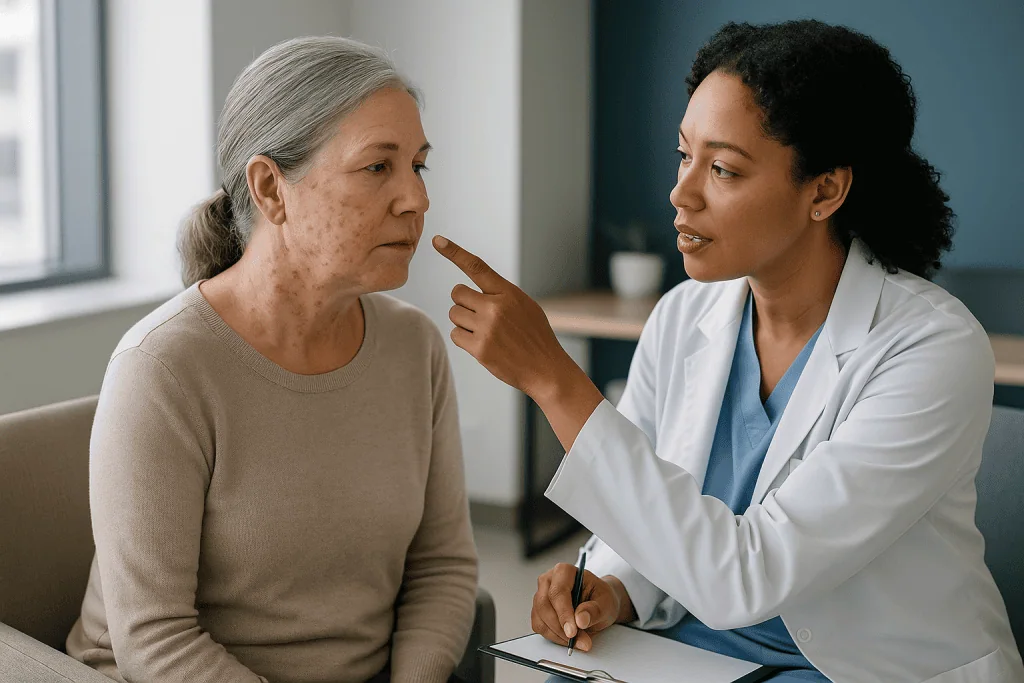
The rash is only the opening act. The National Cancer Institute’s guidance on skin and nail changes during cancer treatment notes that the same drugs commonly cause dryness that can progress to flaking and cracking, and those cracks are most troublesome where the skin flexes, at the fingertips, knuckles and heels. Nail folds can become red, swollen and sore, a condition called paronychia (inflammation of the skin around the nail) that makes typing or buttoning a shirt surprisingly hard. Eyelashes sometimes grow unusually long and curl toward the eye, scalp hair may thin or change texture, and the eyes and nostrils can feel dry.
Severity varies a great deal. Some people notice a handful of spots along the hairline; others develop an eruption that covers most of the face and trunk and interferes with sleep and confidence. Skin color also changes how the rash reads. On darker skin, the redness may look violet, brown or gray, and the bumps may be easier to feel than to see, which is one reason photographs and descriptions written mostly from lighter skin can be misleading. If you are unsure whether what you are seeing counts, a photo sent to the care team, ideally in daylight next to a coin for scale, is far more useful than a guess.
Acneiform rash on cancer treatment: why it is not acne, and why that matters
The label acneiform means acne-like, and the resemblance ends at the surface. Acne begins when a hair follicle becomes clogged with oil and dead cells, forming a comedone (a blocked pore, visible as a blackhead or whitehead), which then becomes colonized by skin bacteria and inflamed. The EGFR inhibitor rash skips the clog entirely. Its follicles are inflamed because the signal that keeps follicular cells calm and well ordered has been switched off, and the pustules that form are usually sterile at first, meaning they do not contain the bacterial infection acne pustules do.
That difference has practical consequences. The standard toolkit for acne is built around drying and exfoliating: benzoyl peroxide washes, salicylic acid, over-the-counter retinoids, astringent toners. Every one of those strips lipids from a skin barrier that the drug has already weakened. The multinational supportive care guidance on EGFR inhibitor skin toxicity, published by Lacouture and colleagues, specifically advises against acne-style treatments for this reason and recommends gentle, barrier-restoring care instead. People who reach for a familiar acne product often report that the rash stings more, dries further and looks angrier within days.
The frequency is also different from anything acne offers. The same guidance describes the papulopustular eruption as occurring in the majority of people treated with EGFR inhibitors, which makes it less a complication than an expected companion of the treatment. Knowing that in advance changes the emotional weight of the first bump. It is not a sign that something has gone wrong with you or with the prescription; it is the most common thing that happens with this class of medicine, and teams that prescribe these drugs manage it every week.
One more distinction matters. Acne rarely becomes infected in a way that needs urgent attention. An acneiform rash can, particularly when scratched or when cracks open the skin, and secondary infection is one of the reasons a rash that suddenly turns yellow-crusted, hot or painful should be reported rather than covered up.
Why does diarrhea from targeted therapy happen?
The lining of the small intestine renews itself every few days, one of the fastest turnovers of any tissue in the body. That renewal is driven by growth signals, and EGFR is among the most important of them. The receptor helps intestinal cells mature, helps the lining repair small injuries, and, less obviously, helps regulate how much chloride and water the gut secretes into its own channel. Interrupt that signal and two things happen at once: the lining repairs itself more slowly, and it leaks more fluid than it reabsorbs. The stool that results is loose, frequent and often urgent.

This is a different mechanism from the diarrhea people associate with chemotherapy. Conventional chemotherapy damages rapidly dividing gut cells directly, producing a raw, inflamed lining called mucositis. Targeted drugs tend to leave the cells intact but misinformed. The distinction matters less for how it feels and more for how it is managed: the National Cancer Institute’s guidance on diarrhea during cancer treatment emphasizes that the cause shapes the plan, which is why the care team will want to know which drug you are on before advising anything.
Other targeted classes reach the gut by their own paths. Drugs aimed at the HER2 protein, used in some breast and stomach cancers, are well known for diarrhea, particularly the small-molecule forms taken as tablets. Multikinase inhibitors that block blood vessel growth can alter gut blood flow and secretion. MEK inhibitors add another route. Immune checkpoint inhibitors, which are a form of immunotherapy rather than targeted therapy in the strict sense, cause diarrhea by an entirely different process: the newly unleashed immune system attacks the bowel wall, producing colitis (inflammation of the colon) that can be serious and that responds to different treatment.
The common thread across all of them is fluid loss. A gut that secretes more than it absorbs can move a person from comfortable to dehydrated within a day or two, especially in hot weather, in older adults, or when nausea keeps fluids from going in. That is why counting episodes and watching for thirst, dizziness and dark urine is not fussiness; it is the core of safe management.
Which treatments cause rash and diarrhea most often, and who is usually asked to wait
People often ask whether targeted therapy is hard on the body. The honest answer is that it is hard in a different pattern from chemotherapy. Blood counts, hair and nausea are usually less affected, while skin, gut, blood pressure and, for some drugs, the heart, liver or thyroid take more of the strain. The table below summarizes the classes most linked to rash and diarrhea; specific drugs within each class differ, and your team’s information sheet takes precedence.
| Drug class (what it blocks) | Typical skin effects | Typical gut effects |
|---|---|---|
| EGFR inhibitors (tablets and antibody infusions) | Acneiform rash, dryness, cracked fingertips, sore nail folds | Diarrhea, often early in treatment |
| BRAF and MEK inhibitors | Rash, sun sensitivity, thickened palms, new skin growths | Diarrhea, nausea |
| Multikinase and VEGF-pathway inhibitors | Hand-foot skin reaction, hair color change | Diarrhea, mouth soreness |
| HER2-targeted tablets | Mild rash | Diarrhea, sometimes prominent |
| Immune checkpoint inhibitors (immunotherapy) | Itchy blotchy rash, vitiligo, rarely blistering | Immune colitis, may include blood and cramping |
Who is usually offered these drugs? Anyone whose tumor carries the specific alteration the drug targets, confirmed by biomarker testing (laboratory analysis of the tumor or blood for particular genetic or protein changes). The National Cancer Institute stresses that most targeted therapies only make sense when that target is present.
Who is sometimes asked to wait, or offered an alternative? People with an active severe skin disease, poorly controlled inflammatory bowel disease, a history of a serious reaction to a related drug, or an acute infection may be advised to stabilize that problem first. Kidney, liver and heart function also shape the choice, because they govern how a drug is cleared and how much extra fluid loss the body can tolerate. None of these are absolute rules. They are conversations, and the weighing of benefit against risk for one individual belongs to the treating team.
Targeted therapy side effects rash timeline: what the first weeks usually look like
Side effects that arrive on a predictable schedule are easier to live with, and the EGFR inhibitor rash is more predictable than most. According to the supportive care guidance by Lacouture and colleagues, the papulopustular eruption typically begins within the first one to two weeks of treatment, reaches its peak around weeks three to five, and then tends to plateau or gradually ease even when the drug continues. Dryness and flaking usually follow rather than lead, becoming noticeable after the first month, and the sore nail folds and fingertip cracks are generally later still, often appearing after one to two months.
This sequence explains a common misunderstanding. Someone who feels the rash worsening in week four may assume the drug is becoming intolerable, when in fact week four is the expected crest. Conversely, the person whose rash has quietened by week eight has not necessarily been given a weaker prescription; the skin has adapted, the care plan has caught up, or both. Antibody forms of EGFR blockers, given by infusion, and tablet forms follow broadly similar patterns, though the antibody rash can be more intense.
Diarrhea tends to keep less regular hours. With EGFR and HER2 tablets it commonly shows up early, sometimes within days, and its pattern depends heavily on the specific drug, on other medicines being taken and on diet. Immune-mediated diarrhea from checkpoint inhibitors is different again: it can surface after several cycles, and occasionally months in, which is why any new change in bowel habit during immunotherapy is taken seriously whenever it appears.
What the first weeks should also include is contact. Most teams schedule an early check specifically to review skin and gut, adjust supportive care, and photograph the rash for comparison. If that check is not on your calendar, ask for one. The timeline above is a typical range drawn from the cited guidance, not a promise; your own course may run faster, slower or milder, and the team’s job is to fit the plan to you rather than to the average.
How do care teams grade a rash or diarrhea, and why the grade matters more than the look
Clinicians do not describe a side effect as bad or mild by feel. They use a standardized scale called the Common Terminology Criteria for Adverse Events, or CTCAE, which assigns a grade from 1 to 5 based on extent, symptoms and impact on daily life. The grade, not the appearance, drives decisions about whether treatment continues as planned, pauses, or changes.
For rash, the supportive care guidance by Lacouture and colleagues explains that grading leans on body surface area and on function. A grade 1 acneiform rash covers less than 10 percent of the body and may or may not itch. Grade 2 covers 10 to 30 percent or brings symptoms that limit some activities, including social ones; the emotional toll of a visible facial rash is written into the scale on purpose. Grade 3 covers more than 30 percent, limits self-care, or involves infection needing oral antibiotics. Grade 4 is life-threatening. A large fraction of what people experience sits in grades 1 and 2, where supportive care and continued treatment are usually the discussion; higher grades are where pauses and changes are considered.
Diarrhea is graded by how many loose stools occur above a person’s normal pattern each day, whether hospital-level fluids are needed, and how much daily life is disrupted. Two people with the same stool count can be graded differently if one is also dizzy, feverish or unable to drink.
Why should a patient care about any of this? Because the questions the team asks on the phone are grading questions in disguise. How much of your body is affected? Can you sleep? How many more times than usual have you gone today? Are you keeping fluids down? Answering those precisely, ideally from notes rather than memory, gets you a faster and more accurate plan. It also protects against the two opposite errors: dismissing a grade 3 problem as a nuisance, or pausing an effective drug for a grade 1 rash that a good moisturizer would have handled. Both of those calls belong to the prescriber, but the information that shapes them starts with you.
What is the best ointment for a rash on cancer treatment? The honest answer
There is no single best product, and anyone who tells you otherwise is selling something. What the evidence supports is a set of principles, and most of them are unglamorous. The National Cancer Institute’s skin-care guidance and the Lacouture supportive care recommendations converge on the same core: protect the barrier, avoid irritation, and shield the skin from ultraviolet light.
Protecting the barrier means moisturizing more than feels necessary. Thick, fragrance-free creams or ointments, applied to damp skin after washing and again at bedtime, do more than lighter lotions because they trap water rather than evaporating with it. The fingertips, knuckles and heels deserve extra attention because they crack first. Washing should be brief, lukewarm rather than hot, with a mild non-soap cleanser; long hot showers feel wonderful and strip lipids the skin cannot spare. Shaving with a fresh blade or an electric razor, and skipping alcohol-based aftershave, reduces trauma to inflamed follicles.
Avoiding irritation means putting the acne arsenal away, as described earlier, and being cautious with exfoliating scrubs, perfumed products and very tight or scratchy fabrics over the chest and back. Sun protection means a broad-spectrum sunscreen and a hat, every day the sun is out, because both EGFR and BRAF pathway drugs make skin burn faster and redden more.
Prescription care sits on top of this, and it is the team’s decision. The Lacouture guidance describes two approaches used by oncologists: topical corticosteroid creams, which calm follicular inflammation, and tetracycline-class oral antibiotics, used not primarily to kill bacteria but for their anti-inflammatory effect on the skin, sometimes started pre-emptively before the rash appears. Whether either is appropriate for you, and for how long, depends on your drug, your grade and your other medicines; these are not products to source independently.
A practical word on the pustules themselves: do not squeeze them. They are sterile inflammation, not infected pores, and opening them invites the very infection they did not have.
Managing diarrhea from targeted therapy day to day
The first tool is a notebook, or a note on your phone. Recording the number of loose stools each day, their consistency, and any blood, cramping, fever or dizziness turns a vague complaint into data the team can act on. Many people are surprised how quickly a pattern emerges, for example a cluster of episodes an hour after the morning tablet, or a worse day after a particular meal.
The second tool is fluid, and specifically fluid with some salt and sugar in it. Plain water replaces volume but not the sodium and potassium that leave with each episode. The National Cancer Institute’s guidance on diarrhea during cancer treatment recommends sipping clear liquids through the day and choosing drinks that contain electrolytes; broths, diluted juices and oral rehydration drinks all serve the purpose. Alcohol, strong coffee and very sugary sodas tend to make things worse.
Food matters, though less dramatically than people fear. During a flare, smaller and more frequent meals built around bland, low-fiber, low-fat choices are generally easier on a lining that is secreting too much: white rice, plain toast, bananas, boiled potatoes, well-cooked eggs and lean poultry are the usual suggestions in the same guidance. Raw vegetables, whole grains, beans, fried food, spicy dishes, sugar-free sweeteners and, for many people, milk are worth pausing until things settle. This is a temporary adjustment, not a permanent diet, and a dietitian on the team can tailor it.
Antidiarrheal medicine is where care is needed. Teams often give people on EGFR or HER2 tablets a plan involving a loperamide-type medicine, which slows gut movement, together with specific instructions about when to begin it and when to stop and call. Follow that plan rather than an improvised one. For anyone on an immune checkpoint inhibitor, the calculation is different: slowing the gut can mask an inflamed colon and delay treatment that colitis needs, so new diarrhea on immunotherapy should be reported before anything is taken for it. In both settings, the Mayo Clinic’s dehydration warning signs, dizziness on standing, very dark or scant urine, dry mouth and a racing heart, mark the point where home management has run out.
Immunotherapy skin rash vs targeted therapy rash: same word, different biology
People searching for immunotherapy skin rash images are often surprised that what appears bears little resemblance to the acne-like eruption described above. That is because immune checkpoint inhibitors, the main type of immunotherapy used for solid tumors, work by releasing the brakes on the immune system rather than by blocking a growth receptor, and the skin they inflame looks and behaves differently.
The most common immunotherapy rash is maculopapular: flat pink or red patches (macules) mixed with small raised bumps (papules), typically on the trunk and limbs rather than concentrated on the face and upper chest. Itch is often the dominant complaint and can occur without any visible rash at all. Some people develop patches of skin that lose pigment, a condition called vitiligo, which in melanoma treatment has been observed alongside immune activity against the cancer. Others develop lichenoid or eczema-like patterns. The National Cancer Institute’s guidance on skin changes notes that these reactions can appear at almost any point in treatment, sometimes weeks or months in, which contrasts with the front-loaded timeline of EGFR rash.
Rarely, immunotherapy triggers severe blistering reactions in which the skin separates or peels, mouth and eye membranes become raw, and fever accompanies the rash. These are uncommon but are medical emergencies, and their possibility is the single most important reason blistering or mucosal soreness on any cancer treatment should be reported the same day.
Gut effects diverge in the same way. Where EGFR diarrhea is secretory and often steady, immune-mediated colitis brings cramping, urgency, sometimes mucus or blood, and it does not reliably respond to slowing the bowel. Its treatment centers on calming the immune system, which is a prescriber’s decision. The two kinds of rash and two kinds of diarrhea share vocabulary and little else; knowing which drug you are on is the first fact the team will need.
Does a rash mean the treatment is working?
Older patients on EGFR inhibitors sometimes arrive at clinic almost hopeful about a new breakout, having heard that rash predicts response. The origin of the idea is real. Several studies of EGFR inhibitors observed that people who developed a rash, particularly a more pronounced one, tended as a group to have better tumor responses and longer disease control than those who did not, an association the Lacouture supportive care guidance discusses. The biology is plausible: a stronger skin reaction may signal that the drug is thoroughly blocking its target throughout the body.
The temptation is to turn a group observation into a personal verdict, and that is where the evidence stops cooperating. Rash intensity varies with skin type, age, sun exposure, drug level in the blood and factors no one has fully mapped. Plenty of people with minimal rash respond well; some with severe rash do not. Oncologists judge whether a targeted drug is working by scans, blood markers and symptoms, not by counting spots. A quiet complexion is not a reason to worry, and a stormy one is not a reason to endure grade 3 misery in silence.
The corollary is worth stating plainly. Because rash and response are only loosely linked, treating the rash does not undermine the treatment. Moisturizers, sun protection and whatever prescription support the team chooses act on the skin’s inflammation, not on the drug’s ability to reach the tumor. Nor should anyone skip a prescribed rash treatment in the hope of preserving a supposed signal of efficacy.
For immunotherapy the picture is similarly suggestive and similarly unreliable at the individual level. Vitiligo during melanoma immunotherapy has been associated with treatment response in observational reports, but its absence means nothing on its own. The best use of a rash is as information for the team about tolerability and grade, not as a private forecast.
What people often get wrong about targeted therapy side effects, rash and diarrhea
It must be an allergy. True drug allergies do occur, and hives, swelling of the lips or face, wheeze or a rash within minutes of an infusion need urgent attention. The acneiform eruption that builds over a week or two is not that. It is an expected pharmacological effect, and labeling it an allergy sometimes leads people to stop a drug that could have continued with support.
Any rash means the dose must be stopped or lowered. Whether treatment pauses depends on grade, on the specific drug and on how the rash responds to supportive care. Many people continue on schedule through a grade 1 or 2 rash. That judgment sits with the prescriber, and self-adjusting the schedule, in either direction, undermines both safety and the treatment’s chance of working.
Acne products will clear it. They usually make it worse, as the supportive care guidance by Lacouture and colleagues sets out, because they dry a barrier already weakened by the drug.
Diarrhea is a nuisance, not a danger. Fluid loss on targeted therapy can escalate quickly, and on immunotherapy new diarrhea can be the first sign of colitis. Counting episodes and reporting early is what keeps a nuisance from becoming an admission.
Cancer itself is causing the rash. People ask whether a rash is a side effect of cancer. Some cancers do cause skin changes directly, for instance through skin involvement or rare paraneoplastic syndromes (skin conditions triggered at a distance by a tumor), but a new rash that begins shortly after starting a targeted drug is far more likely to be the drug. The team can distinguish the two.
Sun is fine now that it is not chemotherapy. EGFR and BRAF pathway drugs increase sun sensitivity markedly; a modest afternoon outdoors can produce a burn that would not have happened before.
There is one ointment that fixes it. No product replaces the combination of barrier care, sun protection and, when the team judges it appropriate, prescription anti-inflammatory treatment.
Questions to ask your care team before and during treatment
A ten-minute conversation at the start of treatment prevents a great many anxious evenings later. Take these to the clinic, in writing if that helps, and add your own.
- Which side effects are most likely with my specific drug, and roughly when do they tend to appear and peak?
- Should I start a skin-care routine before the rash appears, and is pre-emptive prescription treatment part of your usual approach for this drug?
- Which moisturizers, cleansers and sunscreens do you suggest I avoid, and are there ingredients I should look for?
- How should I photograph and describe a rash so you can grade it over the phone?
- For diarrhea, what exactly is my plan: how many episodes above my normal pattern should prompt a call, and when should I begin any medicine you give me?
- Are there foods, supplements or over-the-counter products, including herbal ones, that interact with my drug or worsen diarrhea?
- If I am on immunotherapy, what should I do differently about diarrhea compared with someone on a tablet targeted drug?
- Who do I call out of hours, and what information will they want from me?
- At what grade would you consider pausing or changing treatment, and how is that decision made?
- Will my nails, hair, eyes or eyelashes be affected, and is there anything to do early?
- Can I keep working, exercising, swimming and wearing makeup, and are there adjustments that make those easier?
- Who else on the team can help: a dermatology contact, a dietitian, a pharmacist, a nurse specialist?
Write the answers down, or ask whether the clinic can give them to you in writing. Side effect plans that live only in memory tend to evaporate at two in the morning, which is precisely when they are needed.
When to call your doctor: red-flag signs with rash or diarrhea on targeted therapy
Most rash and diarrhea on targeted therapy can be handled with the plan your team gives you, but a small set of signs should never wait for the next scheduled visit. Call the same day, or use the out-of-hours number, if any of the following appears.
Skin red flags. Blisters, peeling or raw areas of skin; sores or ulcers inside the mouth, on the lips, in the eyes or on the genitals; a rash that spreads rapidly over hours or covers most of the body; fever alongside a rash; skin that is hot, increasingly painful, oozing yellow fluid or developing spreading redness, which can signal infection; and any rash with swelling of the face or tongue, wheeze or difficulty breathing, which needs emergency care.
Gut red flags. Blood in the stool or black, tarry stools; severe or worsening abdominal pain or a swollen, tender abdomen; fever with diarrhea; diarrhea that continues for more than a day despite following your plan, or that exceeds the episode threshold your team set; inability to keep fluids down; and signs of dehydration described by the National Cancer Institute and the Mayo Clinic, including dizziness or fainting on standing, very dark or very little urine, dry mouth, confusion or a rapid heartbeat. On immunotherapy, any new diarrhea deserves a call before you take anything for it.
When to seek care in one paragraph. If skin is blistering or peeling, if mouth or eye membranes are sore, if there is fever, if stools contain blood, if you cannot drink enough to stay hydrated, or if you feel faint or confused, contact the treating team immediately or go to emergency care; these are the signs that separate a manageable side effect from one that needs assessment today.
Whatever you notice, do not stop, skip or change the drug on your own. The right response to a severe reaction may indeed be a pause, but that judgment, and everything that follows from it, belongs to the team that prescribed the treatment and knows the whole picture.
Frequently asked questions
What does immunotherapy skin rash look like?
An immunotherapy rash from checkpoint inhibitors is usually maculopapular: flat pink or red patches mixed with small raised bumps, most often on the trunk and limbs, and frequently itchy. It differs from the acne-like EGFR inhibitor rash, which concentrates on the face and upper chest. Some people develop patches of lost pigment (vitiligo) or eczema-like areas. Blistering, peeling or sores in the mouth or eyes are rare but need same-day medical attention.
Is targeted therapy hard on the body?
Targeted therapy is demanding in a different pattern from chemotherapy rather than uniformly easier. Blood counts, hair loss and nausea are usually less affected, while skin, gut, blood pressure and, for certain drugs, the heart, liver or thyroid carry more of the strain. Rash and diarrhea are the most frequent complaints across several classes. Most side effects are graded on a standard scale and managed with supportive care, with any pause or change decided by the treating team.
Is a rash a side effect of cancer itself?
Occasionally, but much less often than it is a side effect of treatment. Some cancers involve the skin directly, and rare paraneoplastic syndromes cause skin changes triggered at a distance by a tumor. A rash that begins in the first weeks after starting a targeted drug or immunotherapy is far more likely to come from the medicine. Your care team can distinguish the two by examining the rash and reviewing your treatment timeline.
What is the best ointment to use on a chemo rash or targeted therapy rash?
No single product is best; the evidence supports principles rather than brands. Thick, fragrance-free moisturizing creams or ointments applied to damp skin, a mild non-soap cleanser, lukewarm water and daily broad-spectrum sunscreen form the foundation. Acne products should be avoided because they worsen dryness. Prescription options, such as topical corticosteroids or tetracycline-class antibiotics used for their anti-inflammatory effect, are decisions for the prescribing clinician based on your drug and rash grade.
How long does an EGFR inhibitor rash last?
The supportive care guidance by Lacouture and colleagues describes a typical course in which the rash appears within the first one to two weeks of treatment, peaks around weeks three to five, and then plateaus or gradually eases even while treatment continues. Dryness and cracked fingertips tend to follow after the first month, and sore nail folds later still. These are typical ranges, not promises, and individual courses vary with the drug and the person.
Can I use acne treatments on an acneiform rash from cancer treatment?
Generally no. Although the rash looks like acne, it has no blocked pores and its pustules are usually sterile, so drying products such as benzoyl peroxide, salicylic acid and over-the-counter retinoids strip lipids from a barrier the drug has already weakened, and most people find the rash stings more and looks angrier. The multinational supportive care guidance advises gentle, barrier-restoring care instead. Ask your team before applying anything new to the affected skin.
Should I stop my tablets if I get diarrhea from targeted therapy?
Do not stop, skip or change the medicine on your own; report the diarrhea to your care team and follow the plan they gave you. Whether treatment continues, pauses or changes depends on how many extra episodes you are having, whether you can stay hydrated, and which drug you take. Teams frequently manage mild to moderate diarrhea with fluids, dietary adjustments and, for some drugs, a prescribed antidiarrheal, while continuing the treatment as scheduled.
Is diarrhea from targeted therapy dangerous?
It can become dangerous mainly through dehydration and, on immunotherapy, through colitis. A gut that secretes more fluid than it absorbs can move a person from comfortable to dehydrated within a day or two, especially in older adults or hot weather. Blood in the stool, fever, severe abdominal pain, dizziness on standing, very dark or scant urine, or inability to keep fluids down are red flags that need same-day contact with the treating team.
Can I wear makeup or go in the sun with a targeted therapy rash?
Many people wear makeup over the rash, and non-comedogenic, fragrance-free products applied over a moisturizer are usually tolerated; check with your team if the skin is cracked or infected. Sun exposure needs real caution, because EGFR and BRAF pathway drugs increase sensitivity and a short time outdoors can cause a burn that would not have happened before. Daily broad-spectrum sunscreen, a hat and shade are part of standard skin care on these drugs.
Does a rash on targeted therapy mean the treatment is working?
Not reliably for any one person. Studies of EGFR inhibitors observed that groups of people who developed a rash tended to have better tumor responses, and the biology is plausible, but rash intensity depends on skin type, age, sun exposure and other factors. Plenty of people with little rash respond well and some with severe rash do not. Oncologists judge response with scans and blood tests, and treating the rash does not weaken the drug’s effect.
This article is for general information only and is not a substitute for professional medical advice. Please consult a qualified doctor about your individual situation.

More from the Blog

Follow-Up After Thyroid Cancer: What Blood Tests and Ultrasound Track Over Time
After treatment for differentiated thyroid cancer, follow-up usually rests on three blood tests, thyroglobulin, thyroglobulin antibodies and TSH, paired with a neck ultrasound. Thyroglobulin…

Basal Cell Carcinoma in Older Adults: How Treatment Is Tailored to Health and Skin
Basal cell carcinoma treatment in older adults is tailored to the tumor's size, location, subtype and growth rate, and to the person's overall health,…
Who May Be a Candidate for SBRT for Early-Stage Lung Cancer When Surgery Is Not Planned
SBRT for early-stage lung cancer is usually considered for people with a small non-small cell lung cancer that has not spread to lymph nodes…

Why a PSMA PET Scan Comes Before Lutetium-177 PSMA Therapy and What It Has to Show
A PSMA PET scan comes before lutetium-177 PSMA therapy because the treatment only works on cancer cells that display the PSMA protein, and the…

Eating After Pancreatic Cancer Surgery: Enzyme Replacement, Blood Sugar and Small Meals
After pancreatic cancer surgery, many people need enzyme replacement because the remaining pancreas cannot release enough digestive enzymes; the capsules are taken with food…

Infection Prevention During Lymphocytic Leukemia Treatment: Vaccines, Habits, Warning Signs
CLL infection prevention during treatment rests on four layers: non-live vaccines timed around therapy (ideally before B-cell-depleting drugs, then again once the immune system…