

Recovering From Ovarian Cancer Surgery: Hospital Days, Home Weeks and Starting Chemotherapy
Key Takeaways
- After open debulking surgery, a hospital stay of a few days to about a week and six to eight weeks before heavy lifting are the typical ranges quoted by the NHS and MedlinePlus, with shorter timelines after keyhole surgery.
- Enhanced recovery programs get people out of bed and eating within a day because early movement lowers the risk of blood clots, chest infections and bowel slowdown after major abdominal surgery.
- Chemotherapy is usually planned to begin within a few weeks of surgery once the wound has healed and the pathology report is reviewed, as the standard second half of treatment rather than a sign the operation failed.
- Removing both ovaries causes immediate surgical menopause; whether hormone therapy is appropriate depends on the cancer subtype and must be decided with the gynecologic oncologist.
- CA-125 is a trend marker that can be raised by inflammation and healing itself, so a single result should never be interpreted without scans and examination.
- A fever of 38°C or higher during chemotherapy is treated as an emergency because a low white cell count can let a minor infection become dangerous within hours.
Ovarian cancer surgery recovery usually means a hospital stay of a few days to a week, then roughly six to eight weeks of gradually returning to normal activity after open abdominal surgery, with shorter timelines after keyhole procedures. Chemotherapy, when planned, typically begins once the wound has healed, often within a few weeks. Exact timing depends on the extent of surgery and is set by the treating team.
The night before surgery, most people are not thinking about the operation itself. They are thinking about the week after it: whether they will be able to climb the stairs at home, who will feed the dog, and how soon the word “chemotherapy” will move from the consent form into the calendar. Those are the practical questions, and they deserve practical answers.
Ovarian cancer surgery recovery is not one thing. For some people it is a single laparoscopic operation and a couple of weeks of tiredness. For others it is a long open operation that removes several organs, followed by a stoma, a stay on a high-dependency unit and a treatment plan that stretches across most of a year.
This explainer walks through the hospital days, the home weeks and the handover to chemotherapy in the order they actually happen, using what mainstream medical evidence says rather than what a forum thread or a well-meaning relative remembers.
What actually happens during ovarian cancer surgery?
The operation has two jobs at once. It confirms and stages the cancer, and it removes as much of it as the surgeon can safely take out. Doctors call that second part debulking, or cytoreductive surgery: a procedure that removes visible tumor from the abdomen rather than just the ovary that started it.
A typical operation for suspected ovarian cancer removes both ovaries and both fallopian tubes (a bilateral salpingo-oophorectomy), the uterus and cervix (a hysterectomy), and the omentum, the apron of fatty tissue that hangs over the bowel and is a common place for the disease to settle. Nearby lymph nodes may be sampled or removed, and the surgeon takes biopsies from the lining of the abdomen. If the cancer has spread to the bowel surface, the spleen or the lining of the diaphragm, those areas may be treated as well, which is what turns a two-hour operation into a five- or six-hour one.
Most debulking surgery is done through a vertical cut down the middle of the abdomen, because it gives the surgeon a full view. Laparoscopic, or keyhole, surgery through several small cuts is sometimes used for early-stage disease or when the goal is diagnosis. According to the Mayo Clinic and the NHS, the choice depends on how far the cancer appears to have spread on scans and on the person’s general health.
Two terms come up on the pathology report that follows. “Ascites” means fluid that has collected in the abdomen; it is often drained during the operation. “CA-125” is a protein measured in the blood that is often, though not always, raised in ovarian cancer and is tracked through treatment as one signal among several. Neither word on its own tells you how things will go.
Who has surgery first, and who is usually asked to wait?
Surgery is not always the opening move. When scans and biopsy suggest the cancer is confined to the pelvis or the surgeon believes almost all of it can be removed, operating first, then giving chemotherapy, is the standard sequence described by the NHS and the National Cancer Institute.
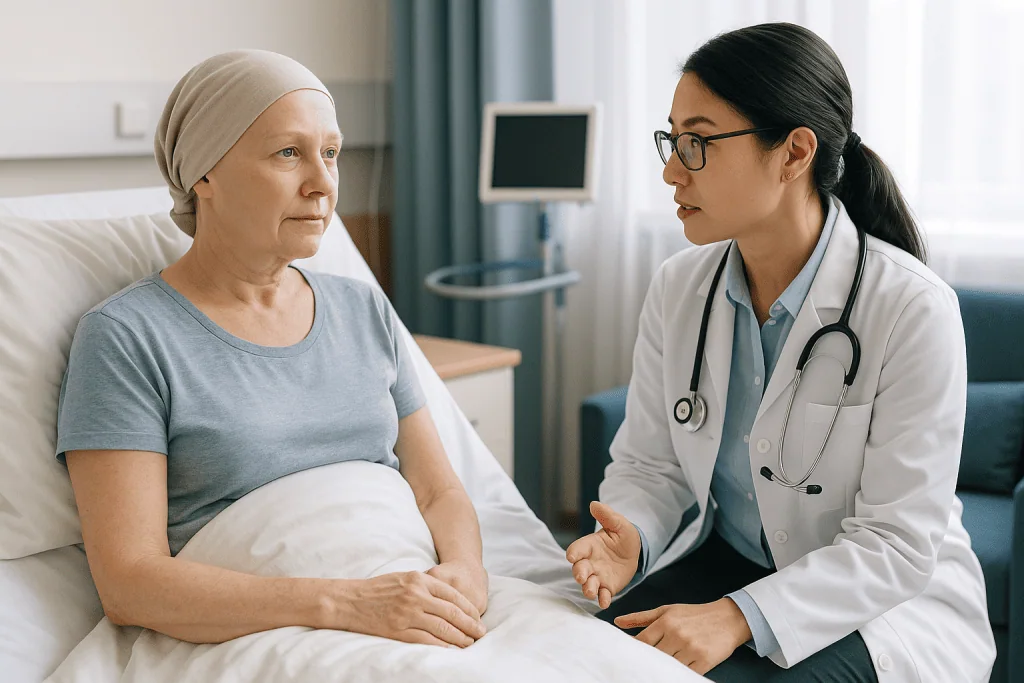
When the disease is widespread, or when someone is frail, poorly nourished or has heart or lung problems that would make a long anesthetic risky, teams often reverse the order. Three or so cycles of chemotherapy come first to shrink the tumor deposits; this is called neoadjuvant chemotherapy, meaning treatment given before the main operation. The operation that follows is called interval debulking surgery. The remaining cycles of chemotherapy are given afterward.
Both approaches are recognized in current guidelines, and the decision is made at a multidisciplinary team meeting where surgeons, oncologists, radiologists and pathologists review the same images together. People are sometimes disappointed to be asked to wait, reading it as a bad sign. It is more accurately read as a judgment about which order gives the operation the best chance of removing everything visible with the fewest complications.
A smaller group is asked to wait for other reasons. Anemia, uncontrolled diabetes, a recent blood clot or an active infection can all delay a date by days or weeks while they are corrected, because each raises the risk of wound problems or a longer stay. Some people with very early disease who hope to have children may be offered a more limited operation that preserves the uterus and one ovary, a choice that requires careful discussion and close follow-up.
None of this is decided by a formula. It is decided by the team who has seen your scans, and it is reasonable to ask them to explain the reasoning in plain terms.
The hospital days: what to expect after ovarian cancer surgery
You will wake up with more attached to you than you expected. A urinary catheter, a drip in one arm, possibly a drain from the abdomen, compression stockings or inflatable leg sleeves, and either a pump you press for pain relief or a small tube in your back delivering local anesthetic. Most of it comes out over the first two or three days.
The first surprise for many people is how early the nurses want them moving. Enhanced Recovery After Surgery, usually shortened to ERAS, is a bundle of evidence-based practices that includes sitting out of bed the same day or the next morning, drinking and eating early rather than waiting for the bowel to “wake up,” removing tubes promptly and using pain relief that spares the gut. The Cleveland Clinic and NHS describe this approach as standard for major gynecologic surgery, and the aim is straightforward: muscle strength, lung function and bowel movement all recover faster when the body is upright and fed.
Pain is managed in layers. Local anesthetic in the wound or spine handles the incision; regular paracetamol-type and anti-inflammatory medicines form the base; opioid medicines are added for breakthrough pain and reduced as quickly as comfort allows, because they slow the bowel and cloud thinking. Which combination you receive, and for how long, is the anesthetic and surgical team’s call.
Bloating, trapped wind and a first bowel movement that takes three or four days are normal after the intestines have been handled. Walking the corridor helps more than lying still. Coughing hurts; a folded pillow pressed against the wound makes it bearable and protects the stitches.
The NHS notes that most people go home within a few days to about a week after open surgery for ovarian cancer, earlier after keyhole surgery, and later if bowel was removed or a high-dependency stay was needed.
Ovarian cancer surgery recovery at home: the first two weeks
The first fortnight is about three things: the wound, the bowel and sleep.

The wound will be closed with dissolvable stitches, staples or glue, often covered by a dressing that can stay on in the shower. Some pinkness at the edges, a firm ridge under the skin and a numb patch around the scar are all expected. What is not expected is spreading redness, heat, a wound that opens, or a discharge that is thick or smells; those need a same-day call. Baths and swimming generally wait until the team says the skin has sealed, typically a few weeks according to MedlinePlus guidance on abdominal hysterectomy recovery.
The bowel is slower to forgive. Constipation is common because of reduced movement, less food and opioid pain relief; the team may suggest a stool softener or laxative, and fluids plus short walks matter as much as any tablet. Loose stool can also happen, particularly if the omentum or part of the bowel was removed, and it usually settles.
Fatigue is the symptom people most underestimate. After a long anesthetic and a large operation, the body is spending energy on healing tissue and rebuilding blood volume. A useful rule from the NHS: expect to feel tired for several weeks, and plan the day around one meaningful activity rather than a list.
Vaginal bleeding or brownish discharge in small amounts is normal in the first weeks after a hysterectomy; heavy bleeding is not. Lifting should be kept to things lighter than a full kettle for the first several weeks to protect the deep layer of the abdominal wall, which takes longer to knit than the skin above it.
Someone at home for the first few days is not a luxury. Shopping, stairs and the school run are all harder than they look on day five.
How long is recovery time after ovarian cancer surgery?
There is no single number, but there are reasonable ranges, and the table below gathers the ones most often quoted by MedlinePlus, the NHS and the Mayo Clinic. They describe typical experience after major abdominal surgery, not a promise for any individual, and your team may set different limits based on what was removed.
| Milestone | Open (midline) surgery | Keyhole surgery | What shifts the timeline |
|---|---|---|---|
| Hospital stay | A few days to about a week | 1–2 days | Bowel resection, stoma, high-dependency care |
| Walking outdoors, light housework | 1–2 weeks | Within the first week | Pain control, anemia |
| Driving | Usually 3–6 weeks, once an emergency stop is comfortable | 1–2 weeks | Insurer rules, ongoing opioid use |
| Desk-based work | Around 4–6 weeks | 2–3 weeks | Chemotherapy start date, fatigue |
| Heavy lifting, vigorous exercise | 6–8 weeks or longer | 4–6 weeks | Wound healing, surgeon’s advice |
| Sexual activity | About 6 weeks, after the internal wound is checked | About 6 weeks | Comfort, vaginal dryness |
Two patterns are worth noticing. First, the deep tissues lag behind how you feel. Many people feel well enough to lift a grandchild at week three; the abdominal wall is not ready, and an incisional hernia (a bulge where the muscle layer has not fully closed) is the price of testing it. Second, the calendar is often set by chemotherapy rather than by the wound. If treatment starts at week four, the return to full-time work is usually planned around the cycles rather than the operation.
Older age, diabetes, smoking and a low blood count before surgery all tend to stretch these ranges. Being prepared for the longer end and pleasantly surprised is easier than the reverse.
Pain, bowels and bladder: what is normal in the weeks after debulking surgery?
Debulking surgery recovery is measured partly in what stops hurting and partly in what starts working again.
Wound pain follows a fairly predictable curve. It is worst in the first two or three days, eases steadily over the first two weeks and settles into an ache on movement, coughing or getting out of a low chair. A sharp, new pain that is different in character, or pain that gets worse after having been better, is a reason to call rather than to wait. Shoulder-tip pain after keyhole surgery is common and comes from gas used during the operation irritating the diaphragm; it usually fades within a couple of days.
Bowel habit takes longer to find its rhythm. Beyond the initial constipation, some people notice urgency, more frequent motions or a sense of incomplete emptying for several weeks, particularly if part of the bowel or the omentum was removed. Bloating that keeps returning, with vomiting or an inability to pass wind, can signal an obstruction, which is one of the reasons teams ask you to report it promptly.
The bladder is often the quiet casualty. A catheter left in for a day or two, plus swelling near the bladder from the hysterectomy, can leave a feeling of not fully emptying, a weak stream or leaking on coughing. The Cleveland Clinic notes that most of this settles as swelling subsides over the first few weeks; pelvic floor exercises help, and pain or burning on passing urine should be checked for infection.
Numbness around the scar and down the front of the thighs is a nerve effect and can persist for months. It is unsettling but rarely a problem in itself.
The medicines used for pain are chosen by the prescribing team; if a medicine is not controlling the pain, or is causing nausea, drowsiness or constipation you cannot tolerate, tell them rather than adjusting it yourself.
Surgical menopause, body image and other changes people rarely warn you about
Removing both ovaries before natural menopause produces menopause overnight, without the years of gradual hormonal decline that usually cushion it. Hot flushes, night sweats, vaginal dryness, disturbed sleep and low mood can begin within days of the operation. The NHS notes that the intensity often surprises people, and that it deserves a conversation rather than stoicism.
Whether hormone replacement therapy is appropriate depends heavily on the type of ovarian cancer. For some subtypes it is considered reasonable; for others, particularly certain low-grade or hormone-sensitive tumors, oncologists are cautious. This is a decision for the gynecologic oncologist, not for a general practitioner or a menopause website, and it is worth raising early. Non-hormonal approaches to flushes and vaginal moisturizers are also part of the discussion.
Bone and heart health change too. Estrogen protects bone density and blood vessels, so earlier menopause increases longer-term risk of osteoporosis and cardiovascular disease. Weight-bearing exercise, adequate calcium and vitamin D from diet, not smoking and blood pressure checks are the ordinary measures the American Heart Association and NHS recommend, and they matter more after surgical menopause, not less.
A midline scar, a stoma or a changed abdomen alters how people feel about their bodies, and about intimacy. Sexual activity is usually cleared around six weeks once the top of the vagina has healed, but readiness is emotional as well as physical. Lubricants, taking things slowly and an honest conversation with a partner are the practical starting points; a clinical nurse specialist or psychosexual counselor can help when it feels stuck.
If a temporary or permanent stoma was needed because a section of bowel was removed, a stoma nurse will teach you to manage it before discharge and follow you at home. Most people become confident within a few weeks, even though the first days feel impossible.
Chemotherapy after ovarian cancer surgery: when does it start and why?
For most people with ovarian cancer beyond the very earliest stage, surgery is followed by chemotherapy. The reasoning is simple: even when the surgeon removes everything visible, microscopic clusters of cells can remain on the peritoneum or in the bloodstream, and chemotherapy is the tool that reaches them.
Timing is a balance. Start too early and the wound and bowel have not healed; wait too long and the treatment loses some of its purpose. In practice, the NHS and National Cancer Institute describe chemotherapy typically beginning within a few weeks of surgery, once the incision has closed, blood counts have recovered and the pathology report has been reviewed. If bowel surgery or a complication occurred, that window may be pushed back. The precise date is chosen by the oncologist, and a few days either way does not change the plan.
The standard first-line treatment described in mainstream guidance is a platinum-based drug combined with a taxane, given as an infusion into a vein, usually in cycles about three weeks apart for around six cycles. Some people are also offered a targeted medicine that interferes with the blood supply tumors depend on, or, after chemotherapy, a maintenance tablet from the class known as PARP inhibitors, which block a DNA-repair pathway certain cancers rely on. Which of these applies depends on the cancer’s stage, its genetic features and your overall health. None of this is a recommendation; it is a map of the options your team will discuss.
Before the first cycle, expect a clinic appointment, blood tests, a discussion of side effects, and possibly a port or central line placed under the skin to spare your arm veins. Hair loss, tiredness, nausea, tingling in the fingers and toes, and a temporary drop in infection-fighting white cells are the effects most people ask about, and each has a management plan.
Reading the pathology report: stage, grade and what CA-125 does and does not tell you
About a week or two after surgery, the tissue removed has been examined under the microscope and the team can give you a stage. Stage describes how far the cancer has spread: stage 1 is confined to the ovaries, stage 2 has reached other pelvic organs, stage 3 involves the abdominal lining or lymph nodes, and stage 4 has spread beyond the abdomen, for example to the fluid around the lungs or the liver itself. Grade describes how abnormal the cells look and how quickly they are likely to grow.
People understandably search for what a stage means for their future. The honest answer is that stage is one of several factors, alongside the amount of disease left after surgery, the cancer’s subtype and its response to chemotherapy. The National Cancer Institute’s patient treatment summary explains that advanced ovarian cancer is treated with the aim of controlling the disease and that many people live for years with periods of treatment and remission. Numbers quoted online come from large historical groups and cannot be applied to one person; your oncologist can put your own result in context.
The report will also state whether any visible tumor was left behind, often recorded as the size of the largest remaining deposit. “Complete” or “optimal” cytoreduction means very little or none remained, which is why surgeons work so hard to achieve it.
CA-125, the blood protein mentioned earlier, is usually measured before surgery and before each chemotherapy cycle. A falling level is reassuring; a rising one is a prompt for scans, not a diagnosis in itself. It can be raised by inflammation, endometriosis and even surgery itself, so a single value should never be read in isolation. Genetic testing of the tumor and, often, of your own blood for inherited changes such as BRCA mutations is now routine and can affect both your treatment options and your relatives’ screening.
Eating and moving during recovery: what the evidence supports
Two ordinary things speed healing more than anything you can buy: protein and walking.
Surgery raises the body’s protein requirement because it is building new tissue and replacing blood loss. Appetite is often poor for the first weeks, so small, frequent meals with protein at each one, such as eggs, yogurt, fish, beans or a milk-based drink, work better than three large plates. The NHS and Mayo Clinic both note that people who lost weight before surgery, common when ascites and bloating made eating uncomfortable, may be referred to a dietitian. Constipation responds to fluids, fiber introduced gradually and movement; if bowel was removed, the team may temporarily advise a lower-fiber diet, and their advice overrides general rules.
Nutritional supplements marketed for cancer recovery have no evidence of benefit beyond correcting a measured deficiency, and some herbal products interact with chemotherapy. Anything beyond food should be cleared with the oncology pharmacist.
Movement follows a simple progression. Days one to fourteen: short walks several times a day, increasing by a few minutes each time. Weeks two to six: longer walks, gentle stretching, stairs, light housework. After six weeks, and with the surgeon’s agreement: swimming, cycling, resistance work and gradually anything you did before. Harvard Health and the American Heart Association summarize evidence that regular moderate activity during and after cancer treatment reduces fatigue, improves mood and sleep, and supports heart health, which matters after surgical menopause. Exercise during chemotherapy is encouraged rather than discouraged, scaled to how you feel on each day of the cycle.
Abdominal exercises such as sit-ups wait until the muscle layer has fully healed, usually beyond eight weeks. A physiotherapist can advise on rebuilding the core safely, and on lymphedema precautions if pelvic lymph nodes were removed.
How to live with ovarian cancer: the emotional side of recovery
The physical timeline has an end point. The emotional one is less tidy. Many people describe the weeks after surgery as the hardest of the whole experience: the adrenaline of diagnosis has drained away, the body feels foreign, and the calendar is suddenly full of appointments about a word they had never used about themselves.
Low mood, anxiety before scans and a sense of grief for the life planned before diagnosis are common and are not a sign of coping badly. The NHS and Mayo Clinic both point to clinical nurse specialists, psycho-oncology services and peer support groups as routine parts of cancer care, not add-ons for people who are “not managing.” Asking for a referral early, before a crisis, is the practical move.
Fertility loss deserves its own acknowledgment. Even for people who had not planned more children, the finality of a hysterectomy and oophorectomy can bring a sadness that surprises them. Counseling that specifically addresses this exists and is worth asking about.
Practically, living with ovarian cancer through treatment means learning your own pattern. Most people find that chemotherapy has predictable good and bad days within each cycle, and that planning work, social life and rest around that pattern restores a sense of control. Employers in many countries are required to make reasonable adjustments; a letter from the team often helps.
Family members are recovering too. Partners and adult children frequently carry anxiety they hide to protect you, and carer support services are available to them in their own right.
Follow-up after treatment usually involves regular clinic visits, symptom review and blood tests for several years, with scans if anything changes. Knowing the plan, and who to call between visits, is one of the most stabilizing things a team can give you.
What people often get wrong about ovarian cancer surgery recovery
Several beliefs circulate widely enough to deserve a direct correction.
“If I feel fine, I can lift and drive.” Feeling fine is about skin and pain relief. The muscle layer of the abdominal wall takes six to eight weeks or more to regain strength, according to MedlinePlus guidance on abdominal surgery recovery, and an incisional hernia is a real and avoidable complication. Driving depends on being able to brake hard without hesitation and on not taking sedating pain medicines, not on how you feel in the passenger seat.
“Bed rest is the safest way to heal.” The opposite is closer to the truth. Lying still raises the risk of blood clots in the legs and lungs, chest infections and muscle loss, which is why enhanced recovery programs get people walking within a day. Clots are among the most serious early complications after pelvic cancer surgery, and movement is the cheapest prevention.
“Chemotherapy after surgery means the operation failed.” It means the opposite: the operation did its job of removing visible disease, and chemotherapy addresses what no surgeon can see. It is the planned second half of treatment for most stages.
“A falling CA-125 means I am clear; a rising one means it is back.” The marker is a trend, not a verdict, and can be raised by inflammation and healing itself. Scans and examination decide, not one blood test.
“A special diet or supplement will stop it coming back.” No diet has been shown to prevent recurrence. Good nutrition supports healing and tolerating chemotherapy; that is its evidence-based role. Some supplements interfere with treatment.
“Menopause symptoms are just something to put up with.” Surgical menopause is abrupt and often severe, and there are recognized options, hormonal and non-hormonal, to be discussed with the oncology team.
“Everyone recovers at the same pace.” Age, what was removed, blood count and previous fitness all shift the timeline. Comparing yourself with a forum post is rarely useful.
Questions to ask your care team before and after surgery
Consultations are short and the days after them are long. Writing questions down, and bringing someone to write down the answers, changes what you take home. These are the ones people most often wish they had asked.
- Which organs do you expect to remove, and what would make you remove more or less once you can see inside?
- Will the operation be open or keyhole, and why that choice for me?
- Is there a chance I will need a stoma, and would it be temporary or permanent?
- Roughly how long do you expect me to stay in hospital, and will I go to a high-dependency unit first?
- What pain relief plan will I have, and who adjusts it if it is not working?
- How will surgical menopause be managed, and is hormone therapy an option for my type of cancer?
- When will I get the pathology result, and who will explain the stage and grade to me?
- Do you expect chemotherapy afterward, and how soon might it start?
- Will my tumor and my blood be tested for inherited gene changes, and what would the results mean for my family?
- When can I drive, lift, return to work and have sex, given the specific operation I am having?
- Who is my named contact between appointments, and what number do I call at night or at a weekend?
- What signs mean I should come back urgently rather than wait for my next visit?
- Is there a clinical nurse specialist, dietitian, physiotherapist or counselor I can be referred to now?
- What clinical trials, if any, would I be eligible for?
There is no wrong question, and no question that a good team has not heard before. If an answer is unclear, ask for it in different words. If a decision is being made, ask what the alternatives were and why this one was chosen for you.
When to call your doctor
Most of recovery is uneventful, and most calls to the ward or the cancer helpline end with reassurance. The ones that matter are the ones not made. Call your team the same day, or use emergency services if severe, for any of the following.
- A temperature of 38°C (100.4°F) or higher, shivering, or feeling suddenly unwell, at any point after surgery and especially during chemotherapy, when a low white cell count can turn a minor infection serious within hours.
- Redness spreading from the wound, heat, swelling, a wound that opens, or thick or foul-smelling discharge.
- Heavy vaginal bleeding, or bleeding that soaks a pad in an hour.
- Pain, swelling or warmth in one calf, or sudden breathlessness, chest pain or coughing up blood, which can signal a blood clot.
- Abdominal pain that is severe, worsening after improving, or accompanied by vomiting and an inability to pass wind or stool.
- Persistent vomiting, or being unable to keep fluids down for more than a day.
- Burning on passing urine, urine that is cloudy or bloody, or being unable to pass urine.
- A stoma that turns dark or stops producing output, or skin around it that breaks down.
- New confusion, fainting, or a racing heartbeat.
- Low mood that feels unmanageable, or thoughts of not wanting to be here.
You will be given a card or number for a 24-hour line before discharge; keep it by the phone and in your wallet. The NHS and Mayo Clinic are clear that people undergoing chemotherapy should treat a fever as an emergency rather than waiting to see if it settles. When in doubt, call. The team would rather hear from you ten times about nothing than miss the one call that mattered.
Frequently asked questions
What is the typical recovery time after ovarian cancer surgery?
Most people leave hospital within a few days to about a week after open surgery and need roughly six to eight weeks before returning to heavy lifting or vigorous exercise, according to NHS and MedlinePlus guidance. Keyhole surgery usually halves those ranges. Fatigue often lasts longer than wound pain, and the timeline stretches if bowel was removed or complications occurred. Your surgical team sets the limits that apply to your operation.
What is debulking surgery recovery like compared with a simple hysterectomy?
It is usually longer and more tiring because more tissue is removed and the operation lasts longer. A debulking operation may take out the ovaries, uterus, omentum, lymph nodes and sometimes sections of bowel or the spleen, so bloating, bowel changes and fatigue are more pronounced, and a stoma is possible. The wound itself heals on a similar timeline, but the body has more to repair beneath it.
When does chemotherapy after ovarian cancer surgery usually begin?
Typically within a few weeks of the operation, once the incision has healed, blood counts have recovered and the pathology report has been reviewed, as described by the NHS and the National Cancer Institute. The oncologist chooses the date, and a delay of days does not change the plan. If chemotherapy was given before surgery, the remaining cycles resume on a similar basis after recovery.
What can I expect after ovarian cancer surgery in the first 48 hours?
Expect a catheter, a drip, possibly a drain, compression on your legs and a pain relief pump or spinal tube, most of which are removed within two or three days. Nurses will ask you to sit out of bed and start drinking on the first day, part of enhanced recovery care. Bloating, trapped wind and drowsiness are normal. Coughing with a pillow held against the wound protects the stitches.
Can stage 3 ovarian cancer be treated?
Yes. Stage 3 disease, where cancer has reached the abdominal lining or lymph nodes, is routinely treated with a combination of debulking surgery and platinum-based chemotherapy, sometimes with targeted or maintenance medicines afterward. The aim is to remove all visible disease and control what remains. How any one person responds depends on the subtype, how much disease is left after surgery and its response to treatment, which your oncologist can discuss in your own context.
Who is a survivor of stage 4 ovarian cancer?
Stage 4 means the cancer has spread beyond the abdomen, for example to fluid around the lungs. People with stage 4 disease are treated with chemotherapy, often surgery, and increasingly with targeted and maintenance therapies, and the National Cancer Institute notes that many live for years with periods of treatment and remission. Survival statistics describe large historical groups and cannot predict one person’s course; your team can explain what applies to you.
What are the typical symptoms of stage 4 ovarian cancer?
Symptoms depend on where the cancer has spread and overlap heavily with earlier stages: persistent bloating from fluid in the abdomen, feeling full quickly, pelvic or abdominal discomfort and changes in bowel or bladder habit. Spread to the chest can cause breathlessness. None of these features confirms a stage, which is determined by scans and surgery, so new or persistent symptoms should be reported to your doctor rather than interpreted at home.
How do I live with ovarian cancer during and after treatment?
Most people find a rhythm by learning the pattern of good and harder days within each chemotherapy cycle and planning work, rest and social life around it. Regular gentle exercise, protein-rich meals, a named contact at the cancer center and early referral to a nurse specialist or counselor are the measures with the best evidence for wellbeing. Family members benefit from support too. Follow-up continues for years, and knowing the plan helps.
Will I go through menopause after ovarian cancer surgery?
If both ovaries are removed before natural menopause, yes, and it begins within days rather than years. Hot flushes, night sweats, vaginal dryness and disturbed sleep can be intense. Whether hormone replacement is suitable depends on the cancer subtype, so the decision belongs to your gynecologic oncologist. Non-hormonal options and vaginal moisturizers are also available. Earlier menopause raises long-term bone and heart risks, which exercise and diet help address.
When can I drive, work and have sex after ovarian cancer surgery?
Driving usually waits until you can perform an emergency stop without pain and are no longer taking sedating pain medicines, often three to six weeks after open surgery. Desk work commonly resumes around four to six weeks, adjusted around chemotherapy. Sexual activity is generally cleared at about six weeks once the top of the vagina has healed. These are typical ranges from NHS and MedlinePlus guidance; your team confirms yours.
References
This article is for general information only and is not a substitute for professional medical advice. Please consult a qualified doctor about your individual situation.

More from the Blog
Skin Cancer Excision Explained: Margins, Closure Options and What Happens to the Sample
A skin cancer excision procedure removes the visible tumor plus a rim of normal-looking skin, called the margin, usually under local anesthetic in an…

Before a Mastectomy: Blood Thinners, Herbal Products, Smoking and the Days Leading Up
Preparing for a mastectomy usually means giving your surgical and anesthesia team a complete list of prescription medicines, over-the-counter drugs and herbal products, following…
Sperm Banking Before Testicular Cancer Treatment: Why Your Team Raises It Early
Sperm banking before testicular cancer treatment means freezing one or more semen samples, ideally before surgery, chemotherapy or radiotherapy begins, because these treatments can…
How Long Do International Patients Stay After Mohs Surgery Before Flying Home?
No published guideline sets a fixed waiting period for flying after Mohs surgery. In practice, surgeons often ask patients with a simple closure to…
When Immunotherapy Enters a Cancer Treatment Plan: First Line, After Surgery or Later
Immunotherapy is used at several points in a cancer treatment plan, not only late. Depending on the cancer type, its stage and biomarker test…
Why Head Cancer Follow-Up Keeps Examinations and Scans on a Schedule After Treatment
Head and neck cancer follow up scans and examinations stay on a schedule because most recurrences appear within the first few years after treatment,…