

How Bladder Cancer Treatment Is Planned: Non-Muscle-Invasive and Muscle-Invasive Disease
Key Takeaways
- Bladder cancer treatment forks at the muscle wall: non-muscle-invasive tumors are managed with TURBT and bladder instillations, while muscle-invasive tumors call for chemotherapy plus cystectomy or chemoradiation.
- Grade travels with stage, so a high-grade Ta tumor is planned very differently from a low-grade one in the same T category.
- A second TURBT for high-risk T1 disease is standard practice to confirm depth, not a sign the first operation failed.
- BCG is a weakened bacterium that provokes an immune response in the bladder lining, and it is given in an induction course followed by maintenance for one to three years in higher-risk disease per the NCI.
- Cisplatin-based chemotherapy before cystectomy is recommended for eligible people because it treats cancer cells that may already have left the bladder, which surgery alone cannot reach.
- The NHS schedule for high-risk non-muscle-invasive disease is cystoscopy every 3 months for 2 years, every 6 months for 2 more, then yearly for life.
Bladder cancer treatment is planned around one finding: whether the tumor has grown into the bladder's muscle wall. Non-muscle-invasive disease is usually treated by removing the tumor through the urethra, often followed by medicine placed inside the bladder and scheduled cystoscopy checks. Muscle-invasive disease typically involves chemotherapy before removing the bladder, or combined chemotherapy and radiation to preserve it. The specialist team tailors the plan to stage, grade and overall health.
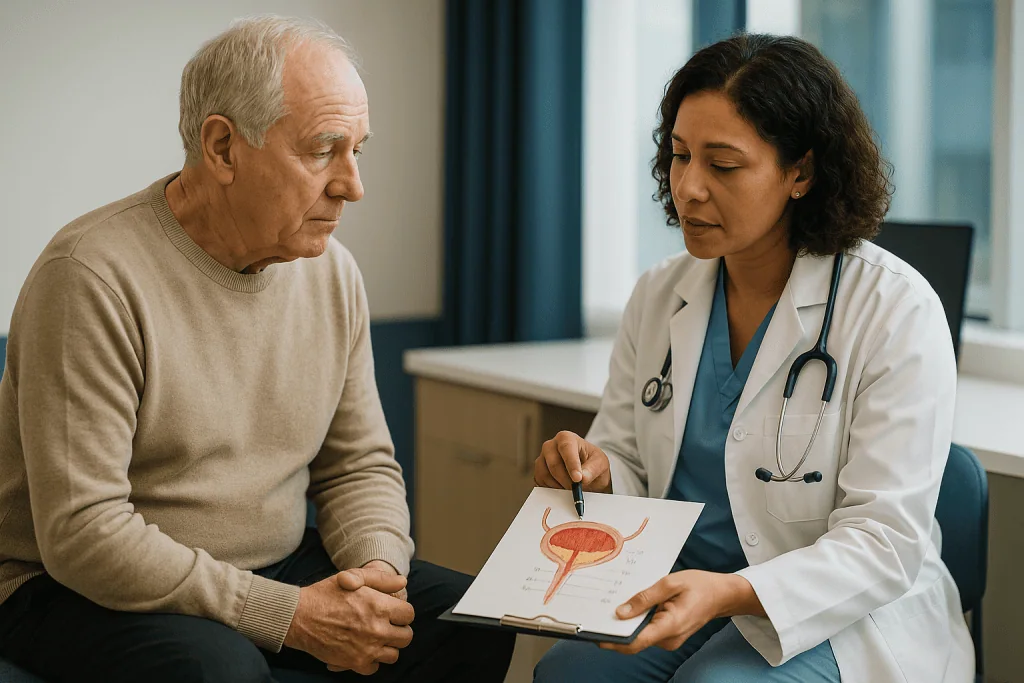
The urologist has drawn a bladder on the back of a leaflet. It looks like a deflated balloon with three pencil rings inside it. “Your tumor is here,” she says, tapping the innermost ring, “and the whole plan depends on whether it has crossed this line.” The man across the desk, who came in three weeks ago because his urine looked like weak tea, is trying to work out why a single pencil line matters so much.
It matters because bladder cancer treatment by stage is not one pathway but two, and the fork sits at the muscle wall. Cross it, and the conversation shifts from a day procedure and bladder instillations to chemotherapy, major surgery or radiation. Stay on the near side, and the emphasis moves to preventing the tumor from coming back and catching it early if it does.
This explainer walks through both pathways: what the pathologist is looking for, what each treatment actually involves, who is usually offered what, and what the weeks afterward tend to look like, so that the leaflet sketch makes sense before the next appointment.
Why bladder cancer treatment by stage begins with one question: how deep?
The bladder is a muscular bag lined with a thin layer of cells called the urothelium, and roughly 90% of bladder cancers start in that lining, according to the Cleveland Clinic. Everything in treatment planning depends on how far a tumor has traveled outward from the lining. Tumors that stay in the lining, or in the thin connective layer just beneath it, are called non-muscle-invasive. Tumors that reach the muscle wall are muscle-invasive. The two behave so differently that clinicians plan them almost as separate diseases.
Depth is established with a procedure called TURBT, short for transurethral resection of bladder tumor: a surgeon passes a thin telescope through the urethra, shaves away the visible tumor and sends the tissue to a pathologist. No incision is made. The report answers two questions that shape every later decision. Stage tells how deep the tumor reached. Grade tells how abnormal the cells look under the microscope, from low grade (closer to normal) to high grade (more disorganized and more prone to spread).
Imaging supplies the wider picture. A CT urogram, a scan that uses contrast dye to outline the kidneys, ureters and bladder, checks for tumors elsewhere in the urinary tract and for enlarged lymph nodes. Where the muscle is involved, scans of the chest and abdomen look for spread beyond the pelvis. The National Cancer Institute notes that most people are diagnosed while the tumor is still confined to the lining, which is one reason visible blood in the urine deserves prompt evaluation rather than a wait-and-see approach.
Strip away the jargon and bladder cancer treatment by stage is a decision tree with a single trunk: has the muscle been reached? Every branch grows from that answer.
Bladder cancer stages explained: Ta, T1, T2 and beyond
Doctors describe bladder cancer with the TNM system. T is the depth of the tumor, N is whether lymph nodes contain cancer, and M is whether it has spread to distant organs. The T categories are the ones most patients hear first, and they map neatly onto the pencil rings from the consulting room.
Ta means the tumor grows as a small outcrop on the lining without pushing beneath it. Tis, or carcinoma in situ, is a flat, high-grade patch that stays in the lining but is considered aggressive because of how the cells look. T1 means the tumor has entered the connective tissue under the lining but not the muscle. Ta, Tis and T1 together are non-muscle-invasive disease, which the NCI groups as stages 0 and I.
T2 means the muscle wall itself is involved. T3 means the tumor has pushed through the muscle into the fatty tissue around the bladder. T4 means it has reached neighboring structures such as the prostate, uterus, vagina or pelvic wall. Any N or M finding raises the overall stage, and spread to distant organs is stage IV regardless of how deep the bladder tumor itself is.
Two points get lost in the numbering. First, grade travels alongside stage: a high-grade Ta tumor is planned very differently from a low-grade one, even though both sit in the same T category. Second, the stage on the first TURBT report is provisional. If the pathologist cannot see muscle in the sample, the surgeon cannot be sure the tumor stopped short of it, and a second resection is often arranged before the plan is fixed. Stages are a starting map, not a verdict.
Non-muscle-invasive bladder cancer treatment: risk groups drive the plan
For tumors that have not reached the muscle, the TURBT that made the diagnosis is also the first treatment. What happens next is sorted by recurrence risk, because the central problem with non-muscle-invasive disease is not usually that it spreads but that it comes back. The NCI describes recurrence in the bladder as common after resection alone, which is why almost nobody is simply discharged after surgery.
Guidelines used across the UK and US place people into low, intermediate and high risk groups based on grade, stage, tumor size, number of tumors and whether carcinoma in situ is present. A single small, low-grade Ta tumor sits at the low end. Multiple tumors, large tumors or repeated recurrences push into the intermediate group. Any high-grade tumor, any T1 tumor and any carcinoma in situ is high risk.
The plan scales with the group. Low-risk disease is often managed with resection plus a single-episode chemotherapy instillation, meaning a chemotherapy medicine placed directly into the bladder through a catheter soon after surgery and drained away, followed by cystoscopy surveillance. Intermediate-risk disease usually adds a course of intravesical treatment over subsequent months, either chemotherapy or BCG. High-risk disease is typically treated with BCG given over an extended period, and for the highest-risk T1 tumors the team may discuss removing the bladder up front rather than waiting to see whether the tumor invades.
A second-look TURBT is a normal part of high-risk planning, not a sign that something went wrong. The NCI notes that a repeat resection can find residual tumor or reveal deeper invasion than the first sample showed, and it is done before committing to months of bladder treatment. Non-muscle-invasive bladder cancer treatment, in other words, is a proportional response: more risk, more intervention, closer watching.
What is BCG and why is it placed inside the bladder?
BCG stands for bacillus Calmette-Guérin, a weakened strain of the bacterium related to tuberculosis, and it has been used against bladder cancer for decades. It is not chemotherapy. When a liquid containing BCG is instilled into the bladder through a catheter and held for a period before being passed out, it provokes an inflammatory immune response in the bladder lining. That response appears to recruit immune cells that attack cancer cells the surgeon could not see. Mayo Clinic and the NCI both list BCG as the standard intravesical treatment for high-risk non-muscle-invasive disease.

Treatment usually comes in two phases. An induction course over several weeks begins some weeks after TURBT, once the resection site has healed. If the response is satisfactory, maintenance instillations follow at intervals, and the NCI treatment summary describes maintenance continuing for one to three years in higher-risk disease. The exact number and spacing of instillations is set by the treating urologist based on risk and tolerance, and it varies.
Side effects are mostly local and short-lived: burning on urination, frequency, urgency and sometimes blood in the urine for a day or two after each instillation. Flu-like symptoms with a low fever are also common. A high fever, or symptoms that persist beyond a couple of days, needs to be reported because BCG can, uncommonly, cause a body-wide infection that requires treatment.
Some tumors do not respond to BCG, or return during maintenance. The NHS and NCI describe the main options at that point as removal of the bladder, further intravesical treatment with a different agent, or systemic therapy including immune checkpoint inhibitors, a class of medicines that release the brakes on the immune system. Which of these is appropriate is a decision for the specialist team, weighed against the person’s overall health and preferences.
Muscle-invasive bladder cancer treatment: why the whole bladder is on the table
Once a tumor has reached the muscle, the goal changes. Scraping tumors off the lining is no longer enough, because cancer cells in the muscle wall have access to blood vessels and lymph channels and may already have left the bladder. The NCI describes radical cystectomy, removal of the whole bladder together with nearby lymph nodes, as a standard approach for T2 to T4a disease without distant spread. In men this typically includes the prostate; in women it may include the uterus, ovaries and part of the vagina.
Surgery is usually not the first step. Cisplatin-based combination chemotherapy given before the operation, called neoadjuvant chemotherapy, is recommended by the NCI for people fit enough to receive it, because it treats microscopic disease that has already escaped the bladder and can shrink the main tumor. The full course runs over a period of months, so the timeline from diagnosis to operation is longer than many people expect, and that delay is deliberate.
Removing the bladder means building a new way for urine to leave the body, called a urinary diversion. Mayo Clinic describes three main types. An ileal conduit uses a short piece of small intestine to carry urine to an opening on the abdominal wall, where an external bag collects it. A neobladder uses a longer intestinal segment shaped into a pouch connected to the urethra, allowing urination in a more familiar way, though often with relearning and, for some, catheter use. A continent cutaneous reservoir stores urine internally and is emptied by catheter through a small stoma. Which diversion is possible depends on kidney function, the extent of the tumor and the person’s ability to manage self-care.
Muscle-invasive bladder cancer treatment is major surgery with real recovery demands, and the alternatives deserve equal airtime.
Bladder preservation: when chemoradiation is considered instead
Not everyone with muscle-invasive disease has their bladder removed. The NCI and NHS both describe an alternative called trimodality therapy, which combines a thorough TURBT to remove as much tumor as possible, external radiation aimed at the bladder, and chemotherapy given alongside the radiation to make cancer cells more sensitive to it. The bladder stays in place.
This route tends to be considered for people whose tumor is a single lesion, is not associated with widespread carcinoma in situ, has not blocked a ureter and has left the bladder functioning reasonably well. It is also discussed for people who are not fit enough for a lengthy operation, or who feel strongly about keeping their bladder after hearing what a diversion involves. The NCI notes that trimodality therapy is a reasonable option in appropriately selected patients, while pointing out that head-to-head trials against cystectomy have been difficult to complete, so the evidence rests largely on single-arm series and comparisons across studies rather than direct randomization.
Preserving the bladder means keeping an organ that can grow new tumors. Surveillance cystoscopy continues indefinitely, and if invasive cancer returns in the treated bladder, removal, called salvage cystectomy, is the usual fallback. Radiation also has its own side effects: irritation of the bladder and bowel during treatment, and a longer-term chance of reduced bladder capacity or bleeding from fragile blood vessels in the lining.
There is no universal right answer here. A person with good kidney function, a solitary tumor and a strong preference for avoiding a stoma may reasonably choose one path; someone with multiple tumors and carcinoma in situ may be advised toward the other. The comparison belongs in a multidisciplinary discussion where a urologist, oncologist and radiation specialist are all present.
Who is usually offered which treatment, and who is asked to wait
Fitness for treatment is assessed as carefully as the tumor itself. Cisplatin, the backbone of the chemotherapy used before cystectomy, is hard on the kidneys, hearing and nerves, so the NCI notes that people with reduced kidney function, significant hearing loss, existing nerve damage or poor heart function are often not candidates. For them, the team may move to surgery alone, or to chemoradiation with a different sensitizing medicine, or discuss immune checkpoint inhibitors within a clinical trial or approved indication.
Age by itself is not a barrier. Frailty, measured by how well someone manages daily activities and recovers from illness, predicts complications far better than a birth date, and many people in their late seventies undergo cystectomy well. Conversely, a younger person with severe heart or lung disease might be steered toward bladder preservation.
Some people are asked to wait, and the reasons are usually protective rather than dismissive. After TURBT, BCG is delayed until the raw resection surface has healed, because live bacteria on an open wound raise the risk of a serious infection. High-risk tumors often prompt a second-look resection before any long course of treatment begins, so that the plan is built on an accurate stage. Between neoadjuvant chemotherapy and surgery there is a deliberate recovery gap so blood counts and kidney function can rebound.
Watchful waiting has a place too. For a small, low-grade recurrence in someone who has had several before, some urologists offer active surveillance, meaning regular cystoscopy without immediate resection, because these tumors rarely progress and each operation carries anesthetic risk. That approach is individualized, agreed with the patient, and abandoned promptly if the tumor grows or changes appearance. Waiting, in this context, is a monitored decision, never an absence of one.
Stage 4 bladder cancer: what treatment aims for
Stage IV covers two situations that feel very different in the consulting room: cancer that has grown into the pelvic or abdominal wall, and cancer that has spread to distant lymph nodes, bone, liver or lung. For the first, some people are still offered treatment aimed at removing or eliminating all visible disease, usually chemotherapy followed by surgery or radiation if the response is good. For the second, the NCI describes treatment as focused on controlling the cancer, extending life and easing symptoms.
Systemic treatment is the mainstay. Options described by the NCI include platinum-based chemotherapy, immune checkpoint inhibitors that help the immune system recognize cancer cells, antibody-drug conjugates that deliver a chemotherapy payload to cells carrying a specific surface protein, and targeted therapies for tumors with particular gene changes found on molecular testing. Which is used first, and in what sequence, depends on kidney function, tumor genetics and how the disease responds. These are decisions for the oncology team, revisited at each scan.
People understandably search for survival rates by age group. Published figures for distant-stage bladder cancer come from national registries and describe large populations treated over past years, often before newer medicines were widely used. They are not routinely broken down by age in a way that predicts an individual’s course, and this article deliberately does not quote a number: a registry average says nothing about one person’s tumor biology, treatment response or other health conditions. Asking the oncologist how those figures apply, and what the scans are showing, gives a far more useful answer.
Palliative care deserves a plain definition, because the phrase frightens people. It is specialist support for symptoms such as pain, bleeding or fatigue, offered alongside cancer treatment and not instead of it. Involving it early is standard practice, not a signal that treatment is being withdrawn.
Bladder cancer treatment by stage at a glance
The table below summarizes the usual starting point for each stage as described by the NCI and NHS. It is a map of typical options, not a prescription; individual plans routinely depart from it based on grade, fitness, kidney function and preference.
| Stage and depth | What it means | Usual treatment options | Main follow-up |
|---|---|---|---|
| Stage 0 (Ta, Tis) | Tumor confined to the lining | TURBT; post-operative chemotherapy instillation; BCG for carcinoma in situ or high grade | Cystoscopy on a risk-based schedule |
| Stage I (T1) | Into connective tissue, not muscle | TURBT with repeat resection; BCG induction and maintenance; cystectomy discussed for highest risk | Frequent cystoscopy, upper tract imaging |
| Stage II (T2) | Into the muscle wall | Neoadjuvant cisplatin-based chemotherapy then radical cystectomy; or trimodality chemoradiation | CT scans; cystoscopy if bladder preserved |
| Stage III (T3–T4a, or nodes) | Through muscle to fat or nearby organs | Neoadjuvant chemotherapy then cystectomy; chemoradiation; immunotherapy after surgery in some cases | Scans; blood tests; stoma or diversion care |
| Stage IV | Pelvic wall or distant spread | Systemic chemotherapy, immune checkpoint inhibitors, antibody-drug conjugates, targeted therapy; palliative radiation or surgery for symptoms | Scans every few cycles; symptom review |
Two features of the table repay attention. Follow-up is a column of its own because bladder cancer, at every stage, is a disease of watching: the lining that grew one tumor can grow another. And the middle rows show a genuine choice between surgery and bladder preservation, which means that people with muscle-invasive disease should expect to hear from both a surgeon and a radiation oncologist before deciding. If only one option is described, it is reasonable to ask why the other was ruled out.
What the following days and weeks usually look like
After TURBT, most people go home the same day or after one night, according to the NHS. A catheter may be left in briefly if the resection was large. Blood-tinged urine and a stinging sensation are expected for a few days, and drinking fluids steadily helps flush the bladder. Heavy lifting is discouraged for a couple of weeks while the resection site heals. Pathology results typically arrive within one to two weeks and set the next step.
Intravesical treatment settles into a rhythm. Each BCG or chemotherapy instillation is an outpatient visit: catheter in, medicine held in the bladder for a set period, then passed. The NHS advises sitting to urinate and cleaning the toilet with bleach for the first several hours after BCG, because the live bacteria are present in the urine. Irritative symptoms tend to peak the evening of treatment and ease over a day or two.
Radical cystectomy is a different scale of recovery. The NHS describes a hospital stay of around a week or more, with early walking, gradual return to eating and teaching from a stoma or continence nurse before discharge. Full recovery takes several weeks, and fatigue commonly outlasts the wound. People with a neobladder spend early weeks learning to empty by timing and abdominal pressure, and night-time leakage is common at first. Those with a conduit learn to change and empty the bag until it becomes routine.
Chemotherapy, whether before surgery or for advanced disease, is delivered in cycles with rest periods, and blood tests before each cycle check that counts have recovered. Chemoradiation involves daily weekday radiation visits for several weeks, with bladder and bowel irritation building toward the end and easing afterward. None of these timelines is a promise; they are the typical ranges described by the NHS and Mayo Clinic, and the care team adjusts them to the person.
How often should you have a cystoscopy after bladder cancer?
Cystoscopy after bladder cancer is where the disease is most often caught early, so the schedule matters more than almost anything else in the plan. A flexible cystoscope, a thin bendable telescope passed through the urethra under local anesthetic gel, lets the urologist inspect the whole lining in a few minutes as an outpatient.
Frequency follows the risk group, and UK guidance summarized by the NHS gives a clear framework. People with low-risk non-muscle-invasive disease usually have a cystoscopy at 3 months and again at 12 months after treatment; if both are clear, they may be discharged from routine surveillance with advice to report any new blood in the urine. Intermediate-risk disease is checked more often over the first couple of years and then yearly. High-risk disease is typically checked every 3 months for 2 years, every 6 months for the next 2 years, and then annually for life. High-risk follow-up also includes periodic imaging of the kidneys and ureters, because the same lining extends upward and can grow tumors there.
Urine tests for cancer cells, called urine cytology, are often added for high-grade disease because they can pick up flat carcinoma in situ that is hard to see. Newer urine biomarker tests exist, but guidelines currently treat them as supplements rather than replacements for looking directly at the bladder.
People who have had their bladder removed no longer need cystoscopy, but they do need scans and blood tests to check the lymph nodes, distant organs, kidney function and the remaining urethra and upper tract, on a schedule the oncology team sets. Anyone whose bladder was preserved with chemoradiation stays on a high-risk cystoscopy schedule indefinitely. The reassuring flip side of all this checking is that recurrences found on schedule are usually small and treatable again with TURBT.
What people often get wrong about bladder cancer treatment
“Non-muscle-invasive means it isn’t really cancer.” It is cancer, and high-grade T1 disease or carcinoma in situ can progress to the muscle if left untreated. The label describes depth, not seriousness. Grade tells the other half of the story.
“BCG is a kind of chemotherapy.” It is a live, weakened bacterium that works by provoking an immune response in the bladder lining. That is why the precautions after treatment, and the side effects, differ from those of chemotherapy instillations.
“Chemotherapy before surgery just delays the operation.” The delay is the point. The NCI recommends neoadjuvant cisplatin-based chemotherapy for eligible people because it treats cancer cells that may already have left the bladder, and surgery alone cannot reach those.
“Removing the bladder means the end of a normal life.” Adjustment is real and can be hard, and sexual function is affected for many people because of nerves and organs near the bladder. Even so, the NHS notes that most people return to work, travel, exercise and intimacy with support from stoma and continence specialists, and reconstructive options exist for erectile and vaginal changes. Asking about these before surgery is entirely appropriate.
“Once I’m in remission, I’m done.” Remission means no detectable cancer on current tests. In bladder cancer, the lining that produced one tumor can produce another years later, which is why surveillance continues. Missing a scheduled cystoscopy is the most common way an early, treatable recurrence becomes a later, harder one.
“It’s too late to stop smoking.” Smoking is the leading risk factor for bladder cancer, per the NHS, and continuing after diagnosis is associated with higher recurrence and worse tolerance of surgery and anesthesia. Stopping at any point still helps.
Questions to ask your care team
A bladder cancer consultation moves fast, and the terms are unfamiliar. Writing questions down beforehand, and bringing someone to take notes, turns a blur into a plan. These are the questions that tend to unlock the most useful answers.
- What is the exact stage and grade on my pathology report, and was muscle present in the sample so you can be confident about depth?
- Which risk group am I in, and what specifically put me there?
- Do I need a second TURBT before we decide on further treatment?
- If BCG is recommended, how long will the whole course run, and what would make you change course partway through?
- If my disease is muscle-invasive, am I a candidate for chemotherapy before surgery, and if not, why?
- Has bladder preservation with chemoradiation been considered for me, and what makes me a better or worse candidate for it?
- Which urinary diversion options are open to me, and what does daily life with each one involve?
- How will treatment affect sexual function, fertility and continence, and what support is available for each?
- What is my follow-up schedule for the next two years, and who do I contact between appointments?
- Are there clinical trials I could be considered for at this stage?
- What symptoms should prompt me to call rather than wait for the next visit?
- Who is on my multidisciplinary team, and have they all reviewed my case?
No question on this list is a challenge to the team. Clinicians expect them, and the answers often reveal reasoning that was not spelled out in the first appointment. The decision about treatment is shared, but the shared part only works if the person facing it understands the choices as clearly as the people offering them.
When to call your doctor
Most of the aftermath of bladder cancer treatment is expected and mild: stinging, urgency, a little blood, tiredness. A few signs are different, and they need a same-day call to the urology or oncology team rather than a note for the next appointment. The NHS and Mayo Clinic list the following as reasons to seek prompt care during or after treatment.
- Fever above 38.5°C (101.3°F), shaking chills, or feeling suddenly very unwell, especially within a few days of a BCG instillation or during chemotherapy when blood counts may be low.
- Heavy bleeding in the urine, clots, or urine that stops flowing because of a clot or blockage.
- Inability to pass urine for several hours despite the urge, or severe lower abdominal pain with a full bladder.
- Pain, redness, swelling or discharge at a surgical wound or stoma, or a stoma that turns dark or blue.
- Vomiting that prevents fluids from staying down, or signs of dehydration such as dizziness and very dark urine.
- New calf pain or swelling, chest pain or breathlessness after surgery, which can signal a blood clot.
- Persistent flank pain or a sharp drop in urine output after cystectomy, which may indicate a blocked ureter or kidney problem.
Between treatments, new or returning blood in the urine, even once, should be reported even if the next cystoscopy is months away. It may be nothing more than irritation, but it is the sign the whole surveillance program exists to catch, and the team would rather look and find nothing.
Every decision in this article, from the first resection to the choice between surgery and radiation, rests with the treating team who have seen the pathology and the scans. This explainer is for understanding the conversation, not replacing it.
Frequently asked questions
Can bladder cancer be in remission?
Yes. Remission means no cancer can be detected on current cystoscopy, scans or urine tests, and many people with bladder cancer reach that point after treatment. Because the bladder lining that produced one tumor can produce another, remission in this disease is monitored rather than assumed permanent, which is why cystoscopy or imaging continues for years. Staying on the follow-up schedule is what keeps a future recurrence small and treatable.
What is the survival rate for stage 4 bladder cancer in different age groups?
Published survival figures for distant-stage bladder cancer come from national registries describing large populations treated in past years, and they are not routinely broken down by age in a way that predicts an individual’s course. This article does not quote a number for that reason. Your oncologist can explain how those averages relate to your tumor biology, treatment response and other health conditions, which is far more meaningful than a population statistic.
Can you share some survival stories for people with bladder cancer?
A medical explainer cannot responsibly present individual stories, because one person’s course says little about another’s stage, grade or health. Many cancer charities and hospital support programs host moderated peer groups where people describe living with a stoma or neobladder, going through BCG, or managing advanced disease. Your care team or specialist nurse can direct you to reputable groups, and hearing from others who have been through the same treatment is genuinely valuable.
How often should you have a cystoscopy after bladder cancer?
It depends on your risk group. The NHS describes low-risk non-muscle-invasive disease being checked at 3 and 12 months, intermediate risk more often over the first couple of years and then yearly, and high-risk disease every 3 months for 2 years, every 6 months for 2 more years, and annually thereafter. People whose bladder was removed have scans instead. Your urologist sets the exact schedule based on your pathology.
Can you explain bladder cancer stages 0 to 4 in plain terms?
Stage 0 and stage I are non-muscle-invasive: the tumor sits in the bladder lining (Ta or Tis) or the connective tissue just beneath it (T1). Stage II means the muscle wall is involved. Stage III means the tumor has grown through the muscle into surrounding fat or nearby organs, or lymph nodes are involved. Stage IV means spread to the pelvic or abdominal wall or to distant organs. Grade, describing how abnormal the cells look, is reported alongside stage.
Is non-muscle-invasive bladder cancer treatment always BCG?
No. Low-risk tumors are often treated with TURBT plus a chemotherapy instillation into the bladder soon after surgery, followed by surveillance, without BCG. Intermediate-risk disease may receive a course of intravesical chemotherapy or BCG. BCG is the standard for high-risk disease, including high-grade tumors and carcinoma in situ, and for the highest-risk T1 tumors the team may discuss bladder removal instead. The choice follows the risk group and the person’s overall health.
Does muscle-invasive bladder cancer treatment always mean removing the bladder?
Not always. Radical cystectomy after chemotherapy is a standard approach described by the NCI, but trimodality therapy, combining a thorough TURBT with radiation and sensitizing chemotherapy, is an established alternative for suitable people, typically those with a single tumor, no widespread carcinoma in situ and a well-functioning bladder. Preservation requires lifelong cystoscopy and carries a chance of later salvage surgery. A surgeon and radiation oncologist should both be involved in the decision.
Why is chemotherapy given before bladder surgery instead of after?
Giving cisplatin-based chemotherapy before cystectomy treats microscopic cancer cells that may already have traveled beyond the bladder, shrinks the main tumor, and is delivered while the person is at their fittest, before major surgery. The NCI recommends it for eligible people with muscle-invasive disease. Chemotherapy or immunotherapy after surgery is sometimes used when high-risk features are found in the removed tissue and nothing was given beforehand.
What is a second TURBT and why might I need one?
A second, or re-staging, TURBT is a repeat resection performed some weeks after the first, usually for high-grade or T1 tumors or when the first sample contained no muscle tissue. The NCI notes it can reveal leftover tumor or deeper invasion than originally reported. Its purpose is to make sure months of bladder treatment are built on an accurate stage, and to catch muscle involvement that would change the whole plan.
Does quitting smoking still help after a bladder cancer diagnosis?
Yes. Smoking is the leading risk factor for bladder cancer according to the NHS, and continuing after diagnosis is associated with a higher chance of recurrence and poorer recovery from surgery and anesthesia. Stopping at any stage reduces exposure of the bladder lining to the chemicals concentrated in urine and improves general fitness for treatment. Your care team can connect you with stop-smoking support alongside your cancer plan.
References
This article is for general information only and is not a substitute for professional medical advice. Please consult a qualified doctor about your individual situation.

More from the Blog

Targeted Therapy for Chronic Myeloid Leukemia: How Daily Treatment and Monitoring Work
Targeted therapy for chronic myeloid leukemia uses daily oral tyrosine kinase inhibitors (TKIs) that block BCR-ABL1, the abnormal enzyme driving the disease. Treatment is…
Why a Dental Assessment Comes Before Head Cancer Radiotherapy and What It Involves
A dental assessment before head and neck radiotherapy is a specialist check of the teeth, gums and jaw carried out before treatment starts. Radiation…

What Happens After TURBT? How Pathology Results and Follow-Up Cystoscopy Guide the Next Steps
After TURBT, the removed tissue goes to a pathologist, whose report on stage, grade and the presence of bladder muscle in the sample decides…
Bone Marrow Transplant in Older Adults: Reduced-Intensity Conditioning and What Age Changes
Older adults can and do receive bone marrow transplants; fitness, organ function and the specific blood cancer matter more than a birthday. Reduced-intensity conditioning…

Who May Be a Candidate for HIPEC? Peritoneal Spread, Imaging and the Surgical Evaluation
People considered for HIPEC usually have cancer confined to the lining of the abdomen, a primary tumor type where the approach is supported by…
Your First Chemotherapy Infusion Day: Check-In, Blood Work, Pre-Medication and the Infusion
On a first chemotherapy infusion day, most people check in, have weight and vital signs recorded, give a blood sample, and wait for results…