

How Colon Cancer Treatment Changes With Stage and Tumor Location
Key Takeaways
- Colon cancer stage is set by depth of growth, lymph node involvement and distant spread, not by tumor size, so a small tumor with one positive node is stage III.
- Pathologists should examine at least 12 lymph nodes after colectomy, because too few can make a stage III cancer look like stage II and change the treatment offered.
- Chemotherapy is not standard for stage I colon cancer, and at stage II it is usually reserved for tumors with high-risk features such as T4 growth or obstruction.
- For stage III, trials found a three-month oxaliplatin-based course matched six months for lower-risk cases with less lasting nerve damage, so duration is a real decision point.
- Right-sided tumors are more often MSI-high and BRAF-mutated and present with anemia, while left-sided tumors more often cause bleeding or obstruction and respond better to anti-EGFR antibodies at stage IV.
- Rectal cancer, unlike colon cancer, is commonly treated with radiation plus chemotherapy before surgery because the fixed pelvis makes precise targeting possible and local recurrence has been a larger problem there.
Colon cancer treatment by stage generally moves from surgery alone for early tumors (stage 0 to I), to surgery with chemotherapy only for higher-risk stage II, to surgery followed by several months of chemotherapy at stage III, and to chemotherapy, targeted or immune therapy, and sometimes surgery on spread sites at stage IV. Tumor location and molecular testing further shape which drugs and procedures a care team recommends.
The call usually comes on an ordinary weekday. A pathology report has turned “a polyp we removed” into a word nobody wanted, and within a day the vocabulary changes: T3, N1, resection, adjuvant. People describe that first week as learning a new language while standing on a moving train.
What most of them want is a map. Not a promise, a map. Where is the tumor, how far has it traveled, and what does that mean for what happens next? That is exactly what oncologists mean by colon cancer treatment by stage: the stage is the coordinate system, and the plan follows from it.
Location matters more than people expect. A tumor in the right colon behaves differently from one near the rectum, right down to the drugs likely to help. This article walks through both dimensions, stage and place, so the conversation with your care team feels a little less foreign.
What does the stage of colon cancer actually mean?
Stage is shorthand for three questions, and every letter on a report answers one of them. T describes how deeply the tumor has grown through the layers of the colon wall, from the inner lining outward through muscle to the outer surface and beyond. N asks whether cancer cells have reached nearby lymph nodes, the small filters that sit along the blood vessels draining the bowel. M asks whether cells have traveled to distant organs, most often the liver or lungs, because blood leaving the gut passes through the liver first.
Those answers combine into stages 0 through IV. Stage 0, sometimes called carcinoma in situ, means abnormal cells confined to the innermost lining. Stage I has grown into the wall but not through it. Stage II has pushed through the wall, occasionally into neighboring tissue, but the nodes are clear. Stage III means lymph nodes are involved, regardless of how deep the tumor is. Stage IV means spread to a distant site, according to the National Cancer Institute.
Two practical details matter. The stage you hear before surgery is a clinical estimate built from scans and a biopsy; the definitive pathologic stage arrives only after a pathologist examines the removed bowel and its nodes. Guidelines ask that at least 12 nodes be examined, because too few can make a stage III cancer look like stage II. Second, stage is not size. A small tumor with one positive node outranks a large one with clean nodes, and treatment follows that logic.
Think of stage as coordinates rather than a verdict. It tells the team where the cancer is on the map. It does not, by itself, say how one person’s disease will behave.
Colon cancer treatment by stage: the big picture in one table
Before the detail, the shape of the whole thing. Each stage has a backbone treatment that most guidelines agree on, and a set of decisions that depend on the individual report. The table condenses what the National Cancer Institute, the NHS and Mayo Clinic describe as standard approaches for cancer of the colon; rectal cancer follows a different path and gets its own section below.

| Stage | Where the cancer is | Usual backbone | What is decided case by case |
|---|---|---|---|
| 0 | Inner lining only | Removal during colonoscopy or limited surgery | Whether margins are clean |
| I | Into the wall, not through it | Surgery (polypectomy or colectomy) | Whether a polyp removal is enough |
| II | Through the wall, nodes clear | Surgery; chemotherapy only if high-risk features | Whether chemotherapy adds enough to justify side effects |
| III | Lymph nodes involved | Surgery followed by chemotherapy | Drug combination and three- versus six-month course |
| IV | Distant organs involved | Systemic therapy; surgery or ablation of spread when feasible | Targeted or immune drugs based on molecular tests; sequence of treatments |
Two things jump out. Surgery anchors every stage except widespread stage IV, because removing the tumor both treats it and produces the definitive stage. And chemotherapy is not a default; it enters when the odds of unseen spread are high enough that the trade-off makes sense.
What the table cannot show is the second axis. A stage III tumor in the cecum and a stage III tumor in the sigmoid get the same chemotherapy plan but different operations, present with different symptoms, and, if they later spread, may respond to different targeted drugs. Keep that in mind as the sections below move down the colon.
Stage 0 and stage I: when removing the tumor is the whole plan
For the earliest tumors, the pathologist’s report is often the entire treatment. A stage 0 lesion or a small stage I cancer sitting inside a polyp on a stalk can sometimes be removed completely during colonoscopy, a procedure called polypectomy, in which the polyp is snared or lifted off the bowel wall. If the margins are clear, meaning no cancer cells at the cut edge, and the microscopic features look favorable, the National Cancer Institute notes that no further surgery may be needed.
Where the cancer has grown deeper, or a polyp cannot be removed in one clean piece, the standard step is a segmental colectomy: removing the section of colon containing the tumor together with its blood supply and the lymph nodes that drain it, then rejoining the two ends. The operation treats the tumor and stages it accurately in a single step.
Chemotherapy is not usually part of stage I care. The chance of hidden spread is low, and trials have not shown a benefit large enough to justify months of side effects. This surprises people who assume the word cancer always brings chemotherapy with it.
The team weighs a short list of microscopic findings: whether the polyp came out whole, whether cancer cells were seen inside small lymph or blood vessels, the tumor grade (how abnormal the cells look), and the distance from cancer to the cut margin. Any one of these can shift a “watch” decision toward a colectomy.
Afterward, surveillance takes over. Mayo Clinic describes a colonoscopy around one year after treatment, then at intervals the team sets based on what is found. Stage I is where the phrase “caught early” carries real weight, and where the argument for screening from age 45, as the CDC recommends for average-risk adults, is strongest.
Stage II colon cancer: who is offered chemotherapy and who is asked to wait
Stage II is where the room goes quiet at a tumor board. The tumor has grown through the wall, the nodes are clear, and the question is whether to add adjuvant chemotherapy, meaning drugs given after surgery to mop up cells too small to see on any scan.
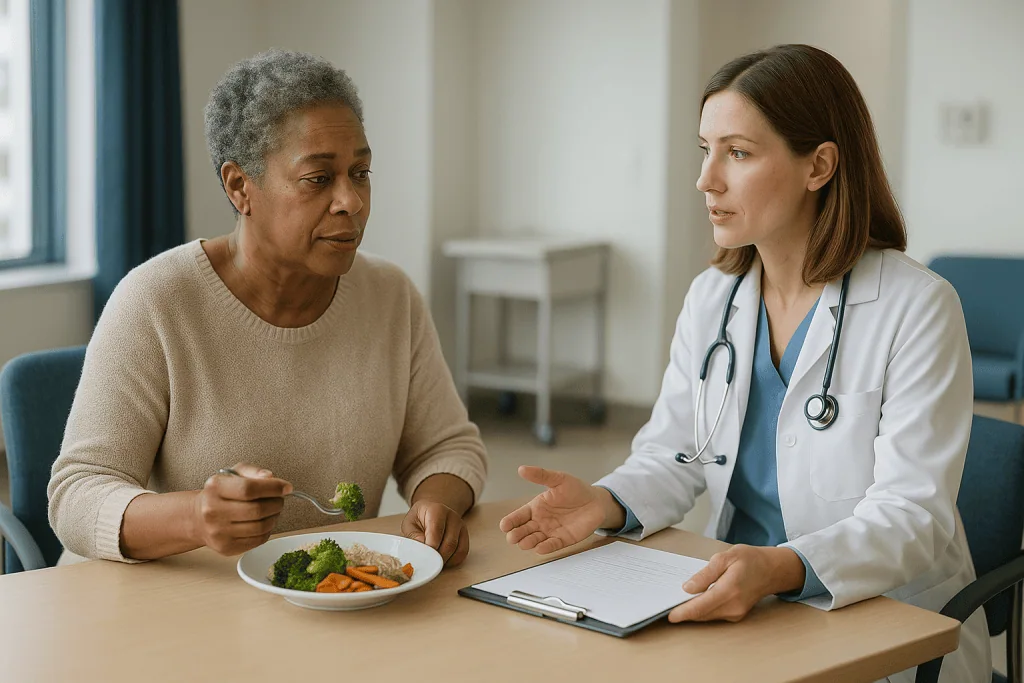
The evidence is genuinely mixed. For many people with stage II colon cancer, surgery alone is standard, and the National Cancer Institute summarizes trial data showing only a small or uncertain added benefit from chemotherapy for the group as a whole. So the team hunts for features that raise the odds of microscopic spread:
- tumor grown into the outer surface or a neighboring organ (T4)
- fewer than 12 lymph nodes examined
- cancer cells seen in lymph vessels, blood vessels or along nerves
- bowel obstruction or perforation at diagnosis
- high-grade, poorly differentiated cells
Who is usually offered chemotherapy: people with one or more of these features, particularly T4 disease. Who is usually asked to wait: those with none of them, and those whose tumor shows microsatellite instability, a pattern in which the tumor’s DNA repair machinery is faulty. These MSI-high tumors tend to behave more favorably at stage II, and the evidence suggests a fluoropyrimidine drug alone offers them little.
Blood tests that detect fragments of tumor DNA after surgery are being studied to sharpen this decision, but they are not yet standard in most guidelines.
If chemotherapy is recommended, it usually means a fluoropyrimidine, a class that interferes with the building blocks of DNA, sometimes paired with oxaliplatin, over a course the NHS describes as lasting several months. Few decisions in oncology are more personal. Some people want every possible edge; others weigh months of side effects against a modest gain. Both positions are reasonable, and the treating team should be able to lay out the numbers for your specific report.
Stage 3 colon cancer treatment: why surgery is followed by chemotherapy
Cancer in a lymph node changes the calculation. Once cells have shown they can travel, the working assumption is that some may already be circulating unseen, and adjuvant chemotherapy after colectomy is standard for most stage III colon cancers, according to both the National Cancer Institute and the NHS.
The backbone is usually a combination: a fluoropyrimidine plus oxaliplatin, a platinum-based drug that binds strands of DNA together so dividing cells cannot copy them. Oncologists refer to these regimens by acronyms; the letters simply stand for the generic drugs. Treatment runs in cycles, typically every two or three weeks, so healthy tissues can recover between rounds.
Duration has become a real conversation. Trials comparing three months with six months found that for lower-risk stage III cancers a shorter course gave similar results with less nerve damage, while higher-risk cases may still be offered the longer course. Your team will tell you which group your pathology falls into.
Expected side effects include fatigue, nausea, mouth soreness, diarrhea and lowered blood counts that raise infection risk. Oxaliplatin adds numbness and tingling in the hands and feet and a peculiar sensitivity to cold; that neuropathy can linger after treatment ends. Adjusting the plan when it appears is how teams protect long-term function, and those adjustments belong to the prescribing clinician.
Timing matters too. Chemotherapy generally begins within roughly six to eight weeks of surgery once healing allows, per the National Cancer Institute.
Radiation is not routine for stage III colon cancer. The colon moves, and the small bowel around it tolerates radiation poorly; it may be considered only when a tumor was stuck to an adjacent structure. That is a key difference from rectal cancer, covered below.
Stage 4 colon cancer treatment options: what "the last stage" does and doesn't mean
Stage IV is the highest stage; there is no stage V. But “last” is a poor word. It describes location, not a timeline. Within stage IV sit people with a single small liver deposit and people with disease throughout the abdomen, and the National Cancer Institute describes treatment paths for them that diverge sharply.
Three broad situations shape the plan. When spread is limited, often called oligometastatic, a few deposits in the liver or lung may be removed surgically or destroyed with heat or focused radiation, alongside removal of the bowel tumor and chemotherapy before or after. The stated aim is to leave no visible disease, and some people treated this way remain free of detectable cancer for long periods. When there is too much to remove now, chemotherapy may shrink it enough to make surgery possible later. When disease is widespread, the goal shifts toward controlling growth, protecting quality of life and extending time, using lines of systemic therapy given in sequence.
Systemic therapy here means chemotherapy combinations plus drugs chosen by molecular testing. Anti-VEGF antibodies block the signal tumors use to recruit blood vessels. Anti-EGFR antibodies block a growth receptor on the cell surface and help only when RAS and BRAF genes are normal. Immune checkpoint inhibitors release the brakes on the immune system and are used for MSI-high tumors. Specific inhibitors exist for a BRAF mutation called V600E.
People ask about life expectancy, and the honest answer is that published survival statistics are averages of everyone diagnosed years ago across all three situations. They cannot be applied to one person, and the drugs available have changed what stage IV means. Ask your team for a range based on your disease burden, molecular profile and response to the first treatments. Palliative care alongside active treatment is symptom control, not surrender.
Right vs left sided colon cancer: why location changes the plan
The colon is not one organ so much as two that grew together. The right side, from the cecum through the ascending colon to about two-thirds of the transverse colon, develops from the embryonic midgut. The left side, descending and sigmoid, develops from the hindgut. They have different blood supplies, different gene activity in their lining, and, as the National Cancer Institute describes, different tumor biology.
Right-sided tumors are more likely to be MSI-high, to carry a BRAF mutation, and to produce mucus. They are also quieter. The right colon is wide and its contents are liquid, so a tumor can grow large before anything blocks, and the first clue is often iron-deficiency anemia with tiredness rather than a change in bowel habit. Left-sided tumors sit where the lumen is narrower and stool is formed, so they tend to announce themselves earlier with visible bleeding, narrowed stools or obstruction.
The operation differs. A right hemicolectomy removes the cecum and ascending colon and rejoins small bowel to transverse colon, a join that heals reliably. Left-sided and sigmoid resections create a join lower in the bowel where leaks are somewhat more common, and a temporary stoma is more often part of the plan. Tumors at the splenic flexure, the sharp bend under the spleen, are technically the most awkward.
In stage IV, sidedness has become a treatment variable. Trials found that anti-EGFR antibodies help people with RAS-normal left-sided tumors considerably more than those with right-sided ones, and guidelines now factor side into the choice of first-line drugs. Immunotherapy, by contrast, matters more on the right because MSI-high tumors cluster there.
What location does not change is the adjuvant chemotherapy plan for stage III. Both sides get the same backbone.
What if the tumor is in the rectum? A different playbook
The rectum is the final stretch of the large bowel, roughly the last 15 centimeters, and it is treated by different rules for anatomical reasons. It sits deep in a narrow bony pelvis, close to the bladder, the reproductive organs, the nerves controlling them and the anal sphincter. It lacks the outer protective layer the colon has, so tumors reach neighboring tissue sooner, and the surgical margins are tight. Local recurrence has historically been a bigger problem here than anywhere else in the bowel.
Those same features make radiation practical. The pelvis holds still, so a beam can be aimed precisely. For stage II and III rectal cancer the National Cancer Institute describes radiation combined with chemotherapy given before surgery, called neoadjuvant chemoradiation, to shrink the tumor and reduce the chance it returns in the pelvis. Surgery then removes the rectum with its surrounding fatty envelope in one block, a technique called total mesorectal excision. Chemotherapy may follow. Increasingly, teams deliver all the chemotherapy and radiation up front, an approach called total neoadjuvant therapy.
A small number of people whose tumor disappears completely on scans and examination after that treatment are offered close observation instead of surgery, but this is not standard everywhere and is undertaken with intensive follow-up. Whether the sphincter can be preserved, or a permanent stoma is needed, depends largely on how close the tumor sits to the anal opening. A temporary ileostomy to protect a low join is common.
This matters for a colon cancer reader because tumors near the junction of sigmoid and rectum can be classified either way, and that label decides whether radiation is on the table. Ask which category your team is using and why.
What the tumor's biology adds: MSI, RAS and BRAF testing
Two people with identical stages can leave clinic with different plans because of what the laboratory finds inside the tumor. A handful of tests now shape treatment, and each is worth understanding in plain terms.
Mismatch repair testing looks at whether the tumor can fix small copying errors in its DNA. When it cannot, the tumor is called MMR-deficient or MSI-high, and it accumulates thousands of mutations. Guidelines recommend this test for every colorectal cancer, partly because it screens for Lynch syndrome, an inherited condition that raises cancer risk across several organs and has implications for relatives. In stage IV, MSI-high tumors respond to immune checkpoint inhibitors, and the National Cancer Institute reports trial results showing these drugs outperformed chemotherapy as a first treatment in that group. In stage II, the same finding argues against chemotherapy alone.
RAS testing examines the KRAS and NRAS genes. A mutation locks a growth switch permanently on, downstream of the EGFR receptor, which is why anti-EGFR antibodies do nothing for those tumors. Roughly half of colorectal cancers carry a RAS mutation, so this test is routine before those drugs are considered in stage IV.
BRAF testing identifies a mutation, most often V600E, that marks a more aggressive tumor, is commoner on the right side, and has its own targeted drug combinations. HER2 amplification is checked in some stage IV cases because specific antibodies exist for it.
A baseline CEA blood level, a protein many colon tumors release, is drawn before surgery so it can serve as a marker later. None of these results dictate a plan on their own. They narrow the menu, and the treating team chooses from it with you.
What actually happens during colon cancer surgery
The operation most people have is a colectomy under general anesthesia. Before it, a pre-assessment checks heart and lung fitness, and a bowel-cleansing preparation is usually prescribed. Many centers now use enhanced recovery pathways: a carbohydrate drink the evening before, no prolonged fasting, and walking within a day of surgery.
Inside, the surgeon removes the segment containing the tumor with a margin of healthy bowel on either side, together with the wedge of fatty tissue carrying its blood vessels and lymph nodes. That wedge is the key to accurate staging. The two healthy ends are then joined, either with sutures or a stapling device, forming an anastomosis.
Most colectomies are performed laparoscopically, through several small incisions with a camera, and sometimes with robotic assistance. Trials summarized by the National Cancer Institute found keyhole approaches gave the same cancer outcomes as open surgery with shorter recovery. Open surgery is still chosen for very large tumors, dense scar tissue, or emergencies.
A stoma, an opening of the bowel onto the abdominal wall drained by a pouch, is created when a join is judged too risky to rely on or cannot be made. Most stomas after colon surgery are temporary and are reversed in a second, smaller operation months later; a minority are permanent.
Risks are described in neutral terms by every consent form: bleeding, wound infection, a leak at the join, a temporary shutdown of bowel movement called ileus, blood clots, injury to nearby organs, and hernia at an incision later on. For people too frail for a major operation, alternatives include a stent to hold an obstructed bowel open, a diverting stoma alone, or systemic therapy without surgery. Which path is safest is the surgical team’s call, made with you.
What the weeks after surgery and during treatment usually look like
The first days are about the bowel waking up. Passing gas is celebrated on surgical wards for good reason; it signals the anastomosis is working. The NHS describes a hospital stay of a few days to a week after bowel cancer surgery, with several weeks of recovery at home before energy returns. Pain is managed with a stepped approach, and walking is encouraged early because it reduces clot risk and speeds bowel recovery.
Bowel habits change. With a shorter colon, stools are often looser and more frequent at first, particularly after left-sided resections, and they settle gradually over months. A dietitian can help with pacing fiber and fluids. Lifting restrictions typically apply for several weeks; driving and returning to work depend on the individual and the job.
If chemotherapy is planned, it begins once healing allows, generally within six to eight weeks. A port, a small device under the skin of the chest, may be placed to spare arm veins. Each cycle follows a pattern: blood tests, infusion or tablets, a predictable dip in energy and appetite a few days later, then recovery before the next round. Keeping a simple diary of side effects gives the team what it needs to adjust.
After active treatment ends, surveillance starts. Mayo Clinic and the National Cancer Institute describe periodic visits with a CEA blood test every few months for the first years, CT scans of chest, abdomen and pelvis on a schedule set by stage, and colonoscopy around one year after surgery, then at three years and then five if clear. The logic is straightforward: most recurrences appear within the first few years, and finding them early keeps more options open.
What people often get wrong about colon cancer treatment by stage
“Stage IV means nothing can be done.” It means distant spread, nothing more. Some people with limited liver or lung deposits have surgery aimed at removing all visible disease; others live with controlled disease through several lines of therapy. Treatment intent is set by the pattern of spread, not the Roman numeral.
“Everyone with cancer gets chemotherapy.” Most stage I and many stage II colon cancers are treated with surgery alone. Adding chemotherapy where trials show little benefit adds side effects without adding safety.
“If the surgeon got it all, why do I need chemotherapy?” Because “all” refers to what can be seen and felt. Adjuvant therapy targets cells that may have slipped into circulation before surgery, which is why lymph node status, not the surgeon’s confidence, drives the decision.
“A bigger tumor means a higher stage.” Depth and node involvement decide stage; a small tumor with one positive node is stage III.
“Right and left colon cancers are the same disease.” They differ in biology, symptoms, surgery and, at stage IV, drug choice.
“A survivor I read about proves this treatment works.” Individual stories are real and worth celebrating. They usually involve a particular situation, often removable spread and a favorable tumor profile, that may or may not match yours. Build the plan on your own pathology and molecular report.
“Sugar feeds cancer, so cutting it out shrinks the tumor.” Every cell uses glucose. No diet, supplement or alkaline regimen has been shown to treat colon cancer, and unproven products can interfere with prescribed drugs. Eating well during treatment matters for strength and recovery, which is a different claim.
“Colonoscopy or biopsy spreads cancer.” There is no evidence for this, and skipping the procedure delays the one thing that changes the outcome: knowing the stage.
Questions to ask your care team
Consultations run short and memories run shorter. Write questions down, bring someone to take notes, and ask permission to record the conversation. The list below is built around the decision points in this article; not every question will apply to you.
- What is my clinical stage now, and what could change it once the pathology is back?
- How many lymph nodes were examined, and how many contained cancer?
- Is my tumor right-sided, left-sided or rectal, and how does that affect the plan?
- Has the tumor been tested for mismatch repair status, RAS, BRAF and HER2? What did the results show, and should my family be offered genetic counseling?
- If chemotherapy is recommended, what is the expected benefit for someone with my exact report, and what happens if I decline or stop early?
- Are we discussing a three-month or six-month course, and why?
- Will I need a stoma? If so, is it likely to be temporary, and when would reversal be considered?
- Is keyhole surgery an option for me?
- For stage IV: is the goal to remove all visible disease, to make that possible later, or to control the cancer long term?
- Which side effects should I report the same day, and whom do I call after hours?
- Could a clinical trial be appropriate, and how would I find out?
- What will follow-up look like, and for how long?
- Who coordinates my care across surgery, oncology and nursing?
One more question is worth asking out loud: what matters most to you, and does the team know it? Someone who works with their hands may weigh neuropathy risk differently from someone who does not. Guidelines set the menu. Your values help choose from it, and a good team wants to hear them.
When to call your doctor
Treatment for colon cancer creates a few situations where waiting until the next appointment is the wrong move. Your team will give you a direct number; use it. Seek urgent care or emergency help for any of the following.
During chemotherapy, a temperature of 38°C (100.4°F) or higher, or shivering and feeling unwell even without a measured fever, needs same-day assessment. Chemotherapy lowers white blood cells, and the NHS and Mayo Clinic both describe infection in that window as an emergency because it can worsen within hours. Other same-day calls include vomiting that stops you keeping fluids down for more than a day, diarrhea that is severe or contains blood, and dizziness or reduced urination suggesting dehydration.
After surgery, call for a wound that becomes red, hot, swollen or leaks fluid; abdominal pain that is worsening rather than easing; a swollen, tight belly with no gas or stool passing; or persistent vomiting. These can signal a leak at the join or an obstruction. A stoma that turns dark purple or black, or that stops producing output while the abdomen swells, needs prompt review.
At any point, treat sudden breathlessness, chest pain, or a painful swollen calf as a possible blood clot and seek emergency care. The same applies to heavy rectal bleeding, black tarry stools, new confusion, a seizure, yellowing of the skin or eyes, or new severe headache.
Symptoms that are less dramatic but persistent still deserve a call: numbness that interferes with buttoning a shirt, mouth soreness that stops you eating, or a mood that has sunk and stayed there. None of these should be endured quietly. Adjustments exist for all of them, and the people best placed to make those adjustments are the ones treating you.
Frequently asked questions
What is the life expectancy for someone with stage 4 bowel cancer with treatment?
There is no single figure that applies to an individual. Published survival statistics are averages across everyone diagnosed with stage IV years ago, from people with one removable liver deposit to people with widespread disease, and treatments have changed since. Your treating team can give a realistic range based on how much disease there is, where it sits, its molecular profile and how it responds to the first line of therapy.
Can you survive stage 2 colon cancer?
Many people treated for stage II colon cancer never have it return. At this stage the tumor has grown through the bowel wall but not reached lymph nodes or distant organs, and surgery alone is standard for those without high-risk features. Chemotherapy is added when features such as T4 growth, obstruction or too few examined nodes raise the risk. Follow-up with blood tests, scans and colonoscopy is designed to catch any recurrence early.
Colon cancer stages explained: what is the last stage of colon cancer?
Stage IV is the highest stage, meaning the cancer has spread to a distant organ such as the liver or lungs. It is not a single situation. Some people have limited spread that can be surgically removed or destroyed, others have disease that chemotherapy may shrink to make surgery possible, and others have widespread disease managed with ongoing systemic treatment. Treatment goals are set by that pattern rather than by the stage number alone.
Who are some successful survivors of stage 4 colon cancer?
People living years after a stage IV diagnosis are real, and their stories usually share features: limited spread that surgeons could remove, tumor biology that responded to targeted or immune drugs, and continued follow-up. Names matter less than the pattern. Ask your team whether your own disease fits any of those situations, because that is the information that actually shapes your plan.
What is the treatment for stage 3 colon cancer?
Stage III colon cancer is usually treated with surgery to remove the tumor segment and its lymph nodes, followed by adjuvant chemotherapy, most often a fluoropyrimidine combined with oxaliplatin given in cycles over three to six months. Chemotherapy generally starts within about six to eight weeks of surgery. Radiation is not routine for colon cancer at this stage, unlike rectal cancer. The exact regimen and duration are decided by the oncology team.
What are the stage 4 colon cancer treatment options?
Options include chemotherapy combinations, targeted antibodies chosen by molecular testing such as anti-VEGF and anti-EGFR drugs, immune checkpoint inhibitors for MSI-high tumors, BRAF-directed combinations, and surgery or ablation of liver or lung deposits when spread is limited. Radiation may control specific painful or bleeding sites. Palliative care runs alongside to manage symptoms. Which combination and sequence is appropriate depends on disease extent, tumor genetics and overall health.
Does the location of a colon tumor change treatment?
Yes. Right-sided and left-sided tumors need different operations, tend to present differently, and at stage IV respond differently to targeted drugs, with anti-EGFR antibodies helping RAS-normal left-sided tumors more. Right-sided tumors are more often MSI-high, which makes immunotherapy relevant. Tumors in the rectum follow a separate pathway that commonly includes radiation before surgery. Adjuvant chemotherapy for stage III is the same on both sides of the colon.
Is chemotherapy always needed after colon cancer surgery?
No. Stage I cancers are almost always treated with surgery alone, and many stage II cancers are too, because trials show little added benefit from chemotherapy in those groups. Chemotherapy is standard after surgery for stage III, when lymph nodes contain cancer, and is considered for stage II tumors with high-risk features. The decision weighs the expected reduction in recurrence against months of side effects.
How long is recovery after colon cancer surgery?
Most people spend a few days to a week in hospital after a colectomy and need several weeks at home before energy returns, according to the NHS. Keyhole surgery tends to shorten recovery compared with open surgery. Bowel habits are often looser and more frequent at first and settle over months. Chemotherapy, if planned, usually begins once healing allows, typically within six to eight weeks.
Why is my tumor tested for MSI, RAS and BRAF?
These tests change treatment rather than just describing the tumor. Mismatch repair or MSI status identifies tumors that respond to immune checkpoint inhibitors and screens for inherited Lynch syndrome. RAS mutations mean anti-EGFR antibodies will not work. A BRAF V600E mutation marks a more aggressive tumor with its own targeted drug combinations. Results help the team narrow the menu of options for your specific cancer.
References
- NHS: Bowel cancer – Treatment
- Cleveland Clinic: Colorectal (Colon) Cancer
- MedlinePlus: Colorectal Cancer
- CDC: Screening for Colorectal Cancer
This article is for general information only and is not a substitute for professional medical advice. Please consult a qualified doctor about your individual situation.

More from the Blog

Targeted Therapy for Chronic Myeloid Leukemia: How Daily Treatment and Monitoring Work
Targeted therapy for chronic myeloid leukemia uses daily oral tyrosine kinase inhibitors (TKIs) that block BCR-ABL1, the abnormal enzyme driving the disease. Treatment is…
Why a Dental Assessment Comes Before Head Cancer Radiotherapy and What It Involves
A dental assessment before head and neck radiotherapy is a specialist check of the teeth, gums and jaw carried out before treatment starts. Radiation…

What Happens After TURBT? How Pathology Results and Follow-Up Cystoscopy Guide the Next Steps
After TURBT, the removed tissue goes to a pathologist, whose report on stage, grade and the presence of bladder muscle in the sample decides…
Bone Marrow Transplant in Older Adults: Reduced-Intensity Conditioning and What Age Changes
Older adults can and do receive bone marrow transplants; fitness, organ function and the specific blood cancer matter more than a birthday. Reduced-intensity conditioning…

Who May Be a Candidate for HIPEC? Peritoneal Spread, Imaging and the Surgical Evaluation
People considered for HIPEC usually have cancer confined to the lining of the abdomen, a primary tumor type where the approach is supported by…
Your First Chemotherapy Infusion Day: Check-In, Blood Work, Pre-Medication and the Infusion
On a first chemotherapy infusion day, most people check in, have weight and vital signs recorded, give a blood sample, and wait for results…