

Red Light Therapy: The Home-Panel Boom vs the Clinical Data
Key Takeaways
- Red light (630–660 nm) penetrates only a few millimeters of tissue, while near-infrared (810–850 nm) reaches somewhat deeper, so panels plausibly affect skin, follicles, and superficial muscles, not internal organs.
- The best-supported home uses are skin texture and fine lines, and pattern hair loss, where sham-controlled trials show modest gains after roughly 8–26 weeks of consistent use.
- "FDA-cleared" on a light device is a safety and similarity judgment, not proof of effectiveness: a distinction most marketing quietly exploits.
- Light dosing is biphasic: published benefits cluster around specific delivered doses, and longer sessions can blunt rather than boost the effect.
- Independent measurements have found some consumer panels deliver a fraction of their advertised intensity at realistic distances, so trial results may not transfer to your device.
- Skip unsupervised use over the eyes, changing skin lesions, or known tumors, and check with a clinician first if you take photosensitizing medication or have a light-sensitive condition like lupus.
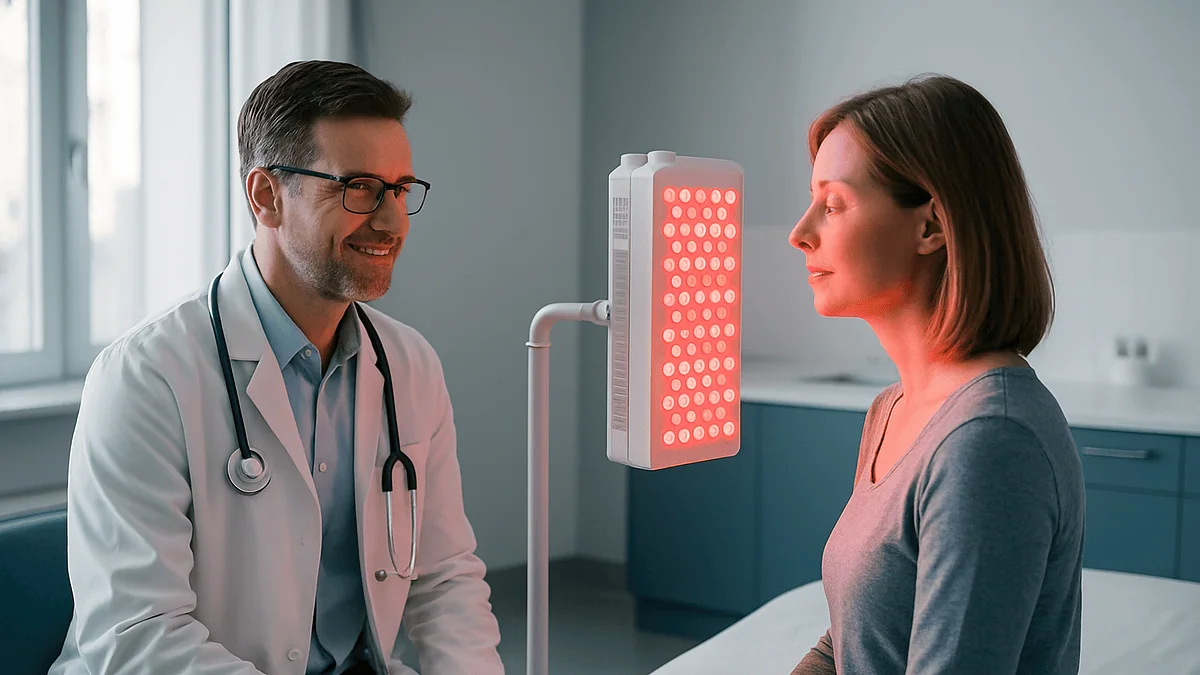
Red light therapy uses low-level red and near-infrared light to nudge cellular energy production, and controlled trials show modest, gradual benefits for skin texture, fine lines, and pattern hair loss. Evidence for pain relief is mixed, and claims about fat loss or hormones are unproven. It is generally safe for healthy adults, but home panels often deliver weaker doses than the devices studied in research.
There’s a spare bedroom in America right now glowing like a photography darkroom. A full-length panel, bought after a podcast episode, hums against the wall while its owner stands in front of it for ten minutes a day, hoping for better skin, thicker hair, and less knee pain, ideally all three.
The panels have jumped from dermatology offices and pro sports facilities into home gyms and bathroom counters, and the marketing has sprinted well ahead of the research. Depending on which ad you saw last, red light supposedly smooths wrinkles, melts fat, balances hormones, and speeds healing.
Some of that has genuine science behind it. Some of it has almost none. The honest story sits in the gap between a carefully calibrated clinical device used in a trial and the panel that arrived on your doorstep, and that gap is wider than most buyers realize.
What exactly does red light therapy do?
Strip away the branding and red light therapy, researchers call it photobiomodulation, is a dose of visible red light (roughly 630–660 nanometers) or near-infrared light (roughly 810–850 nanometers) delivered at intensities too low to heat or damage tissue. The idea traces back decades; NASA-funded work on LEDs in the 1990s helped move it from lasers to the panels sold today.
The leading explanation for how it works centers on mitochondria. An enzyme in the cellular energy chain, cytochrome c oxidase, absorbs photons at these wavelengths, which appears to modestly boost production of ATP: the molecule cells run on. Reviews in the dermatology literature, including a widely cited 2013 paper on light therapy in skin, describe downstream effects: brief signaling bursts of reactive oxygen species, release of nitric oxide, increased local blood flow, and stimulation of fibroblasts, the cells that make collagen.
Depth matters. Red light penetrates only a few millimeters, enough to reach the skin’s collagen-producing layer and hair follicles, but not your liver, thyroid, or deep joint cartilage. Near-infrared light travels somewhat farther, which is why devices aimed at muscles and joints lean on those wavelengths. Any claim that a surface panel is directly treating a deep internal organ deserves heavy skepticism.
So the mechanism is real and reasonably well described. Whether that cellular nudge translates into visible, meaningful results for a given problem is a separate question, and the answer changes dramatically depending on which problem you’re asking about.
Where the evidence is strong, where it's promising, and where it's thin
Not all red light claims are created equal, and lumping them together is how people end up either dismissing the whole field or believing all of it. A rough evidence map looks like this.
- Best supported: skin photoaging (fine lines, texture, collagen density) and androgenetic, pattern, hair loss. Multiple randomized, sham-controlled trials show modest benefits, which is why several devices have regulatory clearance for these uses. In hospital settings, light therapy is also used to help manage painful mouth sores during certain cancer treatments, under clinical supervision.
- Promising but inconsistent: short-term relief in tendon problems and joint pain, wound healing support, and muscle recovery after exercise. Some trials show benefit; others show nothing, often because doses and devices vary wildly between studies.
- Thin to essentially absent: fat reduction that lasts, hormone changes, thyroid treatment, “detoxification,” and systemic anti-aging effects. Here the marketing runs far ahead of any controlled human data.
Cleveland Clinic’s consumer summary lands in the same place: promising for certain skin applications, generally safe, and in need of larger, better trials for most everything else. That’s not a hedge: it’s an accurate description of a young field where the average study enrolls dozens of people, not thousands.
Keep this map in mind as you read the rest. The strongest home-use cases happen to be the ones where light only needs to travel a few millimeters, which is exactly what physics says it can do.
Does red light therapy actually work for wrinkles and skin?
This is the best-tested home use, and the data are genuinely encouraging, as long as you hold the word “modest” firmly in mind. A 2014 randomized controlled trial published in a peer-reviewed photomedicine journal followed 113 participants receiving red and near-infrared light treatments twice a week. Compared with controls, treated participants showed improved skin complexion and feeling, reduced skin roughness, and, the detail dermatologists care about, increased collagen density measured by ultrasound, not just self-report.
Harvard Health’s review of LED skin devices reaches a similar verdict: there is credible evidence that red wavelengths can soften fine lines and improve texture over time, though results are subtle and build gradually. Think eight to twelve weeks of consistent use before judging, not eight days. And the effect behaves like exercise: stop entirely, and gains fade over months.
What red light will not do is replace the fundamentals. It cannot undo deep static wrinkles, lift sagging tissue, or compensate for unprotected sun exposure, ultraviolet light remains the single biggest driver of visible skin aging, and no panel offsets skipping sunscreen. It also won’t match the magnitude of in-office procedures a dermatologist might perform.
A fair summary: for fine lines, texture, and overall skin quality, red light is one of the few home gadgets with real trial data behind it. The catch is that trial participants used calibrated devices on fixed schedules: a standard many home users, and some home panels, never actually meet.
Can red light regrow hair?
For one specific kind of hair loss, androgenetic alopecia, the common pattern thinning that affects both men and women: the answer is a qualified yes. Low-level light devices in the red range have earned regulatory clearance for this use, and pooled analyses of randomized, sham-controlled trials report measurable increases in hair density in treated areas compared with placebo devices.
The proposed mechanism fits the physics: hair follicles sit within red light’s reach, a few millimeters into the scalp, and the light appears to push more follicles from their resting phase into their active growth phase while extending that growth window.
Now the fine print, which matters more here than almost anywhere else:
- The gains are modest, noticeably fuller in photographs and follicle counts, not a restored hairline.
- Trials typically ran 16 to 26 weeks before measuring results. Patience is part of the protocol.
- It works on thinning follicles, not dead ones. Long-bald areas with smooth, shiny scalp will not respond.
- Benefits require ongoing use. This is maintenance, not a cure.
One more caveat that deserves a headline of its own: pattern loss is only one cause of shedding. Thyroid conditions, iron deficiency, autoimmune disease, stress-related shedding, and some medications all thin hair too, and light does nothing for the underlying cause. Sudden, patchy, or rapid hair loss warrants a medical evaluation first: a panel purchase second, if at all.
What about pain, arthritis, and muscle recovery?
Here the picture gets genuinely murky, and anyone who tells you otherwise is selling something. The research on photobiomodulation for musculoskeletal pain spans hundreds of small trials, knee osteoarthritis, tennis elbow, low back pain, neck pain, post-exercise soreness, and the results point in different directions.
Some sham-controlled studies of knee osteoarthritis report short-term pain reduction. Others find no difference from placebo. Reviews of tendinopathy trials show a similar split. The most consistent finding across this literature isn’t a clinical result at all; it’s a methodological one: the studies use wildly different wavelengths, intensities, session lengths, and devices, which makes them nearly impossible to pool cleanly. When a therapy “works” at one dose and not another, and nobody has standardized the dose, you get exactly this kind of scattered evidence.
Muscle recovery research in athletes shows small effects on soreness and performance markers in some studies, typically using near-infrared wavelengths applied close to the skin, conditions a home panel can roughly approximate, though usually at lower intensity.
Two honest takeaways. First, near-infrared light plausibly reaches superficial muscles and joints like knees and elbows, so the biology isn’t absurd: this is not the same category as “red light balances your hormones.” Second, the effect, where it exists, appears modest and temporary, closer to a warm compress than a medical intervention. If joint pain is limiting your daily life, evidence-backed care, evaluation, physical therapy, activity modification, should come before, not after, a four-figure panel.
Why a home panel is not the same as the device in a clinical trial
This is the crux of the home-panel boom, and it’s the part almost no product page explains. Light therapy has a dose, just like anything else: the intensity hitting your skin (irradiance, measured in milliwatts per square centimeter) multiplied by time gives the delivered energy (joules per square centimeter). Published trials typically report delivered doses somewhere in the single digits to tens of joules per square centimeter at the tissue, carefully measured with lab-grade meters.
Home panels routinely muddy every variable in that equation:
- Inflated intensity claims. Some brands advertise total wattage drawn from the wall, or irradiance measured with the sensor pressed against the LEDs, numbers that can overstate real skin-level intensity several-fold. Independent measurements of consumer panels have often found a fraction of the advertised figure at realistic distances.
- Distance changes everything. Intensity falls off sharply as you step back. A panel delivering a meaningful dose at six inches may deliver a trivial one at three feet.
- Wavelength drift. Cheap LEDs may peak outside the 630–660 or 810–850 nanometer ranges most studies used.
The result: a positive trial using a calibrated clinical device tells you the biology can work under those conditions. It does not tell you that your panel, at your distance, for your session length, reproduces them. This is why two people can buy “red light therapy” and have completely different experiences: they may be receiving completely different doses of light while believing they’re doing the same thing.
What are the negatives of red light therapy?
Serious harm is rare, which is one legitimate point in red light’s favor. Cleveland Clinic and Harvard Health both describe it as generally safe when devices are used as directed. But “safe” isn’t the same as “free of downsides,” and the negatives fall into a few buckets.
Physical side effects. Temporary redness, skin tightness, or mild irritation can follow sessions, particularly early on. Poorly made or high-heat devices have caused burns and blistering in reported cases. Headaches and eye strain crop up with face-level use of bright panels. Near-infrared light is invisible, so your blink reflex offers no protection, eye protection or closed eyes matters more than people assume.
Interaction risks. Some medications and medical conditions increase light sensitivity. If you take anything known to cause photosensitivity, or you have a condition like lupus that flares with light exposure, talk to your clinician before using a panel.
Dose backfire. The photobiomodulation literature consistently describes a biphasic dose response: too little light does nothing, and too much can blunt or reverse the benefit. Marathon sessions are not devotion; they may be self-sabotage.
Cost and opportunity cost. Panels run from around a hundred dollars to several thousand, and the quiet risk is substitution, spending months treating a changing mole, unexplained hair loss, or worsening joint pain with light instead of getting it properly evaluated. That delay, not the light itself, is the most consequential negative on this list.
Why don't doctors recommend red light therapy?
The framing of this common search hides a nuance: plenty of dermatologists use LED light in their offices, and light-based therapies have long, legitimate histories in medicine. What most physicians won’t do is broadly recommend home panels, and their reasons are worth understanding, because they’re not dismissiveness.
The trials are small and scattered. Much of the literature consists of studies with a few dozen participants, short follow-up, and inconsistent dosing. Medicine sets a high bar before recommending something to millions of people, and most red light applications haven’t cleared it yet.
“Cleared” is not “proven.” Many home devices reach the market through a regulatory pathway that establishes they’re low-risk and similar to existing devices: a safety judgment, not a demonstration of effectiveness. Consumers routinely read “FDA-cleared” as an endorsement it was never designed to be.
No standardized prescription exists. A doctor recommending a treatment needs to say how much, how often, and for how long. For red light, those parameters vary across every study and every device, so an evidence-based “prescription” is genuinely hard to write.
Better-proven options usually exist. For most conditions people hope to treat with light, there are interventions with deeper evidence, and clinicians reasonably steer patients there first.
Notice what’s absent from this list: any claim that the underlying science is fake. The mainstream medical position is closer to “plausible, modestly supported for a few uses, oversold for the rest”, which is a very different thing from quackery, and a very different thing from an endorsement.
What do Mayo Clinic and other major medical sources say?
People searching this question usually want a credibility check: do serious medical institutions treat red light therapy as real? The published consumer guidance from major academic medical sources converges on a consistent, careful position.
Mayo Clinic’s consumer health publishing describes red light therapy as generally safe and potentially helpful for certain skin-related uses, while emphasizing that research on many marketed claims remains limited and that results, where they occur, are modest. Cleveland Clinic’s patient article strikes the same chord almost note for note: promising early evidence for skin health and hair growth, generally low risk, and a clear call for larger, longer, better-controlled trials before firmer conclusions. Harvard Health, reviewing at-home LED devices specifically, allows that red wavelengths can improve fine lines and skin texture with consistent use, while warning readers to temper expectations and be wary of dramatic before-and-after marketing.
One clarification worth making, because it confuses a lot of readers: the light therapy used within health systems like the NHS to treat conditions such as psoriasis is typically ultraviolet phototherapy: a medically supervised treatment with meaningful risks that is an entirely different technology from consumer red light panels. When you see “light therapy” cited as hospital-proven, check which light is being discussed.
The pattern across all these sources is the same: no institution calls red light therapy nonsense, and no institution calls it a breakthrough. The consensus lives in the unglamorous middle, which is precisely where honest health writing should leave you too.
Who should be cautious, or skip home panels entirely
Low risk for most people doesn’t mean low risk for everyone. A short list of situations calls for a conversation with your clinician before you stand in front of a panel.
- Photosensitizing medications. A range of common prescriptions can make skin react abnormally to light. If any medication label mentions sun or light sensitivity, ask first.
- Photosensitive conditions. Lupus and certain other disorders can flare with light exposure.
- A history of skin cancer, or any changing lesion, in the treatment area. Current evidence doesn’t show red light causes skin cancer, it contains no ultraviolet, but shining light on an undiagnosed or previously cancerous spot without medical guidance is unwise.
- Active cancer near a treatment site. Because photobiomodulation influences cell activity, clinicians generally advise against unsupervised use over known tumors; hospital use in cancer care happens under specialist oversight for specific indications.
- Eye disease. Anyone with retinal conditions should treat bright panels, especially near-infrared, which you can’t see, with real caution and appropriate eye protection.
- Pregnancy. Not because of known harm, but because safety data in pregnancy is sparse; “unknown” is reason enough to ask.
For everyone else, the sensible baseline is the boring one: follow the device instructions, protect your eyes, start with shorter sessions, and stop if your skin reacts. A therapy’s safety record was earned by people using it as directed, not by people improvising.
How to read a panel's spec sheet without getting fooled
If you decide to buy, the spec sheet is where marketing and physics collide. Four numbers matter far more than the glossy photos, and knowing what each actually means puts you ahead of most buyers, and, frankly, ahead of some sellers.
| Spec | What it actually means | What to look for |
|---|---|---|
| Wavelength (nm) | The color of light emitted; determines how deep it penetrates and whether it matches studied ranges | Peaks near 630–660 nm (red) and/or 810–850 nm (near-infrared), the ranges most trials used |
| Irradiance (mW/cm²) | Intensity reaching a surface: the single most inflated number in this market | A figure stated at a specific distance (e.g., at 6 inches), ideally verified by independent third-party measurement |
| Dose (J/cm²) | Irradiance × time; the actual “amount” of therapy delivered per session | Guidance for reaching the single-digit-to-tens range reported in published trials, more is not better |
| Safety certification | Independent electrical and photobiological safety testing | Recognized safety marks and clear eye-protection guidance in the manual |
Red flags deserve equal billing. Be suspicious of irradiance claims with no distance stated, “total wattage” presented as if it were skin-level intensity, disease-treatment language (legitimate wellness devices avoid promising to treat medical conditions), and before-and-after photos with different lighting: an old trick, and an ironic one for a light company. A seller confident in its numbers will tell you exactly how they were measured. Silence on methodology is itself an answer.
Red light, near-infrared, blue light: a two-minute decoder
The wellness market blends these terms freely, but they are different tools with different targets, and knowing which is which prevents both wasted money and mismatched expectations.
- Red light (roughly 620–700 nm). Visible, penetrates a few millimeters. Its natural targets are things that live near the surface: the collagen-producing dermis, hair follicles, superficial wounds. This is the wavelength behind the skin and hair evidence discussed above.
- Near-infrared (roughly 780–1,100 nm). Invisible to the eye, reaches somewhat deeper, which is why muscle, joint, and recovery devices favor it. Because you can’t see it, a panel that “looks dim” may still be delivering substantial energy; this is also why eye protection matters even when the glow seems mild.
- Blue light (roughly 400–470 nm). A surface-level wavelength studied mainly for acne, where it targets the bacteria involved in breakouts. Harvard Health’s LED review treats blue-for-acne and red-for-lines as the two consumer uses with the most support. Blue light is not a substitute for red, and vice versa.
- Ultraviolet phototherapy. Not a consumer product. UV treatment for conditions like psoriasis is delivered under medical supervision because UV carries genuine skin-cancer and aging risks. Home panels contain no UV, which is both a safety feature and a reminder that they are not the hospital treatment sometimes cited to sell them.
Many premium panels combine red and near-infrared, which is reasonable. What no combination of LEDs changes is the underlying rule: wavelength determines depth, and depth determines what the light can plausibly reach.
When to see a doctor instead of pointing a light at it
The most expensive mistake in home wellness isn’t buying a gadget that underdelivers: it’s letting the gadget stand in for a diagnosis. Certain situations should send you to a clinician before, or instead of, a panel.
- Hair loss that is sudden, patchy, or accompanied by scalp symptoms. Pattern thinning develops slowly. Rapid or patchy shedding suggests causes light won’t touch, thyroid problems, iron deficiency, autoimmune conditions, and each is identifiable with straightforward testing.
- Any skin spot that is new, changing, bleeding, or refusing to heal. Get it examined before treating the area with anything, light included. Skin cancers caught early are highly manageable; skin cancers illuminated for six months while a mole quietly changes are a different story.
- Joint or muscle pain that persists beyond a few weeks, wakes you at night, or comes with swelling, locking, or giving way. These features point toward problems that benefit from evaluation and targeted treatment.
- Wounds that aren’t healing, especially if you have diabetes or circulation problems, nonhealing wounds are a medical issue, full stop.
- Unexplained fatigue, mood changes, or “low energy” you’re hoping light will fix. These are symptoms with long diagnostic lists, and a mitochondrial nudge is not a workup.
None of this means abandoning the panel. It means sequencing matters: diagnosis first, adjunct experiments second. A device that’s harmless in isolation becomes harmful the moment it delays care that would have actually worked.
The honest verdict on the home-panel boom
Here’s where the evidence leaves a fair-minded reader. Red light therapy is neither the miracle its marketers describe nor the pseudoscience its harshest critics assume. The mechanism is biologically plausible and reasonably well characterized. The clinical results, where they exist, are real but modest, concentrated in exactly the places physics predicts: skin and hair follicles a few millimeters from the surface, with a softer case for superficial muscles and joints.
If you’re considering a panel, the calculus is straightforward. For fine lines, skin texture, or early pattern thinning, with realistic expectations, a device whose specs you’ve actually verified, and the patience for two to three months of consistent use: it’s a defensible, low-risk experiment. For deep joint disease, fat loss, hormones, or anything involving internal organs, the evidence simply isn’t there, and your money is better spent almost anywhere else in your health budget.
The strongest opinion this article will offer is about priorities. Red light sits, at best, in the garnish layer of health, after sleep, movement, sun protection, and not smoking, each of which has evidence a thousand times deeper. A glowing panel in the spare bedroom can be a reasonable addition to a solid foundation. What it can’t be is the foundation. Buy it, if you buy it, the way you’d buy any modest tool: informed, unhurried, and immune to the before-and-after photos.
Frequently asked questions
What exactly does red light therapy do?
It delivers low-intensity red or near-infrared light that mitochondria can absorb, modestly increasing cellular energy production and triggering downstream effects like improved local blood flow and collagen stimulation. In controlled trials, this translates into small, gradual improvements in skin texture, fine lines, and hair density in pattern thinning. It does not heat or damage tissue, and it cannot reach deep organs, red light penetrates only a few millimeters.
What are the negatives of red light therapy?
The main drawbacks are cost, time, and overstated claims rather than serious harm. Reported side effects include temporary redness, tightness, headaches, and eye strain; poorly made devices have caused burns. Overuse can blunt benefits, since light dosing follows a biphasic curve. People on photosensitizing medications or with light-sensitive conditions should check with a clinician first. The biggest risk is using a panel as a substitute for diagnosing a real medical problem.
What does Mayo Clinic say about red light therapy?
Mayo Clinic’s consumer health publications describe red light therapy as generally safe and potentially helpful for certain skin-related uses, while stressing that research behind many marketed claims is limited and results tend to be modest. That position closely matches Cleveland Clinic and Harvard Health guidance: promising early evidence for skin and hair applications, low risk when used as directed, and a clear need for larger, longer trials before broader recommendations.
Why don't doctors recommend red light therapy?
Mostly because the evidence hasn’t met medicine’s bar for a formal recommendation, not because the science is fake. Trials are small, dosing is unstandardized, and many devices reach market through a clearance pathway that establishes safety rather than effectiveness. Doctors also prefer to steer patients toward better-proven options first. Many dermatologists do use LED light in-office for select purposes, which shows the caution is about evidence quality, not dismissal.
How long does it take to see results from red light therapy?
Expect weeks to months, not days. Skin trials showing improved texture and collagen density typically ran eight to twelve weeks with two or more sessions per week, and hair studies measured results after sixteen to twenty-six weeks. Benefits build gradually and fade if you stop, much like exercise. Anyone promising visible transformation in a few sessions is describing marketing, not the published research.
Is red light therapy safe for your eyes?
Bright panels warrant real caution around the eyes. Visible red light triggers your blink reflex, but near-infrared light is invisible, so your eyes get no warning while still absorbing energy. Reported issues include eye strain and headaches, and people with retinal conditions should be especially careful. The practical rule: keep eyes closed or wear the eye protection supplied with the device, and never stare directly into LEDs at close range.
Does an FDA-cleared red light device mean it's proven to work?
No. Clearance means regulators judged the device low-risk and substantially similar to devices already on the market: a safety determination, not a demonstration of effectiveness. Some cleared uses, like low-level light for pattern hair loss, do have supporting trial data, but the clearance itself isn’t that proof. Treat “FDA-cleared” as a floor for safety, then look separately for published, sham-controlled trials matching the device’s wavelengths and dose.
Can you overdo red light therapy?
Yes, in the sense that more stops helping and may work against you. The photobiomodulation literature consistently describes a biphasic dose response: below a threshold nothing happens, within a window you see effects, and beyond it benefits diminish or reverse. Marathon sessions also raise the odds of skin irritation, eye strain, and heat-related discomfort. Following the device’s recommended session length is not timidity: it’s how the studied doses were achieved.
What's the difference between a red light panel and an infrared sauna?
They work by different mechanisms. Red light panels deliver specific wavelengths at intensities meant to trigger cellular photochemistry without meaningful heating. Infrared saunas use far-infrared energy primarily to heat your body, producing effects similar to traditional heat exposure, sweating, increased heart rate, relaxation. A sauna is a heat therapy; a panel is a light therapy. Claims that either replicates the other’s studied effects aren’t supported by the evidence.
Does red light therapy help acne?
The stronger acne evidence belongs to blue light, which targets acne-related bacteria near the skin’s surface; some devices combine blue and red wavelengths, with red included for its effects on inflammation and skin quality. Harvard Health notes at-home LED devices are less powerful than professional versions, so results are gentler and slower. For moderate or severe acne, proven medical treatments exist, and a clinician can help you weigh light as an add-on rather than a replacement.
References
This article is for general information only and is not a substitute for professional medical advice. Please consult a qualified doctor about your individual situation.

More from the Blog

Chlorophyll: The Green-Drops Trend vs Plant Biology
Chlorophyll is the pigment plants use to capture sunlight for photosynthesis. Most liquid "chlorophyll" supplements actually contain chlorophyllin, a semi-synthetic, copper-based derivative. Evidence for…

Why Antibiotics Cause Thrush and What Helps
Yes. Antibiotics can cause thrush because they kill helpful bacteria that normally keep Candida yeast in check in the mouth, gut, vagina and skin…

The Smallest Bone in the Body: Meet the Stapes
The smallest bone in the human body is the stapes, one of three tiny ossicles in the middle ear. Shaped like a stirrup, it…
Does Coffee Stunt Your Growth? A Century-Old Myth, Measured
No, coffee does not stunt growth. Adult height is determined mostly by genetics, along with childhood nutrition, sleep, and overall health, and no credible…
How Much Blood Is in the Human Body? Liters, Pints and Donations
The average adult carries about 4.5 to 5.7 liters of blood, roughly 9 to 12 pints, or 1.2 to 1.5 gallons, equal to about…

Microplastics in the Body: What Has Been Found in Blood and Tissue, and What Reduces Exposure
Microplastics in the body are real: small studies have detected plastic fragments in human blood, placenta, lung tissue and artery plaque. What that means…