

Regular Cleaning vs SRP Deep Cleaning: What Below-the-Gumline Treatment Adds

Key Takeaways
- Healthy gum crevices measure 1–3 millimeters; readings of 4 millimeters or more with bone loss on X-ray are what turn a regular cleaning recommendation into a scaling and root planing recommendation.
- A regular cleaning works on the crown and gum edge, while scaling and root planing cleans and smooths root surfaces inside pockets, which is why it usually requires numbing and more than one visit.
- Periodontitis is frequently painless, so the decision rests on probing numbers and X-rays rather than on whether anything hurts.
- The CDC estimates roughly 47 percent of US adults over 30 have some form of periodontal disease, so a deep cleaning recommendation is common rather than a red flag on its own.
- After SRP, tenderness typically lasts days and cold sensitivity a few weeks, with re-measurement several weeks later deciding whether pockets have tightened enough for maintenance.
- People treated for periodontitis usually move to periodontal maintenance at shorter intervals than the standard recall, and a 2018 Cochrane review found little evidence that a fixed six-month cleaning benefits adults with already healthy gums.
A regular cleaning removes plaque and tartar from tooth surfaces above and just at the gumline, and is for people with healthy gums or mild gingivitis. A deep cleaning, called scaling and root planing, treats periodontitis by cleaning below the gumline into gum pockets and smoothing the roots, usually with numbing and over more than one visit. Your dentist's measurements decide which one fits.
The hygienist has just finished, and you are expecting the usual sign-off: a new toothbrush, a reminder about flossing, see you in six months. Instead the dentist pulls up a chart dotted with numbers, points to a few fours and fives, and says the phrase that sends people straight to a search engine in the parking lot: “We’re going to recommend a deep cleaning.”
It is a confusing moment. You brush. You came in on time. Nothing hurts. Yet the treatment plan now includes numbing, two appointments and a word, periodontitis, that sounds far more serious than a cleaning. Understanding regular cleaning vs deep cleaning is less about marketing and more about anatomy: where the gum meets the tooth, and what has started to happen underneath it.
This explainer walks through what each procedure involves, how a dentist decides between them, what recovery usually looks like, and which questions are worth asking before you agree to anything.
Regular cleaning vs deep cleaning: what the two terms actually mean
Dentistry has a habit of using friendly words for procedures that are quite different from one another. “Regular cleaning” is the everyday name for a dental prophylaxis, a preventive procedure that removes plaque (the soft, sticky film of bacteria that forms on teeth daily) and tartar (plaque that has hardened and bonded to the tooth) from the crowns of the teeth and the shallow groove where gum meets enamel.
“Deep cleaning” is the everyday name for scaling and root planing, often shortened to SRP. Scaling means removing tartar and bacterial deposits from the tooth, including the part below the gumline. Root planing means smoothing the root surfaces so that gum tissue can reattach and bacteria have fewer rough ledges to cling to. Mayo Clinic and Cleveland Clinic both describe SRP as the standard first-line, non-surgical treatment for periodontitis, the stage of gum disease in which infection has moved from the gum into the supporting bone.
The distinction matters because the two procedures answer different questions. A regular cleaning asks, “How do we keep a healthy mouth healthy?” A deep cleaning asks, “How do we stop an active infection from destroying more bone?” One is maintenance. The other is treatment.
That framing also explains why a deep cleaning cannot simply be swapped for a very thorough regular cleaning. The instruments, the depth of work, the need for numbing and the follow-up schedule all change once the problem has moved below the gumline. In the sections that follow, the phrase regular cleaning vs deep cleaning will keep coming back to a single measurement: how deep the space between your gum and your tooth has become.
Why the gumline is the dividing line: how gum pockets form
Healthy gums hug the tooth like a turtleneck collar. Between gum and tooth there is a shallow crevice, usually 1–3 millimeters deep according to Cleveland Clinic and Mayo Clinic, and a dentist can slide a thin measuring probe into it without much resistance and without bleeding.

Plaque that sits along this collar for days provokes inflammation. The gum swells, reddens and bleeds easily when brushed. This early, reversible stage is gingivitis, and MedlinePlus notes that it can be resolved with thorough daily cleaning and a professional cleaning because the bone and ligament holding the tooth are still intact.
If inflammation continues, the collar starts to pull away from the tooth. The crevice deepens into what dentists call a periodontal pocket. Bacteria colonize the pocket, tartar forms on the root where a toothbrush cannot reach, and the body’s immune response, not just the bacteria, begins to break down the ligament and bone that anchor the tooth. Mayo Clinic describes pockets of 4 millimeters or more as a sign that periodontitis is present, and deeper pockets generally signal more bone loss.
This is the mechanical reason deep cleaning exists. A regular cleaning cleans what can be reached above and just below the gum edge. Once pockets have formed, the deposits that drive the disease live several millimeters down, on root surfaces, in a space that is both hard to see and hard to reach. Removing them requires different instruments, more time and, usually, a numb mouth.
The condition is common. The CDC reports that about 47 percent of US adults aged 30 and older have some form of periodontal disease, rising to roughly 70 percent of adults aged 65 and older. A recommendation for SRP is therefore not rare or exotic; it is one of the most frequent treatment conversations in general dentistry.
What actually happens during a regular cleaning
A standard preventive visit is designed for a mouth whose supporting structures are healthy, even if there is some surface tartar and a little bleeding from gingivitis.
The hygienist first uses a small mirror and a probe to look for tartar, inflammation and any obvious changes since the last visit. Scaling follows, using either hand instruments (thin metal scalers with angled tips) or an ultrasonic scaler, a vibrating tip that sprays water and shakes deposits loose. The work stays on the visible crown of the tooth and in the shallow crevice at the gum edge. Polishing with a gritty paste removes surface stain and leaves the enamel smooth so plaque has a harder time settling. Flossing between the teeth and, where appropriate, a fluoride application round out the visit. Numbing is generally not needed.
Most of the appointment fits comfortably into a single visit, and the NHS describes routine scale and polish as a way of removing the hardened plaque that brushing alone cannot shift.
Two points about the evidence deserve honesty. First, a large Cochrane systematic review published in 2018 found little to no difference in gingivitis or probing depth between adults who had routine scale and polish every 6 or 12 months and those who had none over 2–3 years, in people who already had healthy or mildly inflamed gums. Second, that same review does not apply to people with periodontitis, who were excluded. The takeaway is not that cleanings are useless; it is that a regular cleaning is a preventive service for healthy mouths, and its value in a given person depends on their individual risk, which is why the NHS notes that recall intervals can range from 3 months to 2 years rather than a fixed six.
How scaling and root planing works, step by step
Scaling and root planing is best understood as a cleaning that has been re-engineered for a different target: infected root surfaces inside pockets.
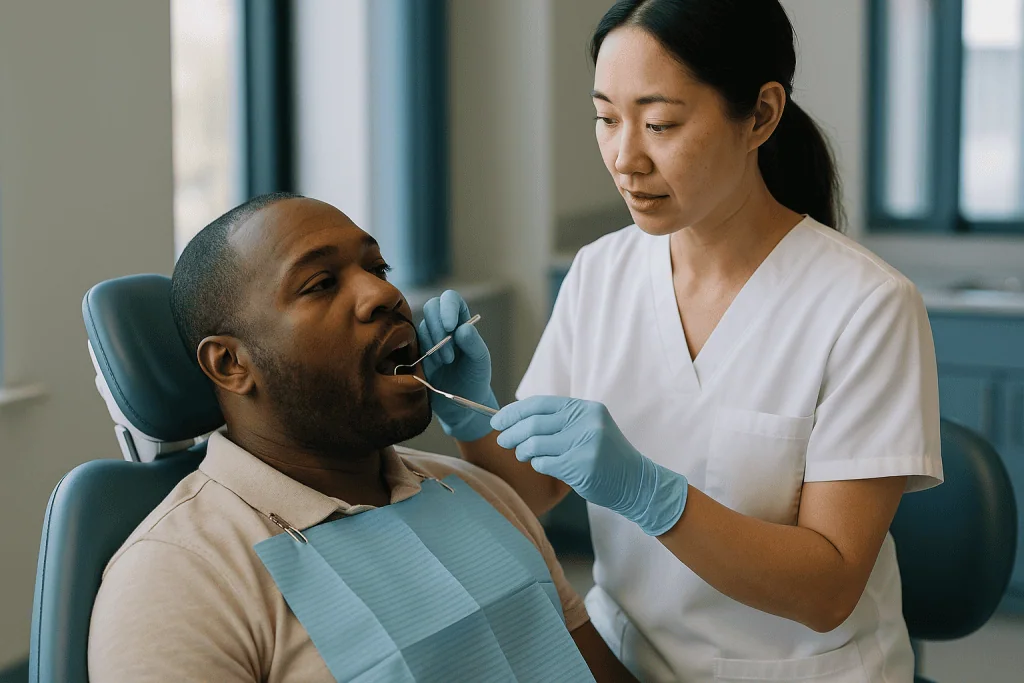
The visit typically begins with local anesthetic, a numbing medicine injected near the teeth being treated, because working several millimeters under the gum on an exposed root would otherwise be uncomfortable. Once the area is numb, the clinician uses ultrasonic and hand instruments to remove tartar and bacterial deposits from the root surface all the way to the bottom of each pocket. That is the scaling phase.
Root planing follows. Roots that have been exposed to infection develop a roughened surface and can absorb bacterial toxins. The clinician uses fine hand instruments called curettes to smooth those surfaces. Cleveland Clinic explains that smoothing the root serves two purposes: it removes remaining contaminated material, and it gives the gum a clean, even surface to reattach to as inflammation settles.
Because the work is slower and more detailed than a regular cleaning, Cleveland Clinic and Mayo Clinic both note that SRP is commonly divided across more than one appointment, often treating one side or one quadrant of the mouth per visit so that only part of the mouth is numb at a time. Some clinicians place an antimicrobial rinse or a locally applied antibiotic into deeper pockets afterward; whether that adds benefit for a specific patient is a decision for the treating clinician based on pocket depth and overall health.
A few weeks later comes a re-evaluation. The clinician re-measures every pocket to see how much the gum has tightened. Pockets that have shrunk to a maintainable depth move into a maintenance schedule. Pockets that remain deep may prompt a repeat of SRP in those spots or a referral to a periodontist, a dentist who specializes in gum and bone conditions, to discuss further options.
How do I know if I need a deep cleaning or a regular cleaning?
You cannot reliably tell from the mirror. Periodontitis is frequently painless until it is advanced, which is why the decision rests on measurement rather than symptoms.
The key tool is the periodontal probe, a slim ruler marked in millimeters that is gently slid into the crevice at six points around each tooth. Those readings, recorded as a chart of numbers, are what the dentist is looking at when the conversation turns to deep cleaning. Mayo Clinic describes depths of 1–3 millimeters as healthy and depths of 4 millimeters or more as a sign of periodontitis. The clinician also records bleeding on probing, gum recession, tooth mobility and whether the roots between teeth are exposed.
X-rays add the second half of the picture. Bone level shows up on dental radiographs, and a dentist comparing current images with older ones can see whether the bone that supports the teeth has receded. Pocket depth plus radiographic bone loss is the combination that distinguishes gingivitis, which a regular cleaning handles, from periodontitis, which needs SRP.
A few features make it easier to trust the recommendation you receive:
- You were shown or told the actual pocket numbers, ideally tooth by tooth.
- Recent X-rays were taken or reviewed, and bone loss was pointed out.
- The plan specifies which areas need SRP, since it is common for only certain quadrants or teeth to qualify.
- A re-evaluation appointment is built into the plan.
If none of those elements is present, it is reasonable to ask for them before scheduling. And if your general health includes diabetes, smoking, pregnancy or medications that dry the mouth, mention it; Mayo Clinic lists these among factors that raise periodontitis risk and can influence how aggressively a clinician wants to treat early pockets.
Regular cleaning vs deep cleaning side by side
Seeing the two procedures next to each other makes the decision logic clearer. The details below reflect how Mayo Clinic, Cleveland Clinic and the NHS describe each procedure; individual plans vary with the patient.
| Feature | Regular cleaning (prophylaxis) | Deep cleaning (scaling and root planing) |
|---|---|---|
| Purpose | Prevention; remove plaque, tartar and stain from healthy or mildly inflamed mouths | Treatment; remove infected deposits from root surfaces inside periodontal pockets |
| Typical pocket depths | 1–3 mm | 4 mm or more, usually with bone loss on X-ray |
| Where the work happens | Crown of the tooth and the gum edge | Below the gumline, along the root to the pocket base |
| Numbing | Usually not needed | Local anesthetic is common |
| Visits | One | Often two or more, by quadrant or half of the mouth |
| Instruments | Scalers, ultrasonic tip, polishing cup | Same plus fine curettes for root planing |
| Follow-up | Next recall visit, interval set by risk | Re-evaluation a few weeks later, then periodontal maintenance |
| Afterward | Little or no soreness | Tenderness and sensitivity for days to a few weeks |
One row deserves emphasis: the pocket depth line. Everything else in the table flows from it. Shallow pockets mean the disease process has not reached the root, so a surface cleaning is enough. Deeper pockets with bone loss mean bacteria are living where surface cleaning cannot reach, so the procedure must change.
The other row worth noticing is follow-up. A regular cleaning ends when you leave. SRP is the start of a longer relationship with your gums, one that includes re-measurement and, for many people, a permanently shorter recall interval. That ongoing commitment is part of what you are agreeing to when you agree to a deep cleaning.
Who SRP is usually for, and who is usually asked to wait
Scaling and root planing is designed for adults with a diagnosis of periodontitis: pockets of 4 millimeters or more, bleeding on probing and evidence of bone loss. Within that group it is the first treatment offered, before any surgical option, according to Mayo Clinic’s overview of periodontitis treatment.
It is generally recommended even in the absence of pain, because the disease is usually silent. People with diabetes are a group clinicians pay particular attention to. The CDC and Mayo Clinic describe a two-way relationship in which uncontrolled blood sugar makes gum infection harder to control and gum infection can make blood sugar harder to manage. Smokers are another group in whom periodontitis tends to progress faster and respond less completely, which affects planning but does not rule anyone out.
Who is usually asked to wait, or to take a different path?
- People whose probing depths are all 3 millimeters or less, with no bone loss, do not need SRP; a regular cleaning and improved home care are the appropriate response to gingivitis.
- People with very advanced disease, deep pockets and loose teeth may be referred directly to a periodontist, since SRP alone may not reach the base of the deepest pockets and surgical options may need discussion.
- People with certain heart conditions, recent joint replacement or conditions affecting bleeding or immunity may need their dentist to coordinate with their physician first. Whether antibiotic premedication is advisable is decided by the treating team based on current guidance, not by a general rule.
- During pregnancy, dental treatment for active gum disease is generally considered safe and appropriate, but timing and any medicines are coordinated with the obstetric team.
The through line is that SRP is matched to a measured stage of disease. Being asked to wait is not a dismissal; it means the measurements did not cross the threshold, or that a different level of care is the better fit.
Does a deep cleaning hurt? Numbing, comfort and what it feels like
This is the question people are often too embarrassed to ask directly, so it deserves a direct answer. During the procedure itself, most people feel pressure, vibration and scraping sensations rather than sharp pain, because the area has been numbed with a local anesthetic. The numbing is the same class of medicine used for a filling, and the choice of agent and amount belongs to the clinician.
The injections themselves are the part many people dread. Clinicians commonly apply a numbing gel to the gum before the needle, and the treatment is usually split so only one region of the mouth is numb at a time. Cleveland Clinic notes that dividing SRP across visits helps keep each appointment tolerable and lets you eat normally on the other side afterward.
Once the anesthetic wears off, typically within a few hours, the gums are commonly tender and may feel bruised. Teeth often become sensitive to cold, sweet or touch for a while. That sensitivity has a mechanical explanation: tartar that was covering exposed root surfaces has been removed, and inflamed gums that shrink back as they heal leave slightly more root uncovered. The root is not protected by enamel, so it transmits temperature more readily. For most people this fades over days to a few weeks as the gum tightens and the root surface adapts, according to Cleveland Clinic’s patient guidance.
Managing comfort afterward is usually straightforward: soft foods for a day or two, avoiding very hot or very cold items, gentle brushing with a soft brush, and any rinse or over-the-counter pain relief your clinician recommends. If you are on blood thinners, have a bleeding disorder or have had a difficult reaction to dental anesthetics before, tell the team before the appointment rather than on the day. Anxiety about needles is common and worth mentioning too; many practices can adjust pacing or discuss options.
What the days and weeks after scaling and root planing usually look like
Recovery from SRP has a fairly predictable shape, though the intensity varies with how deep the pockets were and how many areas were treated.
The first 24 hours. Numbness lasts for a few hours. Once it fades, gums are sore and may bleed slightly when brushed. A little swelling is common. Eating soft, lukewarm foods on the untreated side is easier. Smoking during this window slows healing and is discouraged by every major dental source.
Days 2–7. Soreness settles and bleeding on brushing decreases. Cold sensitivity often peaks in this stretch. Cleveland Clinic describes soreness lasting a few days and sensitivity persisting for a few weeks as typical. Gentle but thorough home care matters most here, because the goal is to keep newly cleaned root surfaces free of fresh plaque while the gum reattaches.
Weeks 2–6. Inflammation resolves and the gum tightens against the tooth. As swelling goes down, gums may look shorter or teeth may look longer; that is not damage from the cleaning but the true position of gum that was previously puffed up by inflammation. Small gaps between teeth at the gumline can appear for the same reason.
The re-evaluation visit. Cleveland Clinic and Mayo Clinic describe a follow-up several weeks after treatment at which every pocket is re-measured. Pockets that have shrunk to a depth you can keep clean at home move into a maintenance schedule. Pockets that remain deep may be re-treated or referred.
Two honest notes. Bone that has already been lost does not grow back with SRP; the procedure aims to stop further loss and let the gum reattach to a clean root. And the result depends heavily on what happens at home between visits, which is why clinicians spend time on brushing and interdental cleaning technique during recovery rather than treating it as an afterthought.
Periodontal maintenance vs regular cleaning: why the schedule changes afterward
Many people are surprised to learn that after a deep cleaning they do not simply return to “regular cleanings.” They move onto periodontal maintenance, a different kind of recall visit, and the distinction is worth understanding before treatment rather than after.
Periodontal maintenance is a recurring appointment for someone who has been diagnosed with and treated for periodontitis. Each visit includes re-probing the pockets, cleaning below the gumline in any areas that remain deeper than normal, removing new tartar from root surfaces and reviewing home care. It is, in effect, a lighter, targeted version of SRP repeated at intervals to keep pockets from refilling with bacteria.
The interval is usually shorter than the standard preventive recall. Mayo Clinic notes that people with periodontitis are typically seen more often than the general population; a common pattern is every three to four months, though the exact interval is set by the treating team based on how the pockets respond. The NHS describes recall intervals in general as ranging from 3 months to 2 years depending on individual risk, so a shorter interval after periodontitis fits within that framework rather than being unusual.
Why not go back to a regular cleaning once the gums look better? Because periodontitis is a chronic condition. The bacteria that drive it are always present in the mouth, and pockets that have been reduced can deepen again if deposits accumulate. Bone that was lost has not regrown, so the tooth has less margin for error than before. A regular cleaning would leave the areas that matter most, the residual pockets, untreated between visits.
This is one of the practical differences to weigh in the regular cleaning vs deep cleaning conversation. Agreeing to SRP is also agreeing, in most cases, to a lifelong pattern of more frequent and more detailed visits. For a disease that can otherwise cost teeth quietly, most guideline sources consider that trade worthwhile, but it should be part of the informed decision, not a surprise at the next appointment.
Can a dentist do a regular cleaning instead of a deep cleaning? Risks and alternatives
Technically, a dentist can perform any procedure a patient consents to. The more useful question is what happens if periodontitis is treated with a procedure designed for healthy gums.
A regular cleaning removes deposits above and just at the gumline. In a mouth with 5- or 6-millimeter pockets, the tartar and bacteria at the base of those pockets are untouched. The surface may look and feel cleaner, but the process destroying bone continues underneath. Mayo Clinic lists tooth loss as the principal complication of untreated periodontitis, and also notes associations with conditions such as heart disease, respiratory disease and complications in diabetes, though it is careful to describe these as associations rather than proven cause and effect.
A regular cleaning attempted on inflamed, deep-pocketed gums also tends to be uncomfortable and bloody without numbing, which is one reason clinicians decline to substitute it.
What alternatives genuinely exist?
- Watchful waiting for borderline readings. If pockets are at the 4-millimeter threshold with minimal bleeding and no clear bone loss, some clinicians will intensify home care and re-measure at a shorter interval before committing to SRP. This is a legitimate clinical judgment, not a way of avoiding treatment indefinitely.
- Localized SRP. Often only certain teeth qualify. Treating those areas and performing a regular cleaning elsewhere is common and reasonable.
- Referral to a periodontist. For deep or complex pockets, a specialist may discuss SRP followed by surgical options such as flap surgery or regenerative procedures, which Mayo Clinic describes as later steps when non-surgical treatment is insufficient.
- Adjunctive antimicrobials. Locally applied or systemic antibiotics are sometimes added to SRP. They do not replace mechanical cleaning, and whether they help a particular person is a decision for the prescribing clinician.
Declining SRP is your right, and a good clinician will document the recommendation, explain the likely course of the disease and keep the door open. What no clinician can do is make a surface cleaning reach the bottom of a pocket.
Why are dentists recommending deep cleanings, and is a deep cleaning worth it?
Suspicion about deep cleaning recommendations is widespread, and the concern is understandable: the procedure takes longer, involves more visits and leads to a schedule of more frequent care. It is fair to ask whether the recommendation is driven by your gums or by something else.
Several things are true at once. Periodontitis is genuinely common; the CDC’s estimate that roughly 47 percent of adults over 30 have some form of it means a busy general practice will legitimately recommend SRP often. Probing is also more consistently performed than it was a generation ago, so disease that was once overlooked is now measured and named. At the same time, there is variation in how aggressively different clinicians treat borderline pockets, and no guideline requires SRP for every 4-millimeter reading in an otherwise healthy mouth.
So how do you tell a well-founded recommendation from an over-eager one?
- Ask to see the periodontal chart and the X-rays, and ask the clinician to point to the pockets and the bone loss. A sound recommendation can be shown, not just asserted.
- Ask which specific teeth or quadrants qualify. Whole-mouth SRP in someone with only a few deep spots is a reasonable thing to question.
- Ask what the plan is if you do nothing for three months and re-measure. The answer will tell you how urgent the clinician believes it is.
- Seek a second opinion if the numbers are borderline or the explanation is thin. Periodontal charts are objective enough that a second clinician can re-measure and confirm or disagree.
On the question of whether it is worth it: for measured periodontitis with bone loss, SRP is the treatment every major source describes as the standard first step, and the alternative is progressive loss of the structures holding your teeth. For healthy gums with shallow pockets, it is not indicated. Worth is therefore not a general verdict; it depends entirely on whether the disease is actually present, which is exactly what the chart and X-rays exist to show.
What people often get wrong about deep cleaning
“A deep cleaning is just a longer regular cleaning.” It is a different procedure with a different target. Regular cleaning addresses tooth surfaces above the gum; SRP treats root surfaces inside pockets that have formed because of bone loss. The instruments overlap; the depth, purpose and follow-up do not.
“My gums don’t hurt, so I can’t have gum disease.” Periodontitis is typically painless until it is advanced. Bleeding when brushing, bad breath that persists and gums that look slightly receded are more common early signals than pain, and even those are easy to miss. Mayo Clinic specifically notes that the condition can progress with few noticeable symptoms.
“Deep cleaning makes gums recede.” What people see after SRP is gum returning to its true position once inflammation-related swelling resolves. The recession was caused by the disease; the cleaning revealed it.
“Once the deep cleaning is done, I’m fixed.” SRP controls the infection and lets gum reattach to a clean root. It does not regrow lost bone, and pockets can deepen again without maintenance and daily interdental cleaning. Periodontitis is managed over a lifetime, not eliminated in two visits.
“Everyone needs a cleaning every six months.” The 2018 Cochrane review found little evidence that a fixed six-month scale and polish improved gum health in adults with healthy gums, and the NHS describes recall intervals from 3 months to 2 years depending on individual risk. The right interval is personal. For people with treated periodontitis it is usually shorter than six months, not longer.
“If I get a deep cleaning I can skip flossing.” The opposite is true. The root surfaces cleaned during SRP begin collecting plaque again within hours. Daily cleaning between the teeth is what keeps the treatment from being undone.
“Mouthwash can do the job instead.” Rinses can reduce surface bacteria, but no rinse removes hardened tartar or reaches the base of a deep pocket. Mechanical removal is the part that cannot be skipped.
Questions to ask your care team before agreeing to SRP
A good consultation should leave you able to explain to a friend why you are having a deep cleaning and what happens next. These questions help get you there. Write down the answers; the numbers in particular are worth keeping for comparison at your re-evaluation.
- What are my pocket depths, tooth by tooth, and which ones are 4 millimeters or more?
- Do my X-rays show bone loss, and can you show me where?
- Is this periodontitis, or is it gingivitis that could respond to a regular cleaning and better home care?
- Which specific teeth or quadrants need scaling and root planing, and which only need a regular cleaning?
- How many visits do you expect, and how will the mouth be divided between them?
- Will I be numbed, and are there options if I am anxious about injections?
- Do you plan to use any antimicrobial rinse or locally applied medicine, and what is the reasoning?
- What should I expect in the first week, and what would be a sign that something is wrong?
- When is my re-evaluation, and what results would mean the treatment has done its job?
- What recall interval do you anticipate afterward, and how is that decided?
- Do any of my medical conditions or medicines change how you approach this, and should you coordinate with my physician?
- If I choose to wait and re-measure in a few months, what do you expect to happen?
- Would a periodontist’s opinion be useful in my case?
Notice that none of these questions challenges the clinician’s competence. They ask for the evidence behind the plan, which is exactly what a careful clinician will be glad to walk through. If a question is met with vagueness, that is useful information too. The regular cleaning vs deep cleaning decision is one of the few in dentistry that rests on a small set of measurable facts, and you are entitled to see them.
Bring the list to your appointment. It is far easier to ask a prepared question than to remember it while reclined in the chair.
When to call your doctor
Most recovery after scaling and root planing is uneventful: tender gums, some cold sensitivity and a little bleeding on brushing for a few days. A small number of people run into problems that need prompt attention. Contact your dental office, or if it is closed seek urgent care, if you notice any of the following.
- Bleeding that does not slow with gentle pressure after 20–30 minutes, or that restarts heavily hours after the visit, particularly if you take blood-thinning medicine.
- Pain that worsens after the second or third day instead of easing, or pain not controlled by the measures your clinician recommended.
- Swelling of the face, jaw or neck, or swelling that increases rather than decreases after the first day.
- Fever, chills or a general feeling of being unwell in the days after treatment, which can signal a spreading infection.
- Pus, a foul taste or a bad smell coming from a treated area.
- Difficulty swallowing or breathing, which is a medical emergency; call emergency services rather than the dental office.
- Numbness that persists well beyond the expected few hours, or new tingling in the lip, tongue or chin.
- A tooth that becomes noticeably loose or shifts position.
- Signs of an allergic reaction to anything used during or after the visit, such as hives, facial swelling or wheezing.
Separately from recovery, certain gum changes in everyday life warrant a dental appointment rather than waiting for the next scheduled visit: gums that bleed regularly when you brush, gums that are pulling away from teeth, persistent bad breath, a change in how your teeth fit together when you bite, or a tooth that feels loose. MedlinePlus and Mayo Clinic list these among the signs of periodontitis, and earlier measurement generally means simpler treatment.
People with diabetes, heart valve conditions, weakened immunity or recent joint replacement should let both their dentist and their physician know about any unexpected symptoms after dental treatment, since these conditions can change how infection behaves. Every decision about further treatment, medication or referral stays with the clinicians who examined you.
Frequently asked questions
How do I know if I need a deep cleaning or a regular cleaning?
The answer comes from measurement, not symptoms. Your dentist probes the space between gum and tooth at several points around each tooth. Depths of 1–3 millimeters are healthy and suit a regular cleaning; depths of 4 millimeters or more, especially with bone loss visible on X-ray, indicate periodontitis and usually call for scaling and root planing. Ask to see your chart and images.
Is a deep cleaning worth it if nothing hurts?
For measured periodontitis, yes in the view of every major dental source, because pain is a late sign and untreated pockets keep destroying the bone that holds teeth. For shallow pockets without bone loss, it is not indicated. Worth depends entirely on whether disease is actually present, which the periodontal chart and X-rays are designed to show.
Can a dentist do a regular cleaning instead of a deep cleaning?
A dentist can only perform what you consent to, but a regular cleaning does not reach the base of periodontal pockets, so the infection driving bone loss continues untouched. Attempting it on inflamed, deep pockets without numbing is also uncomfortable. Legitimate alternatives include localized SRP on only the affected teeth, watchful re-measurement for borderline readings, or referral to a periodontist.
Why are dentists pushing deep cleanings so often?
Partly because periodontitis is common, affecting about 47 percent of US adults over 30 according to the CDC, and partly because probing is now performed more consistently, so disease once overlooked is measured and named. Clinicians do vary in how they treat borderline pockets. Asking to see the numbers and X-rays, or seeking a second opinion, separates a sound recommendation from an over-eager one.
What is the deep cleaning teeth procedure like from start to finish?
The area is numbed with local anesthetic, then ultrasonic and hand instruments remove tartar and bacteria from root surfaces down to the pocket base, and fine curettes smooth the roots so gum can reattach. Treatment is often split across two or more visits by quadrant. A re-evaluation several weeks later re-measures every pocket to decide on maintenance or further care.
Does scaling and root planing hurt?
During treatment most people feel pressure and vibration rather than sharp pain because the area is numbed. Afterward, gums are commonly tender for a few days and teeth sensitive to cold for a few weeks as inflamed tissue shrinks and exposes root. Soft foods, gentle brushing and any relief your clinician recommends usually manage it. Tell the team beforehand about needle anxiety or bleeding concerns.
What is the difference between periodontal maintenance and a regular cleaning?
Periodontal maintenance is the recurring visit for someone already treated for periodontitis. It includes re-probing pockets, cleaning below the gumline in areas still deeper than normal and removing tartar from root surfaces, usually every three to four months as set by the treating team. A regular cleaning addresses tooth surfaces above the gum for people whose supporting structures are healthy.
Do I need a deep cleaning if only a few teeth have deep pockets?
Often only the affected teeth or quadrants need scaling and root planing, with a regular cleaning performed elsewhere. This localized approach is common and reasonable. If a whole-mouth deep cleaning is recommended when the chart shows only a few deep spots, it is fair to ask which specific teeth qualify and why the broader plan was chosen.
How long does recovery from a deep cleaning take?
Cleveland Clinic describes gum soreness lasting a few days and sensitivity persisting for a few weeks as typical. Inflammation settles and gums tighten against the teeth over the following weeks, sometimes making teeth look longer as swelling resolves. A re-evaluation visit several weeks after treatment confirms how much the pockets have improved. Individual timelines vary with pocket depth and home care.
Will my gums grow back after a deep cleaning?
Gum tissue that was swollen by inflammation shrinks back to its true position and can reattach more tightly to a clean root, which often looks like recession but is actually healing. Bone already lost to periodontitis does not regrow with scaling and root planing. The goal is to stop further loss; surgical or regenerative options for advanced cases are discussed with a periodontist.
References
- MedlinePlus: Periodontitis
- NHS: Gum Disease
- CDC: About Periodontal (Gum) Disease
- PubMed: Routine scale and polish for periodontal health in adults (Cochrane Review, 2018)
This article is for general information only and is not a substitute for professional medical advice. Please consult a qualified doctor about your individual situation.

More from the Blog

Impacted Tooth Treatment in Adults vs Teens: Why Timing Changes the Approach
An impacted tooth is one blocked from fully coming through the gum. In teens, roots are still forming and bone is more adaptable, so…

Keeping Up Orofacial Myology Exercises Between Visits: Why Daily Practice Shapes the Result
Daily myofunctional exercises matter because orofacial myology works through motor learning: the tongue, lips and jaw muscles only adopt a new resting posture and…

Bleeding Gums in Pregnancy and With Diabetes: Why Gum Care Is Planned Differently
Bleeding gums in pregnancy are usually pregnancy gingivitis: hormonal changes make gums react more strongly to plaque, so they swell and bleed with brushing.…

How Oral and Maxillofacial Surgeons Train, and Questions to Ask Before Your Procedure
Oral and maxillofacial surgeons first complete dental school, then a hospital-based surgical residency that typically runs four to six years and includes rotations in…

Recovery After Gummy Smile Treatment: Swelling, Sensitivity and the Reshaped Gum Line
Recovery after gummy smile treatment depends on the procedure. Gum contouring and crown lengthening usually bring mild swelling, tenderness and temporary tooth sensitivity that…
Is Sensitivity After Teeth Whitening Normal? What Helps and When to Call the Dentist
Yes. Temporary sensitivity is one of the most common side effects of peroxide-based teeth whitening. It usually appears during or shortly after treatment as…