

Why Teeth Shift After Orthodontics and What Retreatment Involves
Key Takeaways
- The periodontal ligament reorganizes over roughly the first three to four months after braces come off, making that window the highest-risk period for rapid movement without a retainer.
- Gum fibers around rotated teeth can retain their pull for a year or more, which is why rotated teeth are among the first to slip back.
- Lower front teeth crowd with age in treated and untreated people alike, so retention is framed by the NHS and Cochrane as potentially lifelong rather than a fixed period.
- The Cochrane review found no retainer design clearly superior for stability, so the best retainer is the one you will actually wear and have checked.
- Grinding, periodontitis, tongue habits and missing teeth each move teeth independently, and retreatment plans usually address them first to avoid a repeat.
- Retreatment ranges from a new retainer alone to a full course commonly lasting around 18 months to 2 years, with the choice resting on function, gum health and realistic goals.
Teeth shifting after braces is common and usually gradual. The ligament and bone around each tooth take months to settle, gum fibers retain a pull toward the old position, and lifelong forces such as chewing, grinding and age-related jaw change continue afterward. Consistent retainer wear limits movement. If shifting becomes noticeable, an orthodontist can assess it and discuss options ranging from a new retainer to limited or full retreatment.
The photograph was taken the day the braces came off. Straight, even, a smile that had cost two years of wax, wires and awkward school lunches. Fifteen years later, brushing in a hotel bathroom mirror, the same person tilts their head and notices something: the lower front teeth are no longer lined up like piano keys. One has slid behind its neighbor. The retainer, if it still exists, is somewhere in a parent’s attic.
This is one of the most frequent conversations in an orthodontic practice, and it rarely comes with drama. People arrive a little embarrassed, a little annoyed, and often convinced they did something wrong. Teeth shifting after braces is not a failure of willpower or of the original treatment. It is what teeth do when the structures holding them keep changing, which they do for life.
The useful questions are practical ones. How much has moved, why, whether it matters for health as well as looks, and what a second round would actually involve. Those are the questions this article works through.
Is teeth shifting after braces normal?
Yes, and orthodontists expected it long before patients started noticing it on their phone cameras. The technical word is relapse: the tendency of teeth to drift back toward the position they occupied before treatment, or to move into a new but still irregular arrangement. Long-term follow-up studies summarized in the Cochrane review on orthodontic retention describe some degree of relapse in most people who stop wearing retainers, particularly in the lower front teeth.
That sounds alarming until you look at the scale involved. The movement that troubles most people is a millimeter or two of rotation or overlap, often in a single lower incisor. Chewing, speech and gum health are usually unaffected at that level. What changes is the appearance of a smile that someone worked hard for, and that is a legitimate reason to ask about it.
The pattern is not random. The lower front teeth crowd most readily because they are the smallest teeth, sit in the narrowest part of the arch and are held by the thinnest bone. Upper front teeth may drift apart again if a gap was closed, and rotated teeth like to rotate back. Bite changes, such as a deep bite deepening, tend to appear more slowly.
Two facts should sit side by side. First, teeth shifting after braces happens even in people who wore retainers reasonably well, because biology does not stop when the wires come off. Second, the amount of shift is strongly influenced by retainer wear, which is why the same review concludes that retention is a permanent part of orthodontic care rather than an optional extra. Neither fact is a reason for guilt. Both are reasons to understand what is actually happening under the gums.
Why do teeth move after braces? The biology of relapse
A tooth is not cemented into the jaw. It hangs in its socket by the periodontal ligament, a thin sling of collagen fibers running between the root and the bone. When braces press on a tooth, that ligament is compressed on one side and stretched on the other. Bone dissolves where the pressure is and rebuilds where the tension is, so the socket slowly migrates. This is how a rigid-looking tooth can travel several millimeters over months.
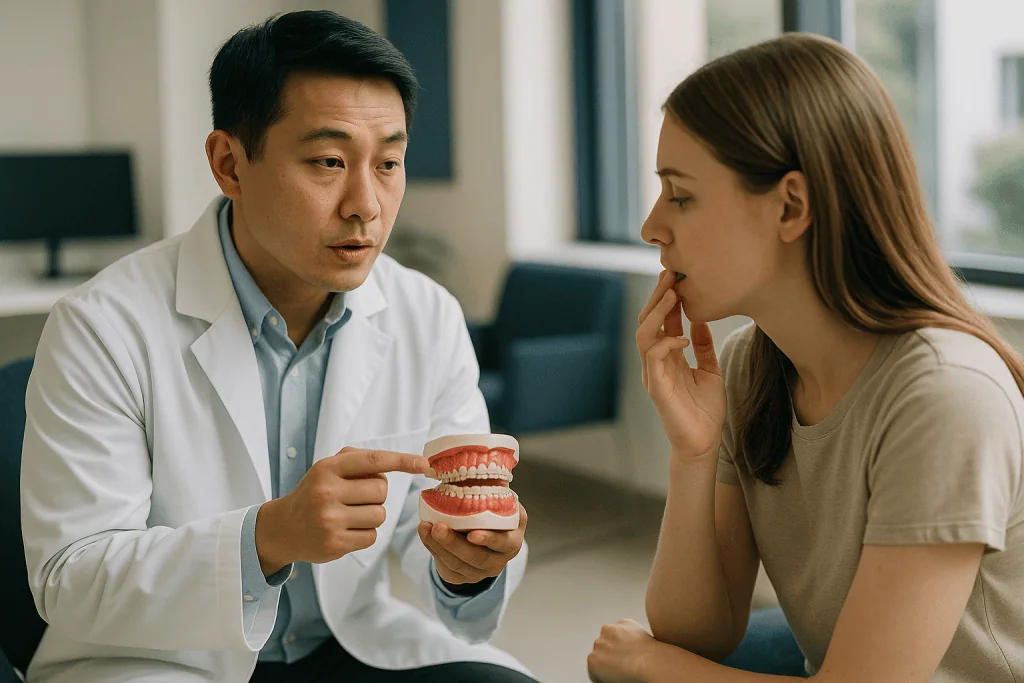
The same mechanism runs in reverse once the force is removed. Orthodontic reviews, including the Cochrane background summarized in the references, describe the ligament fibers as reorganizing over roughly the first three to four months after appliances come off, while the surrounding bone is still immature and easily reshaped. Any tooth left unsupported in that window can drift quickly.
Gum fibers are slower still. The elastic fibers in the gum tissue above the bone, especially those wrapped around rotated teeth, are stretched by treatment and can retain that tension for a year or more. Think of a twisted rubber band that has been taped down: remove the tape and it starts to unwind. That is why rotated teeth are among the first to slip back.
Then there are the forces that never went away. The tongue pushes outward with every swallow. The lips and cheeks push inward. The bite loads each tooth thousands of times a day. Before braces, these forces had settled into an equilibrium with the teeth where they were. Move the teeth, and the muscles, soft tissue and bite have to agree to a new equilibrium. When they do not, the teeth drift until they find one. The retainer’s job is to hold the line long enough for the biology to accept the new arrangement, and in some mouths that acceptance is never complete.
How long should you wear a retainer after braces?
The honest answer from current guidance is longer than most people were told a generation ago. The NHS advises that retainers are needed after almost every course of orthodontic treatment and that many people will need to wear one, at least at night, indefinitely. The Cochrane review on retention procedures reaches a similar conclusion: there is no reliable point at which teeth can be declared permanently stable, so the review frames retention as potentially lifelong.
A retainer is a custom-made appliance that holds teeth in position without moving them. Three broad types are in common use:
- Removable vacuum-formed retainers: clear plastic shells molded over the teeth, worn at night or as instructed.
- Removable wire-and-acrylic retainers, often called Hawley retainers: a wire across the front teeth attached to an acrylic plate against the palate.
- Fixed or bonded retainers: a thin wire glued to the inside surfaces of the front teeth, usually the lower six, which the wearer cannot remove.
The Cochrane review found low-quality evidence overall and no clear winner among these designs for stability. Each has trade-offs. Removable retainers only work when worn, and the review notes that wear declines over the years. Bonded retainers work continuously, but they can detach without the wearer noticing, they make flossing harder, and they need periodic checks.
Instructions therefore vary by orthodontist, by the type of movement that was done and by how the bite settles at follow-up visits. Someone whose treatment involved closing a large gap or correcting severe rotations will usually be asked for more conservative wear than someone whose teeth were mildly crowded. The right schedule is the one the treating orthodontist sets, reviewed over time, not a rule copied from a friend.
Which teeth shift most, and how quickly does it happen?
Not all shifting is equal, and knowing the usual pattern helps people judge what they are seeing. Long-term data summarized in the Cochrane retention review point consistently to the lower front six teeth as the most vulnerable, with crowding there increasing gradually over decades even in people who never had orthodontic treatment. The lower arch is a narrow curve of small teeth resting in thin bone; a small change in arch width translates directly into overlap.
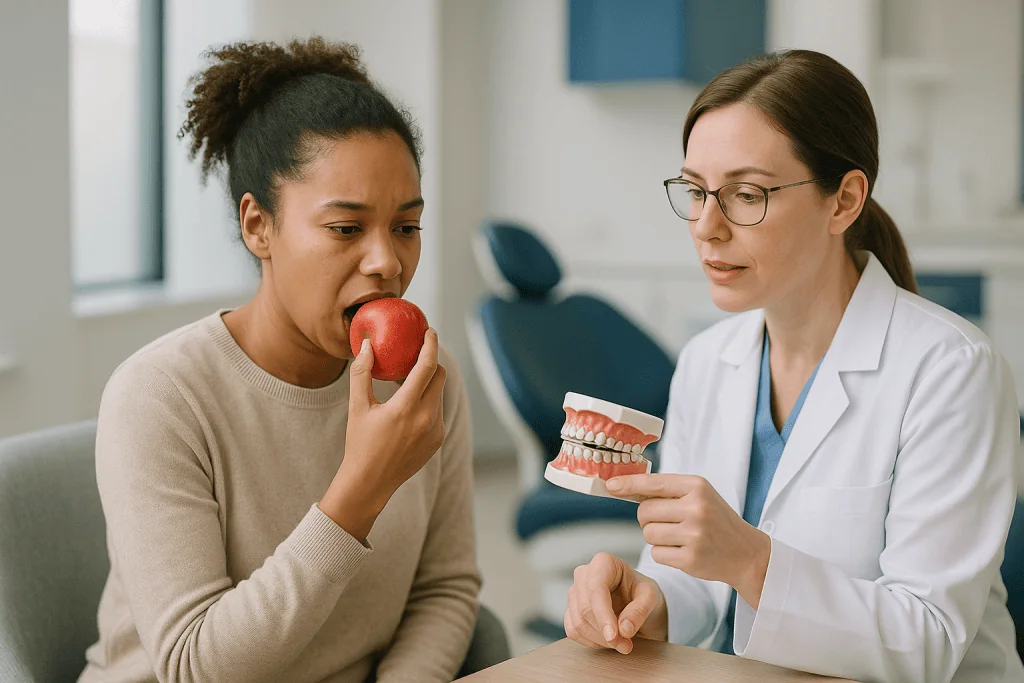
Upper front teeth behave differently. A gap that was closed between the two upper central incisors has a habit of reopening slightly, because the gum tissue between those teeth is thick and elastic. Teeth that were rotated into line tend to rotate back a few degrees. Canines that were moved a long way can drift toward their starting point. Back teeth, held by multiple roots and heavy bone, move least.
Speed follows biology. The fastest window is the first few months after braces come off, when the ligament is still reorganizing and the bone is soft. A retainer left in a drawer during that period can allow visible change within weeks. After the first year, movement usually slows to a crawl measured in fractions of a millimeter per year. That slow phase can still add up: a quarter of a millimeter each year becomes a visible overlap by the time someone is in their forties.
The everyday comparison many orthodontists use is a garden hedge. Trim it into shape and it looks finished, but growth never stops; it simply becomes gradual enough that you only notice when you compare old photographs. The practical message is that early retainer wear prevents the fast changes, and long-term wear prevents the slow ones.
Other forces at work: grinding, gum disease, tongue habits and age
Retainer habits explain much teeth shifting after braces, but not all of it. Several ordinary conditions push teeth around independently, and a retreatment assessment usually looks for them, because correcting alignment without addressing the cause invites the same drift again.
Bruxism, the medical term for clenching or grinding the teeth, loads teeth with forces far beyond normal chewing, often during sleep. Mayo Clinic describes worn enamel, flattened tooth edges, jaw soreness and increased tooth mobility among its effects. Chronic heavy loading can tip teeth and widen the spaces between them. Many people are unaware they grind until a partner mentions the noise or a dentist points out the wear.
Periodontitis, the advanced form of gum disease, destroys the bone that anchors the teeth. MedlinePlus lists loosening and shifting teeth, new gaps and changes in how the teeth meet among its signs. A tooth with less bone around it responds to ordinary forces like a fence post in loose soil. This matters twice in orthodontics: active gum disease must be controlled before any tooth movement, and previously straightened teeth in a mouth with bone loss will not stay straight without support.
Habits count too. A tongue that rests against the front teeth or pushes forward on swallowing applies a small force thousands of times a day. Missing teeth allow neighbors to tilt and opposing teeth to drift into the gap.
Finally, age. The lower jaw continues subtle forward and upward rotation into adulthood, the arches narrow slightly, and the front teeth are pushed into tighter contact. This happens to nearly everyone, treated or not. It is the reason a retainer that fit perfectly at twenty may feel snug at fifty, and why orthodontists describe retention as a lifelong project rather than a finish line.
Noticing a change versus needing treatment: how much shift matters?
A camera and a critical eye will find some irregularity in almost any adult smile. The question an orthodontist asks is different: does this change affect function, oral health or the person’s wellbeing enough to justify intervention, and what is the least that would address it?
Function comes first. Malocclusion, the term for teeth that do not meet properly, is described by MedlinePlus as ranging from purely cosmetic to changes that make biting and chewing difficult or that wear teeth unevenly. A single lower incisor tucked slightly behind its neighbors rarely alters the bite. A front tooth that has drifted so far forward that it takes the full force of the bite alone, or back teeth that have tipped and now trap food, is a different matter.
Health follows. Overlapping teeth are harder to clean, and plaque that sits undisturbed at a crowded contact raises the risk of decay and gum inflammation at that spot. Whether that risk is meaningful depends on how tight the overlap is and how good the person’s brushing and flossing are, which is something a dental examination can judge better than a mirror.
Then there is the person. Some people are untroubled by a few degrees of rotation. Others find that a smile they associate with a difficult adolescence has changed, and that bothers them daily. Guidelines do not dismiss this. The NHS notes that orthodontic treatment is offered for appearance as well as function, provided expectations are realistic.
What guidelines and orthodontists do warn against is the assumption that any shift means full braces again. Often the answer is a new retainer to stop further movement and a frank conversation about what the person can live with. Deciding that together, with clear information, is the point of the consultation.
Orthodontic relapse treatment: what the assessment involves
Retreatment begins not with brackets but with measurement. Anyone who has drifted since their first course arrives with a mouth that differs from the one originally treated: older bone, possibly some gum recession, perhaps a crown or an implant, and a bite that has adapted to its new shape. The assessment aims to describe that mouth precisely before anyone proposes moving anything.
A typical appointment includes several elements:
- A clinical examination of the teeth, gums and how the jaws close, including checks for tooth mobility, wear facets that suggest grinding, and pockets around the gums that suggest bone loss.
- Photographs and a digital scan or impressions of the teeth, which create a three-dimensional model that can be compared with any records surviving from the first treatment.
- Dental X-rays to look at root length, bone levels and the position of unerupted or missing teeth. Roots can shorten slightly during orthodontic treatment, and an orthodontist will want to know their current length before applying force again.
- A conversation about the original treatment, retainer history, habits such as grinding, and what specifically the person wants changed.
Two findings can pause the process. Active periodontitis must be stabilized by a dentist or periodontist first, because moving teeth in inflamed, resorbing bone accelerates damage. Untreated decay or a failing filling is similarly dealt with before appliances go on. MedlinePlus and the NHS both frame a healthy foundation as a prerequisite rather than a formality.
The output of the assessment is a diagnosis and a range of options, from doing nothing beyond a new retainer to a full second course. A good orthodontist will explain what each option can and cannot achieve for this specific pattern of movement, and will be candid about uncertainty. The choice, and the timing, remain with the person and their treating team.
Retreatment options compared: retainer, limited touch-up or full course
Relapse does not come in one size, and neither does its treatment. The table summarizes the options an orthodontist commonly lays out. Durations are typical ranges described in general orthodontic guidance such as the NHS, not predictions for any individual; the treating team will give a personal estimate after assessment.
| Option | Usually considered when | What it involves | Typical duration |
|---|---|---|---|
| New or adjusted retainer only | Shift is minimal and the person accepts current alignment; goal is to stop further movement | Scan or impression, new removable or bonded retainer, review visits | Ongoing, often at night indefinitely |
| Limited touch-up (short course of aligners or sectional braces) | Movement confined to a few front teeth; bite otherwise acceptable | Small tooth movements, sometimes minor enamel reshaping between teeth, followed by new retainers | A few months, varies with the amount of movement |
| Full retreatment (comprehensive braces or aligners) | Bite has changed, multiple teeth involved, or other dental work needs alignment first | Full records, complete appliance on both arches, regular adjustments, new retention plan | NHS describes comprehensive treatment as commonly lasting around 18 months to 2 years |
| Restorative alternatives | Person prefers not to move teeth; concern is mainly appearance of one or two teeth | Discussed with a dentist; may involve reshaping or covering tooth surfaces rather than repositioning | Depends on the procedure |
Two clarifications matter. Interproximal reduction, the technical name for removing a very thin layer of enamel from between teeth to create space, is sometimes used in touch-up cases; it is done conservatively and only where enamel thickness allows. And the Cochrane review’s central finding applies to all rows: whatever moves the teeth, retention afterward is what keeps them there. A second course without a realistic retention plan is likely to repeat the first course’s ending.
Who retreatment is usually for, and who is usually asked to wait
Orthodontists rarely refuse to discuss retreatment, but they do triage. Some situations move forward readily; others are put on hold until something else is sorted out.
Retreatment is commonly considered for adults and older teenagers whose teeth have drifted enough to affect cleaning, bite comfort or their confidence, and whose gums and teeth are otherwise healthy. Age itself is not a barrier. Adult bone responds more slowly than adolescent bone, so movement may take a little longer, but the biological process is the same. Adults also tend to be diligent about retainer wear the second time, having learned the lesson once.
People are usually asked to wait, or to complete other care first, when:
- Gum disease is active. MedlinePlus describes periodontitis as bone-destroying; moving teeth through inflamed bone is unsafe until the disease is controlled and the person has shown they can maintain that control.
- There is untreated decay, a cracked tooth or a failing restoration. Appliances are placed on sound teeth.
- Roots are already unusually short on X-ray. Orthodontic movement carries a small risk of further root shortening, so the orthodontist may limit or avoid movement of those teeth.
- Heavy grinding is uncontrolled. Realigned teeth under grinding forces tend to drift again, so the dentist may address the bruxism with protective measures first.
- Major dental work such as implants or crowns is planned. Implants cannot be moved, so the sequence of orthodontics and restorative work has to be planned together.
A third group is often gently steered away from treatment altogether: people whose shift is very slight and whose expectation is an outcome no appliance can deliver. Ethical practice includes saying that a new retainer and acceptance may serve them better than a second course. Whoever the person is, the decision about whether and when to proceed sits with them and the treating team, informed by the examination rather than the mirror.
What the first days and weeks of retreatment usually look like
People who had braces as children are often surprised by how familiar the second experience feels, and by how much has changed. Whether the plan uses fixed braces or a series of removable aligners, the early weeks follow a recognizable pattern.
Fitting day is mostly administrative and technical. Brackets are bonded or the first aligner is seated, the orthodontist checks the fit, and instructions on cleaning and eating are repeated. Discomfort typically begins several hours later as the periodontal ligament responds to pressure. The NHS describes this soreness as common and usually lasting a few days after each adjustment, easing as the ligament adapts. Softer foods and the usual approaches a dentist suggests for tooth tenderness are generally enough; any questions about pain relief belong with the pharmacist or treating clinician.
The first week brings small irritations: a cheek rubbed by a bracket, a lisp with a new aligner, the discovery that flossing around a wire takes twice as long. Orthodontic wax over a rough spot and patience with speech usually settle these within days.
Adjustment or aligner-change visits then follow at intervals set by the orthodontist. Each visit renews the force on the teeth, so a rhythm develops of a few sore days followed by a comfortable stretch. Adults often notice that soreness is milder than they remember from adolescence, partly because the movements in a touch-up case are smaller.
Cleaning is the real work. Appliances trap plaque, and gums that were healthy at the start can become inflamed within weeks if brushing slips. Most orthodontists ask for regular dental hygiene visits throughout treatment for exactly this reason.
The end of active treatment is not the end. Retainers are fitted the same day or within days, and the orthodontist explains a wear schedule and a review plan. This time, the retainer conversation tends to land differently.
Risks and trade-offs of a second course
Orthodontic retreatment is generally considered low risk, but low is not zero, and a person deciding on it deserves the full list rather than reassurance. The NHS and MedlinePlus both describe orthodontic treatment as safe when carried out on healthy teeth and gums, with the risks below discussed at the planning stage.
Root shortening is the one orthodontists watch most closely. Moving a tooth can cause a small amount of root resorption, the loss of a little root length at the tip. In most people it is minor and without consequence. Teeth that have been moved before, moved a long way, or that already show shortening on X-ray carry a somewhat higher risk, which is why baseline X-rays matter and why movement may be limited on certain teeth.
Gum recession can occur when teeth are moved outward through thin bone, exposing more of the root. Adult gums are less forgiving than adolescent gums here, and an orthodontist will plan the direction of movement with bone thickness in mind.
Decalcification, the chalky white patches that appear when plaque sits against enamel around brackets, is a cleaning problem rather than an orthodontic one, but it is permanent. It is the strongest argument for the hygiene demands of treatment.
Relapse itself is a risk of retreatment. Teeth that have drifted once show a willingness to drift again, and the Cochrane review’s finding that retainer wear declines over years applies to second courses too. Many orthodontists recommend a bonded retainer, careful long-term review, or both after retreatment for this reason.
Trade-offs are as real as risks. Treatment demands months of appointments, dietary caution and daily cleaning. Aligners require many hours of wear each day to work. Some bite corrections that were straightforward in a growing teenager are limited or need other dental specialties in an adult. None of these are reasons to avoid retreatment; they are the facts that make an informed decision possible.
What people often get wrong about teeth shifting after braces
Misunderstandings about relapse are so common that orthodontists hear the same five nearly every week. Each has a kernel of logic and a flaw the evidence exposes.
“My wisdom teeth pushed everything forward.” The timing is persuasive: wisdom teeth erupt in the late teens, just when lower incisors start to crowd. But crowding of the lower front teeth increases with age in people with and without wisdom teeth, and the Cochrane retention review attributes relapse to ligament, gum and growth changes rather than to third molars. Removing wisdom teeth to prevent crowding is not supported by good evidence.
“The braces were left on too short a time.” Stability depends on retention after treatment more than on how long the appliances were worn. Teeth held perfectly for three years still drift if the retainer stops.
“Once I hit my thirties, my teeth stopped moving, so I can quit the retainer.” Jaw shape and arch width continue changing throughout adulthood. The movement slows but does not stop, which is why guidance frames retention as indefinite.
“A retainer will push my teeth back.” Retainers hold; they are not designed to move teeth. Forcing an old retainer over shifted teeth can crack it or apply uncontrolled pressure. If an old retainer no longer seats easily, the right step is an assessment, not force.
“Straight teeth are healthy teeth, so any shift is a health problem.” MedlinePlus is clear that many malocclusions are cosmetic with no functional consequence. Health becomes a factor when overlap traps plaque, when the bite loads one tooth unfairly, or when shifting signals gum disease. Otherwise the decision is about appearance and personal preference, which are valid but different reasons.
Correcting these ideas changes the conversation from blame to planning. Nobody caused their teeth to remember where they used to be. The question is what, if anything, to do about it now.
Questions to ask your care team about retreatment
A consultation goes better when the person arrives with questions of their own. The list below is not a script; it is a set of prompts that experienced patients wish they had raised the first time around. Write down the answers, because appointments move quickly and the details blur by evening.
- What exactly has moved, by how much, and which of those changes affect function or gum health rather than appearance?
- Is there any sign of gum disease, bone loss, root shortening or grinding that should be addressed before we consider moving teeth?
- What is the least intervention that would meet my goals? Would a new retainer alone be reasonable if I decide I can live with the current position?
- If a touch-up course is possible, which teeth would move, and would any enamel be reshaped between them?
- For a full course, what does the plan involve for each arch, and how does it fit with any crowns, implants or other dental work I have or may need?
- What does the typical timeline look like for a case like mine, and what would make it longer?
- Which retainer design do you recommend afterward, why, and how will we check it over the years?
- How often will you want to see me, both during treatment and after?
- What signs should prompt me to contact you between appointments?
- If I do nothing, what do you expect to change over the next decade?
Two further questions are worth asking of yourself rather than the orthodontist. What outcome would make this feel worthwhile, and is it something teeth can deliver? Realistic goals are the strongest predictor of feeling that treatment was the right decision, and an orthodontist can only help you set them if you say what you want out loud.
The team’s answers should be specific to your records, delivered without pressure, and open to the possibility that waiting or doing less is the better choice. Any decision, including the decision to leave things alone, rests with you and the clinicians who have examined you.
When to call your doctor or dentist about shifting teeth
Slow drift of a front tooth over years is an orthodontic question that can wait for a routine appointment. Some changes are not slow, and those deserve a prompt call to a dentist or, if the mouth is under active treatment, to the orthodontist. The distinction is speed and company: rapid movement, or movement that arrives with other symptoms, points to something other than ordinary relapse.
Arrange an urgent dental or medical review if you notice:
- A tooth that has become noticeably loose or moved within days or weeks rather than years.
- Bleeding gums, persistent bad breath, gums pulling away from teeth, pus or new gaps between teeth; MedlinePlus lists these among the signs of periodontitis, which destroys the bone that anchors teeth.
- Teeth that suddenly no longer meet as they did, especially after a blow to the face or jaw, or with jaw pain, clicking or difficulty opening the mouth.
- Swelling of the gum, face or jaw, or a tooth that has become painful to bite on.
- A bonded retainer wire that has come loose from a tooth or is scratching the tongue, or a removable retainer that no longer fits; both should be seen soon, because teeth can move quickly once support is lost.
- A bracket or wire that has broken and is causing bleeding or an ulcer that does not settle.
- Numbness of the lip, chin or teeth, which is not a feature of ordinary orthodontics and needs assessment.
Seek emergency care the same day for facial swelling that is spreading, fever with a dental infection, or any difficulty breathing or swallowing. These are rare but are not orthodontic problems.
Between those extremes sits a large middle ground: a retainer that feels tight, a tooth that seems to have turned a little, a bite that feels different but not painful. None of these are emergencies. All of them are worth mentioning at the next dental visit, or sooner if they worry you, because the earlier a shift is measured, the more options remain for managing it.
Frequently asked questions
Why do teeth move after braces even if I wore my retainer for years?
Because the forces that shape tooth position never switch off. The jaw continues subtle growth and rotation through adulthood, arches narrow slightly, and chewing, swallowing and lip pressure act on the teeth daily. Retainer wear limits these effects but cannot abolish them, and wear that tapers from nightly to occasional lets small changes accumulate. Slight drift after good retainer use is expected, not a sign that something failed.
How long should I wear a retainer after braces?
Current guidance from the NHS and the Cochrane review on retention describes retainer wear as potentially indefinite, often at night, because teeth show no reliable point of permanent stability. The exact schedule depends on what movements were made and how the bite settles at follow-up, so it should come from the treating orthodontist and be reviewed over time rather than copied from a general rule.
My teeth moved without a retainer for a decade. Can they be straightened again?
Usually the teeth can be realigned, provided the gums and bone are healthy and the roots are sound on X-ray. An orthodontist will assess how much has moved and whether a limited course or a full course is appropriate. Age is not a barrier in itself, though adult bone responds more slowly. Active gum disease or heavy grinding would generally need to be addressed first.
Can I just start wearing my old retainer to push my teeth back?
It is not advisable. Retainers are designed to hold teeth, not move them, and forcing a retainer that no longer seats can crack it or apply uncontrolled pressure to teeth and gums. If it still slips on easily, wearing it as originally instructed may prevent further drift, but if it feels tight or does not fit, an orthodontist should assess the teeth and decide what is safe.
What does orthodontic relapse treatment involve?
It begins with an examination, photographs, a digital scan or impressions, and X-rays to check bone and root health. Based on those records, the orthodontist outlines options: a new retainer alone, a limited touch-up course moving a few teeth, or a comprehensive second course if the bite has changed. Every option ends with a new retention plan, because keeping the result depends on what happens afterward.
Did my wisdom teeth cause my front teeth to crowd?
The evidence does not support this popular idea. Lower front crowding increases with age in people with and without wisdom teeth, and long-term orthodontic research attributes relapse to ligament and gum fiber memory, ongoing jaw change and the absence of retention. Wisdom teeth may need removal for other reasons, but taking them out to prevent or reverse crowding is not backed by good evidence.
Is a fixed retainer better than a removable one for stopping teeth shifting?
Neither is clearly superior according to the Cochrane review, which found only low-quality evidence comparing designs. A bonded wire works continuously and does not depend on memory, but it can detach unnoticed and makes flossing harder. Removable retainers are easier to clean around but only work when worn. Many orthodontists match the design to the person’s habits and the movements that were corrected.
Can gum disease make teeth shift after braces?
Yes. Periodontitis destroys the bone holding teeth in place, and MedlinePlus lists loose or shifting teeth and new gaps among its signs. Teeth with reduced bone support drift under ordinary chewing and tongue forces regardless of past orthodontics. Any shifting that comes with bleeding gums, persistent bad breath or receding gums should be examined by a dentist before orthodontic options are considered.
How long does a second course of braces or aligners take?
It depends on how much has moved. A limited touch-up confined to a few front teeth may take a matter of months, while the NHS describes comprehensive treatment as commonly lasting around 18 months to 2 years. Adults may need slightly longer than adolescents because bone remodels more slowly. The orthodontist will give a personal range after reviewing records, and it is an estimate rather than a promise.
Will my teeth shift again after retreatment?
They can, and teeth that have drifted once show a tendency to do so again. The Cochrane review notes that retainer wear tends to decline over the years, which is the main reason relapse recurs. Orthodontists often suggest a bonded retainer, long-term review visits or both after a second course, and addressing grinding or gum problems reduces the forces that drove the original movement.
References
- Retention procedures for stabilising tooth position after treatment with orthodontic braces (Cochrane systematic review, PubMed)
- NHS: Orthodontics
- MedlinePlus: Malocclusion of teeth
- MedlinePlus: Periodontitis
This article is for general information only and is not a substitute for professional medical advice. Please consult a qualified doctor about your individual situation.

More from the Blog

Gummy Smile Results: How the Gum Line Settles and What a Balanced Smile Realistically Means
Gummy smile results depend on the cause and the method used. Gum reshaping produces a new gum line that is visible at once but…

How TMJ Disorder Progresses: Clicking, Locking and Bite-Related Discomfort Explained
TMJ disorder usually begins with painless clicking as the cushioning disc inside the jaw joint slips out of position, can progress to intermittent or…

Is It Dry Socket? Tooth Extraction Pain That Returns and When to Call Your Dentist
Dry socket is a healing complication in which the blood clot that should protect an extraction site fails to form, dissolves early, or is…

What Scaling and Root Planing Usually Achieves: Shallower Pockets and Firmer Gums
Scaling and root planing usually leaves periodontal pockets shallower by roughly 1 to 2 millimeters on average, with deeper pockets improving the most, and…
How Orthodontic Treatment Moves Teeth: Pressure, Bone Remodeling and Adjustment Visits
Orthodontic treatment works by applying light, continuous pressure to teeth through braces, aligners or other appliances. That pressure compresses the ligament on one side…
Who Is a Candidate for Clear Aligners? Bite Types, Gum Health and Wear Commitment
Most people with mild to moderate crowding, spacing or bite problems, healthy gums and a full set of adult teeth can be considered for…