

Robotic Knee Replacement Recovery: When Walking, Stairs and Physical Therapy Begin

Key Takeaways
- Walking with a walker begins on the day of surgery or the next morning, and most people practice stairs with a therapist before going home, according to the NHS and the Mayo Clinic.
- Most people resume the majority of daily activities within about three to six weeks, while the NHS notes that scar tissue and muscle can take up to two years to recover fully.
- The clearest evidence for robotic assistance is more consistent implant alignment; long-term functional or implant-survival advantages over conventional surgery have not been demonstrated.
- Full knee straightening is the early therapy priority, because a knee that rests slightly bent in the first weeks makes walking inefficient and can stiffen in that position.
- Descending stairs is harder than climbing because it loads the quadriceps as it lengthens, which is exactly the strength that swelling and surgery suppress.
- Sudden shortness of breath, chest pain or new calf swelling after knee replacement are emergency signs of a possible blood clot and need immediate care.
Recovery after robotic knee replacement follows the same broad timeline as conventional knee replacement: most people stand and take a few steps with a walker within a day of surgery, climb stairs with a therapist before going home, and resume most daily activities within about three to six weeks. Full strength and comfort can take up to a year or more, and your surgical team sets the milestones.
The first question usually arrives before the paperwork does. Someone has been told the cartilage in their knee is worn down to bone, the surgeon has mentioned a robotic-assisted operation, and the part they actually want to know is refreshingly practical: when will I walk, when can I manage my own stairs, and how many weeks of physical therapy am I signing up for?
It is a fair set of questions, and the honest answers about robotic knee replacement recovery time are more nuanced than the brochures suggest. The robot changes how the surgeon plans and cuts bone. It does not change the biology of a healing joint, which still needs swelling to settle, muscle to wake up, and scar tissue to soften on its own schedule.
What follows is the recovery arc as major medical sources describe it, week by week, with the myths separated from what the evidence actually supports.
What actually happens during a robotic knee replacement?
Start with the word itself. Knee replacement, known medically as total knee arthroplasty, means the worn ends of the thigh bone and shin bone are trimmed and capped with metal, and a plastic spacer is fitted between them so the joint glides again. Johns Hopkins Medicine describes the operation as resurfacing rather than removing the whole knee, which surprises many people who picture the entire joint being lifted out.
The robotic part comes in two stages. Before or at the start of surgery, the team builds a three-dimensional map of your knee, either from a CT scan or by touching landmarks on the bone with a tracked probe once the joint is open. On that map the surgeon plans where each cut should fall and how the implant should sit relative to your hip and ankle. That relationship is called alignment, and it is what surgeons spend most of their planning time on.
Then the cutting begins. Depending on the system, a robotic arm either holds the saw within a boundary the surgeon has set or guides a cutting tool so it cannot drift outside the plan. The surgeon remains in the operating room, hands on the instruments, making every decision. No system operates on its own, and the implants placed are the same families of components used in conventional surgery.
The procedure typically takes one to two hours under general anesthesia or a spinal anesthetic that numbs you from the waist down, according to the Mayo Clinic. Afterward the leg is wrapped, the anesthetic wears off over hours, and the recovery clock starts. Everything that follows in this article applies whether the plan was executed by a robotic arm or by hand, because from this point on it is your tissue doing the work.
Is robotic knee replacement recovery time really faster?
This is where honesty matters more than enthusiasm. The clearest thing the evidence shows is that robotic assistance improves how consistently the implant ends up where the surgeon intended. Cuts fall closer to the plan, and outliers in alignment are less common across a series of patients. That is a real, measurable engineering benefit.

Whether it translates into a faster recovery is less settled. Some studies report lower pain scores in the first days, slightly shorter hospital stays, or less disturbance to the soft tissue around the knee, possibly because a bounded saw is less likely to nick ligament or muscle. Other studies find no meaningful difference once patients reach six weeks or a year. Long-term outcomes, meaning how well the knee functions a decade later and how long the implant lasts, have not yet been shown to differ, largely because the technology is too young for that data to exist.
So the fair summary is this: robotic knee replacement recovery time sits within the same window as conventional surgery. Any early advantage appears to be modest and variable, and it is dwarfed by factors that have nothing to do with the robot: how strong your thigh muscles were beforehand, whether you smoke, how your body handles swelling, how consistently you do your exercises, and how well your pain is controlled in the first two weeks.
It helps to hear this before surgery rather than after. People who expect a dramatically easier recovery because of the technology can feel discouraged when week two feels exactly as hard as their neighbor’s conventional replacement did. The precision is worth having. It is not a shortcut.
How long after robotic knee surgery can you walk?
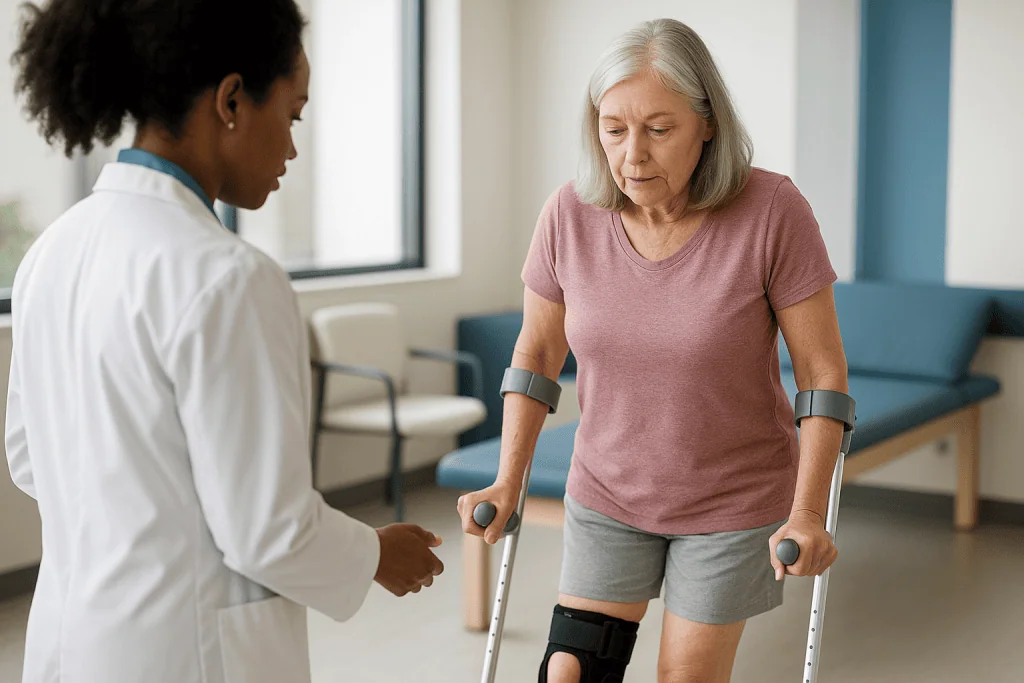
Sooner than most people expect. The Mayo Clinic notes that you will be encouraged to move your foot and ankle right after surgery to keep blood flowing, and that walking with a walker or crutches begins on the day of surgery or the following morning. The NHS describes the same pattern: a physiotherapist helps you stand and take your first steps within about 24 hours.
Those first steps are short. Think of a walk to the bathroom or the end of a hospital corridor, not a stroll. The knee is swollen, the anesthetic may still be fading, and the thigh muscle often feels like it belongs to someone else. That muscle, the quadriceps, is temporarily switched off by pain and swelling, a reflex sometimes described as quadriceps inhibition. Rebuilding its signal is one of the central jobs of early therapy.
You will be taught a specific walking pattern. Walker forward first, then the operated leg, then the other leg. Heel down, toe up, knee straightening as fully as it will allow. Therapists watch for a bent-knee limp, because a knee that never fully straightens in the first weeks can stiffen in that position.
Most people go home within one to three days, according to the NHS, and some centers discharge on the same day when a person is medically stable and has support at home. Before discharge you will usually need to demonstrate safe walking, getting in and out of bed and a chair, and managing whatever stairs your home requires.
Over the following two to three weeks, the walker typically gives way to a cane or a single crutch, and then to nothing, as balance and quadriceps strength return. The pace varies. Someone who was walking two miles daily before surgery often moves through these stages faster than someone who had been largely housebound by pain. Your therapist, not a calendar, decides when each aid comes off.
What does the first week at home look like?
The first week is a strange mixture of relief and tedium. The operation is behind you, and yet the days are structured entirely around three things: moving, icing and elevating.
Swelling dominates. The knee looks and feels tight, often warm, and bruising can track down the calf and ankle as blood settles under gravity. MedlinePlus advises keeping the leg raised above heart level when resting and applying cold packs several times a day, wrapped so they never sit directly on the skin. Swelling is not a sign that something has gone wrong. It is the body flooding the area with fluid and cells to begin repair, and it can persist in some degree for months.
Sleep is usually the hardest part. Finding a position that does not press on the incision, waking when a pain medicine wears off, and lying with the leg straight rather than propped on a pillow under the knee all take adjustment. Surgeons generally discourage a pillow directly beneath the knee because it encourages the joint to rest in a bent position.
The wound needs quiet attention. Dressings are usually left in place until a nurse or clinic visit changes them, and the incision should be kept dry until your team says otherwise. Slight redness along the edges and a small amount of clear or faintly pink fluid in the first days can be normal; spreading redness, thick drainage or a foul smell are not, and those belong in the red-flag section later in this piece.
Exercises happen several times a day, not once. Ankle pumps to move blood, gentle heel slides to bend the knee, thigh squeezes to wake the quadriceps, and short walks around the house every hour or two while awake. It is repetitive. It also matters more in this week than at any other point.
Stairs after knee replacement: when and how do they start?
Stairs are not a distant goal. If you have steps at home, hospital therapists will almost always practice them with you before discharge, usually on the first or second day after surgery, according to the NHS description of post-operative physiotherapy. The early technique is slow, one step at a time, with a handrail.
There is a rhyme therapists use because it works: up with the good, down with the bad. Going up, lead with the non-operated leg so it does the lifting, then bring the operated leg up to meet it. Coming down, lower the operated leg first so the stronger leg controls the descent. Both hands on the rail if two rails exist; a rail and a crutch if not.
Why does descending feel harder than climbing? Coming down asks the quadriceps of the standing leg to lengthen under load, a type of muscle work called eccentric contraction, and it is precisely the kind of strength that swelling and surgery suppress. It is also the movement that produces the most pressure between the kneecap and the thigh bone. Discomfort at the front of the knee on stairs is common for weeks and is one of the last things to fade.
Progression to normal, alternating stairs, one foot per step without a rail, usually arrives somewhere between the fourth and eighth week for many people, though the range is wide and depends on quadriceps recovery. Therapists often use step-ups onto a low block as a bridge exercise, raising the height as control improves.
A practical note for the first weeks: plan the house so you climb the stairs as few times a day as possible. Set up a bedroom or a resting spot on the main floor if you can, keep water, phone and medicines within reach, and treat stair trips as exercise sessions rather than errands.
Physical therapy after robotic knee replacement: what the sessions are for
People sometimes imagine physical therapy as a place you go to be stretched by someone else. It is closer to coaching for a skill you have to relearn in your own living room.
Therapy after knee replacement has three overlapping goals, and the order matters. First comes range of motion, the arc through which the knee bends and straightens. Full straightening, called extension, is the early priority because a knee that stays slightly bent makes walking inefficient and painful. Bending, called flexion, is then built up gradually, with common functional targets described by sources such as the Cleveland Clinic: enough bend to sit comfortably, get in and out of a car, and eventually climb stairs and ride a bicycle.
Second comes strength, chiefly in the quadriceps and the muscles around the hip that stabilize the pelvis when you walk. Third comes function: walking without a limp, turning, balancing on one leg, negotiating curbs.
The schedule varies by program. Some people have a therapist visit at home in the first one to two weeks and then attend an outpatient clinic; others go straight to outpatient sessions two or three times a week. The NHS notes that the exercises you do at home between visits are what actually drive progress, and that they continue for months after formal sessions stop.
Expect the sessions to be uncomfortable but not agonizing. Pushing a stiff knee into more bend does hurt in the moment, and a good therapist will tell you which kind of discomfort is productive and which signals you should stop. Timing pain relief before a session, as directed by your prescriber, is a common and reasonable strategy.
One myth worth retiring: robotic surgery does not shorten or replace therapy. The plan is set by how your knee moves, not by how the bone was cut.
How painful is robotic knee replacement surgery?
Knee replacement has a reputation as one of the more painful joint operations to recover from, and that reputation is not unfair. Bone has been cut, the joint capsule has been opened, and the surrounding muscle has been disturbed. The pain is real, it peaks in the first days, and it eases in steps rather than in a straight line.
Modern pain control is layered, which is why most people describe the experience as manageable rather than overwhelming. A regional block, meaning local anesthetic injected around the nerves supplying the knee, often numbs the area for many hours after surgery. Surgeons commonly inject a long-acting local anesthetic mixture into the tissues around the joint during the operation. Afterward, several classes of medicine are typically combined so that each can be used in smaller amounts: anti-inflammatory drugs that reduce the chemical signals driving swelling, acetaminophen-type analgesics, and, for a limited early period, opioid medicines that act on pain receptors in the nervous system. Which of these you receive, in what form and for how long, is a decision for your prescribing team based on your other health conditions.
Does robotic assistance make it hurt less? Some studies suggest slightly lower pain scores in the first days, possibly because of less soft-tissue trauma, but the finding is inconsistent and the difference, where it exists, appears small. Plan for the pain you would expect from a conventional replacement and treat any easing as a bonus.
Non-drug measures pull more weight than people expect. Cold packs blunt swelling and dull nerve signals. Elevation reduces the throbbing pressure inside the joint. Regular short walks prevent the stiffness that turns into pain when you finally stand. Sleep, hard as it is to get, lowers pain sensitivity the following day.
Pain that steadily worsens after the first week, rather than fluctuating and easing, is a signal to contact your team.
Robotic knee replacement recovery time, week by week
Timelines are useful as long as you treat them as weather forecasts rather than train schedules. The ranges below are drawn from the NHS, the Mayo Clinic and MedlinePlus, and describe what is typical, not what is required.
| Stage | What usually happens | Typical milestones |
|---|---|---|
| Day of surgery to day 3 | Stand and walk short distances with a walker; practice stairs; learn exercises | Discharge home within one to three days for most people (NHS) |
| Weeks 1 to 2 | Swelling and bruising peak; home exercises several times daily; wound check | Walker or crutches; knee straightening prioritized |
| Weeks 2 to 6 | Outpatient therapy; progress from walker to cane to unaided walking | Most daily activities resume at three to six weeks (Mayo Clinic) |
| Weeks 6 to 12 | Strength training intensifies; stairs become more fluid; longer walks | Return to many jobs and to driving, timing set by your team (NHS) |
| Months 3 to 12 | Residual swelling and warmth fade; front-of-knee ache on stairs eases | Low-impact sport such as cycling and swimming, as advised |
| Up to 2 years | Scar tissue matures; muscle bulk continues to recover | The NHS notes full recovery of muscle and scar tissue can take up to two years |
Two patterns are worth pointing out. Progress is fastest in the first six weeks and then slows, which can feel like stalling when it is actually normal consolidation. And the knee often feels warm to the touch for months, a sign of ongoing healing rather than infection when it appears without redness, drainage or fever.
Where you land within each range depends on factors you partly control, such as exercise consistency and smoking, and factors you do not, such as how your body forms scar tissue. Robotic assistance does not move you into a separate, faster table.
Who is robotic knee replacement usually for, and who is asked to wait?
The candidate for a robotic knee replacement is, first and foremost, a candidate for a knee replacement at all. The technology is a method of performing the operation, not a separate treatment with its own indications.
Knee replacement is usually considered when arthritis, most often osteoarthritis, has damaged the joint enough that pain limits walking, sleep and daily tasks, and when less invasive approaches have been given a genuine trial. The NHS lists those approaches: weight management where relevant, supervised exercise and physiotherapy, walking aids, and medicines to manage pain and inflammation. Injections into the joint may also be tried. Surgery is generally offered when these no longer provide adequate relief and the X-ray or scan findings match the symptoms.
Some people are asked to wait or to prepare further before any knee replacement, robotic or otherwise. Active infection anywhere in the body, including a dental abscess or a skin ulcer, is a common reason to postpone, because bacteria in the bloodstream can settle on a new implant. Poorly controlled diabetes raises infection risk and slows wound healing, so teams often ask for better glucose control first. Smoking impairs healing, and many programs ask people to stop for a period before and after surgery. Severe heart or lung disease may need optimization with the relevant specialists. Very significant obesity increases some surgical risks, and a team may discuss preparation, though guidance here is individual rather than a fixed threshold.
Certain knees present technical reasons a surgeon might prefer or avoid a given robotic system: prior hardware from fractures, unusual bone shape, or severe deformity. Those are conversations for the surgeon, who chooses the tool based on the knee in front of them.
Nobody should feel pushed toward a method because it sounds advanced. The question is whether a knee replacement is right for you now; the robot is a detail of how.
When can you drive, work and sleep normally again?
The three questions asked most often in the second week have little to do with the operating room and everything to do with getting life back.
Driving depends on which knee was replaced, whether the car is automatic, and whether you are still taking medicines that impair reaction time. The Mayo Clinic suggests many people can return to driving around three weeks after surgery if the operated knee is the left one and the car is automatic, while the NHS describes a more cautious window of several weeks and stresses that you must be able to perform an emergency stop comfortably. Your surgeon gives the final word, and insurers may have their own expectations, so ask both.
Work follows the demands of the job. Desk-based roles are often resumed within a few weeks, sometimes part-time or from home at first, whereas jobs involving standing, lifting, kneeling or climbing may need three months or longer. The NHS frames six weeks as a typical point for returning to many normal activities, with heavier work taking longer. Kneeling on a replaced knee is often uncomfortable for a long time and some people never find it easy, though it is not usually harmful.
Sleep improves slowly. Night pain is common through the first month because the knee stiffens when still and because daytime distractions vanish. Side-sleeping with a pillow between the knees, a firm pillow lengthwise under the whole calf rather than just the knee, and timing any prescribed pain relief before bed, as directed, all help. Most people report that sleep is one of the later things to normalize, often around the six-to-twelve-week mark.
Travel deserves a word. Long periods of sitting in the early weeks raise the risk of blood clots, so short trips with frequent movement breaks are preferred, and any longer journey should be cleared by your team.
Which complications actually shape recovery?
Most knee replacements proceed without serious complications, but the ones that do occur explain many of the rules you will be given, so it is worth understanding them rather than simply following instructions.
Blood clots are the reason for the ankle pumps, the early walking, the compression stockings and the blood-thinning medicine most people take for a period after surgery. A clot in the deep veins of the leg is called a deep vein thrombosis, and if a piece travels to the lungs it becomes a pulmonary embolism, which can be life-threatening. The Mayo Clinic lists clots among the main risks, and prevention is a combination of movement and, where prescribed, medicines that slow the blood’s clotting cascade. Which anticoagulant, for how long, and in what form is decided by your team based on your bleeding and clotting risk.
Infection is the reason for the wound-care rules and for postponing surgery when another infection is present. Superficial wound infections are treated with antibiotics; a deep infection around the implant is rarer but serious and may require further surgery. The Cleveland Clinic describes infection as an uncommon but significant complication.
Stiffness is the reason therapists push range of motion so hard in the first weeks. Scar tissue forms quickly, and if the knee is not moved through its range while that tissue is soft, it can set in a limited arc. When stiffness resists therapy, some surgeons perform a manipulation under anesthesia, gently bending the knee while you are asleep to break up adhesions.
Less common issues include nerve irritation causing numbness around the incision, which is very common and usually harmless, kneecap tracking problems, implant loosening years later, and ongoing pain without a clear cause in a minority of people. Alternatives to surgery, including continued non-operative management or a partial knee replacement where only one compartment is worn, should have been discussed before you reached this point.
What people often get wrong about recovery (five common mistakes)
Ask therapists what slows people down and they tend to name the same handful of habits. None of them are about the robot.
Doing too little, too soon. Resting the knee feels sensible, but a joint that sits bent on the sofa for days stiffens quickly. Short, frequent movement beats long rests followed by long walks.
Doing too much, too soon. The opposite error is just as common: a good day in week two leads to a long outing, and the knee swells for three days afterward. Swelling that flares after activity is the knee’s way of asking for a smaller step. Pushing through it repeatedly lengthens recovery.
Skipping the straightening work. Bending gets the attention because it is dramatic and measurable. Full extension is less glamorous and more important early. A knee that stops a few degrees short of straight makes every step harder and often hurts at the back.
Under-treating pain out of caution. Fear of medicines leads some people to skip prescribed relief and then avoid exercises because they hurt. Pain control exists to make movement possible. Concerns about any medicine belong in a conversation with the prescriber, not in a private decision to stop.
Assuming the technology did the work. Robotic assistance improves alignment. It does not perform your heel slides or climb your stairs. People who expect a lighter recovery sometimes ease off the exercises and are surprised when progress stalls.
Two smaller myths deserve a mention. The knee is not fragile; the implant is fixed to bone and can bear full weight from day one unless your surgeon says otherwise. And clicking or a sense of the knee feeling different from the original is normal with a metal-and-plastic joint and is not a sign of failure.
Questions to ask your care team before and after surgery
A good consultation leaves you knowing what to expect and whom to call. These questions tend to surface the information that matters most for recovery, and none of them are awkward to ask.
- Which robotic system will be used, and how does it change the plan for my knee compared with a conventional approach?
- Will I need a CT scan beforehand, and does that affect the timing of surgery?
- Will I go home the same day or stay overnight, and what do I need to demonstrate before discharge?
- What kind of anesthesia and nerve block are planned, and how long will the numbness last?
- What is the plan for pain relief in the first two weeks, and who do I contact if it is not working?
- How long will I take a blood-thinning medicine, and what signs of bleeding or clotting should I watch for?
- Will physical therapy start at home or in a clinic, how often, and for roughly how many weeks?
- What range of motion are you hoping I reach by two weeks and by six weeks?
- Are there movements or positions I should avoid, such as pillows under the knee or twisting?
- When is it reasonable for someone with my job and car to drive and return to work?
- How should I care for the dressing, and when can I shower?
- Which symptoms mean I should call the clinic, and which mean I should go to an emergency department?
Bring a second person if you can. The volume of information in a pre-operative visit is large, and a companion often remembers the practical details while you are absorbing the clinical ones. Writing the answers down, especially phone numbers and the early motion targets, turns a vague sense of the plan into something you can check yourself against during the slow days at home.
After surgery, the most useful question at each therapy visit is simply: what should be different by next time?
When to call your doctor
Most of what you feel in the first weeks, including swelling, warmth, bruising, night pain and numbness near the scar, is expected. A small number of signs are not, and they should prompt a call to your surgical team the same day or, for the most urgent, a trip to emergency care. The lists below reflect guidance from MedlinePlus, the NHS and the Mayo Clinic.
Seek emergency care immediately for:
- Sudden shortness of breath, chest pain, or coughing up blood, which can signal a clot in the lungs
- New calf pain, tenderness, warmth or swelling in either leg, especially if one calf is noticeably larger than the other
- Fainting, confusion, or a very fast heartbeat
- Heavy bleeding from the wound that does not slow with firm pressure
Call your surgeon or clinic promptly for:
- Fever or chills, particularly if combined with any change at the wound
- Redness spreading outward from the incision, increasing warmth, thick or cloudy drainage, or a foul smell
- Wound edges pulling apart or a dressing that is repeatedly soaked through
- Pain that steadily worsens after the first week rather than fluctuating and easing, or pain that is not controlled by your prescribed plan
- The knee becoming markedly stiffer, or a loss of motion you had already achieved
- A fall onto the operated leg, or a sudden change in how the knee feels when you bear weight
- Numbness or weakness in the foot that is new or getting worse
- Bleeding gums, blood in urine or stool, or extensive bruising while taking a blood-thinning medicine
You do not need to be certain that something is wrong before you call. Teams would far rather answer a question about a normal symptom than hear about a real one late. Keep the clinic number and the after-hours line where you can find them from your resting spot, and do not let uncertainty about whether you are overreacting delay the call.
Frequently asked questions
How long after robotic knee surgery can you walk?
Most people take their first assisted steps within about 24 hours of surgery, often on the same day, using a walker or crutches with a physiotherapist alongside. Early walks are short, measured in feet rather than blocks. Over the following two to three weeks the walker typically gives way to a cane and then to unaided walking, with the pace set by your therapist based on balance and thigh strength rather than by a fixed date.
Is recovery faster with robotic knee replacement?
Not by a large or reliable margin. Robotic assistance improves how consistently the implant is aligned, and some studies report slightly less early pain or shorter hospital stays, but findings are mixed and any difference is small. By six weeks and beyond, recovery timelines for robotic and conventional knee replacement overlap almost completely. Your pre-surgery fitness, swelling control and exercise consistency influence recovery far more than the cutting method.
How painful is robotic knee replacement surgery?
Knee replacement is genuinely painful in the first days, whether robotic or conventional, because bone is cut and the joint capsule is opened. Pain peaks early and eases in steps over weeks. It is managed with a combination of nerve blocks, local anesthetic placed during surgery, and several classes of medicine chosen by your prescribing team, alongside ice, elevation and regular movement. Pain that steadily worsens after the first week should be reported.
What are the five mistakes people make after knee replacement?
Therapists most often name resting too much so the knee stiffens, overdoing activity on a good day and triggering days of swelling, neglecting full straightening in favor of bending, under-treating pain and then avoiding exercises, and assuming the surgical technology reduces the need for rehabilitation. Each of these lengthens recovery. Frequent short walks, steady progression and consistent home exercises address most of them.
When can you climb stairs after robotic knee replacement?
Usually within the first day or two, with a therapist, using a handrail and the one-step-at-a-time method: lead up with the non-operated leg and down with the operated leg. Fluid, alternating stairs without a rail commonly return somewhere between four and eight weeks as quadriceps strength rebuilds, though the range is wide. Descending remains uncomfortable at the front of the knee for longer than climbing for many people.
How long is physical therapy after robotic knee replacement?
Formal sessions commonly run for several weeks to about three months, starting at home or in an outpatient clinic two or three times a week, but the home exercise program continues for months afterward. The schedule is set by your knee’s range of motion and strength, not by the surgical method. Robotic assistance does not shorten therapy. The NHS emphasizes that exercises done between sessions drive most of the progress.
How long does swelling last after knee replacement?
Swelling peaks in the first one to two weeks and then fades gradually, but mild swelling and warmth around the knee can persist for several months, according to MedlinePlus and the Mayo Clinic. Swelling that flares after activity is common and usually signals that the step up was too large. Elevation above heart level, cold packs wrapped in cloth, and regular movement all help. Swelling with spreading redness, fever or calf pain needs a call to your team.
When can I drive after robotic knee replacement?
It depends on which knee was operated on, whether your car is automatic, and whether you are still taking medicines that slow reactions. The Mayo Clinic suggests some people return around three weeks if the left knee was replaced and the car is automatic; the NHS describes a longer, more cautious window. You must be able to perform an emergency stop comfortably, and your surgeon gives the final clearance. Check with your insurer as well.
Is it normal for the knee to feel warm months after surgery?
Yes, a knee that feels warm to the touch for several months is common and reflects ongoing healing and increased blood flow to the area. It becomes a concern only when accompanied by spreading redness, drainage from the wound, fever or chills, or a sudden increase in pain, which could indicate infection. Clicking or a sense that the knee feels different from your original joint is also normal with a metal-and-plastic implant.
Who should not have robotic knee replacement right away?
Anyone with an active infection, including dental or skin infections, is usually asked to wait, because bacteria can settle on a new implant. Poorly controlled diabetes, smoking, and unmanaged heart or lung disease are common reasons to prepare further first. These apply to any knee replacement, not specifically to the robotic method. Some knees with prior hardware or unusual anatomy may lead a surgeon to choose a different approach, a decision that rests with the treating team.
References
- NHS: Knee replacement: Recovery
- MedlinePlus: Knee joint replacement: discharge
- Cleveland Clinic: Knee Replacement
This article is for general information only and is not a substitute for professional medical advice. Please consult a qualified doctor about your individual situation.

More from the Blog

The Types of Arthritis Explained (and Osteoarthritis vs Rheumatoid)
There are more than 100 forms of arthritis, but seven account for most diagnoses: osteoarthritis, rheumatoid arthritis, psoriatic arthritis, gout, ankylosing spondylitis, juvenile idiopathic…

Chiropractic Care: What the Evidence Supports and What It Does Not
Chiropractic care has moderate evidence for easing low back pain and some neck pain, with spinal manipulation performing about as well as exercise or…

Pillar Pain and Scar Tenderness After Carpal Tunnel Surgery: Normal Healing or a Problem?
Pillar pain after carpal tunnel surgery is aching or tenderness in the heel of the hand, on either side of the incision, that usually…

SI Joint Pain: The Often-Missed Cause of Low Back and Buttock Pain
SI joint pain comes from the sacroiliac joints, the two joints that connect the base of the spine to the pelvis. It usually causes…

Heel Pain: Plantar Fasciitis, Achilles or Something Else: How to Tell
Heel pain is most often plantar fasciitis, which causes a sharp pain under the heel with the first steps of the morning. Pain at…

Anterior Hip Replacement: How the Front Approach Differs, and for Whom
Anterior hip replacement reaches the hip joint through the front of the thigh, working between muscles rather than detaching them. Research suggests modestly less…