

Scalp Massage for Hair Growth: The Small Study Everyone Cites
Key Takeaways
- The scalp massage study most often shared involved nine healthy men, ran 24 weeks, had no control group and found thicker strands but no increase in hair count.
- The 2019 paper often called a follow-up trial was an online survey of 340 self-selected respondents reporting their own results, which places it low on the evidence hierarchy.
- In the laboratory, stretching dermal papilla cells for 72 hours increased activity of hair-growth genes and reduced the inflammatory messenger interleukin-6, the proposed mechanism behind massage.
- A scalp follicle needs roughly three months to move from rest into visible growth, so no intervention, proven or unproven, can show density changes in a few weeks.
- Topical minoxidil and oral finasteride have multiple randomized placebo-controlled trials behind them; scalp massage has none, which is the key difference the viral videos omit.
- Patchy loss, scalp pain or scaling, sudden heavy shedding, or loss of eyebrows and body hair are red flags that warrant a clinician rather than a massage routine.
Scalp massage has only weak evidence for hair growth. The study most often shared tested nine men who massaged for four minutes daily over 24 weeks and found slightly thicker hair strands, not more hairs, with no control group. A later survey relied on self-reports. Massage is safe for most people but is not a proven treatment for pattern hair loss; see a clinician for evaluated options.
The video is always the same. Someone presses their fingertips into their temples, closes their eyes, and a caption promises that a few minutes of this every day “regrows hair, proven by science.” As of mid-2025, scalp massage clips are among the most shared hair-loss content on short-form video, and the comment sections keep asking the same question: is there really a study behind this?
There is. It is nine pages long, it involved nine men, and it was published in 2016. Almost every viral claim about scalp massage traces back to it, usually without mentioning the sample size, the lack of a comparison group, or the fact that it measured strand thickness rather than new hairs.
That is not a reason to dismiss the practice. Massage is pleasant, free of side effects for most people, and biologically plausible. It is a reason to read the actual paper before rearranging your mornings around it, which is what we will do here.
What changed recently: a 2016 paper meets the algorithm
Nothing new has been published that changes the science of scalp massage. What changed is attention. The practice has cycled through social platforms before, but the current wave is bigger, and it leans harder on the word “study” as a trust signal.
The study in question appeared in the open-access journal Eplasty in January 2016. A Japanese research team recruited nine healthy men, gave each a handheld massage device, and asked them to use it on the scalp for four minutes a day for 24 weeks. The paper is indexed on PubMed, which is one reason it travels so well: a creator can link to a government database and the claim looks settled.
A second paper, published in 2019 in the journal Dermatology and Therapy, is also circulating. It reported on an online survey of 340 people who had tried a standardized massage routine for hair loss. Most of them said their hair had stabilized or regrown. That paper is frequently described as a “follow-up trial.” It was not a trial of any kind; it was a questionnaire filled in by people who chose to respond.
Two things have shifted since those papers were written. First, the rest of the hair-loss field has moved on, with more randomized data for topical minoxidil, low-level laser devices and microneedling, which makes the gap between massage and evaluated treatments more visible. Second, short-form video compresses nuance. “Nine men, thicker strands, no control group” becomes “science says massage regrows hair.”
So the honest headline for what changed is this: the evidence is a decade old and small, and the audience is new and enormous. Keep that in mind as you scroll.
Does scalp massage help hair growth? Inside the study everyone cites
Here is what the 2016 study actually did, stripped of the hype.
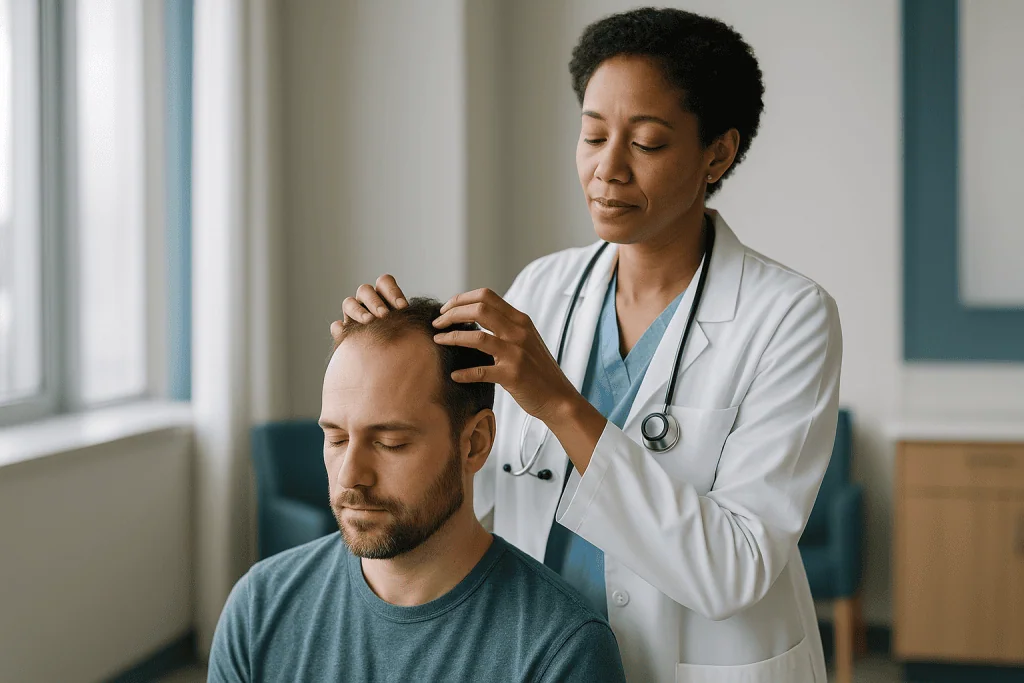
Nine Japanese men with no diagnosed hair disease each received a mechanical scalp massager. They used it for four minutes daily on a defined area of the scalp for 24 weeks. The researchers photographed and measured the hair in that area at the start, at 12 weeks and at 24 weeks, counting hairs and measuring the diameter of individual strands.
The result that launched a thousand videos: by week 24, average hair thickness in the massaged area had increased by a measurable amount. Hair count, meaning the number of hairs per square centimeter, did not change significantly. In plain terms, the men did not grow new hairs in the test area; the hairs they already had became slightly thicker.
The team also ran a laboratory experiment that is often skipped in retellings. They cultured human dermal papilla cells, the small cluster of cells at the base of each follicle that helps direct hair growth, and placed them under a gentle stretching force for 72 hours. Gene activity shifted: several genes associated with hair growth became more active, and a gene for an inflammatory messenger called interleukin-6 became less active. This is the mechanism half of the paper.
Now the limits. Nine people is a very small sample. There was no untreated comparison group, so natural variation, seasonal shedding patterns and measurement drift cannot be ruled out. Participants were healthy men without pattern hair loss, so the study says nothing directly about the people most likely to try massage. And strand thickness is a modest endpoint; thicker hair can look fuller, but it is not the same as reversing loss.
Does scalp massage help hair growth? On this evidence, it may slightly thicken existing hairs in some people. Anything beyond that is extrapolation.
What the 2019 survey added, and what it could not
Three years after the Japanese paper, a different group published survey results from people who had followed a standardized scalp massage protocol for hair loss. The protocol called for roughly 11 to 20 minutes of twice-daily massage, considerably more than the four minutes in the original study.
Of 340 people who completed the questionnaire, about 69 percent reported that their hair loss had stabilized or that hair had regrown. On average, respondents had massaged for more than seven months, and those who reported improvement tended to have logged more total massage time. Participants who said they also used minoxidil or other treatments were analyzed separately, and the pattern held among those who reported massage alone.
That sounds persuasive until you consider how surveys work. Respondents were self-selected; people who felt the routine helped were more likely to find the survey, finish it and remember their results favorably. There was no baseline photography, no blinded assessment and no control group. Hair loss also fluctuates on its own, and people typically start a new routine when shedding feels worst, so some apparent “stabilization” is simply the natural rebound to average.
This is observational, self-reported data, which sits near the bottom of the evidence hierarchy for treatment effects. It can generate a hypothesis worth testing. It cannot tell you whether massage works.
What the survey did add was a sense of dose. If massage has any effect, the 2019 data hint that it may require daily commitment over many months, which matches how hair biology works: a follicle takes months to move from a resting phase into active growth, so no intervention, proven or not, shows results in weeks.
What the evidence actually says: grading the strength
Medicine grades evidence by how well a study design rules out alternative explanations. Randomized controlled trials, where participants are assigned by chance to treatment or comparison groups, sit at the top. Observational studies and surveys sit lower. Laboratory experiments on cells and expert opinion sit lower still for questions about what happens in real people.
Applied to scalp massage, the picture is clear.
- Randomized trials: none of meaningful size have tested scalp massage alone for hair growth in people with pattern hair loss.
- Uncontrolled pilot study: one, with nine healthy men, showing modestly thicker strands and no change in hair count over 24 weeks.
- Self-reported survey: one, with 340 self-selected respondents, most reporting improvement without objective confirmation.
- Laboratory data: cultured dermal papilla cells respond to mechanical stretch with gene changes that are consistent with a growth signal.
- Expert opinion: dermatology sources generally describe massage as harmless and possibly helpful for scalp circulation, while stopping short of recommending it as a treatment.
In evidence-grading language, this is low-certainty evidence. The direction is plausible, the magnitude is small, and the confidence is limited by design.
Compare that with topical minoxidil, which has been evaluated in multiple randomized, placebo-controlled trials over decades, or oral finasteride for men, which carries a similar trial base. Those treatments are not miracle workers either; a meaningful share of users see only slowed loss rather than dramatic regrowth. But we know roughly what to expect from them, and we do not know that for massage.
The responsible summary: scalp massage is a reasonable, low-risk habit with an interesting mechanism and an unproven clinical effect. If you see it described as “clinically proven” or “as effective as” a medication, the claim has outrun the data.
How scalp massage might work: stretching the dermal papilla
The most interesting part of the 2016 paper is not the men; it is the cells.
Each hair follicle has a dermal papilla at its base, a tiny mushroom-shaped cluster of specialized cells sitting in the fatty layer beneath the skin. The dermal papilla acts like a conductor, sending chemical signals that tell the follicle when to grow, when to rest and how thick a shaft to produce. Larger, more active papillae are associated with thicker hairs; in pattern hair loss, papillae shrink and hairs become progressively finer, a process called miniaturization.
Cells can sense mechanical force, a property called mechanotransduction. When tissue is stretched or compressed, proteins at the cell surface change shape and set off signaling cascades inside the cell. This is well established in bone, muscle and skin; it is why resistance training builds muscle and why skin expanders used in reconstructive surgery generate new tissue.
The researchers placed dermal papilla cells on a flexible membrane and stretched it rhythmically for 72 hours. Afterward, the cells showed increased activity of genes linked to hair growth signaling and decreased activity of the gene for interleukin-6, an inflammatory messenger that tends to be elevated around miniaturizing follicles. The authors proposed that regular massage transmits stretching force through the scalp to the subcutaneous layer where papillae sit, nudging them toward a growth-friendly state.
Two other mechanisms are often mentioned. Massage increases local blood flow temporarily, and hair follicles are metabolically demanding. It may also loosen a tight scalp; some researchers have speculated that scalp tension contributes to pattern loss, though this remains a hypothesis rather than a demonstrated cause.
Plausible is the right word. The cell data are real, but a petri dish cannot tell you how much force reaches a papilla through skin and fat in a living person, or whether the gene changes last.
Why hair thins in the first place: the cycle, shedding and pattern loss
To judge any hair-growth claim, it helps to know what a follicle is doing on an ordinary day.
Each follicle cycles through three phases. Anagen is the active growth phase, lasting roughly two to seven years for scalp hair, during which the strand lengthens about a centimeter a month. Catagen is a short transition of a few weeks. Telogen is a resting phase of around three months, after which the old hair is shed and a new one begins. At any moment, roughly 85 to 90 percent of scalp follicles are in anagen. Losing 50 to 100 hairs a day is normal; it is simply follicles finishing telogen on schedule.
Hair loss happens when that rhythm is disturbed. The most common form is androgenetic alopecia, also called pattern hair loss, which affects a majority of men and a substantial share of women over a lifetime. Here, genetically sensitive follicles respond to androgens, a group of hormones that includes testosterone and its more potent derivative dihydrotestosterone, by shortening anagen and shrinking. Hairs grow finer and shorter with each cycle until some follicles produce only fine, barely visible vellus hairs.
Telogen effluvium is different: a stressor such as illness, surgery, childbirth, rapid weight loss or certain medications pushes an unusually large share of follicles into telogen at once, causing diffuse shedding two to three months later. It is usually temporary.
Other causes include alopecia areata, an autoimmune condition producing smooth round patches; traction alopecia from tight hairstyles; scalp conditions such as seborrheic dermatitis; thyroid disorders; and iron deficiency.
Why does this matter for massage? Because the cause determines what might help. Massage cannot alter androgen sensitivity, replace iron or calm an autoimmune attack. Diagnosis comes first; routines come second.
Scalp massage vs. evaluated treatments: how the evidence compares
Context is everything. The table below places scalp massage alongside the main options a dermatologist might discuss for pattern hair loss, graded by the kind of evidence behind each. It is a summary of evidence quality, not a recommendation; the right option depends on diagnosis, sex, age, other health conditions and personal preference, all of which belong in a conversation with a clinician.
| Approach | Best available evidence | What studies typically show | Regulatory status |
|---|---|---|---|
| Scalp massage | One uncontrolled pilot (9 men); one self-report survey (340 people); cell culture data | Slightly thicker strands in the pilot; no change in hair count; survey improvement unverified | Not a regulated treatment |
| Topical minoxidil | Multiple randomized, placebo-controlled trials | Slowed loss and modest regrowth in many users; continued use needed to maintain | Approved over-the-counter for pattern hair loss |
| Oral finasteride (men) | Multiple randomized, placebo-controlled trials | Slowed progression in most men; partial regrowth in some; effect reverses if stopped | Prescription medicine |
| Low-level laser devices | Several small randomized trials | Modest increase in hair density versus sham devices | Cleared as devices |
| Microneedling | Small randomized trials, mostly combined with minoxidil | Added benefit over minoxidil alone in some trials | Device; procedure |
| Platelet-rich plasma injections | Small trials with varying protocols | Mixed results; no standardized method | Procedure; not standardized |
A few readings from the table. Massage is the only row with no controlled data at all. The two medicines have the deepest trial base, and both carry possible side effects that a prescriber weighs individually. The device and procedure rows show that “some evidence” and “strong evidence” are not the same thing.
None of this means massage has no place. It means its place is as a companion habit, not a substitute for an evaluated plan.
How to massage scalp for hair growth, the way the study did it
If you want to try scalp massage, it makes sense to borrow the structure from the published protocols rather than improvise, if only so you can judge the experience against what was actually studied.
The 2016 study used a mechanical device for four minutes a day. The 2019 survey protocol used fingertips, in two sessions daily, totaling roughly 11 to 20 minutes. Both emphasized consistency over months.
A fingertip routine that mirrors those protocols looks like this:
- Use the pads of your fingers, never the nails, with firm but comfortable pressure. The goal is to move the scalp over the skull, not to rub the skin surface.
- Work systematically across the whole scalp, spending extra time wherever you notice thinning: the temples and crown for most men, the center part and top for most women.
- Alternate pressing and releasing with slow circular movement and gentle pinching that lifts the scalp slightly. The pilot study’s rationale was stretch, so stretch is the point.
- Keep sessions short and daily rather than long and occasional. The follicle cycle runs on months, so nothing you do in a single session matters as much as the habit.
- Stop if you feel pain, see redness that lingers, or notice more hair in your hands than usual.
A dry scalp or a shower is fine; oil is optional and discussed below. Many people fold massage into an existing moment, such as while shampoo sits or during an evening wind-down, which is the only reliable way to sustain a daily practice for the six months or more that any honest trial would require.
One caveat worth repeating: these steps describe what was studied, not what has been proven to work. Treat the routine as a low-cost experiment on yourself, with realistic expectations and a photo at the start so memory does not do the measuring.
Scalp massage benefits beyond hair: what is well supported
Strip away the hair-growth claim and scalp massage still has a case to make. Ironically, the benefits with the best support are the ones the viral videos rarely mention.
Relaxation is the most consistent. Massage of any kind activates the parasympathetic nervous system, the branch that slows heart rate and lowers muscle tension, and small studies of scalp and head massage report reductions in self-rated stress and in physiological markers such as heart rate and blood pressure in the minutes afterward. The effect is short-lived but real, and for many people a few quiet minutes with the hands on the head is a more realistic stress tool than a meditation app they never open.
Tension headaches are another area. These headaches often involve tightness in the muscles of the scalp, neck and shoulders, and manual pressure on those muscles is a long-standing self-care measure that many headache clinics endorse alongside hydration, posture and sleep. Massage is not a substitute for medical evaluation of frequent headaches, but it is a reasonable comfort measure.
Scalp health is a more mixed story. Gentle massage during shampooing helps distribute cleanser and lift loose flakes and product buildup, which can leave the scalp feeling cleaner. Aggressive scrubbing does the opposite, irritating skin and worsening conditions such as seborrheic dermatitis, a common inflammatory condition that causes flaking and redness where oil glands are dense.
Finally, there is the behavioral benefit. People who build a daily scalp routine tend to look at their hair and scalp more often and more closely, which means they notice changes, patches or irritation earlier. Earlier noticing leads to earlier evaluation, and for most causes of hair loss, earlier treatment is associated with better preservation of what remains.
So even if the hair effect proves negligible, the habit is not wasted time.
Common myths about scalp massage and hair growth
The claims below circulate widely. Each has a kernel of something, and each overshoots.
“A study proved scalp massage regrows hair.” The 2016 study found slightly thicker strands in nine healthy men with no control group. It found no increase in hair count. That is not regrowth, and a nine-person uncontrolled pilot does not prove anything; it suggests.
“Massage works by boosting blood flow, and bald scalps have poor circulation.” Massage does raise local blood flow briefly. But balding scalp is not starved of blood in any clinically meaningful way; follicles miniaturize because of hormone sensitivity, not because arteries are failing to deliver. Improving circulation does not undo androgen signaling.
“It works as well as minoxidil, without the chemicals.” No head-to-head trial exists. Minoxidil has decades of randomized data; massage has a survey. Framing a well-studied medicine as suspicious and an unstudied practice as safe is a rhetorical move, not an evidence summary. Whether minoxidil suits a given person is a question for a clinician, not a comment section.
“Harder is better.” Vigorous rubbing can irritate the scalp, inflame follicles and, in people with fragile or chemically treated hair, increase breakage. The protocols that have been studied used firm but comfortable pressure.
“Results show within weeks.” Hair follicles take roughly three months to move from rest into visible growth. Any change in density, from any intervention, takes months to appear. Early “results” are usually lighting, haircut or reduced shedding returning to baseline.
“Scalp massage can replace a doctor’s visit.” Hair loss has many causes, several of them treatable in ways massage cannot touch. Patchy loss, scalp pain or sudden heavy shedding deserve evaluation regardless of how pleasant your routine feels.
Tools, oils and devices: does the gadget matter?
Search for scalp massage and you will meet an industry: silicone bristle brushes, octopus-shaped wire heads, vibrating handheld devices, and an entire pantry of oils. Here is how to think about each without the marketing.
Handheld mechanical devices. The 2016 study used one, which is why they are promoted so heavily. The study did not compare device massage with finger massage, so there is no evidence that a device outperforms hands. What a device does offer is consistency of pressure and a lower effort barrier, which may help people stick with the habit.
Silicone shower brushes. These are pleasant and help work shampoo through thick hair. Their soft nubs are unlikely to transmit much stretching force to the deeper layer where dermal papillae sit. Treat them as a cleansing aid rather than a growth tool.
Wire “head scratcher” tools. These stimulate nerve endings and feel remarkable for a minute. They do not move the scalp in the way the stretch hypothesis requires, and the thin wires can scratch skin.
Oils. Coconut, castor, argan and rosemary oils are all popular massage mediums. Oil reduces friction, which protects hair from breakage during massage, and that is a genuine, if modest, benefit. Claims that specific oils “activate follicles” rest on small or indirect studies; rosemary oil has one small trial comparing it with minoxidil that is frequently overstated and has not been replicated at scale. Heavy oils can clog follicles or aggravate seborrheic dermatitis, and castor oil is thick enough to mat fine hair.
The honest answer to “does the gadget matter?” is that no tool has been shown to beat clean fingertips. Choose whatever makes a daily habit most likely, keep it gentle, and spend your skepticism on anything that promises the tool itself is the active ingredient.
Who should be careful with scalp massage
For most people, scalp massage is about as risky as brushing. A few groups should adjust or hold off.
Anyone with an active scalp condition should check first. Psoriasis plaques, seborrheic dermatitis flares, folliculitis (inflamed hair follicles that look like small pimples), ringworm of the scalp, open sores or recent sunburn can all be aggravated by pressure and friction. Massage over an infection can also spread it.
People with alopecia areata, the autoimmune form of patchy hair loss, sometimes notice that hair in and around patches is fragile. Gentle touch is fine; pulling or firm friction over patches is best avoided until a clinician has advised on treatment.
Those with traction alopecia, hair loss from prolonged tension at the hairline or part from tight braids, buns or extensions, need to address the tension first. Massage will not help follicles that are being pulled daily, and massaging while styles are still tight can add stress to already-strained roots.
Hair that has been chemically relaxed, bleached or heat-damaged breaks more easily. For this hair, massage with slightly damp, oiled hair and the pads of the fingers, and avoid any dragging through the lengths.
People taking blood-thinning medicines bruise easily and should keep pressure light. Anyone with a recent scalp procedure, including hair transplantation, should follow the specific aftercare timeline their surgeon gave them; grafts are vulnerable in the first weeks.
Finally, a note on children and older adults. Scalp skin in both groups is thinner. Massage is still fine, but the “firm” in “firm but comfortable” should lean toward comfortable.
If massage causes pain, lasting redness, new flaking or an increase in shed hairs beyond your usual, stop and have the scalp looked at. Those are not signs that the technique is “working.”
Scalp massage for hair loss: how to tell whether anything is changing
Hair is the ultimate unreliable narrator. It looks fuller after a cut, thinner under bathroom lights, denser in winter and sparser after illness. If you are going to try scalp massage for hair loss, measure it the way a study would, or you will end up believing whatever you hoped.
Start with photographs. Take them before you begin, in the same room, the same lighting, the same hair length and the same part, from the front, top and crown. Repeat monthly. Do not judge them until at least six months have passed, because that is roughly how long follicles need to cycle into visible growth. The pilot study ran 24 weeks for a reason.
Count shedding occasionally rather than obsessively. A rough hair count after washing on a set day each month gives a trend line. Normal is up to about 100 hairs a day, with more on wash days if you wash infrequently.
Watch the part width and the hairline position, not the overall impression. Pattern loss in women typically widens the center part; in men it recedes the temples and thins the crown. Those landmarks are easier to compare than a vague sense of volume.
Be honest about confounders. Did you also start a supplement, change shampoo, recover from an illness, lower stress or begin a medication? Each of those can shift hair independently, and the 2019 survey’s biggest weakness was exactly this inability to separate massage from everything else respondents were doing.
What would count as a win? Based on the only clinical data available, a fair expectation is slightly thicker-feeling existing hair and perhaps a sense that shedding has steadied. New growth at a bald temple would exceed anything the literature has shown.
Set the bar there, and you can enjoy the routine without being disappointed by it.
When to see a doctor about hair loss
Scalp massage is a comfort measure, not a diagnosis. Hair loss is a symptom with many causes, and some of them need prompt attention. Book an appointment with a primary care clinician or a dermatologist if you notice any of the following.
- Sudden or heavy shedding, such as clumps in the shower or on the pillow, especially within a few months of illness, surgery, childbirth, a major weight change or a new medication.
- Patchy loss: smooth, round or oval bald areas, or loss confined to one region, which can signal alopecia areata, a fungal infection or a scarring condition.
- Scalp symptoms alongside hair loss: pain, burning, itching, scaling, pus, crusting or tenderness. Scarring forms of hair loss can permanently destroy follicles, and early treatment matters most there.
- Loss of eyebrows, eyelashes or body hair, which points away from ordinary pattern loss.
- Other new symptoms: fatigue, unexplained weight change, feeling cold or hot, irregular periods, acne or excess facial hair. These can reflect thyroid disease, iron deficiency or hormonal conditions that need blood tests.
- Hair loss in a child, which should always be evaluated.
- Distress. If thinning is affecting your mood, confidence or relationships, that alone is a good reason to seek care. There are evaluated options, and discussing them earlier preserves more.
What to expect at a visit: a history, an examination of the scalp and hair, sometimes a gentle pull test, and often blood tests for iron, thyroid function and, where relevant, hormones. A dermatologist may use a handheld magnifier called a dermatoscope to assess follicle miniaturization. Occasionally a small scalp biopsy is needed.
If treatment is recommended, including minoxidil, finasteride, devices or procedures, the choice, the plan and any changes belong with the prescribing clinician. Never start, stop or adjust a prescribed medicine based on a video. Massage can sit comfortably alongside whatever plan you agree on; it just should not stand in for one.
Frequently asked questions
Does scalp massage help hair growth, according to research?
Only weakly. One small uncontrolled study found that nine men who massaged their scalps for four minutes daily over 24 weeks had slightly thicker individual hairs but no increase in hair count. A later survey of 340 people reported self-assessed improvement without objective measurement. No randomized controlled trial has tested scalp massage alone for pattern hair loss, so it remains plausible but unproven.
How to massage scalp for hair growth: how long and how often?
The published protocols used either four minutes daily with a mechanical device or roughly 11 to 20 minutes daily by hand, split across two sessions, over at least six months. Use fingertip pads with firm but comfortable pressure, aiming to move the scalp over the skull rather than rub the surface. Consistency over months matters more than the length of any single session.
What are the proven scalp massage benefits beyond hair?
The best-supported benefits are short-term relaxation, with small studies showing lower stress ratings and a brief drop in heart rate and blood pressure, and relief of muscle tension linked to tension-type headaches. Gentle massage during shampooing also helps lift flakes and product buildup. These effects are modest, but they are better documented than any effect on hair growth.
Can scalp massage for hair loss replace minoxidil or finasteride?
No. Both medicines have decades of randomized, placebo-controlled trial data showing slowed loss and some regrowth in many users; scalp massage has one nine-person pilot and a survey. Whether either medicine is appropriate for you depends on diagnosis, sex, age and health history, and that decision belongs with a prescribing clinician. Massage can be used alongside a treatment plan, not instead of one.
How long before scalp massage shows results?
Expect nothing visible for at least three to six months. Hair follicles spend about three months in the resting phase before a new hair emerges, so any change in density from any intervention lags by that much. The pilot study measured at 24 weeks. Take photos in consistent lighting before you start and compare them monthly rather than trusting memory.
Does scalp massage increase blood flow enough to regrow hair?
Massage does raise local blood flow briefly, but this is unlikely to be the main driver of any benefit. Follicles in pattern hair loss shrink because of inherited sensitivity to androgens, not because of poor circulation. The more interesting proposed mechanism is mechanical stretch on dermal papilla cells, which altered gene activity in laboratory experiments. Even that remains unconfirmed in people.
Is it better to use oil or a massage device?
Neither has been shown to beat clean fingertips. The pilot study used a device but never compared it with hand massage. Oil reduces friction and may protect fragile hair from breakage, which is a real but modest benefit; heavy oils can clog follicles or worsen flaking. Choose whatever makes a gentle daily habit easiest to keep, and treat any claim that the tool itself grows hair with skepticism.
Can scalp massage cause hair loss or make thinning worse?
Gentle massage does not cause hair loss. Hairs that come away during massage were already in the shedding phase and would have fallen within days. Vigorous rubbing, using nails or dragging through chemically treated hair can increase breakage and irritate the scalp, which is worth avoiding. If you notice pain, lasting redness or clearly increased shedding, stop and have the scalp examined.
Does scalp massage work for women with thinning hair?
The only clinical data come from men, so there is no direct evidence for women. The biological reasoning, mechanical stretch on dermal papilla cells, is not sex-specific, but neither is the lack of proof. Women with widening parts or diffuse thinning should have thyroid, iron and hormone levels checked, because treatable causes are common. Massage is safe to add; evaluation should come first.
What is the small scalp massage study everyone cites?
It is a 2016 paper published in the journal Eplasty by a Japanese team. Nine healthy men used a mechanical scalp massager for four minutes daily for 24 weeks, and the researchers measured increased strand thickness but no change in hair count. The same paper reported that stretching cultured dermal papilla cells changed hair-growth gene activity. It is a pilot study, not a trial.
References
This article is for general information only and is not a substitute for professional medical advice. Please consult a qualified doctor about your individual situation.

More from the Blog
Microneedling for Hair Loss: The Evidence, the Protocols, the Caveats
Microneedling shows genuine promise for pattern hair loss, but the evidence is modest. Small randomized trials, mostly in men, found that adding weekly scalp…

Hair Loss in Women: The Patterns, the Hormones and the Tests Worth Asking For
Hair loss in women most often comes from one of two causes: a temporary shedding phase called telogen effluvium, triggered by illness, childbirth, rapid…
Hair Breakage vs Hair Loss: How to Tell Which One You Have
Hair breakage and hair loss differ at the root. Broken hairs are short fragments with no bulb at the end, snapped along the shaft…

Minoxidil for Women: What to Expect, the Shedding Phase and Realistic Results
Minoxidil is the only topical medicine with regulatory approval for female pattern hair loss, and it works by prolonging the growth phase of thinning…
Thinning Hair: The Early Signs and the Options Before It Becomes Obvious
Thinning hair usually begins quietly: a wider part, a thinner ponytail, more scalp showing under bright light, or shedding that lasts longer than three…
Grey Hair: Why It Happens, Whether Stress Causes It and What the Reversal Studies Found
Grey hair appears when pigment-making cells in the hair follicle, called melanocytes, run down and their stem cell reserve is depleted, mostly because of…