

Scalp Reconstruction Recovery: Drains, Flap Checks and Protecting the Wound in the First Weeks

Key Takeaways
- A flap carries its own blood vessels and is most at risk in the first 72 hours, which is why nurses check its color, warmth and capillary refill as often as hourly at first.
- Closed-suction drains are emptied and recorded once or twice daily and come out when output drops below the surgeon's threshold, typically within days for scalp surgery.
- Swelling and bruising usually peak two to three days after surgery and can close an eye on the operated side even when the wound sits on the crown.
- Scalp stitches or staples generally come out at around 7 to 14 days, but the scar keeps gaining strength and changing color for six to twelve months.
- A graft on the scalp will not grow hair, while a flap keeps its follicles but often sheds hair two to three months later before regrowing it.
- Surgical site infections most commonly appear within 30 days, so spreading redness, heat, fever or cloudy drainage in that window warrants a same-day call.
Scalp reconstruction recovery usually means a short period with a surgical drain, regular flap checks to confirm the moved tissue keeps its blood supply, and several weeks of protecting the wound from pressure, sun and infection. Most drains come out within days, stitches within about two weeks, and the tissue settles over months, with the exact timeline set by the surgical team.
The first thing many people notice after waking from scalp surgery is not pain. It is the odd sensation of a snug dressing where hair used to be, a soft tube taped somewhere behind the ear, and a nurse arriving with a small torch to look, press and ask, “Can you feel that?” Those visits will repeat, often through the night, and they can feel strange until someone explains why.
Scalp reconstruction recovery is a phase with its own logic. A surgeon has closed a wound left by a skin cancer excision, a burn, an injury or a previous hair procedure by moving living tissue, and that tissue now has to prove it can survive in its new position. Drains, flap checks and gentle wound care are the tools for the job.
This explainer walks through what actually happens in those first weeks, what the evidence says about healing, and which questions are worth raising before you leave the ward.
What scalp reconstruction recovery actually involves
Scalp reconstruction is any operation that closes a scalp wound too large or too deep to simply stitch shut. A surgeon may stretch neighboring skin, rotate a piece of scalp on a hinge of intact tissue, borrow skin from elsewhere, or combine these. The piece of moved tissue that keeps its own blood vessels is called a flap; a piece of skin moved without its own blood supply is called a graft.
Recovery, then, is really about two things. The first is blood flow. A flap arrives with arteries and veins attached, but those vessels have been bent, stretched and sometimes reconnected under a microscope. In the first few days they can kink or clot, which is why nurses check the flap so often. A graft has no vessels at all and must grow new ones from the wound bed beneath it, so it is usually kept completely still under a firm dressing for several days, according to MedlinePlus guidance on skin flaps and grafts.
The second is fluid. Wherever tissue has been lifted, the body leaks a mix of blood and plasma into the space left behind. A thin, flexible drain carries that fluid out so it cannot pool, press on the flap or become a home for bacteria.
Everything else, the dressings, the sleeping position, the instruction not to bend over or lift, protects those two goals. The scalp is unusual in that it is stretched over bone with little padding, has a rich blood supply that bleeds readily, and moves every time you raise your eyebrows. Recovery instructions are written with those quirks in mind, and following them is the single most useful thing a patient can do.
Who usually has scalp reconstruction, and who is asked to wait
The most common route to a scalp reconstruction is skin cancer. The scalp is sun-exposed, often thinly covered by hair, and a frequent site for basal cell carcinoma, squamous cell carcinoma and melanoma. After a tumor is removed, especially with a margin-controlled technique such as Mohs surgery described by Mayo Clinic, the defect may be too wide to close directly. Trauma, burns, infection that has destroyed tissue, radiation damage and complications from earlier scalp or hair procedures make up most of the rest.

People with hair loss sometimes meet reconstruction from another direction. Scalp reduction, tissue expansion and flap techniques were once common approaches to baldness, and revising or repairing those older operations can call on the same skills. Reconstruction is also considered when a hair transplant scar has widened or when a wound simply will not close.
Surgeons commonly ask some people to wait or to prepare first. Active smokers are often asked to stop for a period before and after surgery, because nicotine narrows small blood vessels and flap survival depends on those vessels. Poorly controlled diabetes, ongoing chemotherapy, recent radiotherapy to the area, blood thinners that cannot be paused safely, and untreated infection at the site are all reasons a team may delay, stage the operation or choose a simpler closure.
None of these are absolute bars. A surgeon weighs the urgency of the wound against the odds of a flap surviving, and the conversation about timing belongs with the treating team, who know the whole picture.
How long do surgical drains stay in after scalp surgery?
A surgical drain is a soft tube placed under the skin at the end of the operation, with its far end sitting in the space where tissue was lifted and its near end passing out through a small separate cut. The most common type on the scalp is a closed-suction drain: a bulb or small container is squeezed flat and capped, and the gentle vacuum draws fluid out continuously.
MedlinePlus, in its guidance on closed-suction bulb drains, describes the usual routine. The container is emptied and the amount recorded once or twice a day, the bulb is squeezed to re-establish suction, and the fluid should shift from bloody to pink to pale yellow as the days pass. The drain stays in until output falls below the threshold your surgeon has set. For scalp surgery that is typically a matter of days rather than weeks, though larger flaps and cases with more oozing can run longer.
Removal is quick. The single stitch holding the tube is cut, you take a deep breath, and the surgeon or nurse slides it out. Most people describe a brief pulling sensation. The small hole seals within a day or two and is covered with a light dressing.
A few points are worth knowing in advance. Keep the container below the level of the wound so gravity helps. Secure the tubing so it cannot be tugged during sleep. A sudden change in the fluid, such as bright red blood filling the bulb quickly, cloudy or foul-smelling drainage, or output stopping abruptly while the scalp swells, is a reason to call the ward the same day rather than wait for the scheduled review.
What is a flap check and what does the nurse look for?
A flap check is a bedside examination of the moved tissue to confirm that blood is flowing in and, just as importantly, flowing out. In the first 24 to 72 hours after surgery, checks are often hourly, then every few hours, then once a shift. The frequency tapers because the risk of a vessel problem is highest early and falls steadily afterward.
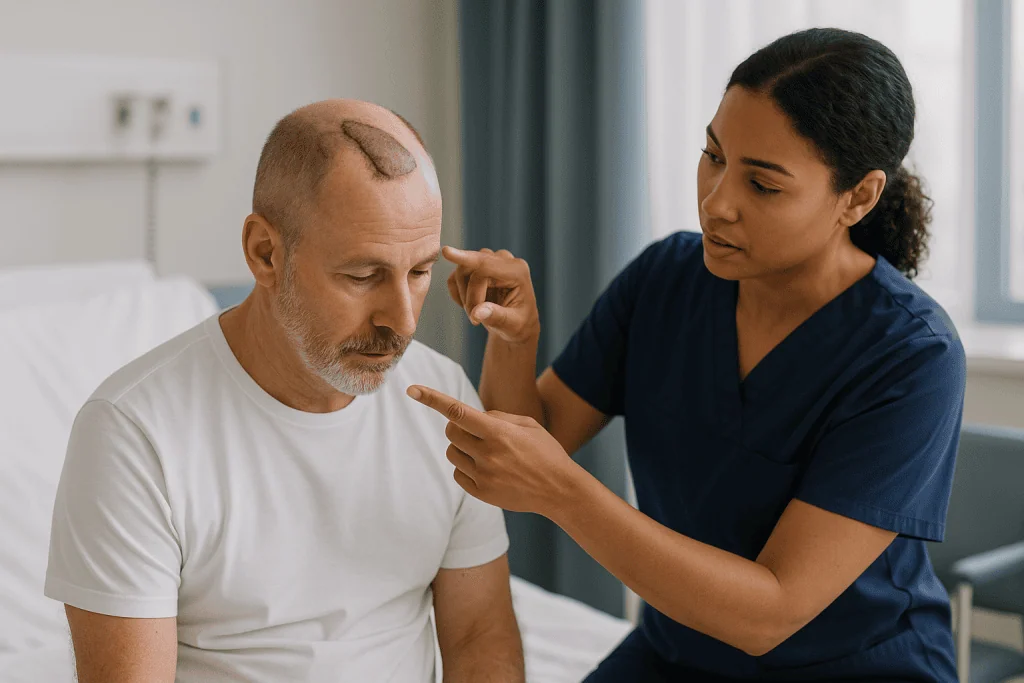
Four things are assessed each time. Color should match the surrounding scalp, allowing for bruising. Temperature is compared to neighboring skin with the back of a hand or a probe. Capillary refill is tested by pressing the flap briefly with a fingertip and watching the blanched spot pink up again; a return over roughly two to three seconds is the usual expectation. Turgor, the springiness of the tissue, tells the nurse whether the flap is soft and well perfused, tense and congested, or flat and empty.
Where a flap has been reconnected to vessels under a microscope, a free flap, the team may also use a handheld Doppler, which converts blood flow into an audible whoosh, or a small implanted probe that gives a continuous reading.
The pattern matters more than any single finding. A flap that is pale, cool and slow to refill suggests arterial inflow is struggling. A flap that is dusky purple, swollen and refills too quickly suggests venous outflow is blocked. Both are time-sensitive, and both are why patients are asked to stay in a position that keeps the head elevated and avoids pressure on the reconstructed area. If you are curious, ask the nurse to show you what a healthy check looks like so you can recognize a change yourself once home.
Signs of flap failure: what to watch for once you are home
Flap failure means part or all of the moved tissue loses its blood supply and dies. Complete loss of a well-planned scalp flap is uncommon, and most problems that do occur are partial, affecting the tip of a flap that was farthest from its blood supply. Even so, early recognition changes what can be done, so it helps to know what a struggling flap looks like.
In the first days, the warning signs mirror what the nurse checks. The flap turns markedly paler or markedly darker than the rest of the scalp. It feels cool. A pressed area stays white for longer than it did in hospital, or refills almost instantly and the tissue looks bruised and tight. Swelling increases rather than settling. Any of these, especially in combination, is a same-day call to the surgical team.
Later in the first two weeks, failure tends to show as a firm, dark, leathery patch at one edge, sometimes with the wound edge separating. This is dead tissue and it will not recover, but the surrounding flap often remains healthy. Surgeons usually let the boundary become clear before trimming the dead portion and deciding whether the wound will heal from the base, needs a small graft or requires a further procedure.
Not every change is failure. Bruising, some blistering of the skin surface and patches of numbness are common and usually benign. The distinction is one for the team to make, ideally with a photograph you have taken in good light. Keep the clinic number where you can find it, and do not wait for an appointment to report a color change that worries you.
Scalp wound care after surgery: dressings, washing and sleeping
Dressings on the scalp do three jobs: they absorb ooze, hold a graft still, and shield the wound from fingers, pillows and hats. A flap is often covered with a light non-stick dressing or left partly open with an ointment layer so the team can see it. A graft is usually held under a firm bolster dressing, sometimes stitched in place, which stays untouched for around five to seven days according to MedlinePlus guidance on flap and graft care.
Washing is the question everyone asks. MedlinePlus advice on closed surgical wounds notes that many wounds can be gently rinsed after the first 24 to 48 hours once the surgeon agrees, but a scalp reconstruction is not a routine closed wound. Expect to be told exactly when water may touch the area, whether to use a cup rather than a shower head, and how to pat rather than rub. Hair near the wound may have been shaved; regrowth around stitches is itchy and best left alone.
Sleep on your back with the head raised on two pillows or a wedge for the first week or so. Elevation reduces swelling and keeps the flap out of contact with the pillow. Side-sleepers often find a travel pillow around the neck helps them stay put.
Small habits protect the wound. Keep fingernails away from scabs. Avoid tight hats, headbands and helmets until cleared. Use a wide-brimmed soft hat or a loose scarf outdoors, because a healing scar burns easily and pigments darker if it does. Do not apply creams, oils or herbal preparations that were not on your discharge sheet; the wound does not need them, and some interfere with dressings or irritate new skin.
Scalp flap surgery recovery time: a week-by-week guide
Timelines vary with the size of the wound, the type of repair and your general health, so treat the ranges below as typical rather than promised. They draw on MedlinePlus guidance on flaps, grafts and surgical wounds and on general surgical practice.
| Stage | What is usually happening | Common instructions |
|---|---|---|
| Days 0–3 | Frequent flap checks; drain in place; swelling peaks around day two or three | Head elevated; no bending, lifting or straining; stay in hospital or nearby |
| Days 3–7 | Drain usually removed; checks taper; bruising spreads to forehead or eyelids and begins to fade | Gentle washing when cleared; first dressing change; short walks |
| Weeks 1–2 | Skin edges seal; stitches or staples removed around 7–14 days on the scalp; graft bolster taken down | Return to desk work if comfortable; no exercise that raises blood pressure |
| Weeks 2–6 | Scar strengthens; numbness and tightness common; hair regrowth begins around the edges | Sun protection; gradual return to activity as advised |
| Months 2–12 | Scar softens and flattens; sensation returns partially; final appearance emerges | Scar massage if recommended; review of any secondary procedures |
Two moments deserve emphasis. The first is the swelling peak at 48 to 72 hours, which can be alarming if no one has warned you; eyes may puff shut on the side of surgery even though the wound is on the crown. The second is the removal of sutures, which many people assume marks the end of recovery. In fact a scar has only a fraction of its final strength at two weeks and continues to remodel for a year. Protecting it from tension, sun and picking during that long tail is what shapes how it eventually looks.
Managing pain, swelling and numbness without guesswork
Scalp surgery is often less painful than people expect, partly because the local anesthetic used during the operation lingers for hours and partly because the nerves supplying the area are frequently cut or stretched, leaving the region numb rather than sore. What people describe more often is a tight, heavy feeling and a headache-like ache around the temples or forehead in the first few days.
Pain relief is decided by the prescribing clinician and tailored to the type of repair. In general terms, simple analgesics form the base, and stronger medicines are used for short periods if needed. Some anti-inflammatory painkillers affect the way blood clots, so surgeons may ask patients to avoid them for a period; that decision rests with the team and depends on the individual case. Tell the team if pain is escalating rather than easing, because increasing pain under a dressing can signal a collecting pocket of blood, known as a hematoma, that may need releasing.
Swelling is managed with elevation, time and patience. Cold packs are sometimes advised for the forehead and eyes but usually not directly over a flap, because cooling narrows the vessels the flap depends on. Ask before applying anything cold to the reconstructed area.
Numbness deserves an honest word. Sensory nerves in the scalp run from the front and back toward the crown, and a large flap will almost always cut across some of them. Feeling usually returns partially over months as nerves regrow at roughly a millimeter a day, but a permanent numb patch is common and does not mean anything has gone wrong. Odd tingling, itching and electric flickers along the scar are typical signs of that regrowth rather than of a problem.
Smoking, blood sugar and blood flow: what the evidence shows
Three ordinary things influence whether a flap thrives, and they sit largely within a patient’s control.
Smoking is the best documented. Nicotine constricts small arteries, carbon monoxide displaces oxygen from red blood cells, and both effects reach the tiny vessels at the far edge of a flap where blood supply is already marginal. Guidance from the CDC and Johns Hopkins on surgical site infections lists smoking among the modifiable risk factors for wound complications, and surgeons across specialties ask patients to stop for a period before and after surgery. This includes vaping and nicotine replacement in many centers, because nicotine, not just smoke, is the problem. The specific advice for your operation should come from your team.
Blood glucose matters for two reasons. High glucose impairs the white blood cells that fight infection and stiffens small vessels over time. People with diabetes are asked to keep readings within their agreed range through recovery, and a stress-related rise in glucose after surgery is common even in people without diabetes.
Blood flow is also about mechanics. Bending forward, straining on the toilet, coughing hard and lifting all raise pressure in the veins of the head and neck, which can congest a flap or restart bleeding. Constipation after surgery is common and worth mentioning to the team early so it can be managed rather than endured.
Alcohol, poor sleep and dehydration are lesser factors but not trivial ones, particularly in the first week. Steady meals with adequate protein support wound healing; there is no evidence that any particular supplement speeds it, and high-dose vitamins are not recommended without medical advice.
Skin grafts versus flaps: how recovery differs on the scalp
Because the two repairs get their blood in different ways, their recoveries feel different, and patients sometimes find themselves comparing notes with a neighbor on the ward who had the other type.
A graft is a thin sheet of skin, usually taken from the thigh or behind the ear, laid onto a healthy wound bed and held motionless. For the first three to five days it survives by soaking up fluid from below; new capillaries then grow into it. The critical enemy is movement or fluid under the graft, which is why the bolster dressing is left sealed and why patients are asked to avoid anything that shifts the scalp. The donor site often hurts more than the graft itself, weeps for a week or more and heals like a large graze. A graft on the scalp will not grow hair, tends to sit slightly lower than the surrounding skin and may look shiny.
A flap brings its own vessels and is therefore more robust to movement, more resistant to infection and better at covering exposed bone. Its risks are concentrated in the first 72 hours, when kinking or clotting of vessels can cut off supply. Flaps preserve hair, though the hair may now grow in a different direction, and the donor area is closed directly or with a small graft, leaving an extra scar.
Swelling and bruising are typically greater after a flap because more tissue is disturbed. Numbness is more extensive. Time in hospital is often longer, particularly for free flaps that need close monitoring. Over the long term, a flap usually gives the more natural contour; a graft is quicker and simpler when bone is covered by healthy tissue. The choice is a surgical judgment made on the size, depth and location of the wound.
Hair, scars and what the scalp looks like later
People undergoing scalp reconstruction for skin cancer are often surprised by how much they care about hair afterward, and those coming from a hair-restoration history care from the outset. Either way, it is fair to ask what to expect.
Hair grows from follicles in the deeper layer of skin. A flap that carries that layer intact will keep its hair, though follicles stressed by surgery frequently shed their shafts two to three months later and then regrow, a pattern known as telogen effluvium. This delayed shedding can be alarming if no one has mentioned it. Hair along the very edge of a flap, where blood supply was thinnest, may be permanently lost in a narrow strip. Grafts carry no follicles and stay bare.
Scars on the scalp behave in a particular way. Because the skin is tight over bone and is pulled by facial expression, scars tend to widen over the first months, especially if the closure was under tension. They also stay red for longer than scars on softer parts of the body, often six to twelve months. Sun exposure during this phase darkens them permanently, so covering the area is a genuine long-term investment rather than fussiness.
Secondary procedures exist for people who want them: scar revision, small hair transplants into a bald strip, and tissue expansion to replace a graft with hair-bearing scalp. Surgeons usually advise waiting until the scar has fully matured, commonly around a year, before deciding. Nothing about the early appearance predicts the final one with confidence, and the most useful stance in the first months is patience combined with good photographs so change can be judged honestly.
What people often get wrong about scalp reconstruction recovery
Myths gather around any surgery, and a few of them actively slow healing.
The first is that a wound must be kept bone dry until it is fully healed. Prolonged dryness is not how skin heals best; a lightly moist, protected environment supports new cells. What matters is following the team’s specific timing for when and how the area may be washed, not avoiding water altogether for weeks.
The second is that scabs are a sign of good healing and should be left thick. A scab is dried blood and fluid. A modest one is fine, but a large crust that traps fluid under a flap edge can hide a problem and delay closure. Do not pick, but do report a scab that is growing, softening or smelling.
The third is that a numb scalp means nerve damage that will never recover. Partial return is the norm, and a fully numb scalp at week two says little about how it will feel at month six.
The fourth is that once the stitches are out, the wound is strong. Scar tissue reaches only a modest fraction of normal skin strength at two weeks and continues gaining for months. Helmets, tight hats and vigorous scrubbing can still widen a scar at week four.
The fifth is that vitamin E oil, cocoa butter or other topical products shrink scars. Mainstream evidence does not support this, and some products cause irritation on freshly healed skin. Silicone sheets or gel have the most supportive evidence for scar softening, but even those should be started only when the team says the wound is ready.
Finally, some assume that a dusky flap will “come good” on its own. It might, but the right response to a color change is a phone call, not a wait-and-see.
Questions to ask your care team before you go home
Discharge conversations can be rushed, and the questions that matter most are often the ones nobody thought to ask until the first night at home. Write yours down. A useful list looks something like this.
- What type of repair did I have, a local flap, a free flap or a graft, and what does that mean for how I move and sleep?
- How often should I look at the flap, and what specific colors or changes should prompt a call?
- When will the drain come out, what daily output are you waiting for, and what should I do if the bulb fills quickly or stops draining?
- Exactly when can water touch the wound, and how should I wash my hair around it?
- Which of my usual medicines should continue, which are paused, and who decides when they restart?
- When are stitches or staples due out, and where will that happen?
- What activities, and roughly when, can I resume: driving, desk work, lifting, exercise, wearing a hat or helmet?
- What is the plan for the donor site, if I have one?
- What number do I call out of hours, and what would make you want me to go to an emergency department instead?
- How will the results of any tissue sent to the laboratory reach me, and when?
Two questions people often hold back from asking are also worth voicing. One is what the scar is likely to look like in a year and what options exist if it bothers you. The other is whether a further operation is already anticipated, because knowing that a second stage is planned reframes the first result as a step rather than a destination. Teams generally welcome these questions; they would rather explain twice than have you worry at home.
When to call your doctor
Most of scalp reconstruction recovery is quiet, and the majority of calls to a surgical unit end with reassurance. Even so, some signs should not wait for the next appointment, because the window for rescuing a struggling flap or treating an early infection is measured in hours and days.
Call the surgical team the same day, or the out-of-hours number they gave you, if you notice any of the following:
- The flap changes color, becoming markedly pale, white, blue, purple or black, or turns cold to the touch.
- Swelling increases rapidly, the scalp feels tense and bulging, or pain climbs steeply under the dressing.
- Bleeding soaks through the dressing or fills the drain bulb with bright red blood within a short time.
- The drain output turns cloudy, thick or foul-smelling, or stops abruptly while the area swells.
- The wound edges gape, or fluid leaks from the incision after it had sealed.
- Redness spreads outward from the wound, the area becomes hot, or you develop a fever or chills; CDC and Johns Hopkins guidance notes surgical site infections most often appear within the first 30 days.
- You have a severe headache unlike your usual pattern, confusion, drowsiness, vomiting or a seizure. These are rare but need urgent assessment, particularly if bone was exposed or the skull was involved.
Go directly to an emergency department, or call emergency services, for heavy bleeding that will not stop with firm pressure, difficulty breathing, chest pain, a swollen painful calf, or a sudden change in alertness. If you are unsure whether something counts, that uncertainty is itself a reason to call. Surgical teams plan for these calls, and no one will think less of you for making one about a wound they created.
Frequently asked questions
How long do surgical drains stay in after scalp reconstruction?
Usually a few days, until the daily fluid output falls below the level your surgeon has set. MedlinePlus describes emptying and recording a closed-suction drain once or twice a day and watching the fluid turn from bloody to pale yellow. Larger flaps or persistent oozing can extend this, and the team decides the exact day of removal.
What is the typical scalp flap surgery recovery time?
Most people see stitches removed at around one to two weeks and return to light activity in that period, while swelling, numbness and scar redness settle over several months. Full scar maturation commonly takes six to twelve months. These are typical ranges from general surgical guidance, not guarantees, and depend on the size and type of repair.
What are the early signs of flap failure?
A flap that turns markedly pale or dusky purple, feels cool, swells tightly or refills too slowly or too fast after gentle pressure may be losing its blood supply. Later, a firm dark leathery patch at one edge indicates tissue that has died. Any color change should be reported the same day so the team can assess it promptly.
How should I wash my hair after scalp surgery?
Only when your team says the wound may get wet, often after the first 24 to 48 hours for a simple closed wound but frequently later for a flap or graft. Use lukewarm water poured gently from a cup, a mild shampoo kept away from the incision, and pat dry. Avoid rubbing, hot water and hair dryers near the area.
Why is my eye swollen when the wound is on top of my head?
Fluid from a scalp wound drains downward under the loose skin of the forehead and eyelids, so bruising and puffiness often appear around the eyes on the operated side two to three days after surgery. It usually fades within a week or two. Keeping the head elevated helps, and a sudden increase in swelling should be reported.
Will my hair grow back over a scalp flap?
Usually, yes, if the flap carried the deeper skin layer where follicles live. Hair often sheds two to three months after surgery and then regrows, which can be alarming but is expected. A narrow strip along the flap edge may stay bare, and the direction of growth may change. Skin grafts do not carry follicles and remain hairless.
Is numbness after scalp reconstruction permanent?
Often partly, but not usually completely. Sensory nerves cut during surgery regrow slowly, at roughly a millimeter a day, so tingling and patchy feeling return over months. A permanent numb area is common and does not mean something has gone wrong. Itching, prickling or electric sensations along the scar are typical signs of nerve recovery.
When can I wear a hat or helmet again?
Loose, soft hats for sun protection are often allowed once the dressing comes off, but tight hats, headbands and helmets that press on the flap are usually restricted for several weeks because pressure can compromise blood flow and widen the scar. Ask your team for a specific date, especially before cycling, motorcycling or contact sports.
Does smoking really affect whether the flap survives?
Yes. Nicotine narrows small blood vessels and carbon monoxide reduces the oxygen carried to tissue, both of which hit the far edge of a flap hardest. CDC and Johns Hopkins list smoking among modifiable risks for wound complications. Surgeons commonly ask patients to stop for a period before and after surgery, including vaping and nicotine products.
Can I use scar creams on my scalp after reconstruction?
Not until your team confirms the wound has fully closed. Mainstream evidence does not support vitamin E or cocoa butter for improving scars, and some products irritate new skin. Silicone gel or sheets have the most supportive evidence for softening scars once healing is complete. Sun protection remains the most reliable way to limit permanent darkening.
References
- MedlinePlus: Skin flaps and grafts – self-care
- MedlinePlus: Closed suction drain with bulb
- MedlinePlus: Surgical wound care – closed
- CDC: About Surgical Site Infections
This article is for general information only and is not a substitute for professional medical advice. Please consult a qualified doctor about your individual situation.

More from the Blog
Hair Transplant Without Shaving Results: Does Working Around Existing Hair Limit Density?
A hair transplant can be done without shaving the whole head, usually as an unshaven or partially shaved follicular unit extraction. Working around existing…

Who Suits Scalp Micropigmentation for Scars and Thinning, and Who Needs Another Approach?
Scalp micropigmentation for scars usually suits adults whose scar is fully healed and flat, whose skin does not tend to form raised keloids, and…

Failed Hair Transplants: Why They Happen and How Repair Works
A hair transplant can fail when grafts don't survive relocation, when the design ignores future hair loss, or when healing is disrupted by infection…
Who Is a Candidate for Robotic Hair Surgery? Why Hair Color, Curl and Contrast Matter
A typical robotic hair surgery candidate has stable, pattern-type hair loss, a dense donor area at the back and sides of the scalp, and…

Eyebrow Transplant Recovery: Healing, Scabbing and the Trimming Routine
Eyebrow transplant recovery typically follows a predictable arc: redness and tiny scabs for the first 5 to 10 days, a shedding phase between roughly…

Afro Hair Transplant for Traction Alopecia: Why Stopping the Pull Comes Before Surgery
An afro hair transplant can restore a hairline thinned by traction alopecia, but only after the pulling has fully stopped and the scalp has…