

Schroth Method for Adults With Scoliosis: How Goals Differ From Treating a Growing Teen

Key Takeaways
- Scoliosis is defined as a sideways spinal curve of at least 10 degrees on X-ray, usually accompanied by rotation, which is why Schroth treats it as a three-dimensional problem.
- In a growing teenager, Schroth aims to limit curve progression measured by Cobb angle before skeletal maturity; in an adult, the spine no longer grows and the goals shift to pain, function, posture and breathing.
- Most Schroth research involves adolescents; adult studies are smaller, mostly measure pain and quality of life, and do not show meaningful reduction in curve size in a mature spine.
- Rotational angular breathing, directing breath into the collapsed side of the rib cage, uses the ribs as levers on the rotated vertebrae and is the signature technique of the method.
- Adult curves can still progress slowly with disc and joint wear, so exercise complements, rather than replaces, the periodic medical monitoring a physician recommends.
- Home practice is intended to carry the benefit, but the exercises should be learned from a trained therapist first because breathing or shifting toward the wrong side can reinforce the curve.
The Schroth method for adults uses the same three-dimensional posture, breathing and strengthening principles taught to teenagers, but the goal shifts. In a growing teen, the aim is to slow curve progression before the skeleton matures. In an adult, the spine is fully grown, so therapists focus on easing pain, improving posture and breathing, protecting function and supporting everyday movement. Evidence in adults is promising but smaller than in adolescents.
She noticed the girl first: fifteen, maybe sixteen, standing at a wall bar in a brace, breathing in a slow, oddly deliberate way while a therapist pressed gently on one side of her ribs. Then she caught her own reflection in the studio mirror, one shoulder blade sitting a little higher than the other, and thought the question so many people in their forties, fifties and sixties bring to a first appointment: is the Schroth method for adults really the same thing that girl is doing, and if so, what is it supposed to do for a spine that stopped growing decades ago?
It is a fair question, and the honest answer is more interesting than a yes or no. The exercises look alike. The reasons for doing them do not. A teenager and a grown adult sit at opposite ends of a biological clock, and that clock changes what success can even mean.
This explainer walks through what actually happens in a Schroth program, what the evidence supports in adults, and how to talk with your care team about goals that fit your spine rather than someone else’s.
What is the Schroth method, and where did it come from?
The Schroth method is a form of physiotherapeutic scoliosis-specific exercise, often shortened to PSSE, a phrase that simply means exercises designed around the individual shape of a person’s curve rather than generic back strengthening. Scoliosis itself is a sideways curvature of the spine, usually with a twist, that measures at least 10 degrees on an X-ray according to Cleveland Clinic. Most people picture it as a C or S shape, but the rotation is what makes it a three-dimensional problem, and it is that rotation the Schroth approach was built to address.
The technique began nearly a century ago in Germany, developed by a woman named Katharina Schroth who had scoliosis herself. Her insight, unusual for the time, was that the ribs could act as levers. She noticed that when she breathed deliberately into the collapsed, concave side of her trunk while holding a corrected position in front of a mirror, her posture changed. She turned that observation into a system of postures, breathing patterns and muscle activation that her daughter and later a growing community of therapists refined and standardized.
Today, as Johns Hopkins describes it, the method is taught by certified physical therapists who classify each person’s curve pattern and build a tailored set of corrective positions. Sessions use mirrors, wall bars, rice bags, poles and stools as props. Nothing about it is passive; the patient does the work, and the therapist coaches.
What often surprises adults is that the method was never designed only for teenagers. Katharina Schroth was an adult when she began experimenting on herself. The adolescent focus in research and clinical practice came later, driven by the very real urgency of stopping curves during growth. The adult story deserves telling on its own terms.
How does the Schroth method actually work?
Picture a spine with scoliosis as a spring that has been both bent and twisted. Schroth therapists describe the work in three broad movements, usually performed together in a single held position.

The first is elongation, meaning actively lengthening the trunk as if someone were gently lifting the crown of the head toward the ceiling. Compression tends to worsen the visible curve; lengthening creates a little room to work with. The second is de-rotation, a deliberate effort to unwind the twist by shifting the rib cage and pelvis in directions opposite to the way the curve has pulled them. The third is stabilization, tensing the trunk muscles at the end of the corrected position so the body learns to hold it for a few breaths before releasing.
Threaded through all of this is rotational angular breathing, the signature of the method. In plain terms, it means directing the breath into the flattened, collapsed areas of the rib cage on the concave side of the curve. Ribs attach to the vertebrae, so expanding one side of the chest applies a small, repeated pull on the twisted bones and the muscles around them. Over many repetitions, the intent is to retrain how the nervous system perceives an upright posture, so that the corrected position begins to feel normal rather than effortful.
Mirrors matter here. Someone with a long-standing curve typically feels perfectly straight when they are, in fact, leaning. Visual feedback, along with the therapist’s hands, helps correct that internal map. Johns Hopkins notes that programs aim to make these corrections habitual in daily activities such as sitting, standing and walking, not only during exercise. That carryover into ordinary life is where much of the day-to-day benefit for adults is expected to come from.
Why treating a growing teen is a race against the clock
To understand what changes in adulthood, it helps to see what is at stake in adolescence. Idiopathic scoliosis, the most common type and one with no identified single cause, usually appears around the growth spurt just before puberty, according to Mayo Clinic. The spine is lengthening quickly, and a curve that exists at that moment can worsen as the vertebrae grow unevenly, the concave side lagging behind the convex.
Clinicians track this with two tools. The Cobb angle is the measurement, in degrees, of how far the spine deviates from straight on an X-ray. The Risser sign is a grading of how much the growth plate on the pelvis has hardened, a proxy for how much growing remains. A large Cobb angle in a child with a low Risser grade is the combination that worries orthopedic teams most, because there is both a curve and time for it to grow.
The treatment goals follow from that logic. Mayo Clinic describes bracing as the standard approach for moderate curves in children whose bones are still growing, worn for many hours a day, with the purpose of preventing the curve from getting worse rather than reversing it. Schroth exercise in adolescents has been studied largely as a companion to bracing or observation, with the hoped-for outcome being a smaller increase in Cobb angle than would otherwise occur.
Everything in the teenage program is oriented toward that measurement. Success is defined on an X-ray. Parents ask about degrees. The urgency is real: once growth finishes, the window in which exercise or bracing might meaningfully alter the size of the curve narrows sharply. That is precisely why the adult conversation has to begin somewhere else.
What the Schroth method for adults is really trying to achieve
When growth is complete, the vertebrae have their adult shape. No amount of exercise will reshape bone. Therapists who work with adults are candid about this, and the honest ones reframe the goals on the first visit.
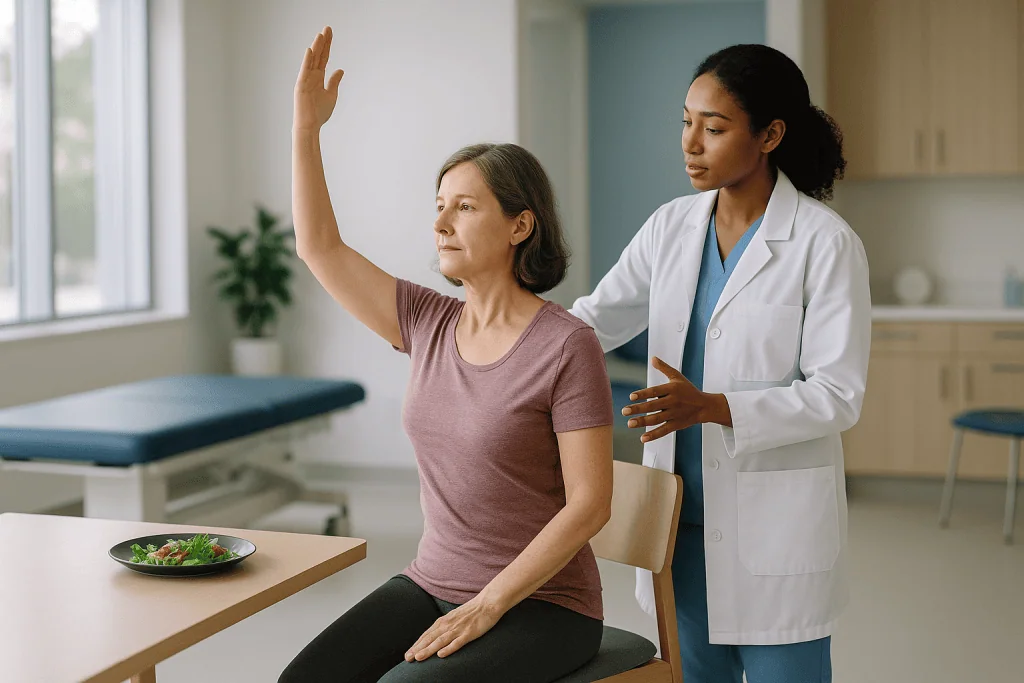
Pain moves to the top of the list. Adults with scoliosis, whether the curve dates from adolescence or developed later through disc and joint wear, often live with muscular fatigue on one side, low back ache, neck tension or pain between the shoulder blades. Cleveland Clinic and NHS both note that in adults, back pain is a far more common reason to seek help than the shape of the curve itself. Schroth exercise targets the overworked muscles on the convex side and the shortened, underused muscles on the concave side, with the intent of redistributing load.
Function is next. Can you carry groceries, sit through a long meeting, garden for an afternoon, sleep comfortably? These are the outcomes adults care about, and they are what the program is built around.
Breathing and posture come third but are far from minor. A rotated rib cage can limit how fully one lung expands. Adults often describe feeling they can take a deeper breath after learning rotational angular breathing, and posture-related self-image improves for many, a point Johns Hopkins highlights among the aims of the method.
Slowing the slow drift is the final goal. Adult curves are not frozen. NHS explains that scoliosis in adults can gradually worsen over years as spinal discs and joints age. Whether exercise alters that trajectory is not established, but building strength and movement habits is a reasonable aim while your team monitors the curve over time.
Does the Schroth method work for adults? What the evidence shows
Here is where a careful writer has to slow down, because the marketing around scoliosis exercise frequently outruns the data.
Most published trials of Schroth and related scoliosis-specific exercise involve adolescents with idiopathic scoliosis. In that group, several randomized studies have reported smaller increases, or small decreases, in Cobb angle compared with observation or general exercise, along with improvements in posture and quality-of-life questionnaires. Those findings are encouraging but come from relatively small studies, and reviewers consistently call for larger, longer trials.
In adults the evidence base is thinner. Studies that exist are mostly small, often without a comparison group, and they tend to measure pain, self-reported function and posture rather than curve size. They generally report that participants feel better and move more easily after a supervised program. What they do not show, at least not convincingly, is that Schroth reduces the Cobb angle in a mature spine or prevents degenerative progression over decades. No one has followed adults long enough to answer that question.
So what can a person reasonably expect? Johns Hopkins describes the method’s goals in terms of posture, pain, breathing and function, not curve reversal, and that framing matches the evidence. Exercise in general is well supported for chronic low back pain, and Schroth is a structured, individualized form of exercise, so it sits on firm ground as a pain and function strategy.
The fair summary is this: Schroth for adults is a low-risk, plausible, modestly supported way to manage symptoms and posture, best judged by how you feel and function rather than by a number on an X-ray. Anyone promising to straighten an adult spine with exercise is promising more than the science can deliver.
Who is the Schroth method usually for, and who is asked to wait?
Adults arrive at scoliosis-specific exercise from two main directions, and the starting point shapes the program.
The first group carries an idiopathic curve from adolescence, sometimes diagnosed decades ago and sometimes only discovered on an X-ray taken for another reason. The spine has adapted to its shape; the muscles have their habits. These patients often do well with the postural retraining side of Schroth because they can usually move freely and tolerate holding corrective positions.
The second group has degenerative, or de novo, scoliosis, a curve that develops later in life as discs thin and the small facet joints of the spine wear unevenly. Cleveland Clinic and Johns Hopkins describe this as increasingly common with age. Here the therapist has to work around arthritis, stiffness and sometimes narrowing of the spinal canal. The program is gentler, more focused on stability and pain than on ambitious correction.
Who is asked to wait, or to see a physician first? Anyone with new leg weakness, numbness, or bladder or bowel changes, because these may signal nerve compression that needs medical evaluation before exercise. People with unexplained weight loss, fever, or pain that wakes them at night belong in a doctor’s office, not a therapy studio, until other causes are excluded. Those with severe osteoporosis need their team’s input on which positions are safe, since certain twisting or loading movements carry fracture risk. And someone recently discharged from spinal surgery follows the surgeon’s rehabilitation plan, which may or may not include Schroth-style work later.
Mayo Clinic notes that adults with scoliosis are generally managed with a combination of monitoring, exercise, pain management and, when needed, surgery. Where Schroth fits is a conversation for your treating team, not a decision the method makes for you.
Teen versus adult Schroth goals at a glance
The table below sets the two situations side by side. Nothing here replaces an individual plan, but seeing the contrasts in one place clarifies why an adult should not measure progress with a teenager’s yardstick.
| Question | Growing teenager | Adult with a mature spine |
|---|---|---|
| Main clinical worry | Curve worsening during remaining growth | Pain, stiffness, fatigue, loss of function |
| How progress is judged | Cobb angle on repeat X-rays, brace tolerance | Pain scores, daily function, posture, breathing, quality of life |
| Key biological factor | Growth remaining (Risser sign, growth velocity) | Disc and joint wear, bone density, muscle strength |
| Typical companions to exercise | Observation or bracing, per Mayo Clinic | Pain management, activity advice, sometimes injections or surgery, per NHS |
| Realistic hope for curve size | Slow or limit increase | Not expected to change meaningfully |
| Emotional focus | Parents, school, brace wear, body image | Work, sleep, staying active, avoiding decline |
Two lines deserve emphasis. First, the measurement column: adults who fixate on degrees often feel they are failing when the X-ray looks the same, even as their pain has eased and they are hiking again. Second, the companions column: in adulthood, Schroth almost always sits inside a broader plan that your physician coordinates, and its job is to make everyday life work better, not to stand in for medical evaluation when symptoms change.
Keep this table in mind when reading testimonials online. A story about a fourteen-year-old’s curve holding steady is real and meaningful, and it tells you almost nothing about what to expect at fifty-two.
What happens at a first Schroth assessment?
The first appointment is longer than a typical physical therapy visit and, for many adults, unexpectedly personal. You will be asked to undress to underwear or fitted clothing so the therapist can see your back, shoulders, hips and rib cage without guessing.
Expect a detailed history. When was the curve found? Has it changed? Where does it hurt, and what makes it better or worse? What do you need your body to do, whether that is lifting toddlers, standing at a workbench, or sleeping through the night? These answers become the goals written into your plan.
The physical examination follows. The therapist looks at you from the front, back and side, watches you bend forward, and often uses a small inclinometer, a handheld tool that measures the tilt of your trunk, to estimate rotation. If you have recent X-rays, they will study the Cobb angle and the overall pattern. They will then classify your curve into one of the Schroth patterns, a shorthand that tells them which side of the rib cage to expand, which hip to shift, and how to position your shoulders.
Only after that do the exercises begin, and they begin slowly. You might spend twenty minutes learning to find an elongated posture and breathe into one side of your ribs while the therapist’s hand rests there as a target. It feels strange. Most people are surprised by how much concentration a single breath can demand.
Before you leave, the therapist typically photographs your posture with your permission, gives you one or two exercises to practice, and explains how the supervised course is likely to unfold. Johns Hopkins describes this pattern of evaluation, a series of coaching sessions, and progressive home practice as the usual structure of a program.
What the first weeks and months usually look like
Schroth is not a treatment you receive; it is a skill you learn, and the timeline reflects that.
In the early weeks, sessions concentrate on awareness. You learn where your curve is, what corrected feels like, and how to breathe into the right places. Many adults notice unfamiliar muscle soreness on the concave side of their trunk in these first sessions, simply because muscles that have been slack for years are being asked to work. This is usually mild and settles between visits. Sharp pain, new numbness or symptoms shooting into a leg are not expected and should be reported to the therapist and your doctor.
As positions become familiar, the therapist adds holds, then movement within the corrected posture, then integration into daily tasks: sitting at a desk in your corrected position, standing at the sink with a slight weight shift, walking with awareness of your rib cage. This is the stretch of the program where adults most often report feeling taller and breathing more freely. Those impressions are real to the people describing them, though they are subjective and not the same as a measured change in the spine.
Over the following months, supervised visits generally become less frequent while home practice continues. Johns Hopkins emphasizes that regular independent practice is central to the method’s intended benefit. Some people return periodically for a refresher when they notice old habits creeping back.
Repeat imaging, if your physician orders it, follows their schedule rather than the therapist’s, and it is used to monitor the curve, not to grade your exercise performance. NHS advises that adults with scoliosis may have periodic reviews to check whether the curve is progressing. Treat the X-ray and the exercise program as two separate conversations that happen to concern the same spine.
Can I do Schroth exercises at home?
Yes, and in fact you are meant to. The supervised sessions exist to teach the exercises correctly; the daily benefit is expected to come from doing them consistently on your own, a point Johns Hopkins makes plainly in describing the method.
What you should not do is try to teach yourself Schroth from videos before an assessment. The method depends on knowing your specific curve pattern. Breathing into the wrong side of the rib cage or shifting the pelvis in the wrong direction does not simply waste effort; it reinforces the very asymmetry you are trying to counter. Because most people with scoliosis feel straight when they are leaning, self-correction without feedback tends to go astray. A therapist’s hands and a mirror are the tools that make the corrections accurate at first.
Once you have been taught, a home practice typically needs very little: a mirror, a wall you can lean against or reach toward, a firm stool or chair, and something soft such as a rolled towel or small cushion to place under one side of the pelvis or ribs as a positional prop. Your therapist will show you how to set these up so they replicate what you learned in the studio.
Consistency beats intensity here. A short daily practice that you actually do is worth more than a long routine you abandon after two weeks. Many adults fold the postural corrections into moments they already have, brushing teeth, waiting for the kettle, standing in a queue, so the corrected position becomes the default rather than an exercise.
Pain that increases with home practice, new symptoms in the legs, or a sense that something has shifted are signals to pause and check in with your therapist or physician before continuing.
What are the best exercises for adults with scoliosis?
People type this question into search engines hoping for a list, and the honest answer is that no single list fits every curve. What the evidence and major medical sources support is a set of principles, and the best program is one built from them for your body.
General movement comes first. Mayo Clinic and NHS both recommend staying active with scoliosis, and exercise is one of the better-supported strategies for chronic back pain of any cause. Walking, swimming, cycling and other low-impact aerobic activity keep the trunk muscles working, support a healthy weight, and lift mood, none of which depends on the shape of your spine.
Core and back strengthening is next. Adults with scoliosis often have one side of the back that works too hard and one that has quietly switched off. Exercises that build endurance in the deep trunk muscles, especially in symmetrical positions supervised by a physical therapist, help share the load. Pilates and yoga-style work can be useful when the instructor understands scoliosis and avoids pushing you into positions that deepen the curve.
Scoliosis-specific exercise, including Schroth, is the third layer. This is where the asymmetry is addressed directly, with positions and breathing tailored to your pattern.
What to be cautious with: repeated heavy loading in a rotated position, deep unsupported backbends, and any movement that produces radiating leg pain or numbness. If you have degenerative scoliosis with spinal stenosis, a narrowing of the canal that houses the nerves, your physician may advise favoring positions with a slight forward lean over full extension. None of these cautions is a reason to avoid movement. They are reasons to have someone who knows your spine help you choose it.
How Schroth fits alongside other adult scoliosis treatments
In adulthood, exercise is rarely the whole plan. NHS lists the usual options for adults as pain relief, exercise, spinal injections in selected cases, and surgery for a minority whose symptoms are severe or whose curve is progressing significantly. Understanding where Schroth sits among these prevents both under- and over-expectation.
Bracing plays a much smaller role in adults than in teenagers. Because the goal of a brace in adolescence is to stop growth-related progression, and adults are no longer growing, Mayo Clinic notes that braces are not typically used to change adult curves. Some adults are offered a soft support for short-term pain relief during flares, a very different purpose.
Medicines, when used, aim at pain. Over-the-counter anti-inflammatory drugs and simple analgesics are the classes most often mentioned by NHS for scoliosis-related back pain; they reduce inflammation or dampen pain signaling for hours at a time and do nothing to the curve itself. Whether, when and how long to use them is a decision for your prescribing clinician, particularly if you have kidney, heart or stomach conditions.
Injections, usually steroid delivered near an irritated nerve or joint, may be offered when pain has a clear inflammatory source. NHS describes their effect as temporary, sometimes lasting weeks to months, and they are used to enable activity rather than as a stand-alone answer.
Surgery for adults, most often spinal fusion, is reserved for those with severe pain, nerve compression or progressive deformity that has not responded to other measures, according to Mayo Clinic and Johns Hopkins. It is a major operation with meaningful risks and a long recovery, and the decision belongs to the surgical team and the patient together.
Schroth complements all of this. It is the daily, active, low-risk component that a person controls, and it can continue whether or not other treatments are added.
What people often get wrong about Schroth for adults
Myths gather around any treatment that promises to help without drugs or surgery. A few need correcting.
Myth: Schroth straightens the adult spine. It does not. Mature bone keeps its shape. What can change is posture, muscle balance, breathing and pain, which is why adults sometimes look and feel taller without any change on X-ray.
Myth: If the curve is not shrinking, the exercises are failing. This imports the teenage yardstick into adulthood. For adults, the right measures are pain, function and quality of life. A stable X-ray alongside less pain is a good outcome, not a disappointing one.
Myth: It is just physical therapy with a fancy name. General back strengthening treats the spine as symmetrical. Scoliosis-specific exercise deliberately does not, and it requires a therapist trained in curve classification. Both have a place; they are not the same thing.
Myth: You can learn it from online videos. Videos can remind you of exercises you have already been taught. They cannot tell you which of your ribs to breathe into or catch you when you drift, and getting the direction wrong can reinforce the curve.
Myth: Adults are too old to benefit. The evidence in adults is smaller than in adolescents, but the studies that exist report improvements in pain and function across a wide age range, and exercise for chronic back pain is supported at every age.
Myth: Schroth means you can skip medical follow-up. NHS notes adult curves can progress with age. Exercise does not replace the periodic review your physician recommends, and new nerve symptoms need medical attention regardless of how well the exercises are going.
The thread running through all of these is the same: Schroth is a tool for living better with a curved spine, not a way to make it stop being curved.
Questions to ask your care team about the Schroth method for adults
A good first conversation sets goals you can actually reach. Bring these questions, and expect specific answers rather than reassurance.
- What type of scoliosis do I have, idiopathic from adolescence or degenerative, and how does that change what exercise can realistically do?
- What is my current Cobb angle, and how often, if at all, do you recommend repeat imaging to monitor it?
- Are there any positions or movements I should avoid because of my bone density, stenosis or other conditions?
- What are we trying to change: pain, posture, breathing, endurance? How will we know in a few months whether it is helping?
- Is the therapist I am seeing certified in the Schroth method or another scoliosis-specific approach, and how will the supervised sessions transition to home practice?
- How does this program fit with the other parts of my plan, including any pain medicines, injections or a surgical opinion?
- Which symptoms should make me stop exercising and contact you the same day?
- If my pain does not improve after a fair trial, what would the next step be?
Notice that none of these questions asks whether Schroth is the best treatment. That framing rarely helps, because adult scoliosis care is almost always a combination, and the right mix depends on your symptoms, your imaging and your life. A team that answers these questions plainly, admits what is uncertain, and writes down goals with you is giving you the most valuable thing available: a plan you understand and can judge for yourself.
Write the answers down or ask permission to record the conversation. Goals set on day one are the standard you will use months later to decide whether the effort has been worth it.
When to call your doctor
Scoliosis exercise is generally safe, and mild muscle soreness in the first weeks is expected. Some symptoms, however, are not part of any exercise program and need a physician’s attention rather than another session.
Contact your doctor promptly, or seek urgent care, if you develop:
- New or worsening weakness in one or both legs, or a foot that drags or slaps when you walk.
- Numbness or tingling spreading down a leg, into the groin or around the buttocks.
- Any change in bladder or bowel control, including difficulty starting to urinate, incontinence or loss of sensation when wiping. These can signal serious nerve compression and are treated as an emergency.
- Severe back pain after a fall, even a minor one, especially if you have osteoporosis or take steroid medicines, because fracture is possible.
- Back pain that wakes you from sleep, comes with fever, night sweats or unexplained weight loss, or steadily worsens over weeks regardless of position.
- New shortness of breath, chest tightness or difficulty breathing that is more than the mild effort of a breathing exercise.
- A visible change in your posture or the shape of your back over a short period.
Cleveland Clinic and NHS both advise that adults with scoliosis should report new nerve-related symptoms and marked increases in pain, since these may indicate progression or a separate problem such as disc herniation or spinal stenosis. Your therapist will want to know too, but a physician is the one who can order imaging and rule out causes that exercise should not be treating.
Outside emergencies, a scheduled call is the right move when pain has plateaued or crept up despite consistent practice, when a new medication has changed how you feel during exercise, or when you are simply unsure whether a symptom belongs to the scoliosis at all. Uncertainty is a good enough reason to ask.
Frequently asked questions
Does the Schroth method work for adults?
It can help adults manage pain, posture and breathing, but it is not expected to shrink a mature curve. Studies in adults are small and mostly report improvements in pain and self-rated function rather than changes in Cobb angle. Larger trials have been done in adolescents. The realistic aim for a grown spine is feeling and moving better while your physician monitors the curve over time.
What are the best exercises for adults with scoliosis?
There is no universal list; the best program is individualized. Mainstream guidance supports regular low-impact aerobic activity, core and back endurance work supervised by a physical therapist, and scoliosis-specific exercise such as Schroth tailored to your curve pattern. Movements to approach cautiously include heavy loading in a twisted position and deep unsupported backbends, particularly if you have stenosis or low bone density. Ask your team which apply to you.
How expensive is Schroth therapy?
This article does not quote costs, because they vary widely by region, the number of supervised sessions your therapist recommends, and whether your insurance covers scoliosis-specific physical therapy. The practical step is to ask the practice for a written description of the program and then contact your insurer about coverage for physical therapy with a scoliosis diagnosis. Your care team can also advise on what parts are essential.
Can I do Schroth exercises at home?
Yes, and daily home practice is central to how the method is meant to work. The catch is that you need to learn the exercises from a certified therapist first, because they are matched to your specific curve pattern, and practicing them in the wrong direction can reinforce the asymmetry. Once taught, a mirror, a wall, a stool and a rolled towel are usually all the equipment required.
How is Schroth for adults different from Schroth for teenagers?
The exercises look similar, but the purpose differs. In a growing teen, therapists aim to slow curve progression before the skeleton matures, and progress is judged on X-ray. In an adult, bone shape is fixed, so the program focuses on pain, function, posture and breathing, with progress judged by how you feel and move. Adult programs also work around arthritis, stenosis and bone density more often.
Can adult scoliosis get worse even with exercise?
Yes. NHS notes that adult scoliosis can gradually progress as discs and spinal joints age, and there is no strong evidence that exercise prevents this. Schroth is a way to manage symptoms and support posture, not a guarantee against progression. That is why physicians often recommend periodic review, and why new pain, weakness or numbness should be reported rather than attributed to the exercises.
What is adult scoliosis physical therapy like at the first visit?
Expect a long appointment. The therapist takes a detailed history of your pain and daily demands, examines your back and rib cage from several angles, reviews any X-rays, and classifies your curve pattern. Early exercises focus on finding an elongated posture and breathing into the collapsed side of the ribs, often with the therapist’s hand as a target. You typically leave with one or two exercises to practice.
Is Schroth safe if I have osteoporosis or spinal stenosis?
Often yes, with modifications, but your physician and therapist need to know about these conditions before you start. Certain twisting or loading positions carry fracture risk with low bone density, and people with stenosis, a narrowing of the canal around the nerves, may be advised to favor slightly flexed positions over full extension. A trained therapist adapts the program; the medical clearance comes from your doctor.
How long does it take to notice a difference with Schroth?
Reliable timelines are not established in adults, and anyone quoting a precise number is guessing. Many people describe feeling taller or breathing more easily within the first weeks of learning the corrections, while changes in pain and endurance tend to build with consistent home practice over months. Judge progress against the goals you set with your team, not against a schedule.
Will I still need a doctor if the exercises are helping?
Yes. Exercise addresses symptoms and posture; it does not replace medical monitoring of the curve or evaluation of new symptoms. Adults with scoliosis are generally advised to keep periodic reviews as recommended by their physician, and to report leg weakness, numbness, bladder or bowel changes, or pain that wakes them at night promptly, since these may point to problems that exercise should not be treating.
References
This article is for general information only and is not a substitute for professional medical advice. Please consult a qualified doctor about your individual situation.

More from the Blog

Who Is a Candidate for Artificial Disc Replacement? Single-Level Disease and Healthy Facets
The typical artificial disc replacement candidate has neck or low back pain traced to a single worn disc, with facet joints and surrounding bone…

Preparing for ACDF Surgery: Medicines to List, Tests to Complete and Soft Foods to Stock
Preparing for ACDF surgery usually means three tasks: giving your surgical team a complete list of every prescription, over-the-counter medicine and supplement you take;…
What an Artificial Disc Actually Does: How the Mobile Implant Moves With Your Spine
An artificial disc is a small mobile implant placed between two vertebrae after a worn or herniated disc is removed. Two metal endplates anchor…

Discectomy vs Disc Replacement: Which Disc Operation Fits Which Spine Problem
A discectomy removes the fragment of a herniated disc that is pressing on a nerve and leaves the rest of the disc in place;…

What Can Go Wrong With Kyphoplasty or Vertebroplasty? Cement Leaks and Symptoms to Report
Kyphoplasty complications are uncommon but real. Bone cement can leak outside the vertebra into the disc, veins or spinal canal; most leaks cause no…

Pain After ACDF Surgery: Neck Soreness, Shoulder Blade Ache and How Relief Is Managed
Pain after ACDF surgery is common and usually has more than one source: the front-of-neck incision, a sore throat from retraction, muscle soreness across…