

Schroth Method vs General Physiotherapy for Scoliosis: What Makes the Approach Curve-Specific

Key Takeaways
- Scoliosis is defined as a sideways spinal curve of at least 10 degrees on X-ray, and most curves also involve rotation of the vertebrae, which is why Schroth treats it as a three-dimensional problem.
- The feature that makes a program curve-specific is classification of the curve pattern followed by positions that elongate, de-rotate and side-shift the trunk while breathing into the concave ribs.
- A randomized trial in adolescents found that adding Schroth exercises to standard care for six months improved back muscle endurance and self-reported pain and self-image scores.
- Bracing has far stronger evidence than any exercise program for preventing progression in growing children, with benefit rising when the brace is worn 13 or more hours a day in the main randomized trial.
- In adults, no exercise method has been shown to reduce the Cobb angle; the realistic goals of both Schroth and general physiotherapy are less pain, more endurance and better daily posture.
- Idiopathic scoliosis is not caused by poor posture, backpacks or sport, so posture training changes how a person carries the curve rather than why it exists.
The Schroth method is a form of physiotherapeutic scoliosis-specific exercise that tailors posture corrections, breathing and strengthening to a person's individual curve pattern, while general physiotherapy addresses overall strength, flexibility and pain without targeting the curve's three-dimensional shape. Evidence, mostly from small trials in adolescents, suggests curve-specific exercise may improve function and self-image alongside standard care; it does not replace bracing or surgery when those are indicated.
The X-ray goes up on the screen and the spine on it makes a shape nobody in the room expected: a gentle S, leaning right at the chest and left at the waist. The parent does the thing most parents do next, which is to type “schroth method vs physiotherapy” into a phone in the parking lot. Two clinics, two websites, two sets of confident claims, and a 13-year-old in the back seat asking whether she can still play volleyball.
That search deserves a calmer answer than the internet usually gives. Both approaches involve a physiotherapist, both involve exercise, and both can be done well or badly. The difference is not effort or enthusiasm. It is whether the program is built around the specific way one particular spine curves and rotates, or around the body in general.
This explainer walks through what each approach involves, what the research can and cannot support, who tends to be offered which option, and the questions worth bringing to the appointment.
What is the Schroth method, in plain language?
Schroth is a system of exercises designed for scoliosis, a sideways curve of the spine of at least 10 degrees on an X-ray, usually with some rotation of the vertebrae as well. The method began in Germany in the 1920s, developed by Katharina Schroth, who had scoliosis herself and noticed that her posture changed when she breathed deliberately into the sunken side of her rib cage.
A century on, the core idea has survived reasonably intact. Scoliosis is treated as a three-dimensional problem, not a flat one. A curve does not just lean to the side; the vertebrae twist, the ribs on one side push backward into a hump, and the trunk shortens. Schroth exercises try to address all three directions at once: lengthening the spine, de-rotating the trunk, and shifting the body back toward the midline.
The signature technique is often called rotational angular breathing. In one sentence: the patient learns to direct each inhale into the collapsed, concave part of the rib cage so that the ribs expand where they have been compressed. Combined with specific positions of the pelvis, shoulders and arms, this creates a corrected posture that the patient then holds using isometric muscle work, meaning muscles tense without the joints moving.
Today Schroth sits inside a broader family that clinicians call physiotherapeutic scoliosis-specific exercises, or PSSE. Several schools exist, including Schroth-based variants taught in different countries, and most share the same principles: self-correction in three dimensions, stabilization of the corrected posture, and training the patient to carry that posture into daily life. Johns Hopkins describes the method as individualized to each person’s curve, delivered by therapists with specific training, and dependent on a daily home program.
The point to hold onto: Schroth is not a brand of stretching. It is a way of teaching a person to find, hold and eventually habituate a better alignment of their own particular curve.
What does "general physiotherapy" for scoliosis usually mean?
General physiotherapy is a wide tent. For someone with scoliosis it typically means a program built from familiar ingredients: core strengthening, hamstring and hip flexor stretching, posture awareness, aerobic conditioning, and manual therapy for stiffness or pain. The exercises are often the same ones a therapist would prescribe for low back pain, with some attention paid to symmetry.
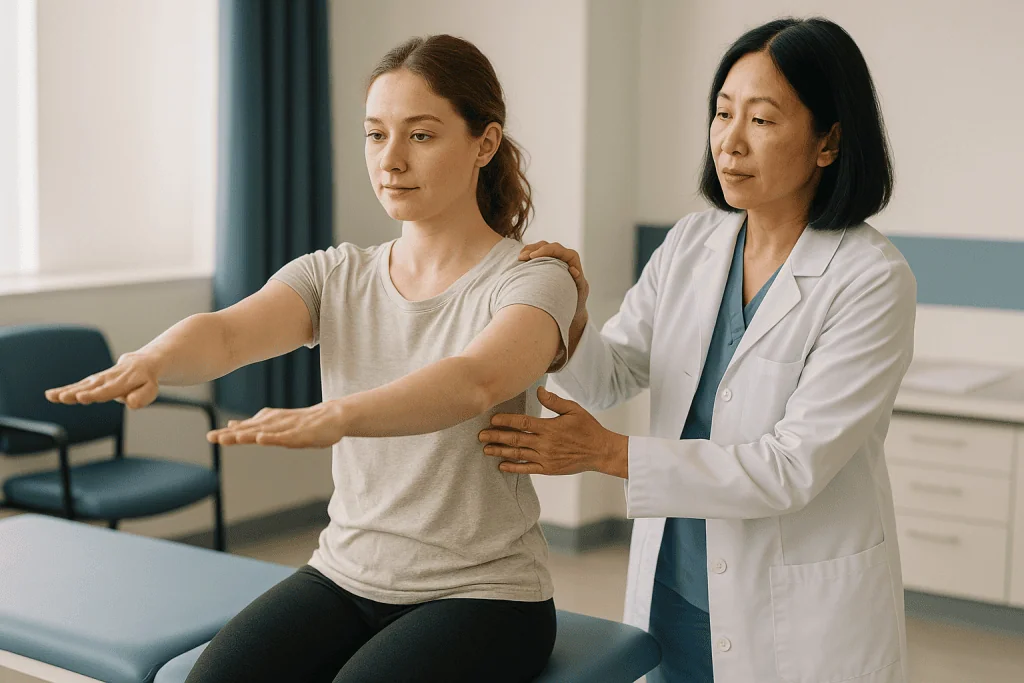
This is not a criticism. Those ingredients matter. A stronger trunk, more flexible hips and better endurance help people with scoliosis move more comfortably, and for adults whose main complaint is pain rather than curve progression, that may be exactly what is needed. The NHS lists physiotherapy and exercise among the measures that can help adults with scoliosis manage pain and stay active.
The distinction lies in what the program is aimed at. General physiotherapy treats the body that happens to have a curve. It does not usually teach a person which direction their lumbar spine rotates or where their ribs are collapsed, and it does not usually ask them to hold a corrected three-dimensional posture while breathing in a specific pattern.
Think of it this way. A general program is like a well-designed fitness plan for someone who also has scoliosis. A curve-specific program is a plan that would make no sense for anyone else, because every position is dictated by one person’s X-ray and posture assessment.
There is also a practical difference in who delivers it. Any licensed physiotherapist can prescribe general exercise. Schroth and related PSSE methods require additional certification, and the quality of the home program depends heavily on how well the patient was taught. Either approach is only as good as the assessment behind it, the clarity of the instruction, and whether the person actually does the exercises after the appointment ends.
Schroth method vs physiotherapy: what actually makes an approach curve-specific?
The phrase “curve-specific” gets used loosely, so it helps to be concrete. Four features separate a scoliosis-specific program from a general one, and a person can check for each of them at the first appointment.
First, the curve pattern is classified. Schroth therapists sort curves into groups based on how many major curves there are and where they sit: a single thoracic curve, a double curve with thoracic and lumbar components, a thoracolumbar curve, and so on. Each pattern gets a different set of corrections. A general program does not usually start with this step.
Second, correction happens in three planes. Side-bending away from the curve, de-rotation of the trunk, and elongation upward are all built into every position. General posture exercises tend to focus on the sagittal plane only, meaning the front-to-back view, which is where slouching lives but not where scoliosis mainly lives.
Third, breathing is a tool, not a cue to relax. The rotational angular breathing described earlier is used to expand the concave ribs and shift the rib hump. This is probably the single most distinctive element, and the one most likely to be absent from a general program.
Fourth, the corrected posture is trained for daily life. Patients practice holding their correction while sitting, standing, walking and eventually during sport, with the aim of making it semi-automatic. General physiotherapy builds strength and flexibility in neutral positions; it rarely trains a specific asymmetric correction.
None of this makes general physiotherapy wrong. For pain management, conditioning, and return to activity after surgery, it is often the right choice. The honest framing is that the two approaches have different targets. One aims at function and comfort in a body that has a curve; the other aims, in addition, at the shape of the curve itself and at how the person carries it.
What actually happens in a Schroth session?
A first visit is mostly assessment. The therapist looks at the X-ray, measures the Cobb angle, which is the standard way of quantifying a curve in degrees between the most tilted vertebrae at the top and bottom, and watches the person stand, bend forward and breathe. Photographs or surface measurements may be taken for comparison later. The curve is classified, and the therapist explains, often with a mirror, exactly where the trunk has shifted, rotated and shortened.
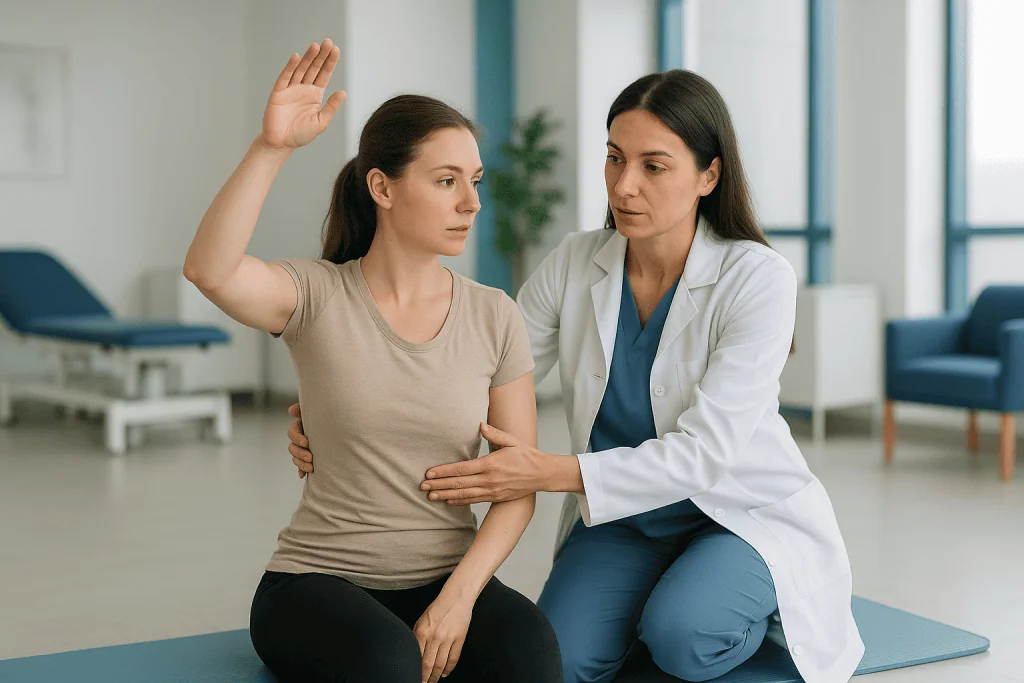
Then the teaching starts. Expect to spend a surprising amount of time on things that look like doing nothing: lying on a mat, learning to feel which side of the rib cage moves on an inhale, placing a hand on a collapsed region and trying to breathe into it. Props are ordinary: a wall bar or ladder, foam pads, poles, towels, sometimes rice bags to give tactile feedback on the concave side.
Once the breathing pattern is grasped, the therapist layers in positions. Each one sets the pelvis, legs and arms so that gravity and muscle pull help the spine toward correction. The patient holds the posture, breathes into the concavities, and then performs an isometric contraction to stabilize it, typically for a slow count before releasing. Progressions move from lying to sitting to standing.
Sessions tend to run close to an hour, and the early phase is frequently delivered as a block of visits so that the home routine is learned properly. The therapist’s real deliverable is not the session itself but the home program: a short set of positions the person can reproduce accurately without supervision.
Children generally need a parent or caregiver to learn the routine too, because correcting a 12-year-old’s shoulder position from memory is hard. Adults usually manage alone but benefit from periodic check-ins to catch drift, because habits creep back in quietly.
Schroth method vs physiotherapy: what the evidence actually shows
This is where honesty matters most, because enthusiasm for scoliosis exercise has sometimes run ahead of the data. The fair summary is that the research base for curve-specific exercise is small but growing, generally positive for function and quality of life, and still limited for the outcome most families care about, which is stopping curve progression.
The best-known randomized trial, published in the journal Scoliosis, compared Schroth exercises added to standard care against standard care alone in adolescents with idiopathic scoliosis and curves between roughly 10 and 45 degrees. Over six months, the Schroth group showed greater improvement in back muscle endurance and in the pain and self-image domains of a standard scoliosis quality-of-life questionnaire. The trial was modest in size, used assessor blinding, and did not set out to prove a change in Cobb angle.
Mayo Clinic’s patient guidance reflects this measured position: exercise and physical therapy can help with symptoms and function, while bracing is the treatment with the stronger evidence for slowing progression in growing children with moderate curves. The NHS likewise frames exercise for scoliosis as helpful for pain and mobility rather than as a way to straighten the spine.
What about general physiotherapy? There is surprisingly little trial evidence specifically for non-specific exercise in scoliosis, partly because it is rarely studied as a scoliosis treatment in its own right. Its benefits for strength, pain and fitness are well established in the broader back-pain literature, and there is no reason to think they vanish in a person with a curve.
Bottom line, graded plainly: curve-specific exercise has low-to-moderate quality evidence for improving function, endurance and self-image in adolescents when added to standard care; evidence that it halts progression on its own is weak; general physiotherapy has good evidence for conditioning and pain, with no claim on curve shape. Either should be seen as part of a plan the treating team sets, not a replacement for it.
Who is Schroth usually for, and who is usually asked to wait?
Most referrals for scoliosis-specific exercise fall into a few recognizable groups.
The largest is adolescents with idiopathic scoliosis, meaning a curve with no identified cause, who are still growing and have mild-to-moderate curves. For a curve too small to brace but large enough to monitor, a Schroth program can give a young person something active to do during the long wait between X-rays, and the trial evidence discussed above was gathered in exactly this group. For a child who is wearing a brace, exercises are commonly prescribed alongside it, both to maintain trunk strength and to teach the correction the brace is trying to impose.
Adults with degenerative or long-standing scoliosis form the second group, typically referred for pain, stiffness or a sense of leaning. Here the aim is almost never to change the curve and almost always to improve comfort and function.
A third, smaller group is people before or after spinal fusion surgery, where a scoliosis-literate therapist can help with conditioning and with movement patterns, although the specifics depend heavily on the surgeon’s protocol.
Who tends to be asked to wait, or steered elsewhere? Children with very large or rapidly progressing curves are usually prioritized for bracing or surgical assessment first, because the window for those decisions is tied to remaining growth. Mayo Clinic notes that surgery is typically considered for curves beyond about 45 to 50 degrees. Anyone whose scoliosis is linked to a neurological or muscular condition needs that condition addressed in the plan, and generic protocols may not fit. People with acute severe back pain, recent fracture or unexplained neurological symptoms should be evaluated before starting any exercise program.
Age alone does not exclude anyone. Motivation and the ability to practice at home matter far more than birthdays, and a very young child who cannot follow instructions may simply be better served by observation until they can.
Side by side: Schroth, general physiotherapy, bracing and observation
Families often see these options presented as rivals. In practice they are layers, and a given person may use two or three of them at once over the course of adolescence. The table below sets out what each one targets and what the mainstream evidence supports, drawing on the NHS, Mayo Clinic, Johns Hopkins and the trials cited in this article.
| Approach | Primary target | Typically offered to | What evidence supports | What it does not do |
|---|---|---|---|---|
| Schroth / PSSE | Three-dimensional self-correction, trunk endurance, posture habits | Growing adolescents with mild-to-moderate curves; adults with pain or postural complaints | Improved back endurance, pain and self-image scores over six months when added to standard care (adolescent RCT) | Has not been shown to reliably stop progression on its own or to replace bracing |
| General physiotherapy | Strength, flexibility, fitness, pain | Adults with pain; anyone needing conditioning; post-surgical rehabilitation | Well-established benefits for function and back pain generally | Does not target curve shape or rotation |
| Bracing | Preventing progression during growth | Skeletally immature children with moderate curves, commonly in the 25–40 degree range | Large randomized trial showed bracing reduced progression to the surgical threshold; benefit rose with hours worn | Does not straighten an established curve or help once growth is complete |
| Observation | Monitoring | Small curves, especially in children still growing | Standard first step; many small curves never progress | Not a treatment, and requires reliable follow-up X-rays |
Two things stand out. Bracing is the only non-surgical option with strong trial evidence for changing the course of a curve in children, which is why guidance from Mayo Clinic and the NHS leads with it for moderate curves in those still growing. And exercise, whether curve-specific or general, earns its place through function and comfort rather than through degrees on an X-ray. Anyone promised otherwise should ask for the study.
Can Schroth replace bracing?
Short answer: current evidence does not support using Schroth or any exercise program instead of a brace when a brace has been recommended for a growing child.
The reason is the quality of evidence on each side. The largest randomized trial of bracing, published in the New England Journal of Medicine, enrolled adolescents with curves of 20 to 40 degrees and meaningful growth remaining. Bracing substantially reduced the proportion whose curves progressed to 50 degrees, the usual surgical threshold, and the benefit increased with the number of hours the brace was worn each day, with roughly 13 hours or more a day associated with the clearest effect. The trial was stopped early because the advantage of bracing was clear.
No exercise trial comes close to that size or that outcome. The Schroth studies measured endurance, pain and self-image over months, not progression to surgery over years. It is entirely possible that future research will show curve-specific exercise slowing progression in some patients; some smaller studies hint at it, but hints are not a basis for declining a brace.
What the evidence does support is doing both. Exercises are routinely prescribed alongside bracing to keep the trunk strong, to reduce the stiffness and deconditioning a brace can cause, and to teach the same correction the brace is applying from outside. Some families find that a child who understands their curve through exercise tolerates the brace better, although that is a clinical impression rather than a proven effect.
Where a curve is below the usual bracing range, exercise alone is a reasonable thing to be doing while the curve is monitored. Where a curve is above it, surgery assessment takes priority. The in-between zone is where the brace-plus-exercise combination most often sits.
Any decision to brace, to delay bracing, or to stop bracing belongs to the orthopedic team following the child, who have the X-rays, the growth markers and the trend over time in front of them.
Does the Schroth method work for adults with scoliosis?
Adults ask this question in a different tone from parents. They are usually not worried about growth; they are worried about pain, a shoulder that sits higher, or a waistline that has shifted over years. For them, the answer depends on what “work” means.
If it means reducing the Cobb angle, the realistic expectation is no. Once the skeleton is mature, the curve is structural, and no exercise program has been shown to straighten it in any meaningful way. Mayo Clinic and the NHS are consistent on this: treatment in adults centers on pain, mobility and, where the curve is severe or compressing nerves, surgical options.
If it means feeling better and moving better, the picture is more encouraging. Adult scoliosis pain often comes from muscle fatigue on the convex side, stiffness in the concave side, and the extra work of holding an asymmetric trunk upright all day. A curve-specific program that teaches elongation, de-rotation and balanced breathing can reduce that workload. Small studies in adults have reported improvements in pain and in how upright people feel, though the research base is thinner than in adolescents and mostly consists of case series rather than randomized trials.
General physiotherapy has a strong claim here too, and for many adults the most useful program blends the two: a scoliosis-literate assessment, a handful of curve-specific corrections for daily posture, and conventional strengthening and aerobic work to keep the back resilient.
Degenerative scoliosis, which develops in later life as discs and facet joints wear unevenly, deserves a special mention. It frequently comes with spinal stenosis, meaning narrowing of the space around the nerves, and leg symptoms. Exercise still helps many people, but anyone with leg pain, numbness or weakness alongside a curve should be assessed by a doctor before starting, because the plan may need to account for nerve involvement.
What the first weeks of a Schroth program usually look like
The early phase is a learning phase, and it is useful to know that in advance so that slow progress does not feel like failure.
Week one is usually dominated by assessment and by breathing. Many people are surprised at how difficult it is to send an inhale into a specific part of the rib cage. There may be soreness in muscles that have not been asked to work asymmetrically before, particularly the muscles along the concave side of the trunk. Mild aching that settles within a day or two is common; sharp pain or pain radiating into a leg is not expected and should be reported.
Weeks two to four are typically when the positions come together. The therapist builds the home program, often two or three exercises done daily, each held for a controlled period and repeated a few times. Daily practice is the single variable that separates people who get something from the method from those who do not, and the adolescent trial that reported benefits used a program combining weekly supervised sessions with daily home exercises over six months.
Over the following months the goal shifts from doing the exercises to living the correction: noticing a slump in a classroom chair and adjusting, catching the hip hitch while standing in a queue. Sessions usually become less frequent, perhaps a review every few weeks, with the home routine continuing.
For children, X-ray follow-up continues on whatever schedule the orthopedic team sets, commonly every 4 to 6 months during growth according to Mayo Clinic, and the exercise program does not change that schedule. For adults, progress is judged by pain, function and posture rather than by imaging.
None of these timeframes is a promise. They are the typical shape of a program, and the treating team may compress or stretch it depending on age, curve and how quickly the technique is learned.
How long does Schroth therapy take, and when does it stop?
There is no official finish line, which frustrates people who want a course with a start and an end. A more useful way to think about it is in two phases: learning and maintaining.
Learning is finite. Most people can reproduce their home program accurately after a block of supervised sessions, and the randomized trial evidence that exists was gathered over a six-month period of combined supervised and home practice. That gives a reasonable, cited benchmark for how long it takes to see measurable changes in endurance and self-reported outcomes in adolescents. Learning may take longer for a young child or for someone with a complex double curve, and shorter for a motivated adult with a single curve.
Maintaining is open-ended for a simple reason: posture is a habit, and habits fade without reinforcement. For a growing adolescent, the maintenance phase realistically runs until skeletal maturity, because that is the period when a curve can change. Johns Hopkins describes the home program as something to continue long term. After growth is complete, many people scale the routine back to a few minutes a day or a short routine several times a week, with occasional reviews.
For adults, duration is driven by symptoms. Some continue indefinitely because it keeps their back comfortable; others use the method intensively during a painful period and then taper.
A sensible question for the therapist at the outset is: what will we measure, and when will we decide whether this is helping? Reasonable markers include trunk endurance tests, posture photographs, a validated quality-of-life questionnaire, and for children, the curve trend on scheduled X-rays. If none of these move after a fair trial of consistent practice, it is worth revisiting the plan with the treating team rather than simply continuing.
What people often get wrong about Schroth and scoliosis exercise
Myth: Schroth straightens the spine. The honest position is that it teaches a better-aligned posture that a person can hold, and that it may support other treatments. Lasting reduction of a structural curve through exercise alone has not been demonstrated in good-quality trials. If a program is marketed with dramatic before-and-after X-rays, ask what was done to the patient between the two images and whether the second was taken in a corrected pose.
Myth: general physiotherapy is useless for scoliosis. Strength, flexibility and fitness are the foundation of a comfortable back regardless of its shape. For adults with pain, a good general program may do more for daily life than anything else.
Myth: any physiotherapist can do Schroth. The method requires specific training, and a program that does not classify the curve, address rotation and use directed breathing is not Schroth, whatever the label says.
Myth: exercises can be stopped once the curve stabilizes. For a growing child, stability at one X-ray is not stability at the next, and the correction has to be practiced until growth ends.
Myth: scoliosis is caused by bad posture, heavy backpacks or sport, so fixing posture will fix the curve. Idiopathic scoliosis has no identified cause; the NHS and Mayo Clinic both make clear that posture and backpacks do not cause it. Posture training helps how a person carries the curve, not why it exists.
Myth: if exercise helps, bracing is unnecessary. The bracing evidence is stronger by an order of magnitude for preventing progression in growing children, and the two are meant to be used together.
Myth: adults are too old to benefit. Curve correction is off the table, but pain, endurance and posture can improve at any age.
Each of these misunderstandings tends to come from the same place: a reasonable hope that a non-surgical, drug-free approach could solve the whole problem. The method has real value; it just has to be described accurately.
Risks, limits and alternatives in neutral terms
Exercise for scoliosis is low-risk, but low-risk is not no-risk, and it helps to name the limits plainly.
The most common adverse effect is muscle soreness in the early weeks, particularly along the concave side of the trunk and around the shoulder blades. It usually resolves with rest between sessions. Less commonly, people over-correct, pushing the trunk past the midline or straining the neck while trying to elongate, which can produce new aches; good supervision in the first weeks prevents most of this.
The larger risk is indirect. If a family treats exercise as a substitute for monitoring or bracing, a progressing curve in a growing child can cross into the surgical range unnoticed. That is a risk of the decision rather than of the exercise, and it is why scheduled X-rays continue regardless of what program a child is following.
Limits are real too. Exercise cannot change a structural curve in an adult, cannot substitute for surgery when a curve is large or compressing nerves, and depends almost entirely on adherence. A perfectly designed program done twice a month does very little.
Alternatives sit on a spectrum. Observation with repeat imaging is the standard approach for small curves. Bracing is the evidence-based option for moderate curves in children still growing. Surgery, most often spinal fusion, is considered for large or progressing curves and for adults with significant pain or nerve compression; Mayo Clinic describes the usual threshold as beyond roughly 45 to 50 degrees. Pain in adults may also be managed with medicines prescribed by a clinician, with mechanisms and timelines explained by them rather than here, and with injections in selected cases.
Choosing among these is not a matter of which is best in the abstract. It depends on age, curve size, growth remaining, symptoms and the person’s own priorities, and it belongs with the orthopedic or spine team following them.
Questions to ask your care team
Bringing the right questions turns a short appointment into a useful one. These are the ones that tend to matter most, grouped by who you are likely to be asking.
For the orthopedic or spine doctor:
- What is the Cobb angle today, what pattern is the curve, and how much growth is likely left?
- Is this curve in the observation range, the bracing range, or the surgical discussion range, and what would move it from one to the next?
- How often will X-rays be repeated, and will exercise change that schedule?
- If exercise is recommended, is it meant to work alongside a brace, instead of one, or simply to maintain fitness?
For the physiotherapist:
- Do you hold specific training in Schroth or another scoliosis-specific method, and what does your assessment include?
- How will you classify my curve, and how will each exercise be chosen for it?
- What will the home program look like, how long will it take each day, and who needs to learn it with me?
- What will we measure, and at what point will we judge whether this is helping?
- What should I do if an exercise causes pain, and how do I reach you between sessions?
For yourself or your child:
- Is daily practice realistic with school, work and sport as they are now?
- What is the main thing I want from this: less pain, better posture, more confidence, or support during bracing?
A team that welcomes these questions is a good sign. Vague answers about straightening the spine, reluctance to say what will be measured, or pressure to commit to a long package before an assessment are reasons to pause and ask for a second opinion. The decision about which approach to use, and for how long, rests with the treating team and the patient together.
When to call your doctor
Scoliosis itself rarely causes emergencies, and most people doing Schroth or general physiotherapy will never need this section. It exists because a small number of symptoms signal something other than a routine curve, and they should not be managed with exercise.
Contact your doctor promptly, or seek urgent care, if any of the following appear:
- New numbness, tingling or weakness in the legs or feet, or a change in walking.
- Loss of bladder or bowel control, or numbness around the groin or inner thighs; this can indicate nerve compression and needs same-day assessment.
- Severe or rapidly worsening back pain, especially pain that wakes you at night or does not ease with rest.
- Shortness of breath or chest tightness linked to a large thoracic curve.
- A visible, rapid change in the shape of the back over weeks rather than months in a growing child.
- Back pain with fever, unexplained weight loss or a history of cancer.
- Pain or symptoms that began during an exercise and have not settled within a day or two.
Non-urgent, but worth a call: a missed follow-up X-ray in a child who is still growing, a brace that no longer fits, pain that is steadily limiting activity despite consistent exercise, or uncertainty about whether a new activity is safe.
Scoliosis in adolescents and adults is common, affecting roughly 2 to 3 percent of people according to Cleveland Clinic, and the great majority of curves never cause the problems listed above. Knowing the short list of signs that matter lets families focus on the ordinary work of practice, monitoring and getting on with life, while the treating team watches the picture that only they can see.
Frequently asked questions
What is the main difference between the Schroth method and regular physiotherapy for scoliosis?
Schroth tailors every exercise to the person’s specific curve pattern, correcting it in three dimensions with directed breathing and held postures, while regular physiotherapy builds general strength, flexibility and fitness without targeting the curve’s shape. Both are delivered by physiotherapists, but Schroth requires additional certification. The two often complement each other rather than compete, and the treating team decides which mix fits a given curve and goal.
Can Schroth replace bracing for my child?
No, not on current evidence. Bracing has large randomized trial support for reducing progression to the surgical range in growing children, whereas Schroth trials have measured endurance, pain and self-image over months rather than long-term progression. Exercises are usually prescribed alongside a brace to keep the trunk strong and reinforce the correction. Any change to a bracing plan belongs with the orthopedic team following your child.
Does the Schroth method work for adults?
It can help adults with pain, stiffness and the sense of leaning, but it will not reduce a mature structural curve. Adult evidence is thinner than adolescent evidence and mostly comes from small studies, so expectations should center on comfort, endurance and posture rather than degrees on an X-ray. Adults with leg numbness, weakness or pain should be assessed by a doctor before starting any program.
How long does Schroth therapy take to show results?
The randomized trial evidence in adolescents reported improvements in endurance, pain and self-image after six months of weekly supervised sessions plus daily home practice. Learning the technique usually takes a block of sessions; maintaining it is open-ended, typically until growth ends in children and as long as symptoms warrant in adults. Timeframes are typical ranges rather than guarantees, and the treating team sets the review points.
Are Schroth exercises for scoliosis safe to do at home?
Generally yes, once they have been taught properly and checked by a trained therapist, because the home program is the core of the method. Mild muscle soreness in the early weeks is common. Sharp pain, pain spreading into a leg, or new numbness or weakness are not expected and should be reported promptly. Children usually need a parent or caregiver to learn the routine alongside them.
Can general physiotherapy make scoliosis worse?
There is no good evidence that appropriately prescribed general exercise worsens a scoliosis curve, and idiopathic scoliosis is not caused by activity or posture. The practical risk is indirect: relying on exercise alone instead of scheduled X-ray monitoring or recommended bracing in a growing child could allow progression to go unnoticed. Keeping follow-up appointments matters more than which type of exercise is chosen.
What curve size is usually treated with exercise versus bracing or surgery?
Small curves are typically observed, often with exercise for function. Bracing is commonly considered for growing children with moderate curves in roughly the 25 to 40 degree range, and surgery is usually discussed beyond about 45 to 50 degrees according to Mayo Clinic. These are typical thresholds rather than fixed rules; growth remaining, symptoms and curve trend all shape the decision, which rests with the treating team.
Does the Schroth method straighten the spine?
It teaches a corrected, better-aligned posture that a person can hold and gradually habituate, but lasting reduction of a structural curve through exercise alone has not been demonstrated in good-quality trials. Photographs taken in a corrected pose can look dramatic without reflecting a change on a standing X-ray. The evidence-based benefits are function, endurance, pain and self-image, especially in adolescents and alongside standard care.
How do I know if a physiotherapist is actually doing a curve-specific program?
Ask whether they hold specific scoliosis training, whether they classify your curve pattern from the X-ray, and whether the exercises address rotation and use directed breathing into the concave ribs. A program made only of core strengthening and stretching in neutral positions is general physiotherapy, which may still be appropriate, but it is not Schroth. Clear answers about what will be measured are a good sign.
Should a child with scoliosis stop sports while doing Schroth?
Usually no. Mainstream guidance from the NHS and Mayo Clinic encourages children with scoliosis to stay active, and sport does not cause the curve to progress. A therapist may suggest carrying the learned correction into sporting movements, and a brace schedule may need adjusting around training. Any restriction on activity should come from the orthopedic team based on the individual curve rather than from general caution.
References
This article is for general information only and is not a substitute for professional medical advice. Please consult a qualified doctor about your individual situation.
Add us as a Preferred Source to see more of our trusted health content across Google Search, AI Overviews and Discover.

More from the Blog
Single-Level vs Multi-Level ACDF: How the Number of Fused Levels Changes Surgery and Recovery
Single-level ACDF removes one damaged cervical disc and fuses two vertebrae; multi-level ACDF treats two, three or occasionally four discs in the same operation.…

Spine Surgery Abroad: How Follow-Up, Imaging and Physiotherapy Continue After You Fly Home
After spine surgery abroad, follow-up does not end at the airport. Patients usually need a named home clinician to review the wound, repeat imaging…

Is Numbness After Spinal Stenosis Surgery Normal? What Fades, What Stays and When to Call
Yes, some numbness after spinal stenosis surgery is common and usually expected. Surgery removes pressure from the nerve, but the nerve itself heals slowly,…
How Spinal Fusion Works: Bone Graft, Screws and Rods and What Fusing Actually Means
Spinal fusion is surgery that permanently joins two or more vertebrae so they heal into a single, solid bone. A surgeon places bone graft…

After Herniated Disc Surgery: Wound Leaks, Fever and New Weakness That Need a Prompt Call
After herniated disc surgery, the signs that need a prompt call are fluid leaking from the wound, a temperature of 100.4°F (38°C) or higher,…
When Is Scoliosis Surgery Recommended? Curve Size, Progression and Symptoms That Matter
Scoliosis surgery is usually recommended when a curve measures about 45 to 50 degrees or more on the Cobb angle, is still progressing, and…