

Single-Level vs Multi-Level ACDF: How the Number of Fused Levels Changes Surgery and Recovery

Key Takeaways
- A two-level ACDF fuses three vertebrae and creates two separate bone-healing sites, so the body has twice the fusion work of a single-level operation.
- Temporary swallowing difficulty and hoarseness become more common and last longer as the number of levels increases, because the esophagus is held aside for the whole procedure.
- Bone fusion takes several months at every treated level, and lifting restrictions are tied to that healing rather than to when arm pain disappears.
- The disc between two vertebrae usually pinches the nerve named for the lower one, so C5-C6 disease classically affects the C6 root, with thumb and biceps symptoms.
- Cervical disc replacement is generally an option for one or two levels with healthy facet joints, which means most three-level disease is a choice between multi-level fusion and a posterior operation.
- Collar use after ACDF ranges from none at all to several weeks and depends on the surgeon and the number of levels; wearing it longer than instructed does not speed healing.
Single-level ACDF removes one damaged cervical disc and fuses two vertebrae; multi-level ACDF treats two, three or occasionally four discs in the same operation. Each added level lengthens surgery, increases the amount of bone that must heal, and raises the odds of temporary swallowing trouble and incomplete fusion. Nerve relief can be similar, but recovery is typically slower and activity limits last longer as the number of fused levels grows.
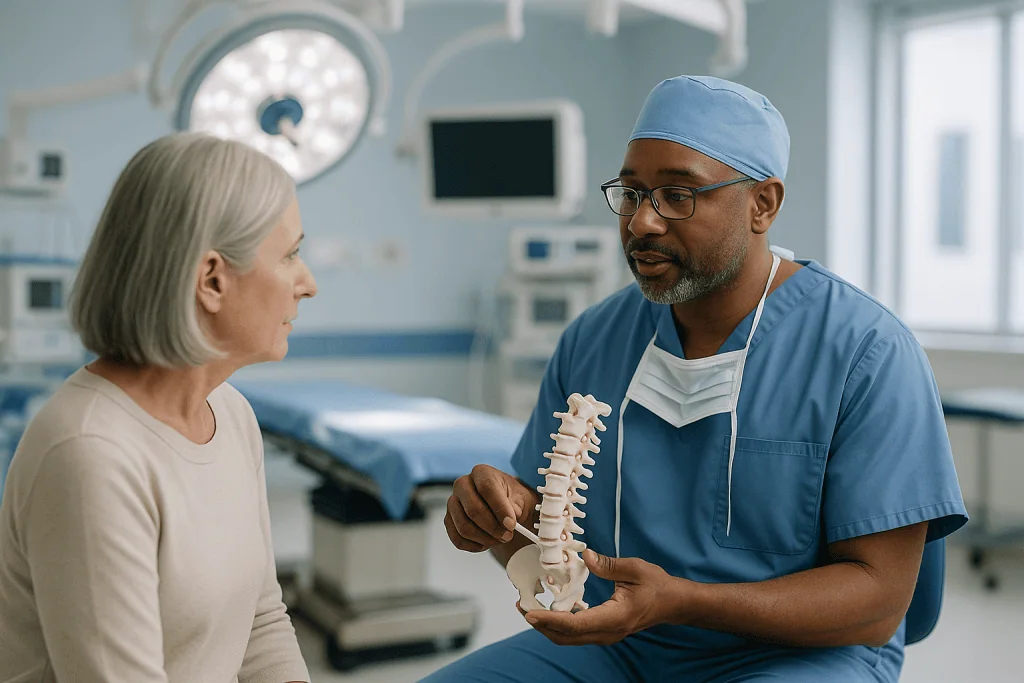
The scan is up on the screen and the surgeon is pointing with a pen. One disc, the kind of bulge that pinches a single nerve and sends pain down one arm, would be a fairly standard operation. But there are two discs here, maybe three, and the spinal cord looks squeezed. The conversation changes. So does the question the patient takes home.
That question, single level vs multi level ACDF, is really about arithmetic. Every disc that comes out must be replaced by a spacer, and every spacer must turn into solid bone. Two levels means two healing sites. Three means three. The plate gets longer, the operation gets longer, and the body has more work to do afterward.
None of that makes a multi-level fusion a bad idea; for some necks it is the only sensible one. It does mean that the number on the operative consent form shapes almost everything that follows, from how your throat feels on day two to how many months pass before the surgeon is satisfied the bone has knitted.
What single level vs multi level ACDF actually means
ACDF stands for anterior cervical discectomy and fusion: the surgeon reaches the neck from the front (anterior), removes a worn or herniated disc (discectomy), and locks the two vertebrae above and below it together so they heal into one bone (fusion). The cervical spine is the seven-vertebra column in the neck, labeled C1 at the skull down to C7 at the shoulders.
A “level” is simply one disc space and the two bones that border it. The disc between C5 and C6 is the C5-C6 level. A single-level ACDF treats one such space. A two-level ACDF treats two neighboring spaces, for example C5-C6 and C6-C7, which means three vertebrae end up fused together. Tri-level ACDF spans four vertebrae; a four-level fusion spans five, which is most of the mobile neck.
Why does the count matter so much? Because each disc space becomes a separate construction project. The surgeon places a spacer, often called a cage, packed with bone graft or bone substitute into the empty gap, then usually secures a titanium plate across the front of the vertebrae with screws. Mayo Clinic’s overview of spinal fusion notes that the bones need several months to heal and grow together, and that healing has to happen at every treated level, not just the first.
Surgeons tend to describe the two groups differently. Single-level cases are frequently done for one pinched nerve root causing arm pain, numbness or weakness in a clear pattern. Multi-level cases more often involve cervical spondylosis, the age-related wear of discs and joints that the NHS describes as extremely common after middle age, and may include pressure on the spinal cord itself, called myelopathy.
What actually happens in the operating room
Picture a small horizontal incision in a skin crease on the front of the neck, usually a couple of inches long. Through it the surgeon gently moves the windpipe and esophagus (the food pipe) toward one side and the large neck vessels toward the other, following a natural pathway between muscles that requires no cutting of major muscle. This is why the front approach is favored for most cervical disc problems, as Johns Hopkins Medicine explains in its patient guide to ACDF.
Once the front of the spine is exposed, an X-ray confirms the correct level. The disc is removed piece by piece under magnification. Bone spurs pressing on the nerve root or spinal cord are shaved away, and the tough ligament behind the disc may be opened to be certain nothing is still compressing nerve tissue. The empty space is then measured and filled with a cage, and a plate and screws are typically added.
For a single level, that sequence happens once. For a multi-level case, the surgeon repeats it at each disc space, often working from one end to the other, and then fits a single longer plate across all the treated vertebrae. The retractors holding the throat structures aside remain in place for the entire time, which is one reason swallowing discomfort is more common after longer, multi-level operations.
A variation sometimes used when disease sits behind the vertebral body rather than just at the disc is corpectomy: removal of part of a vertebra itself, with a longer strut graft spanning the gap. Surgeons may combine corpectomy with a standard discectomy at another level. The decision between these approaches depends on where the compression is and how the bone quality looks, and it belongs to the treating team.
Why each extra level adds more than a few minutes
It is tempting to think of a two-level fusion as a one-level fusion done twice. In practice several things change in ways that are not simply additive.
Time under anesthesia is the obvious one. Each level means another disc to clear, another cage to size and fit, and another set of X-ray checks. Longer procedures tend to involve more retraction of the esophagus, more fluid shifts and, in general, somewhat more blood loss. Guideline-level sources such as MedlinePlus and Mayo Clinic list bleeding, infection, blood clots and anesthesia reactions among the standard risks of spinal fusion, and the exposure to those risks grows with operative time.
Biomechanics change too. A single cage sits snugly between two large vertebral bodies. Add a second level and the middle vertebra is now bordered by cages above and below, with screws entering a bone that has lost both of its discs. The plate has to resist bending across a longer span. Engineers would say the construct has more degrees of freedom, and the surgeon’s practical worry is that any one level might not fuse, leaving a mobile, painful segment inside an otherwise solid column. That failure to heal is called pseudarthrosis, literally a “false joint.”
Then there is the healing burden. Mayo Clinic notes that bone fusion typically takes several months; with three levels, the body has three separate graft sites to convert into mature bone simultaneously, something that becomes harder with smoking, diabetes, osteoporosis or long-term steroid use. Surgeons weigh those factors more heavily the longer the construct.
Finally, motion loss accumulates. A single-level fusion removes a small fraction of neck rotation and bending; most people barely notice. Fusing three or four levels leaves noticeably less flexibility, which is one reason surgeons reserve long fusions for cases where the alternatives are weaker.
Who is usually a candidate for single-level ACDF, and who is asked to wait
The classic single-level patient has a clear story: a herniated disc or bone spur at one space pressing on one nerve root, producing arm pain, tingling or weakness that follows that nerve’s territory, confirmed by an MRI that matches the symptoms. Mayo Clinic’s guide to herniated discs explains that most people with this problem improve without surgery over weeks to months, and surgery is usually considered when symptoms persist despite non-surgical care, or when weakness is progressive.

Candidates for ACDF at one level therefore tend to share a few features. Their symptoms have lasted long enough to show they are not resolving on their own. They have tried a structured period of physical therapy, activity modification and medicine prescribed by their clinician. Their imaging and examination agree about which level is responsible. And they understand that the operation targets arm symptoms far more reliably than diffuse neck ache.
Who is usually asked to wait, or steered elsewhere? People whose main complaint is neck pain alone, without nerve or cord compression, often do not get a satisfying answer from fusion, and most surgeons will say so plainly. Those in the first few weeks of a flare-up are typically encouraged to allow time, since a herniated fragment can shrink. Active infection, uncontrolled diabetes, severe osteoporosis or heavy smoking may prompt a surgeon to delay until those factors are better managed, because each one threatens the bone healing the procedure depends on.
Exceptions exist in both directions. Rapidly worsening weakness, loss of hand dexterity or bladder changes can move surgery forward regardless of how long symptoms have lasted. Conversely, someone with multiple degenerated discs but symptoms clearly coming from one may be offered a single-level operation only, with the other levels watched. That choice rests with the treating team after examining you.
When surgeons recommend tri-level ACDF surgery or more
Tri-level ACDF surgery means three consecutive discs are removed and replaced with cages, fusing four vertebrae, most often across C4 to C7. It is less common than one- or two-level procedures and is generally reserved for situations where disease is genuinely spread across several levels.
The most frequent reason is cervical spondylotic myelopathy: wear-related narrowing of the spinal canal at multiple levels that compresses the spinal cord. Johns Hopkins Medicine and the NHS both describe the hallmarks of cord compression, which differ from a pinched nerve root. People notice clumsy hands, trouble with buttons or handwriting, unsteady walking, or a sense that their legs are stiff and slow. Unlike many disc herniations, cord compression does not reliably improve on its own, and surgeons often recommend decompression to prevent further loss of function rather than to restore what has already been lost.
A second reason is multi-level radiculopathy, when two or three nerve roots are each pinched at different spaces. A third is the need to correct alignment: a neck that has drifted into a forward curve (kyphosis) may be straightened by removing discs at several levels and placing taller cages, which cannot be achieved by working at one space.
Four-level ACDF spans five vertebrae and is uncommon. At that length many surgeons consider alternatives: an operation from the back of the neck such as laminoplasty, which widens the canal without fusing, or a combined front-and-back procedure to give the long construct extra support. The trade-offs involve swallowing risk, fusion rates, neck motion and the pattern of compression, and no two surgeons will weigh them identically. What they share is a reluctance to fuse more levels than the pathology demands.
Single level vs multi level ACDF at a glance
The table below summarizes how the picture typically shifts as levels are added. It describes general patterns reported across mainstream patient resources, not a forecast for any individual; your surgeon’s estimate will reflect your anatomy, bone quality and overall health.
| Factor | Single-level ACDF | Two-level ACDF | Three- or four-level ACDF |
|---|---|---|---|
| Vertebrae fused | 2 | 3 | 4 or 5 |
| Healing sites | 1 | 2 | 3 or 4 |
| Usual indication | One pinched nerve root | Two adjacent nerve roots or early cord compression | Multi-level cord compression, alignment correction |
| Operative time | Shortest | Longer | Longest, more retraction of throat structures |
| Hospital stay | Often same day or one night | Often one night or more | Typically longer, sometimes with swallowing assessment |
| Temporary swallowing difficulty | Common, usually brief | More common | Most common and may last longer |
| Risk of a level not fusing | Lowest | Higher | Highest; supplemental support sometimes considered |
| Loss of neck motion | Minimal | Modest | Noticeable |
| Return to desk work | Often within a few weeks | Often several weeks | Often longer, guided by surgeon |
Two things stand out. First, the hospital stay and swallowing columns move together because both reflect how long the esophagus was held aside, a point Johns Hopkins highlights when describing ACDF recovery. Second, the fusion column is the one that governs the long game: Mayo Clinic’s spinal fusion guidance notes that bone healing is judged over months on follow-up imaging, and a multi-level patient is being checked at every level.
Two level ACDF recovery: what the first days and weeks usually look like
Most people are surprised that the neck incision itself is not the main source of discomfort. The sore throat, the sense that food catches on the way down, and a hoarse voice tend to dominate the first days, particularly after two or more levels. Johns Hopkins Medicine describes these as common and usually temporary consequences of the throat structures being moved aside during surgery. Soft foods and small sips are typical early advice; the care team may involve a speech and swallowing therapist if the problem is pronounced.
Walking begins the same day or the next. MedlinePlus notes that getting up and moving early after spinal fusion helps reduce the risk of blood clots and lung complications, and nursing staff will usually have you on your feet within hours. Discharge after single-level surgery is frequently the same day or after one night, while two-level and longer cases more often involve at least an overnight stay, with the exact timing decided by how you are swallowing, walking and managing pain.
By the end of the first week, arm pain from a compressed nerve has often eased substantially; numbness and weakness lag behind because nerve fibers recover slowly, sometimes over months. Neck stiffness and pain between the shoulder blades are common and gradually settle.
Weeks two through six are about protecting the construct while the graft starts to incorporate. Lifting is usually restricted, bending and twisting kept gentle, and driving resumed only when you can turn your head safely and are no longer taking sedating pain medicine prescribed by your clinician. Desk work is often possible within a few weeks after a single level; two-level recovery tends to run somewhat longer, and physically demanding jobs wait until the surgeon sees evidence of healing. Mayo Clinic’s guidance is blunt that full fusion takes several months, so “feeling fine” at week four does not mean the bone has healed.
How long you wear a cervical collar after ACDF surgery
A cervical collar is a padded brace that wraps around the neck and limits bending and rotation. Whether you wear one after ACDF, and for how long, varies more than almost any other aspect of care, because the evidence does not point to a single right answer.
The logic of bracing is straightforward: less motion across the fused segment should give the graft a quieter environment in which to turn into bone. With a plate and screws providing internal stability, many surgeons feel a collar adds little after a single-level fusion and prescribe it only for comfort in the first days, or not at all. Others prefer a soft collar for a short period. After multi-level fusion, where the construct is longer and the risk of a level failing to fuse is higher, a collar is more frequently recommended and worn for longer, sometimes a rigid one rather than a soft one.
Typical durations described in patient guidance range from no collar at all to a few weeks, and occasionally longer for three- or four-level fusions, with the surgeon adjusting the plan based on follow-up X-rays. Johns Hopkins Medicine notes that a collar may be used to limit movement while healing begins, and that specific instructions come from the operating surgeon. Treat your own team’s instruction as the only one that applies to you.
Practical points help whichever plan you are given. Keep the skin under the collar clean and dry to prevent irritation. Ask whether it may be removed for showering, eating or sleeping. Do not extend wear beyond what you were told in the hope of “extra protection”; prolonged immobilization can weaken the neck muscles that you will need once the collar comes off. If you are unsure, call the clinic rather than guess.
Risks that climb with the number of fused levels
Every spinal fusion carries baseline risks that Mayo Clinic and MedlinePlus list clearly: infection, bleeding, blood clots, reaction to anesthesia, injury to nerves or the spinal cord, and failure of the bone to heal. ACDF adds a few that are specific to the front of the neck. Three of them deserve attention because they scale with level count.
Swallowing difficulty, known as dysphagia, is the most frequent. It results from swelling and stretching of the esophagus and nearby nerves during retraction, and longer operations mean longer retraction. Most cases ease over days to weeks; a smaller number persist for months. Hoarseness from irritation of the recurrent laryngeal nerve, which controls a vocal cord, follows the same pattern.
Pseudarthrosis, the failure of a level to fuse, is the second. A single cage between two robust vertebral bodies generally heals well. With each added level the chance that at least one space fails to unite rises, which is why surgeons scrutinize bone quality, nicotine use and blood sugar control before offering long fusions, and why some add posterior screws from the back of the neck for three- and four-level constructs. A non-union can be painless and need no treatment, or it can cause persistent pain and require revision surgery.
Adjacent segment degeneration is the third. Once a segment is fused, the discs immediately above and below it absorb motion the fused segment no longer provides. Over years some of them wear faster, occasionally enough to cause new symptoms. Research debates how much of this is caused by the fusion and how much reflects the natural aging of a neck that was already degenerating; longer fusions concentrate the extra load on fewer remaining discs. Your surgeon can explain how this applies to your spine. Rarer complications include injury to the esophagus, hardware loosening and, very uncommonly, spinal cord injury.
ACDF vs disc replacement: how serious is disc replacement in your neck?
Cervical disc replacement, also called cervical arthroplasty, is the main surgical alternative to fusion for one or two levels. The approach through the front of the neck and the removal of the disc are essentially identical to ACDF. The difference comes at the end: instead of a cage that is meant to turn into solid bone, the surgeon inserts a mechanical implant with a moving core, designed to preserve motion at that level.
Is it serious? It is the same order of operation as ACDF, performed under general anesthesia through the same corridor, with the same early risks of swallowing trouble, hoarseness, bleeding and nerve injury. People often go home the same day or after one night. It is not a minor procedure, but neither is it more dangerous than fusion in the hands of a surgeon who performs both.
The appeal is twofold. Preserving motion may reduce the extra stress placed on neighboring discs, which in theory lowers the chance of adjacent segment problems over the long term, though the evidence on how much this matters in practice is still being gathered. And because nothing has to fuse, there is no risk of pseudarthrosis and often fewer restrictions on movement early on.
The limits are equally concrete. Artificial discs are generally used for one or two adjacent levels in people with healthy facet joints, good bone, and compression that comes mainly from the disc. They are usually not considered for necks with significant arthritis of the small joints, instability, osteoporosis, severe deformity or kyphosis, or compression spread across three or more levels. For most multi-level disease, in other words, the realistic comparison is between a multi-level ACDF, a posterior operation, or a hybrid in which one level is replaced and another fused. Your surgeon’s judgment about your facet joints and alignment, not a general preference for “keeping motion,” should drive the choice.
Which nerves are affected at C3, C4, C5, C6 and C7?
Each cervical nerve root exits the spine just above or below a numbered vertebra and supplies a predictable patch of skin and set of muscles. Cleveland Clinic’s guide to cervical radiculopathy, the medical term for a pinched nerve root in the neck, maps these patterns, and they explain why the level on your MRI matters as much as the number of levels.
- C3 and C4: supply the back and side of the neck and the top of the shoulder; C4 also contributes to the phrenic nerve, which drives the diaphragm. Problems here are uncommon and tend to cause neck and shoulder pain rather than arm symptoms.
- C5: powers the deltoid, the muscle that lifts the arm out to the side, and supplies sensation over the outer shoulder. Weakness raising the arm points here.
- C6: runs to the biceps and wrist extensors and gives sensation to the thumb and index finger. Trouble bending the elbow or a tingling thumb is a classic C6 picture.
- C7: drives the triceps, which straightens the elbow, and supplies the middle finger. A diminished triceps reflex is a common sign.
- C8: exits below C7 and controls finger flexion and grip, with sensation in the ring and little fingers.
The disc between two vertebrae typically pinches the nerve named for the lower one: the C5-C6 disc affects the C6 root, the C6-C7 disc affects C7. This is why a surgeon examining your reflexes and finger strength can often predict what the scan will show before it is read.
The spinal cord itself runs behind all these discs, and compression of the cord produces a different picture: clumsy hands, unsteady gait and brisk reflexes in the legs, as the NHS describes under cervical spondylosis. That distinction, root versus cord, is frequently what separates a one-level recommendation from a multi-level one.
What people often get wrong about multi-level cervical fusion
“More levels means I will not be able to move my neck.” A two-level fusion removes a modest share of total neck motion, and most of what people call turning the head comes from the top two joints, C1 and C2, which ACDF almost never involves. Three- and four-level fusions do reduce flexibility noticeably, but people still drive, swim and check blind spots by turning their shoulders a little more.
“Once the pain is gone, the fusion has healed.” Nerve pain often eases within days because the pressure is off. Bone healing is a different process and takes months, as Mayo Clinic’s guidance makes clear. Lifting restrictions are tied to the bone, not to how you feel.
“Surgery will fix my neck pain.” ACDF is most dependable for arm pain, numbness and weakness caused by nerve compression, and for stopping the progression of cord compression. Generalized neck ache from arthritis and muscles responds less predictably, and honest surgeons say so before the operation rather than after.
“A single-level fusion today guarantees a multi-level fusion later.” Adjacent discs do carry extra load, and some wear faster, but many people never need a second operation. Age, genetics and the condition of the other discs matter at least as much as the fusion itself.
“Disc replacement is always the better option because it keeps motion.” It is an excellent option for the right one- or two-level problem. It is not designed for arthritic facet joints, instability or three-level disease, and choosing it where it does not fit creates its own problems.
“The collar does the healing.” The plate and screws provide most of the stability; the collar is an adjunct that some surgeons use and some do not. Wearing it longer than instructed does not speed fusion and can weaken neck muscles.
Questions to ask your care team before single- or multi-level ACDF
A good consultation leaves you able to explain, in your own words, why this many levels and not one more or fewer. These questions help get there.
- Which exact levels do you plan to fuse, and what on my MRI and examination tells you each one is causing symptoms?
- Is my problem mainly a pinched nerve root, pressure on the spinal cord, or both? How does that change what surgery can and cannot improve?
- Would a single-level operation address my main symptom, with the other levels monitored, or do you think treating them together is necessary now?
- Did you consider disc replacement, a posterior approach such as laminoplasty, or a hybrid procedure? Why did you settle on this plan for my neck?
- How do my bone density, blood sugar, nicotine use and other medicines affect the chance that every level will fuse, and is there anything you want me to change beforehand?
- How long do you expect me to stay in hospital, and what would extend it?
- Will I wear a cervical collar, which type, for how long, and when may I remove it?
- What swallowing or voice changes should I expect, and when should they prompt a call?
- When can I drive, return to my type of work, lift my children or groceries, and exercise?
- How and when will you confirm the fusion has healed, and what happens if one level does not?
- What is the plan for pain management after discharge, and who adjusts it?
- If I decide to wait, what signs would mean waiting is no longer safe?
Write the answers down or bring someone who will. Surgeons expect these questions and generally welcome them; a patient who understands the plan tends to follow restrictions more faithfully, which is good for the fusion.
When to call your doctor after ACDF
Most recovery hiccups are ordinary: a scratchy throat, a stiff neck, fatigue that lasts longer than expected. Some signs are not ordinary and should prompt a same-day call to the surgical team or, when severe, emergency care.
Seek emergency help immediately for difficulty breathing, rapidly increasing swelling of the neck, or a feeling of the throat closing. The front-of-neck approach sits beside the airway, and a collection of blood after surgery, though rare, can compress it. Also treat as emergencies any new or worsening weakness in the arms or legs, loss of bladder or bowel control, or sudden severe numbness, which can indicate pressure on the spinal cord.
Call the surgical team the same day for a fever, redness, warmth, increasing pain or fluid leaking from the incision, which can signal infection; inability to swallow liquids or saliva, or choking when you eat; chest pain, shortness of breath, or a swollen, painful calf, which can indicate a blood clot, a risk MedlinePlus and Mayo Clinic both list after spinal surgery; a sudden change in voice that is new rather than present since surgery; or pain that was improving and then sharply worsens, especially with a popping sensation or a feeling of movement in the neck, which may relate to the hardware.
Mention at your next visit persistent hoarseness beyond a few weeks, numbness that is slow to fade, or difficulty with the collar.
When in doubt, call. Surgical teams would far rather hear about a symptom that turns out to be nothing than learn later that a treatable problem was waited out at home. Every decision about tests, imaging or returning to the operating room rests with the team that performed your surgery and knows your spine.
Frequently asked questions
What is tri level ACDF surgery?
Tri-level ACDF removes three consecutive cervical discs, most often between C4 and C7, replaces each with a cage, and secures the four involved vertebrae with a single plate so they heal into one bone. It is usually reserved for cord compression or nerve compression spread across several levels. Compared with a single-level fusion, it involves a longer operation, more swallowing discomfort early on, a longer collar period for some patients, and a higher chance that one level is slow to fuse.
How long do you wear a cervical collar after ACDF surgery?
It varies from no collar at all to a few weeks, and sometimes longer after three- or four-level fusions. Because a plate and screws provide internal stability, many surgeons skip the collar after single-level ACDF or use a soft one briefly for comfort. Longer constructs more often get a rigid collar for several weeks. Your surgeon’s instruction is the only one that applies to you, and it is adjusted according to follow-up X-rays showing how healing is progressing.
How serious is disc replacement in your neck?
Cervical disc replacement is a major operation of the same order as ACDF, done under general anesthesia through the same small incision at the front of the neck. The early risks, including sore throat, swallowing difficulty, hoarseness, bleeding and nerve injury, are similar. Many people go home the same day or after one night. It avoids the need for bone fusion but is generally limited to one or two levels in people with healthy facet joints and good bone.
What nerves are affected by C3, C4, C5, C6 and C7?
C3 and C4 supply the neck and top of the shoulder, with C4 contributing to the nerve that drives the diaphragm. C5 lifts the arm out to the side and feels the outer shoulder. C6 bends the elbow, extends the wrist and feels the thumb and index finger. C7 straightens the elbow and feels the middle finger. C8, exiting below C7, controls grip and feels the ring and little fingers. Cord compression produces a different pattern: clumsy hands and unsteady walking.
Is two level ACDF recovery much longer than single level?
Typically somewhat longer, though the difference is often weeks rather than months. People frequently stay at least one night after a two-level fusion, early swallowing problems are more common, and return to desk work tends to take a few weeks longer. The bigger difference is the healing burden: two cages must fuse instead of one, so surgeons may keep lifting restrictions in place longer and watch follow-up imaging more closely before clearing full activity.
Does a multi-level ACDF always mean losing a lot of neck movement?
No. Most head turning comes from the top two cervical joints, which ACDF almost never involves. A two-level fusion in the lower neck removes a modest share of motion that most people adapt to quickly. Three- and four-level fusions reduce flexibility noticeably, particularly bending the chin to the chest and looking up, but daily activities such as driving remain possible with a little more shoulder turning.
Why do some necks need fusion at multiple levels instead of just the worst one?
Because the symptoms are coming from more than one place. Cervical spondylosis often narrows the canal at several adjacent levels, and decompressing only one leaves the spinal cord squeezed elsewhere. Multiple nerve roots can be pinched at different spaces. Sometimes a forward curve must be corrected across several discs. Surgeons generally fuse the fewest levels that fully address the compression, and if one level clearly explains everything, they will often treat that one alone.
What is the difference between ACDF and corpectomy?
ACDF removes a disc and replaces it with a cage between two intact vertebrae. Corpectomy removes most of a vertebral body itself, along with the discs above and below it, and bridges the larger gap with a longer strut graft or cage. It is used when compression sits behind the bone rather than only at the disc. Surgeons may combine a corpectomy at one level with a standard discectomy at another to suit the pattern of disease.
Can disc replacement be done at three levels instead of a multi-level ACDF?
In most settings artificial cervical discs are used at one or two adjacent levels in people with healthy facet joints, good alignment and no instability. Three-level replacement is not standard practice. For three-level disease, realistic options are usually a multi-level ACDF, a posterior operation such as laminoplasty that widens the canal without fusing, or a hybrid in which one level is replaced and the others fused. The choice depends on your anatomy and rests with your treating team.
How does ACDF vs disc replacement affect the risk of problems at neighboring discs?
Fusion transfers the motion of the fused segment to the discs above and below, and some of them wear faster over years; longer fusions concentrate that load on fewer remaining discs. Disc replacement preserves motion and in theory lessens this effect, though research is still clarifying how large the real-world difference is, since many adjacent discs were already aging. Your surgeon can explain how this applies to the condition of your other discs.
References
- MedlinePlus: Spinal fusion
- NHS: Cervical spondylosis
- Cleveland Clinic: Cervical Radiculopathy (Pinched Nerve)
This article is for general information only and is not a substitute for professional medical advice. Please consult a qualified doctor about your individual situation.
Add us as a Preferred Source to see more of our trusted health content across Google Search, AI Overviews and Discover.

More from the Blog

Spine Surgery Abroad: How Follow-Up, Imaging and Physiotherapy Continue After You Fly Home
After spine surgery abroad, follow-up does not end at the airport. Patients usually need a named home clinician to review the wound, repeat imaging…

Is Numbness After Spinal Stenosis Surgery Normal? What Fades, What Stays and When to Call
Yes, some numbness after spinal stenosis surgery is common and usually expected. Surgery removes pressure from the nerve, but the nerve itself heals slowly,…

How Spinal Fusion Works: Bone Graft, Screws and Rods and What Fusing Actually Means
Spinal fusion is surgery that permanently joins two or more vertebrae so they heal into a single, solid bone. A surgeon places bone graft…

After Herniated Disc Surgery: Wound Leaks, Fever and New Weakness That Need a Prompt Call
After herniated disc surgery, the signs that need a prompt call are fluid leaking from the wound, a temperature of 100.4°F (38°C) or higher,…

When Is Scoliosis Surgery Recommended? Curve Size, Progression and Symptoms That Matter
Scoliosis surgery is usually recommended when a curve measures about 45 to 50 degrees or more on the Cobb angle, is still progressing, and…

Why Repeat X-Rays Matter During Scoliosis Bracing: Checking Fit, Growth and Curve Control
Repeat X-rays during scoliosis bracing let the care team measure the Cobb angle, check how well the brace is holding the curve, and track…