

Scoliosis Surgery in Adults vs Teens: Why Goals, Risks and Recovery Differ With Age

Key Takeaways
- Scoliosis is defined by a Cobb angle of 10 degrees or more, but in adults the symptoms, not the degrees, usually decide whether surgery is discussed.
- Teen scoliosis surgery targets a large, progressing curve during growth, while adult surgery targets pinched nerves, forward lean and pain, often with decompression or bone cuts added to the fusion.
- Adult degenerative scoliosis forms when discs and joints in the lower back wear unevenly, and its leg symptoms usually come from spinal stenosis rather than the curve itself.
- Adults face higher rates of nonunion, hardware problems and revision surgery because bone is thinner, spines are stiffer and other health conditions add risk.
- Hospital stays of about a week are typical for both groups, but the NHS describes teens returning to school within weeks while adults may need up to a year for full recovery.
- Exercise cannot straighten a mature spine, yet strengthening trunk and hip muscles measurably improves pain, standing tolerance and surgical fitness in adults.
Scoliosis surgery in adults usually aims to relieve nerve pain, restore balance and stop a wearing spine from worsening, while surgery in teens aims to halt a large curve that is still growing before the skeleton matures. Adults generally face higher complication rates, longer fusions and slower recovery because of bone quality, other health conditions and stiffer spines. Whether to operate is a shared decision with the treating team.
In one consultation room sits a 15-year-old whose curve jumped on this year’s X-ray, a parent gripping the folder of reports. Two doors down, a 62-year-old grips something else: the back of a chair, because standing straight for more than ten minutes sends a hot wire down one leg. Both have scoliosis. Both have been told the word surgery. Almost nothing else about their situations is the same.
That gap is the heart of this explainer. Scoliosis surgery in adults is a different operation with different aims than the procedure a teenager undergoes, even when the surgeon’s tools, the screws, rods and bone graft, look identical on the tray. The teenager’s spine is still growing and the question is about degrees. The adult’s spine is settling, wearing and pinching nerves, and the question is about pain, balance and what daily life is costing.
Understanding why the goals diverge makes the risks, the recovery and the hard question of whether it is worth it far easier to weigh.
What actually happens during scoliosis surgery in adults and teens
Nearly all scoliosis surgery rests on one idea: spinal fusion, which means joining two or more vertebrae so they heal into a single solid bone that can no longer bend or twist. The surgeon places screws into the thick part of each vertebra, called the pedicle, connects them with metal rods, and uses those rods to pull the curve toward a straighter, better balanced position. Bone graft, small pieces of the patient’s own bone or a substitute, is packed along the segment so the vertebrae knit together over the following months. The metal holds the shape while biology does the permanent work. MedlinePlus describes this fusion process and notes that the bone takes months to become solid.
For a teenager, that is usually the whole operation, performed through an incision on the back. The curved section is straightened and fused, the discs above and below are left free, and a hospital stay of roughly a week is typical, according to the NHS.
For an adult, the fusion is often only one part. The surgeon may also need to perform a decompression, which means removing bone or thickened ligament that is pressing on a nerve. Where the spine has stiffened into a fixed tilt, an osteotomy, a controlled cut through bone to allow realignment, may be added. The fusion frequently extends lower, sometimes to the pelvis, because the worn lower back is where the trouble lives. Some adults have a staged operation, with a front approach through the abdomen or side to place spacers between vertebrae, followed by the posterior fusion.
Throughout either procedure, a technique called neuromonitoring tracks electrical signals traveling through the spinal cord, giving the team a real-time warning if nerve function changes.
Why the same curve means different things at 15 and at 55
Doctors measure scoliosis with the Cobb angle, the angle between the most tilted vertebrae at the top and bottom of a curve on a standing X-ray. A Cobb angle of 10 degrees or more defines scoliosis, as the Cleveland Clinic explains. Beyond that shared starting line, the number does very different jobs at different ages.
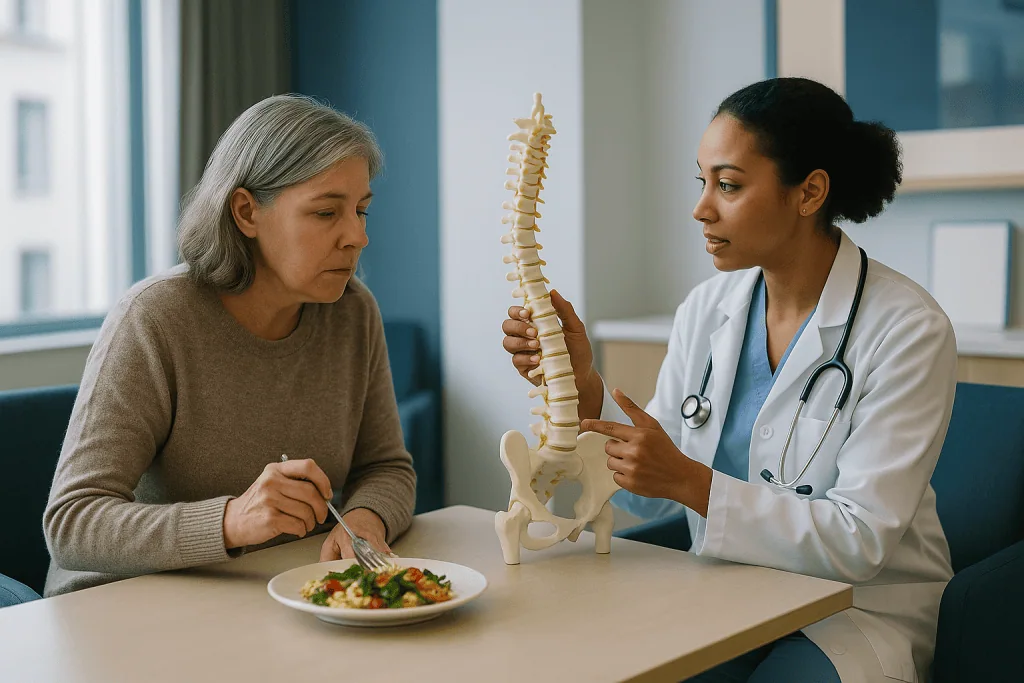
In a teenager, most curves are idiopathic, meaning no cause can be found, and the central worry is growth. A curve can steepen quickly during a growth spurt, so a 30-degree curve in a child with years of growth ahead is watched more closely than a 30-degree curve in someone who has finished growing. The Mayo Clinic notes that mild curves often need no treatment beyond monitoring, while larger curves in growing children may be braced to slow progression. Surgery in this group is essentially a decision about the trajectory of a number.
In an adult, the number often matters less than the symptoms. A 55-year-old with a modest 30-degree lumbar curve and a pinched nerve may be far more limited than a 25-year-old with a 50-degree curve who climbs stairs without a thought. Adults are usually referred because of back pain that does not settle, leg pain or numbness from nerve compression, or a growing sense of leaning forward or to one side.
That is why an adult spine specialist asks about walking distance, how long the person can stand at a sink, and whether they need a shopping cart to stay upright, while a pediatric specialist asks about growth, menstruation onset and shoe size. Same diagnosis, different questions, different surgery.
What is adult degenerative scoliosis, and why does it change the surgical goal?
Adult scoliosis arrives by two roads. Some adults carry a curve from adolescence that was never treated or was treated with a brace; this is adult idiopathic scoliosis. Others develop a new curve later in life, and that is adult degenerative scoliosis: a sideways bend that forms when the discs and small joints of the lower spine wear unevenly, letting one side of the spine collapse more than the other. The Cleveland Clinic and Mayo Clinic both list this wear-related process among the causes of scoliosis appearing in adulthood.
The degenerative version behaves differently from a teenager’s curve. It tends to sit in the lumbar spine, it is often modest in degrees, and it is frequently accompanied by spinal stenosis, a narrowing of the canal that houses the spinal cord and nerve roots. That narrowing, not the curve itself, usually produces the classic complaint of aching or cramping legs that ease when sitting or leaning on a cart.
A second feature matters just as much: sagittal balance, meaning how well the head sits over the pelvis when viewed from the side. Worn discs lose height at the front, tipping the trunk forward. The body compensates by bending the knees and tilting the pelvis, which is exhausting and painful over a day.
Those two problems reshape the surgical goal. A teenager’s surgeon wants a straighter curve that stops growing. An adult’s surgeon wants free nerves and a trunk that balances over the hips with the least amount of fusion that will hold. Cosmetic straightening becomes a secondary benefit rather than the point.
Who is usually offered surgery, and who is usually asked to wait
The pattern for teenagers is comparatively clear. The Mayo Clinic notes that surgery is generally considered for severe curves, and clinicians commonly use a threshold around 45 to 50 degrees, especially when the curve is still progressing during growth. Smaller curves are observed with repeat X-rays every few months, and moderate curves in a still-growing child are often braced, since bracing works only while growth remains, as the NHS explains. A teen with a mild, stable curve is asked to wait, and most wait successfully into adulthood without ever needing an operation.

Adults are selected on a different basis. Surgery is typically discussed when pain or nerve symptoms persist despite a genuine trial of nonsurgical care, when the curve or forward lean is visibly progressing on serial X-rays, or when nerve compression is causing weakness, numbness or difficulty walking. The NHS treatment guidance for adults describes surgery as an option when other treatments have not helped and the problem is significantly affecting daily life.
Several groups are usually asked to pause. People whose symptoms are manageable with exercise and occasional pain relief are generally kept on that path. People who smoke are often asked to stop first, because nicotine impairs bone healing and raises the chance the fusion fails. Those with low bone density, poorly controlled diabetes, heart or lung disease, or a high body weight may be asked to address those first, since each raises operative risk.
Age alone is not a cutoff. A fit 75-year-old may be a reasonable candidate; a frail 60-year-old may not. That judgment belongs to the treating team, informed by tests of bone density, heart and lung function, and an honest conversation about what the person hopes to regain.
Teens vs adults: how the goals, risks and recovery compare
Laid side by side, the two situations read almost like different conditions. This summary reflects patterns described by the NHS, Mayo Clinic and Cleveland Clinic; individual plans vary widely.
| Factor | Teens (adolescent idiopathic) | Adults (idiopathic or degenerative) |
|---|---|---|
| Main reason for surgery | Large or progressing curve during growth | Persistent pain, nerve symptoms, loss of balance |
| Typical goal | Stop progression, correct curve | Free nerves, restore balance, relieve pain |
| Usual procedure | Posterior fusion of the curved segment | Fusion often with decompression, sometimes osteotomy, may extend to pelvis |
| Spine flexibility | Flexible, corrects readily | Stiff, needs more force or bone cuts |
| Bone quality | Strong, heals quickly | May be thinner; slower healing |
| Other health conditions | Usually none | Common; heart, lung, diabetes, weight |
| Hospital stay | About a week (NHS) | About a week, sometimes longer (NHS) |
| Return to normal activity | School within weeks, sport within months (NHS) | Gradual over months, up to a year (NHS) |
| Complication risk | Lower | Higher, including nonunion and revision |
Two rows deserve a closer look. Flexibility explains a great deal: a teenager’s spine bends toward straight almost like a green branch, so the correction is achieved with rods alone. An adult’s spine has often locked into position, so the surgeon must cut bone to move it, which lengthens the operation and adds blood loss.
The health-conditions row explains the rest. A teenager rarely brings anything to the operating room beyond the curve. An adult brings decades of living, and each condition on that list adds its own layer of risk that the surgical team must plan around.
What are adult scoliosis treatment options before surgery?
For most adults, surgery is the last chapter, not the first. The NHS lists a sequence of nonsurgical measures that come before an operation is considered, and the Mayo Clinic describes a similar ladder.
Physical therapy leads. A therapist works on strengthening the trunk and hip muscles that hold the spine upright, restoring flexibility where the spine has stiffened, and teaching postures that unload irritated nerves. Walking programs matter because leg endurance and general fitness are what nerve-related pain steals first.
Pain-relieving medicines sit alongside. Acetaminophen acts centrally to dull pain signals; anti-inflammatory medicines reduce the chemical irritation around worn joints and nerves. Both are typically used for flares rather than continuously, and the choice, duration and safety for any individual, especially those with kidney, stomach or heart conditions, rest entirely with the prescribing clinician.
Injections come next for some. A corticosteroid injected into the space around a compressed nerve reduces inflammation and can settle leg pain for a period of weeks to months. Effects are temporary, and the NHS notes injections are usually offered when pain is severe and other measures have not helped. They can also confirm which nerve is causing trouble, useful information if surgery is later considered.
Bracing plays a limited role in adults. Unlike in a growing child, a brace cannot change an adult curve; it may ease pain during long periods of standing, as the NHS explains, but long-term wear can weaken the very muscles the spine depends on.
Bone health, weight, sleep and mood round out the list. Treating low bone density and staying active protect the spine whether or not surgery ever happens, and they make any future operation safer.
Why the risks of scoliosis surgery in adults are higher, and how teams manage them
Every spinal fusion carries a shared set of risks, which the Mayo Clinic lists: infection, bleeding, blood clots, injury to nerves or blood vessels, poor healing of the fusion, and pain at the graft site. Adults face each of these at a higher rate than teenagers, and they face several extra risks specific to older, longer fusions.
Nonunion, also called pseudarthrosis, is the failure of the bone graft to knit into solid bone. Rods and screws are designed to hold only until fusion occurs; if it never does, the metal eventually loosens or breaks. Thinner bone, smoking, diabetes and long fusions all raise this risk.
Proximal junctional kyphosis is a forward bend that develops just above the top of a long fusion, where a flexible segment meets a rigid one. Adjacent segment disease is the accelerated wear of discs next to the fusion, which now absorb motion the fused levels no longer allow. Both can lead to revision surgery, sometimes years later.
Medical complications, including heart strain, pneumonia, urinary infection and delirium, rise with age, operative time and blood loss. Adult deformity operations can run many hours.
Teams manage these risks deliberately. Before surgery, bone density is checked and treated if low, blood sugar is tightened, smoking cessation is required, and heart and lung function are tested. During surgery, neuromonitoring guards the nerves, blood-recycling systems reduce transfusion needs, and some long operations are split into two sittings days apart. After surgery, early walking, compression stockings and clot-preventing medicines lower the chance of a dangerous clot, and a bracing or activity plan protects the healing fusion. None of this removes risk; it shifts the odds, and the surgeon should be able to explain how.
Scoliosis surgery recovery time: what the first days and weeks usually look like
The first morning after surgery looks similar for a 16-year-old and a 60-year-old. Both wake with a dressing along the spine, an intravenous line, often a tube draining fluid from the wound, and a pain plan that combines several types of medicine so that no single one has to do all the work. The exact combination, and how long each is continued, is set by the anesthesia and surgical team.
Movement begins early, usually within the first day or two. A physical therapist teaches the log-roll, turning the body as one unit rather than twisting, then supervises sitting, standing and the first steps. Early walking is not a test of toughness; it is how the team lowers the risk of blood clots and pneumonia. Teenagers tend to be up and down corridors quickly. Adults may need a walker for a period and are sometimes discharged to a rehabilitation unit rather than straight home.
The NHS describes a hospital stay of around a week for both groups, with adults sometimes staying longer depending on the extent of surgery and their general health.
Once home, the rules are consistent: no bending at the waist, no lifting anything heavier than a light bag, no twisting, for a period the surgeon specifies. Showering is usually allowed once the wound is sealed. Some adults are given a brace to wear when upright. Fatigue is profound in the first weeks and catches many people off guard; the body is spending enormous energy healing bone.
Follow-up X-rays at intervals confirm the metal is holding and the fusion is progressing. The first weeks are about protecting the repair, not testing it.
Getting back to school, work and sport: the longer road
Here the two paths separate sharply. The NHS notes that children and teenagers can usually return to school within a few weeks of scoliosis surgery and to most sports after a few months, with contact sports and activities that involve heavy loading or falls typically delayed longest and cleared individually. Young bone fuses quickly, and a flexible, healthy spine tolerates the new rigidity well.
Adults travel the same road at a slower pace. The NHS describes recovery from adult scoliosis surgery as a gradual process that can take up to a year. Desk work is often possible within several weeks once sitting tolerance returns; physically demanding jobs wait far longer and sometimes require a permanent change in duties. Driving resumes when the person can turn to check mirrors without pain and is no longer taking medicines that impair reaction time, a judgment the surgical team makes.
Bone fusion itself, per MedlinePlus, takes months to become solid, and surgeons often restrict high-impact activity until X-rays show a mature fusion. For adults with a fusion to the pelvis, some movements change permanently: bending to tie shoes or getting in and out of a low car requires new techniques that a therapist teaches.
Physical therapy after the early protective phase shifts to rebuilding endurance and strength, particularly in the hips and trunk. Many adults report that improvement continues well past the six-month mark as deconditioned muscles recover.
Expectations matter. A teenager is typically returning to a life they had. An adult is often building a new baseline, ideally one with less pain and more upright hours, but shaped by a spine that now moves differently.
Is scoliosis surgery worth it for adults? How to think about the trade-off honestly
No honest answer to this question comes as a single number. The evidence summarized by major centers, including the Mayo Clinic and Cleveland Clinic, indicates that carefully selected adults with persistent pain, nerve compression or progressive imbalance can gain meaningful improvement in pain and function from surgery. The same sources are clear that adult deformity surgery carries a substantial rate of complications and a real chance of needing another operation, and that outcomes vary widely from person to person.
A more useful way to frame the question is to ask what the surgery is being weighed against. For a teenager, the alternative to operating on a large, progressing curve is a curve that will likely keep growing into adulthood. For an adult, the alternative is usually continuing life as it is now, with whatever nonsurgical measures are helping. If that life is tolerable, the balance tilts toward waiting, and waiting is rarely dangerous for degenerative curves as long as nerve function is stable.
If that life has shrunk to a few hundred yards of walking, nights broken by leg pain, and a forward lean that turns every task into an endurance event, the balance shifts. Even then, the question is not whether surgery will work but which specific problems it targets, how likely it is to help each, and what the person is prepared to endure in recovery to find out.
Surgeons who treat adult deformity often ask patients to name the one thing they most want back. Standing to cook, walking a dog, sleeping through the night. That answer, more than any Cobb angle, tells the team whether the operation on offer fits the life it is meant to serve. The decision stays with the patient and the treating team, together.
Can you live a long life with severe scoliosis?
For the great majority of people, yes. Scoliosis is a structural condition of the spine, not a disease that shortens life, and most adults with curves, including large ones, live a normal lifespan. What scoliosis threatens is comfort, mobility and independence, not years.
The exception is narrow and mostly concerns very large thoracic curves that began in early childhood. The Mayo Clinic notes that in severe scoliosis the rib cage can press against the lungs and make breathing harder. Curves of that magnitude in the chest region, particularly those that developed before the lungs finished growing, can reduce lung capacity over time. This is one reason large curves in growing children are treated rather than watched. It is rarely relevant to an adult with a lumbar degenerative curve, which sits below the rib cage.
What the evidence does show for adults is a strong link between untreated scoliosis-related pain and reduced quality of life: less walking, less social activity, more time seated, and the knock-on effects on heart health, weight and mood that inactivity brings. That indirect path is a more realistic long-term concern than the curve itself.
The practical message is reassuring. A person told they have severe scoliosis is not being handed a prognosis about lifespan. They are being told they have a spine that needs attention to stay comfortable and functional. Staying active, protecting bone density, managing weight and treating nerve symptoms promptly all serve that goal, whether or not surgery is ever part of the plan. Anyone with a large thoracic curve who notices new breathlessness should raise it with their doctor so lung function can be assessed.
What are the best exercises for scoliosis, and what can they realistically do?
Ask this question of a spine physical therapist and the first answer will be a correction: for adults, exercise does not straighten the curve. The Cleveland Clinic and NHS both frame exercise as a tool for strength, flexibility and pain control rather than curve correction in a mature spine. Understanding that up front prevents disappointment and, more importantly, prevents people from abandoning exercise when the X-ray does not change.
What exercise can do for an adult is considerable. Strengthening the deep trunk muscles and the gluteal muscles improves the body’s ability to hold itself upright over a day, which directly reduces the forward-lean fatigue that degenerative curves produce. Stretching tight hip flexors and hamstrings lets the pelvis sit in a more neutral position, easing pressure on the lower back. Regular walking, cycling or swimming builds the leg endurance that nerve-related pain erodes, and general fitness makes any future surgery safer.
Scoliosis-specific programs, of which the Schroth method is the most widely known, use breathing and positional exercises tailored to the individual’s curve pattern. The evidence for these programs is more encouraging in growing adolescents, where some studies suggest they may complement bracing in slowing progression; in adults, the evidence supports improvements in pain and posture awareness rather than curve size. They should be viewed as one option among several, not a proven alternative to other care.
The best exercise for scoliosis, in practice, is the one a person will do consistently, taught by a therapist who has examined their specific spine. Movements that involve heavy overhead loading or repeated twisting under load are usually approached cautiously in people with significant curves. A therapist can adjust a program as symptoms change, which is the real advantage over any generic routine.
What people often get wrong about scoliosis surgery
Myth: surgery makes the spine perfectly straight. It does not, and in adults it is not meant to. Teen surgery aims for a large correction; adult surgery aims for a balanced, pain-free spine, and surgeons often deliberately leave part of the curve to avoid the longer fusion a full correction would require.
Myth: adults are too old for spinal fusion. Age is a factor, not a barrier. Bone density, heart and lung fitness, and the severity of symptoms drive the decision. Many adults have surgery in their sixties and seventies after optimization; some younger adults are advised against it.
Myth: the rods and screws must come out later. They stay for life in nearly all cases. Once the bone fuses, the metal is simply along for the ride, and removal is done only if hardware causes a specific problem.
Myth: a fused spine cannot move at all. Only the fused levels lose motion. The rest of the spine, the hips and the shoulders continue to move, and most people bend, walk and lift within the limits their surgeon sets. Long fusions to the pelvis change how a person bends more noticeably, which is why surgeons try to fuse as little as the problem allows.
Myth: if you skip surgery, the curve will inevitably become dangerous. Degenerative adult curves usually progress slowly, and many never reach a point where surgery is needed. Stable nerve function and manageable pain justify continued observation.
Myth: exercise or chiropractic treatment can reverse an adult curve. No mainstream evidence supports curve reversal in a mature spine by any nonsurgical method. Exercise helps pain and function; claims of straightening should prompt skepticism.
Myth: teens and adults recover on the same timeline. The NHS describes weeks for teens returning to school and up to a year for adults regaining full function, a gap rooted in bone healing, stiffness and general health.
Questions to ask your care team
A good consultation about scoliosis surgery in adults or teens leaves the person able to explain the plan to someone at home. These questions help get there.
- Which of my problems is this surgery designed to fix: pain, leg symptoms, balance, curve progression or appearance? Which is it not expected to help?
- How many levels would be fused, and would the fusion reach the pelvis? How will that change the way I bend and move afterward?
- Will decompression or an osteotomy be part of the operation, and would it be done in one stage or two?
- What is my personal risk of infection, nonunion, nerve injury and needing another operation, given my age, bone density and health conditions?
- What should I do before surgery to lower those risks, and how long do I need to prepare?
- What does the hospital stay involve, and is a rehabilitation unit likely afterward?
- What restrictions will I have at home, for how long, and when can I drive, return to work and resume the activities I care about?
- What happens if I choose not to have surgery now? How would we monitor the spine, and what changes would prompt us to revisit the decision?
- For a teenager: how much growth remains, and how does that affect the timing? Will the fusion affect final height or future pregnancy?
- Who do I contact after discharge if something worries me, and what symptoms should trigger an immediate call?
Bring someone to take notes, and ask for the answers in writing if the plan is complex. It is entirely reasonable to request time to think, or a second opinion, before a major elective spinal operation. Surgeons who treat spinal deformity expect both.
When to call your doctor
Some symptoms in scoliosis, before or after surgery, need same-day attention rather than a note for the next appointment. The Mayo Clinic and NHS both advise prompt medical assessment for new nerve-related symptoms.
Before surgery, or while being observed, contact your doctor urgently if you develop new weakness in a leg or foot, numbness spreading in the legs or around the groin and inner thighs, difficulty controlling your bladder or bowels, or leg pain that suddenly becomes severe and constant. These can indicate significant nerve compression that changes the timeline. Seek emergency care for loss of bladder or bowel control with numbness in the saddle area, or for new difficulty walking that develops over hours.
After surgery, call the surgical team the same day if you notice fever, spreading redness, warmth or discharge from the wound, or a wound edge that opens. Call urgently for new or worsening numbness or weakness, a change in bladder or bowel function, a sudden increase in back pain after a fall or a pop, or a noticeable change in how your back looks. Calf pain and swelling in one leg, chest pain, or sudden breathlessness may signal a blood clot and need emergency assessment.
For teenagers specifically, a parent should call if pain is not controlled by the plan provided, if the child is unable to keep fluids down, or if a limb feels different in sensation or strength than before.
None of these calls is an overreaction. Surgical teams would far rather hear about a symptom that turns out to be nothing than miss one that mattered. Any question about changing, stopping or starting a medicine after surgery belongs with the prescribing clinician, not with a search engine.
Frequently asked questions
Is scoliosis surgery worth it for adults?
For carefully selected adults with persistent pain, nerve compression or progressive imbalance that nonsurgical care has not eased, surgery can meaningfully improve pain and function, but it carries substantial complication and reoperation risks and outcomes vary. The decision depends on how much daily life is limited, what specific problems the operation targets, and the person’s health and bone quality. It is a shared decision with the treating team, never a default.
What is adult degenerative scoliosis?
Adult degenerative scoliosis is a sideways curve that develops later in life when the discs and small joints of the lower spine wear unevenly, letting one side collapse more than the other. It usually sits in the lumbar region, is often modest in degrees, and frequently comes with spinal stenosis, a narrowing that pinches nerves and causes aching legs. It differs from curves carried over from adolescence.
What are adult scoliosis treatment options before surgery?
Most adults start with physical therapy to strengthen the trunk and hips and restore flexibility, alongside regular walking. Pain-relieving medicines of the acetaminophen or anti-inflammatory class may be used for flares under a clinician’s direction. Steroid injections around a compressed nerve can settle leg pain temporarily. Bracing offers comfort but cannot correct an adult curve. Treating low bone density and staying active protect the spine regardless.
How long is scoliosis surgery recovery time for adults compared with teens?
Both groups typically spend about a week in hospital, according to the NHS. Teenagers usually return to school within a few weeks and to most sports after a few months. Adults recover more gradually, with the NHS describing full recovery as taking up to a year, because bone fuses more slowly, spines are stiffer and other health conditions slow healing. Restrictions on bending, lifting and twisting apply to both.
Can you live a long life with severe scoliosis?
Yes, the vast majority of people with scoliosis, including large curves, live a normal lifespan. Scoliosis mainly affects comfort, mobility and independence rather than years. The exception is very large chest curves that began in early childhood, which can reduce lung capacity over time, as the Mayo Clinic notes. Adult lumbar degenerative curves sit below the rib cage and do not carry that concern.
What are the best exercises for scoliosis?
For adults, the most useful exercises strengthen the deep trunk and gluteal muscles, stretch tight hip flexors and hamstrings, and build walking or cycling endurance. These improve pain and upright tolerance but do not straighten a mature spine. Scoliosis-specific programs such as the Schroth method have more encouraging evidence in growing adolescents than in adults. A physical therapist who has examined your specific curve should tailor the routine.
Why is the same Cobb angle treated differently in a teenager and an adult?
In a growing teenager the central risk is that the curve will steepen during growth spurts, so the number and its trajectory drive decisions, with surgery commonly considered around 45 to 50 degrees. In an adult the spine has stopped growing, so pain, nerve symptoms and loss of balance matter more than degrees. A modest adult curve with a pinched nerve can be more disabling than a larger, symptom-free one.
Do the rods and screws from scoliosis surgery have to be removed later?
No, in nearly all cases the hardware stays for life. Rods and screws hold the spine in position only until the bone graft fuses into solid bone, which MedlinePlus notes takes months. Once fused, the metal is inert and rarely causes trouble. Removal is considered only if hardware becomes prominent, loosens, breaks or is linked to a specific problem such as infection.
Why are complication rates higher for scoliosis surgery in adults?
Adult spines are stiffer, so correction often requires bone cuts that lengthen surgery and increase blood loss. Adult bone may be thinner, raising the risk that the fusion fails to knit. Longer fusions, sometimes to the pelvis, invite problems above the fused segment. Conditions such as diabetes, heart or lung disease and smoking each add risk. Teams lower these odds with preoperative optimization, neuromonitoring and early mobilization.
What happens if an adult decides not to have scoliosis surgery?
For most adults with degenerative curves, choosing to wait is reasonable as long as nerve function is stable and pain is manageable. The spine is monitored with periodic X-rays, and nonsurgical measures such as physical therapy, activity and occasional pain relief continue. Progression tends to be slow. New leg weakness, numbness, bladder or bowel changes, or a clear increase in forward lean would prompt the team to revisit the decision.
References
- NHS: Scoliosis, Treatment in adults
- NHS: Scoliosis, Treatment in children
- Cleveland Clinic: Scoliosis
- MedlinePlus: Spinal fusion
This article is for general information only and is not a substitute for professional medical advice. Please consult a qualified doctor about your individual situation.

More from the Blog
When Does Juvenile Scoliosis Move From Monitoring to Bracing or Surgery? The Decision Points
Juvenile scoliosis is usually monitored while the curve stays below about 20 to 25 degrees, braced when a still-growing child's curve reaches roughly 25…
Which Spine Operation Fits Which Problem? Decompression, Fusion and Disc Surgery Compared
Decompression, fusion and disc surgery treat different mechanical problems. Decompression removes bone or ligament that is squeezing nerves, usually for spinal stenosis. Disc surgery…
Which Symptoms After Spine Surgery Need a Same-Day Call? Wound, Bladder and Leg Changes
Call your surgical team the same day if you notice new or worsening leg weakness, numbness spreading between the legs or around the genitals,…

Who Benefits From the Schroth Method? Curve Size, Age and Growth Stage Considerations
The Schroth method is usually considered for people with idiopathic scoliosis and mild to moderate curves, most often growing adolescents with Cobb angles roughly…

Who Is Suitable for Endoscopic Disc Surgery? Herniation Type, Location and Prior Surgery
An endoscopic disc surgery candidate is typically an adult with a single, imaging-confirmed lumbar disc herniation that presses on one nerve root, causing leg…
How Long Does an Artificial Disc Last? Wear, Motion Over Time and Realistic Expectations
Nobody can promise a fixed number of years for an artificial disc. Published follow-up now stretches to roughly seven to ten years for several…