

Second Opinion for Fibroids: Questions to Ask Before Agreeing to Surgery

Key Takeaways
- Fibroids are benign, grow slowly and often shrink after menopause, so there is usually time to seek a fibroid surgery second opinion before committing to an operation.
- The same fibroid can require a scar-free hysteroscopic procedure or an open abdominal operation depending on where it sits, which is why a second clinician should review the actual images, not just the report.
- A hysterectomy is the only treatment that prevents fibroids from returning, but a myomectomy, embolization, focused ultrasound and medicines all keep the uterus and should be discussed before it is chosen.
- A planned myomectomy can occasionally become a hysterectomy if bleeding cannot be controlled, and the surgeon should tell you how often this happens in their own practice.
- The NHS describes full recovery from a hysterectomy as taking around 6 to 8 weeks, while a hysteroscopic myomectomy may allow a return to normal activity within days.
- Ask how fibroid tissue will be removed from the body, because morcellation carries a small risk of spreading an unrecognized uterine cancer and surgeons now take specific steps to reduce it.
A second opinion before fibroid surgery is reasonable and common, because fibroids are rarely an emergency and several treatments can relieve the same symptoms. Ask the second clinician to review your imaging, explain the size, number and location of the fibroids, confirm why surgery is being suggested now, and outline the uterus-sparing and non-surgical alternatives. The final decision rests with you and your treating team.
The appointment lasted twelve minutes. She left with a leaflet, a surgery date pencilled in for the spring, and a question she did not think to ask until the elevator doors closed: did it have to be the whole uterus? Anyone who has sat in that elevator knows the feeling. The decision seemed to arrive fully formed, and the clock seemed to be running.
It usually is not. Fibroids grow slowly, they almost never turn into cancer, and a fibroid surgery second opinion is one of the most routine requests a gynecology service receives. Clinicians expect it. Many quietly welcome it, because a patient who understands the choice tends to do better with whatever is chosen.
This explainer is for the person holding that leaflet. It walks through how fibroid treatments actually work, who is usually offered an operation and who is asked to wait, what the honest risks look like, and the specific questions worth asking before you agree to anything.
Why a fibroid surgery second opinion is normal, not rude
Patients sometimes worry that asking another doctor to look at their case will offend the first one. In practice, the opposite is closer to the truth. Fibroids are a condition with several legitimate treatment paths, and professional guidance from bodies such as the NHS and the Mayo Clinic describes the choice as depending on symptoms, age, fertility wishes, and the size and position of the fibroids, not on a single correct answer.
That is the crucial point. When a diagnosis has one obvious treatment, a second opinion rarely changes anything. When a diagnosis has four or five reasonable treatments, a second clinician may weigh your priorities differently, read the ultrasound or MRI with a different eye, or simply have more experience with one option than the first clinician did. None of that makes the first opinion wrong. It makes the picture fuller.
Fibroids are also unusually common. The NHS notes that around 1 in 3 women develop symptoms from fibroids at some point, most often between the ages of 30 and 50, and Cleveland Clinic describes them as the most common non-cancerous growths of the uterus. A condition that common produces an enormous range of experience across clinicians, and that range is exactly what a second visit lets you sample.
There is a practical reason too. Surgery on the uterus is permanent in a way that medicine or a procedure through the blood vessels is not. If you remove the uterus, there is no revisiting that choice later. A second conversation costs you some time. The alternative, a decision you did not fully understand, can cost considerably more.
How fibroid treatment actually works: what happens inside the uterus
A fibroid is a knot of smooth muscle and fibrous tissue that grows in or on the wall of the uterus. It is not cancer and it does not spread. What it does is take up space, bleed more easily than normal uterine lining, and respond to the hormones estrogen and progesterone, which is why fibroids tend to grow during the reproductive years and often shrink after menopause, as the NHS describes.
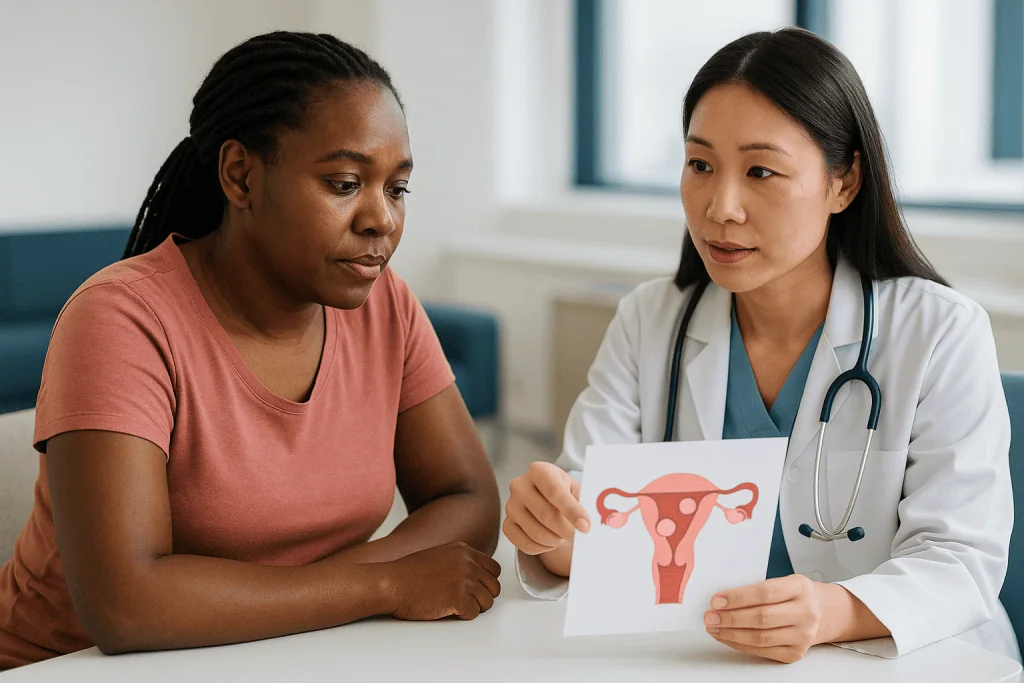
Every treatment works on one of three levers. The first lever is hormones: medicines that lower estrogen exposure or alter the lining of the uterus can reduce heavy bleeding and sometimes shrink fibroids while they are being taken. The second lever is blood supply: uterine artery embolization, a procedure in which tiny particles are injected through a catheter to block the arteries feeding the fibroids, starves them so they soften and shrink over months. The third lever is physical removal: a myomectomy removes the fibroids and leaves the uterus; a hysterectomy removes the uterus itself.
Location changes which lever makes sense. Fibroids are described by where they sit. Submucosal fibroids bulge into the cavity of the uterus and tend to cause the heaviest bleeding. Intramural fibroids grow within the muscular wall. Subserosal fibroids push outward toward the abdomen and are more likely to cause pressure than bleeding. Pedunculated fibroids hang from a stalk, either inside the cavity or outside the uterus.
This is why a good second opinion begins with the pictures rather than the leaflet. A fibroid sitting just under the lining might be removed through the cervix with a thin telescope and no incisions at all. A similar-sized fibroid deep in the back wall might need an abdominal operation. Same diagnosis, very different operations, and the difference is visible on imaging before anyone picks up a scalpel.
Who is usually offered surgery, and who is usually asked to wait
Guidance from the Mayo Clinic and the NHS converges on a simple principle: fibroids that cause no symptoms generally need no treatment. Many fibroids are found by accident during a scan for something else, and the usual advice is monitoring, often with a repeat ultrasound to confirm they are not growing quickly.
Surgery tends to enter the conversation when symptoms are affecting daily life and simpler measures have not helped. Heavy bleeding that leads to iron-deficiency anemia, pressure on the bladder or bowel, pelvic pain, a visibly enlarged abdomen, or difficulty conceiving that has been linked to a fibroid distorting the uterine cavity are the situations in which clinicians most often suggest an operation.
Several groups are commonly asked to wait or to try something else first:
- People approaching menopause, because fibroids frequently shrink once estrogen levels fall, and symptoms may resolve on their own.
- People whose main symptom is bleeding that has not yet been tested against a hormonal treatment or a hormone-releasing intrauterine device.
- People with small fibroids whose symptoms could plausibly have another cause, such as adenomyosis (a condition where lining tissue grows into the uterine muscle) or a bleeding disorder.
- People who are pregnant or planning pregnancy very soon, where timing and the type of operation matter a great deal.
Fertility deserves its own sentence. If you may want to carry a pregnancy, a hysterectomy is off the table, and the discussion shifts to myomectomy, medicines, or watchful waiting. A second opinion from a clinician with a focus on reproductive surgery is often worthwhile in that situation, simply because the trade-offs are more intricate.
Nobody on this list is being denied care. They are being offered the least invasive thing that could reasonably work, with surgery held in reserve.
Why don't doctors want to remove fibroids?
This question appears constantly in search engines, and it usually reflects frustration rather than curiosity. The person asking has been told to wait, or to try medicine, when what they wanted was for the thing to be gone.

The reluctance is rarely about the fibroids themselves. It is about arithmetic. Removing a fibroid means an operation, and operations carry risks that a benign growth does not: bleeding, infection, injury to nearby organs, blood clots, anesthesia complications, and scar tissue inside the pelvis. If the fibroid is not causing meaningful symptoms, every one of those risks is being accepted in exchange for nothing the patient can feel.
There is a second reason specific to myomectomy. Fibroids can grow back. The Mayo Clinic notes that new fibroids may develop after a myomectomy, and that some people eventually need further treatment. A surgeon who removes fibroids from a thirty-year-old is aware that the same conversation may return within the decade, and that each operation leaves more scarring than the last.
A third reason is that the symptom driving the request, most often heavy bleeding, sometimes responds to treatments that do not involve cutting anything. Hormonal medicines, tranexamic acid (a medicine that helps blood clot and is used for heavy periods), and hormone-releasing devices are all described by the NHS as options before surgery. If a non-surgical route controls the bleeding, the fibroid becomes a passenger rather than a problem.
None of this means a request for surgery is unreasonable. It means the request should be matched to a symptom. A fibroid that is pressing on the bladder six times a night, or causing anemia that iron tablets cannot keep up with, is a very different proposition from one that showed up on a scan and has never been felt. The honest answer to “why won’t they remove it” is usually “because it has not yet earned the risk.”
Hysterectomy vs myomectomy for fibroids: what each one changes
These two operations are often described in the same breath, yet they lead to different lives afterward, and the difference is worth stating bluntly.
A hysterectomy removes the uterus. Fibroids cannot return, periods stop, and pregnancy is no longer possible. The ovaries are often left in place, in which case natural hormone production continues and menopause arrives on its own schedule; if the ovaries are removed as well, menopause begins immediately. The NHS lists hysterectomy as the only treatment that removes any chance of fibroids coming back, which is its central appeal for people who have finished having children and want a definitive answer to years of heavy bleeding.
A myomectomy removes the fibroids and reconstructs the uterus. It can be done through the cervix with a hysteroscope (a thin telescope passed through the vagina) for fibroids inside the cavity, through small abdominal incisions with a laparoscope, or through a larger open incision for very large or numerous fibroids. The uterus stays, which preserves the option of pregnancy, but the same tissue that produced fibroids once can produce them again.
Recovery also differs. The NHS describes full recovery from a hysterectomy as taking around 6 to 8 weeks, with earlier return to light activity for keyhole approaches. Myomectomy recovery depends heavily on the route: a hysteroscopic procedure may allow a return to normal activity within days, while an open myomectomy is comparable in recovery to an open hysterectomy.
A second opinion matters most when the first recommendation was a hysterectomy and the patient has not been offered a myomectomy, or vice versa. Sometimes the first clinician had a sound reason, such as fibroids too numerous to remove individually. Sometimes the reason was habit. Asking “what would it take for the other operation to be possible for me” tends to reveal which.
Fibroid surgery alternatives worth asking about
Surgery is one option among several. A second clinician should be able to walk through each of the following and explain why it does or does not fit your situation. The table summarizes what the mainstream sources describe.
| Option | How it works | Uterus kept? | Typical notes |
|---|---|---|---|
| Watchful waiting | Monitoring with periodic scans; no active treatment | Yes | Usual approach for fibroids without troubling symptoms |
| Hormonal medicines | Lower estrogen exposure or thin the uterine lining to reduce bleeding | Yes | Effects generally last only while the medicine is taken; prescriber decides suitability |
| Hormone-releasing intrauterine device | Releases progestogen locally to reduce heavy bleeding | Yes | Does not shrink fibroids; may be unsuitable if the cavity is distorted |
| Uterine artery embolization | Particles injected via a catheter block blood flow to fibroids | Yes | Performed by an interventional radiologist; fibroids shrink over months |
| Focused ultrasound or ablation | Heat or ultrasound energy destroys fibroid tissue | Yes | Availability varies; suitable for selected fibroids only |
| Myomectomy | Surgical removal of fibroids, uterus repaired | Yes | Fibroids can recur; preserves pregnancy option |
| Hysterectomy | Surgical removal of the uterus | No | Permanent; fibroids cannot return |
Two caveats belong next to that table. First, “available” and “appropriate” are different words. Focused ultrasound, for example, is described by the Mayo Clinic as suitable only for certain fibroids, and not every center offers it. Second, the uterus-sparing options are not automatically gentler on the body in every respect. Embolization can cause several days of significant cramping as the fibroids lose their blood supply, and medicines carry side effects that your prescriber will need to weigh against the bleeding they are meant to control.
The question for a second opinion is not “which of these is best” in the abstract. It is “which of these have I actually been considered for, and why was each one set aside.” If the answer to the second half is silence, you have learned something useful.
How serious is fibroid removal surgery?
Serious enough to deserve respect; routine enough that gynecologic surgeons perform these operations every week. Both things are true, and a second opinion is partly about hearing the risks described in proportion.
The general risks are those of any pelvic operation under anesthesia. The Mayo Clinic lists bleeding that may require a transfusion, infection, blood clots in the legs or lungs, and injury to the bladder, bowel or ureters (the tubes carrying urine from the kidneys). Open operations carry more of each than keyhole ones, and larger or more numerous fibroids lengthen the operation, which in turn raises the chance of blood loss.
Myomectomy has a particular risk profile. Because the uterus is cut and stitched, it can bleed heavily during surgery, and in a small number of cases a planned myomectomy becomes a hysterectomy when bleeding cannot be controlled. The Mayo Clinic describes this possibility directly, and any surgeon proposing a myomectomy should mention it. Scar tissue in the uterine wall is another consideration if a future pregnancy is planned; clinicians may advise a cesarean delivery depending on how deeply the wall was entered.
Hysterectomy carries the additional, non-surgical weight of permanence, and some people describe a sense of loss afterward that has nothing to do with the physical recovery. That deserves airtime in the consultation.
A separate concern that patients increasingly raise is morcellation, a technique in which a fibroid is cut into small pieces inside the abdomen so it can be removed through a keyhole incision. In rare cases a growth assumed to be a fibroid is a leiomyosarcoma, a cancer of uterine muscle, and morcellation can spread it. The Mayo Clinic notes that this cancer is uncommon and that surgeons now take steps to reduce the risk. Ask how your surgeon plans to remove the tissue and what they do to minimize this possibility.
What is the most difficult fibroid to remove?
Difficulty is a combination of three things: where the fibroid sits, how big it is, and how many there are. Any single factor can make an operation harder; all three together make it genuinely demanding.
Location matters most. Fibroids growing near the cervix, in the broad ligament (the sheet of tissue beside the uterus that carries blood vessels and the ureters), or deep in the back wall of the uterus sit close to structures a surgeon cannot afford to injure. A fibroid pressing against the ureter, for instance, forces a slower, more careful dissection. Fibroids inside the cavity, by contrast, are often the easiest to reach, because a hysteroscope can be passed through the cervix without any incision.
Size is next. Very large fibroids, sometimes compared to a melon or to a pregnancy of several months, distort the normal anatomy, stretch the blood vessels feeding them, and may be too big to remove through keyhole incisions in one piece. Large intramural fibroids also leave a bigger wound in the uterine wall after removal, which bleeds more and takes longer to repair.
Number is the third factor. A single fibroid is one incision in the uterus. Twenty small fibroids scattered through the wall are twenty incisions, or a judgment call about which ones to leave. This is the situation in which surgeons most often say that a myomectomy is not practical and a hysterectomy would be safer, and it is a reasonable thing to seek a second view on.
Deeply buried fibroids with no clear edge against normal muscle are sometimes not fibroids at all but adenomyosis, which cannot be shelled out the same way. Good preoperative MRI helps distinguish the two, and a second opinion that includes a fresh look at the imaging is particularly valuable here. The honest answer to the search question is that the hardest fibroid to remove is the one that was never properly mapped before surgery.
Should I get a second opinion for fibroids? Signs it is worth the appointment
Not every case needs one. If your fibroids are small, your symptoms are mild, and your clinician has suggested monitoring, a second opinion is unlikely to change the plan. The situations below are different.
- The only option offered was a hysterectomy, and nobody explained why a myomectomy or embolization was unsuitable.
- You want to keep the possibility of pregnancy and the conversation did not address it in detail.
- Surgery was recommended for a fibroid that has not caused symptoms you can feel.
- You were told the fibroids are “too big” or “too many” without seeing the imaging or hearing the measurements.
- The plan involves morcellation and the cancer risk was not discussed.
- You are within a few years of menopause and the option of waiting for natural shrinkage was not mentioned.
- Something in the consultation felt rushed, and you left with questions you could not voice.
Preparing for the second visit is mostly about paper. Request copies of your ultrasound and any MRI reports, along with the images themselves on disc or through a patient portal; a report that says “multiple fibroids, largest 8 cm” is far less useful to a second clinician than the pictures. Bring recent blood results, particularly a full blood count showing whether you are anemic, and a short written summary of your symptoms: how many days you bleed, how often you change protection, whether you miss work, how many times you wake at night.
Ask specifically for the second clinician’s view of the same options, not just for approval of the first plan. A second opinion that simply says “yes, go ahead” is still useful, because it means two people looked at the same pictures and reached the same conclusion. A second opinion that says “have you considered” is the reason the whole process exists.
Questions to ask before fibroid surgery: the care team checklist
The questions below are deliberately specific. Vague questions get vague answers; these are designed to produce measurements, reasons and alternatives.
- How many fibroids do I have, how large is each, and where exactly does each one sit in the uterine wall?
- Which of my symptoms do you think the fibroids are actually causing, and could anything else explain them?
- What would happen if I did nothing for a year? For five years?
- Have I been considered for medicine, a hormone-releasing device, embolization or focused ultrasound, and why was each ruled in or out?
- If you are recommending a hysterectomy, what would need to be different for a myomectomy to be possible?
- Which route are you planning, hysteroscopic, laparoscopic or open, and what decides that?
- How will the tissue be removed from my body, and what steps reduce the risk of spreading an unrecognized cancer?
- What is the chance a planned myomectomy becomes a hysterectomy during the operation, in your own practice?
- Will my ovaries and cervix be kept, and what does each choice mean for hormones and future screening?
- If I want to become pregnant later, how would this operation affect that, and would I need a cesarean delivery?
- What does recovery usually look like for this specific operation, week by week?
- Which complications would you want me to call about immediately?
- How often do fibroids return after the operation you are proposing, according to the published evidence?
One more question belongs at the end, and it is the hardest to ask: “If I were your sister, what would you suggest, and why?” Clinicians are trained to present options neutrally, which is proper. But the question invites them to show their reasoning rather than their menu, and reasoning is what a second opinion is meant to surface. Write the answers down. Memory after a consultation is unreliable, especially when the word hysterectomy has been spoken.
What the days and weeks after fibroid surgery usually look like
Timelines vary with the operation and the person, so the ranges below are typical rather than promised, and they come from NHS and Mayo Clinic descriptions of recovery.
After a hysteroscopic myomectomy, most people go home the same day. Cramping and light bleeding for a few days are common, and many return to desk work within the week. Because there is no abdominal wound, the main restrictions concern avoiding tampons and intercourse until bleeding has settled, on the advice of the surgical team.
After a laparoscopic myomectomy or hysterectomy, a stay of one night is usual, and the NHS describes most people leaving hospital within 1 to 4 days depending on the approach. Shoulder-tip pain from the gas used to inflate the abdomen is a frequent surprise in the first two days. Walking is encouraged early because it reduces the risk of blood clots, and gentle daily activity usually expands over two to three weeks.
After an open operation, the first week is dominated by the wound and by fatigue that patients often describe as out of proportion to how they expected to feel. The NHS puts full recovery from a hysterectomy at around 6 to 8 weeks, and an open myomectomy is broadly comparable. Lifting is restricted during this period, driving waits until an emergency stop would not hurt, and the return to work depends on how physical the job is.
Three things are common across every route. Vaginal bleeding or discharge can continue for several weeks after a hysterectomy and is normal in the early stages. Emotional dips in the second and third week are frequent, partly from the anesthetic and partly from the enforced stillness. Periods after a myomectomy often improve within the first cycle or two, though it can take longer for iron levels to rebuild if anemia was present. A follow-up appointment, usually around six weeks, is where the team confirms healing and discusses anything unresolved.
What people often get wrong about fibroid surgery
Myths around fibroids are durable, partly because the condition is so common that everyone knows someone who had a different experience. Several deserve correcting.
“Fibroids turn into cancer if you leave them.” They do not. Fibroids are benign, and the Mayo Clinic notes that they rarely interfere with life expectancy or become cancerous. The rare uterine cancer of muscle, leiomyosarcoma, is thought to arise on its own rather than from an existing fibroid.
“A hysterectomy means instant menopause.” Only if the ovaries are removed. When they are left in place, hormone production continues, although some evidence suggests menopause may arrive slightly earlier than it otherwise would, which is worth asking your team about.
“Keyhole surgery is always better.” It usually means a faster recovery, but for very large or numerous fibroids an open operation may be safer and more complete. The route should follow the anatomy, not a preference for small scars.
“Once the fibroids are out, the problem is solved.” After a myomectomy, fibroids can return, and the Mayo Clinic describes further treatment being needed in some people. After a hysterectomy, bleeding stops, but pressure symptoms that were actually caused by something else will not.
“Waiting is the same as ignoring it.” Monitoring is an active plan with repeat imaging and a threshold for action. The NHS describes it as a standard approach for fibroids that are not causing problems.
“Medicines just mask the symptoms.” For heavy bleeding, controlling the symptom is the goal. If a hormone-releasing device keeps iron levels normal and life manageable, the fibroid itself may never need to be touched.
“Asking for a second opinion means I don’t trust my doctor.” It means you are taking a permanent decision seriously. Most clinicians would do the same with their own body.
Is fibroid surgery worth it? How to weigh the decision honestly
Worth is personal, which is an unsatisfying thing to read when you want a verdict. But it can be made concrete by putting the two sides of the ledger in the same units.
On one side sits the burden of the current symptoms. Count it. Days of heavy bleeding each month, nights broken by trips to the bathroom, events avoided, iron infusions needed, pain scores, the number of pads or cups on the worst day. Clinicians use structured questionnaires for this precisely because “heavy” means different things to different people, and a second opinion goes better when you arrive with numbers rather than adjectives.
On the other side sits what the operation asks of you: weeks of recovery, the risks described earlier, the possibility of needing further treatment after a myomectomy, and, for a hysterectomy, the end of fertility. Each has a different weight depending on your age, your plans, your job and your support at home.
Between the two sides sit the alternatives, and this is where second opinions earn their keep. If a less invasive option has not been tried and could plausibly reduce the symptom burden, the honest answer to “is surgery worth it” is “not yet.” If alternatives have been tried and have failed, or are genuinely unsuitable for your fibroids, the ledger shifts toward surgery.
Timing belongs in the calculation too. A person two years from likely menopause may reasonably choose to manage bleeding with medicine and let nature shrink the fibroids. A person in their early thirties with anemia and a cavity-distorting fibroid may find that waiting costs more than operating.
What makes surgery worth it, in the end, is not the size of the fibroid but the size of the problem it causes, measured against the least invasive thing that can fix it. A second opinion is simply a second attempt at that measurement.
When to call your doctor
Most people with fibroids can take their time over treatment decisions. A few situations should not wait for a scheduled appointment or a second opinion, and they fall into two groups.
Before any surgery, contact your care team or seek urgent care if you experience bleeding heavy enough to soak through a pad or tampon every hour for several hours, bleeding accompanied by dizziness, fainting, chest pain or breathlessness, sudden severe pelvic pain that does not ease, pain with fever, or an inability to pass urine. Severe sudden pain can signal a fibroid losing its blood supply, called degeneration, or a pedunculated fibroid twisting on its stalk, and both need prompt assessment. Symptoms of significant anemia, including a racing heart at rest, unusual breathlessness on stairs or persistent exhaustion, also warrant a prompt blood test rather than a wait.
After surgery, the Mayo Clinic and the NHS advise contacting your team without delay if you notice a temperature of 38°C (100.4°F) or higher, increasing rather than decreasing pain, redness, swelling or discharge from a wound, heavy or foul-smelling vaginal bleeding, pain or swelling in one calf, chest pain or sudden shortness of breath, persistent vomiting, or difficulty passing urine or opening your bowels. Calf swelling and breathlessness in particular can indicate a blood clot, which is a recognized risk after pelvic surgery and is treatable when caught early.
If anything feels wrong and you cannot reach your surgical team, use your local emergency number or go to an emergency department and tell them what operation you had and when.
Every threshold in this article is general. Your own team may give you different limits based on your operation and your health, and theirs take precedence. The decision to operate, to wait, or to try something else is yours to make with them, and no article, including this one, should sit in that chair.
Frequently asked questions
Should I get a second opinion for fibroids before agreeing to a hysterectomy?
Yes, a second opinion is reasonable whenever a hysterectomy has been recommended, because it is permanent and several uterus-sparing alternatives exist. Ask the second clinician to review your imaging, explain whether myomectomy, embolization or medicines were considered, and say what would need to change for a different option to be possible. The decision remains yours, made with your treating team.
Why don't doctors want to remove fibroids that aren't causing symptoms?
Because surgery carries real risks and a symptom-free fibroid offers nothing to gain from accepting them. Fibroids are benign, rarely become cancerous and often shrink after menopause. Mainstream guidance from the NHS and Mayo Clinic recommends monitoring rather than removal when fibroids cause no problems, reserving surgery for symptoms such as heavy bleeding with anemia, pressure or pain that simpler treatments have not controlled.
Is fibroid surgery worth it?
It depends on how much the fibroids disrupt your life and whether less invasive options have been tried. Surgery is usually worth considering when heavy bleeding, pressure or pain persist despite medicines or other treatments, or when a fibroid is affecting fertility. For mild symptoms, or close to menopause, waiting or non-surgical management may offer a better balance. Your care team can help you weigh the two sides.
How serious is a fibroid removal surgery?
A myomectomy or hysterectomy is major pelvic surgery performed under anesthesia, with risks including bleeding, infection, blood clots and injury to the bladder, bowel or ureters. The Mayo Clinic also notes that a myomectomy can occasionally become a hysterectomy if bleeding cannot be controlled. Keyhole and hysteroscopic approaches carry fewer risks and faster recovery than open operations, but all deserve a careful discussion of alternatives.
What is the most difficult fibroid to remove?
Fibroids near the cervix, in the broad ligament beside the uterus, or deep in the back wall are the hardest, because they sit close to the ureters and major blood vessels. Very large fibroids and cases with many fibroids scattered through the wall also increase difficulty and blood loss. Fibroids inside the uterine cavity are often the easiest, as they can be removed through the cervix without an incision.
What are the main fibroid surgery alternatives?
The NHS and Mayo Clinic describe several: watchful waiting with repeat scans, hormonal medicines that reduce bleeding, a hormone-releasing intrauterine device, uterine artery embolization that blocks the fibroids’ blood supply, and focused ultrasound or ablation that destroys fibroid tissue with energy. Suitability depends on the size, number and location of the fibroids and on whether future pregnancy is planned, which your care team will assess.
What is the difference between hysterectomy vs myomectomy for fibroids?
A hysterectomy removes the uterus, ends periods and pregnancy, and means fibroids cannot return. A myomectomy removes the fibroids and keeps the uterus, preserving the option of pregnancy, but fibroids can grow back and further treatment is sometimes needed. Recovery depends more on the surgical route, hysteroscopic, laparoscopic or open, than on which of the two operations is performed.
What questions should I ask before fibroid surgery?
Ask for the number, size and location of each fibroid, which symptoms they are actually causing, what would happen if you waited, and why each non-surgical option was ruled in or out. Ask which surgical route is planned, how tissue will be removed, the chance a myomectomy becomes a hysterectomy, whether ovaries and cervix are kept, and what recovery looks like week by week.
What should I bring to a fibroid surgery second opinion appointment?
Bring the actual ultrasound and MRI images, not just the written reports, along with recent blood results showing whether you are anemic, a list of medicines, and a written summary of your symptoms with numbers: bleeding days per month, protection changes on the worst day, nights disturbed, work missed. Concrete details let the second clinician judge both the fibroids and the burden they cause.
Can fibroids come back after surgery?
After a myomectomy, yes. The Mayo Clinic notes that new fibroids can develop and some people eventually need further treatment, since the uterine tissue that produced fibroids remains. After a hysterectomy, fibroids cannot return because the uterus has been removed. This difference is one of the main factors clinicians weigh when discussing which operation, if any, suits a particular person.
References
- NHS: Fibroids
- NHS: Hysterectomy, Recovery
- Cleveland Clinic: Uterine Fibroids
- MedlinePlus: Uterine Fibroids
This article is for general information only and is not a substitute for professional medical advice. Please consult a qualified doctor about your individual situation.

More from the Blog

When Vaginal Infections Keep Returning: How Gynecologists Investigate and Plan Prevention
Recurrent vaginal infections usually mean one of three things: the original diagnosis was wrong, the infection was never fully cleared, or a specific trigger…

What to Expect After a Hysterectomy: Pathology Results, Symptom Relief and Follow-Up Visits
After a hysterectomy, the removed tissue is routinely examined by a pathologist, and the written report most often confirms a benign cause such as…

Life After Ovarian Cyst Surgery: Cycles, Fertility Follow-Up and Long-Term Ovary Health
Life after ovarian cyst surgery usually means a few weeks of recovery, then periods that return on roughly their previous schedule when at least…

After Endometriosis Surgery: What Is Normal, and Which Symptoms Mean a Call to Your Surgeon?
After endometriosis surgery, mild to moderate incision soreness, bloating, shoulder-tip pain from residual gas, fatigue and light vaginal bleeding are expected for several days…

Does a Hysteroscopy Hurt? Anesthesia Options and Managing Cramping Afterward
Hysteroscopy is often described as uncomfortable rather than severely painful, most commonly as cramping similar to strong period pain while the thin scope passes…

Which Questions Help You Understand a PCOS Plan? Cycles, Skin and Future Fertility
The most useful questions about a PCOS plan ask what the plan is for, since PCOS is managed by goal rather than by a…